clutch MITSUBISHI MONTERO 1987 1.G Owner's Manual
[x] Cancel search | Manufacturer: MITSUBISHI, Model Year: 1987, Model line: MONTERO, Model: MITSUBISHI MONTERO 1987 1.GPages: 284, PDF Size: 14.74 MB
Page 274 of 284
24-38 AIR-CONDITIONING-Service Adjustment Procedures
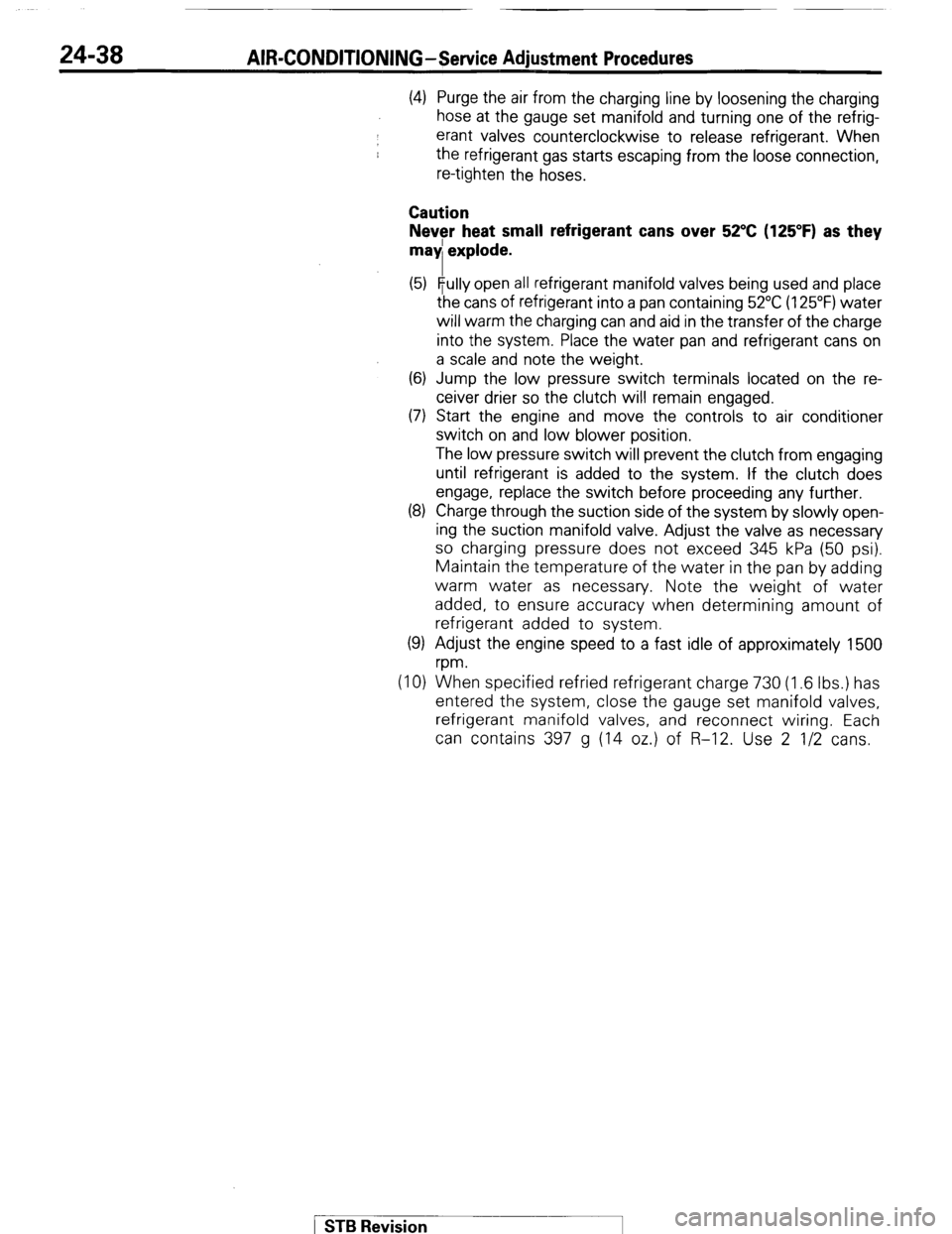
(4) Purge the air from the charging line by loosening the charging
hose at the gauge set manifold and turning one of the refrig-
erant valves counterclockwise to release refrigerant. When
the refrigerant gas starts escaping from the loose connection,
re-tighten the hoses.
Caution
Never heat small refrigerant cans over 52°C (125°F) as they
mad explode.
(5) qully open all refrigerant manifold valves being used and place
the cans of refrigerant into a pan containing 52°C (125°F) water
will warm the charging can and aid in the transfer of the charge
into the system. Place the water pan and refrigerant cans on
a scale and note the weight.
(6) Jump the low pressure switch terminals located on the re-
ceiver drier so the clutch will remain engaged.
(7) Start the engine and move the controls to air conditioner
switch on and low blower position.
The low pressure switch will prevent the clutch from engaging
until refrigerant is added to the system. If the clutch does
engage, replace the switch before proceeding any further.
(8) Charge through the suction side of the system by slowly open-
ing the suction manifold valve. Adjust the valve as necessary
so charging pressure does not exceed 345 kPa (50 psi).
Maintain the temperature of the water in the pan by adding
warm water as necessary. Note the weight of water
added, to ensure accuracy when determining amount of
refrigerant added to system.
(9) Adjust the engine speed to a fast idle of approximately 1500
rpm.
(IO) When specified refried refrigerant charge 730 (1.6 Ibs.) has
entered the system, close the gauge set manifold valves,
refrigerant manifold valves, and reconnect wiring. Each
can contains 397 g (14 oz.) of R-12. Use 2 l/2 cans.
1 STB Revision
-1
Page 277 of 284
AIR-CONDITIONING -Service Adjustment Procedures 24-41
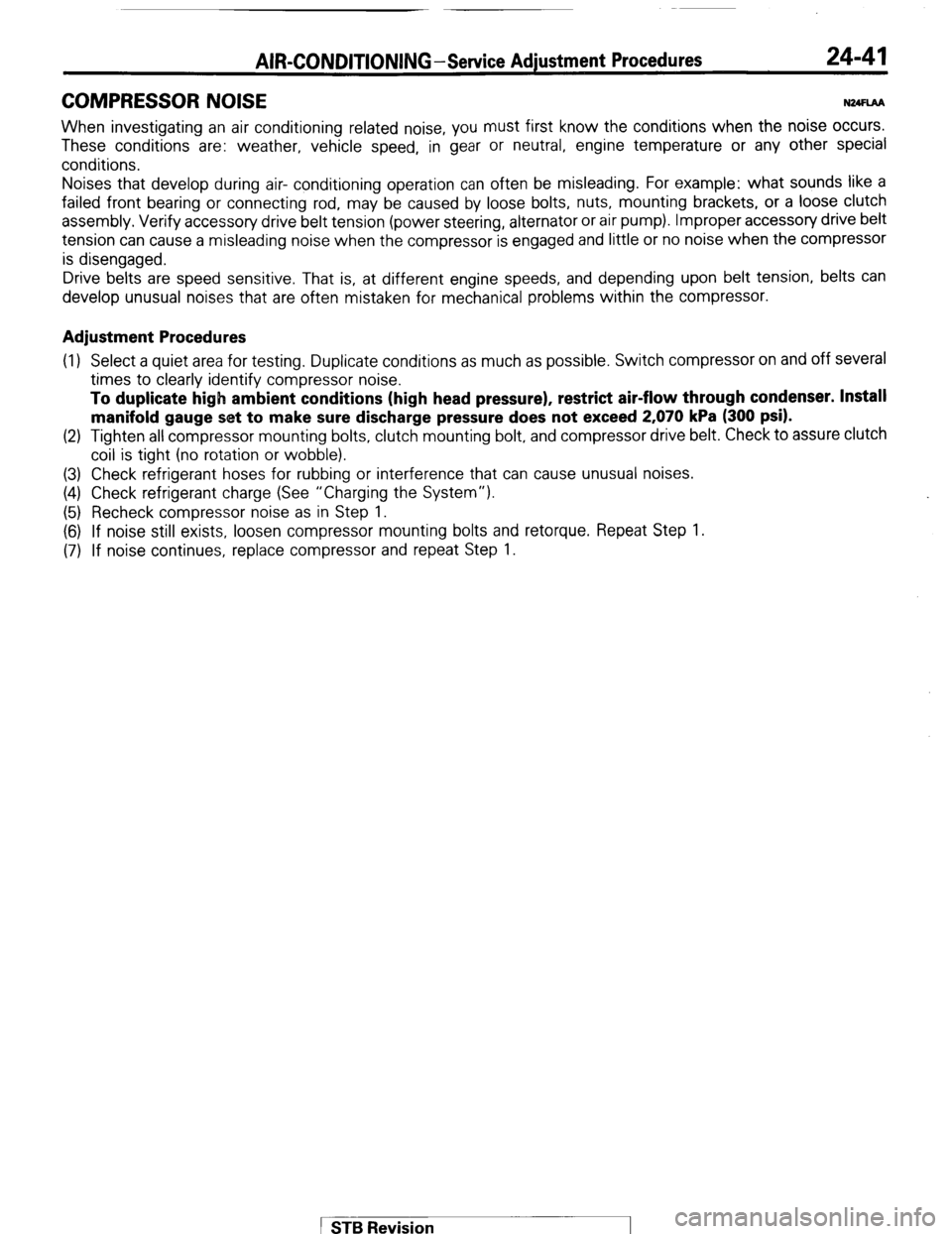
COMPRESSOR NOISE NWLM
When investigating an air conditioning related noise, you must first know the conditions when the noise occurs.
These conditions are: weather, vehicle speed, in gear or neutral, engine temperature or any other special
conditions.
Noises that develop during air- conditioning operation can often be misleading. For example: what sounds like a
failed front bearing or connecting rod, may be caused by loose bolts, nuts, mounting brackets, or a loose clutch
assembly. Verify accessory drive belt tension (power
steering, alternator or air pump). Improper accessory drive belt
tension can cause a misleading noise when the compressor is engaged and little or no noise when the compressor
is disengaged.
Drive belts are speed sensitive. That is, at different engine speeds, and depending upon belt tension, belts can
develop unusual noises that are often mistaken for mechanical problems within the compressor.
Adjustment Procedures
(1) Select a quiet area for testing. Duplicate conditions as much as possible. Switch compressor on and off several
times to clearly identify compressor noise.
To duplicate high ambient conditions (high head pressure), restrict air-flow through
condenser. Install
manifold gauge set to make sure discharge pressure does not exceed 2,070 kPa (300 psi).
(2) Tighten all compressor mounting bolts, clutch mounting bolt, and compressor drive belt. Check to assure clutch
coil is tight (no rotation or wobble).
(3) Check refrigerant hoses for rubbing or interference that can cause unusual noises.
(4) Check refrigerant charge (See “Charging the System”).
(5) Recheck compressor noise as in Step 1.
(6) If noise still exists, loosen compressor mounting bolts and retorque. Repeat Step 1.
(7) If noise continues, replace compressor and repeat Step 1.
1 STB Revision
Page 281 of 284
AIR-CONDITIONING - Receiver drier, Condenser, Compressor Clutch Assembly 24-45
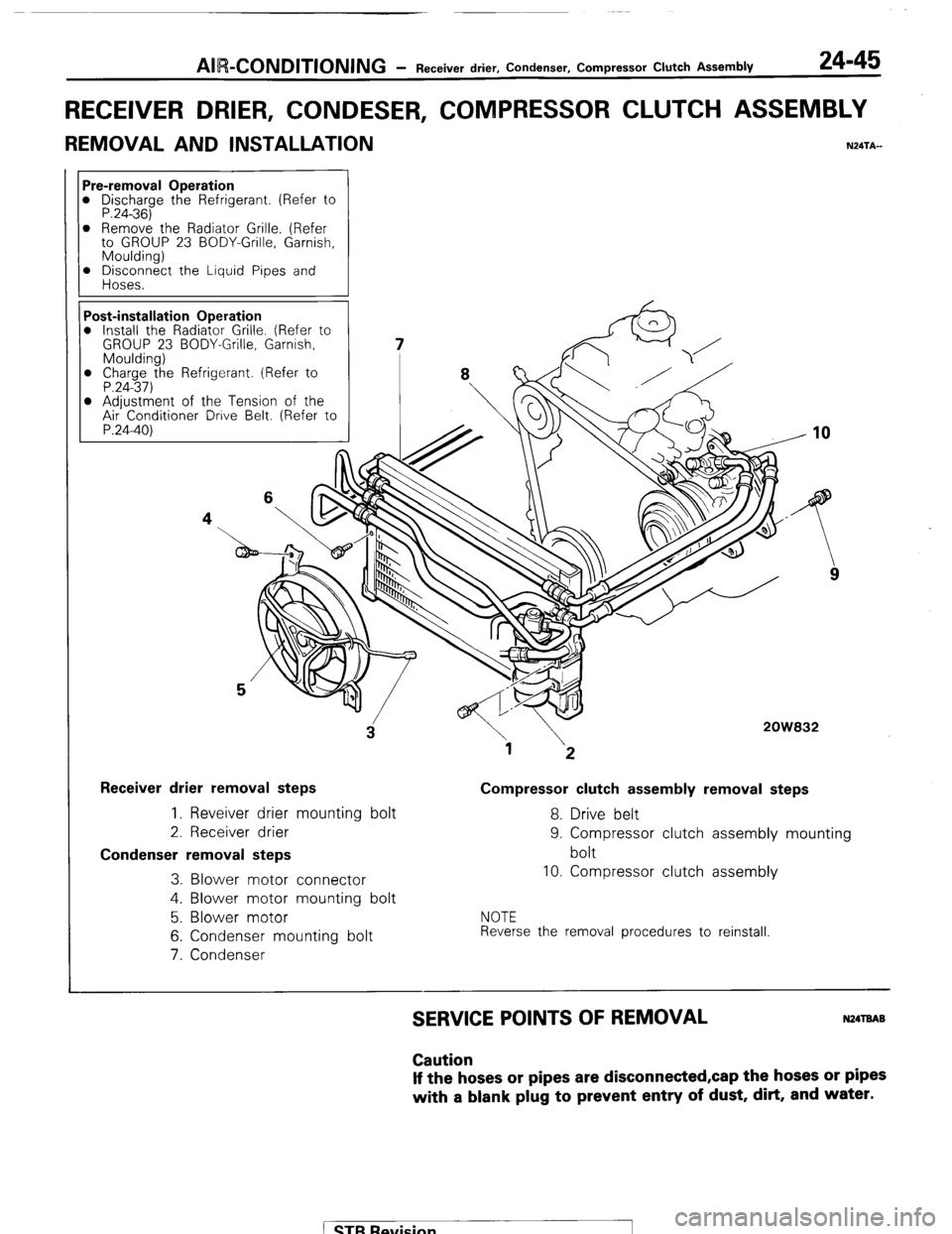
RECEIVER DRIER, CONDESER, COMPRESSOR CLUTCH ASSEMBLY
REMOVAL AND INSTALLATION N24TA--
Pre-removal Operation l Discharge the Refrigerant. (Refer to
P.24-36)
l Remove the Radiator Grille. (Refer
to GROUP 23 BODY-Grille, Garnish,
Moulding)
l Disconnect the Liquid Pipes and
Hoses.
Post-installation Operation
l Install the Radiator Grille. (Refer to
GROUP 23 BODY-Grille, Garnish,
Moulding)
l Charge the Refrigerant. (Refer to
P.24.37)
l Adjustment of the Tension of the
Air Conditioner Drive Belt. (Refer to
P.24-40)
2OW832 Receiver drier removal steps
Compressor clutch assembly removal steps
1. Reveiver drier mounting bolt
8. Drive belt
2. Receiver drier
9. Compressor clutch assembly mounting
Condenser removal steps
3. Blower motor connector
4. Blower motor mounting bolt
5. Blower motor
6. Condenser mounting bolt
7. Condenser bolt
10. Compressor clutch assembly
NOTE
Reverse the removal procedures to reinstall.
SERVICE POINTS OF REMOVAL N24TBAB 1 STB Revision Caution
If the hoses or pipes are disconnected,cap the hoses or pipes
with a blank plug to prevent entry of dust, dirt, and water.
Page 282 of 284
24-46
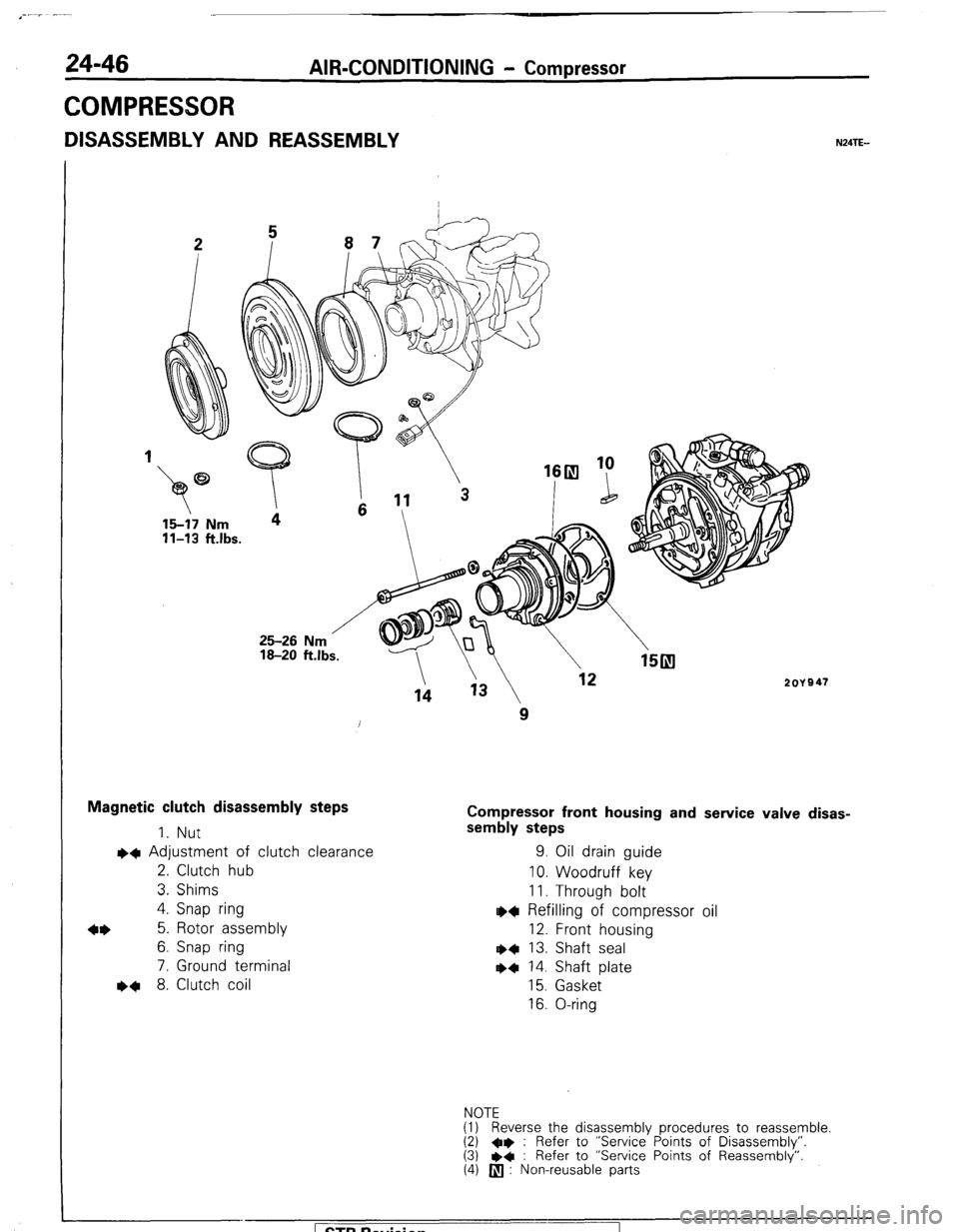
COMPRESSOR
AIR-CONDITIONING - Compressor
DISASSEMBLY AND REASSEMBLY N24TE-
15-h Nm
11-13 ftlbs 16
a 0
I
26-26 Nm
16-20 ftlbs. Magnetic clutch disassembly steps
1. Nut
~~ Adjustment of clutch clearance
2. Clutch hub
3. Shims
4.
Snap ring
4* 5. Rotor assembly
6.
Snap ring
7.
Ground terminal
l + 8. Clutch coil
l5Dl
2QY947 Compressor front housing and service valve disas-
sembly steps
9. Oil drain guide
10.
Woodruff key
Il. Through bolt
** Refilling of compressor oil
12. Front housing
o+
13. Shaft seal
04 14.
Shaft plate
15.
Gasket
16. O-ring
NOTE
(1) Reverse the disassembly procedures to reassemble.
(2) +e : Refer to “Service Points of Disassembly”.
(3) e+ : Refer to “Service Points of Reassembly”.
(4)
q : Non-reusable parts 1 STB Revision
Page 283 of 284
AIR-CONDITIONING - Compressor 24-47
SERVICE POINTS OF DISASSEMBLY N24TFAE
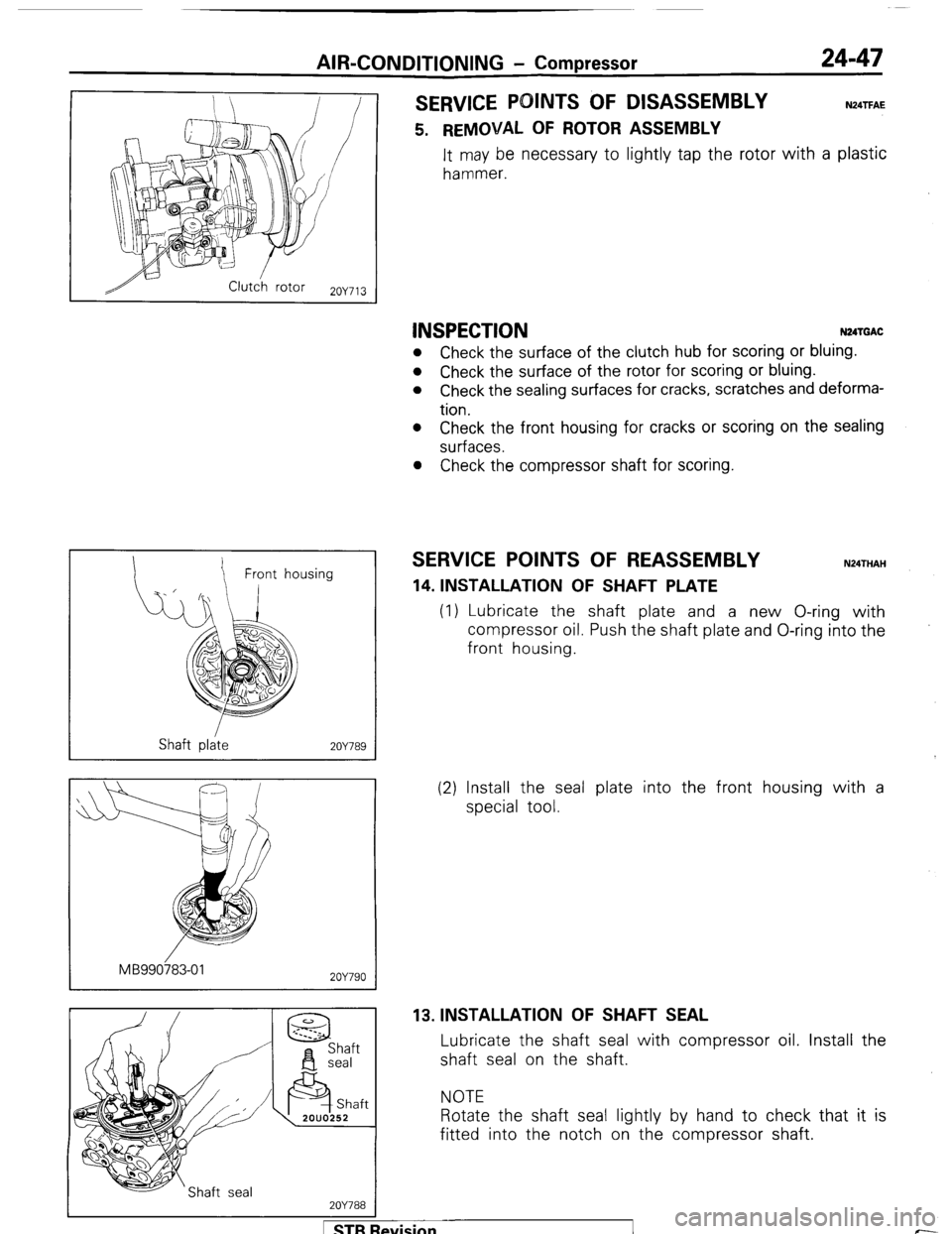
5. REMOVAL OF ROTOR ASSEMBLY
It may be necessary to lightly tap the rotor with a plastic
hammer.
2OY713
Front housing
Shaft pl&e
2OY789
I MB990?83-01 2OY790
2OY788
INSPECTION N24TGAC
l
Check the surface of the clutch hub for scoring or bluing.
l Check the surface of the rotor for scoring or bluing.
l Check the sealing surfaces for cracks, scratches and deforma-
tion.
l Check the front housing for cracks or scoring on the sealing
surfaces.
l Check the compressor shaft for scoring.
SERVICE POINTS OF REASSEMBLY N24THAH
14. INSTALLATION OF SHAFT PLATE
(1) Lubricate the shaft plate and a new O-ring with
compressor oil. Push the shaft plate and O-ring into the
front housing.
(2) Install the seal plate into the front housing with a
special tool.
13. INSTALLATION OF SHAFT SEAL
Lubricate the shaft seal with compressor oil. Install the
shaft seal on the shaft.
NOTE
Rotate the shaft seal lightly by hand to check that it is
fitted into the notch on the compressor shaft. evision
r
Page 284 of 284
,: 24-48 AIR-CQNDITIONING - Compressor
I
2OY717
1 iOY718 l
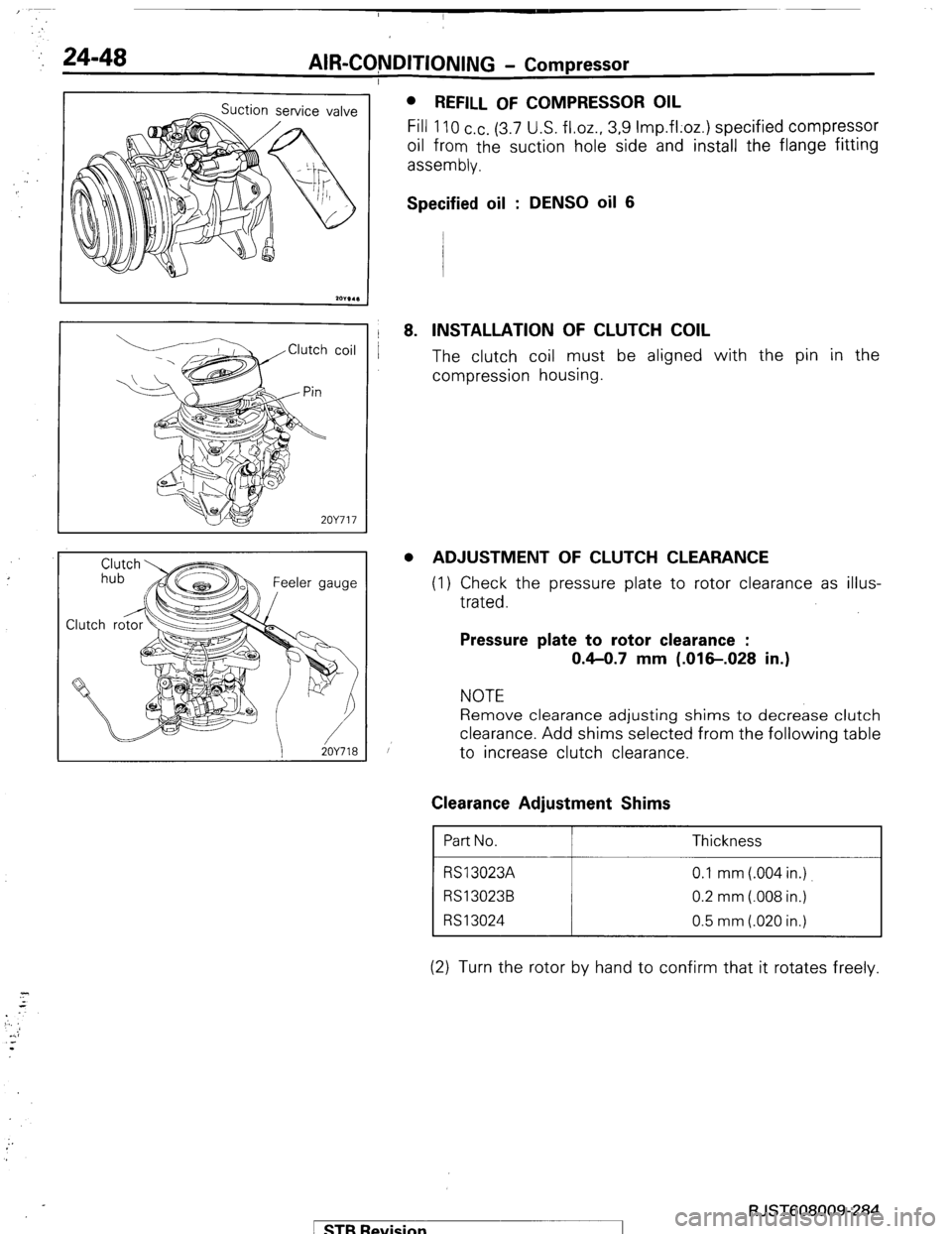
REFILL OF COMPRESSOR OIL
Fill 110 cc. (3.7 U.S. fl.oz., 3.9 Imp.fl;oz.) specified compressor
oil from the suction hole side and install the flange fitting
assembly.
Specified oil : DENS0 oil 6
8. INSTALLATION OF CLUTCH COIL
The clutch coil must be aligned with the pin in the
compression housing.
. ADJUSTMENT OF CLUTCH CLEARANCE
(1) Check the pressure plate to rotor clearance as illus-
trated.
Pressure plate to rotor clearance :
0.4-0.7 mm (.016-.028 in.)
NOTE
Remove clearance adjusting shims to decrease clutch
clearance. Add shims selected from the following table
to increase clutch clearance.
Clearance Adjustment Shims
Part No. Thickness
RSI 3023A 0.1 mm (.004 in.).
RSI 3023B 0.2 mm (.008 in.)
RSI 3024 0.5 mm (.020 in.)
(2) Turn the rotor by hand to confirm that it rotates freely.
:.
RJST608009-284
1 STB Revision
-1