wheel MITSUBISHI MONTERO 1987 1.G Owner's Manual
[x] Cancel search | Manufacturer: MITSUBISHI, Model Year: 1987, Model line: MONTERO, Model: MITSUBISHI MONTERO 1987 1.GPages: 284, PDF Size: 14.74 MB
Page 199 of 284
I 1
+ -
li.if 1
2
WIPER AND WASHER SYSTEM - Rear Washer / Headlight Washer 8-179 (1) Check to be sure that there is washer fluid in the washer
tank.
(2) Check to be sure that the washer motor operates and the
fluid is forced out under pressure when the battery’s
positive (+) terminal is connected to terminal 2 and the
negative (-) terminal is connected to terminal 1.
INSPECTION
WASHER MOTOR AND PUMP Make the check while the motor is installed to the washer
tank.
SERVICE POINTS OF INSTALLATION
1. INSTALLATION OF REAR WHEELHOUSE TRIM AND
QUARTER TRIM Refer to GROUP 23 BODY - Trims.
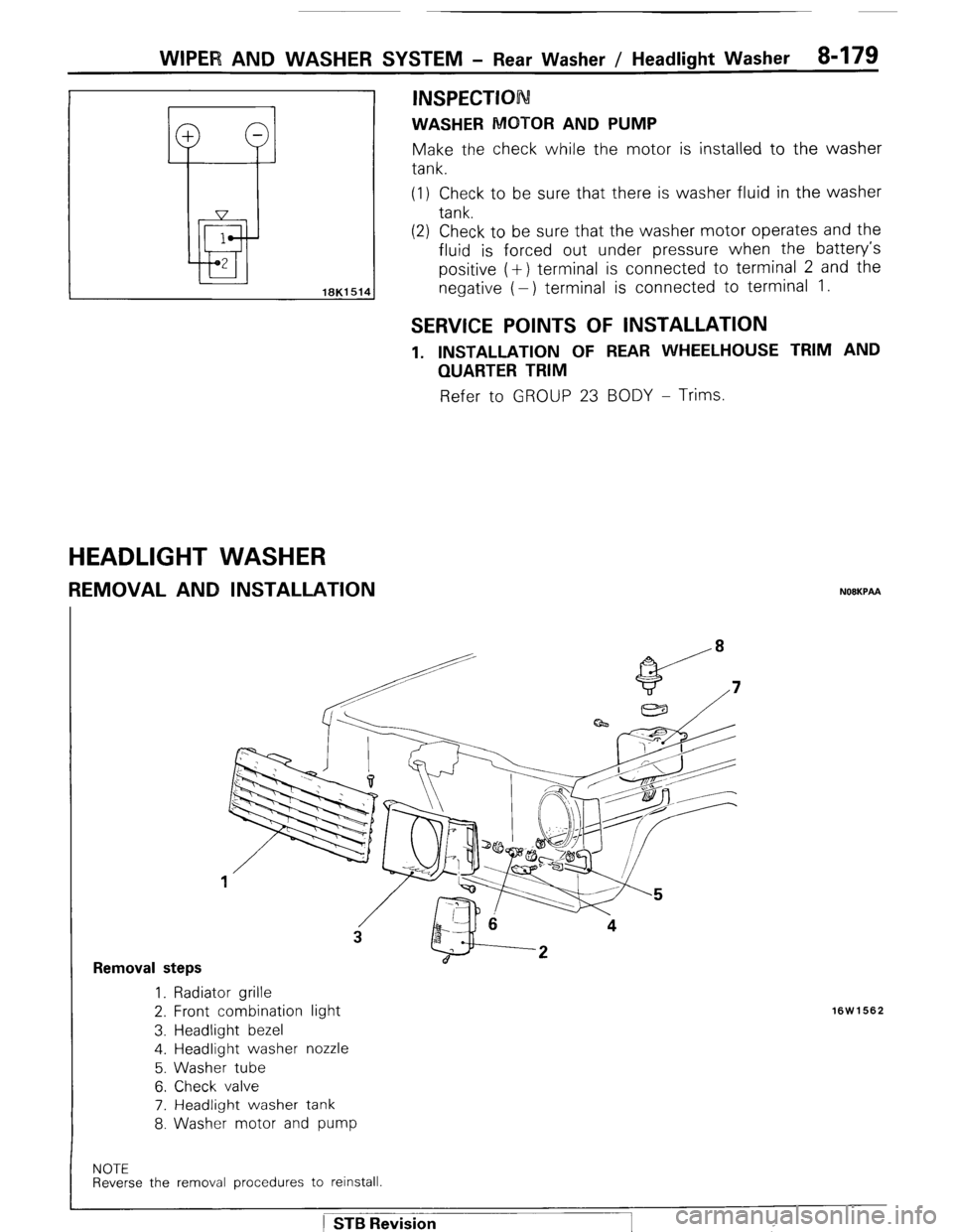
HEADLIGHT WASHER
REMOVAL AND INSTALLATION NOEKPAA
Removal steps 1. Radiator grille
2. Front combination light
3. Headlight bezel
4. Headlight washer nozzle
5. Washer tube
6. Check valve
7. Headlight washer tank
8. Washer motor and pump
16W1562
NOTE Reverse the removal procedures to reinstall.
) STB Revision
Page 201 of 284
WIPER AND WASHER SYSTEM - Column Switch
COLUMN SWITCH 8-181
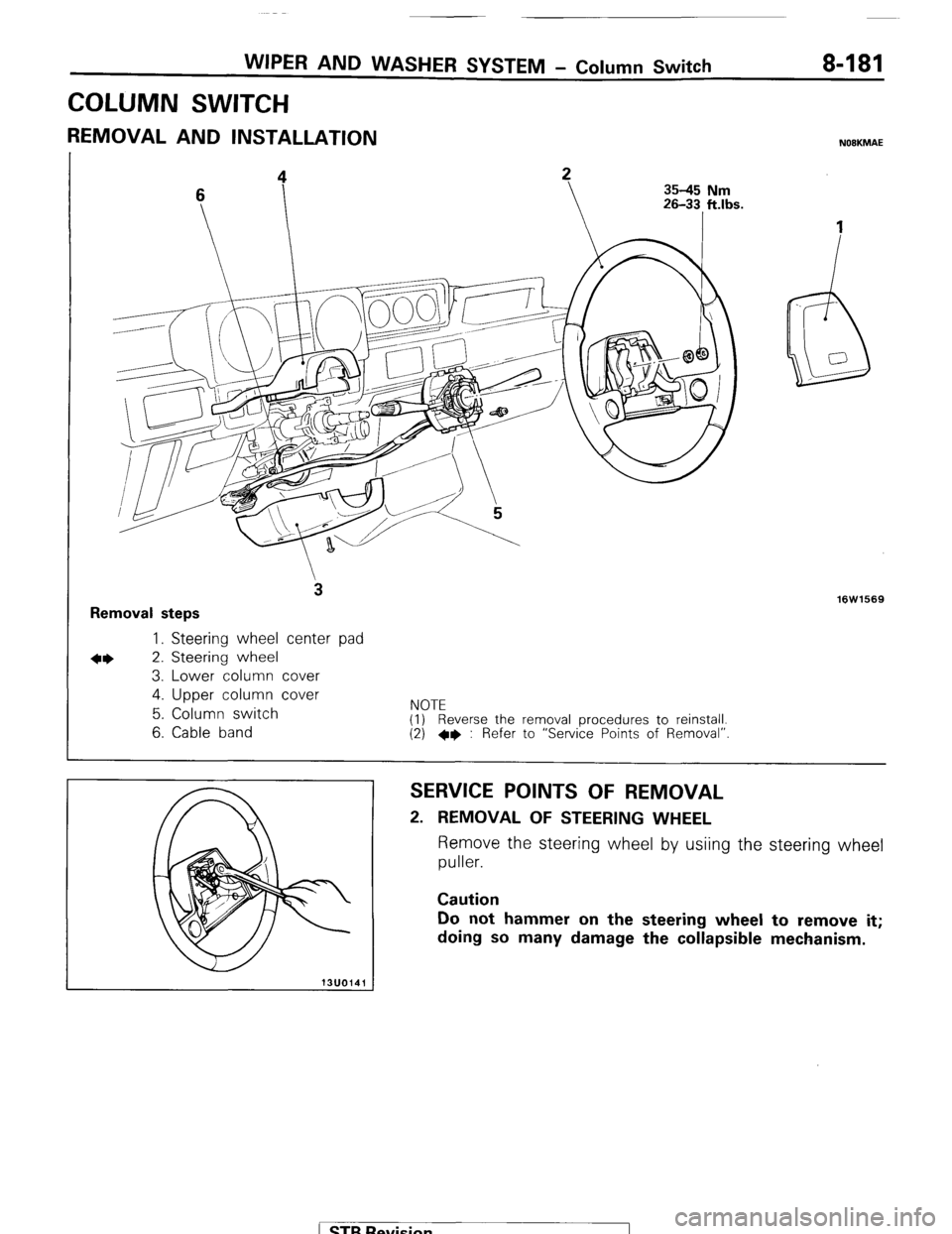
REMOVAL AND INSTALLATION NOBKMAE
35-45 Nm
Removal steps
3
l * 1. Steering wheel center pad
2. Steering wheel
3. Lower column cover
4. Upper column cover
5. Column switch
6. Cable band
NOTE
(1) Reverse the removal procedures to reinstall.
(2) *I) : Refer to “Service Points of Removal” 16W1569
SERVICE POINTS OF REMOVAL
2. REMOVAL OF STEERING WHEEL
Remove the steering wheel by usiing the steering wheel
puller.
Caution
Do not hammer on the steering wheel to remove it;
doing so many damage the collapsible mechanism.
) STB Revision
Page 204 of 284
8-184
HORN
HORN - Specifications / Troubleshooting
SPECIFICATIONS
GENERAL SPECIFICATIONS I NOBLE--
Items
Effective sounding voltage V
Power consumption (at 12V) A
Sound level dB
Fundamental frequency Hz
“High” sound
“Low” sound 11-14.5
Max. 3.5
100-7 10
400--440
340--380 Specifications
TORQUE SPECIFICATIONS
Steering wheel lock nut Items
i Nm ft.lbs.
35-45 26-33
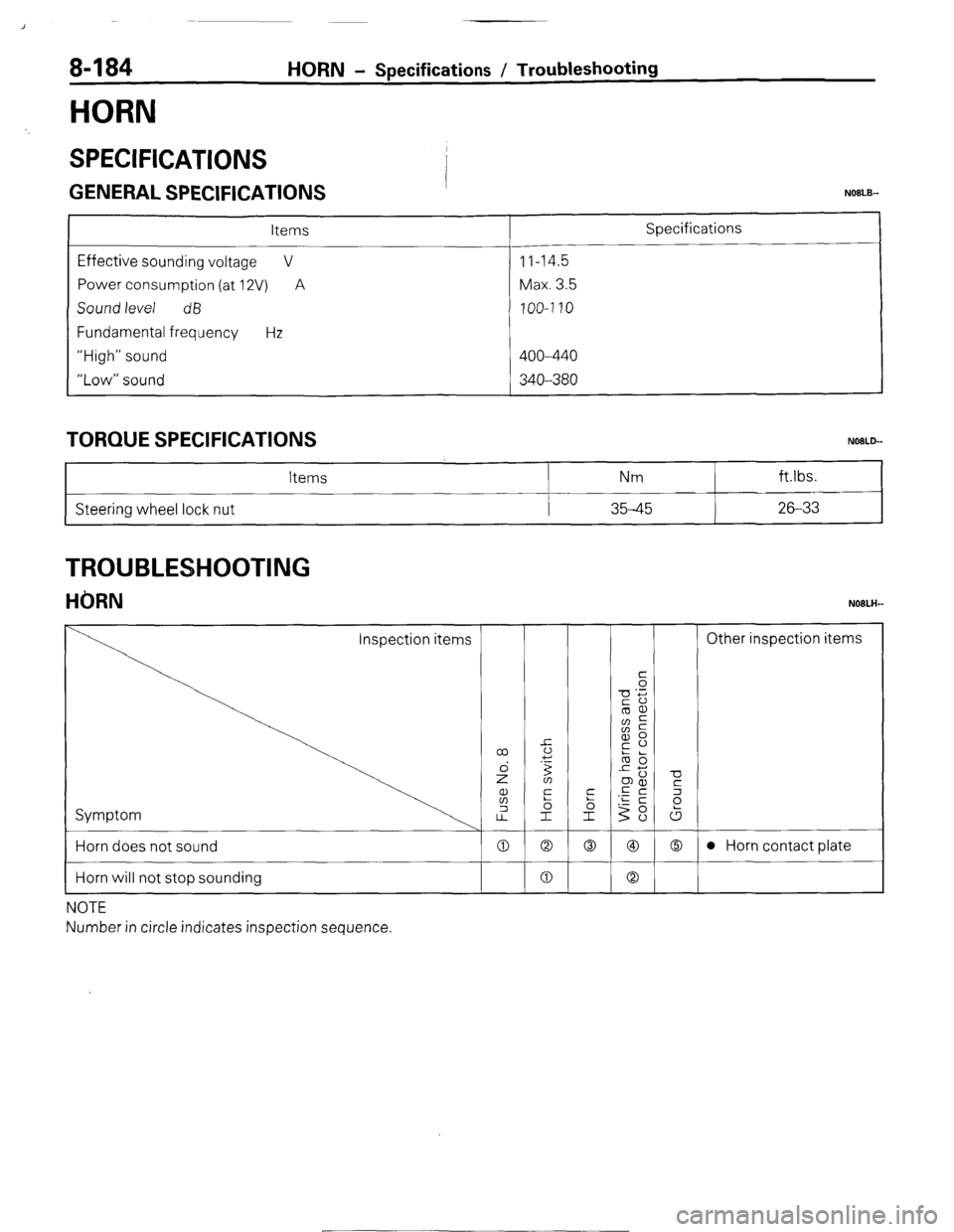
TROUBLESHOOTING
HORN NOBLH-
Horn does not sound
Horn will not stop sounding
NOTE
Number in circle indicates inspection sequence. 0 Q 0 @I 0 l Horn contact plate
0 0
1 STB Revision
~-1
Page 207 of 284
HORN SWITCH
HORN - Horn Switch 8-187
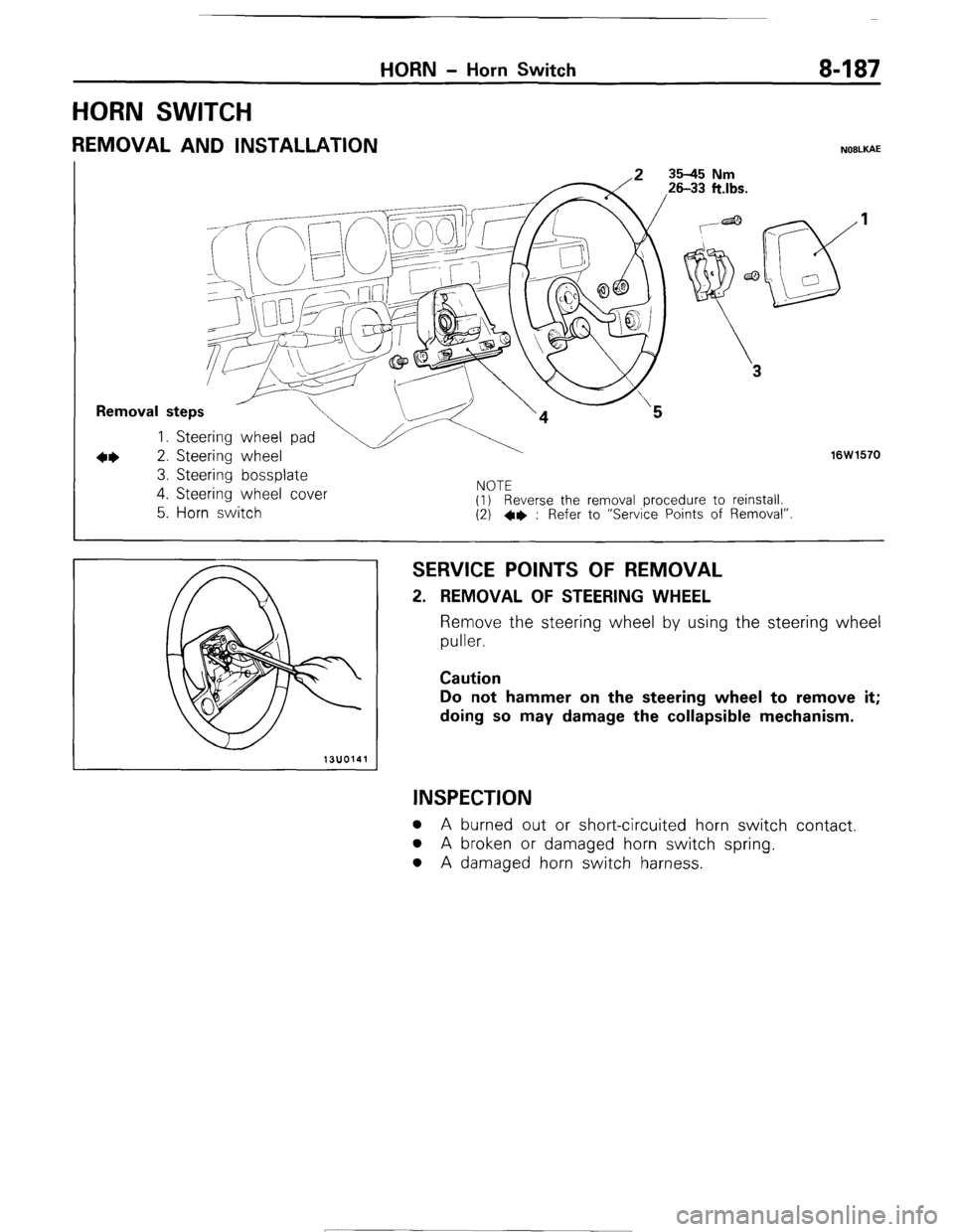
REMOVAL AND INSTALLATION NOILKAE
I T--J2
Removal steps
1. Steering wheel pa
+I) 2. Steering wheel
3. Steering bossplate
16W1570
4. Steering wheel cover
5. Horn switch I”” IL (1) Reverse the removal procedure to reinstall.
(2) +e : Refer to “Service Points of Removal”.
SERVICE POINTS OF REMOVAL 2. REMOVAL OF STEERING WHEEL
Remove the steering wheel by using the steering wheel
puller.
Caution
Do not hammer on the steering wheel to remove it;
doing so may damage the collapsible mechanism.
INSPECTION
l A burned out or short-circuited horn switch contact.
l A broken or damaged horn switch spring.
l A damaged horn switch harness. 1 STB Revision
Page 228 of 284
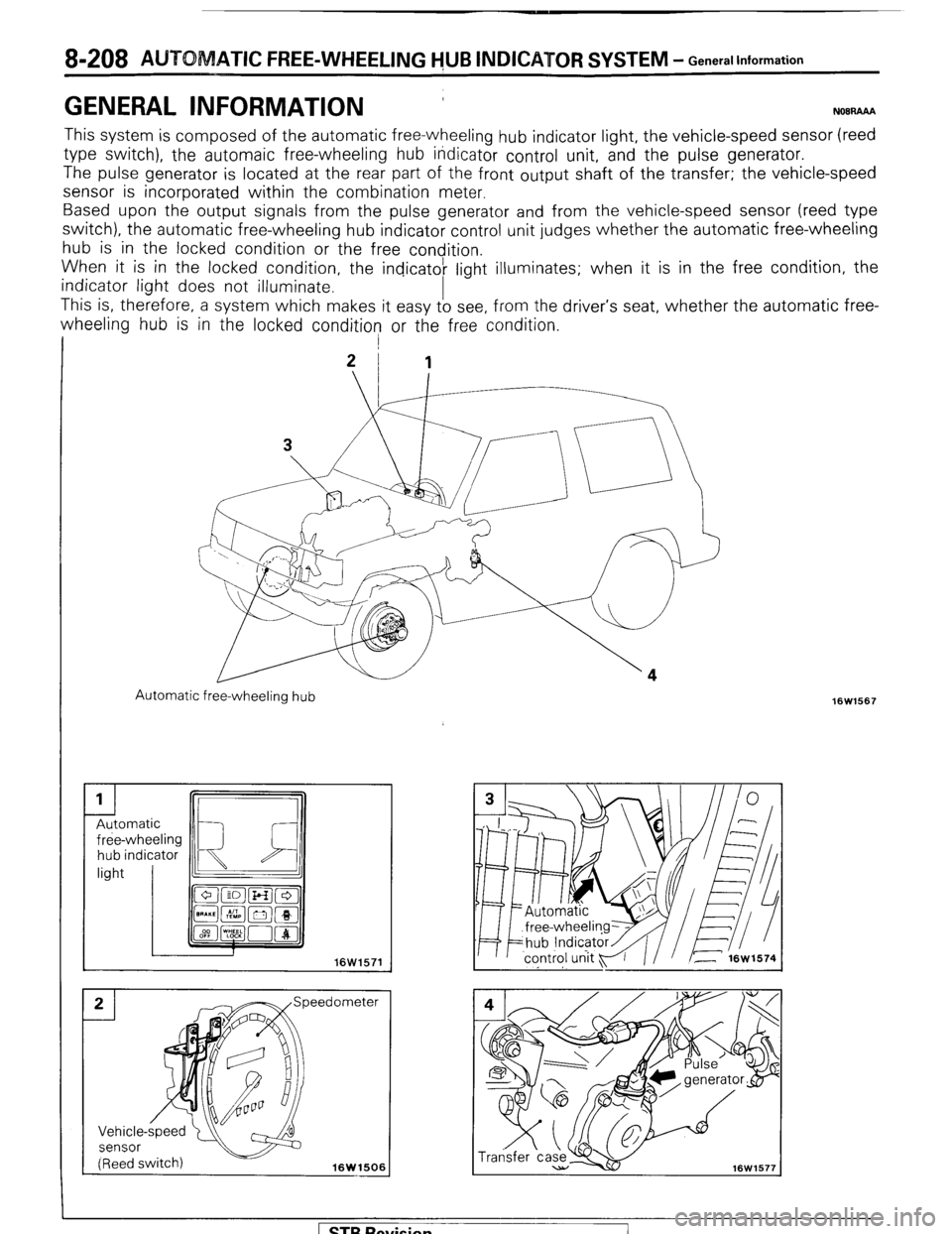
8-208 AUTO
ATIC FREE-WHEELING HUB INDICAUOR SYSTEM - General Information
GENERAL INFORMATION ’ N08RAAA
This system is composed of the automatic free-wheeling hub indicator light, the vehicle-speed sensor (reed
type switch), the automaic free-wheeling hub itidicator control unit, and the pulse generator.
The pulse
generator is located at the rear part of the front output shaft of the transfer; the vehicle-speed
sensor is incorporated within the combination meter.
Based upon the output signals from the pulse generator and from the vehicle-speed sensor (reed type
switch), the automatic free-wheeling hub indicator control unit judges whether the automatic free-wheeling
hub is in the locked condition or the free condition.
When it is in the locked condition, the indicatok light
illuminates; when it is in the free condition, the
indicator light does not illuminate.
This is, therefore, a system which makes it easy to see, from the driver’s seat, whether the automatic free-
wheeling hub is in the locked condition or the free condition.
I j
21 1
Automatic free-wheeling hub
hub indicator
16W1506 16W1567
1 STB Revision
Page 229 of 284
AUTOMATIC FREE-WHEELING HUB INDICATOR SYSTEM - General Information 8-209
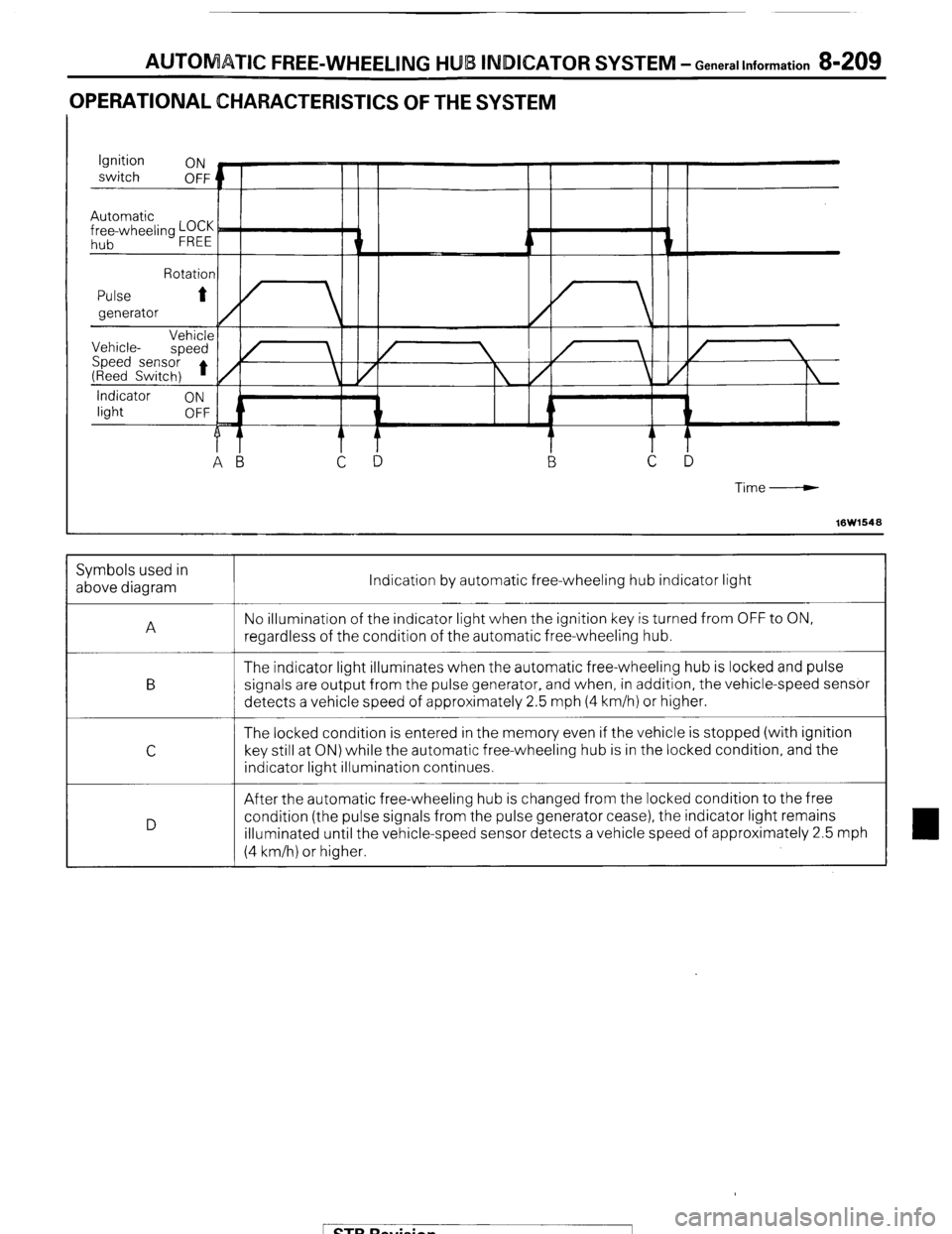
OPERATIONAL CHARACTERISTICS OF THE SYSTEM
Time-----w
16W1548 Indication by automatic free-wheeling hub indicator light
No illumination of the indicator light when the ignition key is turned from OFF to ON,
regardless of the condition of the automatic free-wheeling hub.
The indicator light illuminates when the automatic free-wheeling hub is locked and pulse
signals are output from the pulse generator, and when, in addition, the vehicle-speed sensor
detects a vehicle speed of approximately 2.5 mph (4 km/h) or higher.
The locked condition is entered in the memory even if the vehicle is stopped (with ignition
key still at ON) while the automatic free-wheeling hub is in the locked condition, and the
indicator light illumination continues.
After the automatic free-wheeling hub is changed from the locked condition to the free
condition (the pulse signals from the pulse generator cease), the indicator light remains
illuminated until the vehicle-speed sensor detects a vehicle speed of approximately 2.5 mph
(4 km/h) or higher. Symbols used in
above diagram
A
B
C
D
1 STB Revision
Page 230 of 284
8-210 AUTOMATIC FREE-WHEELING HUB INDICATOR SYSTEM - General Information
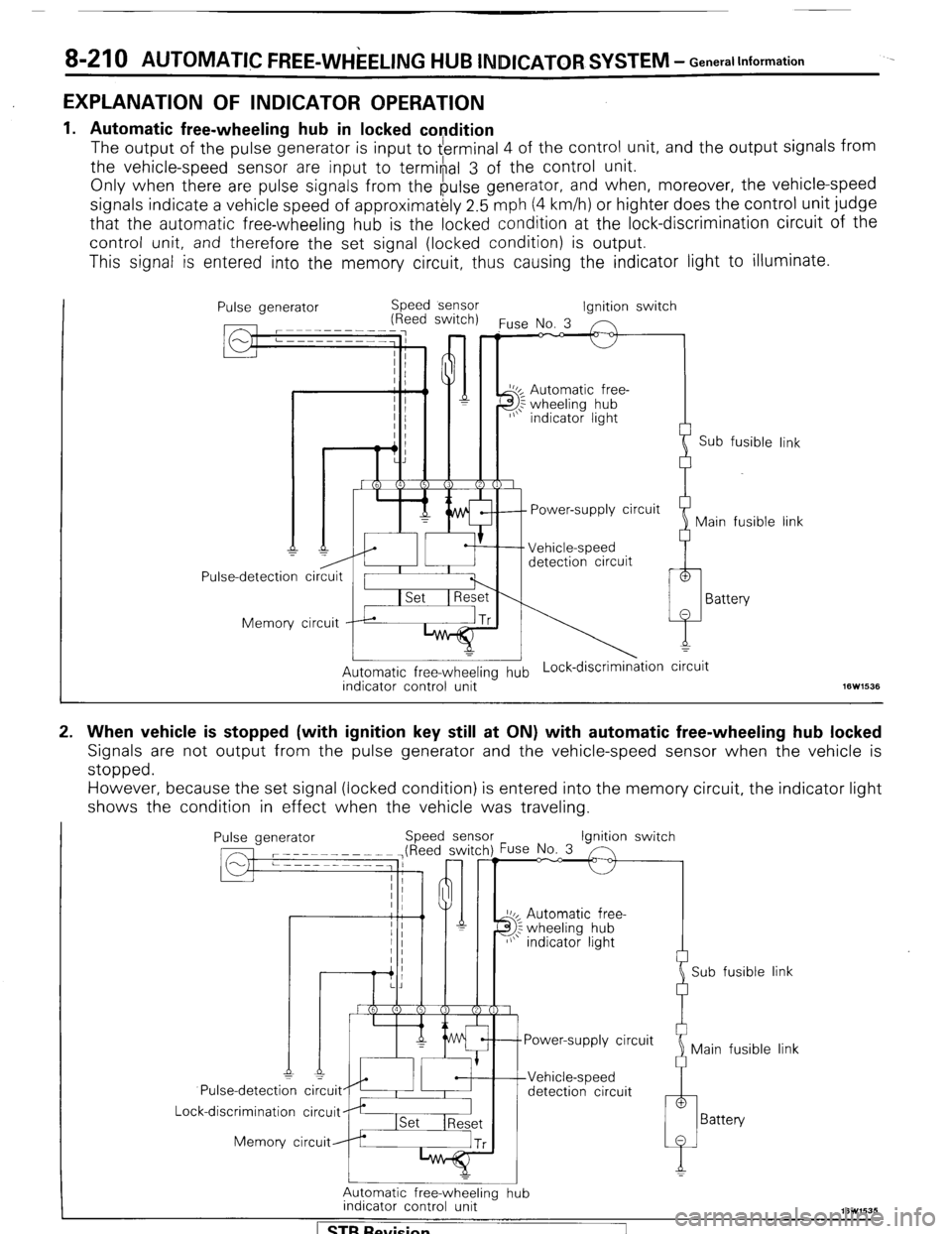
EXPLANATION OF INDICATOR OPERATION
.
1.
2. Automatic free-wheeling hub in locked condition
The
output of the pulse generator is input to $ertninal 4 of the control unit, and the output signals from
the vehicle-speed sensor are input
to termi#al 3 of the control unit.
Only when there are pulse signals from the pulse generator, and when, moreover, the vehicle-speed
signals indicate a vehicle speed of approximatkly 2.5 mph (4 km/h) or highter does the control unit judge
that the automatic free-wheeling hub is the locked condition at the lock-discrimination circuit of the
control unit, and therefore the set signal (locked condition) is output.
This signal is entered into the memory circuit, thus causing the indicator light to illuminate.
Pulse generator Speed sensor
(Reed switch)
Pulse-detection circuit / I I
Memory circuit rp*
I
Automatic free-wheeling hub Lock-discrimin&ion circuit
indicator control unit 16W1535 Ignition switch
‘use No. 3 n
J 2
I_
Power-supply circuit
Vehicle-speed
detection circuit 1
Sub fusible link 1
Main fusible link 1
)
1
Battery
When vehicle is stopped (with ignition key still at ON) with automatic free-wheeling hub locked
Signals are not output from the pulse generator and the vehicle-speed sensor when the vehicle is
stopped.
However, because the set signal (locked condition) is entered into the memory circuit, the indicator light
shows the condition in effect when the vehicle was traveling.
Pulse generator Speed sense
Pulse-detecti: ci~uit~~I~ #
Lock-discrimination circuit
Memory circuit ‘use No. 3 Ignition switch
10~ Automatic free-
3; wheeling hub
I/\’ indicator light
Sub fusible link
Power-supply circuit
Main fusible link
detection circuit
Automatic free-wheeling hub
indicator control unit
[ STB Revision
Page 231 of 284
AUTOMATIC FREE-WHEELING HUB INDICATOR SYSTEM - Generallnformation 8-211
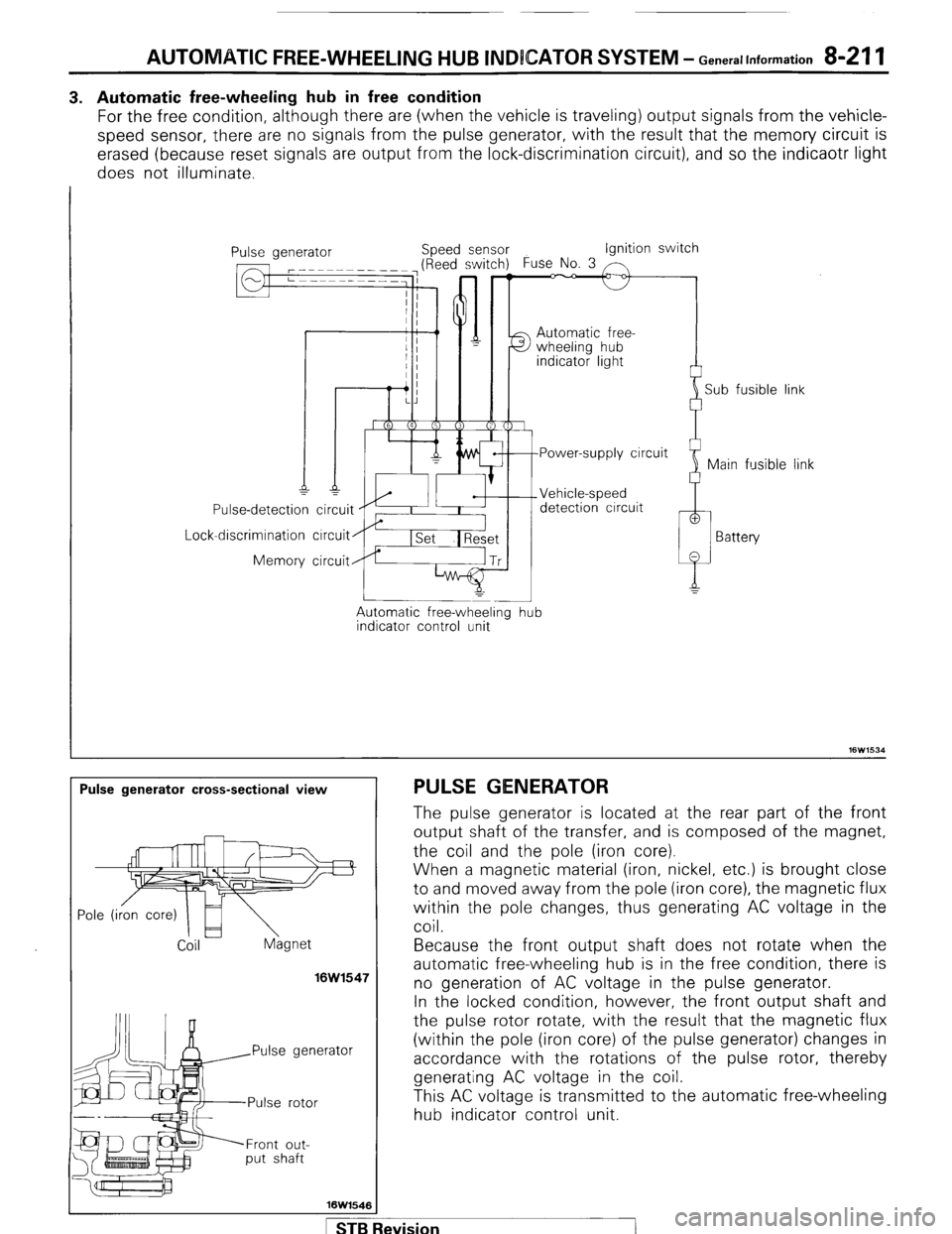
3. Automatic free-wheeling hub in free condition
For the free condition, although there are (when the vehicle is traveling) output signals from the vehicle-
speed sensor, there are no signals from the pulse generator, with the result that the memory circuit is
erased (because reset signals are output from the lock-discrimination circuit), and so the indicaotr light
does not illuminate.
I
Lock Use-detection
-discrimination
Memory ipeed sensor Ignition switch
Automatic free-
detection circuit
circuit
circuit
Automatic free-wheeling
indicator control unit -
hub i
Sub fusible link
link
Pulse generator cross-sectional view PULSE GENERATOR
Coil hgnet
16W1547
rator
Front out-
put shaft
16W1546 The pulse generator is located at the rear part of the front
output shaft of the transfer, and is composed of the magnet,
the coil and the pole (iron core).
When a magnetic material (iron, nickel, etc.) is brought close
to and moved away from the pole (iron core), the magnetic flux
within the pole changes, thus generating AC voltage in the
coil.
Because the front output shaft does not rotate when the
automatic free-wheeling hub is in the free condition, there is
no generation of AC voltage in the pulse generator.
In the locked condition, however, the front output shaft and
the pulse rotor rotate, with the result that the magnetic flux
(within the p o e I (’ Iron core) of the pulse generator) changes in
accordance with the rotations of the pulse rotor, thereby
generating AC voltage in the coil.
This AC voltage is transmitted to the automatic free-wheeling
hub indicator control unit.
STB Revision
Page 232 of 284
8-212 AUTOMATIC FREE-WHEELING HUB lNCDlCATOR SYSTEM - $%%60n’~at’on’
Speedometer
I
iensor Vehicle-speed
sensor
16W1506
12R0058
Circuit Diagram
16W153
SPECIFICATIONS
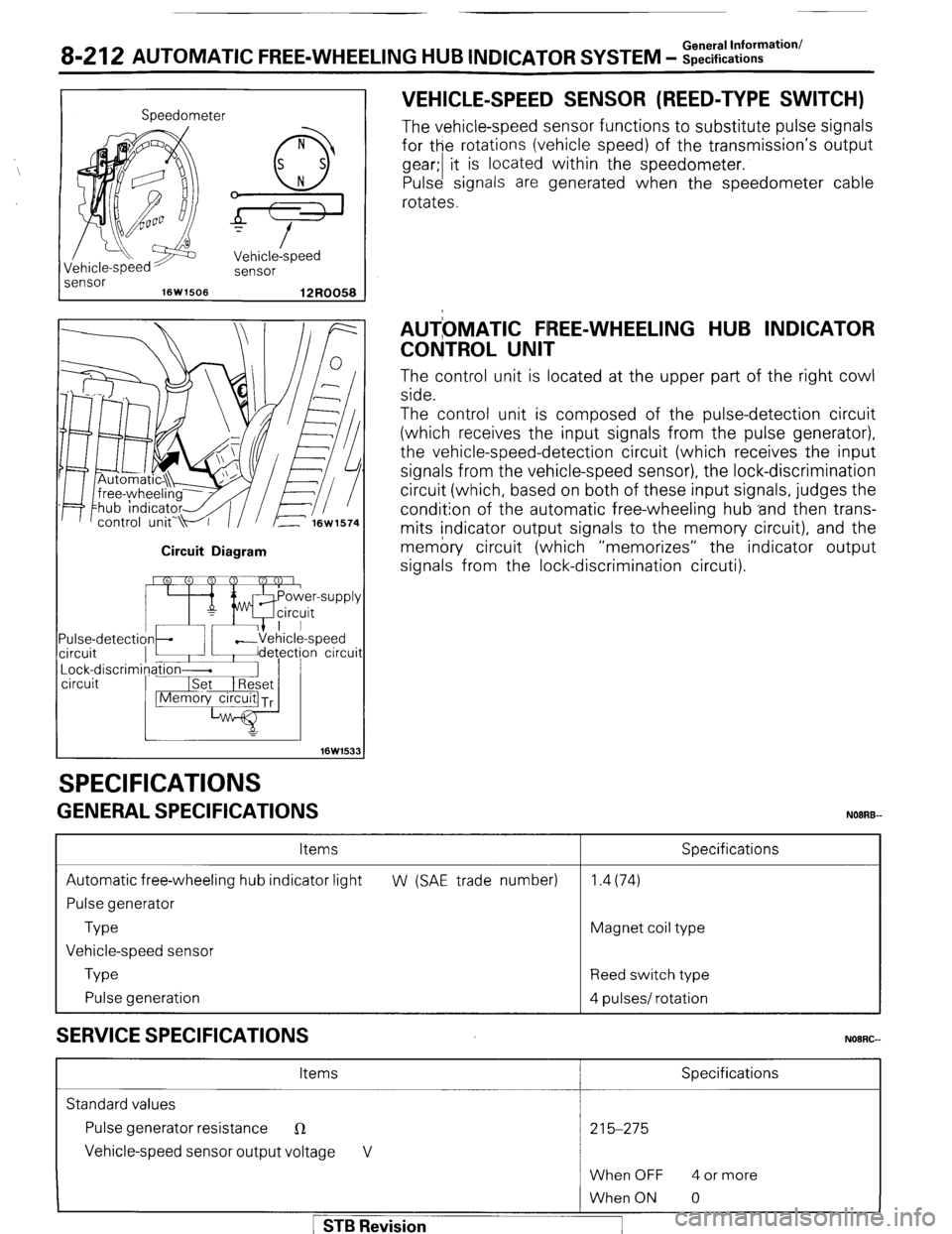
GENERAL SPECIFICATIONS VEHICLE-SPEED SENSOR (REED-TYPE SWITCH)
The vehicle-speed sensor functions to substitute pulse signals
for the rotations (vehicle speed) of the transmission’s output
gear;/ t i is located within the speedometer.
Pulse signals are generated when the speedometer cable
rotates.
AUTbMATlC FREE-WHEELING HUB INDICATOR
CONTROL UNIT
The control unit is located at the upper part of the right cowl
side.
The control unit is composed of the pulse-detection circuit
(which receives the input signals from the pulse generator),
the vehicle-speed-detection circuit (which receives the input
signals from the vehicle-speed sensor), the lock-discrimination
circuit (which, based on both of these input signals, judges the
condition of the automatic free-wheeling hub ‘and then trans-
mits indicator output signals to the memory circuit), and the
memory circuit (which “memorizes” the indicator output
signals from the lock-discrimination circuti).
Items
Automatic free-wheeling hub indicator light
Pulse generator
Type
Vehicle-speed sensor
Type
Pulse generation
SERVICE SPECIFICATIONS
Specifications
W (SAE trade number) 1.4(74)
Magnet coil type
Reed switch type
4 pulses/ rotation
NOORG-
Items Specifications
Standard values
Pulse generator resistance
R 215-275
Vehicle-speed sensor output voltage V
When OFF 4 or more 1 STB Revision
When ON 0
Page 233 of 284
AUTOMATIC FREE-WHEELING HUB INDICATOR SYSTEM -Troubleshooting 8-213
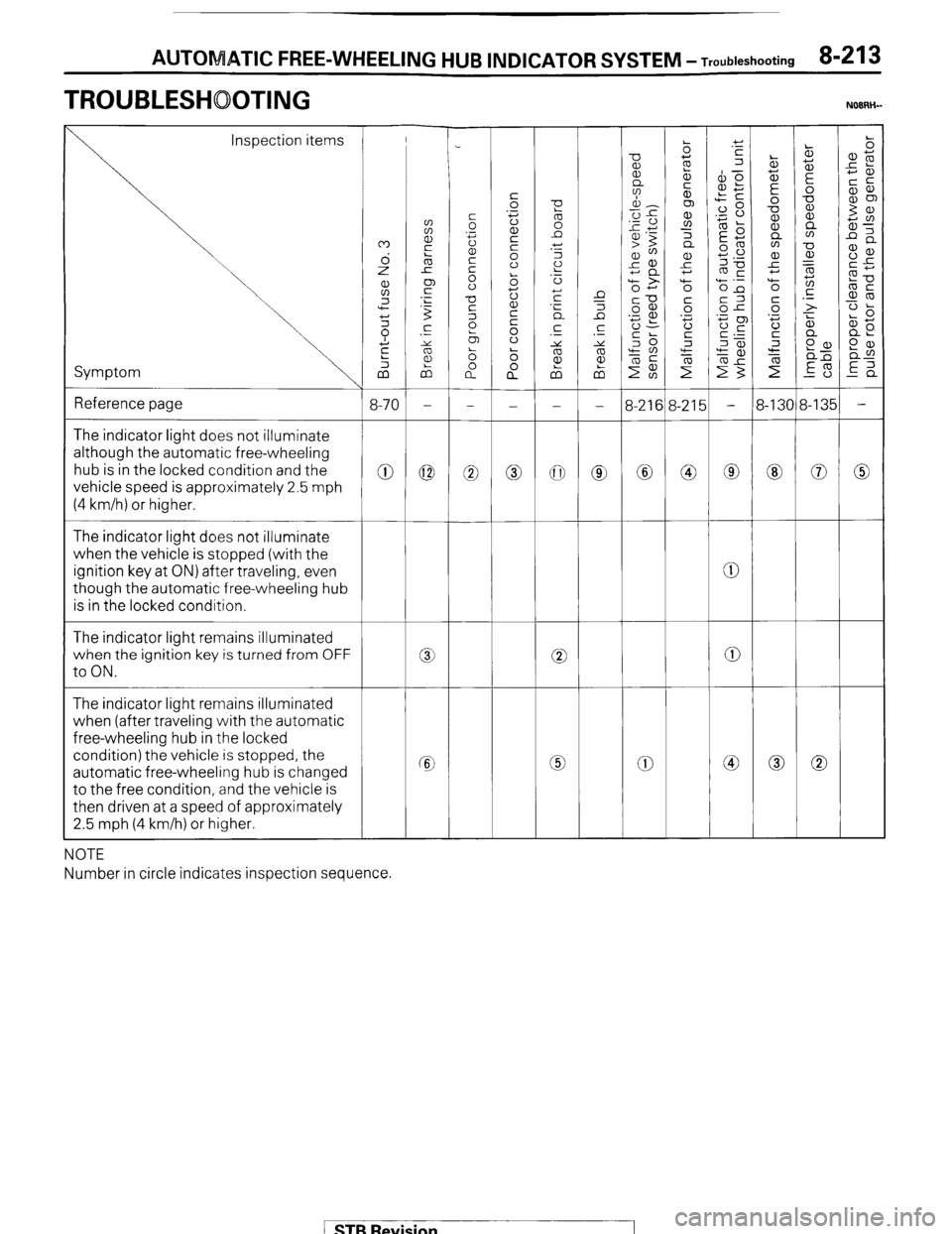
TROUBLESHOOTING NOIRH-
Inspection items
Symptom
Reference page
3-21E
0 The indicator light does not illuminate
although the automatic free-wheeling
hub is in the locked condition and the
vehicle speed is approximately 2.5 mph
(4 km/h) or higher.
0 0 0
0
The indicator light does not illuminate
when the vehicle is stopped (with the
ignition key at ON) after traveling, even
though the automatic free-wheeling hub
is in the locked condition.
The indicator light remains illuminated
when the ignition key is turned from OFF
to ON.
0
0 0 0
a 0
The indicator light remains illuminated
when (after traveling with the automatic
free-wheeling hub in the locked
condition) the vehicle is stopped, the
automatic free-wheeling hub is changed
to the free condition, and the vehicle is
then driven at a speed of approximately
2.5 mph (4 km/h) or higher.
0 Cc 0
NOTE
Number in circle indicates inspection sequence.
/ STB Revision