ignition MITSUBISHI MONTERO 2000 Service Repair Manual
[x] Cancel search | Manufacturer: MITSUBISHI, Model Year: 2000, Model line: MONTERO, Model: MITSUBISHI MONTERO 2000Pages: 1839, PDF Size: 29.19 MB
Page 601 of 1839
MITSUBISHI SC-Troubleshooting13E-12
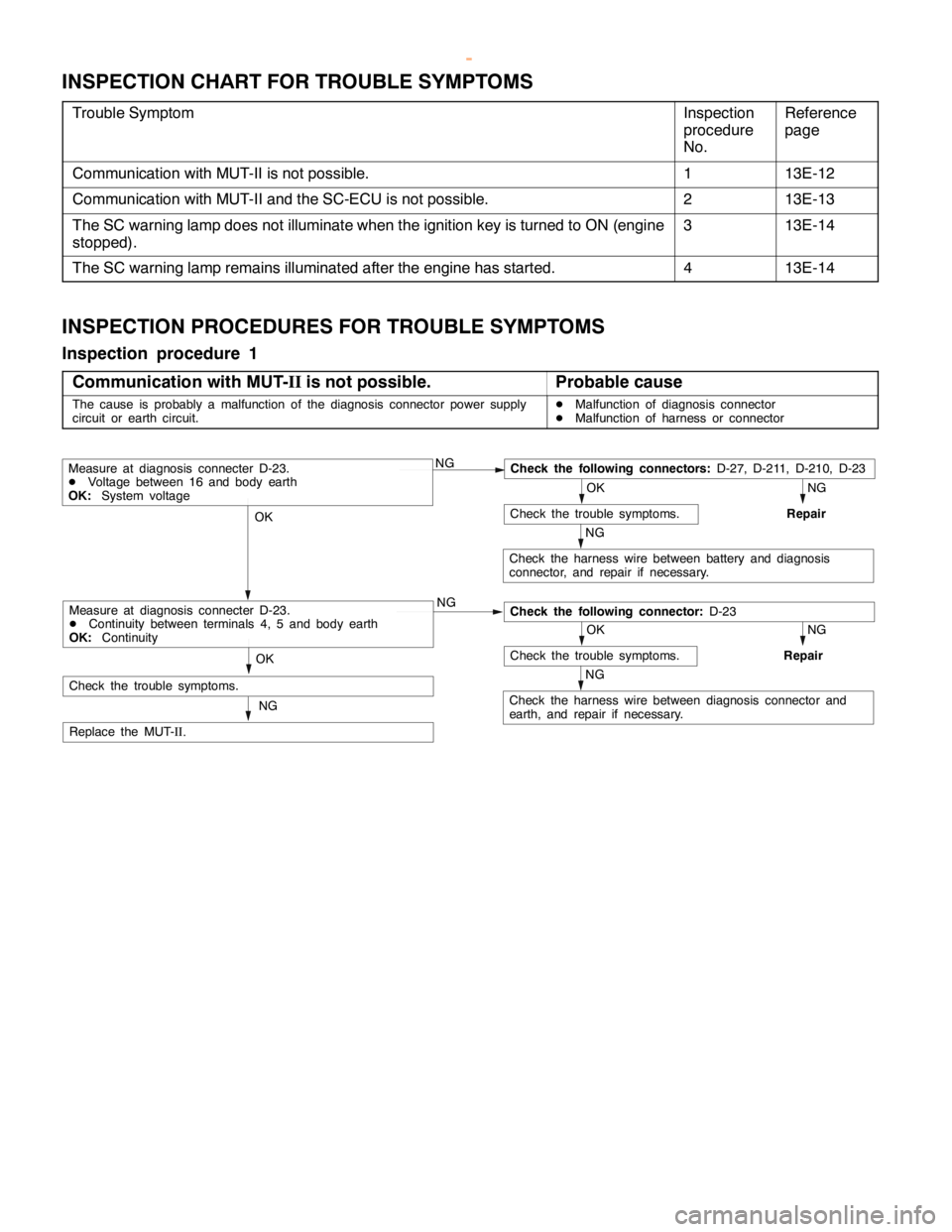
INSPECTION CHART FOR TROUBLE SYMPTOMS
Trouble SymptomInspection
procedure
No.Reference
page
Communication with MUT-II is not possible.113E-12
Communication with MUT-II and the SC-ECU is not possible.213E-13
The SC warning lamp does not illuminate when the ignition key is turned to ON (engine
stopped).313E-14
The SC warning lamp remains illuminated after the engine has started.413E-14
INSPECTION PROCEDURES FOR TROUBLE SYMPTOMS
Inspection procedure 1
Communication with MUT-
IIis not possible.
Probable cause
The cause is probably a malfunction of the diagnosis connector power supply
circuit or earth circuit.DMalfunction of diagnosis connector
DMalfunction of harness or connector
NGCheck the following connectors:
D-27, D-211, D-210, D-23
NG
Repair
OK
Check the trouble symptoms.
NG
Check the harness wire between battery and diagnosis
connector, and repair if necessary.
OK
NG
NG
Repair
OK
Check the trouble symptoms.
NG
Check the harness wire between diagnosis connector and
earth, and repair if necessary.
OK
NG
Replace the MUT-
II.
Measure at diagnosis connecter D-23.
DVoltage between 16 and body earth
OK:
System voltage
Check the following connector:
D-23Measure at diagnosis connecter D-23.
DContinuity between terminals 4, 5 and body earth
OK:
Continuity
Check the trouble symptoms.
www.WorkshopManuals.co.uk
Purchased from www.WorkshopManuals.co.uk
Page 602 of 1839
MITSUBISHI SC-Troubleshooting13E-13
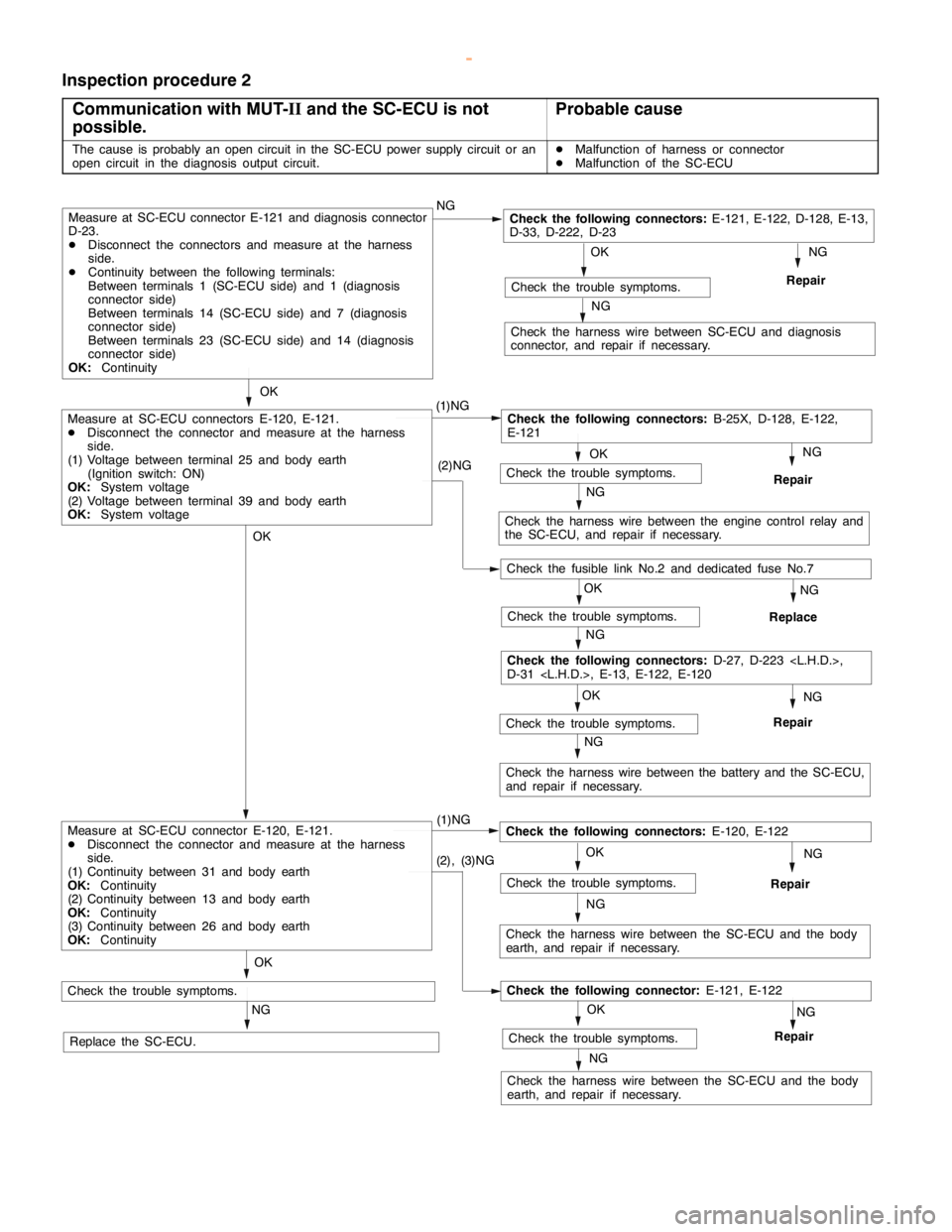
Inspection procedure 2
Communication with MUT-
IIand the SC-ECU is not
possible.
Probable cause
The cause is probably an open circuit in the SC-ECU power supply circuit or an
open circuit in the diagnosis output circuit.DMalfunction of harness or connector
DMalfunction of the SC-ECU
NG
Repair
OK
Check the trouble symptoms.
NG
Check the harness wire between SC-ECU and diagnosis
connector, and repair if necessary.
OK
Measure at SC-ECU connector E-121 and diagnosis connector
D-23.
DDisconnect the connectors and measure at the harness
side.
DContinuity between the following terminals:
Between terminals 1 (SC-ECU side) and 1 (diagnosis
connector side)
Between terminals 14 (SC-ECU side) and 7 (diagnosis
connector side)
Between terminals 23 (SC-ECU side) and 14 (diagnosis
connector side)
OK:
ContinuityNGCheck the following connectors:
E-121, E-122, D-128, E-13,
D-33, D-222, D-23
OK
NG
Repair
OK
Check the trouble symptoms.
NG
OKNG
Repair
OK
(1)NGCheck the following connectors:
B-25X, D-128, E-122,
E-121
NG
Check the harness wire between the engine control relay and
the SC-ECU, and repair if necessary. (2)NG
OK
Check the trouble symptoms.
NG
Replace
NG
Check the harness wire between the battery and the SC-ECU,
and repair if necessary.
Check the following connectors:
D-27, D-223
D-31
Measure at SC-ECU connectors E-120, E-121.
DDisconnect the connector and measure at the harness
side.
(1) Voltage between terminal 25 and body earth
(Ignition switch: ON)
OK:
System voltage
(2) Voltage between terminal 39 and body earth
OK:
System voltage
NG (1)NG
Check the harness wire between the SC-ECU and the body
earth, and repair if necessary.
Repair
NG
Replace the SC-ECU.
Check the trouble symptoms.
Check the following connectors:
E-120, E-122
NG
(2), (3)NG
Check the harness wire between the SC-ECU and the body
earth, and repair if necessary.
OK
NG
Repair
NGCheck the trouble symptoms.
Check the following connector:
E-121, E-122
OK
Check the trouble symptoms.
Measure at SC-ECU connector E-120, E-121.
DDisconnect the connector and measure at the harness
side.
(1) Continuity between 31 and body earth
OK:
Continuity
(2) Continuity between 13 and body earth
OK:
Continuity
(3) Continuity between 26 and body earth
OK:
Continuity
Check the trouble symptoms.
Check the fusible link No.2 and dedicated fuse No.7
www.WorkshopManuals.co.uk
Purchased from www.WorkshopManuals.co.uk
Page 603 of 1839
MITSUBISHI SC-Troubleshooting13E-14
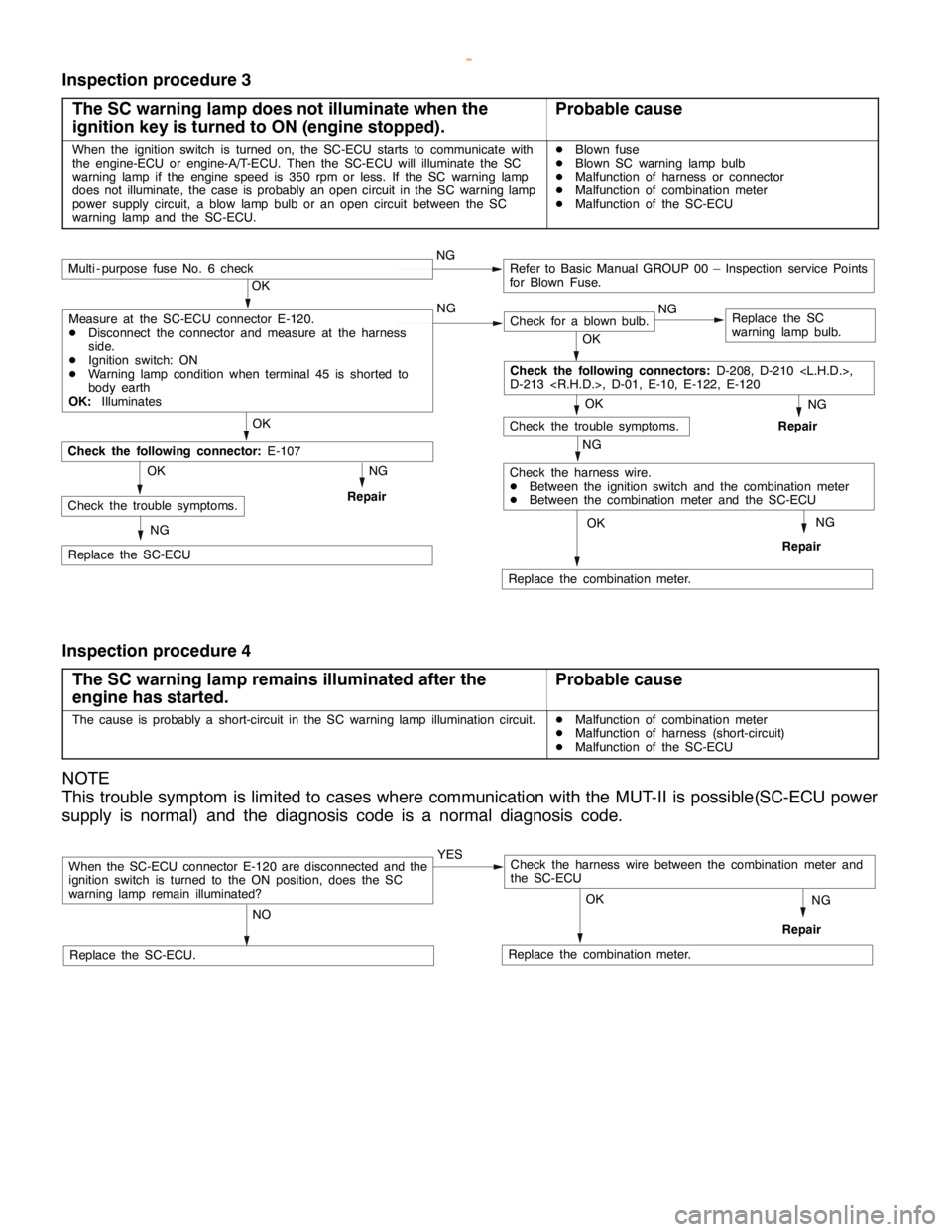
Inspection procedure 3
The SC warning lamp does not illuminate when the
ignition key is turned to ON (engine stopped).
Probable cause
When the ignition switch is turned on, the SC-ECU starts to communicate with
the engine-ECU or engine-A/T-ECU. Then the SC-ECU will illuminate the SC
warning lamp if the engine speed is 350 rpm or less. If the SC warning lamp
does not illuminate, the case is probably an open circuit in the SC warning lamp
power supply circuit, a blow lamp bulb or an open circuit between the SC
warning lamp and the SC-ECU.DBlown fuse
DBlown SC warning lamp bulb
DMalfunction of harness or connector
DMalfunction of combination meter
DMalfunction of the SC-ECU
NG
Replace the combination meter.
NG
Repair
OK
NG
Check for a blown bulb.Replace the SC
warning lamp bulb.
OK
NG
Repair
OK
Check the trouble symptoms.
Multi - purpose fuse No. 6 checkNGRefer to Basic Manual GROUP 00 – Inspection service Points
for Blown Fuse.
NG
Check the harness wire.
DBetween the ignition switch and the combination meter
DBetween the combination meter and the SC-ECU
OK
OK
Replace the SC-ECU
Check the following connector:
E-107
NG
RepairCheck the trouble symptoms.OK
NG
Check the following connectors:
D-208, D-210
D-213
Measure at the SC-ECU connector E-120.
DDisconnect the connector and measure at the harness
side.
DIgnition switch: ON
DWarning lamp condition when terminal 45 is shorted to
body earth
OK:
Illuminates
Inspection procedure 4
The SC warning lamp remains illuminated after the
engine has started.
Probable cause
The cause is probably a short-circuit in the SC warning lamp illumination circuit.DMalfunction of combination meter
DMalfunction of harness (short-circuit)
DMalfunction of the SC-ECU
NOTE
This trouble symptom is limited to cases where communication with the MUT-II is possible(SC-ECU power
supply is normal) and the diagnosis code is a normal diagnosis code.
When the SC-ECU connector E-120 are disconnected and the
ignition switch is turned to the ON position, does the SC
warning lamp remain illuminated?YES
NO
Replace the SC-ECU.Replace the combination meter.
NG
Repair
OK
Check the harness wire between the combination meter and
the SC-ECU
www.WorkshopManuals.co.uk
Purchased from www.WorkshopManuals.co.uk
Page 604 of 1839

MITSUBISHI SC-Troubleshooting13E-15
DATA LIST REFERENCE TABLE
The following ECU input data items can be read using the MUT-
II.
Item
No.Check itemInspection conditionsNormal condition
10Vehicle speedWhen vehicle is being drivenSpeedometer display and
MUT-IIdisplay are identical.
11AcceleratorIgnition switch:Release the accelerator pedal.0.9 - 1.1 V
pedal position
sensorONDepress the accelerator pedal gradually.Increases in response to
pedal depression stroke.
Depress the accelerator pedal fully4.0 V or more
18Power supply
voltageIgnition switch: ONSystem voltage
19Accelerator
pedal positionIgnition switch:
ONRelease the accelerator pedalON
pedal position
switch (Idle
switch)ON
Depress the accelerator pedal slightly.OFF
20Ignition switchIgnition switch: ONON
Ignition switch: OFFOFF
22Front-right
wheel speedWhen vehicle is being drivenSpeedometer display and
MUT-IIdisplay are identical.
28Engine typeVehicles with the 6G74 engine6G74
Vehicles with the 4M41 engine4M41
30Trace controlSC system control is activeON
SC system control is not activeOFF
31Engine specifi-Vehicles with the 6G74 engineDOHC
cation 1Vehicles with the 4M41 engine-
32Engine specifi-Vehicles with the 6G74 engineN/A
cation 2Vehicles with the 4M41 engine-
33Engine specifi-Vehicles with the 6G74 engineMIVEC/ETV
cation 3Vehicles with the 4M41 engine-
35Destination-EC
40Engine speedDepress the accelerator pedal gradually.Tachometer display and
MUT-IIdisplay are identical.
51Inhibitor switchIgnition switch:Selector lever position: PP
ONSelector lever position: RREngine:
stopped
Selector lever position: NN
Selector lever position: DD
52Shift positionSelector lever
position: sportsDriving at a constant speed of 10 km/h in
1st1st
modeDriving at a constant speed of 30 km/h in
2nd2nd
Driving at a constant speed of 50 km/h in
3rd3rd
Driving at a constant speed of 50 km/h in
4th4th
Driving at a constant speed of 70 km/h in
5th5th
www.WorkshopManuals.co.uk
Purchased from www.WorkshopManuals.co.uk
Page 607 of 1839

MITSUBISHI SC-Troubleshooting/On-vehicle Service13E-18
Terminal No.Signal nameNormal condition
Between terminal 13 and body earthEarthContinuity
Between terminal 26 and body earthEarth
Between terminal 31 and body earthEarth
ON-VEHICLE SERVICE
OPERATION TEST OF MITSUBISHI SC
1. Connect the MUT-
IIto the 16-pin diagnosis connector.
Caution
Turn the ignition switch to the LOCK (OFF) position
when connecting and disconnecting the MUT-
II.
2. Move the shift lever to the neutral
lever to the P range.
3. Start the engine.
4. Use the MUT-
IIto activate the Actuator Test (item No.05)
while depressing the accelerator pedal fully. Check that
the engine speed should decrease gradually.
Caution
Activate the Actuator Test for three seconds.
Release the accelerator pedal immediately after the
Actuator Test is complete, or the engine speed will
rise.
NOTE
During the Actuator Test, the SC-ECU transmits the signal,
which requests no torque and wide open throttle, to the
engine-ECU or engine-A/T-ECU for three seconds.
WHEEL SPEED SENSOR (FR) CHECK
Refer to Basic Manual GROUP 35B - On-vehicle service.
VEHICLE SPEED SENSOR CHECK
Refer to Basic Manual GROUP 54A - Combination Meter.
www.WorkshopManuals.co.uk
Purchased from www.WorkshopManuals.co.uk
Page 612 of 1839

DIESEL FUEL <4D5-stepIII>-General/General Information13E-2
GENERAL
OUTLINE OF CHANGE
An electronically-controlled injection pump has been added in order to comply with Regulation STEP
III. Due to this, the following service procedures have been added.
GENERAL INFORMATION
The electronically-controlled fuel injection system consists of sensors which detect the condition of the
diesel engine, an engine-ECU which controls the system based on signals from these sensors, and actuators
which operate according to control commands from the engine-ECU.
The engine-ECU carries out operations such as fuel injection rate control, fuel injection timing control
and idle up control. In addition, the engine-ECU is equipped with several self-diagnosis functions which
make troubleshooting easier in the event that a problem develops.
FUEL INJECTION RATE CONTROL
The fuel injection completion timing is controlled by means of a solenoid-type spill valve to ensure that
the optimum amount of fuel is supplied to the engine in accordance with gradual changes in the engine
running condition.
Before fuel injection starts, the solenoid-type spill valve is on (energized), so that the valve is closed.
As the plunger turns and rises, fuel is sent out under pressure, and when the fuel flow rate reaches
the target value for fuel injection, the solenoid-type spill valve turns off. When the solenoid-type spill
valve turns off, the fuel under high pressure inside the plunger is leaked out into the pump chamber
and fuel injection is completed.
FUEL INJECTION TIMING CONTROL
The position of the injection pump timer piston is controlled so that fuel injection is carried out at the
optimum timing in accordance with the engine running condition.
The timer piston position is determined by duty control of the timing control solenoid valve which is located
in the line between the high-pressure chamber and the low-pressure chamber of the timer piston.
The fuel injection timing is advanced by increasing the control duty of the timing control solenoid valve.
IDLE SPEED CONTROL
Controlling the fuel injection rate in accordance with the engine running condition maintains the idle speed
at the optimum condition.
SELF-DIAGNOSIS FUNCTION
DWhen an abnormality is detected in any of the sensors or actuators, the engine warning lamp illuminates
to warn the driver.
DWhen an abnormality is detected in any of the sensors or actuators, a diagnosis code number
corresponding to the problem which occurred is output.
DThe RAM data relating to the sensors and actuators which is stored in the engine-ECU can be read
using the MUT-II. In addition, the actuators can be force-driven under certain conditions.
OTHER CONTROL FUNCTIONS
1. Power Supply Control
When the ignition switch is turned to ON, the relay turns on and power is supplied to components
such as the timing control solenoid valve.
2. Intake Air Throttle Control
When the engine-ECU detects an abnormality in any of the sensors or actuators, the throttle valve
is half opened to restrict the amount of intake air in order to prevent the vehicle from running away.
3. A/C Relay Control
Turns the compressor clutch of the A/C ON and OFF
4. Condenser Fan Motor Relay Control
Controls the condenser fan motor relay based on the A/C switch, engine coolant temperature and
vehicle speed input signals.
5. Glow Control
Refer to GROUP 16.
6. EGR Control
Refer to GROUP 17.
www.WorkshopManuals.co.uk
Purchased from www.WorkshopManuals.co.uk
Page 619 of 1839
DIESEL FUEL <4D5-stepIII>-Troubleshooting13E-9
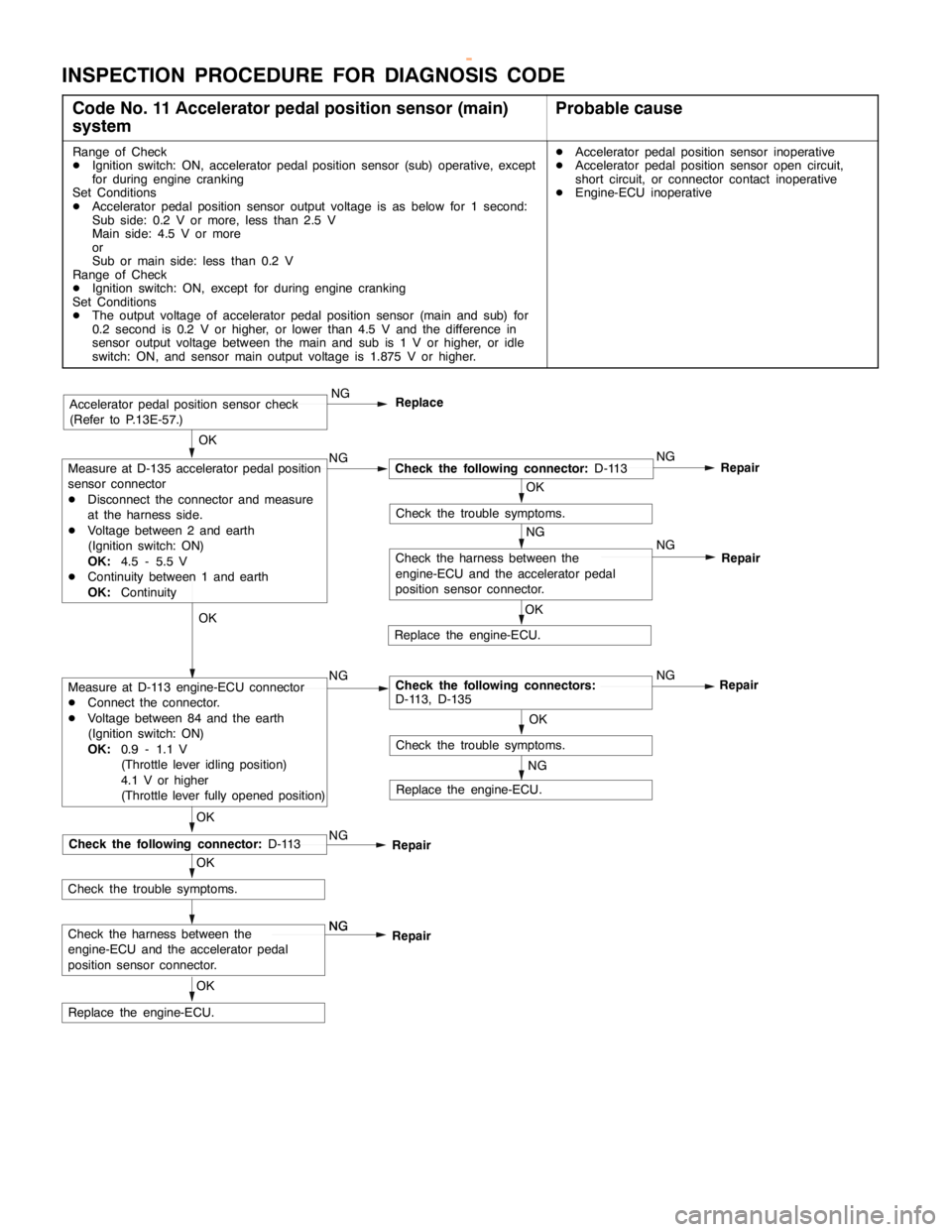
INSPECTION PROCEDURE FOR DIAGNOSIS CODE
Code No. 11 Accelerator pedal position sensor (main)
systemProbable cause
Range of Check
DIgnition switch: ON, accelerator pedal position sensor (sub) operative, except
for during engine cranking
Set Conditions
DAccelerator pedal position sensor output voltage is as below for 1 second:
Sub side: 0.2 V or more, less than 2.5 V
Main side: 4.5 V or more
or
Sub or main side: less than 0.2 V
Range of Check
DIgnition switch: ON, except for during engine cranking
Set Conditions
DThe output voltage of accelerator pedal position sensor (main and sub) for
0.2 second is 0.2 V or higher, or lower than 4.5 V and the difference in
sensor output voltage between the main and sub is 1 V or higher, or idle
switch: ON, and sensor main output voltage is 1.875 V or higher.DAccelerator pedal position sensor inoperative
DAccelerator pedal position sensor open circuit,
short circuit, or connector contact inoperative
DEngine-ECU inoperative
NGOK
OK
Measure at D-135 accelerator pedal position
sensor connector
DDisconnect the connector and measure
at the harness side.
DVoltage between 2 and earth
(Ignition switch: ON)
OK:4.5 - 5.5 V
DContinuity between 1 and earth
OK:ContinuityNGCheck the following connector:D-113NG
Repair
OK
OKRepair
NGAccelerator pedal position sensor check
(Refer to P.13E-57.)Replace
Check the trouble symptoms.
Replace the engine-ECU.NG
Check the trouble symptoms.
NG
Replace the engine-ECU.
NG
RepairCheck the following connectors:
D-113, D-135
OK NG
NG
Check the following connector:D-113NG
Repair
OK
Check the harness between the
engine-ECU and the accelerator pedal
position sensor connector.
OK
Measure at D-113 engine-ECU connector
DConnect the connector.
DVoltage between 84 and the earth
(Ignition switch: ON)
OK:0.9 - 1.1 V
(Throttle lever idling position)
4.1 V or higher
(Throttle lever fully opened position)
Check the harness between the
engine-ECU and the accelerator pedal
position sensor connector.
NG
Repair NG NG
NG
NG
NG
Check the trouble symptoms.
OK
Replace the engine-ECU.
www.WorkshopManuals.co.uk
Purchased from www.WorkshopManuals.co.uk
Page 620 of 1839
DIESEL FUEL <4D5-stepIII>-Troubleshooting13E-10
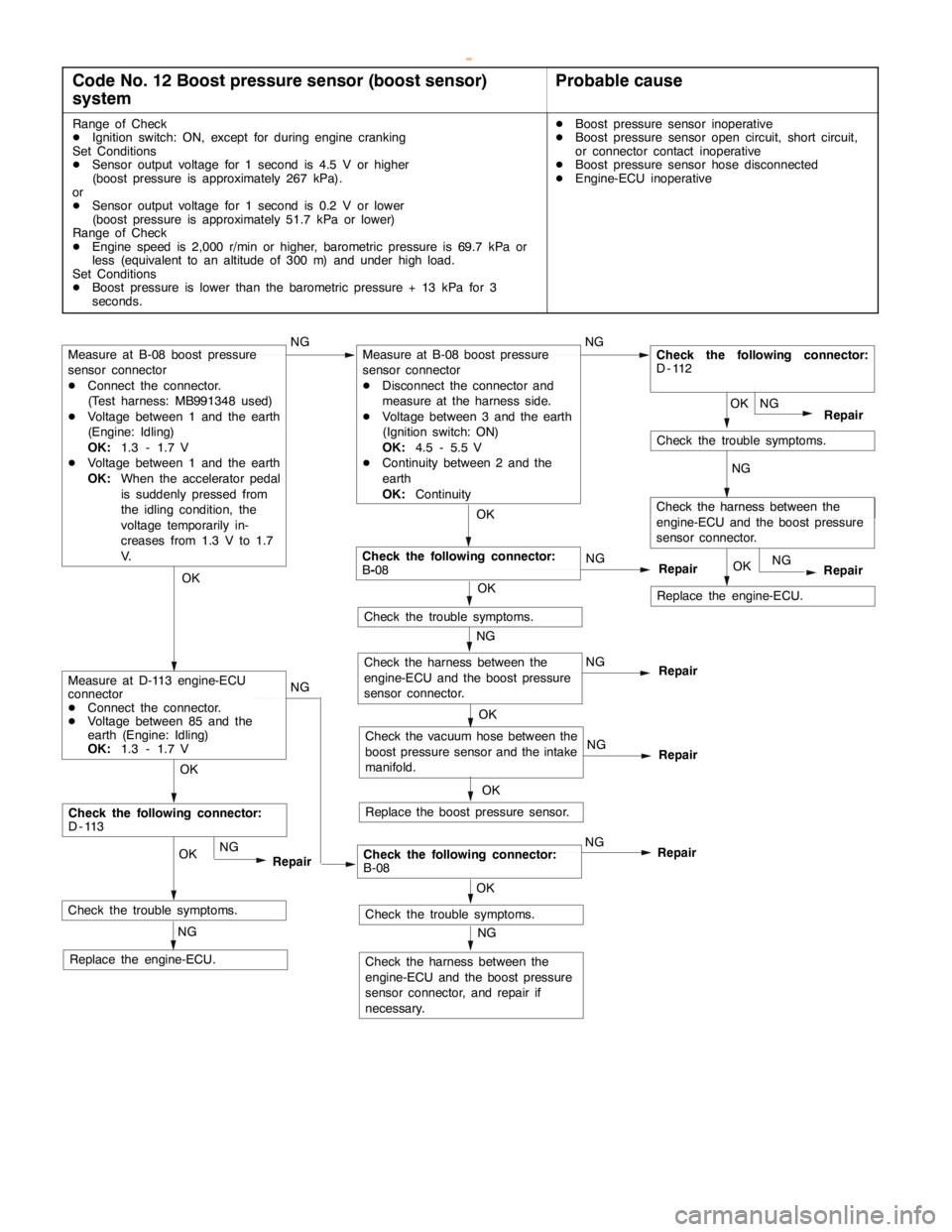
Code No. 12 Boost pressure sensor (boost sensor)
systemProbable cause
Range of Check
DIgnition switch: ON, except for during engine cranking
Set Conditions
DSensor output voltage for 1 second is 4.5 V or higher
(boost pressure is approximately 267 kPa).
or
DSensor output voltage for 1 second is 0.2 V or lower
(boost pressure is approximately 51.7 kPa or lower)
Range of Check
DEngine speed is 2,000 r/min or higher, barometric pressure is 69.7 kPa or
less (equivalent to an altitude of 300 m) and under high load.
Set Conditions
DBoost pressure is lower than the barometric pressure + 13 kPa for 3
seconds.DBoost pressure sensor inoperative
DBoost pressure sensor open circuit, short circuit,
or connector contact inoperative
DBoost pressure sensor hose disconnected
DEngine-ECU inoperative
NG
Check the trouble symptoms.
Replace the engine-ECU.
Check the following connector:
D-113
NGOK
NG
Repair
RepairOK
NG
Check the trouble symptoms.
OKOK
OK
Check the following connector:
B-08NG
Check the trouble symptoms. NG
Repair
NG
NG
Check the vacuum hose between the
boost pressure sensor and the intake
manifold.
Replace the boost pressure sensor.
OK OK OK
Repair
NG
Repair
Check the trouble symptoms.
Check the harness between the
engine-ECU and the boost pressure
sensor connector, and repair if
necessary.
NG OK
NG
RepairCheck the following connector:
B-08NG
Measure at B-08 boost pressure
sensor connector
DConnect the connector.
(Test harness: MB991348 used)
DVoltage between 1 and the earth
(Engine: Idling)
OK:1.3 - 1.7 V
DVoltage between 1 and the earth
OK:When the accelerator pedal
is suddenly pressed from
the idling condition, the
voltage temporarily in-
creases from 1.3 V to 1.7
V.
Measure at D-113 engine-ECU
connector
DConnect the connector.
DVoltage between 85 and the
earth (Engine: Idling)
OK:1.3 - 1.7 V
Check the harness between the
engine-ECU and the boost pressure
sensor connector.
Measure at B-08 boost pressure
sensor connector
DDisconnect the connector and
measure at the harness side.
DVoltage between 3 and the earth
(Ignition switch: ON)
OK:4.5 - 5.5 V
DContinuity between 2 and the
earth
OK:Continuity
Replace the engine-ECU.NGCheck the harness between the
engine-ECU and the boost pressure
sensor connector.
Replace the engine-ECU.OK
NG
Repair
Check the following connector:
D-112
www.WorkshopManuals.co.uk
Purchased from www.WorkshopManuals.co.uk
Page 621 of 1839
DIESEL FUEL <4D5-stepIII>-Troubleshooting13E-11
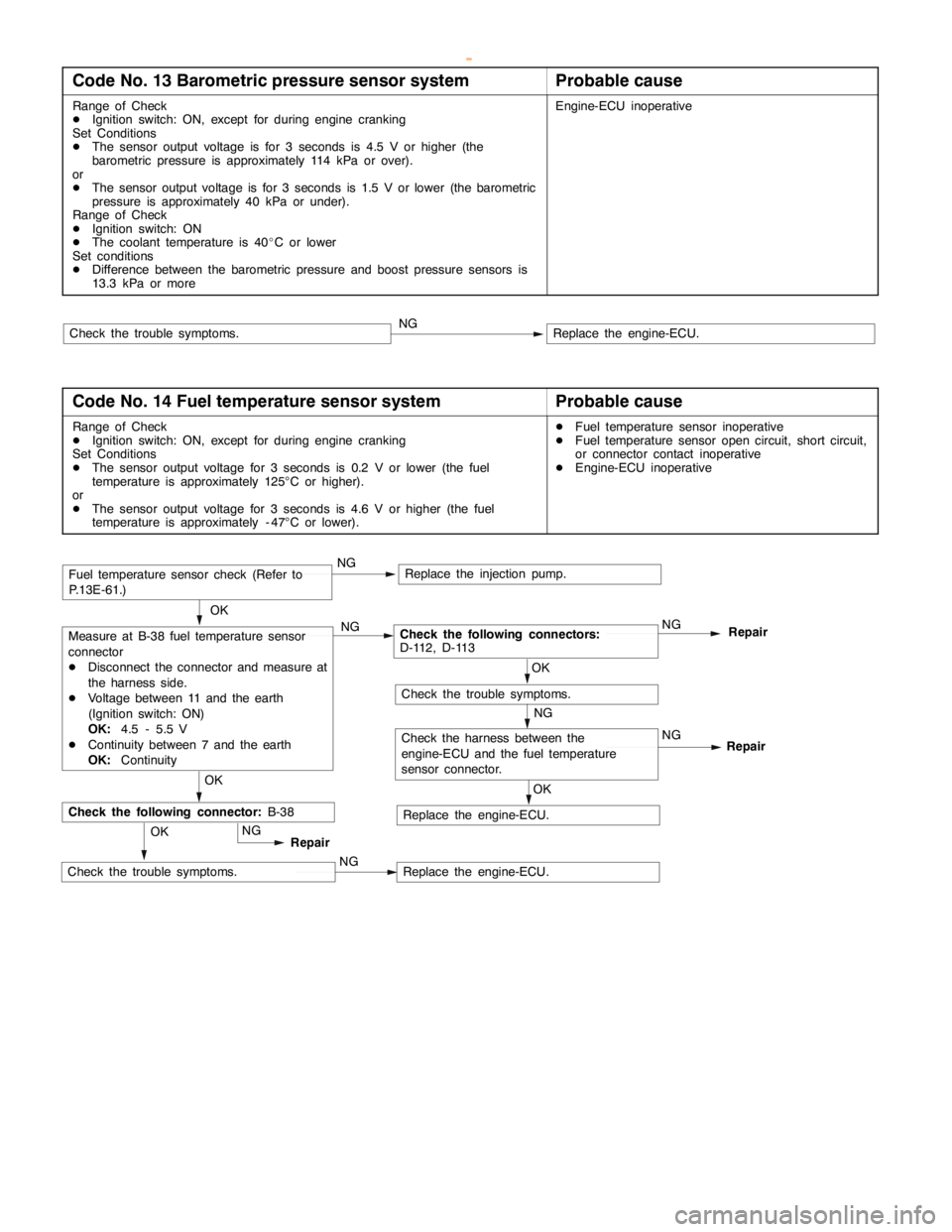
Code No. 13 Barometric pressure sensor systemProbable cause
Range of Check
DIgnition switch: ON, except for during engine cranking
Set Conditions
DThe sensor output voltage is for 3 seconds is 4.5 V or higher (the
barometric pressure is approximately 114 kPa or over).
or
DThe sensor output voltage is for 3 seconds is 1.5 V or lower (the barometric
pressure is approximately 40 kPa or under).
Range of Check
DIgnition switch: ON
DThe coolant temperature is 40_C or lower
Set conditions
DDifference between the barometric pressure and boost pressure sensors is
13.3 kPa or moreEngine-ECU inoperative
Replace the engine-ECU.NGCheck the trouble symptoms.
Code No. 14 Fuel temperature sensor systemProbable cause
Range of Check
DIgnition switch: ON, except for during engine cranking
Set Conditions
DThe sensor output voltage for 3 seconds is 0.2 V or lower (the fuel
temperature is approximately 125°C or higher).
or
DThe sensor output voltage for 3 seconds is 4.6 V or higher (the fuel
temperature is approximately - 47°C or lower).DFuel temperature sensor inoperative
DFuel temperature sensor open circuit, short circuit,
or connector contact inoperative
DEngine-ECU inoperative
OK
Measure at B-38 fuel temperature sensor
connector
DDisconnect the connector and measure at
the harness side.
DVoltage between 11 and the earth
(Ignition switch: ON)
OK:4.5 - 5.5 V
DContinuity between 7 and the earth
OK:ContinuityNGCheck the following connectors:
D-112, D-113NG
Repair
OK
OK
Check the harness between the
engine-ECU and the fuel temperature
sensor connector.Repair
NG
Check the trouble symptoms.
Replace the engine-ECU.NG
Replace the engine-ECU.OKNG
Replace the injection pump.
OK
Repair
Check the following connector:B-38
NG
NGCheck the trouble symptoms.
Fuel temperature sensor check (Refer to
P.13E-61.)
www.WorkshopManuals.co.uk
Purchased from www.WorkshopManuals.co.uk
Page 622 of 1839
DIESEL FUEL <4D5-stepIII>-Troubleshooting13E-12
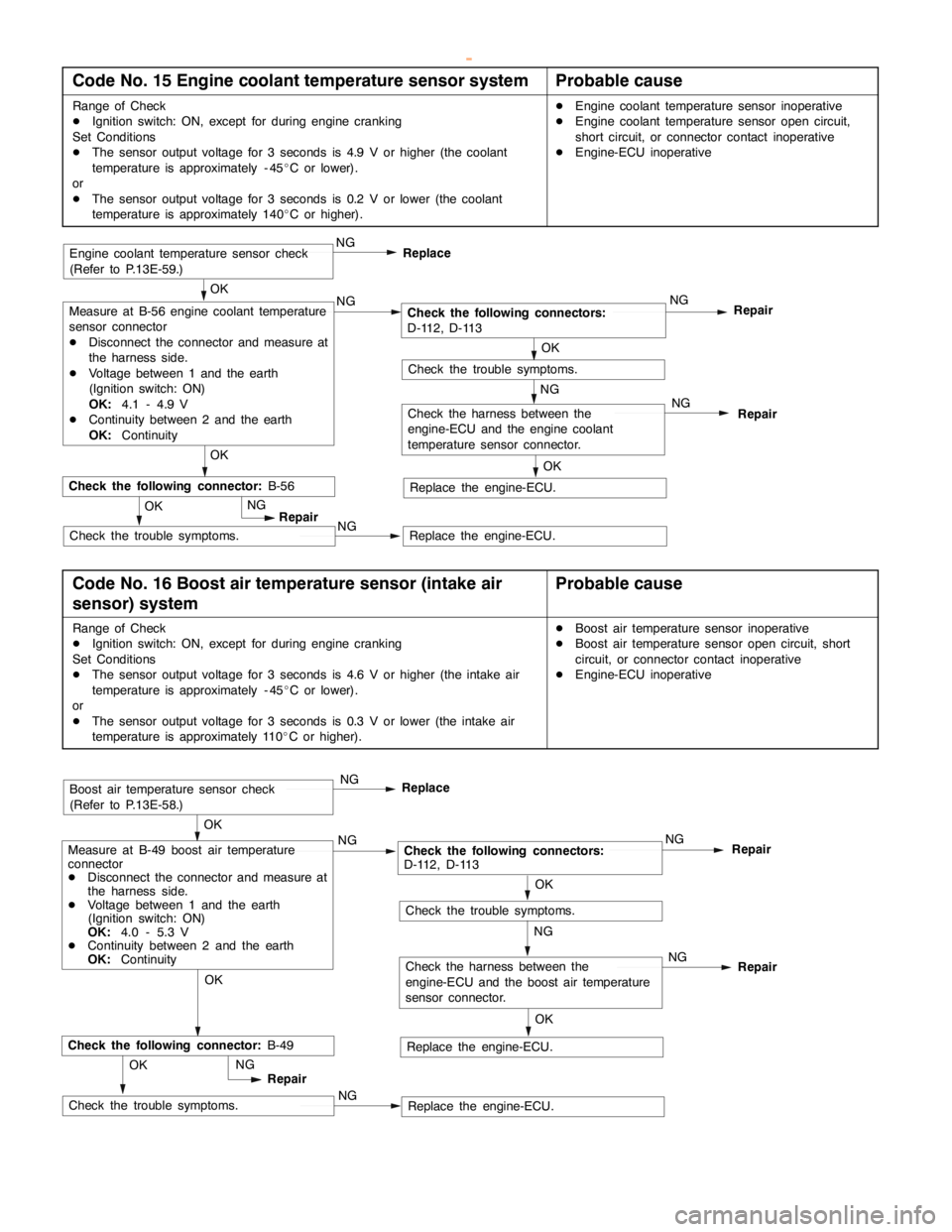
Code No. 15 Engine coolant temperature sensor systemProbable cause
Range of Check
DIgnition switch: ON, except for during engine cranking
Set Conditions
DThe sensor output voltage for 3 seconds is 4.9 V or higher (the coolant
temperature is approximately - 45_C or lower).
or
DThe sensor output voltage for 3 seconds is 0.2 V or lower (the coolant
temperature is approximately 140_C or higher).DEngine coolant temperature sensor inoperative
DEngine coolant temperature sensor open circuit,
short circuit, or connector contact inoperative
DEngine-ECU inoperative
OK
NGNG
Repair
OK
OKRepair
NGEngine coolant temperature sensor check
(Refer to P.13E-59.)
Replace the engine-ECU.NG
Replace the engine-ECU.OK NG
OK
Repair
Check the following connector:B-56
NGCheck the trouble symptoms.NG
Measure at B-56 engine coolant temperature
sensor connector
DDisconnect the connector and measure at
the harness side.
DVoltage between 1 and the earth
(Ignition switch: ON)
OK:4.1 - 4.9 V
DContinuity between 2 and the earth
OK:ContinuityCheck the following connectors:
D-112, D-113
Check the harness between the
engine-ECU and the engine coolant
temperature sensor connector.
Check the trouble symptoms. Replace
Code No. 16 Boost air temperature sensor (intake air
sensor) systemProbable cause
Range of Check
DIgnition switch: ON, except for during engine cranking
Set Conditions
DThe sensor output voltage for 3 seconds is 4.6 V or higher (the intake air
temperature is approximately - 45_C or lower).
or
DThe sensor output voltage for 3 seconds is 0.3 V or lower (the intake air
temperature is approximately 110_C or higher).DBoost air temperature sensor inoperative
DBoost air temperature sensor open circuit, short
circuit, or connector contact inoperative
DEngine-ECU inoperative
OK
Measure at B-49 boost air temperature
connector
DDisconnect the connector and measure at
the harness side.
DVoltage between 1 and the earth
(Ignition switch: ON)
OK:4.0 - 5.3 V
DContinuity between 2 and the earth
OK:ContinuityNGCheck the following connectors:
D-112, D-113NG
Repair
OK
OKRepair
NGBoost air temperature sensor check
(Refer to P.13E-58.)
Check the trouble symptoms.
Replace the engine-ECU.NG
Replace the engine-ECU.OK NG
OK
Repair
Check the following connector:B-49Replace
NGCheck the trouble symptoms.NG
Check the harness between the
engine-ECU and the boost air temperature
sensor connector.
www.WorkshopManuals.co.uk
Purchased from www.WorkshopManuals.co.uk