alternator MITSUBISHI MONTERO 2000 Service User Guide
[x] Cancel search | Manufacturer: MITSUBISHI, Model Year: 2000, Model line: MONTERO, Model: MITSUBISHI MONTERO 2000Pages: 1839, PDF Size: 29.19 MB
Page 344 of 1839

Page 367 of 1839
Page 380 of 1839

Page 400 of 1839
Page 409 of 1839
Page 636 of 1839
DIESEL FUEL <4D5-stepIII>-Troubleshooting13E-26
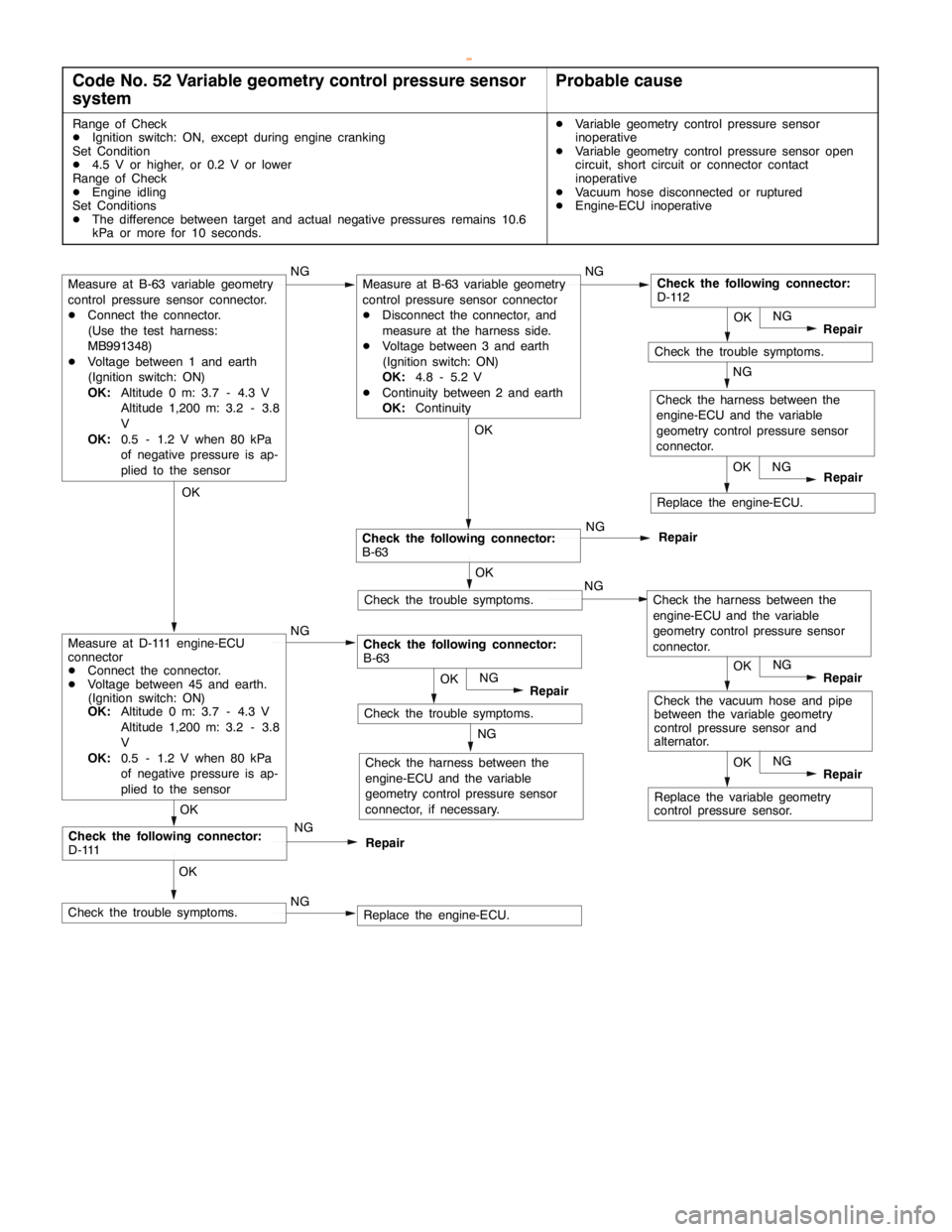
Code No. 52 Variable geometry control pressure sensor
systemProbable cause
Range of Check
DIgnition switch: ON, except during engine cranking
Set Condition
D4.5 V or higher, or 0.2 V or lower
Range of Check
DEngine idling
Set Conditions
DThe difference between target and actual negative pressures remains 10.6
kPa or more for 10 seconds.DVariable geometry control pressure sensor
inoperative
DVariable geometry control pressure sensor open
circuit, short circuit or connector contact
inoperative
DVacuum hose disconnected or ruptured
DEngine-ECU inoperative
NGReplace the engine-ECU.
Check the harness between the
engine-ECU and the variable
geometry control pressure sensor
connector, if necessary.
NG
Check the trouble symptoms.OK
NG
Repair
Replace the variable geometry
control pressure sensor.OK
NG
Repair
Check the vacuum hose and pipe
between the variable geometry
control pressure sensor and
alternator.OK
NG
Repair
NG
NG
Check the trouble symptoms.OK
Repair
Check the trouble symptoms.
OK
Replace the engine-ECU.OK
Repair NG NG
Check the harness between the
engine-ECU and the variable
geometry control pressure sensor
connector.
Check the trouble symptoms.OK
NG
Repair
Check the following connector:
D-111NG
Repair
OK
OKOK
Check the following connector:
B-63NG
NGNG
Check the following connector:
B-63
Measure at B-63 variable geometry
control pressure sensor connector.
DConnect the connector.
(Use the test harness:
MB991348)
DVoltage between 1 and earth
(Ignition switch: ON)
OK:Altitude 0 m: 3.7 - 4.3 V
Altitude 1,200 m: 3.2 - 3.8
V
OK:0.5 - 1.2 V when 80 kPa
of negative pressure is ap-
plied to the sensor
Measure at D-111 engine-ECU
connector
DConnect the connector.
DVoltage between 45 and earth.
(Ignition switch: ON)
OK:Altitude 0 m: 3.7 - 4.3 V
Altitude 1,200 m: 3.2 - 3.8
V
OK:0.5 - 1.2 V when 80 kPa
of negative pressure is ap-
plied to the sensor
Measure at B-63 variable geometry
control pressure sensor connector
DDisconnect the connector, and
measure at the harness side.
DVoltage between 3 and earth
(Ignition switch: ON)
OK:4.8 - 5.2 V
DContinuity between 2 and earth
OK:ContinuityCheck the following connector:
D-112
Check the harness between the
engine-ECU and the variable
geometry control pressure sensor
connector.
www.WorkshopManuals.co.uk
Purchased from www.WorkshopManuals.co.uk
Page 749 of 1839

16-1
ENGINE
ELECTRICAL
CONTENTS
CHARGING SYSTEM 2................
GENERAL INFORMATION 2................
SERVICE SPECIFICATIONS 3..............
SPECIAL TOOL 4.........................
ON-VEHICLE SERVICE 5..................
Alternator Output Line Voltage Drop Test 5....
Output Current Test 6.......................
Regulated Voltage Test 8....................
Waveform Check Using An Analyzer 11.......
ALTERNATOR 13.........................
STARTING SYSTEM 23................
GENERAL INFORMATION 23..............
SERVICE SPECIFICATIONS 24............
STARTER MOTOR 24.....................
IGNITION SYSTEM 37.................
GENERAL INFORMATION 37..............
SERVICE SPECIFICATIONS 38............
SPECIAL TOOL 38.......................
ON-VEHICLE SERVICE 38................
Ignition Coil (With Built-in Power Transistor)
Check 38...................................
Spark Plug Check and Cleaning 39...........
Ignition Failure Sensor Check 40.............
Camshaft Position Sensor Check, Crank angle
Sensor Check, Detonation Sensor Check 40...
IGNITION COIL <6G7> 41.................
CRANKSHAFT ANGLE SENSOR
<6G7> 42................................
CAMSHAFT POSITION SENSOR
<6G7> 42................................
DETONATION SENSOR <6G7> 43.........
GLOW SYSTEM 44....................
GENERAL INFORMATION 44..............
SERVICE SPECIFICATIONS 45............
ON-VEHICLE SERVICE 45................
Self-regulating Glow System Check 45........
Glow & EGR Control Unit Check 48..........
Engine ECU Check 49.......................
Glow Plug Relay Check 50..................
Glow Plug Check 51........................
Engine Coolant Temperature Sensor
Check 51...................................
GLOW PLUG 52..........................
www.WorkshopManuals.co.uk
Purchased from www.WorkshopManuals.co.uk
Page 758 of 1839

ENGINE ELECTRICAL -Charging System16-10
14. If the voltage reading conforms to the value
in the voltage regulation, then the voltage
regulator is operating normally.
If the voltage is not within the standard value,
there is a malfunction of the voltage regulator
or of the alternator.
15. After the test, lower the engine speed to the
idle speed.
16. Turn the ignition switch off.17. Remove the tachometer or the MUT-II.
18. Disconnect the negative battery cable.
19. Disconnect the ammeter and voltmeter.
20. Connect the alternator output wire to the
alternator “B” terminal.
21. Remove the special tool, and return the
connector to the original condition.
22. Connect the negative battery cable.
Voltage Regulation Table
Standard value:
Inspection terminalVoltage regulator ambient temperature_
CVoltage V
Terminal “S”-2014.2 - 15.4
2013.9 - 14.9
6013.4 - 14.6
8013.1 - 14.5
www.WorkshopManuals.co.uk
Purchased from www.WorkshopManuals.co.uk
Page 1640 of 1839
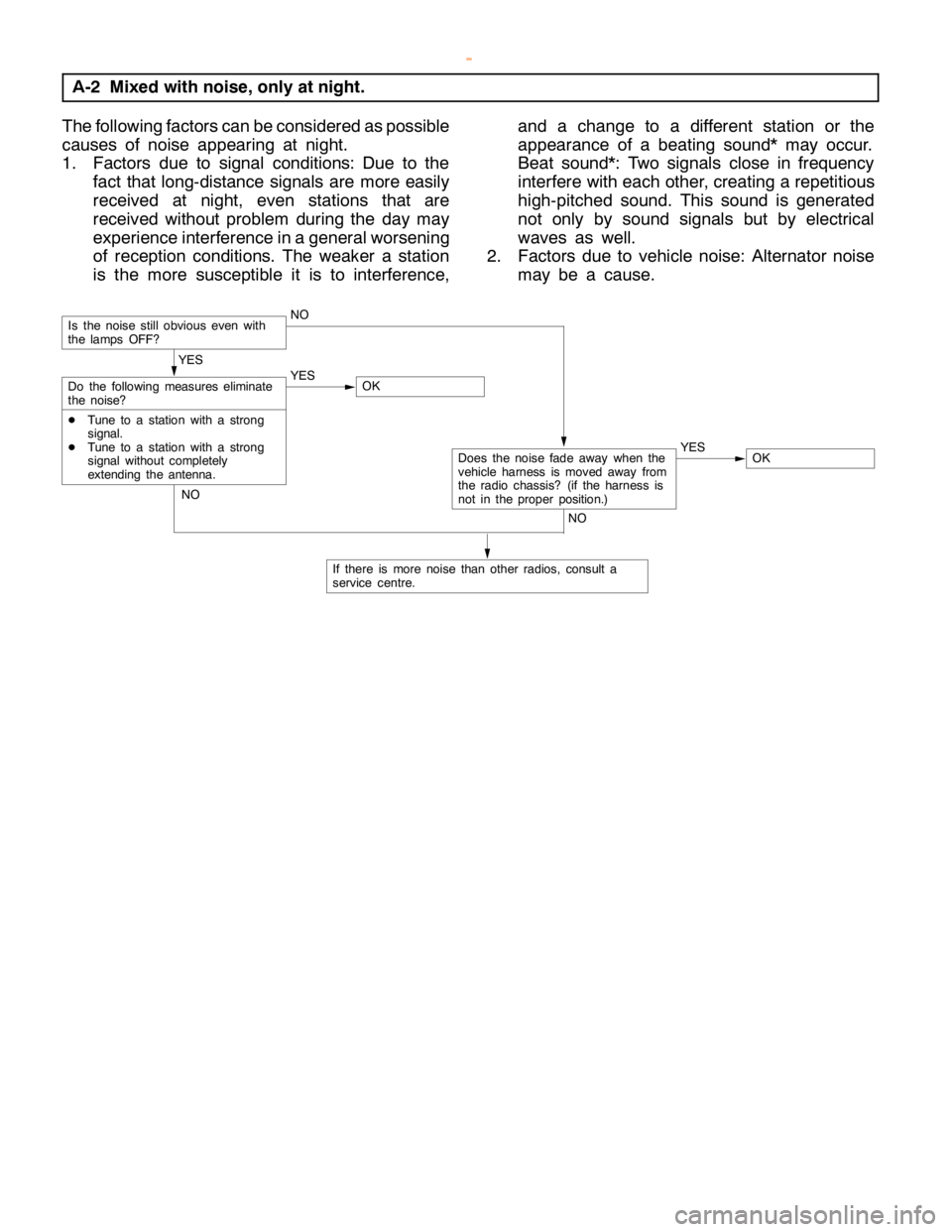
CHASSIS ELECTRICAL -Radio/Tape Player54A-70
A-2 Mixed with noise, only at night.
The following factors can be considered as possible
causes of noise appearing at night.
1. Factors due to signal conditions: Due to the
fact that long-distance signals are more easily
received at night, even stations that are
received without problem during the day may
experience interference in a general worsening
of reception conditions. The weaker a station
is the more susceptible it is to interference,and a change to a different station or the
appearance of a beating sound* may occur.
Beat sound*: Two signals close in frequency
interfere with each other, creating a repetitious
high-pitched sound. This sound is generated
not only by sound signals but by electrical
waves as well.
2. Factors due to vehicle noise: Alternator noise
may be a cause.
Is the noise still obvious even with
the lamps OFF?NO
YES
Do the following measures eliminate
the noise?
DTune to a station with a strong
signal.
DTune to a station with a strong
signal without completely
extending the antenna.YESOK
NO
Does the noise fade away when the
vehicle harness is moved away from
the radio chassis? (if the harness is
not in the proper position.)YESOK
NO
If there is more noise than other radios, consult a
service centre.
www.WorkshopManuals.co.uk
Purchased from www.WorkshopManuals.co.uk
Page 1763 of 1839

HEATER, AIR CONDITIONER AND VENTILATION - On-vehicle Service55A-17
REFRIGERANT LEAK REPAIR
LOST CHARGE
If the system has lost all charge due to a leak:
1. Evacuate the system. (See procedure.)
2. Charge the system with approximately one
pound of refrigerant.
3. Check for leaks.
4. Discharge the system.
5. Repair leaks.
6. Replace receiver drier.
Caution
Replacement filter-drier units must be
sealed while in storage. The drier used in
these units will saturate water quickly upon
exposure to the atmosphere. When
installing a drier, have all tools and supplies
ready for quick reassembly to avoid keeping
the system open any longer than necessary.
7. Evacuate and charge system.
LOW CHARGE
If the system has not lost all of its refrigerant charge;
locate and repair all leaks. If it is necessary to
increase the system pressure to find the leak
(because of an especially low charge) add
refrigerant. If it is possible to repair the leak without
discharging the refrigerant system, use the
procedure for correcting low refrigerant level.HANDLING TUBING AND FITTINGS
Kinks in the refrigerant tubing or sharp bends in
the refrigerant hose lines will greatly reduce the
capacity of the entire system. High pressures are
produced in the system when it is operating.
Extreme care must be exercised to make sure that
all connections are pressure tight. Dirt and moisture
can enter the system when it is opened for repair
or replacement of lines or components. The
following precautions must be observed. The
system must be completely discharged before
opening any fitting of connection in the refrigeration
system. Open fittings with caution even after the
system has been discharged. If any pressure is
noticed as a fitting is loosened, allow trapped
pressure to bleed off very slowly.
Never attempt to rebend formed lines to fit. Use
the correct line for the installation you are servicing.
A good rule for the flexible hose lines is keep the
radius of all bends at least 10 times the diameter
of the hose.
Sharper bends will reduce the flow of refrigerant.
The flexible hose lines should be routed so that
they are at least 80 mm from the exhaust manifold.
It is good practice to inspect all flexible hose lines
at least once a year to make sure they are in good
condition and properly routed.
Unified plumbing connections with O-rings, these
O-rings are not reusable.
COMPRESSOR NOISE
You must first know the conditions when the noise
occurs. These conditions are: weather, vehicle
speed, in gear or neutral, engine temperature or
any other special conditions.
Noises that develop during A/C operation can often
be misleading. For example: what sounds like a
failed front bearing or connecting rod, may be
caused by loose bolts, nuts, mounting brackets,
or a loose clutch assembly. Verify accessory drive
belt tension (power steering or alternator).
Improper accessory drive belt tension can cause
a misleading noise when the compressor is
engaged and little or no noise when the compressor
is disengaged.
Drive belts are speed-sensitive. That is, at different
engine speeds, and depending upon belt tension,
belts can develop unusual noises that are often
mistaken for mechanical problems within the
compressor.ADJUSTMENT
1. Select a quiet area for testing. Duplicate
conditions as much as possible. Switch
compressor on and off several times to clearly
identify compressor noise. To duplicate high
ambient conditions (high head pressure),
restrict air flow through condenser. Install
manifold gauge set to make sure discharge
pressure doesn’t exceed 2,070 kPa.
2. Tighten all compressor mounting bolts, clutch
mounting bolt, and compressor drive belt.
Check to assure clutch coil is tight (no rotation
or wobble).
3. Check refrigerant hoses for rubbing or
interference that can cause unusual noises.
4. Check refrigerant charge. (See “Charging
System”.)
5. Recheck compressor noise as in Step 1.
6. If noise still exists, loosen compressor mounting
bolts and retorque. Repeat Step 1.
7. If noise continues, replace compressor and
repeat Step 1.
www.WorkshopManuals.co.uk
Purchased from www.WorkshopManuals.co.uk