air condition MITSUBISHI MONTERO 2000 Service Manual PDF
[x] Cancel search | Manufacturer: MITSUBISHI, Model Year: 2000, Model line: MONTERO, Model: MITSUBISHI MONTERO 2000Pages: 1839, PDF Size: 29.19 MB
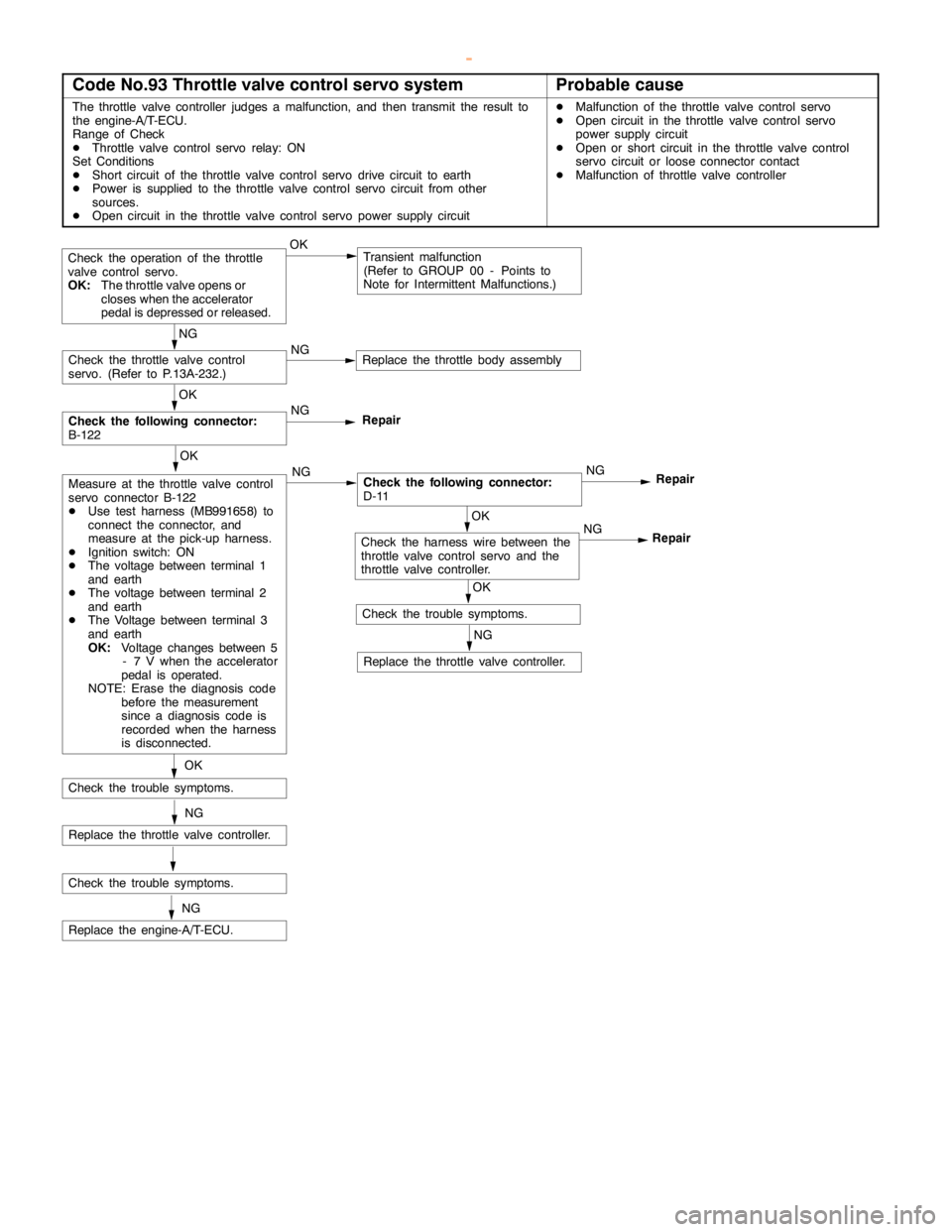
Page 377 of 1839
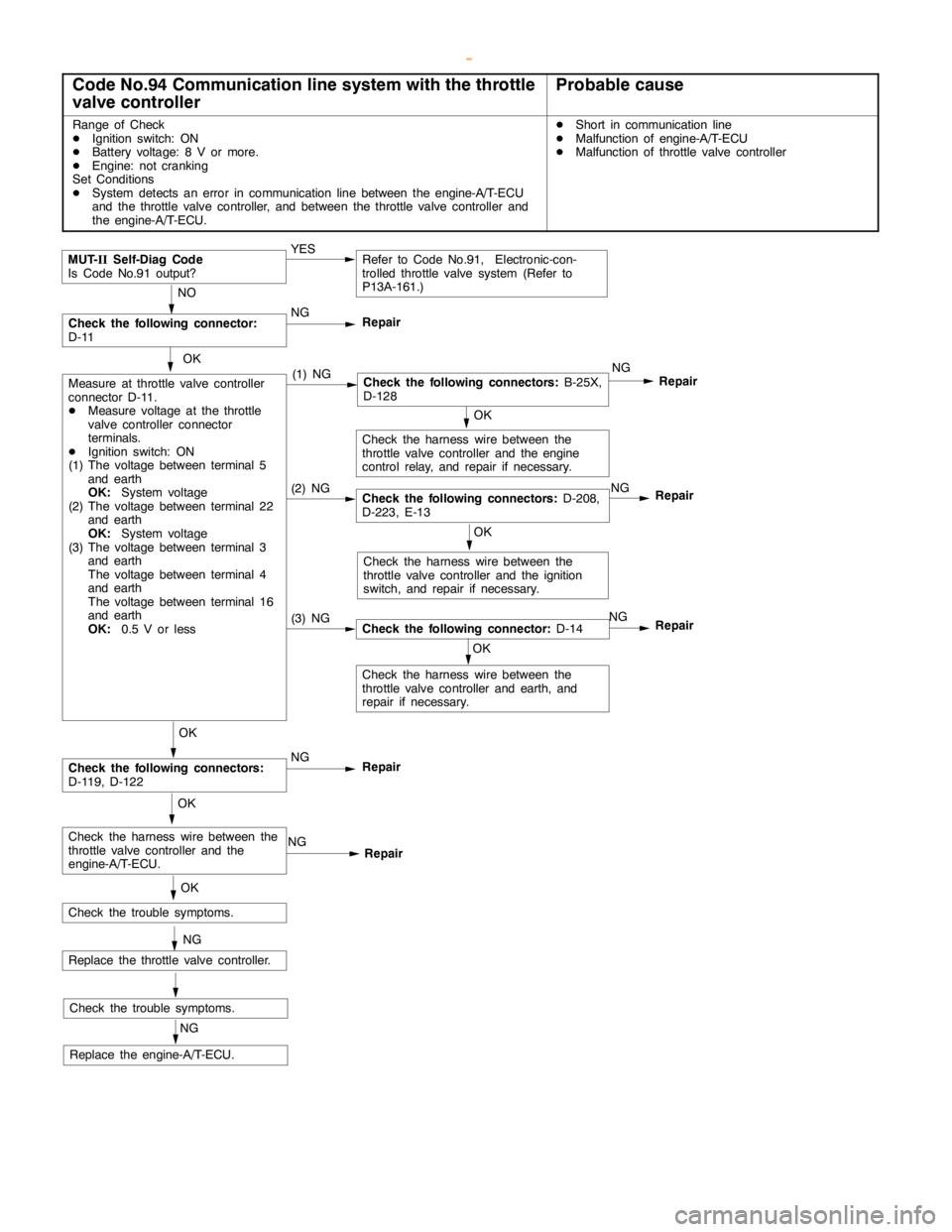
Page 378 of 1839
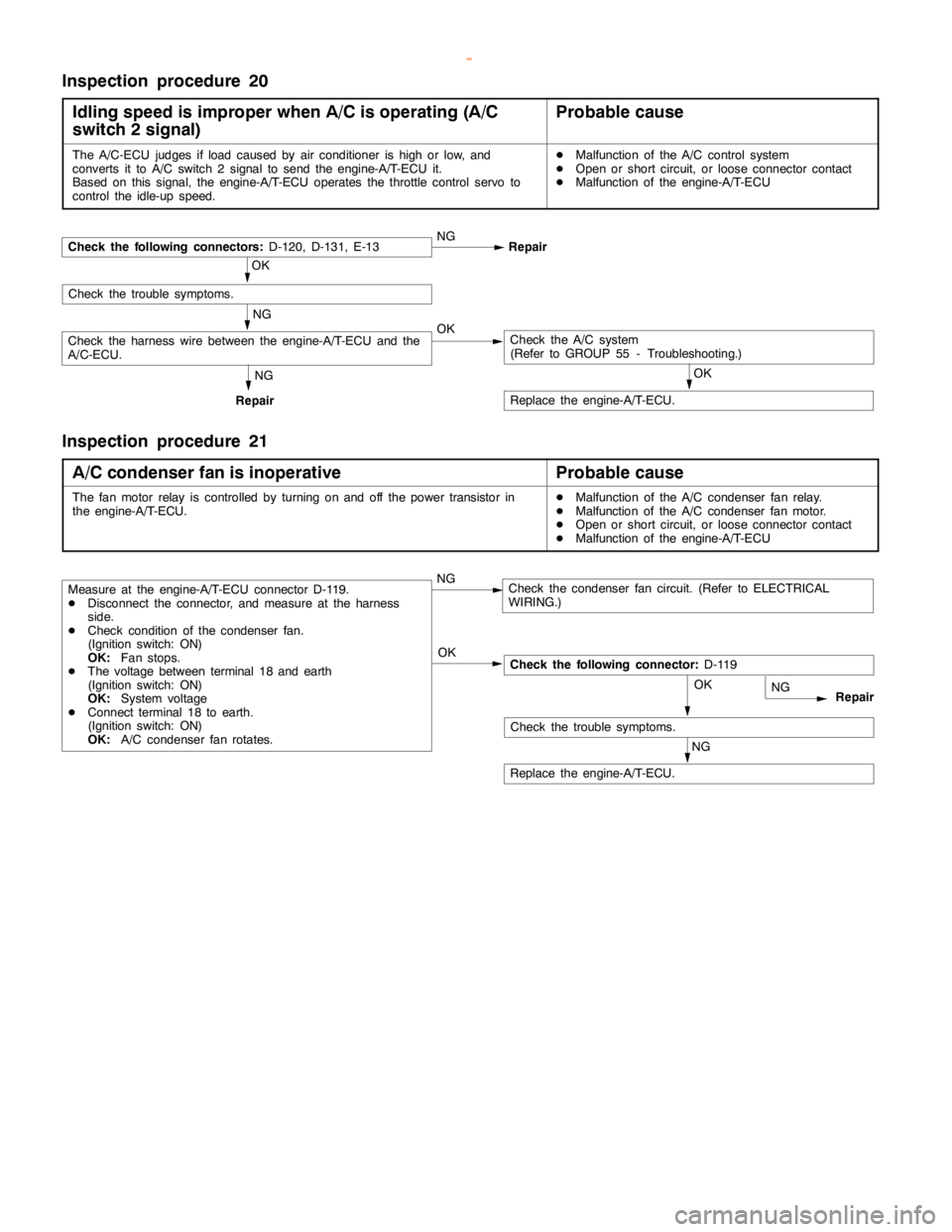
Page 401 of 1839
Page 412 of 1839

Page 414 of 1839

Page 419 of 1839

Page 420 of 1839

Page 473 of 1839
GDI -TroubleshootingGDI -Troubleshooting13A-4
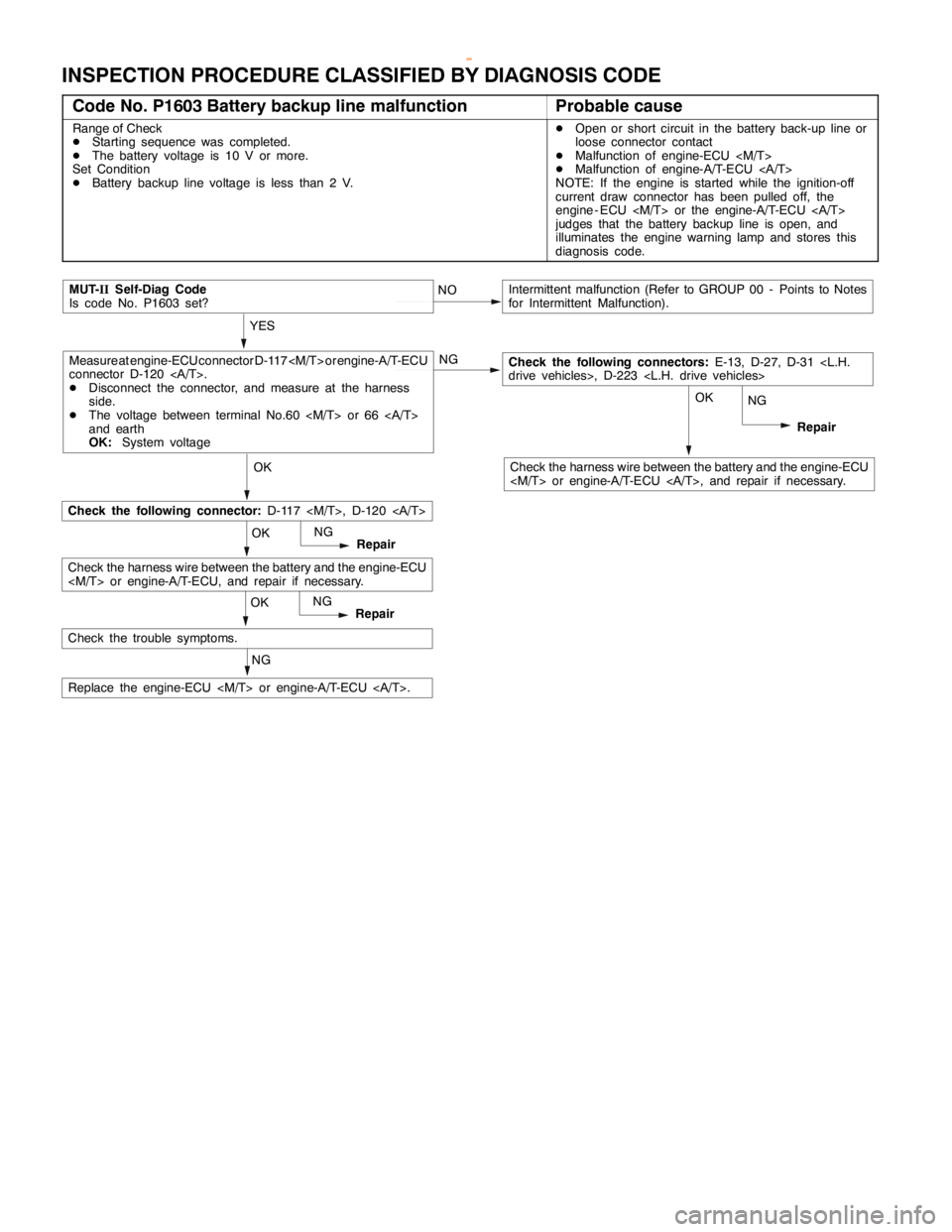
INSPECTION PROCEDURE CLASSIFIED BY DIAGNOSIS CODE
Code No. P1603 Battery backup line malfunctionProbable cause
Range of Check
DStarting sequence was completed.
DThe battery voltage is 10 V or more.
Set Condition
DBattery backup line voltage is less than 2 V.DOpen or short circuit in the battery back-up line or
loose connector contact
DMalfunction of engine-ECU
DMalfunction of engine-A/T-ECU
NOTE: If the engine is started while the ignition-off
current draw connector has been pulled off, the
engine - ECU
judges that the battery backup line is open, and
illuminates the engine warning lamp and stores this
diagnosis code.
NG
Replace the engine-ECU
Check the trouble symptoms.
OKNG
Repair
Check the harness wire between the battery and the engine-ECU
OKNG
Repair
Check the harness wire between the battery and the engine-ECU
OK
NG
Repair
MUT-IISelf-Diag Code
Is code No. P1603 set?
Check the following connector:D-117
Check the following connectors:E-13, D-27, D-31
connector D-120 .
DDisconnect the connector, and measure at the harness
side.
DThe voltage between terminal No.60
and earth
OK:System voltageNG
Intermittent malfunction (Refer to GROUP 00 - Points to Notes
for Intermittent Malfunction).
www.WorkshopManuals.co.uk
Purchased from www.WorkshopManuals.co.uk
Page 474 of 1839

GDI -Troubleshooting13A-5
DATA LIST REFERENCE TABLE
The data list has been changed as the engine-ECU and the engine-A/T-ECU have been changed. The
other items are the same as for M/T.
Item
No.Inspection
itemInspection contentsNormal conditionInspec-
tion pro-
cedure
No.Refer-
ence
page
22Crank angle
sensorDEngine: Cranking
DTachometer:
ConnectedCompare the engine
speed readings on
the tachometer and
the MUT-II.AccordCode
No.
P033513A-56*
DEngine: Idling
DIdle position
switch: ONWhen engine
coolant temperature
is - 20_C1,300 - 1,500
r/min
When engine
coolant temperature
is 0_C1,300 - 1,500
r/min
When engine
coolant temperature
is 20_C1,250 - 1,450
r/min
When engine
coolant temperature
is 40_C1,100 - 1,300
r/min
When engine
coolant temperature
is 80_C (more than
four minutes later
after engine has
started)600 - 800 r/min
A1LOxygen
sensorEngine: After having
warmed up. (Air/fuel
mixture is made
leaner when deceler-When at 4,000
r/min, engine is
decelerated200 mV or lessCode
No.
P013013A-28*
leanerwhendeceler
ating, and is made
richer when racing.)Rev the engine.600 - 1000 mV
Engine: After having
warmed up (The
oxygen sensor signal
is used to check the
air/fuel mixture ratio,
and control condition
isalsocheckbythe
Engine is idling
(more than 4
minutes later after
engine has started)Voltage should
alternate between
400 mV or less
and 600 - 1,200
mV (more than 4
minutes after the
enginehasisalso checkbythe
engine-ECU
or engine-A/T-ECU
.)
2,500 r/min
enginehas
started).
24LVehicle
speed sen-
sorDrive at 40 km/hApproximately 40
km/hCode
No.
P050013A-63*
www.WorkshopManuals.co.uk
Purchased from www.WorkshopManuals.co.uk
Page 493 of 1839

DIESEL FUEL <4M4> -General Information13C-2
GENERAL INFORMATION
The electronically-controlled fuel injection system consists of sensors which detect the condition of the
diesel engine, an engine-ECU which controls the system based on signals from these sensors, and actuators
which operate according to control commands from the engine-ECU.
The engine-ECU carries out operations such as fuel injection rate control, fuel injection timing control
and idle up control. In addition, the engine-ECU is equipped with several self-diagnosis functions which
make troubleshooting easier in the event that a problem develops.
FUEL INJECTION RATE CONTROL
The fuel injection completion timing is controlled by means of a solenoid-type spill valve to ensure that
the optimum amount of fuel is supplied to the engine in accordance with gradual changes in the engine
running condition.
Before fuel injection starts, the solenoid-type spill valve is on (energized), so that the valve is closed.
As the plunger turns and rises, fuel is sent out under pressure, and when the fuel flow rate reaches
the target value for fuel injection, the solenoid-type spill valve turns off. When the solenoid-type spill
valve turns off, the fuel under high pressure inside the plunger is leaked out into the pump chamber
and fuel injection is completed.
FUEL INJECTION TIMING CONTROL
The position of the injection pump timer piston is controlled so that fuel injection is carried out at the
optimum timing in accordance with the engine running condition.
The timer piston position is determined by duty control of the timing control solenoid valve which is located
in the line between the high-pressure chamber and the low-pressure chamber of the timer piston.
The fuel injection timing is advanced by increasing the control duty of the timing control solenoid valve.
IDLE SPEED CONTROL
Controlling the fuel injection rate in accordance with the engine running condition maintains the idle speed
at the optimum condition.
SELF-DIAGNOSIS FUNCTION
DWhen an abnormality is detected in any of the sensors or actuators, the engine warning lamp illuminates
to warn the driver.
DWhen an abnormality is detected in any of the sensors or actuators, a diagnosis code number
corresponding to the problem which occurred is output.
DThe RAM data relating to the sensors and actuators which is stored in the engine-ECU can be read
using the MUT-II. In addition, the actuators can be force-driven under certain conditions.
OTHER CONTROL FUNCTIONS
1. Power Supply Control
When the ignition switch is turned to ON, the relay turns on and power is supplied to components
such as the timing control solenoid valve.
2. Intake Air Throttle Control
When the engine is idling after having warmed up, the throttle valve is half opened to restrict the
amount of intake air in order to reduce vibration and noise.
3. A/C Relay Control
Turns the compressor clutch of the A/C ON and OFF
4. Fan motor relay control
The radiator fan and condenser fan operating speeds are controlled in accordance with the engine
coolant temperature and the vehicle speed.
5. Glow Control
Refer to GROUP 16.
6. EGR Control
Refer to GROUP 17.
www.WorkshopManuals.co.uk
Purchased from www.WorkshopManuals.co.uk