warning light MITSUBISHI OUTLANDER 2015 3.G User Guide
[x] Cancel search | Manufacturer: MITSUBISHI, Model Year: 2015, Model line: OUTLANDER, Model: MITSUBISHI OUTLANDER 2015 3.GPages: 446, PDF Size: 59.52 MB
Page 52 of 446
Child restraint systems
Seat and restraint systems 4-25
4
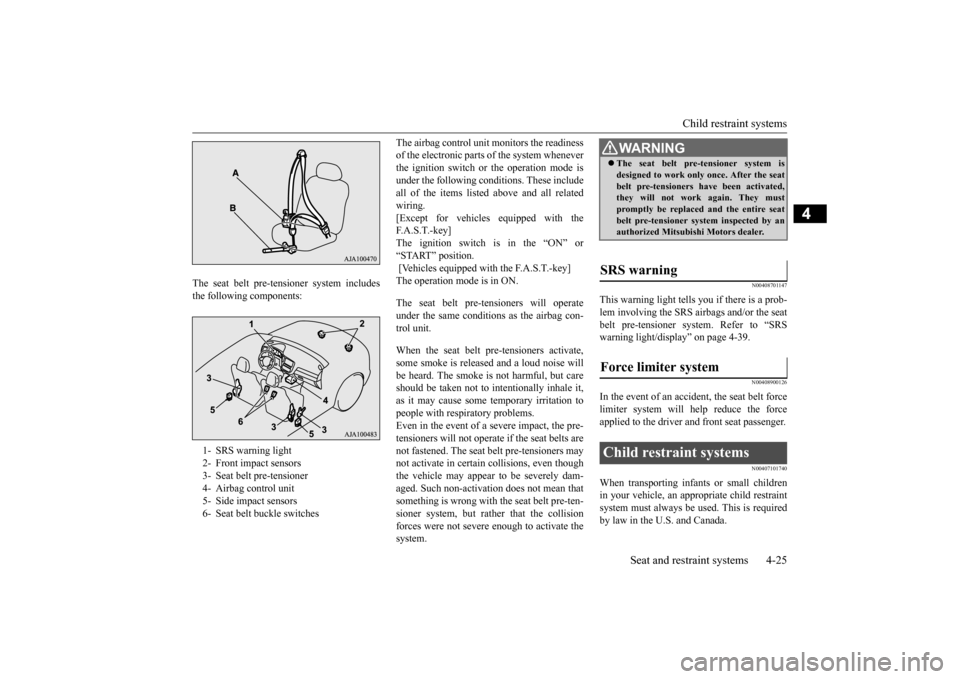
The seat belt pre-tensioner system includes the following components:
The airbag control unit
monitors the readiness
of the electronic parts of the system wheneverthe ignition switch or the operation mode is under the following conditions. These include all of the item
s listed above a
nd all related
wiring. [Except for vehicles equipped with the F. A . S . T. - k e y ]The ignition switch is in the “ON” or “START” position. [Vehicles equipped with the F.A.S.T.-key] The operation mode is in ON. The seat belt pre-tens
ioners will operate
under the same conditions
as the airbag con-
trol unit. When the seat belt pre-tensioners activate, some smoke is released
and a loud noise will
be heard. The smoke is
not harmful, but care
should be taken not to in
tentionally inhale it,
as it may cause some
temporary irritation to
people with respiratory problems.Even in the event of a severe impact, the pre- tensioners will
not operate if the seat belts are
not fastened. The seat be
lt pre-tensioners may
not activate in certai
n collisions, even though
the vehicle may appear
to be severely dam-
aged. Such non-activation does not mean thatsomething is wrong with the seat belt pre-ten- sioner system, but rather that the collision forces were not severe
enough to activate the
system.
N00408701147
This warning light tells you if there is a prob-lem involving the SRS airbags and/or the seat belt pre-tensioner system. Refer to “SRS warning light/display” on page 4-39.
N00408900126
In the event of an accident, the seat belt forcelimiter system will help reduce the forceapplied to the driver a
nd front seat passenger.
N00407101740
When transporting infants or small children in your vehicle, an appr
opriate child restraint
system must always be
used. This is required
by law in the U.S. and Canada.
1- SRS warning light 2- Front impact sensors 3- Seat belt
pre-tensioner
4- Airbag control unit 5- Side impact sensors 6- Seat belt
buckle switches
WA R N I N GThe seat belt pre-tensioner system is designed to work only
once. After the seat
belt pre-tensioners have been activated,they will not work again. They must promptly be replaced and the entire seat belt pre-tensioner system inspected by anauthorized Mitsubis
hi Motors dealer.
SRS warning Force limiter system Child restraint systems
BK0211800US.book 25 ページ 2014年3月12日 水曜日 午後2時42分
Page 62 of 446
Supplemental Restraint System (SRS) - airbag
Seat and restraint systems 4-35
4
N00407801532
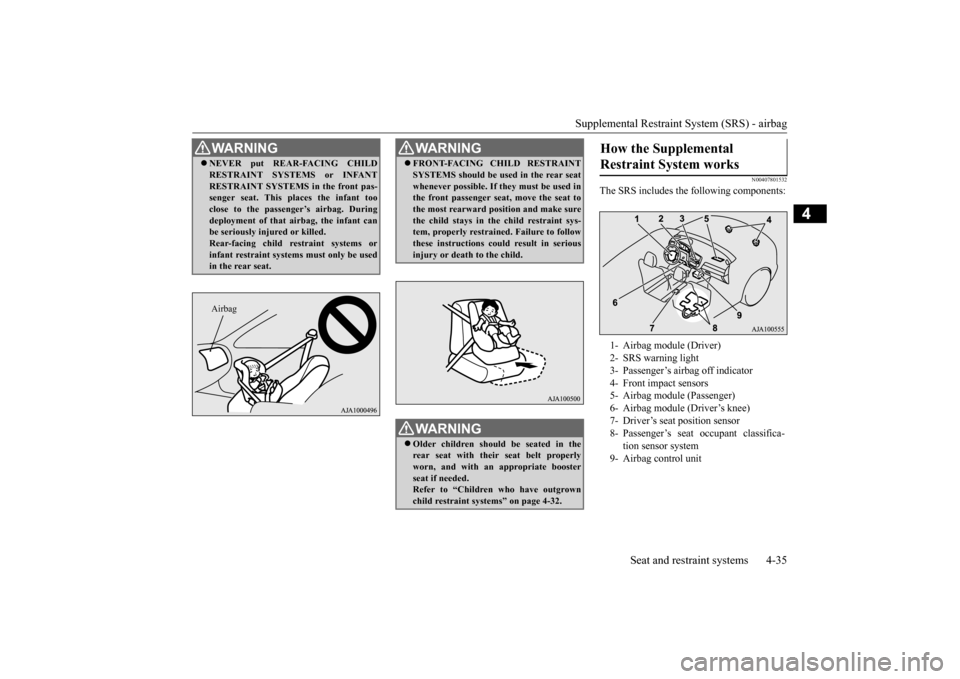
The SRS includes the following components:
WA R N I N G NEVER put REAR-FACING CHILD RESTRAINT SYSTEMS or INFANTRESTRAINT SYSTEMS in the front pas-senger seat. This pl
aces the infant too
close to the passenger’s airbag. During deployment of that airbag, the infant canbe seriously inju
red or killed.
Rear-facing child restraint systems or infant restraint systems must only be usedin the rear seat.Airbag
WA R N I N G FRONT-FACING CHILD RESTRAINT SYSTEMS should be used in the rear seatwhenever possible. If they must be used inthe front passenger seat, move the seat to the most rearward po
sition and make sure
the child stays in the child restraint sys-tem, properly restrained. Failure to follow these instructions could result in serious injury or death to the child.WA R N I N G Older children should be seated in the rear seat with thei
r seat belt properly
worn, and with an
appropriate booster
seat if needed. Refer to “Children
who have outgrown
child restraint systems” on page 4-32.
How the Supplemental Restraint System works 1- Airbag module (Driver) 2- SRS warning light 3- Passenger’s airb
ag off indicator
4- Front impact sensors5- Airbag module (Passenger) 6- Airbag module (Driver’s knee) 7- Driver’s seat
position sensor
8- Passenger’s seat oc
cupant classifica-
tion sensor system
9- Airbag control unit
BK0211800US.book 35 ページ 2014年3月12日 水曜日 午後2時42分
Page 64 of 446
Supplemental Restraint System (SRS) - airbag
Seat and restraint systems 4-37
4
To read data recorded
by an EDR, special
equipment is requi
red, and access to the vehi-
cle or the EDR is needed. In addition to thevehicle manufacturer, ot
her parties, such as
law enforcement, that have the special equip- ment, can read the information if they haveaccess to the vehicle or the EDR.
N00417900177
The driver’s seat posit
ion sensor is attached
to the seat rail and pr
ovides the airbag control
unit with information
on the seat’s fore-aft
position. The airbag control unit controlsdeployment of the driver’s front airbag in accordance with the information it receives from this sensor.If there is a problem involving the driver’s seat position sensor, the SRS warning light in
the instrument panel will come on. Refer to “SRS warning light/display” on page 4-39.
N00418001374
The passenger’s seat oc
cupant classification
sensor system is attached to the front passen- ger seat cushion and provides the airbag con-trol unit with inform
ation regarding the
occupant on the front passenger seat. The air-
bag control unit controls deployment of the passenger’s front airbag
in accordance with
the information it receives from this system. The passenger’s front airbag will not deploy in an impact when the system senses no occu-pant on the front passenge
r’s seat or a child in
a child restraint system. In this case, the pas- senger airbag off indi
cator will come on.
Refer to “Passenger’s ai
rbag off indicator” on
page 4-38. If there is a problem involving the passen- ger’s seat occupant cl
assification sensor sys-
tem, the SRS warning light in the instrumentpanel will come on. Re
fer to “SRS warning
light/display” on page 4-39.
NOTE
EDR data are recorded by your vehicle only if a non-trivial crash si
tuation occurs; no data
are recorded by the EDR under normal driv-ing conditions and no
personal data (e.g.,
name, gender, age, a
nd crash location) are
recorded. However, other parties, such aslaw enforcement, could combine the EDR data with the type of personally identifying data routinely acquire
d during a crash inves-
tigation.
Driver’s seat position sensor
WA R N I N G If the SRS warning li
ght or warning dis-
play comes on, have th
e vehicle inspected
by an authorized
Mitsubishi Motors
dealer as soon
as possible.
Please observe the following instructions to ensure that the driver’s seat positionsensor can operate correctly.• Adjust the seat to the correct position,and sit well back
against the seatback.
Refer to “Front seats” on page 4-4.• Do not recline the seatback more thannecessary when driving.• Do not place metall
ic objects or luggage
under the front seat.
If the vehicle is
involved in a severe
impact, have the SRS sensors inspected by an authorized Mitsubi
shi Motors dealer as
soon as possible.
Passenger’s seat occupant clas- sification sensor system
WA R N I N G If any of the following conditions occur, you should immediatel
y have your vehicle
inspected by an authorized Mitsubishi Motors dealer as soon as possible:• The SRS warning light does not initiallycome on when the ignition switch or the operation mode is under the followingconditions. [Except for vehicles equipped with the F. A . S . T. - k e y ]The ignition switch is in the “ON” or “START” position. [Vehicles equipped with the F.A.S.T.-key]The operation mode is in ON.• The SRS warning light does not go outafter several seconds.
BK0211800US.book 37 ページ 2014年3月12日 水曜日 午後2時42分
Page 66 of 446
Supplemental Restraint System (SRS) - airbag
Seat and restraint systems 4-39
4
N00408301589
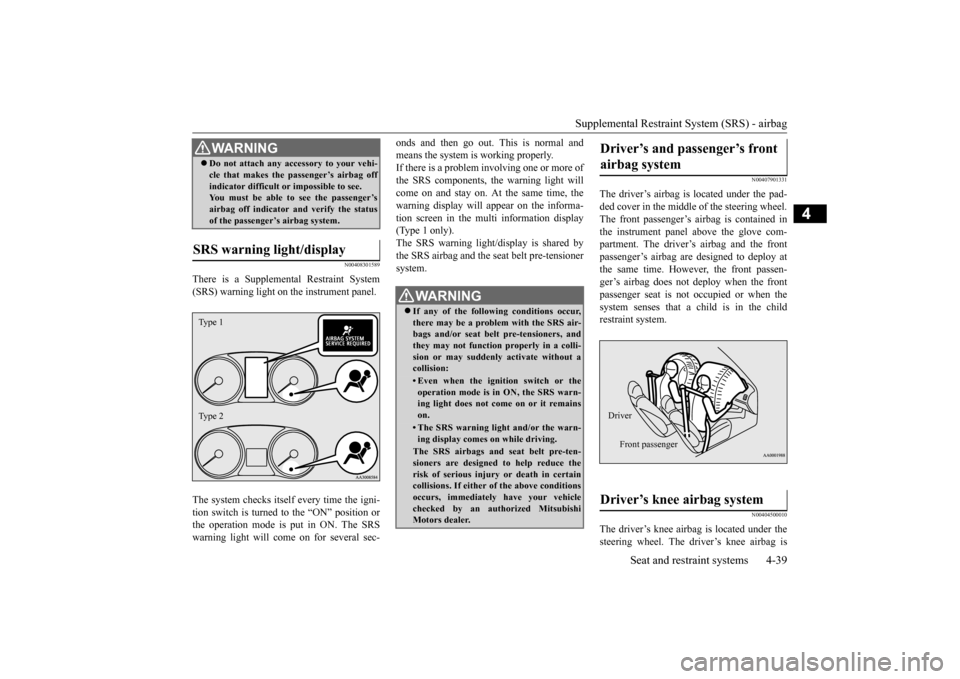
There is a Supplemental Restraint System (SRS) warning light on
the instrument panel.
The system checks itself every time the igni- tion switch is turned
to the “ON” position or
the operation mode is put in ON. The SRS warning light will co
me on for several sec-
onds and then go out. This is normal and means the system is working properly.If there is a problem involving one or more of the SRS components, the warning light will come on and stay on. At the same time, thewarning display will
appear on the informa-
tion screen in the multi information display (Type 1 only).The SRS warning light/display is shared by the SRS airbag and the seat belt pre-tensioner system.
N00407901331
The driver’s airbag is located under the pad-ded cover in the middle of the steering wheel.The front passenger’s airbag is contained in the instrument panel above the glove com- partment. The driver’s airbag and the frontpassenger’s airbag ar
e designed to deploy at
the same time. However, the front passen- ger’s airbag does not deploy when the front passenger seat is not
occupied or when the
system senses that a child is in the childrestraint system.
N00404500010
The driver’s knee airbag is located under the steering wheel. The driver’s knee airbag is
Do not attach any ac
cessory to your vehi-
cle that makes the passenger’s airbag offindicator difficult or impossible to see.You must be able to see the passenger’s airbag off indicator and verify the status of the passenger’s airbag system.
SRS warning light/display
WA R N I N G
Type 1 Type 2
WA R N I N G If any of the follow
ing conditions occur,
there may be a proble
m with the SRS air-
bags and/or seat belt pre-tensioners, and they may not function properly in a colli-sion or may suddenly
activate without a
collision:• Even when the ignition switch or theoperation mode is in ON, the SRS warn- ing light does not come on or it remainson.• The SRS warning light and/or the warn-ing display comes on while driving.The SRS airbags and seat belt pre-ten-sioners are designed to help reduce the risk of serious injury
or death in certain
collisions. If either of the above conditionsoccurs, immediately
have your vehicle
checked by an authorized Mitsubishi Motors dealer.
Driver’s and passenger’s front airbag system Driver’s knee airbag system Driver
Front passenger
BK0211800US.book 39 ページ 2014年3月12日 水曜日 午後2時42分
Page 78 of 446
5
Features and controlsBreak-in recommendations ..............................................................5-3 Keys .................................................................................................5-3 Electronic immobilizer (Anti-theft starting system) ........................5-4Keyless entry system (if so equipped) ..............................................5-7 Free-hand Advanced Security Tr
ansmitter (F.A.S.T.-key) (if so
equipped).....................................................................................5-12Door locks ......................................................................................5-31 Power door locks ......
...........
...........
...........
...........
...........
.........
.....5-33
Child safety locks for rear door ..........
...........
.........
.........
.........
.....5-35
Liftgate (except for vehi
cles equipped with the
power liftgate) ....5-35
Power liftgate (if so equipped) .......................................................5-36 Inside liftgate release .....................................................................5-43Theft-alarm system ........................................................................5-44 Power window control ...................................................................5-47 Sunroof (if so equipped) .................................................................5-50Parking brake .................................................................................5-52 Steering wheel height and reach adjustment ..................................5-53 Inside rearview mirror ...................................................................5-53Outside rearview mirrors ...............................................................5-54 Ignition switch ...............................................................................5-55 Steering wheel lock (if so equipped) ..............................................5-57Starting the engine .........................................................................5-58 Automatic transaxle (if so equipped)..............................................5-60 Continuously variable transmission
(CVT) (if so equipped)..........5-67
Electronically controlled
4WD system (if so equipped).................5-74
S-AWC (Super-All Wheel Control) (if
so equipped) .....................5-77
4-wheel drive operation .................................................................5-80Inspection and maintenance followi
ng rough road operation ........5-82
Cautions on the handling of 4-wheel dr
ive vehicles ..................... 5-83
Service brake ................................................................................. 5-84 Hill start assist (if so equipped) ...................................................... 5-85Brake assist system ........................................................................ 5-86 Anti-lock braking system .............................................................. 5-86 Electric power steering system (EPS) ........................................... 5-88Active stability control (ASC) ....................................................... 5-89 Cruise control ................................................................................ 5-92 Adaptive Cruise Control System (ACC) (if so equipped) .............. 5-96Forward Collision Mitigation System
(FCM) (if so equipped) .... 5-106
Lane Departure Warning System (LDW
) (if so equipped)........... 5-111
Tire pressure monitoring system ................................................. 5-114Rear-view camera (if so equipped)............................................... 5-118 Instrument cluster ........................................................................ 5-120 Multi Information display - Type 1 ............................................. 5-122Multi Information display - Type 2 ............................................. 5-140 Indicator light, warning light, and
information screen display list
(multi information display - Type 1) ....................................... 5-148Indicator and warning light package
(multi information display - Type
2) .............................................................................................. 5-165 Indicators ..................................................................................... 5-166Warning lights .............................................................................. 5-167 Information screen display (Vehicle equipped with the multi informa- tion display - Type 1) ............................................................... 5-169Combination headlights and dimmer switch ............................... 5-171 Headlight leveling switch (if so equipped)................................... 5-176 Turn signal lever .......................................................................... 5-176Hazard warning flasher switch .................................................... 5-177
BK0211800US.book 1 ページ 2014年3月12日 水曜日 午後2時42分
Page 99 of 446
Free-hand Advanced
Security Transmitter (F.A.S
.T.-key) (if so equipped)
5-22 Features and controls
5
N00514301080
After pressing the e
ngine switch and opera-
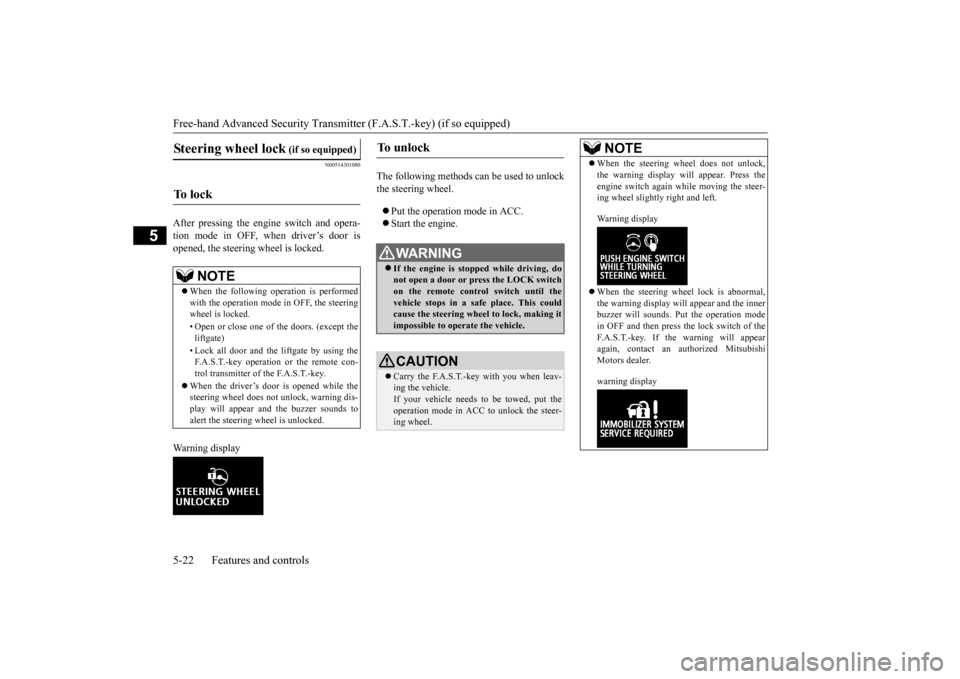
tion mode in OFF, when driver’s door isopened, the steering wheel is locked. Warning display
The following methods ca
n be used to unlock
the steering wheel. Put the operation mode in ACC. Start the engine.
Steering wheel lock
(if so equipped)
To l o c k
NOTE
When the following ope
ration is performed
with the operation mode
in OFF, the steering
wheel is locked. • Open or close one of the doors. (except the liftgate) • Lock all door and the liftgate by using the F.A.S.T.-key operation or the remote con- trol transmitter of the F.A.S.T.-key.
When the driver’s door is opened while the steering wheel does not
unlock, warning dis-
play will appear and the buzzer sounds toalert the steering wheel is unlocked.
To u n l o c k
WA R N I N G If the engine is stopped while driving, do not open a door or press the LOCK switch on the remote control switch until the vehicle stops in a safe
place. This could
cause the steering wheel to lock, making it impossible to operate the vehicle.CAUTION Carry the F.A.S.T.-key with you when leav- ing the vehicle.If your vehicle needs to
be towed, put the
operation mode in ACC to unlock the steer- ing wheel.
NOTE
When the steering wheel does not unlock, the warning display wi
ll appear. Press the
engine switch again wh
ile moving the steer-
ing wheel slightly right and left. Warning display When the steering wheel lock is abnormal, the warning display will
appear and the inner
buzzer will sounds. Put the operation mode in OFF and then press the lock switch of theF.A.S.T.-key. If the warning will appear again, contact an authorized Mitsubishi Motors dealer. warning display
BK0211800US.book 22 ページ 2014年3月12日 水曜日 午後2時42分
Page 101 of 446
Free-hand Advanced
Security Transmitter (F.A.S
.T.-key) (if so equipped)
5-24 Features and controls
5
5. Press the engine switch. 6. Confirm that all warning lights and warn-ing displays are functioning properly.
After several attempts
, you may experience
that the engine still does not start. 1. Make sure that all electric devices, such as lights, air conditi
oning blower and rear
window defogger, are turned off. 2. While depressing the brake pedal, pressthe accelerator peda
l halfway and hold it
there, then crank th
e engine. Release the
accelerator pedal, immediately after theengine starts.
3. If the engine still wi
ll not start, the engine
could be flooded with too much gasoline.While depressing the brake pedal, push the accelerator pedal all the way down and hold it there, then press the engineswitch to crank the engine. If the engine does not start after 5 to 6 seconds, push the engine switch to stop cranking theengine, and release th
e accelerator pedal.
Put the operation mode in OFF. Wait a few seconds, and then press the engine switch to crank the engine again while depressing the brake pedal, but do notpush the accelerator pedal. If the engine fails to start, repeat these procedures. If the engine still will
not start, contact your
local Mitsubishi Motors dealer or a repair facility of your choi
ce for assistance.
Startability of the en
gine with an ambient
temperature of -22 °F (-30 °C) or lowerWhen the ambient temperature is -22 °F (-30 °C) or lower, it may not be possible to start from a standstill even wi
th the selector lever
in the “D” (DRIVE) position. This phenomenon occurs because the trans- axle has not warmed up sufficiently; it doesnot indicate a problem.
If this occurs, place
the selector lever in the “P” (PARK) position and let the engine idle
for at least 10 minutes.
The transaxle will wa
rm up, and you will be
able to start normally.
Do not leave the vehicle during warm-up operation. The MIVEC engine automatically switches its intake-valve contro
l between a low-speed
mode and a high-speed mode in accordancewith driving conditions for maximum engine performance.
N00568201024
NOTE
The engine can only be started when the selector lever is in the “P” (PARK) or “N”(NEUTRAL) position.For safety reasons,
the engine should be
started when the selector lever is in the “P” (PARK) position in which the driving wheelslock.NOTE
Minor noises may be he
ard on engine start-
up. These will disappear
as the engine warms
up.
When the engine is hard to start
Using the MIVEC engine
NOTE
To protect the engine, the high-speed mode may not be selected wh
ile the engine coolant
temperature is low. In such a case, the enginerevolutions do not rise to over 5,000 rpm even if the accelerator pedal is depressed.
Stopping the engine
WA R N I N G Do not operate the en
gine switch while
driving except in an emergency. If theengine is stopped whil
e driving, the brake
servomechanism will ce
ase to function and
braking efficiency will deteriorate. Also, the power steering system will not func-tion and it will require greater manual effort to operate the steering. This could result in a serious accident.
BK0211800US.book 24 ページ 2014年3月12日 水曜日 午後2時42分
Page 102 of 446
Free-hand Advanced Securi
ty Transmitter (F.A.S.T.-key) (if so equipped)
Features and controls 5-25
5
1. Stop the vehicle. 2. Fully engage the parking brake while depressing the brake pedal. 3. Move the selector lever to the “P”(PARK) position, and then press the engine switch to
stop the engine.
N00568301041
Insert the F.A.S.T.-key into the key slot in the instrument panel. St
arting the engine and
changing the operation
mode should be now
possible.
Remove the F.A.S.T.-key from the key slot after starting the engine or changing the oper-ation mode.
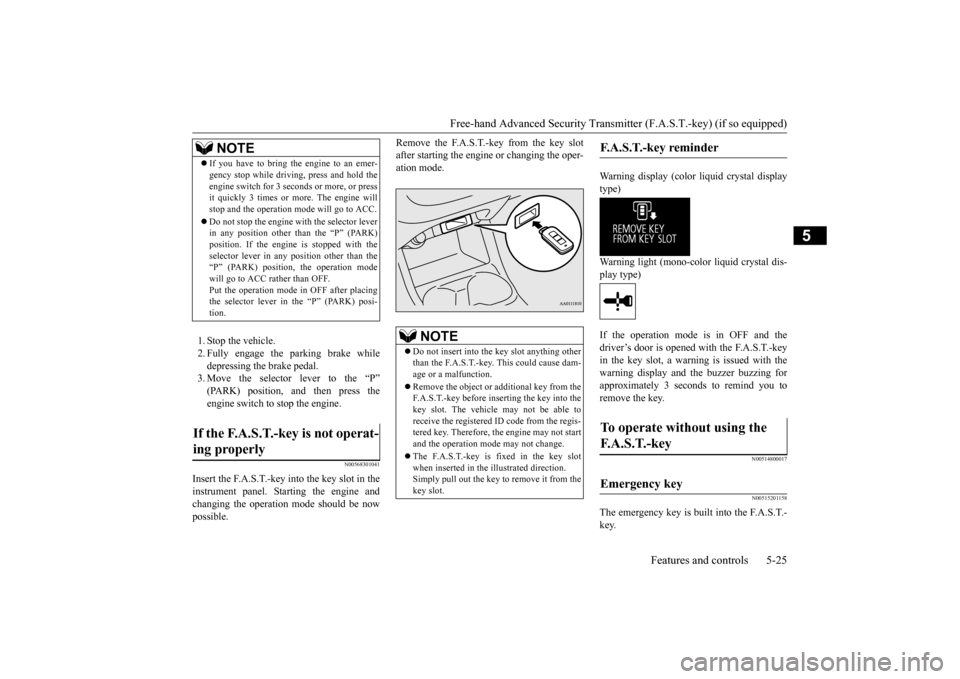
Warning display (color liquid crystal display type) Warning light (mono-color liquid crystal dis- play type) If the operation mode is in OFF and the driver’s door is opened with the F.A.S.T.-key in the key slot, a warning is issued with thewarning display and the buzzer buzzing for approximately 3 seconds to remind you to remove the key.
N00514800017 N00515201158
The emergency key is built into the F.A.S.T.- key.
NOTE
If you have to bring the engine to an emer- gency stop while drivi
ng, press and hold the
engine switch for 3 sec
onds or more, or press
it quickly 3 times or more. The engine will stop and the operation mode will go to ACC. Do not stop the engine wi
th the selector lever
in any position other than the “P” (PARK) position. If the engine
is stopped with the
selector lever in any
position other than the
“P” (PARK) position, the operation mode will go to ACC rather than OFF.Put the operation mode
in OFF after placing
the selector lever in the “P” (PARK) posi- tion.
If the F.A.S.T.-key is not operat- ing properly
NOTE
Do not insert into the
key slot anything other
than the F.A.S.T.-key. This could cause dam- age or a malfunction. Remove the object or
additional key from the
F.A.S.T.-key before inserting the key into the key slot. The vehicle may not be able toreceive the registered ID code from the regis- tered key. Therefore, the engine may not start and the operation mode
may not change.
The F.A.S.T.-key is fixed in the key slot when inserted in the illustrated direction.Simply pull out the key to
remove it from the
key slot.
F.A.S.T.-key reminder
To operate without using the F. A . S . T. - k e y
Emergency key
BK0211800US.book 25 ページ 2014年3月12日 水曜日 午後2時42分
Page 129 of 446
Parking brake 5-52 Features and controls
5
N00511401400
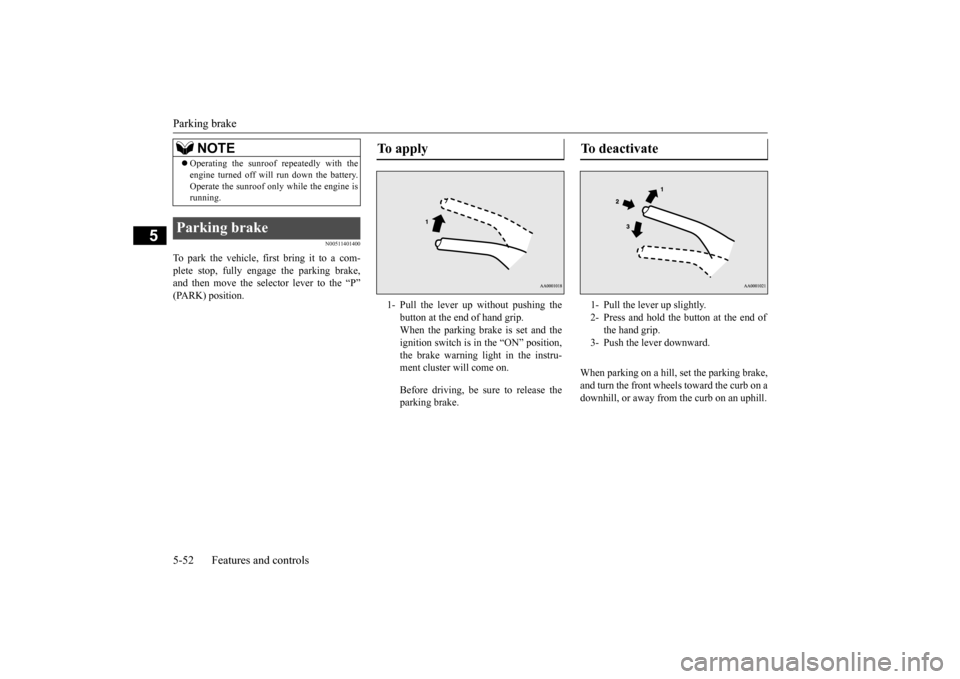
To park the vehicle, first bring it to a com- plete stop, fully engage the parking brake,and then move the selector lever to the “P” (PARK) position.
When parking on a hill, set the parking brake, and turn the front wheels toward the curb on a downhill, or away from
the curb on an uphill.
Operating the sunroof repeatedly with the engine turned off will
run down the battery.
Operate the sunroof onl
y while the engine is
running.
Parking brake
NOTE
To apply 1- Pull the lever up without pushing the
button at the end of hand grip. When the parking brake is set and theignition switch is in the “ON” position, the brake warning light in the instru- ment cluster will come on. Before driving, be sure to release the parking brake.
To deactivate 1- Pull the lever up slightly. 2- Press and hold the button at the end of
the hand grip.
3- Push the lever downward.
BK0211800US.book 52 ページ 2014年3月12日 水曜日 午後2時42分
Page 130 of 446
Steering wheel height
and reach adjustment
Features and controls 5-53
5
N00511501241
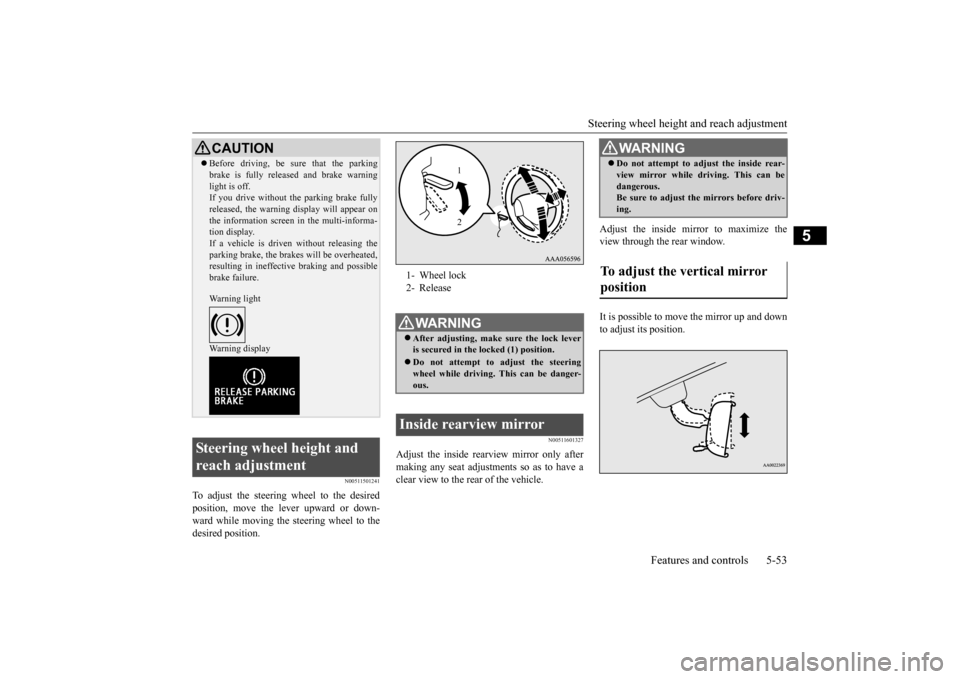
To adjust the steering wheel to the desired position, move the lever upward or down- ward while moving the steering wheel to the desired position.
N00511601327
Adjust the inside rearview mirror only after making any seat adjustme
nts so as to have a
clear view to the rear of the vehicle.
Adjust the inside mirror to maximize the view through the rear window. It is possible to move
the mirror up and down
to adjust its position.
CAUTION Before driving, be sure that the parking brake is fully released and brake warninglight is off.If you drive without the parking brake fully released, the warning di
splay will appear on
the information screen in the multi-informa-tion display. If a vehicle is driven without releasing the parking brake, the brakes will be overheated,resulting in ineffectiv
e braking and possible
brake failure. Warning light Warning display
Steering wheel height and reach adjustment
1- Wheel lock 2- ReleaseWA R N I N G After adjusting, make sure the lock lever is secured in the locked (1) position. Do not attempt to adjust the steering wheel while driving. This can be danger-ous.
Inside rearview mirror
1 2
WA R N I N G Do not attempt to adjust the inside rear- view mirror while driving. This can bedangerous.Be sure to adjust the mirrors before driv- ing.
To adjust the vertical mirror position
BK0211800US.book 53 ページ 2014年3月12日 水曜日 午後2時42分