ECU MITSUBISHI OUTLANDER 2016 3.G Manual PDF
[x] Cancel search | Manufacturer: MITSUBISHI, Model Year: 2016, Model line: OUTLANDER, Model: MITSUBISHI OUTLANDER 2016 3.GPages: 464, PDF Size: 60.77 MB
Page 402 of 464
Engine hood 9-4 Vehicle care and maintenance
9
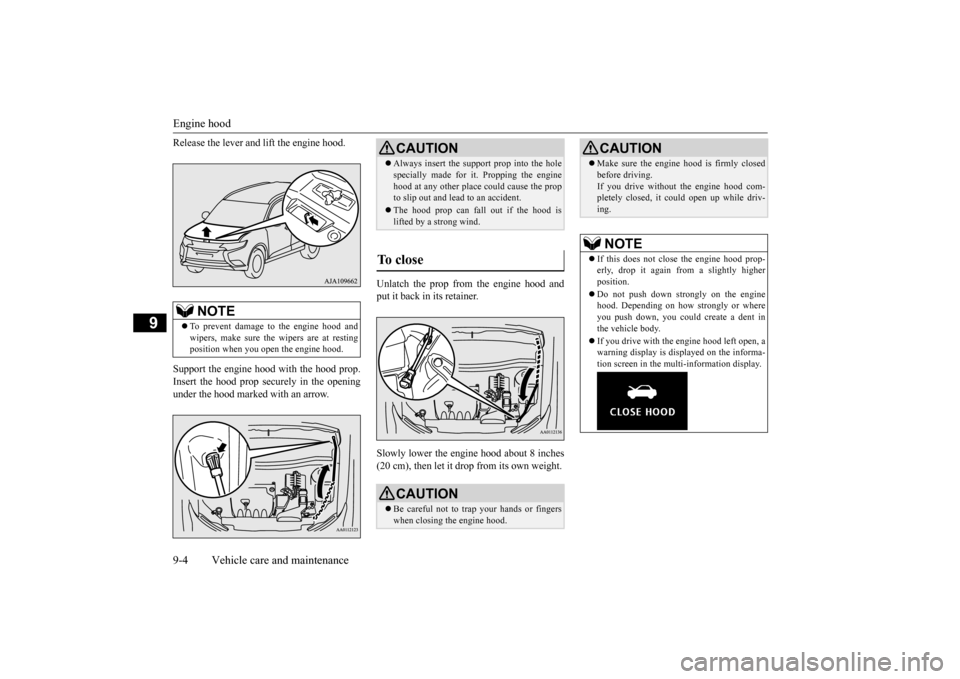
Release the lever and
lift the engine hood.
Support the engine hood with the hood prop. Insert the hood prop securely in the opening under the hood marked with an arrow.
Unlatch the prop from the engine hood and put it back in its retainer. Slowly lower the engine hood about 8 inches (20 cm), then let it drop from its own weight.
NOTE
To prevent damage to the engine hood and wipers, make sure the
wipers are at resting
position when you open the engine hood.
CAUTION Always insert the support prop into the hole specially made for it. Propping the enginehood at any other place
could cause the prop
to slip out and lead
to an accident.
The hood prop can fall out if the hood is lifted by a strong wind.
To close
CAUTION Be careful not to trap your hands or fingers when closing the engine hood.
Make sure the engine hood is firmly closed before driving.If you drive without the engine hood com-pletely closed, it c
ould open up while driv-
ing.NOTE
If this does not clos
e the engine hood prop-
erly, drop it again from a slightly higher position. Do not push down strongly on the engine hood. Depending on how strongly or whereyou push down, you could create a dent in the vehicle body. If you drive with the e
ngine hood left open, a
warning display is displayed on the informa- tion screen in the multi-information display.CAUTION
BK0223400US.book 4 ページ 2015年2月13日 金曜日 午後12時15分
Page 412 of 464
Battery 9-14 Vehicle care and maintenance
9
facility of your choice before the start of cold weather. If necessary, have it charged. Thiswill provide more relia
ble starting, and longer
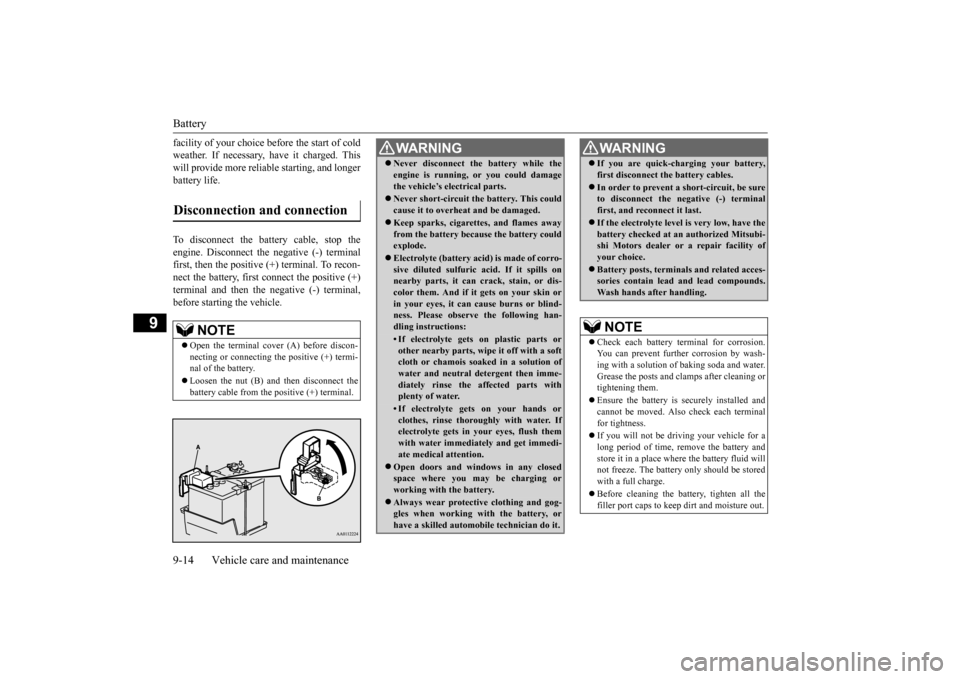
battery life. To disconnect the battery cable, stop the engine. Disconnect the
negative (-) terminal
first, then the positive (+) terminal. To recon- nect the battery, first
connect the positive (+)
terminal and then the negative (-) terminal,before starting the vehicle.Disconnection and connection
NOTE
Open the terminal cover (A) before discon- necting or connecting
the positive (+) termi-
nal of the battery. Loosen the nut (B) a
nd then disconnect the
battery cable from the positive (+) terminal.
WA R N I N G Never disconnect the battery while the engine is running, or you could damagethe vehicle’s electrical parts. Never short-circuit the battery. This could cause it to overheat and be damaged. Keep sparks, cigarettes, and flames away from the battery because the battery couldexplode. Electrolyte (battery acid) is made of corro- sive diluted sulfuric acid. If it spills on nearby parts, it can crack, stain, or dis- color them. And if it gets on your skin orin your eyes, it can cause burns or blind- ness. Please observe the following han- dling instructions:• If electrolyte gets on plastic parts orother nearby parts, wipe it off with a softcloth or chamois soak
ed in a solution of
water and neutral detergent then imme- diately rinse the affected parts withplenty of water.• If electrolyte gets on your hands orclothes, rinse thoroughly with water. If electrolyte gets in your eyes, flush them with water immediately and get immedi-ate medical attention.
Open doors and wind
ows in any closed
space where you may be charging or working with the battery. Always wear protecti
ve clothing and gog-
gles when working with the battery, or have a skilled automobi
le technician do it.
If you are quick-ch
arging your battery,
first disconnect the battery cables. In order to prevent a
short-circuit, be sure
to disconnect the negative (-) terminal first, and reconnect it last. If the electrolyte level
is very low, have the
battery checked at an
authorized Mitsubi-
shi Motors dealer or
a repair facility of
your choice. Battery posts, terminals and related acces- sories contain lead
and lead compounds.
Wash hands after handling.NOTE
Check each battery terminal for corrosion. You can prevent further corrosion by wash-ing with a solution of baking soda and water. Grease the posts and cl
amps after cleaning or
tightening them. Ensure the battery is securely installed and cannot be moved. Also
check each terminal
for tightness. If you will not be driving your vehicle for a long period of time, remove the battery andstore it in a place where the battery fluid will not freeze. The battery only should be stored with a full charge. Before cleaning the battery, tighten all the filler port caps to keep
dirt and moisture out.
WA R N I N G
BK0223400US.book 14 ページ 2015年2月13日 金曜日 午後12時15分
Page 421 of 464
General maintenance
Vehicle care and maintenance 9-23
9
N00940900231
Spark plugs must fire properly to ensure proper engine performance and emission- control.Do not reuse spark plugs by cleaning or regapping. Spark plugs
should be replaced at
the mileage specified in the “WARRANTYAND MAINTENANCE MANUAL”.
N00941000040
Check the hose surfaces for any heat and mechanical damage, ha
rd and brittle rubber,
cracking, tears, cuts and abrasions. Pay spe-cial attention to the hos
es closest to high heat
sources such as the exhaust manifold. Check all the hose connections, such as clamps andcouplings, to make sure they are secure and that there are no leaks. If you see any wear or damage, replace the
hoses immediately.
N00950100050
Have the valve clea
rance checked at an
authorized Mitsubishi Motors dealer at the mileage specified in the “WARRANTY AND MAINTENANCE MANUAL”.If the engine sounds ab
normally loud, have
adjustments made by an authorized Mitsubishi Motors dealer.
N00941300173
Check these regularly for damage or leaks in the fuel lines and conne
ctions. Check the fuel
tank filler cap for dama
ge or looseness. Pay
special attention to the fuel lines closest to
high heat sources such
as the exhaust mani-
fold.
N00941400187
If the fuel-vapor vent line is clogged or dam-aged, the fuel-vapor mixture will escape, pol- luting the air. Have the system checked at an authorizedMitsubishi Motors dealer at the mileage spec- ified in the “WARRANTY AND MAINTE- NANCE MANUAL”.
N00941501299
The next pages list th
e maintenance service
recommended by Mitsubishi Motors Corpo-ration. In addition to the general maintenance that needs to be performed at the times listed,
NOTE
To meet government
regulations and pro-
mote cleaner air, your
vehicle is equipped
with an onboard diagnostic system (OBD).The engine electroni
c control module that
controls OBD functions
stores various data
(especially about th
e exhaust emissions).
This data will be erased if the battery cable is disconnected, which c
ould make a rapid
diagnosis difficult. Do not disconnect thebattery cable when th
e engine malfunction
indicator (“SERVIC
E ENGINE SOON” or
“Check engine light”) is ON.
Spark plugs
NOTE
Use the recommended or
equivalent spark
plugs listed under “Engi
ne specifications” on
page 11-6. Use of other plugs could cause engine damage, loss of
performance or radio
noise.
Fuel hoses Intake valve clearance Fuel system (tank, pipe line and connection, and fuel tank filler cap)
WA R N I N G If you see a fuel leak
or if you smell fuel,
do not run the engine. Any spark (includ- ing from the ignition
), flame or smoking
material could cause an explosion or fire.Call an authorized Mitsubishi Motors dealer or a repair fa
cility of your choice
for assistance.
Evaporative emission control system (except evaporative emission canister) General maintenance
BK0223400US.book 23 ページ 2015年2月13日 金曜日 午後12時15分
Page 426 of 464
Fuses 9-28 Vehicle care and maintenance
9
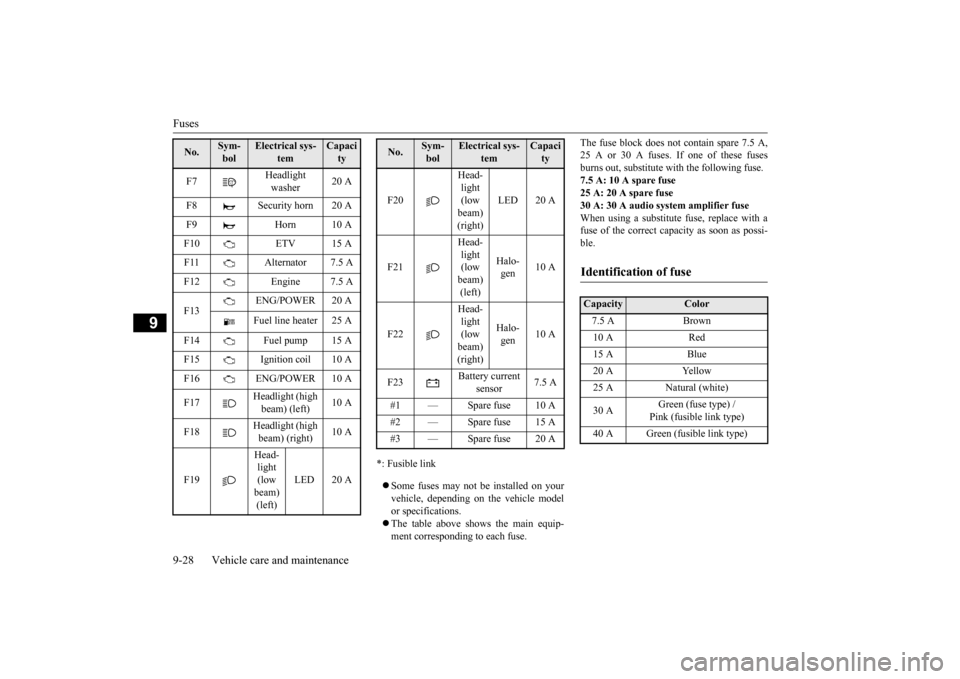
*: Fusible link Some fuses may not be installed on your vehicle, depending on
the vehicle model
or specifications. The table above show
s the main equip-
ment corresponding to each fuse.
The fuse block does not contain spare 7.5 A, 25 A or 30 A fuses. If one of these fusesburns out, substitute wi
th the following fuse.
7.5 A: 10 A spare fuse 25 A: 20 A spare fuse30 A: 30 A audio system amplifier fuse When using a substitute fuse, replace with a fuse of the correct capacity as soon as possi-ble.
F7
Headlight washer
20 A
F8 Security horn 20 A F9 Horn 10 AF10 ETV 15 A F11 Alternator 7.5 A F12 Engine 7.5 A F13
ENG/POWER 20 A Fuel line heater 25 A
F14 Fuel pump 15 A F15 Ignition coil 10 A F16 ENG/POWER 10 A F17
Headlight (high beam) (left)
10 A
F18
Headlight (high beam) (right)
10 A
F19
Head- light (low beam) (left)
LED 20 A
No.
Sym- bol
Electrical sys-
tem
Capacity
F20
Head- light (low beam) (right)
LED 20 A
F21
Head- light (low beam) (left)
Halo- gen
10 A
F22
Head- light (low beam) (right)
Halo- gen
10 A
F23
Battery current
sensor
7.5 A
#1 — Spare fuse 10 A #2 — Spare fuse 15 A #3 — Spare fuse 20 ANo.
Sym- bol
Electrical sys-
tem
Capacity
Identification of fuse Capacity
Color
7.5 A Brown 10 A Red 15 A Blue 20 A Yellow 25 A Natural (white) 30 A
Green (fuse type) / Pink (fusible link type)
40 A Green (fusible link type)
BK0223400US.book 28 ページ 2015年2月13日 金曜日 午後12時15分
Page 427 of 464
Replacement of light bulbs
Vehicle care and maintenance 9-29
9
N00954901141
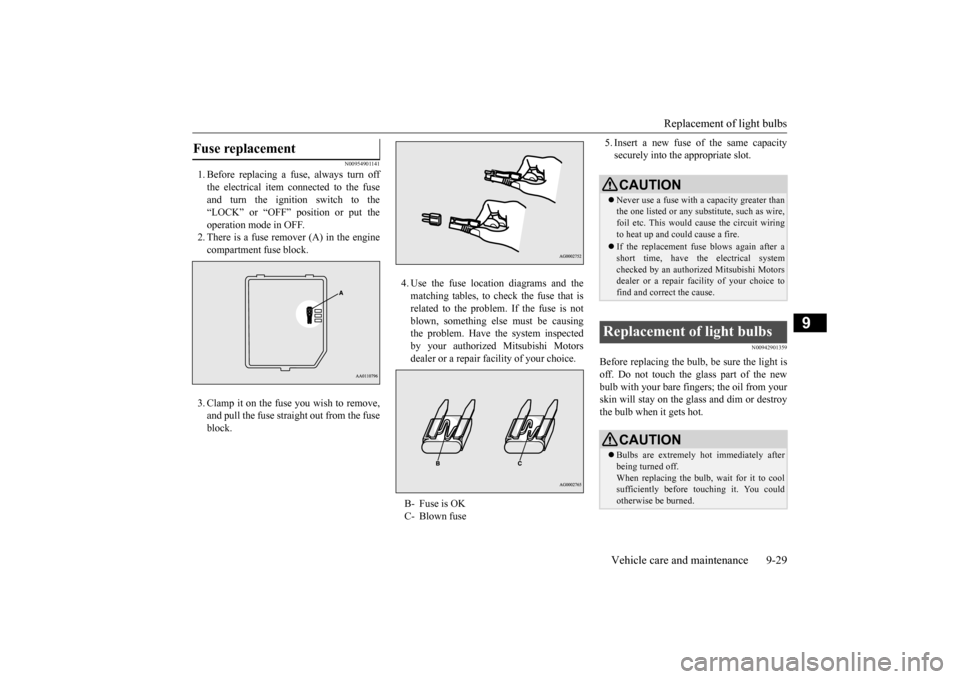
1. Before replacing a fuse, always turn off the electrical item connected to the fuse and turn the ignition switch to the“LOCK” or “OFF” position or put the operation mode in OFF. 2. There is a fuse remover (A) in the enginecompartment fuse block. 3. Clamp it on the fuse you wish to remove, and pull the fuse straight out from the fuseblock.
4. Use the fuse location diagrams and the matching tables, to check the fuse that isrelated to the problem. If the fuse is not blown, something else must be causing the problem. Have the system inspectedby your authorized Mitsubishi Motors dealer or a repair fa
cility of your choice.
5. Insert a new fuse of the same capacity securely into the appropriate slot.
N00942901359
Before replacing the bulb, be sure the light is off. Do not touch the glass part of the new bulb with your bare fingers; the oil from yourskin will stay on the glass and dim or destroy the bulb when it gets hot.
Fuse replacement
B- Fuse is OKC- Blown fuse
CAUTION Never use a fuse with a capacity greater than the one listed or any substitute, such as wire, foil etc. This would
cause the circuit wiring
to heat up and could cause a fire. If the replacement fuse blows again after a short time, have the electrical systemchecked by an authorized Mitsubishi Motors dealer or a repair fa
cility of your choice to
find and correct the cause.
Replacement of light bulbs
CAUTION Bulbs are extremely hot immediately after being turned off. When replacing the bulb, wait for it to coolsufficiently before
touching it. You could
otherwise be burned.
BK0223400US.book 29 ページ 2015年2月13日 金曜日 午後12時15分
Page 458 of 464
Alphabetical index 12-2
12
Child safety locks for rear door
............
5-36
Cleaning
Inside of your vehicle
......................
9-38
Outside of your vehicle
...................
9-39
Clock
.................................................
7-51
Coat hook
........................................
5-235
Consumer information
........................
10-2
Continuously variable transmission (CVT)
....
5-71 Fluid
....................................
9-11
, 11-7
Selector lever operation
...................
5-72
Selector le
ver positions
...................
5-75
Sports mode
...................................
5-76
Coolant (engine)
..........................
9-8
, 11-7
Cruise control
.....................................
5-96
Cup holder
.......................................
5-232
D
Daytime running lights
Bulb capacity
.................................
9-30
Replacement
..................................
9-34
Defogger (rear window)
....................
5-190
Defrosting or defogging (windshield, door windows)
..................................
7-9
, 7-13
Digital clock
Time setting
...................................
7-47
Dimensions
........................................
11-4
Dimmer (high/lo
w beam change)
.......
5-180
Disc brake pads
...................................
9-24
Dome light (front)/Reading lights
.......
5-226
Bulb capacity
..................................
9-32
Dome light (rear)
...............................
5-226
Bulb capacity
..................................
9-32
Doors
Lock
..............................................
5-33
Power door locks
............................
5-35
Driving during cold weather
..................
6-5
Driving precaution
...............................
6-2
Driving, alcohol and drugs
....................
6-2
E
ECO mode switch
.............................
5-184
Electric power steering system (EPS)
....
5-93
Electric rear window
defogger switch
..5-190
Electronic immobilizer (Anti-theft starting system)
.....................................
5-4
, 5-27
Electronically cont
rolled 4WD system
..5-79
Emission-control system maintenance
...
9-22
Engine
Compartment
...................................
9-5
Coolant
...................................
9-8
, 11-7
Hood
...............................................
9-3
Malfunction indicator light
.............
5-173
MIVEC
.................................
5-25
, 5-64
Oil and oil filter
.......................
9-6
, 11-7
Overheating
.....................................
8-4
Serial number
.................................
11-2
Specification
..................................
11-6
Engine hood
.........................................
9-3
Engine switch
.....................................
5-18
Exhaust system
...................................
9-24
F
Floor console box
.............................
5-229
Floor mat
.............................................
6-3
Fluid
Automatic transaxle fluid
.......
9-11
, 11-7
Brake fluid
............................
9-12
, 11-7
Continuously variable transmission (CVT) fluid
...................................
9-11
, 11-7
Engine coolant
........................
9-8
, 11-7
Engine oil
...............................
9-6
, 11-7
Rear axle oil
..........................
9-12
, 11-7
Transfer oil
...........................
9-12
, 11-7
Washer fluid
.........................
9-12
, 11-7
Fluid capacities and lubricants
.............
11-7
Forward Collision Miti
gation System (FCM)
5-111 Free-hand advanced security transmitter (F.A.S.T.-key)
..................................
5-12
Front fog lights
Bulb capacity
.................................
9-30
Indicators
.....................................
5-172
Replacement
..................................
9-35
Switch
.........................................
5-184
BK0223400US.book 2 ページ 2015年2月13日 金曜日 午後12時15分