child lock MITSUBISHI OUTLANDER 2018 (in English) User Guide
[x] Cancel search | Manufacturer: MITSUBISHI, Model Year: 2018, Model line: OUTLANDER, Model: MITSUBISHI OUTLANDER 2018Pages: 441, PDF Size: 13.71 MB
Page 115 of 441
Door locks5-34 Features and controls
5
4. Install a new battery with the +side (A)5. Close the case firmly.6. Check the keyless entry system to see thatit works.
N00509201544
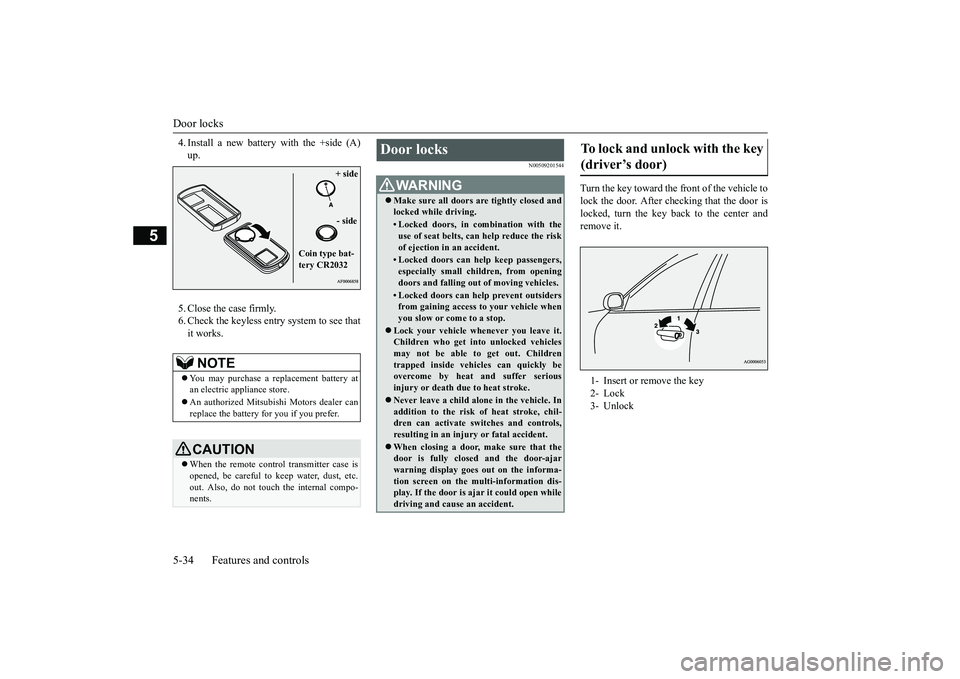
Turn the key toward the front of the vehicle tolock the door. After checking that the door islocked, turn the key back to the center andremove it.
NOTE
You may purchase a re
placement battery at
an electric appliance store.An authorized Mitsubishi Motors dealer canreplace the battery for you if you prefer.CAUTIONWhen the remote control transmitter case isopened, be careful to
keep water, dust, etc.
out. Also, do not touch the internal compo-nents.
+ side- side
Coin type bat-tery CR2032
Door locks
WA R N I N GMake sure all doors are tightly closed andlocked while driving.• Locked doors, in co
mbination with the
use of seat belts, can help reduce the riskof ejection in
an accident.
• Locked doors can help keep passengers,especially small children, from openingdoors and falling out
of moving vehicles.
• Locked doors can help
prevent outsiders
from gaining access to your vehicle whenyou slow or come to a stop.
Lock your vehicle when
ever you leave it.
Children who get into
unlocked vehicles
may not be able to get out. Childrentrapped inside vehicles can quickly beovercome by heat
and suffer serious
injury or death due to heat stroke.Never leave a ch
ild alone in the vehicle. In
addition to the risk
of heat stroke, chil-
dren can activate switches and controls,resulting in an injury
or fatal accident.
When closing a door,
make sure that the
door is fully closed and the door-ajarwarning display goes
out on the informa-
tion screen on the multi-information dis-play. If the door is aj
ar it could open while
driving and cause an accident.
To lock and unlock with the key (driver’s door) 1- Insert or remove the key2- Lock3- Unlock
BK0249100US.book 34 ページ 2017年5月10日 水曜日 午前8時49分
Page 118 of 441
Child safety locks for rear doorFeatures and controls 5-37
5
N00563401180
All doors and the liftg
ate will unlock when
the ignition switch is turned to the “OFF” or“LOCK” position or the operation mode isput in OFF.
All doors and the liftgate will unlock whenthe selector lever is moved to the “P” (PARK)position with the ignition
switch or the opera-
tion mode in ON.
N00509401298
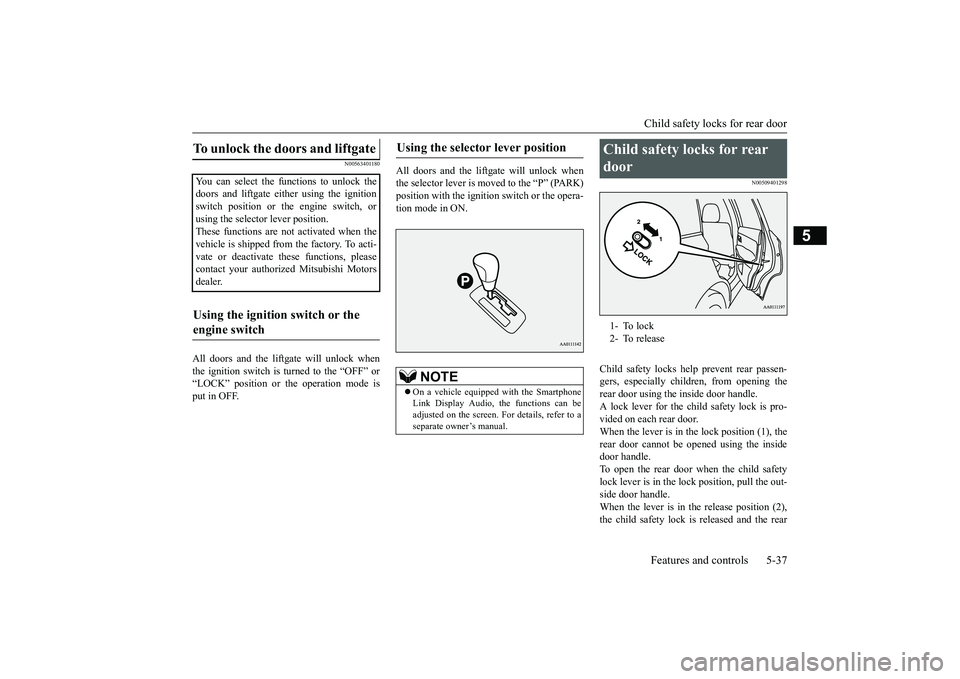
Child safety locks help prevent rear passen-gers, especially children, from opening therear door using the inside door handle.A lock lever for the child safety lock is pro-vided on each rear door.When the lever is in the lock position (1), therear door cannot be opened using the insidedoor handle.To open the rear door when the child safetylock lever is in the lock position, pull the out-side door handle.When the lever is in the release position (2),the child safety lock is released and the rear
To unlock the doors and liftgate You can select the functions to unlock thedoors and liftgate eith
er using the ignition
switch position or the engine switch, orusing the selector lever position.These functions are not activated when thevehicle is shipped from the factory. To acti-vate or deactivate th
ese functions, please
contact your authori
zed Mitsubishi Motors
dealer.Using the ignition switch or the engine switch
Using the selector lever position
NOTE
On a vehicle equipped with the SmartphoneLink Display Audio, the functions can beadjusted on the screen. For details, refer to aseparate owner’s manual.
Child safety locks for rear door 1- To lock2- To release
BK0249100US.book 37 ページ 2017年5月10日 水曜日 午前8時49分
Page 119 of 441
Liftgate (except for vehicles e
quipped with the power liftgate)
5-38 Features and controls
5
door can be opened using the inside door han-dle.
N00510101282
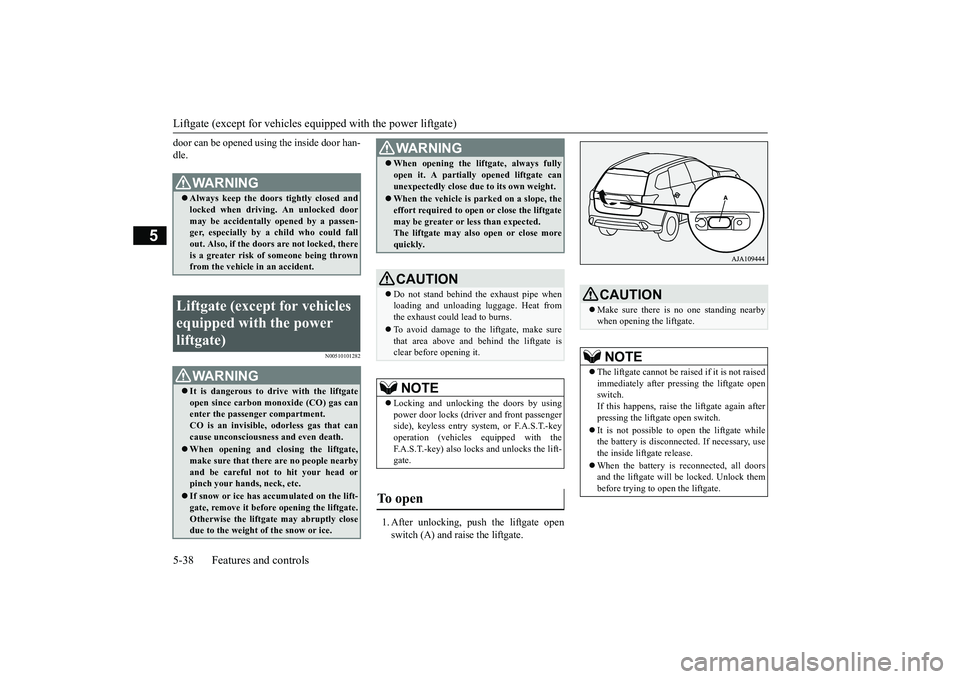
1. After unlocking, push the liftgate openswitch (A) and raise the liftgate.
WA R N I N GAlways keep the door
s tightly closed and
locked when driving. An unlocked doormay be accidentally
opened by a passen-
ger, especially by
a child who could fall
out. Also, if the doors are not locked, thereis a greater risk of someone being thrownfrom the vehicle
in an accident.
Liftgate (except for vehicles equipped with the power liftgate)
WA R N I N GIt is dangerous to drive with the liftgateopen since carbon mo
noxide (CO) gas can
enter the passenger compartment.CO is an invisible, odorless gas that cancause unconsciousness and even death.When opening and cl
osing the liftgate,
make sure that there are no people nearbyand be careful not to hit your head orpinch your hands, neck, etc.If snow or ice has ac
cumulated on the lift-
gate, remove it before
opening the liftgate.
Otherwise the liftgate may abruptly closedue to the weight of the snow or ice.
When opening the lift
gate, always fully
open it. A partially opened liftgate canunexpectedly close due to its own weight.When the vehicle is parked on a slope, theeffort required to open or close the liftgatemay be greater or less than expected.The liftgate may also open or close morequickly.CAUTIONDo not stand behind the exhaust pipe whenloading and unloading
luggage. Heat from
the exhaust could lead to burns.To avoid damage to the liftgate, make surethat area above and behind the liftgate isclear before opening it.NOTE
Locking and unlocking the doors by usingpower door locks (driver and front passengerside), keyless entry system, or F.A.S.T.-keyoperation (vehicles
equipped with the
F.A.S.T.-key) also locks and unlocks the lift-gate.
To open
WA R N I N G
CAUTIONMake sure there is no one standing nearbywhen opening the liftgate.NOTE
The liftgate cannot be rais
ed if it is not raised
immediately after pressing the liftgate openswitch.If this happens, raise th
e liftgate again after
pressing the liftgate open switch.It is not possible to open the liftgate whilethe battery is disconnect
ed. If necessary, use
the inside liftgate release.When the battery is reconnected, all doorsand the liftgate will be locked. Unlock thembefore trying to open the liftgate.
BK0249100US.book 38 ページ 2017年5月10日 水曜日 午前8時49分
Page 120 of 441
Power liftgate (if so equipped)Features and controls 5-39
5
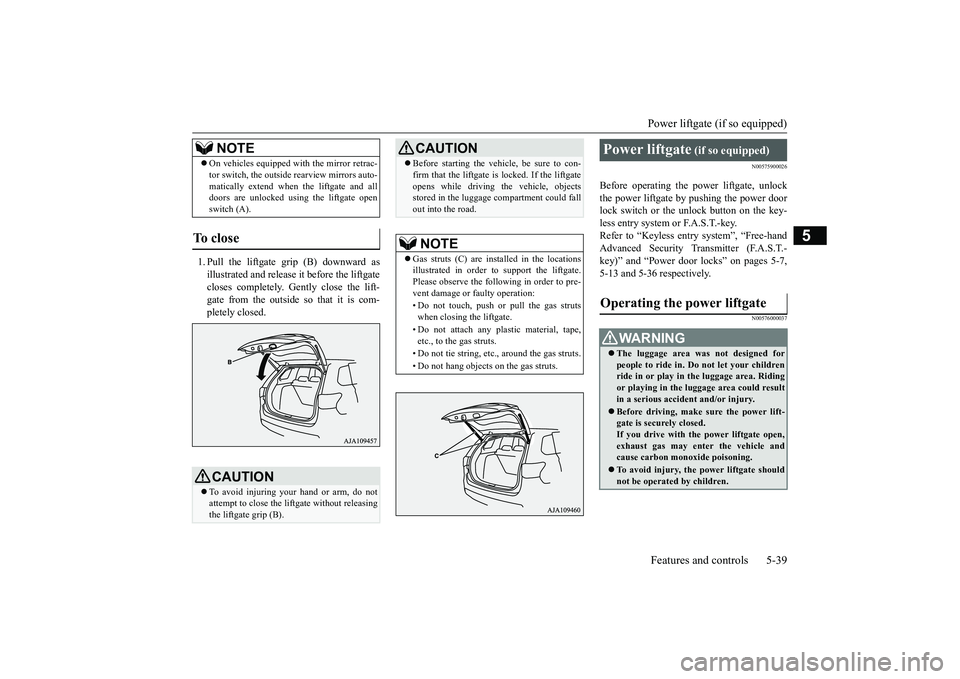
1. Pull the liftgate grip (B) downward asillustrated and release it before the liftgatecloses completely. Gently close the lift-gate from the outside so that it is com-pletely closed.
N00575900026
Before operating the pow
er liftgate, unlock
the power liftgate by pushing the power doorlock switch or the unlock button on the key-less entry system or F.A.S.T.-key.Refer to “Keyless entry system”, “Free-handAdvanced Security Transmitter (F.A.S.T.-key)” and “Power door locks” on pages 5-7,5-13 and 5-36 respectively.
N00576000037
On vehicles equipped wi
th the mirror retrac-
tor switch, the outside rearview mirrors auto-matically extend when
the liftgate and all
doors are unlocked using the liftgate openswitch (A).
To close
CAUTIONTo avoid injuring your hand or arm, do notattempt to close the lift
gate without releasing
the liftgate grip (B).NOTE
Before starting the vehi
cle, be sure to con-
firm that the liftgate is locked. If the liftgateopens while driving the vehicle, objectsstored in the luggage compartment could fallout into the road.NOTE
Gas struts (C) are installed in the locationsillustrated in order to
support the liftgate.
Please observe the foll
owing in order to pre-
vent damage or faulty operation:• Do not touch, push or pull the gas strutswhen closing the liftgate.• Do not attach any pl
astic material, tape,
etc., to the gas struts.• Do not tie string, etc., around the gas struts.• Do not hang objects on the gas struts.CAUTION
Power liftgate
(if so equipped)
WA R N I N GThe luggage area was not designed forpeople to ride in. Do not let your childrenride in or play in
the luggage area. Riding
or playing in the lu
ggage area could result
in a serious accide
nt and/or injury.
Before driving, make sure the power lift-gate is securely closed.If you drive with th
e power liftgate open,
exhaust gas may enter the vehicle andcause carbon monoxide poisoning.To avoid injury, the power liftgate shouldnot be operated by children.
BK0249100US.book 39 ページ 2017年5月10日 水曜日 午前8時49分
Page 130 of 441
Power window control
Features and controls 5-49
5
N00510601157
Use the following procedure to test the sys-tem:1. Lower the driver’s window.2. Arm the system as explained in “Armedstage”.comes on and flashe
s for approximately
20 seconds.4. Wait a few seconds and then unlock thedriver’s side door by using the inside doorlock knob. Open the door.5. Make sure that the horn sounds intermit-tently and the headlights blink when adoor is opened.6. Disarm the system by unlocking all doorsand the liftgate by using the keyless entrysystem or the F.A.S.T.-key operation.
N00510800383
Testing the theft-alarm system
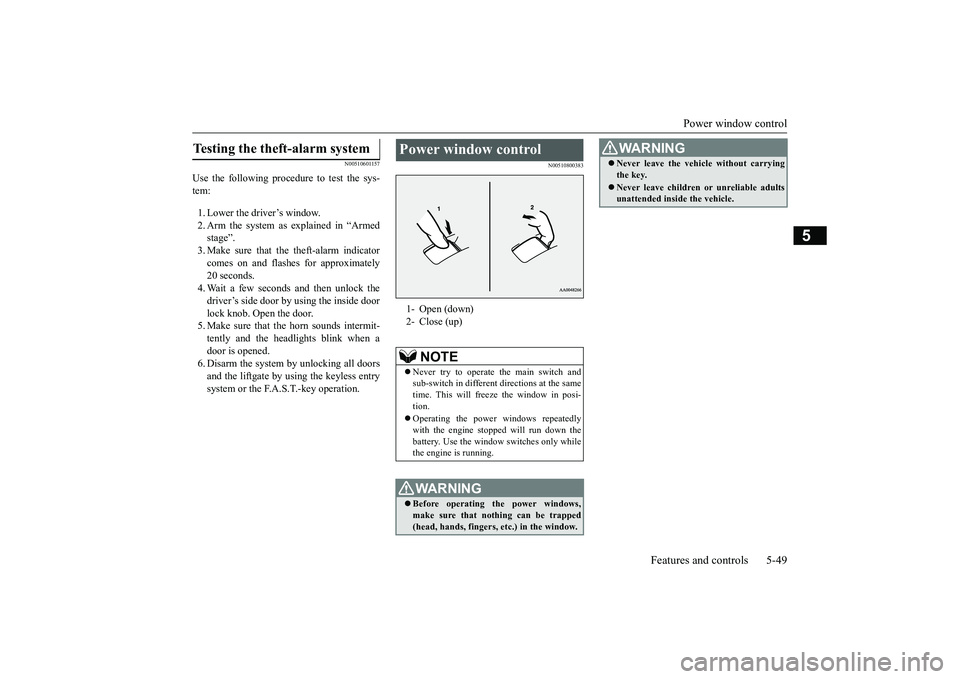
Power window control 1- Open (down)2- Close (up)
NOTE
Never try to operate the main switch andsub-switch in different
directions at the same
time. This will free
ze the window in posi-
tion.Operating the power windows repeatedlywith the engine stoppe
d will run down the
battery. Use the window
switches only while
the engine is running.WA R N I N GBefore operating the power windows,make sure that nothing can be trapped(head, hands, fingers, etc.) in the window.
Never leave the vehicle without carryingthe key.Never leave children
or unreliable adults
unattended inside the vehicle.WA R N I N G
BK0249100US.book 49 ページ 2017年5月10日 水曜日 午前8時49分
Page 132 of 441
Sunroof (if so equipped)
Features and controls 5-51
5
N00528801129
If a hand or head is trapped, for safety thedoor window is automati
cally lowered a little.
After the obstruction is removed, pull up theswitch again to close the door window.
N00551400014
Wind buffeting can be described as the per-ception of pressure on the ears or a boomingor rumbling sound. Your vehicle may exhibitwind buffeting when driving with one or bothrear door windows down or partially opened.This is a normal occurrence that can be mini-mized. If the buffeting
occurs with the rear
door windows open, open the front door win-dows as well as the rear door windows tominimize the condition.
N00511001682
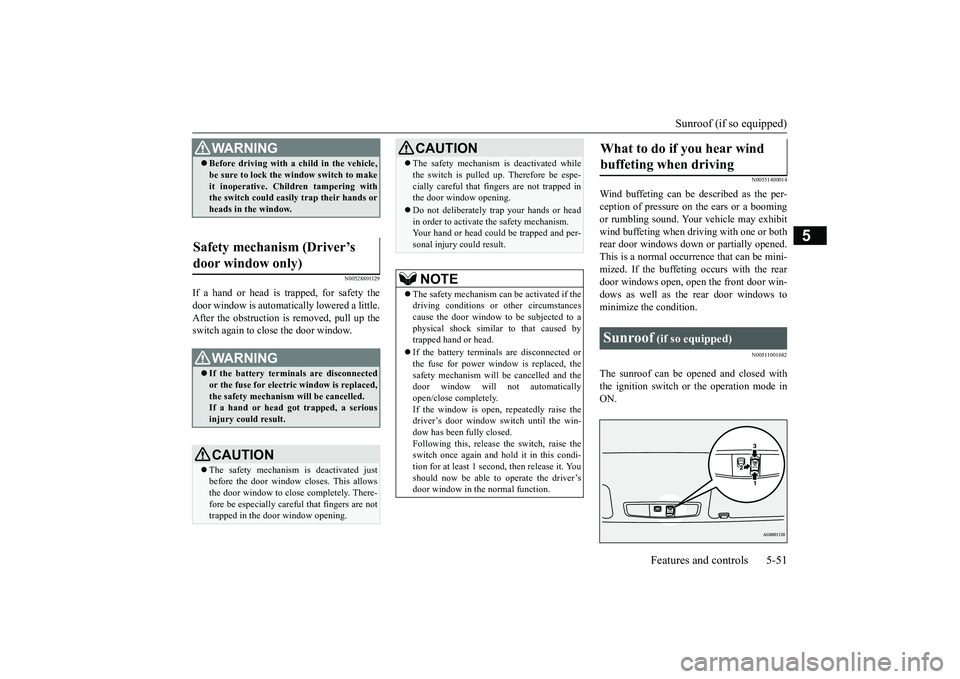
The sunroof can be ope
ned and closed with
the ignition switch or the operation mode inON.
WA R N I N GBefore driving with a child in the vehicle,be sure to lock the window switch to makeit inoperative. Children tampering withthe switch could easily trap their hands orheads in the window.
Safety mechanism (Driver’s door window only)
WA R N I N GIf the battery terminals are disconnectedor the fuse for electric window is replaced,the safety mechanism will be cancelled.If a hand or head got
trapped, a serious
injury could result.CAUTIONThe safety mechanism is deactivated justbefore the door window closes. This allowsthe door window to close completely. There-fore be especially care
ful that fingers are not
trapped in the door window opening.
The safety mechanism is deactivated whilethe switch is pulled up.
Therefore be espe-
cially careful that fi
ngers are not trapped in
the door window opening.Do not deliberately trap your hands or headin order to activate the safety mechanism.Your hand or head coul
d be trapped and per-
sonal injury could result.NOTE
The safety mechanism can be activated if thedriving conditions or
other circumstances
cause the door window to be subjected to aphysical shock similar to that caused bytrapped hand or head.If the battery terminals are disconnected orthe fuse for power window is replaced, thesafety mechanism will
be cancelled and the
door window will not automaticallyopen/close completely.If the window is open,
repeatedly raise the
driver’s door window switch until the win-dow has been fully closed.Following this, release the switch, raise theswitch once again and hold it in this condi-tion for at least 1 second, then release it. Youshould now be able to operate the driver’sdoor window in the normal function.CAUTION
What to do if you hear wind buffeting when driving Sunroof
(if so equipped)
BK0249100US.book 51 ページ 2017年5月10日 水曜日 午前8時49分
Page 333 of 441
Vehicle preparation before driving6-4 Driving safety
6
N00629001709
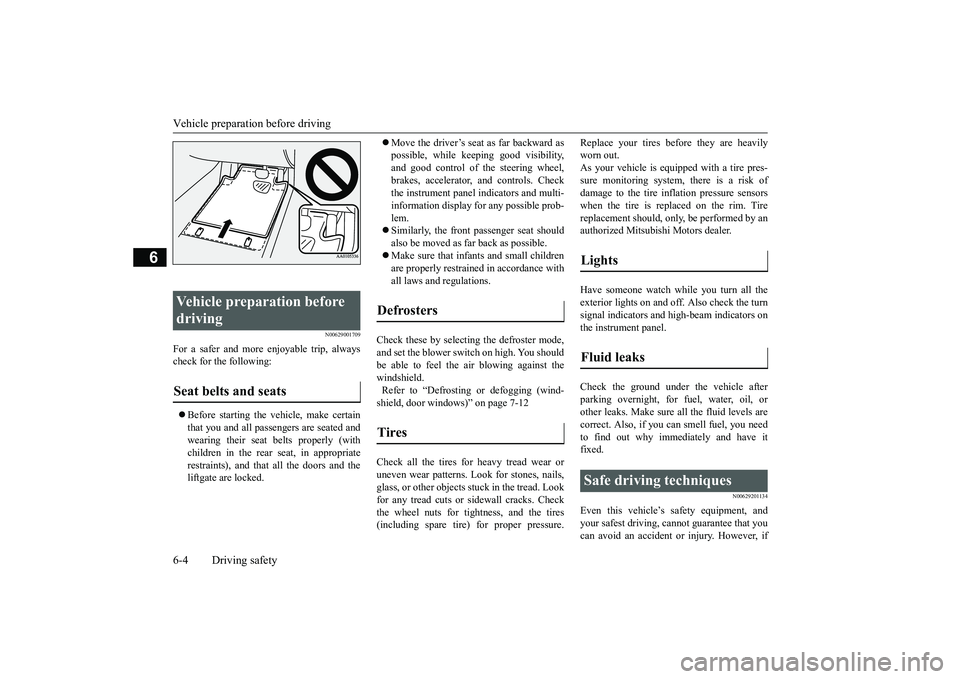
For a safer and more enjoyable trip, alwayscheck for the following:Before starting the vehicle, make certainthat you and all passengers are seated andwearing their seat
belts properly (with
children in the rear seat, in appropriaterestraints), and that all the doors and theliftgate are locked.
Move the driver’s seat as far backward aspossible, while keeping good visibility,and good control of the steering wheel,brakes, accelerator, and controls. Checkthe instrument panel indicators and multi-information display
for any possible prob-
lem.Similarly, the front
passenger seat should
also be moved as fa
r back as possible.
Make sure that infants and small childrenare properly restrained in accordance withall laws and
regulations.
Check these by selecting the defroster mode,and set the blower swit
ch on high. You should
be able to feel the air blowing against thewindshield. Refer to “Defrosti
ng or defogging (wind-
shield, door windows)” on page 7-12Check all the tires for heavy tread wear oruneven wear patterns. Look for stones, nails,glass, or other objects
stuck in the tread. Look
for any tread cuts or
sidewall cracks. Check
the wheel nuts for tightness, and the tires(including spare tire) for proper pressure.
Replace your tires before they are heavilyworn out.As your vehicle is equi
pped with a tire pres-
sure monitoring system, there is a risk ofdamage to the tire inflation pressure sensorswhen the tire is replaced on the rim. Tirereplacement should, onl
y, be performed by an
authorized Mitsubishi Motors dealer.Have someone watch wh
ile you turn all the
exterior lights on and off. Also check the turnsignal indicators and hi
gh-beam indicators on
the instrument panel.Check the ground under the vehicle afterparking overnight, for
fuel, water, oil, or
other leaks. Make sure
all the fluid levels are
correct. Also, if you
can smell fuel, you need
to find out why imme
diately and have it
fixed.
N00629201134
Even this vehicle’s sa
fety equipment, and
your safest driving, ca
nnot guarantee that you
can avoid an accident or injury. However, if
Vehicle preparation before driving Seat belts and seats
Defrosters Tires
Lights Fluid leaks Safe driving techniques
BK0249100US.book 4 ページ 2017年5月10日 水曜日 午前8時49分
Page 436 of 441
Alphabetical index
12-1
12
Numerics
12 V power outlets
............................
5-230
4-wheel drive operation
.......................
5-88
A
Accessory (installation)
.........................
3-6
Active stability control (ASC)
............
5-100
Adaptive Cruise C
ontrol System (ACC)
.......
5-107Air cleaner filter
...................................
9-9
Air conditioner
Dual-zone automatic climate control airconditioner
.....................................
7-5
Important air condi
tioning operating tips
..
7-13
Air purifier
.........................................
7-14
Airbag
...............................................
4-35
All-wheel drive operation
....................
5-88
Aluminum wheels
...............................
9-43
Anti-lock braking system
.....................
5-97
Arm rest
.............................................
4-10
Assist grip
........................................
5-246
Automatic high beam system
.............
5-211
Automatic transaxle
............................
5-68
Fluid
.....................................
9-11
, 11-7
Selector lever operation
...................
5-68
Selector lever positions
...................
5-71
Sports mode
...................................
5-72
B
Back-up light
Bulb capacity
.................................
9-32
Replacement
..................................
9-38
Ball joint, steering linka
ge seals, drive shaft
boots
...............................................
9-24
Battery
..............................................
9-13
Charging system warning light
.......
5-204
Checking battery
electrolyte level
....
9-13
Disconnection and connection
.........
9-14
During cold weather
.......................
9-14
Specification
..................................
11-6
Blind Spot Warning (BSW)
................
5-126
Bottle holders
....................................
5-243
Brake
Fluid
.....................................
9-13
, 11-7
Brake assist
........................................
5-96
Braking
Anti-lock braking system
................
5-97
Braking
...........................................
6-5
Hose
.............................................
9-24
Pad wear alarm
..............................
5-93
Parking brake
.................................
5-53
Pedal
.............................................
5-92
Pedal free play
...............................
9-22
Power brakes
.................................
5-92
Service brake
.................................
5-92
Warning lights and buzzer
.............
5-203
Break-in recommendations
....................
5-3
Bulb capacity
......................................
9-32
C
California Perchl
orate Materials
Requirements
.....................................
3-7
Capacities
..........................................
11-7
Card holder
............................
5-229
, 5-240
Cargo area cover
...............................
5-244
Cargo loads
........................................
6-10
Cargo room light
...............................
5-238
Bulb capacity
.................................
9-33
Catalytic converter
................................
9-2
Cautions on the handling of all-wheel drive vehicles
............................................
5-91
Certification label
...............................
11-3
Charging system warning light
...........
5-204
Child restraint systems
........................
4-27
Child safety locks for rear door
............
5-37
Cleaning
Inside of your vehicle
......................
9-40
Outside of your vehicle
...................
9-41
Coat hook
.........................................
5-246
Consumer information
.........................
10-2
Continuously variable transmission (CVT)
...
5-75
BK0249100US.book 1 ページ 2017年5月10日 水曜日 午前8時49分