belt MITSUBISHI OUTLANDER III 2015 Owners Manual
[x] Cancel search | Manufacturer: MITSUBISHI, Model Year: 2015, Model line: OUTLANDER III, Model: MITSUBISHI OUTLANDER III 2015Pages: 446, PDF Size: 59.52 MB
Page 4 of 446
Instruments and controls
Overview 1-2
1
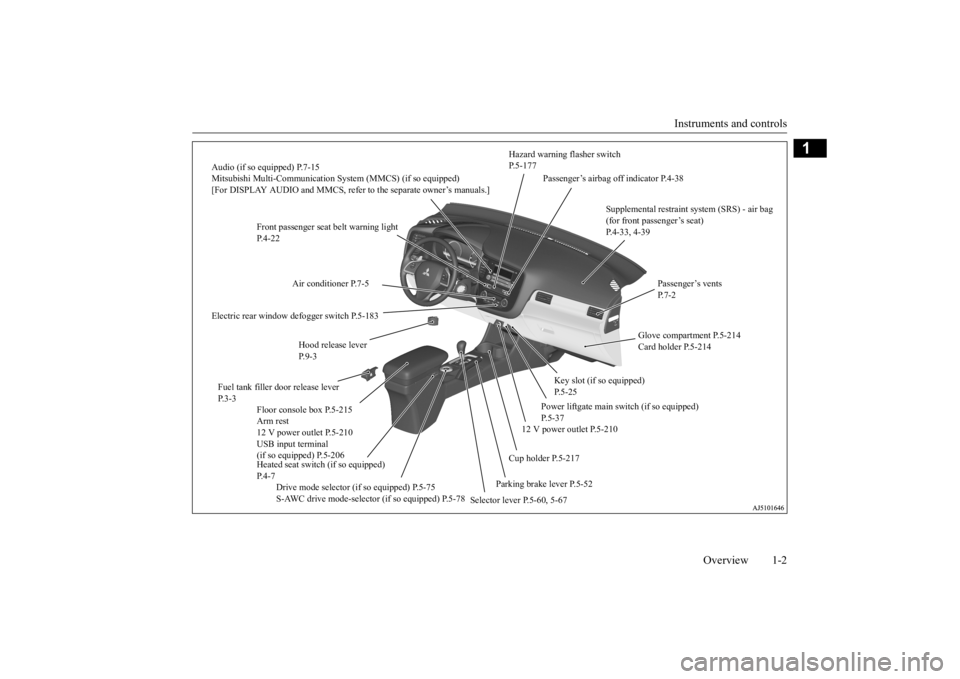
Audio (if so equipped) P.7-15 Mitsubishi Multi-Communication Syst
em (MMCS) (if so equipped)
[For DISPLAY AUDIO and MMCS, refer to the separate owner’s manuals.]
Hazard warning flasher switch P.5-177
Electric rear window defogger switch P.5-183 Fuel tank filler door release lever P. 3 - 3
Drive mode selector (if so equipped) P.5-75 S-AWC drive mode-selector (if so equipped) P.5-78
Selector lever P.5-60, 5-67
Parking brake lever P.5-52
Supplemental restraint system (SRS) - air bag (for front passenger’s seat) P.4-33, 4-39
Air conditioner P.7-5 Hood release lever P. 9 - 3
Floor console box P.5-215 Arm rest 12 V power outlet P.5-210 USB input terminal (if so equipped) P.5-206 Heated seat switch (if so equipped) P. 4 - 7
Cup holder P.5-217
12 V power outlet P.5-210
Power liftgate main sw
itch (if so equipped)
P.5-37
Key slot (if so equipped) P.5-25
Glove compartment P.5-214 Card holder P.5-214
Passenger’s vents P. 7 - 2
Passenger’s airbag off indicator P.4-38
Front passenger seat belt warning light P.4-22
BK0211800US.book 2 ページ 2014年3月12日 水曜日 午後2時42分
Page 5 of 446
Interior 1-3 Overview
1
N00100302314
Interior
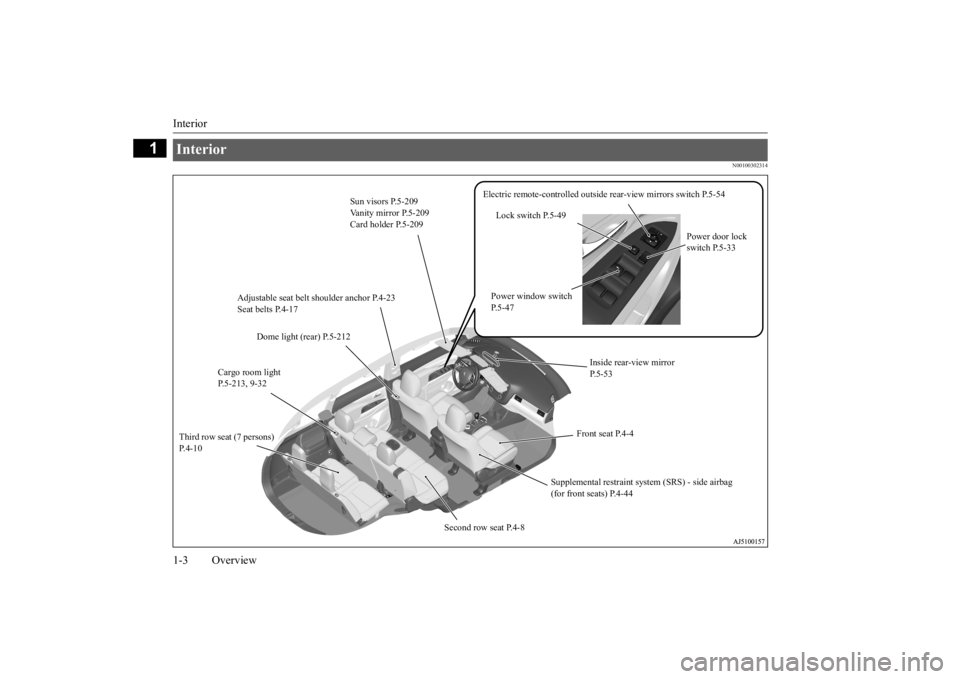
Sun visors P.5-209 Vanity mirror P.5-209Card holder P.5-209
Supplemental restraint system (SRS) - side airbag (for front seats) P.4-44
Front seat P.4-4
Adjustable seat belt shoulder anchor P.4-23 Seat belts P.4-17
Cargo room light P.5-213, 9-32
Electric remote-controlled outside rear-view mirrors switch P.5-54
Lock switch P.5-49
Power door lock switch P.5-33
Power window switch P.5-47
Second row seat P.4-8
Third row seat (7 persons) P. 4 - 1 0
Dome light (rear) P.5-212
Inside rear-view mirror P.5-53
BK0211800US.book 3 ページ 2014年3月12日 水曜日 午後2時42分
Page 12 of 446
If this warning light comes on or
flashes while you’re driving...
Quick index 2-3
2
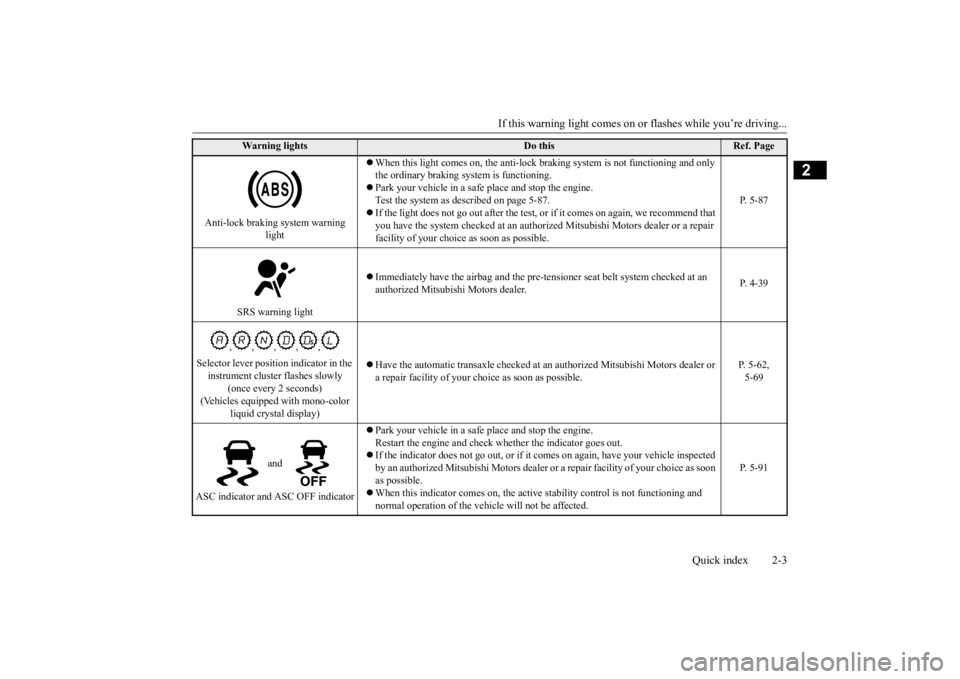
Anti-lock braking system warning
light
When this light comes on,
the anti-lock braking system
is not functioning and only
the ordinary braking system is functioning. Park your vehicle in a safe
place and stop the engine.
Test the system as described on page 5-87. If the light does not go out after the test, or
if it comes on again, we recommend that
you have the system checked at an authorized
Mitsubishi Motors dealer or a repair
facility of your choice
as soon as possible.
P. 5-87
SRS warning light
Immediately have the airbag and the pre-te
nsioner seat belt sy
stem checked at an
authorized Mitsubishi Motors dealer.
P. 4-39
Selector lever position indicator in the instrument cluste
r flashes slowly
(once every 2 seconds)
(Vehicles equipped with mono-color
liquid crystal display)
Have the automatic transaxle checked at an
authorized Mitsubishi Motors dealer or
a repair facility of your c
hoice as soon as possible.
P. 5-62, 5-69
and
ASC indicator and ASC OFF indicator
Park your vehicle in a safe
place and stop the engine.
Restart the engine and check
whether the indicator goes out.
If the indicator does not go out, or if it co
mes on again, have your vehicle inspected
by an authorized Mitsubishi Motors dealer or
a repair facility of your choice as soon
as possible. When this indicator comes on, the active
stability control is
not functioning and
normal operation of the vehicl
e will not be affected.
P. 5-91
Wa rn in g l ig h t s
Do this
Ref. Page
BK0211800US.book 3 ページ 2014年3月12日 水曜日 午後2時42分
Page 26 of 446
California Perchlorate Materials Requirements
General information 3-7
3
able from your Mitsubish
i Motors dealer are
a wide variety of acce
ssories to personalize
your new vehicle. Each Mitsubishi Motors vehicle has a selecti
on of Mitsubishi Motors
authorized accessories to choose from to tai-lor your new vehicle to your own personal preference. Your Mitsubishi Motors dealer’s Parts Manager has in
formation on various
audio systems,
protection items, as well as
interior and exterior ac
cessories available for
your specific model.
N00300100017
Certain components of this vehicle, such asairbag modules, seat belt pretensioners, and button cell batteries, ma
y contain perchlorate
materials.Special handling may apply. For additional information, see www.d
tsc.ca.gov/hazardous-
waste/perchlorate.California Perchlorate Materials Requirements
BK0211800US.book 7 ページ 2014年3月12日 水曜日 午後2時42分
Page 28 of 446
4
Seat and restraint systemsSeats .................................................................................................4-2 Seat arrangement .............................................................................4-3 Seats and restraint systems ..............................................................4-4Front seats ........................................................................................4-4 Second row seats .........
...........
...........
...........
...........
...........
.........
.....4-8
Third row seat (Seating 7 passengers) ...........................................4-10Head restraints ...............................................................................4-10 Making a cargo area .......................................................................4-12 Making a flat seat ...........................................................................4-16Seat belts ........................................................................................4-17 Seat belt use during pregnancy ......................................................4-24 Seat belt pre-tensioner and force limiter systems ..........................4-24Child restraint systems ...................................................................4-25 Maintenance and inspection of seat belts ......................................4-32 Supplemental Restraint Syst
em (SRS) - airbag ......
.........
.........
.....4-33
BK0211800US.book 1 ページ 2014年3月12日 水曜日 午後2時42分
Page 31 of 446
Seats and restraint systems 4-4 Seat and restraint systems
4
N00401601219
Your vehicle has seat
belts and other safety
features that help protect you and your pas- sengers in an accident.Seat belts are the most important safety device. When worn properly, seat belts can reduce the chance of serious injury or deathin various types of crashes. For added protec- tion during a severe fr
ontal collision, your
vehicle has a Supplemental Restraint System (SRS) with airbags for the driver and passen- gers. The seats, head restraints, and doorlocks also are safety equipment, which must be used correctly. Always check the following before you drive: That everyone in your vehicle is properly wearing their seat belt. That infants and small children are prop- erly secured in an appropriate child restraint system in the rear seat. That all doors are fully closed and locked. That seatbacks are upright, with head restraints properly adjusted.
Safety equipment cannot prevent injury or death in all motor ve
hicle accidents. How-
ever, you can help reduce the risk of injury or death, by following the instructions in thismanual.
N00401801426
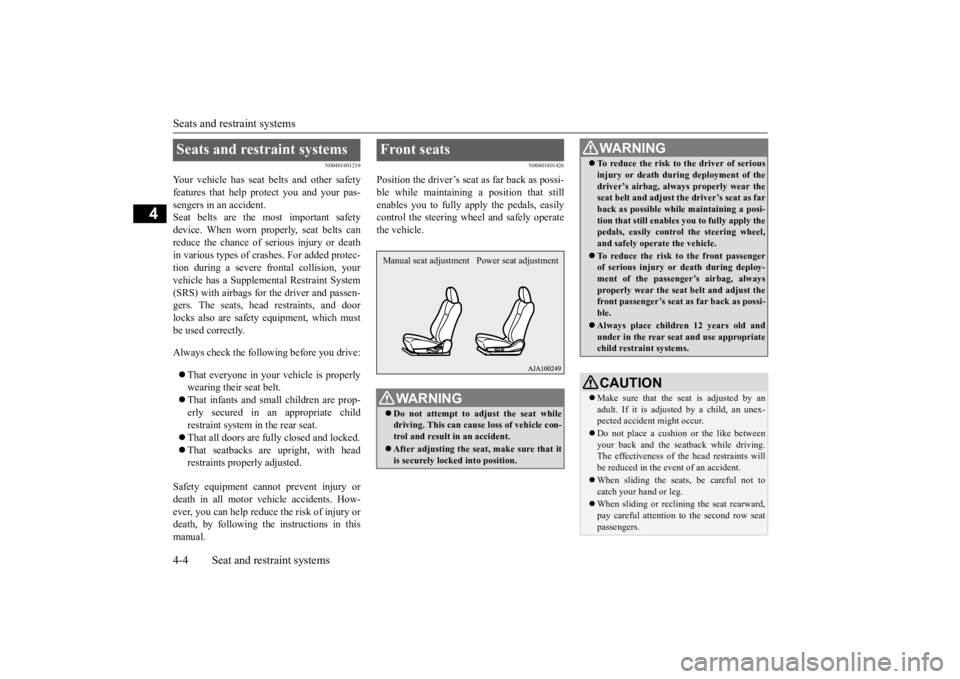
Position the driver’s seat
as far back as possi-
ble while maintaining a position that still enables you to fully apply the pedals, easilycontrol the steering wh
eel and safely operate
the vehicle.
Seats and restraint systems
Front seats
WA R N I N G Do not attempt to adjust the seat while driving. This can cause loss of vehicle con-trol and result
in an accident.
After adjusting the seat, make sure that it is securely locked into position.Manual seat adjustment Power seat adjustment
To reduce the risk to the driver of serious injury or death duri
ng deployment of the
driver’s airbag, always
properly wear the
seat belt and adjust th
e driver’s seat as far
back as possible while maintaining a posi- tion that still enables
you to fully apply the
pedals, easily control the steering wheel, and safely operate the vehicle. To reduce the risk to the front passenger of serious injury or
death during deploy-
ment of the passeng
er’s airbag, always
properly wear the seat
belt and adjust the
front passenger’s seat as far back as possi- ble. Always place childr
en 12 years old and
under in the rear seat
and use appropriate
child restraint systems.CAUTION Make sure that the seat is adjusted by an adult. If it is adjusted by a child, an unex- pected accident might occur. Do not place a cushion
or the like between
your back and the seatback while driving. The effectiveness of the head restraints willbe reduced in the event of an accident. When sliding the seat
s, be careful not to
catch your hand or leg. When sliding or reclin
ing the seat rearward,
pay careful attention
to the second row seat
passengers.WA R N I N G
BK0211800US.book 4 ページ 2014年3月12日 水曜日 午後2時42分
Page 33 of 446
Front seats 4-6 Seat and restraint systems
4
N00402001379
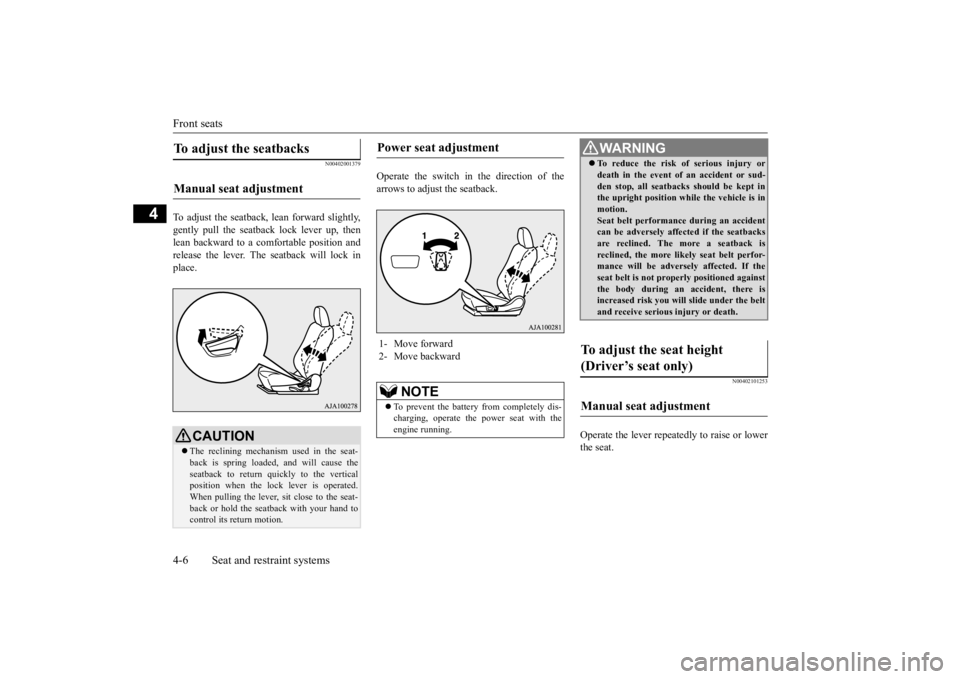
To adjust the seatback, lean forward slightly, gently pull the seatback lock lever up, then lean backward to a comfortable position andrelease the lever. The seatback will lock in place.
Operate the switch in the direction of the arrows to adjust the seatback.
N00402101253
Operate the lever repeatedly to raise or lower the seat.
To adjust the seatbacks Manual seat adjustment
CAUTION The reclining mechanism used in the seat- back is spring loaded, and will cause theseatback to return quickly to the vertical position when the lock lever is operated. When pulling the lever, sit close to the seat-back or hold the seatback with your hand to control its return motion.
Power seat adjustment 1- Move forward 2- Move backward
NOTE
To prevent the battery from completely dis- charging, operate the
power seat with the
engine running.
WA R N I N G To reduce the risk of serious injury or death in the event of
an accident or sud-
den stop, all seatbacks should be kept inthe upright position while the vehicle is in motion. Seat belt performance during an accidentcan be adversely affect
ed if the seatbacks
are reclined. The more a seatback is reclined, the more likely seat belt perfor-mance will be adversely affected. If the seat belt is not proper
ly positioned against
the body during an accident, there isincreased risk you will slide under the belt and receive serious
injury or death.
To adjust the seat height (Driver’s seat only) Manual seat adjustment
BK0211800US.book 6 ページ 2014年3月12日 水曜日 午後2時42分
Page 36 of 446
Second row seats
Seat and restraint systems 4-9
4
Pull the lever up and adjust the seatback by hand to the desired posit
ion, and release the
lever. The seatback will lock in place.
N00403001318
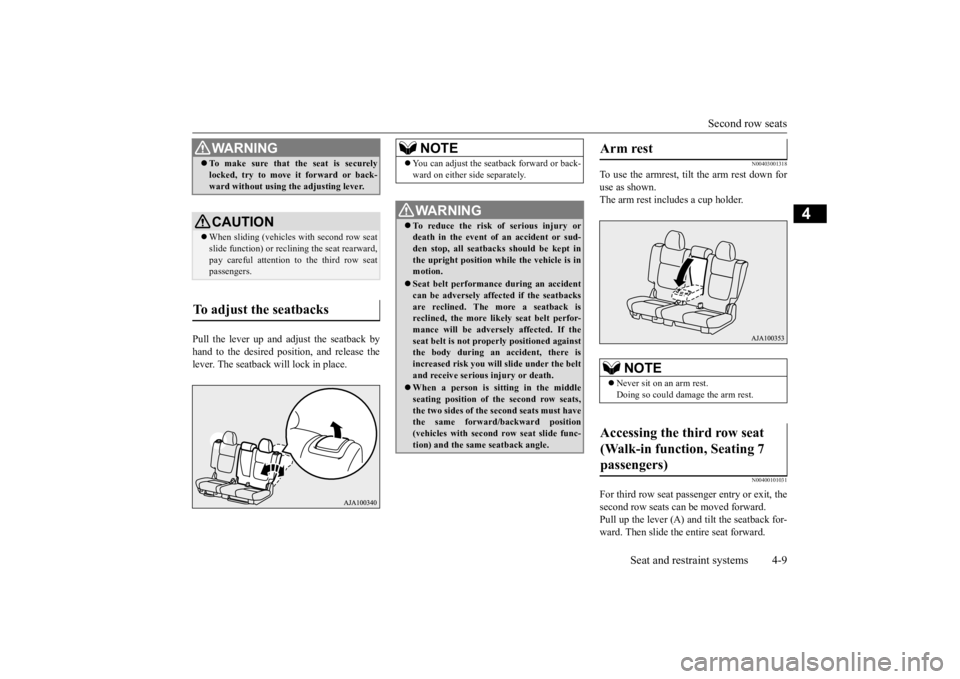
To use the armrest, tilt the arm rest down for use as shown. The arm rest includes a cup holder.
N00400101031
For third row seat passenger entry or exit, thesecond row seats can
be moved forward.
Pull up the lever (A) and tilt the seatback for- ward. Then slide the entire seat forward.
WA R N I N G To make sure that the seat is securely locked, try to move
it forward or back-
ward without using
the adjusting lever.
CAUTIONWhen sliding (vehicles with second row seat slide function) or reclin
ing the seat rearward,
pay careful attention to the third row seat passengers.
To adjust the seatbacks
NOTE
You can adjust the seat
back forward or back-
ward on either side separately.WA R N I N G To reduce the risk of serious injury or death in the event of
an accident or sud-
den stop, all seatbacks should be kept in the upright position while the vehicle is in motion. Seat belt performance during an accident can be adversely affect
ed if the seatbacks
are reclined. The more a seatback is reclined, the more likely seat belt perfor- mance will be advers
ely affected. If the
seat belt is not proper
ly positioned against
the body during an accident, there is increased risk you will slide under the beltand receive serious
injury or death.
When a person is si
tting in the middle
seating position of the second row seats, the two sides of the second seats must have the same forward/backward position(vehicles with second row seat slide func- tion) and the same seatback angle.
Arm rest
NOTE
Never sit on an arm rest. Doing so could damage the arm rest.
Accessing the third row seat (Walk-in function, Seating 7 passengers)
BK0211800US.book 9 ページ 2014年3月12日 水曜日 午後2時42分
Page 37 of 446
Third row seat (Seating 7 passengers) 4-10 Seat and restraint systems
4
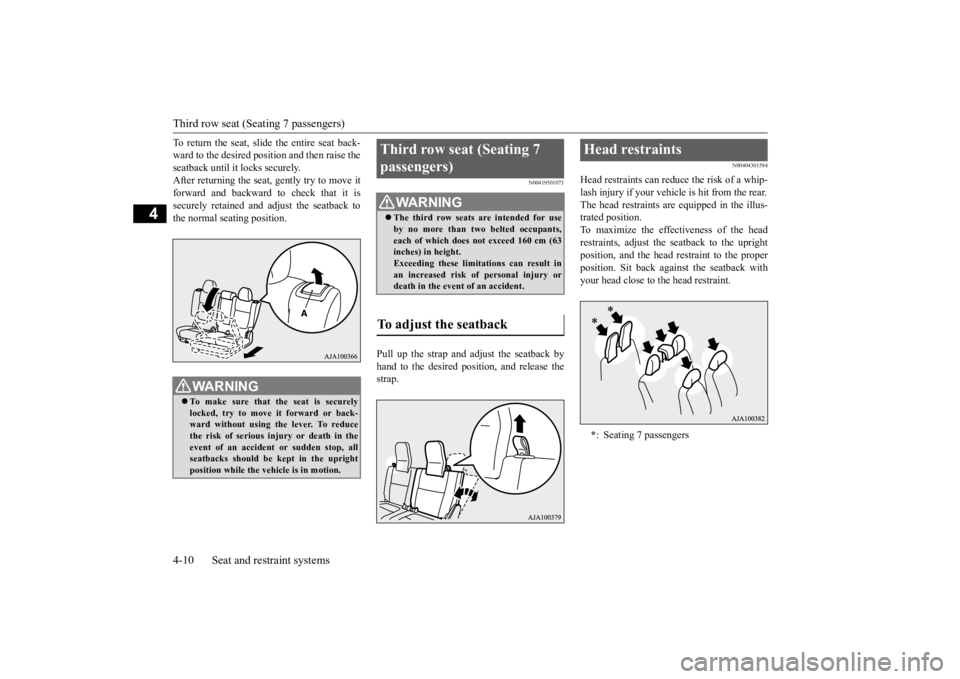
To return the seat, slide the entire seat back- ward to the desired position and then raise theseatback until it locks securely. After returning the seat, gently try to move it forward and backward to check that it issecurely retained and adjust the seatback to the normal seating position.
N00419501073
Pull up the strap and adjust the seatback by hand to the desired posit
ion, and release the
strap.
N00404301594
Head restraints can reduce the risk of a whip- lash injury if your vehicle is hit from the rear. The head restraints ar
e equipped in the illus-
trated position. To maximize the effectiveness of the head restraints, adjust the seatback to the uprightposition, and the head restraint to the proper position. Sit back against the seatback with your head close to the head restraint.
WA R N I N G To make sure that the seat is securely locked, try to move it forward or back-ward without using the lever. To reduce the risk of serious in
jury or death in the
event of an accident
or sudden stop, all
seatbacks should be kept in the upright position while the vehicle is in motion.
Third row seat (Seating 7 passengers)
WA R N I N G The third row seats are intended for use by no more than two belted occupants,each of which does not exceed 160 cm (63 inches) in height. Exceeding these limitations can result inan increased risk of
personal injury or
death in the event of an accident.
To adjust the seatback
Head restraints * : Seating 7 passengers
BK0211800US.book 10 ページ 2014年3月12日 水曜日 午後2時42分
Page 39 of 446
Making a cargo area 4-12 Seat and restraint systems
4
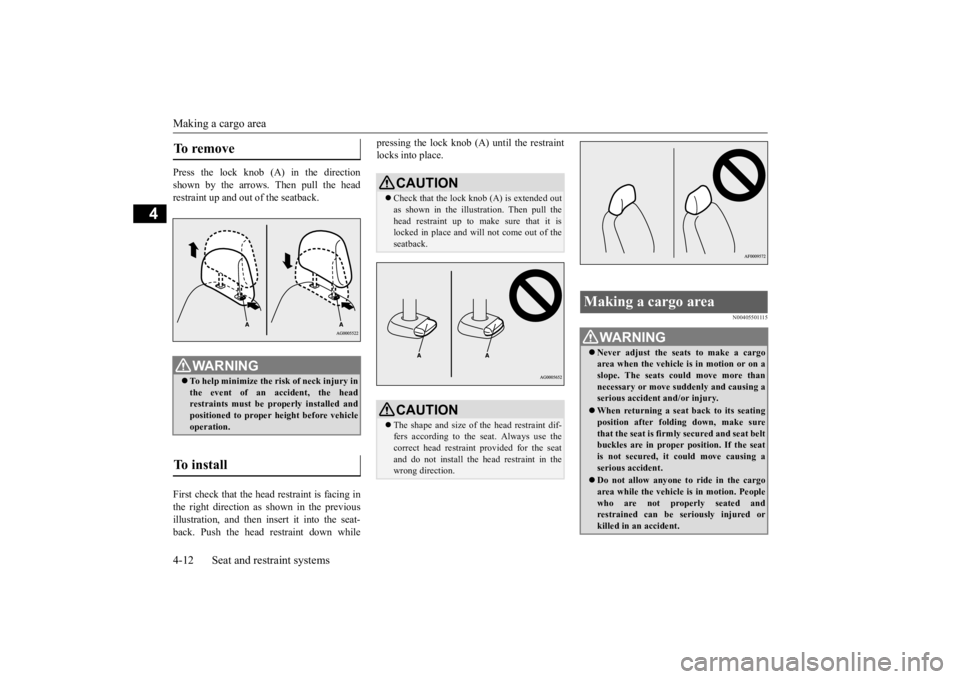
Press the lock knob (A) in the direction shown by the arrows. Then pull the head restraint up and out of the seatback. First check that the head restraint is facing in the right direction as
shown in the previous
illustration, and then insert it into the seat- back. Push the head restraint down while
pressing the lock knob (A) until the restraint locks into place.
N00405501115
To remove
WA R N I N G To help minimize the risk of neck injury in the event of an
accident, the head
restraints must be properly installed and positioned to proper height before vehicle operation.
To install
CAUTION Check that the lock knob (A) is extended out as shown in the illustration. Then pull the head restraint up to make sure that it is locked in place and will
not come out of the
seatback.CAUTION The shape and size of the head restraint dif- fers according to the seat. Always use the correct head restrain
t provided for the seat
and do not install the he
ad restraint in the
wrong direction.
Making a cargo area
WA R N I N G Never adjust the seats to make a cargo area when the vehicle is
in motion or on a
slope. The seats could move more thannecessary or move suddenly and causing a serious accident
and/or injury.
When returning a seat back to its seating position after folding down, make sure that the seat is firmly secured and seat beltbuckles are in proper position. If the seat is not secured, it could move causing a serious accident. Do not allow anyone to ride in the cargo area while the vehicle
is in motion. People
who are not properly seated and restrained can be seriously injured or killed in an accident.
BK0211800US.book 12 ページ 2014年3月12日 水曜日 午後2時42分