airbag MITSUBISHI OUTLANDER III 2017 User Guide
[x] Cancel search | Manufacturer: MITSUBISHI, Model Year: 2017, Model line: OUTLANDER III, Model: MITSUBISHI OUTLANDER III 2017Pages: 521, PDF Size: 14.95 MB
Page 48 of 521
Seat belts
Seat and restraint systems 4-19
4
N00406201513
All seats are equipped with a seat belt which uses one combined lap-and-shoulder belt with an emergency locking retractor. This system is designed to provide both com- fort and safety. It perm
its full extension and
automatic retraction of the belts during nor- mal vehicle operation.
A sensing device
inside the belt retractor is designed to lock the retractor in the event of a sudden change inthe vehicle’s motion.
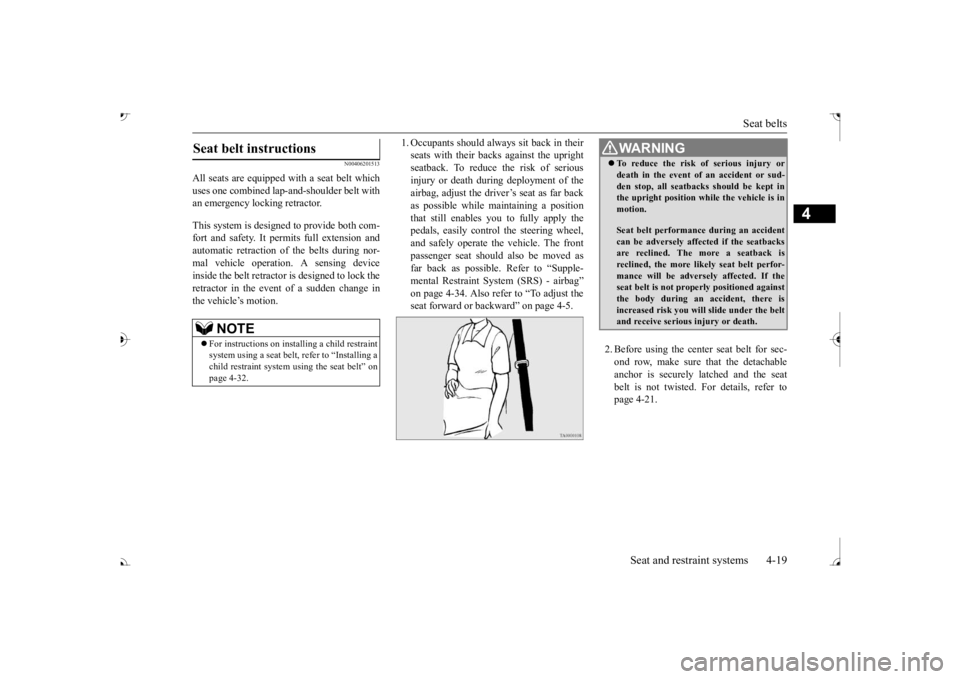
1. Occupants should always
sit back in their
seats with their backs against the uprightseatback. To reduce
the risk of serious
injury or death during deployment of the airbag, adjust the driver’s seat as far backas possible while maintaining a position that still enables you to fully apply the pedals, easily control the steering wheel,and safely operate the vehicle. The front passenger seat should also be moved as far back as possible. Refer to “Supple- mental Restraint System (SRS) - airbag” on page 4-34. Also refer to “To adjust theseat forward or backward” on page 4-5.
2. Before using the center seat belt for sec- ond row, make sure that the detachable anchor is securely
latched and the seat
belt is not twisted. For details, refer topage 4-21.
Seat belt instructions
NOTE
For instructions on installing a child restraint system using a seat belt
, refer to “Installing a
child restraint system
using the seat belt” on
page 4-32.
WA R N I N G To reduce the risk of serious injury or death in the event of
an accident or sud-
den stop, all seatbacks should be kept inthe upright position while the vehicle is in motion. Seat belt performance during an accident can be adversely affect
ed if the seatbacks
are reclined. The more a seatback isreclined, the more likely seat belt perfor- mance will be advers
ely affected. If the
seat belt is not prop
erly positioned against
the body during an accident, there is increased risk you will slide under the belt and receive serious
injury or death.
BK0239700US.book 19 ページ 2016年6月16日 木曜日 午前10時58分
Page 55 of 521
Seat belt pre-tensioner
and force limiter systems
4-26 Seat and restraint systems
4
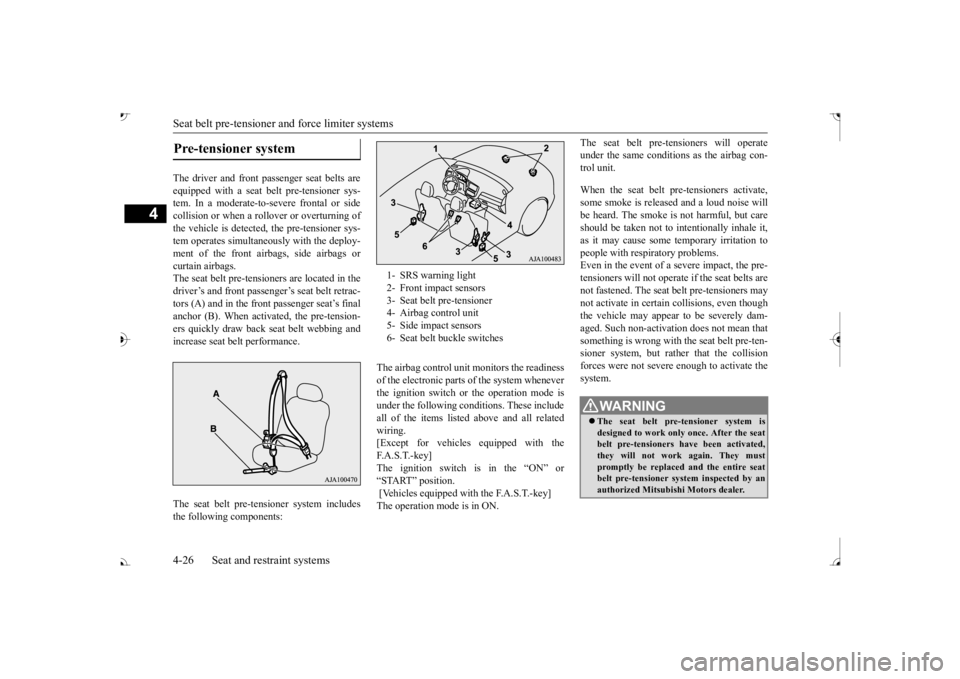
The driver and front pa
ssenger seat belts are
equipped with a seat belt pre-tensioner sys- tem. In a moderate-to-severe frontal or sidecollision or when a rollover or overturning of the vehicle is detected, the pre-tensioner sys- tem operates simultaneous
ly with the deploy-
ment of the front airb
ags, side airbags or
curtain airbags. The seat belt pre-tensi
oners are located in the
driver’s and front passenger’s seat belt retrac- tors (A) and in the front
passenger se
at’s final
anchor (B). When activated, the pre-tension- ers quickly draw back seat belt webbing and increase seat belt performance. The seat belt pre-tens
ioner system includes
the following components:
The airbag control unit monitors the readiness of the electronic parts of the system whenever the ignition switch or the operation mode is under the following conditions. These includeall of the items listed
above and all related
wiring. [Except for vehicles
equipped with the
F. A . S . T. - k e y ] The ignition switch is in the “ON” or “START” position. [Vehicles equipped with the F.A.S.T.-key] The operation mode is in ON.
The seat belt pre-tens
ioners will operate
under the same conditions
as the airbag con-
trol unit. When the seat belt pre-tensioners activate, some smoke is released
and a loud noise will
be heard. The smoke is
not harmful, but care
should be taken not to in
tentionally inhale it,
as it may cause some
temporary irritation to
people with respiratory problems.Even in the event of a severe impact, the pre- tensioners will
not operate if the seat belts are
not fastened. The seat be
lt pre-tensioners may
not activate in certai
n collisions, even though
the vehicle may appear
to be severely dam-
aged. Such non-activation does not mean that something is wrong with
the seat belt pre-ten-
sioner system, but rather that the collisionforces were not severe
enough to activate the
system.
Pre-tensioner system
1- SRS warning light 2- Front impact sensors 3- Seat belt
pre-tensioner
4- Airbag control unit5- Side impact sensors 6- Seat belt
buckle switches
WA R N I N GThe seat belt pre-tensioner system is designed to work only
once. After the seat
belt pre-tensioners have been activated, they will not work again. They must promptly be replaced and the entire seatbelt pre-tensioner system inspected by an authorized Mitsubis
hi Motors dealer.
BK0239700US.book 26 ページ 2016年6月16日 木曜日 午前10時58分
Page 56 of 521
Child restraint systems
Seat and restraint systems 4-27
4
N00408701147
This warning light tells you if there is a prob- lem involving the SRS airbags and/or the seat belt pre-tensioner system. Refer to “SRSwarning light/display” on page 4-40.
N00408900126
In the event of an accident, the seat belt force limiter system will help reduce the force applied to the driver a
nd front seat passenger.
N00407101740
When transporting infants or small children in your vehicle, an appr
opriate child restraint
system must always be
used. This is required
by law in the U.S. and Canada. Child restraint systems specifically designedfor infants and small children are offered by several manufacturers. Choose only a child restraint system with a label certifying that itcomplies with Federal Motor Vehicle Safety Standard 213 (FMVSS 213) or Motor Vehicle Restraint Systems and
Booster Seats Safety
Regulations (RSSR).
Look for the manufac-
turer’s statement of compliance on the box and child restraint system itself.
The child restraint system should be appropri- ate for your child’s we
ight and height, and
should properly fit your vehicle’s seat. For detailed information,
refer to the instruc-
tion manual accompanying the child restraintsystem. All children should be properly restrained in a restraint device that offers the maximumprotection for their size and age. Be sure to check local,
state, or provincial
requirements for child size and age that mayvary from the recommendations listed below. Children less than 1 year old and who weigh 22 pounds (10 kg) or less MUST ride in a rear-facing child safety seat thatMUST ONLY be used in the second row seat. Children older than 1 year of age and who weigh less than 40 pounds (18 kg) or who are less than 40 inches (100 cm) tall must be in a forward-facing restraint used onlyin the rear seat.
Children who weigh more than 40 pounds (18 kg) or who are more than 40 inches(100 cm) tall, regardless of age, should use a suitable child seat or a booster seat in the rear seat until the vehicle’s lap-and-shoulder belt fits
them properly.
SRS warning Force limiter system Child restraint systems
Guidelines for child restraint system selection
WA R N I N G All children must be seated in the rear seat, and properly restrained.Accident statistics
show that children of
all sizes and ages are safer when properly restrained in the rear seat, rather than inthe front seat. Be sure to select a child restraint system that is appropriate not only for the child’s size and age but also for your vehicle. Some child restraint systems may not fityour vehicle properly.
BK0239700US.book 27 ページ 2016年6月16日 木曜日 午前10時58分
Page 57 of 521
Child restraint systems 4-28 Seat and restraint systems
4
Any child who is too large to use a child restraint system should ride in the rearseat and wear the la
p-and-shoulder belt
properly. The shoulder belt must be posi- tioned over the shou
lder and across the
chest, not across their neck, and with thelap belt positioned low on the child’s hips, not across their stomach. If necessary, a booster seat should be
used to help achieve
a proper seat belt fi
t. Follow the booster
seat manufacturer’s instructions. Only use a booster seat that is
certified as comply-
ing with Federal Motor Vehicle Safety Standards or Motor Vehicle Restraint Sys- tems and Booster Seats Safety Regula-tions. WA R N I N G
WA R N I N G Never hold an infant
or child in your arms
or on your lap when ri
ding in this vehicle,
even when you are wearing your seat belt.Never place any part of the seat belt you are wearing around an
infant or child.
Failure to follow these simple instructionscreates a risk of serious injury or death to your child in the even
t of an accident or
sudden stop.
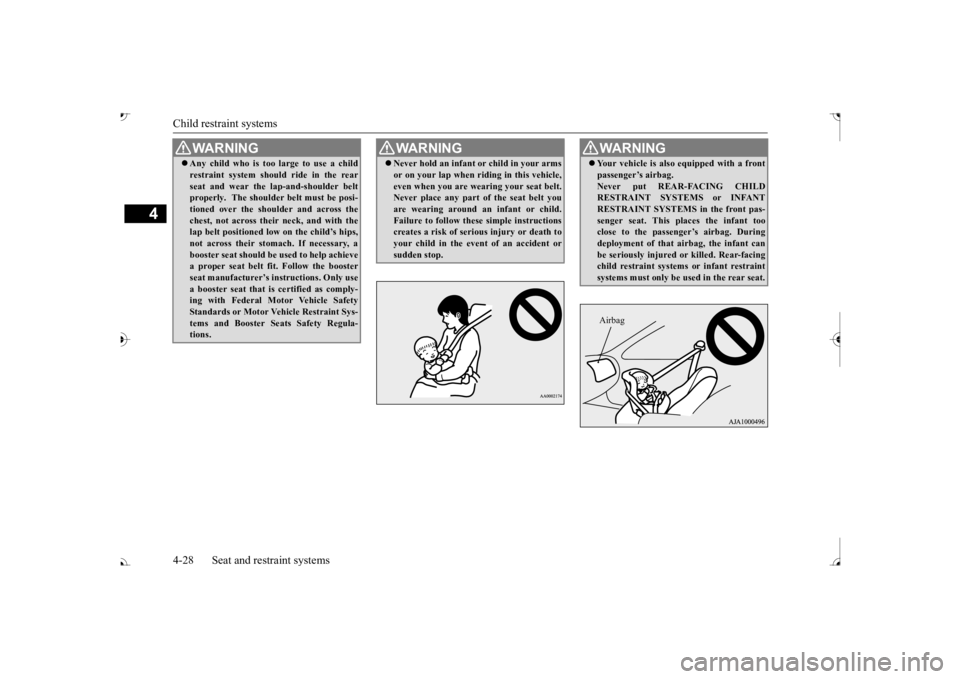
WA R N I N G Your vehicle is also equipped with a front passenger’s airbag.Never put REAR-FACING CHILDRESTRAINT SYSTEMS or INFANT RESTRAINT SYSTEMS in the front pas- senger seat. This places the infant tooclose to the passenger’s airbag. During deployment of that airbag, the infant can be seriously injured
or killed.
Rear-facing
child restraint systems or infant restraint systems must only be used in the rear seat.Airbag
BK0239700US.book 28 ページ 2016年6月16日 木曜日 午前10時58分
Page 63 of 521
Maintenance and inspection of seat belts 4-34 Seat and restraint systems
4
Systems and Booster Se
ats Safety Regula-
tions.
N00407001390
Regularly check your seat belt buckles andtheir release mechanisms for positive engage-ment and release of the latch plate. Check the retractors for automatic locking when in the Automatic Locking Retractor function. The entire seat belt assembly should be replaced if the webbing shows any obvious
cuts, tears, increase in thickness in any sec- tion of the webbing from broken fibers, orsevere fading from sunlig
ht. All of these con-
ditions indicate a weakening of the belt, which may adversely affe
ct seat belt perfor-
mance in an accident.
N00407701863
This vehicle is equippe
d with a Supplemental
Restraint System (SRS), which includes air- bags for the driver and passengers. The SRS front airbags are designed to supple- ment the primary protection of the driver and front passenger seat belt systems by provid- ing those occupants w
ith protection against
head and chest injuries
in certain moderate to
severe frontal collisi
ons. The SRS front air-
bags, together with sensors at the front of the vehicle and sensors attached to the front seats, form an adva
nced airbag system.
The SRS side airbags and the curtain airbags are also designed to s
upplement the seat belts.
The SRS side airbags provide the driver and front passenger with pr
otection against chest
injuries by deploying the bag on the side impacted in moderate
to severe side impact
collisions. The SRS curtain airbags providethe driver and the passengers on the front seat and the second row outboard seats with pro- tection against head in
juries by deploying the
curtain airbag on the side impacted in moder- ate to severe side im
pact collisions and by
deploying both curtain airbags when a roll-over is detected. The curtain airbags are also designed to help reduce the risk of complete
WA R N I N G Any child who is too small to properly wear a seat belt
must be properly
restrained in an appropriate child restraint system, to reduce their risk ofserious injury or de
ath in an
accident.
A child should never be
left unattended in,
or unsupervised around, your vehicle. When you leave the ve
hicle, always take
the child out as well. Children can die from heat stroke if left or trapped inside the vehicle, especially onhot days. Keep your vehicle locked when not in use. Keep your vehicle keys away from chil- dren.
Maintenance and inspection of seat belts
WA R N I N G Do not attempt to repair or replace any part of the seat belt assemblies. This workshould be done by an authorized Mitsubishi Motors dealer. Failure to have an authorized Mits
ubishi Motors dealer
perform the work could reduce the effec- tiveness of the belts an
d could result in a
serious injury or de
ath in an accident.
Never use an organic solvent to clean the seat belt webbing. Do not attempt tobleach or re-dye th
e seat belt webbing.
These may weaken the
seat belt webbing,
increasing risk of in
jury or death in an
accident. Clean seat belt webb
ing only with mild
soap or detergent solution and rinse itwith lukewarm water, and dry the seat belt webbing completely before retracting it.
Supplemental Restraint Sys- tem (SRS) - airbag
BK0239700US.book 34 ページ 2016年6月16日 木曜日 午前10時58分
Page 64 of 521
Supplemental Restraint System (SRS) - airbag
Seat and restraint systems 4-35
4
and partial ejection fro
m the vehicle through
side windows in both side impact and roll-over type accidents. The SRS airbags are NOT a substitute for use of the seat belts. For maximum protection in all types of accidents, seat belts mustALWAYS be worn by everyone who drives or rides in this vehicle
(with infants and small
children in an appropriate child restraint sys-tem in the rear seat, and older children buck- led in the rear seat). Refer to “Child restraint systems” on page 4-27.
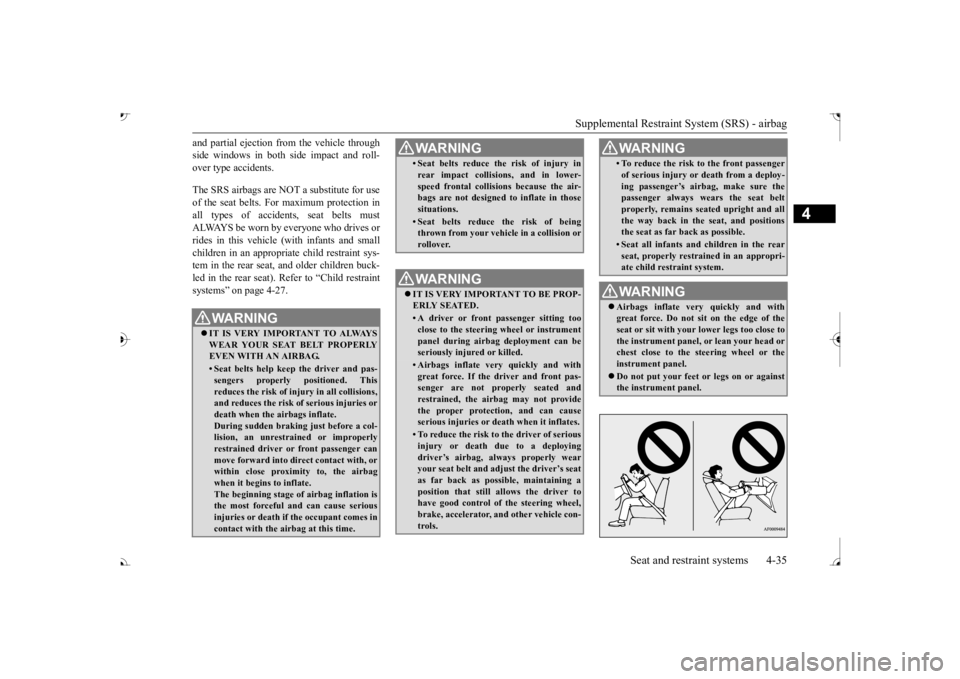
WA R N I N G IT IS VERY IMPORTANT TO ALWAYS WEAR YOUR SEAT BELT PROPERLY EVEN WITH AN AIRBAG.• Seat belts help keep the driver and pas-sengers properly positioned. This reduces the risk of injury in all collisions,and reduces the risk of serious injuries or death when the
airbags inflate.
During sudden braking just before a col-lision, an unrestra
ined or
improperly
restrained driver or front passenger can move forward into direct contact with, orwithin close proximi
ty to, the airbag
when it begins to inflate. The beginning stage of
airbag inflation is
the most forceful and can cause serious injuries or death if the occupant comes in contact with the airbag at this time.
• Seat belts reduce the risk of injury inrear impact collisions, and in lower-speed frontal collisions because the air-bags are not designed
to inflate in those
situations.• Seat belts reduce the risk of beingthrown from your vehi
cle in a collision or
rollover.WA R N I N G IT IS VERY IMPORTANT TO BE PROP- ERLY SEATED.• A driver or front passenger sitting tooclose to the steering wheel or instrumentpanel during airbag deployment can be seriously inju
red or killed.
• Airbags inflate ve
ry quickly and with
great force. If the driver and front pas- senger are not properly seated andrestrained, the airbag may not provide the proper protection, and can cause serious injuries or death when it inflates.• To reduce the risk to the driver of seriousinjury or death due to a deployingdriver’s airbag, al
ways properly wear
your seat belt and adju
st the driver’s seat
as far back as possible, maintaining a position that still allows the driver tohave good control of the steering wheel, brake, accelerator, and other vehicle con- trols.WA R N I N G
• To reduce the risk to the front passengerof serious injury or
death from a deploy-
ing passenger’s airbag, make sure thepassenger always wears the seat belt properly, remains seat
ed upright and all
the way back in the
seat, and positions
the seat as far back as possible.• Seat all infants and children in the rearseat, properly restrain
ed in an appropri-
ate child restraint system.WA R N I N G Airbags inflate very
quickly and with
great force. Do not sit on the edge of the seat or sit with your
lower legs too close to
the instrument panel,
or lean your head or
chest close to the steering wheel or the instrument panel. Do not put your feet or legs on or against the instrument panel.WA R N I N G
BK0239700US.book 35 ページ 2016年6月16日 木曜日 午前10時58分
Page 65 of 521
Supplemental Restraint System (SRS) - airbag 4-36 Seat and restraint systems
4
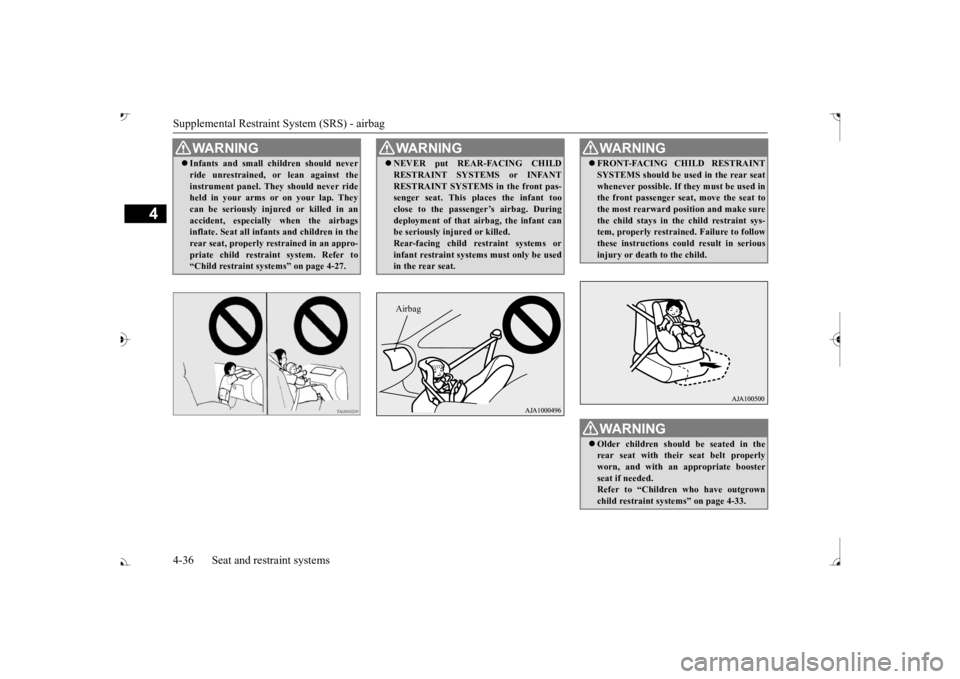
WA R N I N G Infants and small children should never ride unrestrained,
or lean against the
instrument panel. They should never rideheld in your arms or
on your lap. They
can be seriously inju
red or killed in an
accident, especially when the airbagsinflate. Seat all infa
nts and children in the
rear seat, properly re
strained in an appro-
priate child restraint system. Refer to“Child restraint systems” on page 4-27.
WA R N I N G NEVER put REAR-FACING CHILD RESTRAINT SYSTEMS or INFANTRESTRAINT SYSTEMS in the front pas-senger seat. This pl
aces the infant too
close to the passenger’s airbag. During deployment of that airbag, the infant canbe seriously inju
red or killed.
Rear-facing child restraint systems or infant restraint systems must only be usedin the rear seat.Airbag
WA R N I N G FRONT-FACING CHILD RESTRAINT SYSTEMS should be used in the rear seatwhenever possible. If they must be used inthe front passenger se
at, move the seat to
the most rearward po
sition and make sure
the child stays in the child restraint sys-tem, properly restrained. Failure to follow these instructions could result in serious injury or death to the child.WA R N I N G Older children should be seated in the rear seat with thei
r seat belt properly
worn, and with an
appropriate booster
seat if needed. Refer to “Children
who have outgrown
child restraint systems” on page 4-33.
BK0239700US.book 36 ページ 2016年6月16日 木曜日 午前10時58分
Page 66 of 521
Supplemental Restraint System (SRS) - airbag
Seat and restraint systems 4-37
4
N00407801532
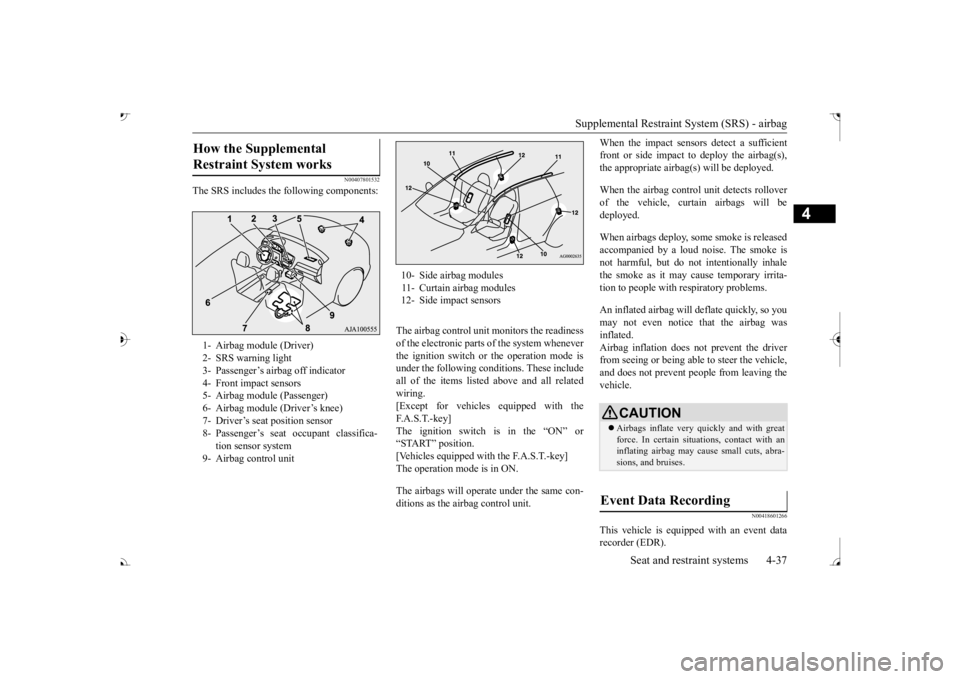
The SRS includes the following components:
The airbag control unit
monitors the readiness
of the electronic parts of the system whenever the ignition switch or the operation mode is under the following conditions. These include all of the item
s listed above a
nd all related
wiring.[Except for vehicles equipped with the F. A . S . T. - k e y ] The ignition switch is in the “ON” or“START” position. [Vehicles equipped with the F.A.S.T.-key] The operation mode is in ON. The airbags will operate under the same con- ditions as the airbag control unit.
When the impact sensors detect a sufficient front or side impact to deploy the airbag(s),the appropriate airbag
(s) will be deployed.
When the airbag control unit detects rollover of the vehicle, curtain airbags will be deployed. When airbags deploy, some smoke is released accompanied by a loud noise. The smoke is not harmful, but do not
intentionally inhale
the smoke as it may ca
use temporary irrita-
tion to people with respiratory problems. An inflated airbag will
deflate quickly, so you
may not even notice that the airbag wasinflated. Airbag inflation does not prevent the driver from seeing or being able
to steer the vehicle,
and does not prevent people from leaving the vehicle.
N00418601266
This vehicle is equipped with an event data recorder (EDR).
How the Supplemental Restraint System works 1- Airbag module (Driver) 2- SRS warning light 3- Passenger’s airb
ag off indicator
4- Front impact sensors5- Airbag module (Passenger) 7- Driver’s seat position sensor8- Passenger’s seat oc
cupant classifica-
tion sensor system
9- Airbag control unit
10- Side airbag modules11- Curtain airbag modules12- Side impact sensors
CAUTION Airbags inflate very quickly and with great force. In certain situations, contact with aninflating airbag may cause small cuts, abra- sions, and bruises.
Event Data Recording
BK0239700US.book 37 ページ 2016年6月16日 木曜日 午前10時58分
Page 67 of 521
Supplemental Restraint System (SRS) - airbag 4-38 Seat and restraint systems
4
The main purpose of an EDR is to record, in certain crash or near crash-like situations,such as an airbag deployment or hitting a road obstacle, data that
will assist in under-
standing how a vehicle’s systems performed.The EDR is designed to
record data related to
vehicle dynamics and sa
fety systems for a
short period of time,
typically 30 seconds or
less. The EDR in this vehicle is designed to record such data as: How various systems in your vehicle were operating; Whether or not the driver and front pas- senger safety belts
were buckled/fastened;
How far (if at all) the driver was depress- ing the accelerator and/or brake pedal; and, How fast the vehicle was traveling.
These data can help provide a better under- standing of the circumstances in which crashes and injuries occur.
To read data recorded
by an EDR, special
equipment is required, a
nd access to the vehi-
cle or the EDR is needed. In addition to thevehicle manufacturer, ot
her parties, such as
law enforcement, that have the special equip- ment, can read the information if they haveaccess to the vehicle or the EDR.
N00417900177
The driver’s seat posit
ion sensor is attached
to the seat rail and provides the airbag control unit with information
on the seat’s fore-aft
position. The airbag control unit controlsdeployment of the driver’s front airbag in accordance with the information it receives from this sensor.If there is a problem involving the driver’s seat position sensor, th
e SRS warning light in
the instrument panel will come on. Refer to “SRS warning light/display” on page 4-40.
N00418001374
The passenger’s seat oc
cupant classification
sensor system is attached to the front passen- ger seat cushion and provides the airbag con-trol unit with inform
ation regarding the
occupant on the front passenger seat. The air-
NOTE
EDR data are recorded by your vehicle only if a non-trivial crash situation occurs; no dataare recorded by the EDR under normal driv-ing conditions and no
personal data (e.g.,
name, gender, age, and crash location) are recorded. However, other parties, such aslaw enforcement, could combine the EDR data with the type of personally identifying data routinely acquire
d during a crash inves-
tigation.
Driver’s seat position sensor
WA R N I N G If the SRS warning li
ght or warning dis-
play comes on, have th
e vehicle inspected
by an authorized
Mitsubishi Motors
dealer as soon
as possible.
Please observe the following instructions to ensure that the driver’s seat positionsensor can operate correctly.• Adjust the seat to the correct position,and sit well back
against the seatback.
Refer to “Front seats” on page 4-4.• Do not recline the seatback more thannecessary when driving.• Do not place metall
ic objects or luggage
under the front seat.
If the vehicle is involved in a severe impact, have the SRS sensors inspected by an authorized
Mitsubishi Motors dealer as
soon as possible.
Passenger’s seat occupant clas- sification sensor system
BK0239700US.book 38 ページ 2016年6月16日 木曜日 午前10時58分
Page 68 of 521
Supplemental Restraint System (SRS) - airbag
Seat and restraint systems 4-39
4
bag control unit controls deployment of the passenger’s front airbag in accordance withthe information it receives from this system. The passenger’s front ai
rbag will not deploy
in an impact when the system senses no occu-pant on the front passenger’s seat or a child in a child restraint system. In this case, the pas- senger airbag off indi
cator will come on.
Refer to “Passenger’s ai
rbag off indicator” on
page 4-39. If there is a problem involving the passen- ger’s seat occupant cl
assification sensor sys-
tem, the SRS warning light in the instrumentpanel will come on. Refer to “SRS warning light/display” on page 4-40.
N00418101346
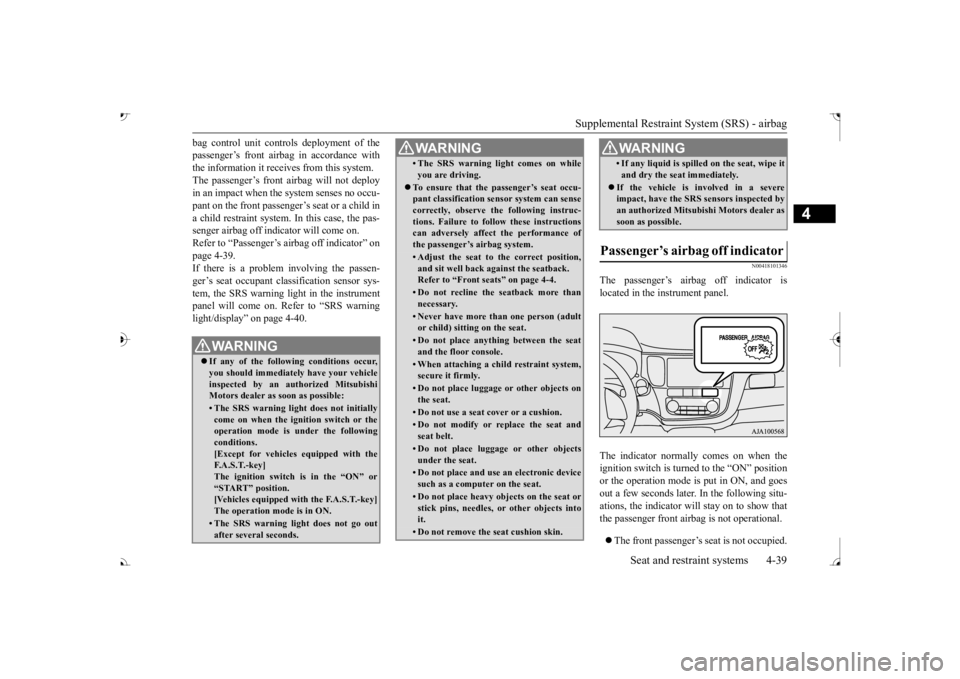
The passenger’s airbag off indicator is located in the instrument panel. The indicator normall
y comes on when the
ignition switch is turned to the “ON” position or the operation mode is put in ON, and goes out a few seconds later. In the following situ-ations, the indicator will stay on to show that the passenger front airb
ag is not operational.
The front passenger’s seat is not occupied.
WA R N I N GIf any of the following conditions occur, you should immediatel
y have your vehicle
inspected by an au
thorized Mitsubishi
Motors dealer as
soon as possible:
• The SRS warning light does not initially come on when the ignition switch or the operation mode is under the followingconditions. [Except for vehicles equipped with the F. A . S . T. - k e y ]The ignition switch is in the “ON” or “START” position. [Vehicles equipped with the F.A.S.T.-key]The operation mode is in ON.• The SRS warning light does not go outafter several seconds.
• The SRS warning li
ght comes on while
you are driving.
To ensure that the passenger’s seat occu- pant classification sensor system can sense correctly, observe the following instruc-tions. Failure to follow these instructions can adversely affect
the performance of
the passenger’s airbag system.• Adjust the seat to the correct position,and sit well back
against the seatback.
Refer to “Front seats” on page 4-4.• Do not recline the seatback more thannecessary.• Never have more than one person (adultor child) sitting
on the seat.
• Do not place anything between the seat and the floor console.• When attaching a chil
d restraint system,
secure it firmly.• Do not place luggage
or other objects on
the seat.• Do not use a seat cover or a cushion.• Do not modify or replace the seat andseat belt.• Do not place luggage or other objectsunder the seat.• Do not place and use
an electronic device
such as a computer on the seat.• Do not place heavy objects on the seat orstick pins, needles, or other objects intoit.• Do not remove the seat cushion skin.WA R N I N G
• If any liquid is spilled on the seat, wipe itand dry the seat
immediately.
If the vehicle is involved in a severe impact, have the SRS sensors inspected by an authorized
Mitsubishi Motors dealer as
soon as possible.
Passenger’s airbag off indicator
WA R N I N G
BK0239700US.book 39 ページ 2016年6月16日 木曜日 午前10時58分