seats MITSUBISHI OUTLANDER III 2017 User Guide
[x] Cancel search | Manufacturer: MITSUBISHI, Model Year: 2017, Model line: OUTLANDER III, Model: MITSUBISHI OUTLANDER III 2017Pages: 521, PDF Size: 14.95 MB
Page 39 of 521
Third row seat (Seating 7 passengers) 4-10 Seat and restraint systems
4
N00403001318
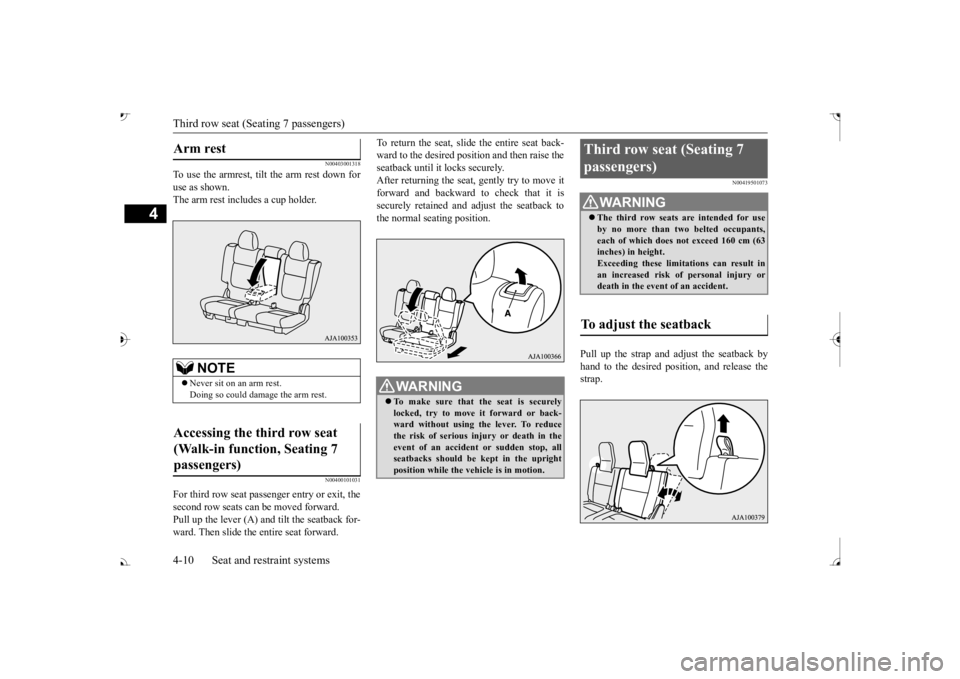
To use the armrest, tilt the arm rest down for use as shown. The arm rest includes a cup holder.
N00400101031
For third row seat passenger entry or exit, thesecond row seats can be moved forward.Pull up the lever (A) and tilt the seatback for- ward. Then slide the entire seat forward.
To return the seat, slide the entire seat back- ward to the desired pos
ition and then raise the
seatback until it locks securely. After returning the seat, gently try to move it forward and backward to check that it issecurely retained and adjust the seatback to the normal seating position.
N00419501073
Pull up the strap and ad
just the seatback by
hand to the desired position, and release thestrap.
Arm rest
NOTE
Never sit on an arm rest. Doing so could damage the arm rest.
Accessing the third row seat (Walk-in function, Seating 7 passengers)
WA R N I N G To make sure that the seat is securely locked, try to move it forward or back-ward without using the lever. To reduce the risk of serious in
jury or death in the
event of an accident
or sudden stop, all
seatbacks should be kept in the upright position while the ve
hicle is in motion.
Third row seat (Seating 7 passengers)
WA R N I N G The third row seats are intended for use by no more than two belted occupants,each of which does not exceed 160 cm (63 inches) in height. Exceeding these limitations can result inan increased risk of
personal injury or
death in the event
of an accident.
To adjust the seatback
BK0239700US.book 10 ページ 2016年6月16日 木曜日 午前10時58分
Page 40 of 521
Head restraints
Seat and restraint systems 4-11
4
N00404301594
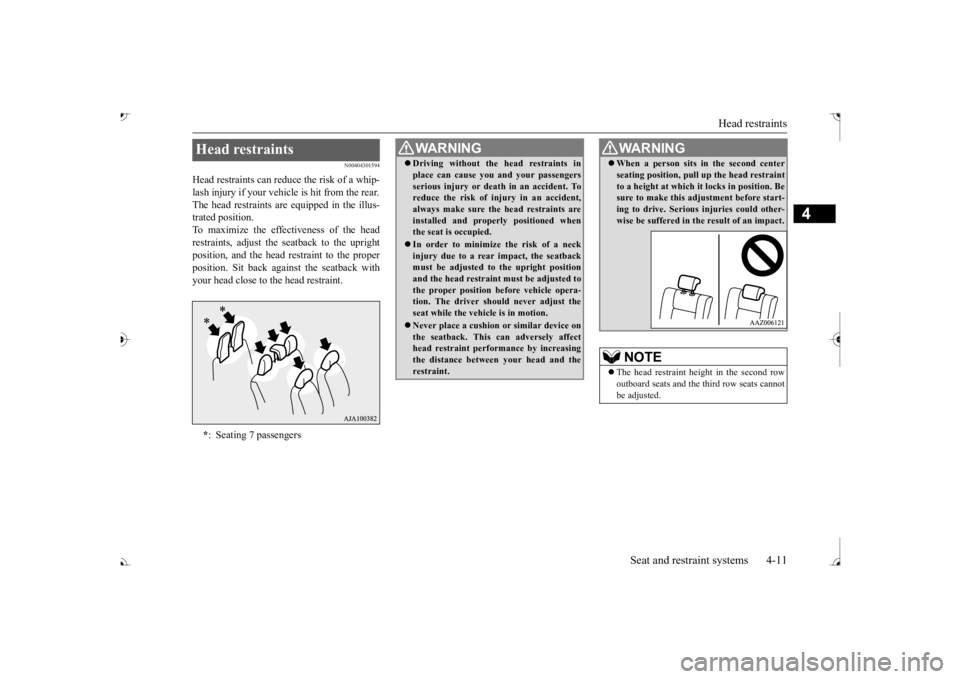
Head restraints can reduce the risk of a whip- lash injury if your vehicle is hit from the rear. The head restraints are equipped in the illus-trated position. To maximize the effectiveness of the head restraints, adjust the seatback to the uprightposition, and the head
restraint to the proper
position. Sit back against the seatback with your head close to the head restraint.Head restraints * : Seating 7 passengers
WA R N I N GDriving without the
head restraints in
place can cause you and your passengersserious injury or deat
h in an accident. To
reduce the risk of in
jury in an accident,
always make sure the head restraints are installed and proper
ly positioned when
the seat is occupied. In order to minimize
the risk of a neck
injury due to a rear impact, the seatback must be adjusted to the upright position and the head restraint
must be adjusted to
the proper position
before vehicle opera-
tion. The driver shou
ld never adjust the
seat while the vehicle is in motion. Never place a cushion
or similar device on
the seatback. This can adversely affecthead restraint performance by increasing the distance betwee
n your head and the
restraint.
When a person sits in the second center seating position, pull up
the head restraint
to a height at which it locks in position. Besure to make this adjustment before start- ing to drive. Serious injuries could other- wise be suffered in the result of an impact.NOTE
The head restraint height in the second row outboard seats and the third row seats cannot be adjusted.WA R N I N G
BK0239700US.book 11 ページ 2016年6月16日 木曜日 午前10時58分
Page 41 of 521
Head restraints 4-12 Seat and restraint systems
4
To reduce the risk of injury in an accident, adjust the head restraint height so that thecenter of the restrain
t is at your ear level
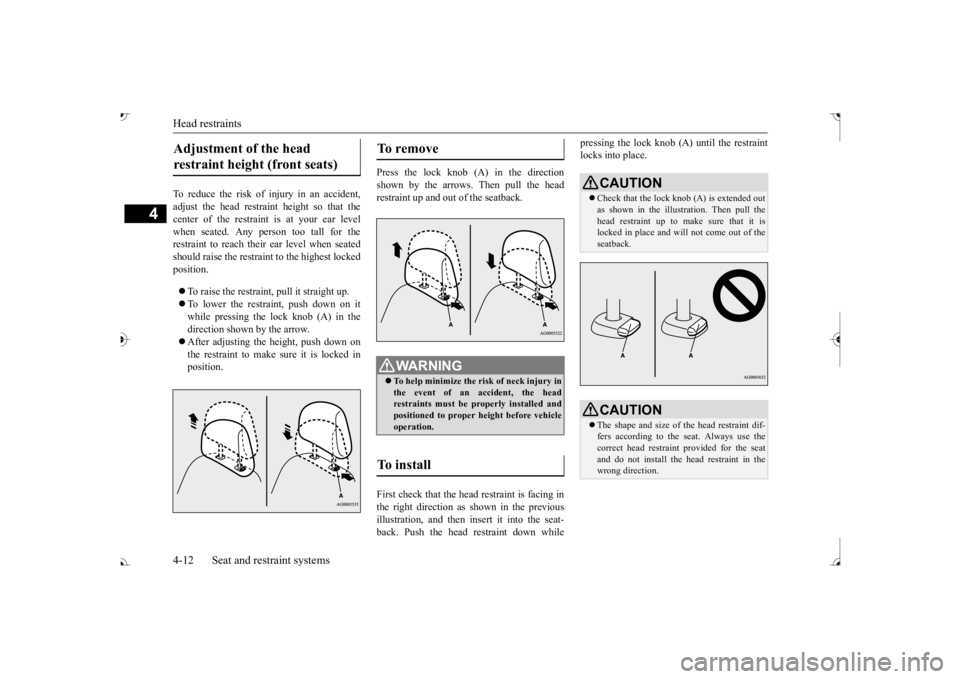
when seated. Any person too tall for the restraint to reach their ear level when seatedshould raise the restraint to the highest locked position. To raise the restraint, pull it straight up. To lower the restraint, push down on it while pressing the lock knob (A) in the direction shown by the arrow. After adjusting the height, push down on the restraint to make sure it is locked in position.
Press the lock knob (A) in the direction shown by the arrows. Then pull the head restraint up and out of the seatback. First check that the head restraint is facing in the right direction as shown in the previousillustration, and then insert it into the seat- back. Push the head restraint down while
pressing the lock knob (A) until the restraint locks into place.
Adjustment of the head restraint height (front seats)
To remove
WA R N I N G To help minimize the risk of neck injury in the event of an accident, the headrestraints must be properly installed and positioned to proper height before vehicle operation.
To install
CAUTION Check that the lock knob (A) is extended out as shown in the illustration. Then pull the head restraint up to make sure that it is locked in place and will
not come out of the
seatback.CAUTION The shape and size of the head restraint dif- fers according to the seat. Always use the correct head restraint provided for the seatand do not install the he
ad restraint in the
wrong direction.
BK0239700US.book 12 ページ 2016年6月16日 木曜日 午前10時58分
Page 42 of 521
Making a cargo area
Seat and restraint systems 4-13
4
N00405501115
N00405701146
The second row seat can be folded to create an additional cargo area.
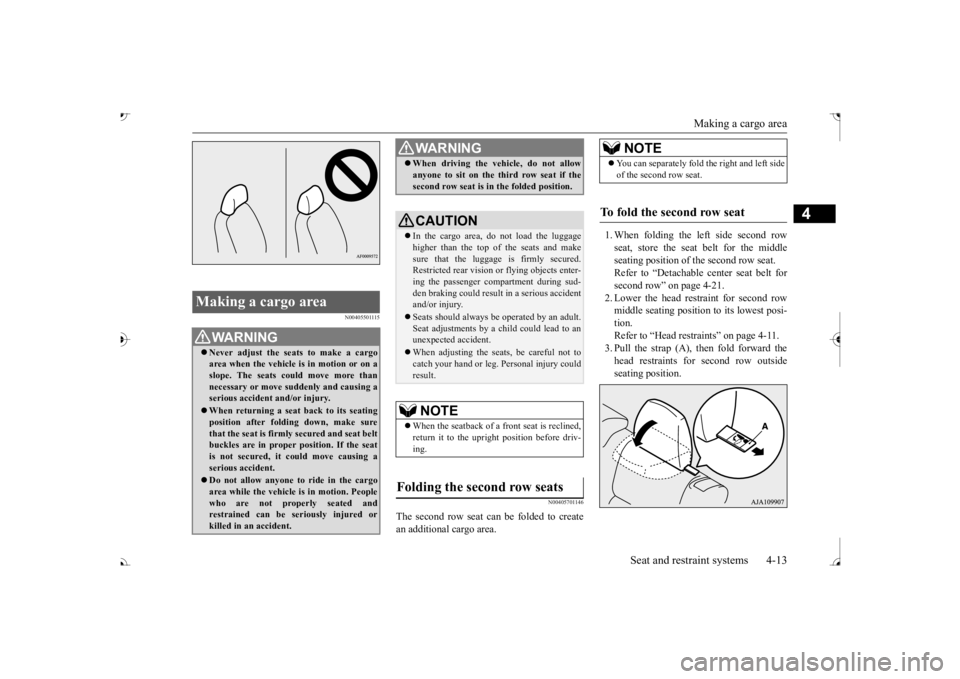
1. When folding the left side second row seat, store the seat belt for the middle seating position of the second row seat.Refer to “Detachable
center seat belt for
second row” on page 4-21. 2. Lower the head restraint for second rowmiddle seating position to its lowest posi- tion. Refer to “Head restraints” on page 4-11.3. Pull the strap (A), then fold forward the head restraints for second row outside seating position.
Making a cargo area
WA R N I N G Never adjust the seats to make a cargo area when the vehicle is in motion or on a slope. The seats co
uld move more than
necessary or move su
ddenly and causing a
serious accident
and/or injury.
When returning a seat back to its seating position after fold
ing down, make sure
that the seat is firmly secured and seat beltbuckles are in proper position. If the seat is not secured, it could move causing a serious accident. Do not allow anyone to ride in the cargo area while the vehicle
is in motion. People
who are not properly seated and restrained can be seriously injured or killed in an accident.
When driving the vehicle, do not allow anyone to sit on the third row seat if thesecond row seat is in the folded position.CAUTION In the cargo area, do not load the luggage higher than the top of the seats and makesure that the luggage is firmly secured. Restricted rear vision or
flying objects enter-
ing the passenger compartment during sud-den braking could result
in a serious accident
and/or injury. Seats should always be
operated by an adult.
Seat adjustments by a child could lead to an unexpected accident. When adjusting the seats, be careful not to catch your hand or leg.
Personal injury could
result.NOTE
When the seatback of a front seat is reclined, return it to the upright
position before driv-
ing.
Folding the second row seats
WA R N I N G
NOTE
You can separately fold
the right and left side
of the second row seat.
To fold the second row seat
BK0239700US.book 13 ページ 2016年6月16日 木曜日 午前10時58分
Page 44 of 521
Making a cargo area
Seat and restraint systems 4-15
4
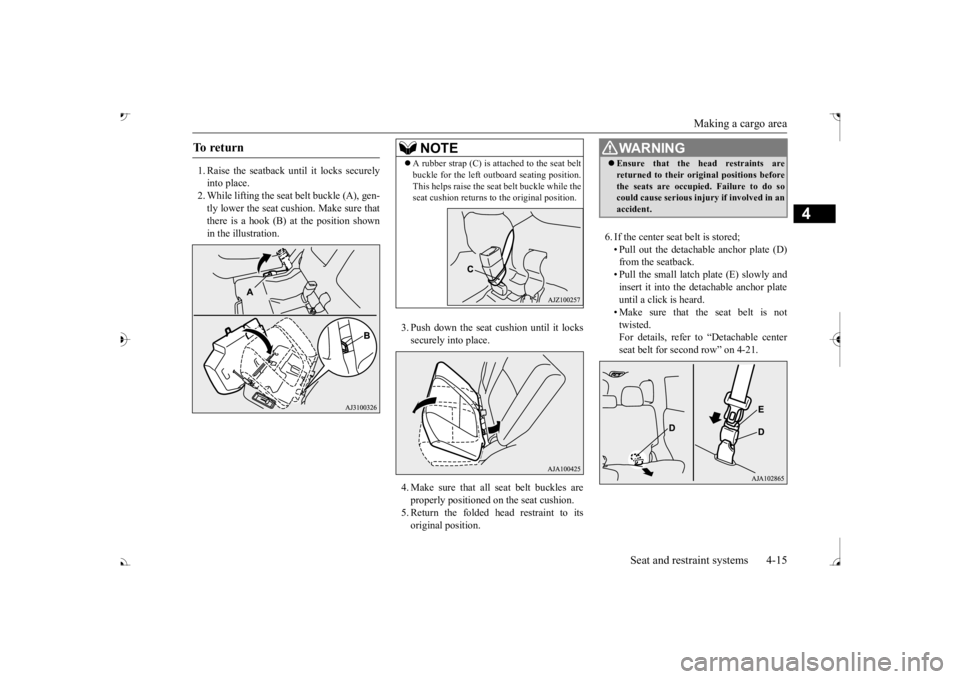
1. Raise the seatback until it locks securely into place. 2. While lifting the seat belt buckle (A), gen- tly lower the seat cushion. Make sure thatthere is a hook (B) at the position shown in the illustration.
3. Push down the seat cushion until it locks securely into place. 4. Make sure that all seat belt buckles are properly positioned on the seat cushion. 5. Return the folded head restraint to itsoriginal position.
6. If the center seat
belt is stored;
• Pull out the detachable anchor plate (D) from the seatback.• Pull the small latch plate (E) slowly and insert it into the detachable anchor plate until a click is heard.• Make sure that the seat belt is not twisted. For details, refer to
“Detachable center
seat belt for second row” on 4-21.
To r e t u r n
NOTE
A rubber strap (C) is atta
ched to the seat belt
buckle for the left out
board seating position.
This helps raise the seat
belt buckle while the
seat cushion returns to the original position.
WA R N I N G Ensure that the head restraints are returned to their original positions beforethe seats are occupied. Failure to do socould cause serious inju
ry if involved in an
accident.
BK0239700US.book 15 ページ 2016年6月16日 木曜日 午前10時58分
Page 45 of 521
Making a flat seat 4-16 Seat and restraint systems
4
N00409800021
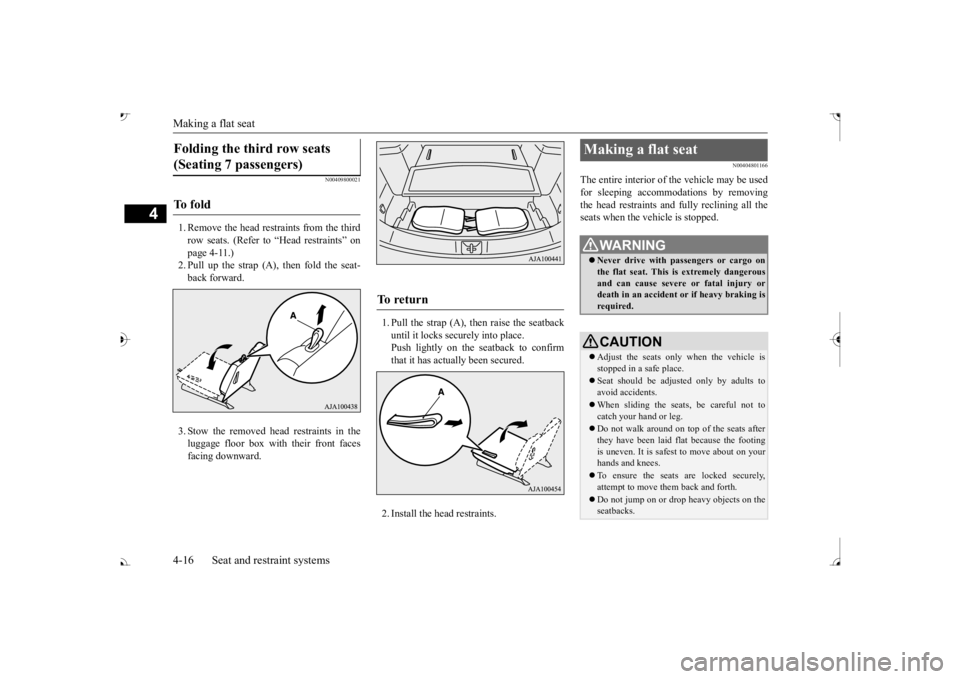
1. Remove the head restraints from the third row seats. (Refer to “Head restraints” on page 4-11.)2. Pull up the strap (A), then fold the seat- back forward. 3. Stow the removed head restraints in the luggage floor box with their front faces facing downward.
1. Pull the strap (A), then raise the seatback until it locks securely into place.Push lightly on the seatback to confirm that it has actually been secured. 2. Install the head restraints.
N00404801166
The entire interior of the vehicle may be used for sleeping accommoda
tions by removing
the head restraints and fully reclining all theseats when the vehicle is stopped.
Folding the third row seats (Seating 7 passengers) To f o l d
To r e t u r n
Making a flat seat
WA R N I N G Never drive with passengers or cargo on the flat seat. This is extremely dangerousand can cause severe or fatal injury or death in an accident
or if heavy braking is
required.CAUTION Adjust the seats only when the vehicle is stopped in a safe place. Seat should be adjusted only by adults to avoid accidents. When sliding the seat
s, be careful not to
catch your hand or leg. Do not walk around on top of the seats after they have been laid flat because the footingis uneven. It is safest to move about on your hands and knees. To ensure the seats are locked securely, attempt to move them back and forth. Do not jump on or drop heavy objects on the seatbacks.
BK0239700US.book 16 ページ 2016年6月16日 木曜日 午前10時58分
Page 46 of 521
Making a flat seat
Seat and restraint systems 4-17
4
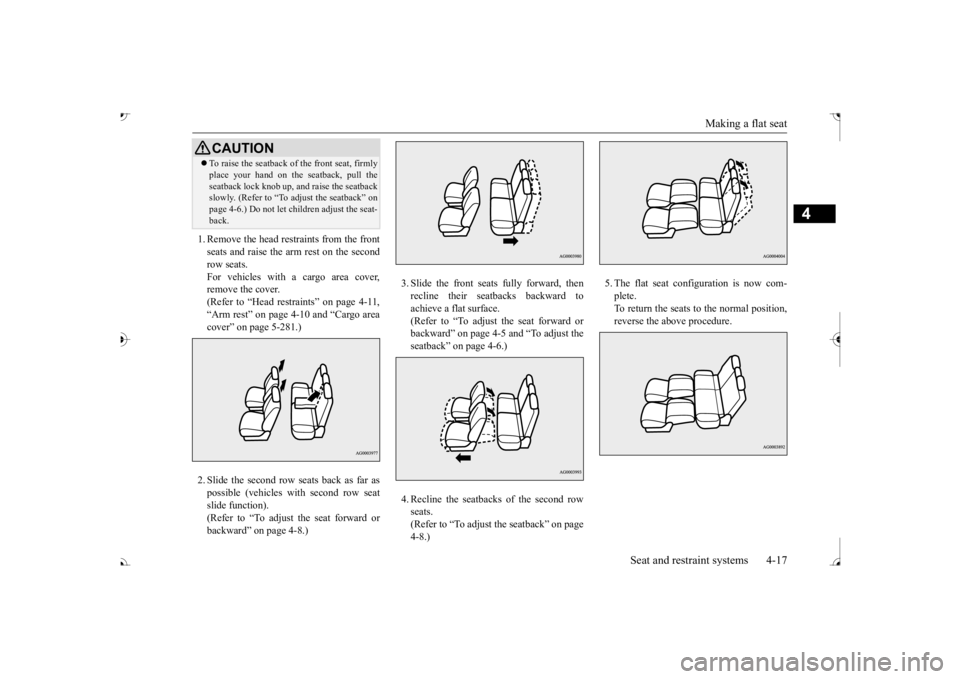
1. Remove the head restraints from the front seats and raise the arm rest on the secondrow seats. For vehicles with a cargo area cover, remove the cover.(Refer to “Head restraints” on page 4-11, “Arm rest” on page 4-10 and “Cargo area cover” on page 5-281.) 2. Slide the second row seats back as far as possible (vehicles with second row seat slide function).(Refer to “To adjust the seat forward or backward” on page 4-8.)
3. Slide the front seats fully forward, then recline their seatbacks backward toachieve a flat surface. (Refer to “To adjust the seat forward or backward” on page 4-5 and “To adjust theseatback” on page 4-6.) 4. Recline the seatbacks of the second row seats.(Refer to “To adjust the seatback” on page 4-8.)
plete.To return the seats to the normal position, reverse the above procedure.
To raise the seatback of the front seat, firmly place your hand on the
seatback, pull the
seatback lock knob up, and raise the seatbackslowly. (Refer to “To adjust the seatback” on page 4-6.) Do not let children adjust the seat- back.CAUTION
BK0239700US.book 17 ページ 2016年6月16日 木曜日 午前10時58分
Page 48 of 521
Seat belts
Seat and restraint systems 4-19
4
N00406201513
All seats are equipped with a seat belt which uses one combined lap-and-shoulder belt with an emergency locking retractor. This system is designed to provide both com- fort and safety. It perm
its full extension and
automatic retraction of the belts during nor- mal vehicle operation.
A sensing device
inside the belt retractor is designed to lock the retractor in the event of a sudden change inthe vehicle’s motion.
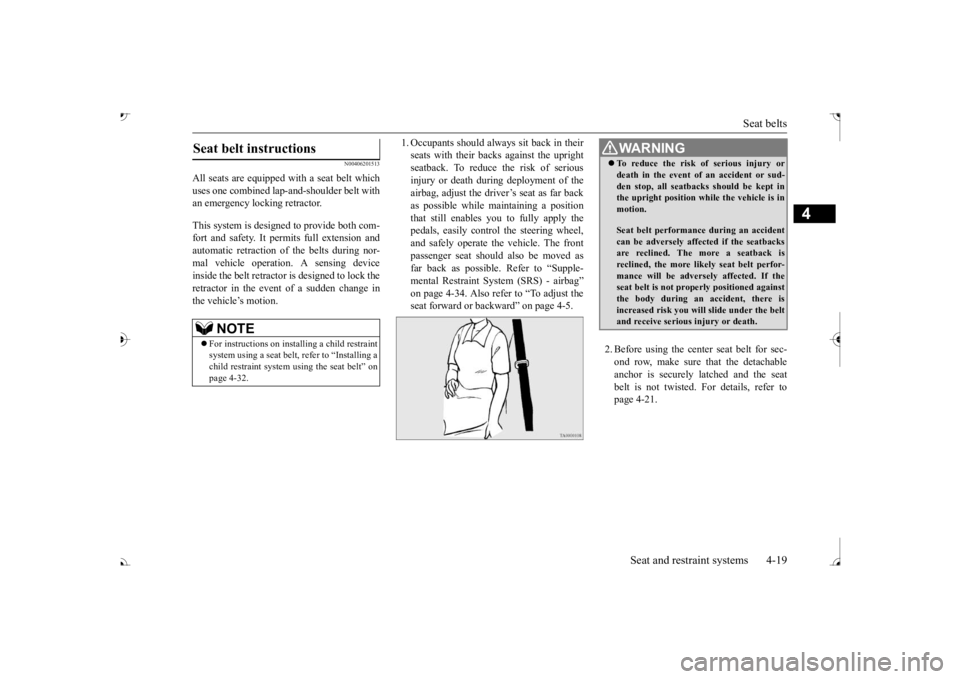
1. Occupants should always
sit back in their
seats with their backs against the uprightseatback. To reduce
the risk of serious
injury or death during deployment of the airbag, adjust the driver’s seat as far backas possible while maintaining a position that still enables you to fully apply the pedals, easily control the steering wheel,and safely operate the vehicle. The front passenger seat should also be moved as far back as possible. Refer to “Supple- mental Restraint System (SRS) - airbag” on page 4-34. Also refer to “To adjust theseat forward or backward” on page 4-5.
2. Before using the center seat belt for sec- ond row, make sure that the detachable anchor is securely
latched and the seat
belt is not twisted. For details, refer topage 4-21.
Seat belt instructions
NOTE
For instructions on installing a child restraint system using a seat belt
, refer to “Installing a
child restraint system
using the seat belt” on
page 4-32.
WA R N I N G To reduce the risk of serious injury or death in the event of
an accident or sud-
den stop, all seatbacks should be kept inthe upright position while the vehicle is in motion. Seat belt performance during an accident can be adversely affect
ed if the seatbacks
are reclined. The more a seatback isreclined, the more likely seat belt perfor- mance will be advers
ely affected. If the
seat belt is not prop
erly positioned against
the body during an accident, there is increased risk you will slide under the belt and receive serious
injury or death.
BK0239700US.book 19 ページ 2016年6月16日 木曜日 午前10時58分
Page 53 of 521
Seat belts 4-24 Seat and restraint systems
4
N00406301354
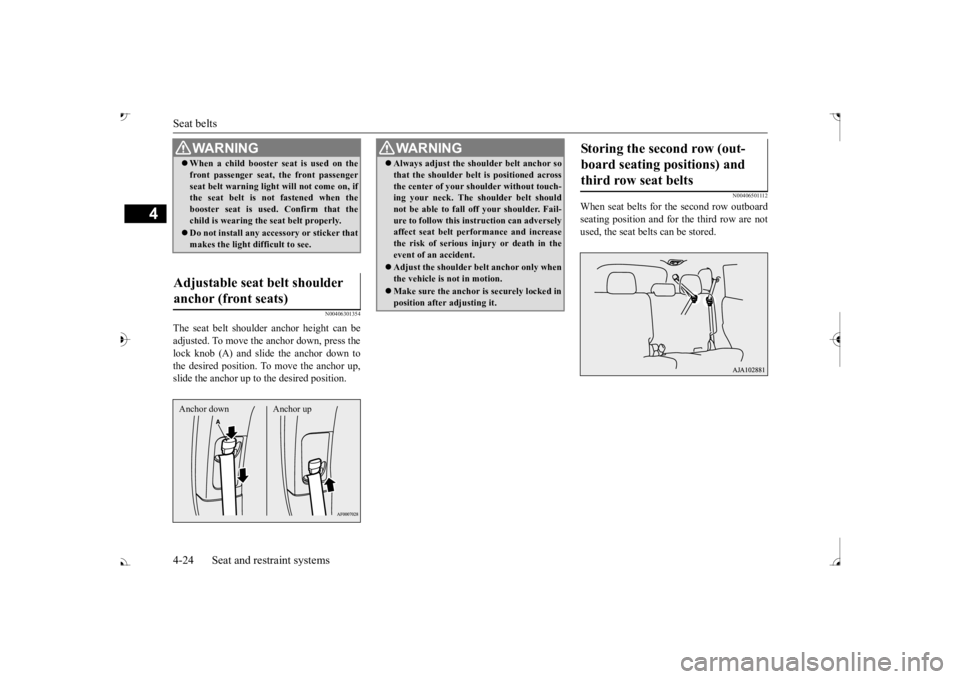
The seat belt shoulder
anchor height can be
adjusted. To move the anchor down, press thelock knob (A) and slide the anchor down to the desired position. To move the anchor up, slide the anchor up to the desired position.
N00406501112
When seat belts for the second row outboardseating position and for the third row are not used, the seat belts can be stored.
WA R N I N G When a child booster se
at is used on the
front passenger seat, the front passengerseat belt warning ligh
t will not come on, if
the seat belt is not fastened when the booster seat is used
. Confirm that the
child is wearing the
seat belt properly.
Do not install any acce
ssory or sticker that
makes the light difficult to see.
Adjustable seat belt shoulder anchor (front seats) Anchor down Anchor up
WA R N I N G Always adjust the shou
lder belt anchor so
that the shoulder belt
is positioned across
the center of your shoulder without touch-ing your neck. The sh
oulder belt should
not be able to fall off your shoulder. Fail- ure to follow this instruction can adverselyaffect seat belt performance and increase the risk of serious in
jury or death in the
event of an accident. Adjust the shoulder be
lt anchor only when
the vehicle is not in motion. Make sure the anchor is securely locked in position after adjusting it.
Storing the second row (out- board seating positions) and third row seat belts
BK0239700US.book 24 ページ 2016年6月16日 木曜日 午前10時58分
Page 54 of 521
Seat belt use during pregnancy
Seat and restraint systems 4-25
4
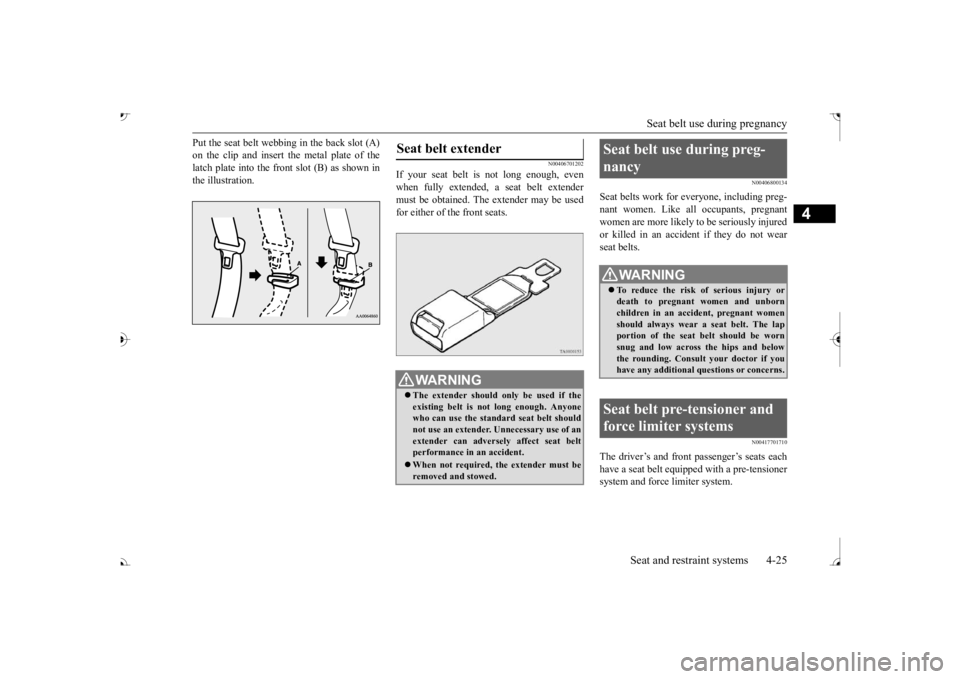
Put the seat belt webbing in the back slot (A) on the clip and insert the metal plate of thelatch plate into the front slot (B) as shown in the illustration.
N00406701202
If your seat belt is not long enough, evenwhen fully extended,
a seat belt extender
must be obtained. The extender may be usedfor either of the front seats.
N00406800134
Seat belts work for everyone, including preg- nant women. Like a
ll occupants, pregnant
women are more likely to be seriously injuredor killed in an accident if they do not wear seat belts.
N00417701710
The driver’s and front passenger’s seats each have a seat belt
equipped with a pre-tensioner
system and force limiter system.
Seat belt extender
WA R N I N G The extender should only be used if the existing belt is not long enough. Anyone who can use the standard seat belt shouldnot use an extender. Unnecessary use of an extender can adversel
y affect seat belt
performance in an accident. When not required, the extender must be removed and stowed.
Seat belt use during preg- nancy
WA R N I N G To reduce the risk of serious injury or death to pregnant women and unborn children in an accident, pregnant womenshould always wear
a seat belt. The lap
portion of the seat belt should be worn snug and low across the hips and belowthe rounding. Consult your doctor if you have any additional qu
estions or concerns.
Seat belt pre-tensioner and force limiter systems
BK0239700US.book 25 ページ 2016年6月16日 木曜日 午前10時58分