seats MITSUBISHI OUTLANDER III 2017 Owner's Manual
[x] Cancel search | Manufacturer: MITSUBISHI, Model Year: 2017, Model line: OUTLANDER III, Model: MITSUBISHI OUTLANDER III 2017Pages: 521, PDF Size: 14.95 MB
Page 56 of 521
Child restraint systems
Seat and restraint systems 4-27
4
N00408701147
This warning light tells you if there is a prob- lem involving the SRS airbags and/or the seat belt pre-tensioner system. Refer to “SRSwarning light/display” on page 4-40.
N00408900126
In the event of an accident, the seat belt force limiter system will help reduce the force applied to the driver a
nd front seat passenger.
N00407101740
When transporting infants or small children in your vehicle, an appr
opriate child restraint
system must always be
used. This is required
by law in the U.S. and Canada. Child restraint systems specifically designedfor infants and small children are offered by several manufacturers. Choose only a child restraint system with a label certifying that itcomplies with Federal Motor Vehicle Safety Standard 213 (FMVSS 213) or Motor Vehicle Restraint Systems and
Booster Seats Safety
Regulations (RSSR).
Look for the manufac-
turer’s statement of compliance on the box and child restraint system itself.
The child restraint system should be appropri- ate for your child’s we
ight and height, and
should properly fit your vehicle’s seat. For detailed information,
refer to the instruc-
tion manual accompanying the child restraintsystem. All children should be properly restrained in a restraint device that offers the maximumprotection for their size and age. Be sure to check local,
state, or provincial
requirements for child size and age that mayvary from the recommendations listed below. Children less than 1 year old and who weigh 22 pounds (10 kg) or less MUST ride in a rear-facing child safety seat thatMUST ONLY be used in the second row seat. Children older than 1 year of age and who weigh less than 40 pounds (18 kg) or who are less than 40 inches (100 cm) tall must be in a forward-facing restraint used onlyin the rear seat.
Children who weigh more than 40 pounds (18 kg) or who are more than 40 inches(100 cm) tall, regardless of age, should use a suitable child seat or a booster seat in the rear seat until the vehicle’s lap-and-shoulder belt fits
them properly.
SRS warning Force limiter system Child restraint systems
Guidelines for child restraint system selection
WA R N I N G All children must be seated in the rear seat, and properly restrained.Accident statistics
show that children of
all sizes and ages are safer when properly restrained in the rear seat, rather than inthe front seat. Be sure to select a child restraint system that is appropriate not only for the child’s size and age but also for your vehicle. Some child restraint systems may not fityour vehicle properly.
BK0239700US.book 27 ページ 2016年6月16日 木曜日 午前10時58分
Page 57 of 521
Child restraint systems 4-28 Seat and restraint systems
4
Any child who is too large to use a child restraint system should ride in the rearseat and wear the la
p-and-shoulder belt
properly. The shoulder belt must be posi- tioned over the shou
lder and across the
chest, not across their neck, and with thelap belt positioned low on the child’s hips, not across their stomach. If necessary, a booster seat should be
used to help achieve
a proper seat belt fi
t. Follow the booster
seat manufacturer’s instructions. Only use a booster seat that is
certified as comply-
ing with Federal Motor Vehicle Safety Standards or Motor Vehicle Restraint Sys- tems and Booster Seats Safety Regula-tions. WA R N I N G
WA R N I N G Never hold an infant
or child in your arms
or on your lap when ri
ding in this vehicle,
even when you are wearing your seat belt.Never place any part of the seat belt you are wearing around an
infant or child.
Failure to follow these simple instructionscreates a risk of serious injury or death to your child in the even
t of an accident or
sudden stop.
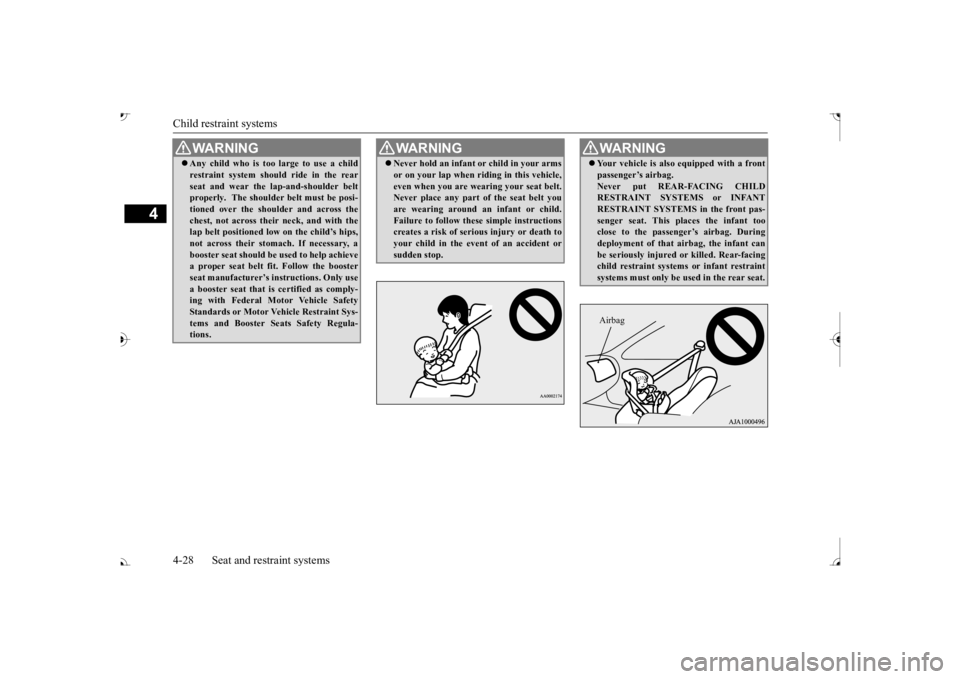
WA R N I N G Your vehicle is also equipped with a front passenger’s airbag.Never put REAR-FACING CHILDRESTRAINT SYSTEMS or INFANT RESTRAINT SYSTEMS in the front pas- senger seat. This places the infant tooclose to the passenger’s airbag. During deployment of that airbag, the infant can be seriously injured
or killed.
Rear-facing
child restraint systems or infant restraint systems must only be used in the rear seat.Airbag
BK0239700US.book 28 ページ 2016年6月16日 木曜日 午前10時58分
Page 59 of 521
Child restraint systems 4-30 Seat and restraint systems
4
N00418801167
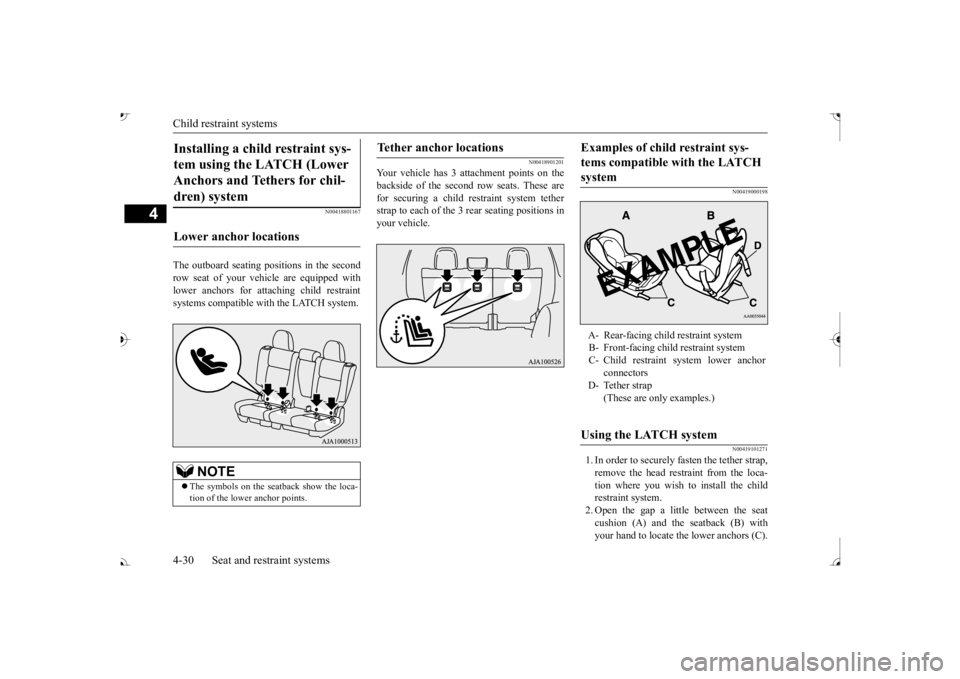
The outboard seating pos
itions in the second
row seat of your vehicle are equipped with lower anchors for attaching child restraint systems compatible with the LATCH system.
N00418901201
Your vehicle has 3 at
tachment points on the
backside of the second
row seats. These are
for securing a child restraint system tetherstrap to each of the 3 rear seating positions in your vehicle.
N00419000198 N00419101271
1. In order to securely
fasten the tether strap,
remove the head restraint from the loca- tion where you wish to install the child restraint system.2. Open the gap a little between the seat cushion (A) and the seatback (B) with your hand to locate the lower anchors (C).
Installing a child restraint sys- tem using the LATCH (Lower Anchors and Tethers for chil- dren) system Lower anchor locations
NOTE
The symbols on the seatback show the loca- tion of the lower anchor points.
Tether anchor locations
Examples of child restraint sys- tems compatible with the LATCH system A- Rear-facing child restraint system B- Front-facing child restraint system C- Child restraint system lower anchor
connectors
D- Tether strap
(These are only examples.)
Using the LATCH system
BK0239700US.book 30 ページ 2016年6月16日 木曜日 午前10時58分
Page 60 of 521
Child restraint systems
Seat and restraint systems 4-31
4
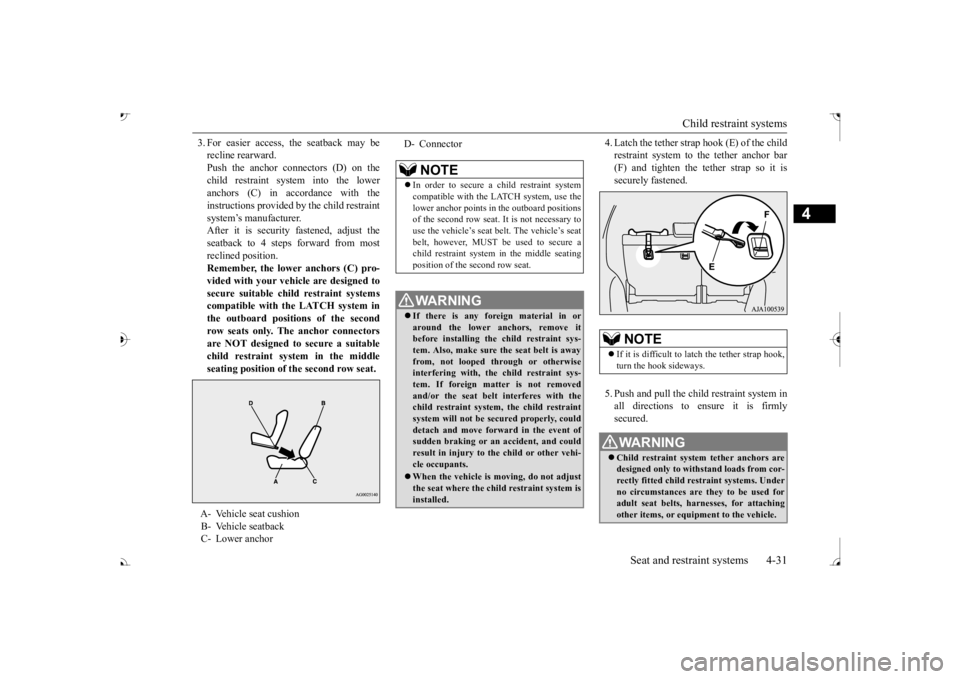
3. For easier access, the seatback may be recline rearward.Push the anchor connectors (D) on the child restraint system into the lower anchors (C) in accordance with theinstructions provided by the child restraint system’s manufacturer. After it is security fastened, adjust theseatback to 4 steps forward from most reclined position. Remember, the lower anchors (C) pro- vided with your vehi
cle are designed to
secure suitable child restraint systemscompatible with the LATCH system in the outboard positions of the second row seats only. The anchor connectorsare NOT designed to secure a suitable child restraint system in the middle seating position of the second row seat.
4. Latch the tether strap hook (E) of the child restraint system to the tether anchor bar(F) and tighten the tether strap so it is securely fastened. 5. Push and pull the chil
d restraint system in
all directions to ensure it is firmlysecured.
A- Vehicle seat cushion B- Vehicle seatback C- Lower anchor
D- Connector
NOTE
In order to secure a child restraint system compatible with the LATCH system, use thelower anchor points in the outboard positions of the second row seat. It is not necessary to use the vehicle’s seat
belt. The vehicle’s seat
belt, however, MUST be
used to secure a
child restraint system in the middle seating position of the second row seat.WA R N I N G If there is any foreign material in or around the lower an
chors, remove it
before installing the child restraint sys- tem. Also, make sure the seat belt is awayfrom, not looped through or otherwise interfering with, the child restraint sys- tem. If foreign matter is not removedand/or the seat belt
interferes with the
child restraint system, the child restraint system will not be secured properly, coulddetach and move forw
ard in the event of
sudden braking or an
accident, and could
result in injury to the child or other vehi-cle occupants. When the vehicle is
moving, do not adjust
the seat where the child restraint system isinstalled.
NOTE
If it is difficult to
latch the tether strap hook,
turn the hook sideways.WA R N I N G Child restraint system tether anchors are designed only to with
stand loads from cor-
rectly fitted child restraint systems. Underno circumstances are they to be used for adult seat belts, harnesses, for attaching other items, or equipment to the vehicle.
BK0239700US.book 31 ページ 2016年6月16日 木曜日 午前10時58分
Page 63 of 521
Maintenance and inspection of seat belts 4-34 Seat and restraint systems
4
Systems and Booster Se
ats Safety Regula-
tions.
N00407001390
Regularly check your seat belt buckles andtheir release mechanisms for positive engage-ment and release of the latch plate. Check the retractors for automatic locking when in the Automatic Locking Retractor function. The entire seat belt assembly should be replaced if the webbing shows any obvious
cuts, tears, increase in thickness in any sec- tion of the webbing from broken fibers, orsevere fading from sunlig
ht. All of these con-
ditions indicate a weakening of the belt, which may adversely affe
ct seat belt perfor-
mance in an accident.
N00407701863
This vehicle is equippe
d with a Supplemental
Restraint System (SRS), which includes air- bags for the driver and passengers. The SRS front airbags are designed to supple- ment the primary protection of the driver and front passenger seat belt systems by provid- ing those occupants w
ith protection against
head and chest injuries
in certain moderate to
severe frontal collisi
ons. The SRS front air-
bags, together with sensors at the front of the vehicle and sensors attached to the front seats, form an adva
nced airbag system.
The SRS side airbags and the curtain airbags are also designed to s
upplement the seat belts.
The SRS side airbags provide the driver and front passenger with pr
otection against chest
injuries by deploying the bag on the side impacted in moderate
to severe side impact
collisions. The SRS curtain airbags providethe driver and the passengers on the front seat and the second row outboard seats with pro- tection against head in
juries by deploying the
curtain airbag on the side impacted in moder- ate to severe side im
pact collisions and by
deploying both curtain airbags when a roll-over is detected. The curtain airbags are also designed to help reduce the risk of complete
WA R N I N G Any child who is too small to properly wear a seat belt
must be properly
restrained in an appropriate child restraint system, to reduce their risk ofserious injury or de
ath in an
accident.
A child should never be
left unattended in,
or unsupervised around, your vehicle. When you leave the ve
hicle, always take
the child out as well. Children can die from heat stroke if left or trapped inside the vehicle, especially onhot days. Keep your vehicle locked when not in use. Keep your vehicle keys away from chil- dren.
Maintenance and inspection of seat belts
WA R N I N G Do not attempt to repair or replace any part of the seat belt assemblies. This workshould be done by an authorized Mitsubishi Motors dealer. Failure to have an authorized Mits
ubishi Motors dealer
perform the work could reduce the effec- tiveness of the belts an
d could result in a
serious injury or de
ath in an accident.
Never use an organic solvent to clean the seat belt webbing. Do not attempt tobleach or re-dye th
e seat belt webbing.
These may weaken the
seat belt webbing,
increasing risk of in
jury or death in an
accident. Clean seat belt webb
ing only with mild
soap or detergent solution and rinse itwith lukewarm water, and dry the seat belt webbing completely before retracting it.
Supplemental Restraint Sys- tem (SRS) - airbag
BK0239700US.book 34 ページ 2016年6月16日 木曜日 午前10時58分
Page 67 of 521
Supplemental Restraint System (SRS) - airbag 4-38 Seat and restraint systems
4
The main purpose of an EDR is to record, in certain crash or near crash-like situations,such as an airbag deployment or hitting a road obstacle, data that
will assist in under-
standing how a vehicle’s systems performed.The EDR is designed to
record data related to
vehicle dynamics and sa
fety systems for a
short period of time,
typically 30 seconds or
less. The EDR in this vehicle is designed to record such data as: How various systems in your vehicle were operating; Whether or not the driver and front pas- senger safety belts
were buckled/fastened;
How far (if at all) the driver was depress- ing the accelerator and/or brake pedal; and, How fast the vehicle was traveling.
These data can help provide a better under- standing of the circumstances in which crashes and injuries occur.
To read data recorded
by an EDR, special
equipment is required, a
nd access to the vehi-
cle or the EDR is needed. In addition to thevehicle manufacturer, ot
her parties, such as
law enforcement, that have the special equip- ment, can read the information if they haveaccess to the vehicle or the EDR.
N00417900177
The driver’s seat posit
ion sensor is attached
to the seat rail and provides the airbag control unit with information
on the seat’s fore-aft
position. The airbag control unit controlsdeployment of the driver’s front airbag in accordance with the information it receives from this sensor.If there is a problem involving the driver’s seat position sensor, th
e SRS warning light in
the instrument panel will come on. Refer to “SRS warning light/display” on page 4-40.
N00418001374
The passenger’s seat oc
cupant classification
sensor system is attached to the front passen- ger seat cushion and provides the airbag con-trol unit with inform
ation regarding the
occupant on the front passenger seat. The air-
NOTE
EDR data are recorded by your vehicle only if a non-trivial crash situation occurs; no dataare recorded by the EDR under normal driv-ing conditions and no
personal data (e.g.,
name, gender, age, and crash location) are recorded. However, other parties, such aslaw enforcement, could combine the EDR data with the type of personally identifying data routinely acquire
d during a crash inves-
tigation.
Driver’s seat position sensor
WA R N I N G If the SRS warning li
ght or warning dis-
play comes on, have th
e vehicle inspected
by an authorized
Mitsubishi Motors
dealer as soon
as possible.
Please observe the following instructions to ensure that the driver’s seat positionsensor can operate correctly.• Adjust the seat to the correct position,and sit well back
against the seatback.
Refer to “Front seats” on page 4-4.• Do not recline the seatback more thannecessary when driving.• Do not place metall
ic objects or luggage
under the front seat.
If the vehicle is involved in a severe impact, have the SRS sensors inspected by an authorized
Mitsubishi Motors dealer as
soon as possible.
Passenger’s seat occupant clas- sification sensor system
BK0239700US.book 38 ページ 2016年6月16日 木曜日 午前10時58分
Page 68 of 521
Supplemental Restraint System (SRS) - airbag
Seat and restraint systems 4-39
4
bag control unit controls deployment of the passenger’s front airbag in accordance withthe information it receives from this system. The passenger’s front ai
rbag will not deploy
in an impact when the system senses no occu-pant on the front passenger’s seat or a child in a child restraint system. In this case, the pas- senger airbag off indi
cator will come on.
Refer to “Passenger’s ai
rbag off indicator” on
page 4-39. If there is a problem involving the passen- ger’s seat occupant cl
assification sensor sys-
tem, the SRS warning light in the instrumentpanel will come on. Refer to “SRS warning light/display” on page 4-40.
N00418101346
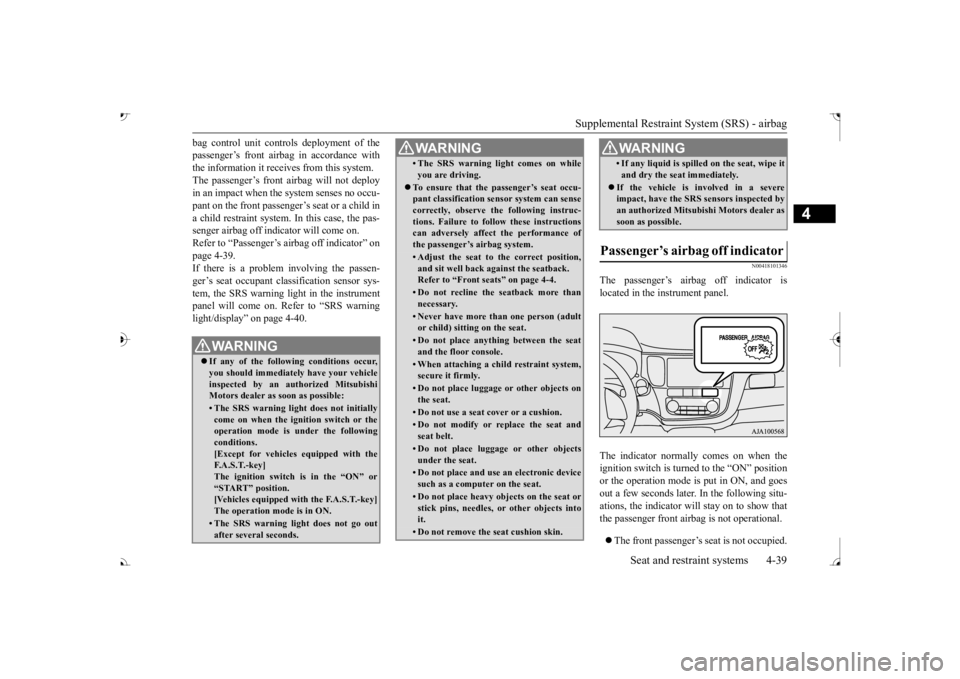
The passenger’s airbag off indicator is located in the instrument panel. The indicator normall
y comes on when the
ignition switch is turned to the “ON” position or the operation mode is put in ON, and goes out a few seconds later. In the following situ-ations, the indicator will stay on to show that the passenger front airb
ag is not operational.
The front passenger’s seat is not occupied.
WA R N I N GIf any of the following conditions occur, you should immediatel
y have your vehicle
inspected by an au
thorized Mitsubishi
Motors dealer as
soon as possible:
• The SRS warning light does not initially come on when the ignition switch or the operation mode is under the followingconditions. [Except for vehicles equipped with the F. A . S . T. - k e y ]The ignition switch is in the “ON” or “START” position. [Vehicles equipped with the F.A.S.T.-key]The operation mode is in ON.• The SRS warning light does not go outafter several seconds.
• The SRS warning li
ght comes on while
you are driving.
To ensure that the passenger’s seat occu- pant classification sensor system can sense correctly, observe the following instruc-tions. Failure to follow these instructions can adversely affect
the performance of
the passenger’s airbag system.• Adjust the seat to the correct position,and sit well back
against the seatback.
Refer to “Front seats” on page 4-4.• Do not recline the seatback more thannecessary.• Never have more than one person (adultor child) sitting
on the seat.
• Do not place anything between the seat and the floor console.• When attaching a chil
d restraint system,
secure it firmly.• Do not place luggage
or other objects on
the seat.• Do not use a seat cover or a cushion.• Do not modify or replace the seat andseat belt.• Do not place luggage or other objectsunder the seat.• Do not place and use
an electronic device
such as a computer on the seat.• Do not place heavy objects on the seat orstick pins, needles, or other objects intoit.• Do not remove the seat cushion skin.WA R N I N G
• If any liquid is spilled on the seat, wipe itand dry the seat
immediately.
If the vehicle is involved in a severe impact, have the SRS sensors inspected by an authorized
Mitsubishi Motors dealer as
soon as possible.
Passenger’s airbag off indicator
WA R N I N G
BK0239700US.book 39 ページ 2016年6月16日 木曜日 午前10時58分
Page 76 of 521
Supplemental Restraint System (SRS) - airbag
Seat and restraint systems 4-47
4
N00408201591
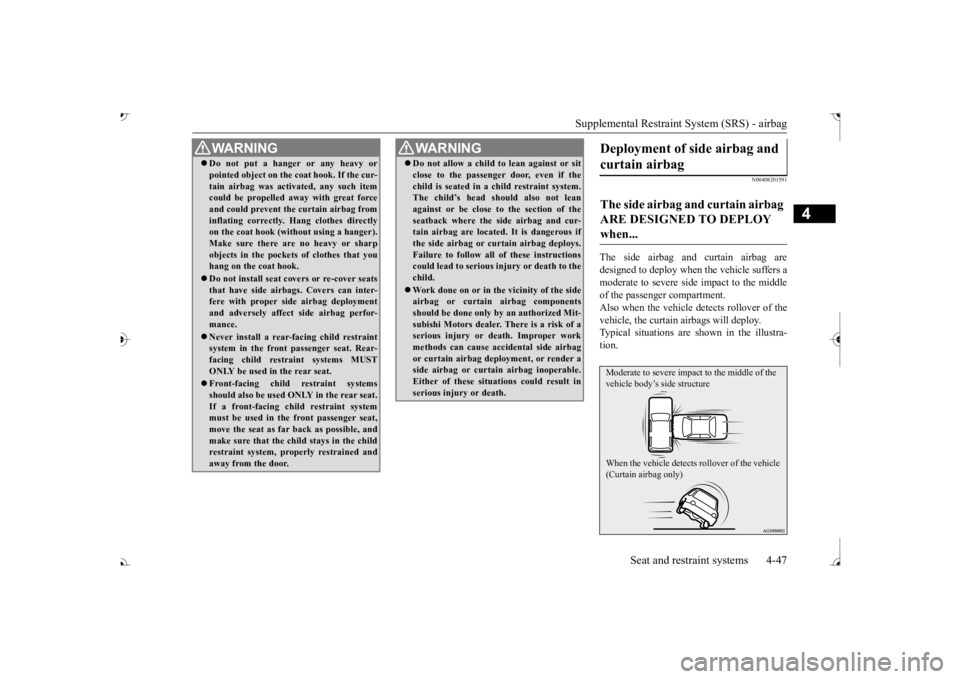
The side airbag and curtain airbag are designed to deploy when
the vehicle suffers a
moderate to severe side
impact to the middle
of the passenger compartment.Also when the vehicle detects rollover of the vehicle, the curtain airbags will deploy. Typical situations are
shown in the illustra-
tion.
WA R N I N G Do not put a hanger or any heavy or pointed object on the
coat hook. If the cur-
tain airbag was activated, any such itemcould be propelled away with great force and could prevent the curtain airbag from inflating correctly. Hang clothes directlyon the coat hook (without using a hanger). Make sure there ar
e no heavy or sharp
objects in the pocket
s of clothes that you
hang on the coat hook. Do not install seat covers or re-cover seats that have side airb
ags. Covers can inter-
fere with proper si
de airbag deployment
and adversely affect
side airbag perfor-
mance. Never install a rear-facing child restraint system in the front passenger seat. Rear- facing child restraint systems MUST ONLY be used in the rear seat. Front-facing child restraint systems should also be used ONLY in the rear seat.If a front-facing child restraint system must be used in the front passenger seat, move the seat as far
back as possible, and
make sure that the child stays in the child restraint system, properly restrained and away from the door.
Do not allow a child to
lean against or sit
close to the passenger door, even if thechild is seated in a child restraint system.The child’s head sh
ould also not lean
against or be close to the section of the seatback where the side airbag and cur-tain airbag are located. It is dangerous if the side airbag or cu
rtain airbag deploys.
Failure to follow all of these instructionscould lead to serious in
jury or death to the
child. Work done on or in th
e vicinity of the side
airbag or curtain
airbag components
should be done only
by an authorized Mit-
subishi Motors dealer. There is a risk of a serious injury or de
ath. Improper work
methods can cause acci
dental side airbag
or curtain airbag depl
oyment, or render a
side airbag or curtai
n airbag inoperable.
Either of these situations could result inserious injury or death.WA R N I N G
Deployment of side airbag and curtain airbag The side airbag and curtain airbag ARE DESIGNED TO DEPLOY when... Moderate to severe impact to the middle of the vehicle body’s side structure When the vehicle detects rollover of the vehicle (Curtain airbag only)
BK0239700US.book 47 ページ 2016年6月16日 木曜日 午前10時58分
Page 78 of 521
Supplemental Restraint System (SRS) - airbag
Seat and restraint systems 4-49
4
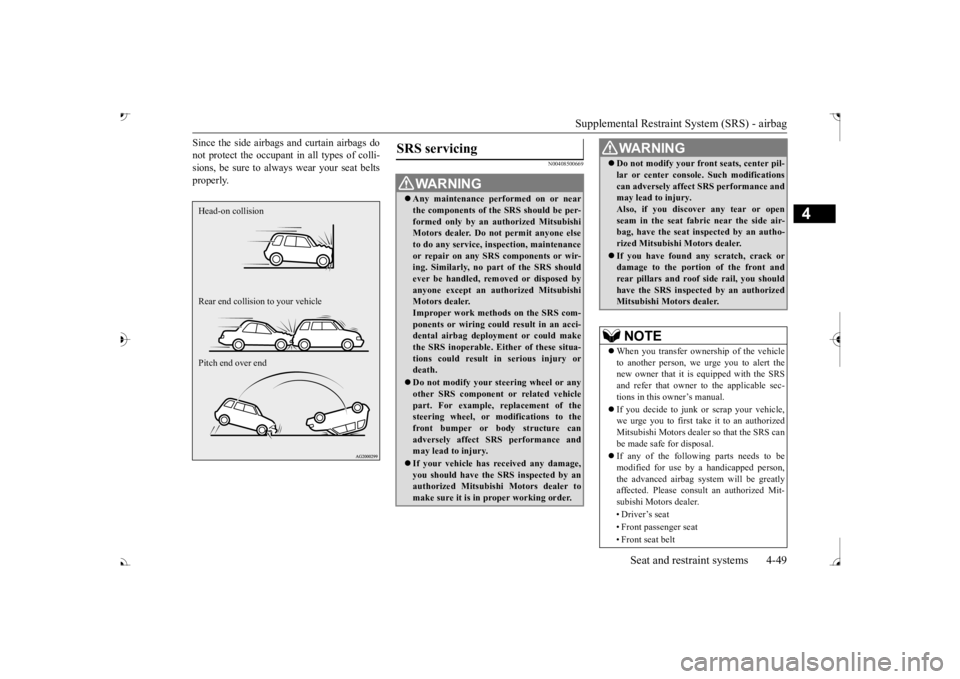
Since the side airbags and curtain airbags do not protect the occupant in all types of colli-sions, be sure to alwa
ys wear your seat belts
properly.
N00408500669
Head-on collision Rear end collision to your vehicle Pitch end over end
SRS servicing
WA R N I N G Any maintenance performed on or near the components of the SRS should be per-formed only by an
authorized Mitsubishi
Motors dealer. Do not permit anyone else to do any service, inspection, maintenanceor repair on any SRS components or wir- ing. Similarly, no part of the SRS should ever be handled, removed or disposed byanyone except an au
thorized Mitsubishi
Motors dealer. Improper work methods on the SRS com-ponents or wiring could result in an acci- dental airbag deployment or could make the SRS inoperable. Ei
ther of these situa-
tions could result in serious injury or death. Do not modify your steering wheel or any other SRS component
or related vehicle
part. For example, replacement of thesteering wheel, or modifications to the front bumper or body structure can adversely affect SR
S performance and
may lead to injury. If your vehicle has re
ceived any damage,
you should have the
SRS inspected by an
authorized Mitsubish
i Motors dealer to
make sure it is in proper working order.
Do not modify your fron
t seats, center pil-
lar or center console. Such modificationscan adversely affect
SRS performance and
may lead to injury. Also, if you discove
r any tear or open
seam in the seat fabr
ic near the side air-
bag, have the seat in
spected by an autho-
rized Mitsubishi Motors dealer. If you have found any scratch, crack or damage to the portion of the front and rear pillars and roof
side rail, you should
have the SRS inspecte
d by an authorized
Mitsubishi Motors dealer.NOTE
When you transfer ownership of the vehicle to another person, we urge you to alert the new owner that it is
equipped with the SRS
and refer that owner to the applicable sec- tions in this owner’s manual. If you decide to junk or scrap your vehicle, we urge you to first take it to an authorized Mitsubishi Motors dealer so that the SRS canbe made safe for disposal. If any of the following parts needs to be modified for use by
a handicapped person,
the advanced airbag sy
stem will be greatly
affected. Please consult an authorized Mit- subishi Motors dealer. •Driver’s seat • Front passenger seat • Front seat beltWA R N I N G
BK0239700US.book 49 ページ 2016年6月16日 木曜日 午前10時58分
Page 359 of 521
Storage spaces 5-278 Features and controls
5
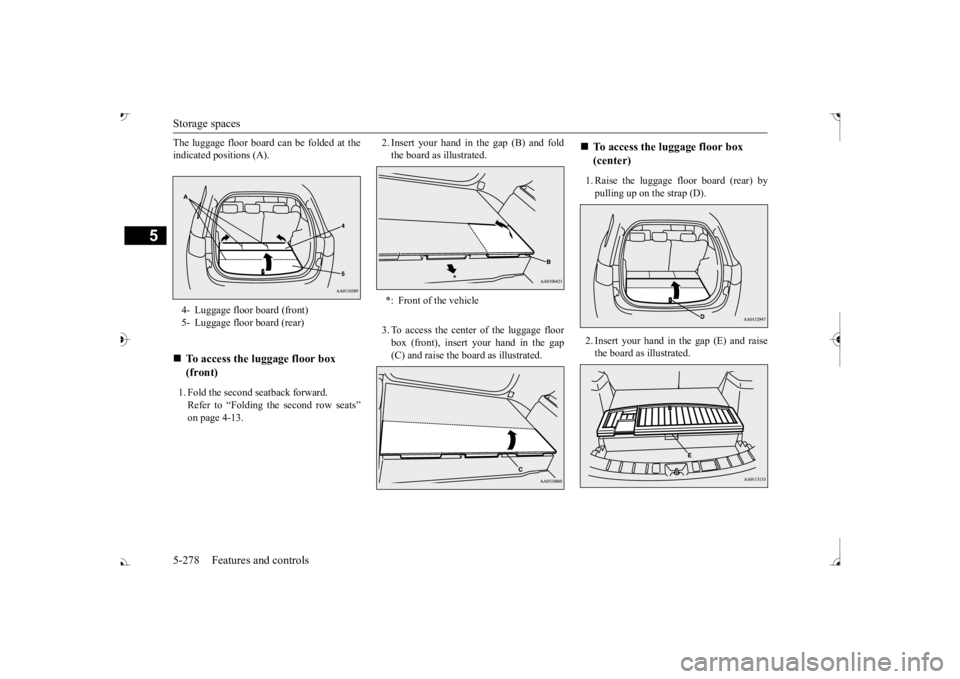
The luggage floor board can be folded at the indicated positions (A). 1. Fold the second seatback forward. Refer to “Folding
the second row seats”
on page 4-13.
2. Insert your hand in the gap (B) and fold the board as illustrated. 3. To access the center of the luggage floor box (front), insert your hand in the gap (C) and raise the boa
rd as illustrated.
1. Raise the luggage floor board (rear) by pulling up on the strap (D). 2. Insert your hand in the gap (E) and raise the board as illustrated.
4- Luggage floor board (front) 5- Luggage floor board (rear)
To access the luggage floor box (front)
*: Front of the vehicle
To access the luggage floor box (center)
BK0239700US.book 278 ページ 2016年6月16日 木曜日 午前10時58分