lock MITSUBISHI OUTLANDER III 2018 Owners Manual
[x] Cancel search | Manufacturer: MITSUBISHI, Model Year: 2018, Model line: OUTLANDER III, Model: MITSUBISHI OUTLANDER III 2018Pages: 441, PDF Size: 13.71 MB
Page 319 of 441
Interior lights5-238 Features and controls
5
3- (OFF)The dome light stays off regardless of anydoor or the liftgate being opened or closed.
N00526101186
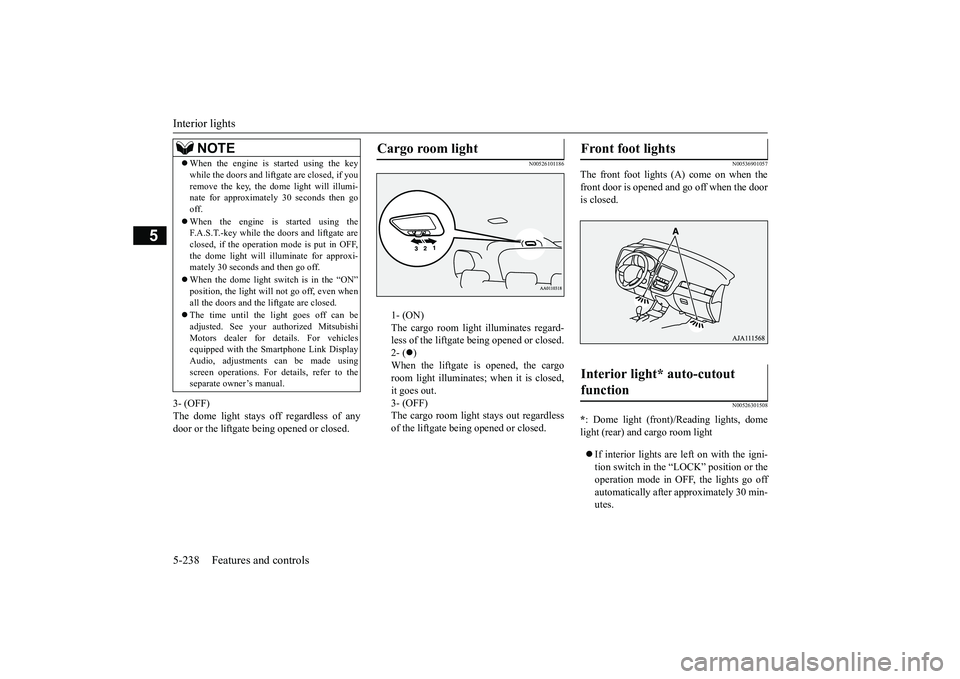
1- (ON)The cargo room light illuminates regard-less of the liftgate being opened or closed.2- (
)
When the liftgate is opened, the cargoroom light illuminates;
when it is closed,
it goes out.3- (OFF)The cargo room light
stays out regardless
of the liftgate bei
ng opened or closed.
N00536901057
The front foot lights (A) come on when thefront door is opened and go off when the dooris closed.
N00526301508
*: Dome light (front)/
Reading lights, dome
light (rear) and cargo room lightIf interior lights are left on with the igni-tion switch in the “LOCK” position or theoperation mode in OFF, the lights go offautomatically after approximately 30 min-utes.
NOTE
When the engine is started using the keywhile the doors and liftga
te are closed, if you
remove the key, the do
me light will illumi-
nate for approximately 30 seconds then gooff.When the engine is started using theF.A.S.T.-key while the doors and liftgate areclosed, if the operation mode is put in OFF,the dome light will il
luminate for approxi-
mately 30 seconds and then go off.When the dome light switch is in the “ON”position, the light will not go off, even whenall the doors and the liftgate are closed.The time until the light goes off can beadjusted. See your authorized MitsubishiMotors dealer for details. For vehiclesequipped with the Sm
artphone Link Display
Audio, adjustments can be made usingscreen operations. For details, refer to theseparate owner’s manual.
Cargo room light
Front foot lights Interior light* auto-cutout function
BK0249100US.book 238 ページ 2017年5月10日 水曜日 午前8時49分
Page 333 of 441
Vehicle preparation before driving6-4 Driving safety
6
N00629001709
For a safer and more enjoyable trip, alwayscheck for the following:Before starting the vehicle, make certainthat you and all passengers are seated andwearing their seat
belts properly (with
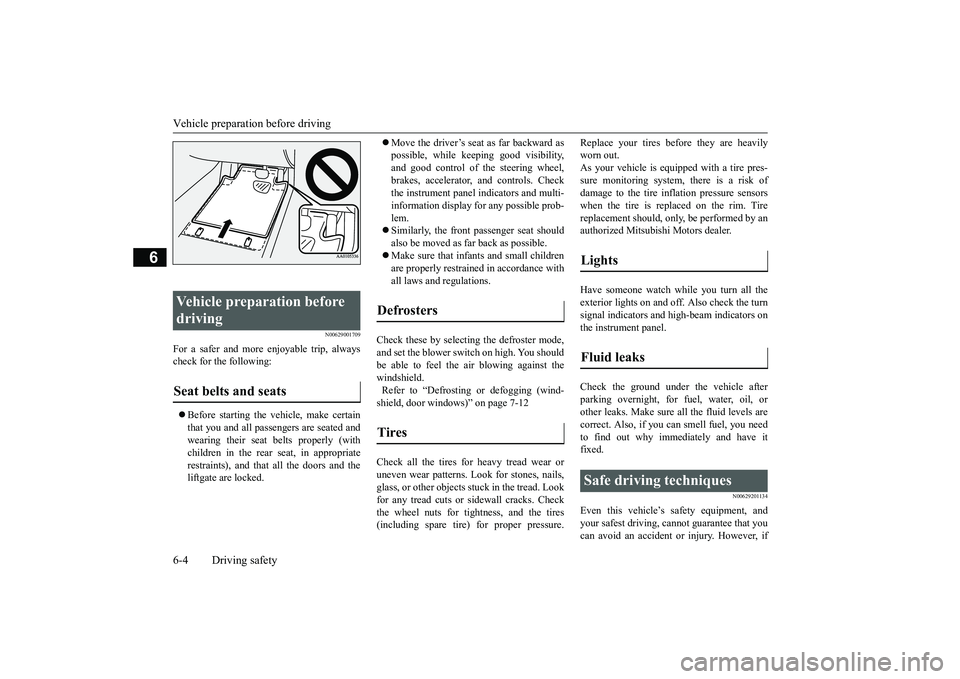
children in the rear seat, in appropriaterestraints), and that all the doors and theliftgate are locked.
Move the driver’s seat as far backward aspossible, while keeping good visibility,and good control of the steering wheel,brakes, accelerator, and controls. Checkthe instrument panel indicators and multi-information display
for any possible prob-
lem.Similarly, the front
passenger seat should
also be moved as fa
r back as possible.
Make sure that infants and small childrenare properly restrained in accordance withall laws and
regulations.
Check these by selecting the defroster mode,and set the blower swit
ch on high. You should
be able to feel the air blowing against thewindshield. Refer to “Defrosti
ng or defogging (wind-
shield, door windows)” on page 7-12Check all the tires for heavy tread wear oruneven wear patterns. Look for stones, nails,glass, or other objects
stuck in the tread. Look
for any tread cuts or
sidewall cracks. Check
the wheel nuts for tightness, and the tires(including spare tire) for proper pressure.
Replace your tires before they are heavilyworn out.As your vehicle is equi
pped with a tire pres-
sure monitoring system, there is a risk ofdamage to the tire inflation pressure sensorswhen the tire is replaced on the rim. Tirereplacement should, onl
y, be performed by an
authorized Mitsubishi Motors dealer.Have someone watch wh
ile you turn all the
exterior lights on and off. Also check the turnsignal indicators and hi
gh-beam indicators on
the instrument panel.Check the ground under the vehicle afterparking overnight, for
fuel, water, oil, or
other leaks. Make sure
all the fluid levels are
correct. Also, if you
can smell fuel, you need
to find out why imme
diately and have it
fixed.
N00629201134
Even this vehicle’s sa
fety equipment, and
your safest driving, ca
nnot guarantee that you
can avoid an accident or injury. However, if
Vehicle preparation before driving Seat belts and seats
Defrosters Tires
Lights Fluid leaks Safe driving techniques
BK0249100US.book 4 ページ 2017年5月10日 水曜日 午前8時49分
Page 335 of 441
Parking6-6 Driving safety
6
On snowy roads, ice can form on the brakingsystem, making the brakes less effective.While driving in such conditions, pay closeattention to surrounding
vehicles and to the
condition of the road surface. From time totime, lightly depress the brake pedal andcheck how effective the brakes are.It is important to take
advantage of the engine
braking by downshifting while driving onsteep downhill roads in order to prevent thebrakes from overheating.
N00629601385
When parking on a hill, set the parking brake,and turn the front wheels toward the curb on adownhill, or away from
the curb on an uphill.
If necessary, apply chocks to the wheels.Be sure that the parki
ng brake is firmly set
when parked and that the selector lever is inthe “P” (PARK) position.
When parking on a hill, it is important to setthe parking brake befo
re moving the selector
lever to the “P” (PARK) position. This pre-vents loading the parking brake against thetransaxle. When this ha
ppens, it is difficult to
move the selector lever out of the “P”Never leave the engine running while youtake a short nap or rest. Also, never leave theengine running in a closed or poorly venti-lated place.Your front bumper can be damaged if youscrape it over curbs or parking stop blocks.Be careful when traveling up or down steepslopes where your bumper can scrape theroad.
Always carry the key and lock all doors andthe liftgate when leaving the vehicle unat-tended.Always try to park your vehicle in a well litarea.Move effort could be required to turn thesteering wheel.Refer to “Electric power steering system(EPS)” on page 5-99.
N00629901434
It is very important to know how muchweight your vehicle can carry. This weight iscalled the vehicle ca
pacity weight and
includes the weight of
all occupants, cargo
(including the roof load), non-factory-
When driving in cold weather When driving downhill Parking Parking on a hill
Parking with the engine run-ning
WA R N I N GLeaving the engine ru
nning risks injury or
death from accidentally moving the selec-tor lever or the accumulation of toxicexhaust fumes in the passenger compart-ment.
Where you park
WA R N I N GDo not park your vehicle in areas wherecombustible materials
such as dry grass or
leaves can come in contact with a hotexhaust, since a fire could occur.
When leaving the vehicle Do not keep the steering wheel fully turned for a long time Loading information
BK0249100US.book 6 ページ 2017年5月10日 水曜日 午前8時49分
Page 339 of 441
Cargo loads6-10 Driving safety
6
N00629700435N00630301092
To determine the cargo load capacity for yourvehicle, subtract the
weight of all vehicle
occupants from the vehi
cle capacity weight.
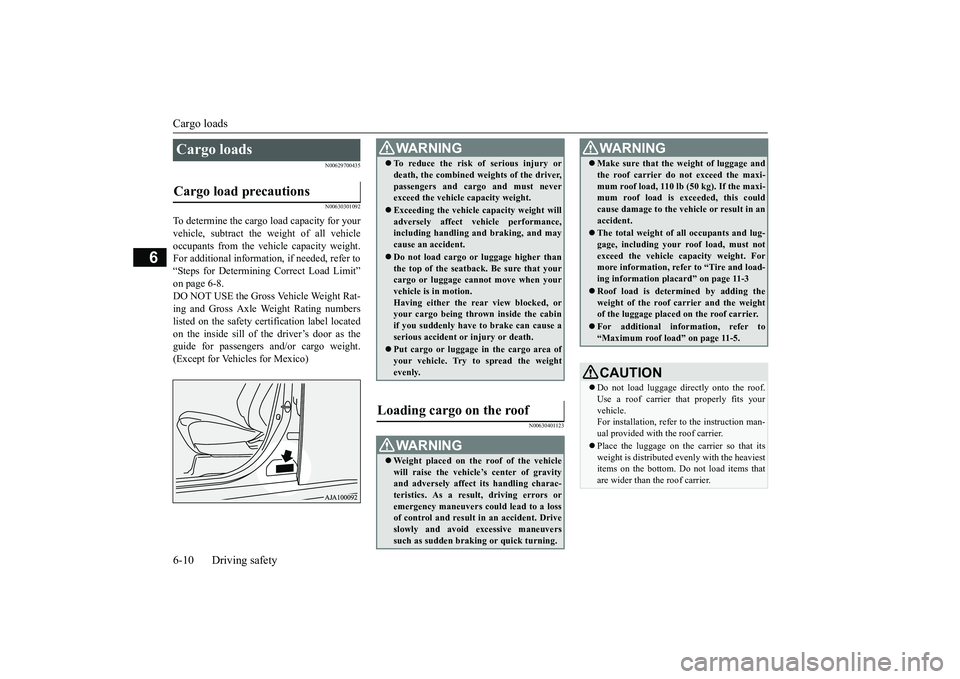
For additional information, if needed, refer to“Steps for Determining Correct Load Limit”on page 6-8.DO NOT USE the Gross Vehicle Weight Rat-ing and Gross Axle Weight Rating numberslisted on the safety certification label locatedon the inside sill of the driver’s door as theguide for passengers and/or cargo weight.(Except for Vehicles for Mexico)
N00630401123
Cargo loads Cargo load precautions
WA R N I N GTo reduce the risk of serious injury ordeath, the combined weights of the driver,passengers and cargo and must neverexceed the vehicle capacity weight.Exceeding the vehicle capacity weight willadversely affect ve
hicle performance,
including handling and braking, and maycause an accident.Do not load cargo or luggage higher thanthe top of the seatback. Be sure that yourcargo or luggage cann
ot move when your
vehicle is in motion.Having either the re
ar view blocked, or
your cargo being thrown
inside the cabin
if you suddenly have to brake can cause aserious accident or
injury or death.
Put cargo or luggage in the cargo area ofyour vehicle. Try to spread the weightevenly.
Loading cargo on the roof
WA R N I N GWeight placed on the
roof of the vehicle
will raise the vehicle’and adversely affect
its handling charac-
teristics. As a result, driving errors oremergency maneuvers could lead to a lossof control and result in an accident. Driveslowly and avoid excessive maneuverssuch as sudden brak
ing or quick turning.
Make sure that the
weight of luggage and
the roof carrier do not exceed the maxi-mum roof load, 110 lb (50 kg). If the maxi-mum roof load is ex
ceeded, this could
cause damage to the ve
hicle or result in an
accident.The total weight of all occupants and lug-gage, including your r
oof load, must not
exceed the vehicle capacity weight. Formore information, refer to “Tire and load-ing information placard” on page 11-3Roof load is determined by adding theweight of the roof
carrier and the weight
of the luggage placed
on the roof carrier.
For additional information, refer to“Maximum roof load” on page 11-5.CAUTIONDo not load luggage directly onto the roof.Use a roof carrier that properly fits yourvehicle.For installation, refer to the instruction man-ual provided with the roof carrier.Place the luggage on the carrier so that itsweight is distri
buted evenly with the heaviest
items on the bottom. Do not load items thatare wider than the roof carrier.WA R N I N G
BK0249100US.book 10 ページ 2017年5月10日 水曜日 午前8時49分
Page 344 of 441
Trailer towing
Driving safety 6-15
6
You’ll need more passing distance up aheadwhen you’re towing a trailer. And, becauseyou’re a good deal longer, you’ll need to gomuch farther beyond the passed vehiclebefore you can return to your lane.Hold the bottom of the steering wheel withone hand. Then, to move the trailer to the left,just move that hand to the left. To move thetrailer to the right, move your hand to theright. Always back up sl
owly and, if possible,
have someone guide you.When you’re turning with a trailer, makewider than normal turns to help prevent thetrailer from striking shoulders, curbs, roadsigns, trees or other objects.
Avoid jerky or sudden maneuvers. Signalwell in advance.Towing a trailer puts additional burden on theengine and transaxle,
which may cause over-
heating. Following ar
e some suggestions to
reduce overheating:When towing at high al
titudes, engine coolant
and automatic transaxle oil will overheat at alower temperature than at normal altitudes.If you turn your engine off immediately aftertowing at high altitude
on steep uphill grades,
your vehicle may show
signs similar to over-
heating. To avoid this
, let the engine run
while parked (preferably on level ground)with the automatic transaxle in the “P”turning the engine off.
If the engine coolant temperature indica-tor flashes on the information screen inthe multi-information display or theengine power drops suddenly, refer to“Engine overheati
ng” on page 8-4.
If the warning display or warningdisplay illuminates, re
fer to “Warning dis-
play” on page 5-70, 5-78.
Reduce speed and downshift before you startdown a long or steep downgrade. If you don’tdownshift, over using the brakes can causereduced brake efficiency.You can tow in “D” (DRIVE) position. Youmay want to shift the selector lever to the 3rdor a lower position, under heavy loads or hillyconditions.Always place chocks or blocks under both thevehicle and trailer wheels when parking. Besure that the parking brake is firmly set andthat the selector lever is in the “P” (PARK)position. Avoid parki
ng on a hill with a
trailer, but if it cannot be avoided, do so onlyafter performing the following:
Passing Backing up Making turns
CAUTIONMaking sharp turns while towing a trailercould cause the
trailer to come in contact
with the vehicle. Your
vehicle could be dam-
aged. Avoid making sharp turns while tow-ing a trailer.
Overheating Cause of overheating
Solution
Air conditioning on Turn offHighway speeds Reduce speedGoing up hills Select lower gear posi-
tion
Stop-and-go city traf-fic
With the vehicle stopped, shift to the “N” (NEUTRAL) position and idle the engine at high idle.
Driving on hills Parking
BK0249100US.book 15 ページ 2017年5月10日 水曜日 午前8時49分
Page 345 of 441
Trailer towing6-16 Driving safety
6
1. Apply the brakes a
nd keep them applied.
2. Have someone plac
e chocks or blocks
under both the vehicle and trailer wheels.3. When the chocks or blocks are in place,release your brakes slowly until thechocks or blocks absorb the load.4. Apply the parking brake firmly.5. Set the selector lever to the
Page 360 of 441
General information about your radio
Comfort controls 7-15
7
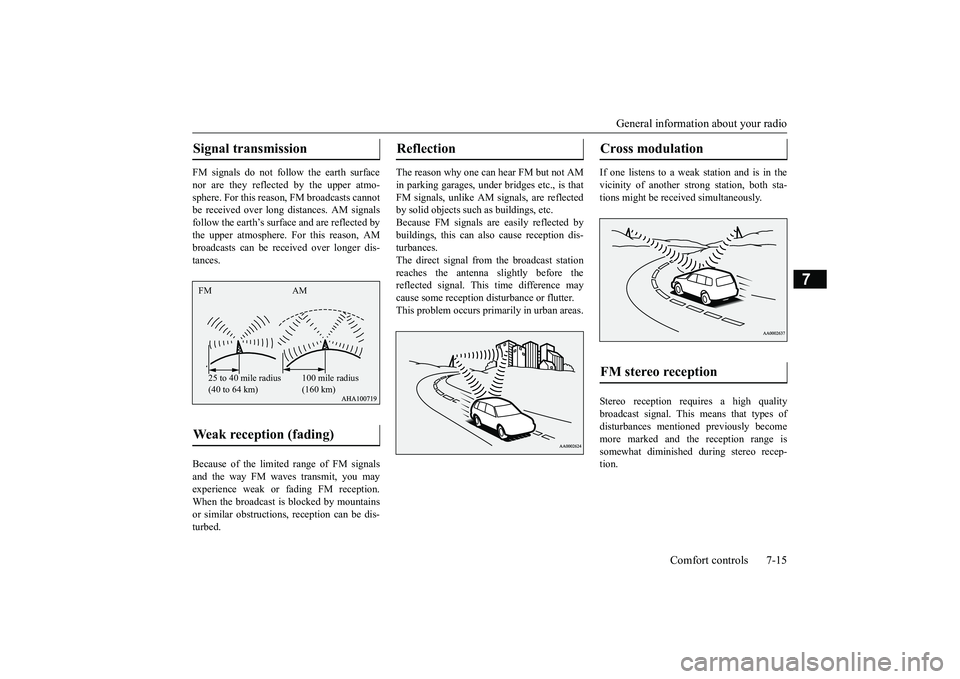
FM signals do not follow the earth surfacenor are they reflected by the upper atmo-sphere. For this reason,
FM broadcasts cannot
be received over long distances. AM signalsfollow the earth’s surface and are reflected bythe upper atmosphere. For this reason, AMbroadcasts can be received over longer dis-tances.Because of the limited
range of FM signals
and the way FM waves transmit, you mayexperience weak or
fading FM reception.
When the broadcast is
blocked by mountains
or similar obstructions,
reception can be dis-
turbed.
The reason why one can hear FM but not AMin parking garages, unde
r bridges etc., is that
FM signals, unlike AM
signals, are reflected
by solid objects such
as buildings, etc.
Because FM signals are easily reflected bybuildings, this can also
cause reception dis-
turbances.The direct signal from
the broadcast station
reaches the antenna slightly before thereflected signal. This time difference maycause some reception di
sturbance or flutter.
This problem occurs primarily in urban areas.
If one listens to a weak station and is in thevicinity of another st
rong station, both sta-
tions might be received simultaneously.Stereo reception re
quires a high quality
broadcast signal. This means that types ofdisturbances mentioned previously becomemore marked and the reception range issomewhat diminished during stereo recep-tion.
Signal transmission Weak reception (fading) FM AM25 to 40 mile radius(40 to 64 km)
100 mile radius(160 km)
Reflection
Cross modulation FM stereo reception
BK0249100US.book 15 ページ 2017年5月10日 水曜日 午前8時49分
Page 363 of 441
If the vehicle breaks down8-2 For emergencies
8
N00836301230
If your vehicle breaks down on the road,move to the shoulder and turn on the hazardwarning flashers. If there is no shoulder, orthe shoulder is not safe, drive in the right laneslowly with the hazard
lights flashing, until
you come to a safe stopping place. Keep theflashers flashing.If the engine stops, there will be no powerassist to the steering and brakes, making thesedifficult to use.The brake booster will not work, so thebrakes will not grip well. The brake pedalwill be harder to press than usual.Since there is no power steering assist, thesteering wheel will be hard to turn.
Get help from your passengers, bystanders,etc. to push the vehicle
and move it to a safe
area.
N00836401778
If the engine cannot be started because thebattery is weak or de
ad, you can start it with
the battery from anothe
r vehicle using jumper
cables.1. Take off any metal jewelry such as watchbands or bracelets th
at might create an
accidental electrical contact.2. Position the vehi
cles close enough
together so that the jumper cables canreach, but be sure the vehicles aren’ttouching each other.
3. Set the parking brake firmly on your vehi-cle and move the selector lever into the“P” (PARK) position.4. Set the parking brake firmly on the othervehicle. Put the automatic transaxle in “P”5. Turn the ignition switch (the engineswitch) on each vehicle to the “LOCK” or“OFF” position.6. Make sure your battery electrolyte is atthe proper level. (Refer to “Battery” onpage 9-13.)
If the vehicle breaks down If the engine stops/fails When the engine fails at the intersection
Jump-starting the engine
WA R N I N GTo reduce the risk of igniting flammablegas that may be emitted from the battery,carefully read this section before jump-starting the vehicle.Do not try to start you
r vehicle by pushing
or towing. This can cause an accidentresulting in serious
injury or death and
can damage the vehicle.NOTE
Do not use jumper cables if they have dam-age or corrosion.
CAUTIONCheck the other vehicle.
It must have a 12-
volt battery. If the other system isn’t 12-volt,both systems can be damaged.NOTE
Turn off all lights, heat
er, and othe
r electrical
loads. This will avoid sparks and help saveboth batteries.
BK0249100US.book 2 ページ 2017年5月10日 水曜日 午前8時49分
Page 365 of 441
Engine overheating8-4 For emergencies
8
If you drive your vehicl
e with a low battery
charge after the engine has been started byusing jumper cables, th
e engine may misfire.
This can cause the anti-lock braking systemwarning light to blink on
and off. This is only
due to the low battery voltage. It is not aproblem with the brake system. If this hap-pens, fully charge the battery and ensure thecharging system is operating properly.
N00836501375
When the engine is overheating, the warningwill be displayed in th
e instrument cluster as
follows.The information screen in the multi infor-mation display will be interrupted and theengine coolant temp
erature warning dis-
play will appear. Also “ ” will blink.(Color liquid crystal display type)lamp will illuminate.
(Mono-color liquid
crystal display type)
If these warnings are displayed:
1. Stop the vehicle in a safe place. Turn onthe hazard warning flashers.2. With the engine st
ill running, carefully
raise the engine hood to vent the enginecompartment.3. Check that the cooling fan is running. Ifthe fan is not turn
ing, stop the engine
immediately and cont
act an authorized
Mitsubishi Motors dealer or a repair facil-ity of your choice for assistance.4. If you see steam or spray coming fromunder the hood, turn off the engine.5. If you do not see steam or spray comingfrom under the hood, leave the engine onuntil the high coolant
temperature warn-
ing goes off. After the high coolant tem-perature warning has gone off, you canstart driving again. If the high coolanttemperature warning stays on, turn off theengine.
Charging the battery by using an external battery charger
WA R N I N GAlways remove the
battery from your
vehicle when the battery is charged by anexternal battery charger.Keep sparks, cigarette
s, and flames away
from the battery because the battery couldexplode.Keep your work area well vented whencharging or using
the battery in an
enclosed space.Remove all the caps before charging thebattery.Electrolyte (battery acid) is made of corro-sive diluted sulfuric acid. If electrolytecomes in contact with your hands, eyes,clothes, or the pain
ted surface of your
vehicle, thoroughly
flush with water. If
electrolyte gets in your eyes, flush themimmediately and thor
oughly with water,
and get prompt medical attention.Always wear protective clothing and gog-gles when working near the battery.Keep the battery out of the reach of chil-dren.
As your vehicle has anti-lock brakes Engine overheating
WA R N I N GTo avoid personal injury, keep hands, hair,jewelry and clothes aw
ay from the cooling
fan. The cooling fan ca
n start at any time.
BK0249100US.book 4 ページ 2017年5月10日 水曜日 午前8時49分
Page 366 of 441
Jack and tools
For emergencies 8-5
8
6. When you do not see any more steam orspray, open the hood. Look for obviousleaks, such as a split radiator hose. Becareful as components will be hot. Anyleak source must be repaired.7. If there is no obvious leak source, checkthe coolant level in the engine coolantreserve tank. If there is
none, or if it is too
low, slowly add coolant.8. If the engine coolant reserve tank needscoolant, you will probably also need toadd coolant to the radiator. Do not loosenor remove the radiator cap until the enginehas cooled down.
9. Start the engine, a
nd slowly add coolant,
up to the bottom of the filler neck. Useplain water if you have to (and replace itwith the right coolant as soon as possible).
10. Replace the radiator cap and tighten it
fully. Check the engine coolant tempera-ture display on the mu
lti information dis-
play (Color liquid crystal display type) orthe high coolant temperature warninglight (Mono-color liqui
d crystal display
type). You can start driving again whenthe high coolant temperature warningdoes not come on.
11. Have the system inspected by your autho-
rized Mitsubishi Motors
dealer or a repair
facility of your choice.
N00836601389
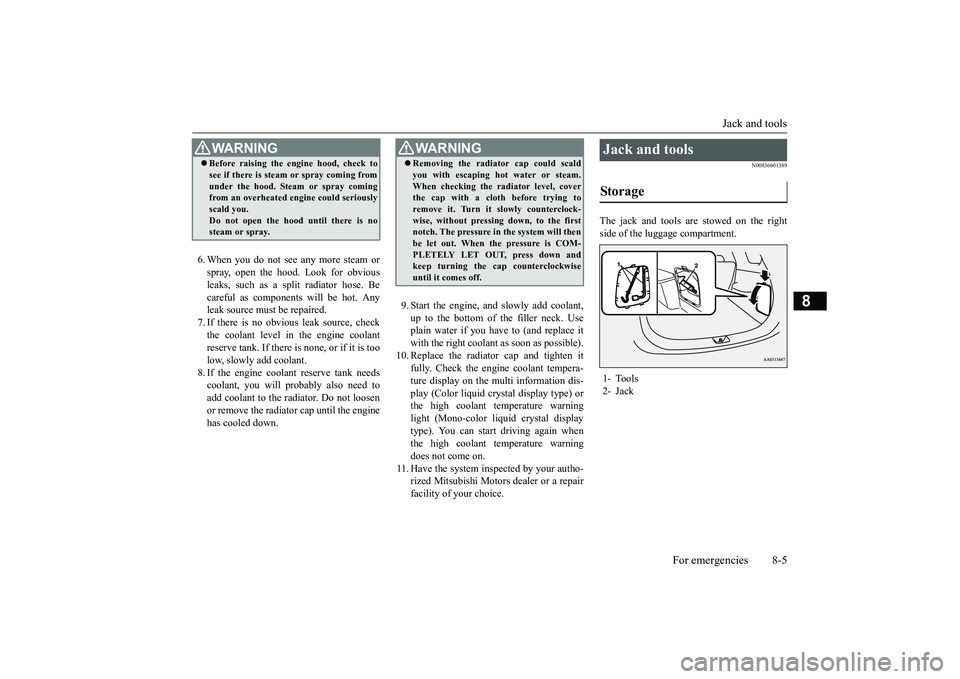
The jack and tools are stowed on the rightside of the luggage compartment.
WA R N I N GBefore raising the en
gine hood, check to
see if there is steam or spray coming fromunder the hood. Steam or spray comingfrom an overheated en
gine could seriously
scald you.Do not open the hood until there is nosteam or spray.
WA R N I N GRemoving the radiat
or cap could scald
you with escaping hot water or steam.When checking the radiator level, coverthe cap with a cloth before trying toremove it. Turn it slowly counterclock-wise, without pressing down, to the firstnotch. The pressure in the system will thenbe let out. When the pressure is COM-PLETELY LET OUT, press down andkeep turning the cap counterclockwiseuntil it comes off.
Jack and tools Storage 1- Tools2- Jack
BK0249100US.book 5 ページ 2017年5月10日 水曜日 午前8時49分