lock MITSUBISHI OUTLANDER III 2018 Owners Manual
[x] Cancel search | Manufacturer: MITSUBISHI, Model Year: 2018, Model line: OUTLANDER III, Model: MITSUBISHI OUTLANDER III 2018Pages: 441, PDF Size: 13.71 MB
Page 367 of 441
How to change a tire8-6 For emergencies
8
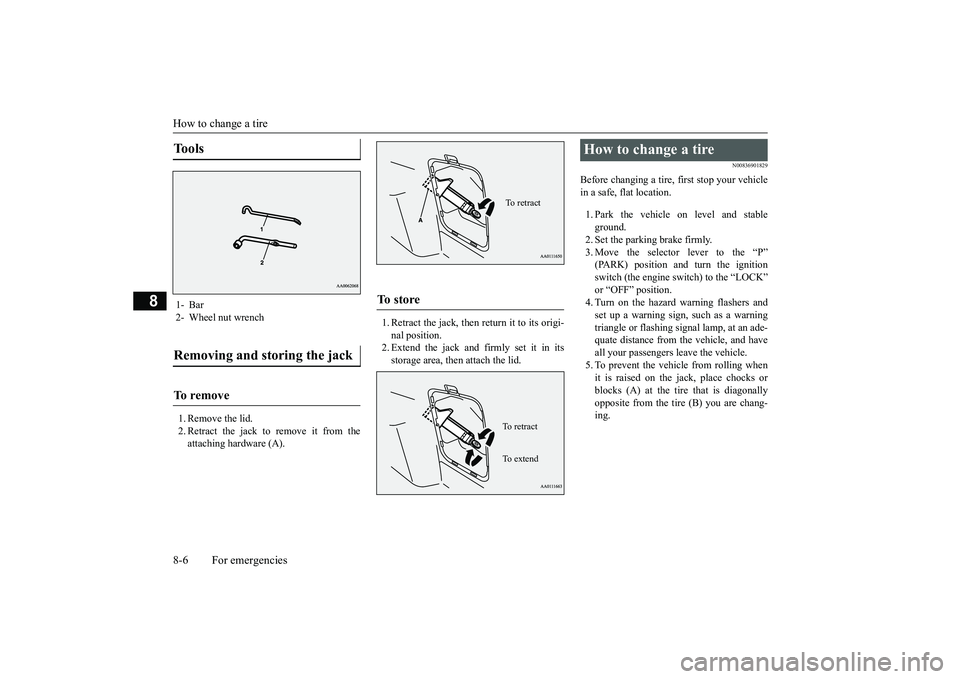
1. Remove the lid.2. Retract the jack to remove it from theattaching hardware (A).
1. Retract the jack, then return it to its origi-nal position.2. Extend the jack and firmly set it in itsstorage area, then attach the lid.
N00836901829
Before changing a tire, first stop your vehiclein a safe, flat location.1. Park the vehicle on level and stableground.2. Set the parking brake firmly.3. Move the selector
lever to the “P”
switch (the engine switch) to the “LOCK”or “OFF” position.4. Turn on the hazard warning flashers andset up a warning sign, such as a warningtriangle or flashing signal lamp, at an ade-quate distance from the vehicle, and haveall your passengers leave the vehicle.5. To prevent the vehicle from rolling whenit is raised on the jack, place chocks orblocks (A) at the ti
re that is diagonally
opposite from the tire (B) you are chang-ing.
Tools 1- Bar2- Wheel nut wrenchRemoving and storing the jack To r e m o v e
To s t o r e
To retractTo r e t r a c tTo e x t e n d
How to change a tire
BK0249100US.book 6 ページ 2017年5月10日 水曜日 午前8時49分
Page 368 of 441
How to change a tire
For emergencies 8-7
8
6. Get the jack, bar and wheel nut wrenchready.(Refer to “Jack and t
ools” on page 8-5.)
N00849600315
The compact spare tire is stowed below theluggage compartment fl
oor. It is designed to
save space in the luggage compartment. Itslighter weight makes it easier to use if a flattire occurs.
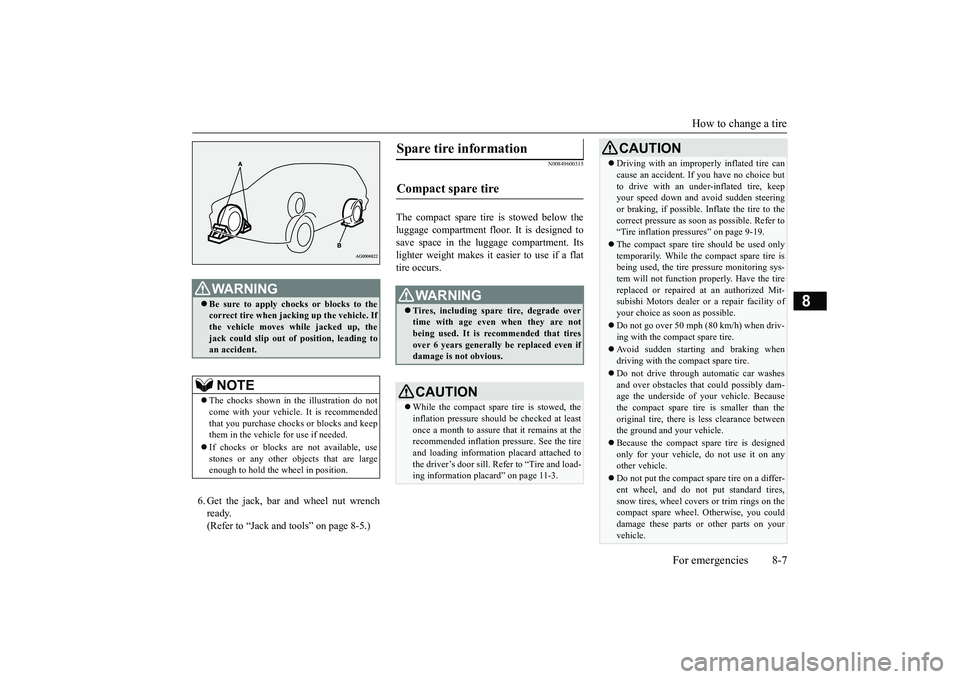
WA R N I N GBe sure to apply choc
ks or blocks to the
correct tire when jacking up the vehicle. Ifthe vehicle moves while jacked up, thejack could slip out of
position, leading to
an accident.NOTE
The chocks shown in the illustration do notcome with your vehicl
e. It is recommended
that you purchase chocks or blocks and keepthem in the vehicle for use if needed.If chocks or blocks
are not available, use
stones or any other obj
ects that are large
enough to hold the wheel in position.
Spare tire information Compact spare tire
WA R N I N GTires, including spar
e tire, degrade over
time with age even when they are notbeing used. It is recommended that tiresover 6 years generally
be replaced even if
damage is not obvious.CAUTIONWhile the compact spare tire is stowed, theinflation pressure shoul
d be checked at least
once a month to assure that it remains at therecommended inflation pressure. See the tireand loading informati
on placard attached to
the driver’s door sill. Refer to “Tire and load-ing information placard” on page 11-3.
Driving with an imprope
rly inflated tire can
cause an accident. If
you have no choice but
to drive with an under-inflated tire, keepyour speed down and avoid sudden steeringor braking, if possible. Inflate the tire to thecorrect pressure as s
oon as possible. Refer to
“Tire inflation pressures” on page 9-19.The compact spare tire should be used onlytemporarily. While the compact spare tire isbeing used, the tire pr
essure monitoring sys-
tem will not function pr
operly. Have the tire
replaced or repaired at an authorized Mit-subishi Motors dealer or
a repair facility of
your choice as soon as possible.Do not go over 50 mph (80 km/h) when driv-ing with the compact spare tire.Avoid sudden starting and braking whendriving with the compact spare tire.Do not drive through automatic car washesand over obstacles that
could possibly dam-
age the underside of your vehicle. Becausethe compact spare tire is smaller than theoriginal tire, there is less clearance betweenthe ground and your vehicle.Because the compact spare tire is designedonly for your vehicle, do not use it on anyother vehicle.Do not put the compact spare tire on a differ-ent wheel, and do not put standard tires,snow tires, wheel covers
or trim rings on the
compact spare wheel. Otherwise, you coulddamage these parts or other parts on yourvehicle.CAUTION
BK0249100US.book 7 ページ 2017年5月10日 水曜日 午前8時49分
Page 369 of 441
How to change a tire8-8 For emergencies
8
N00849701296
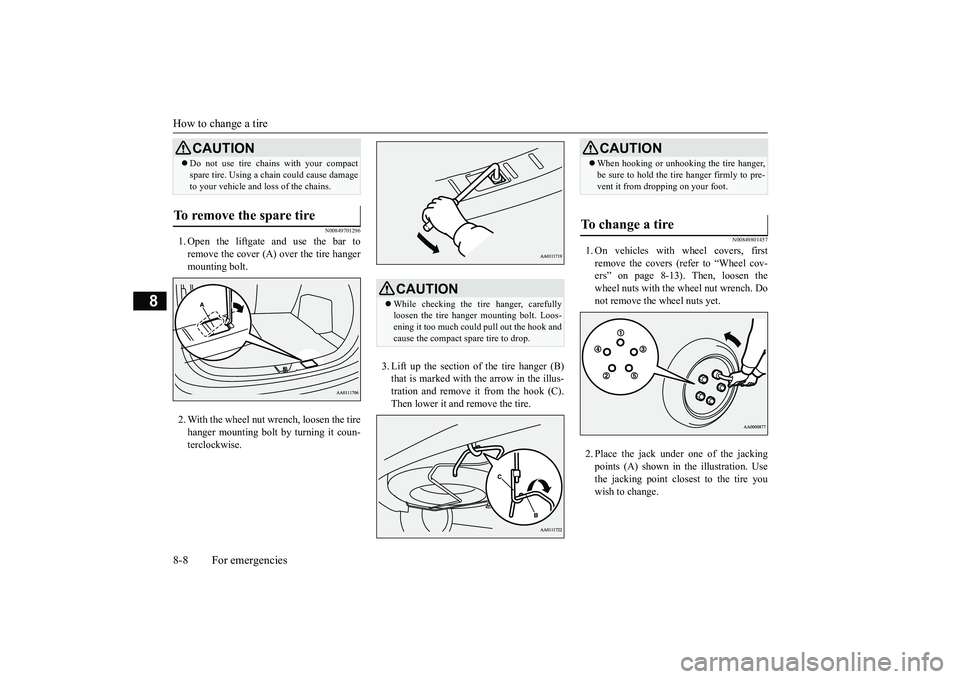
1. Open the liftgate and use the bar toremove the cover (A)
over the tire hanger
mounting bolt.2. With the wheel nut wrench, loosen the tirehanger mounting bolt by turning it coun-terclockwise.
3. Lift up the section of the tire hanger (B)that is marked with the arrow in the illus-tration and remove it from the hook (C).Then lower it and remove the tire.
N00849801457
1. On vehicles with
wheel covers, first
remove the covers (re
fer to “Wheel cov-
ers” on page 8-13). Then, loosen thewheel nuts with the wheel nut wrench. Donot remove the wheel nuts yet.2. Place the jack under one of the jackingpoints (A) shown in the illustration. Usethe jacking point closest to the tire youwish to change.
Do not use tire chains with your compactspare tire. Using a ch
ain could cause damage
to your vehicle and loss of the chains.
To remove the spare tire
CAUTION
CAUTIONWhile checking the tir
e hanger, carefully
loosen the tire hanger mounting bolt. Loos-ening it too much could pull out the hook andcause the compact spare tire to drop.
CAUTIONWhen hooking or unhooking the tire hanger,be sure to hold the tire hanger firmly to pre-vent it from dropping on your foot.
To change a tire
BK0249100US.book 8 ページ 2017年5月10日 水曜日 午前8時49分
Page 371 of 441
How to change a tire8-10 For emergencies
8
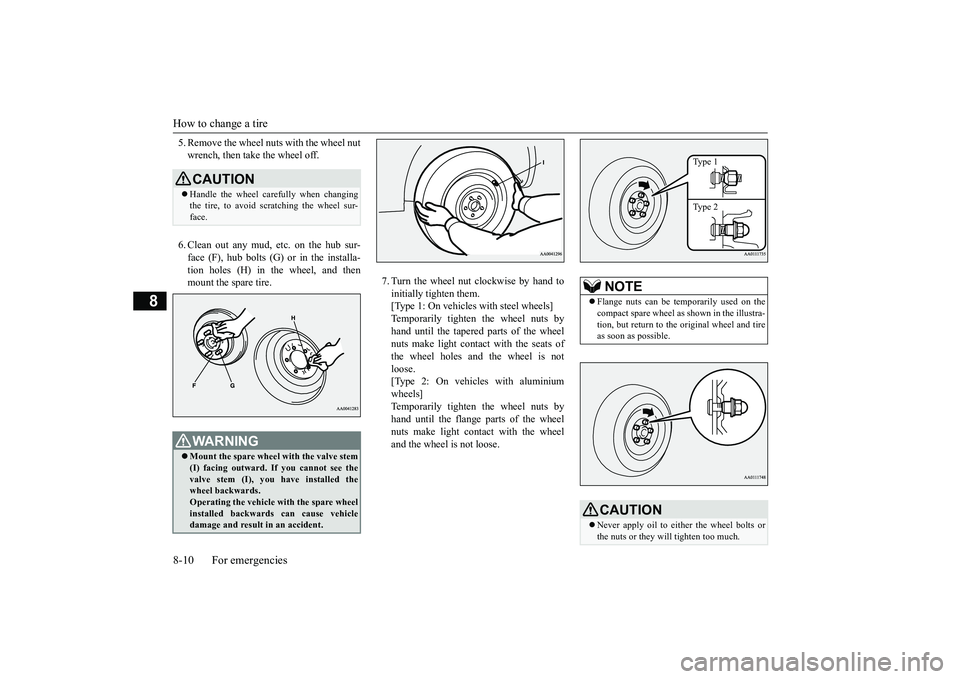
5. Remove the wheel nuts with the wheel nutwrench, then take the wheel off.6. Clean out any mud, etc. on the hub sur-face (F), hub bolts (G)
or in the installa-
tion holes (H) in the wheel, and thenmount the spare tire.
7. Turn the wheel nut clockwise by hand toinitially tighten them.[Type 1: On vehicles
with steel wheels]
Temporarily tighten the wheel nuts byhand until the tapered parts of the wheelnuts make light contac
t with the seats of
the wheel holes and the wheel is notloose.[Type 2: On vehicles with aluminiumwheels]Temporarily tighten the wheel nuts byhand until the flange parts of the wheelnuts make light cont
act with the wheel
and the wheel is not loose.
CAUTIONHandle the wheel carefully when changingthe tire, to avoid scratching the wheel sur-face.WA R N I N GMount the spare wheel with the valve stem(I) facing outward. If
you cannot see the
valve stem (I), you
have installed the
wheel backwards.Operating the vehicle with the spare wheelinstalled backwards can cause vehicledamage and result
in an ac
cident.
NOTE
Flange nuts can be te
mporarily used on the
compact spare wheel as shown in the illustra-tion, but return to the original wheel and tireas soon as possible.CAUTIONNever apply oil to either the wheel bolts orthe nuts or they will tighten too much.
Type 1Type 2
BK0249100US.book 10 ページ 2017年5月10日 水曜日 午前8時49分
Page 372 of 441
How to change a tire
For emergencies 8-11
8
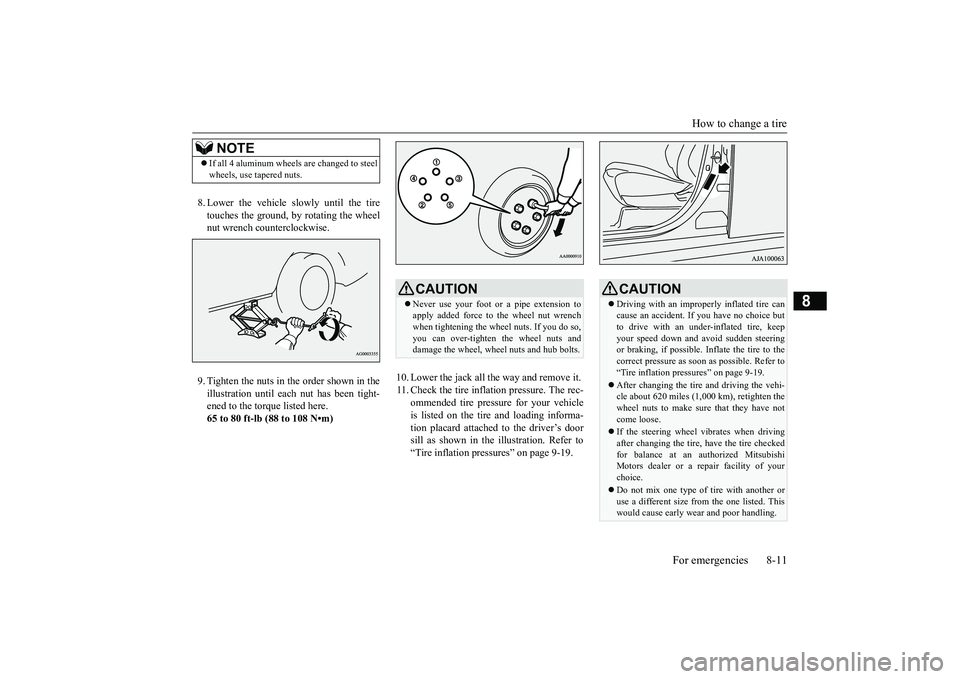
8. Lower the vehicle slowly until the tiretouches the ground, by rotating the wheelnut wrench counterclockwise.9. Tighten the nuts in the order shown in theillustration until each
nut has been tight-
ened to the torque listed here.65 to 80 ft-lb (88 to 108 N•m)
10. Lower the jack all the way and remove it.11. Check the tire inflation pressure. The rec-
ommended tire pressure for your vehicleis listed on the tire
and loading informa-
tion placard attached to the driver’s doorsill as shown in the illustration. Refer to“Tire inflation pressures” on page 9-19.
NOTE
If all 4 aluminum wheels are changed to steelwheels, use tapered nuts.
CAUTIONNever use your foot or a pipe extension toapply added force to the wheel nut wrenchwhen tightening the wheel nuts. If you do so,you can over-tighten the wheel nuts anddamage the wheel, wheel nuts and hub bolts.
CAUTIONDriving with an imprope
rly inflated tire can
cause an accident. If
you have no choice but
to drive with an under-inflated tire, keepyour speed down and avoid sudden steeringor braking, if possible. Inflate the tire to thecorrect pressure as s
oon as possible. Refer to
“Tire inflation pressures” on page 9-19.After changing the tire
and driving the vehi-
cle about 620 miles (1,000 km), retighten thewheel nuts to make sure
that they have not
come loose.If the steering wheel vibrates when drivingafter changing the tire, have the tire checkedfor balance at an authorized MitsubishiMotors dealer or a repair facility of yourchoice.Do not mix one type of tire with another oruse a different size from the one listed. Thiswould cause ea
rly wear and poor handling.
BK0249100US.book 11 ページ 2017年5月10日 水曜日 午前8時49分
Page 373 of 441
How to change a tire8-12 For emergencies
8
N00832300020
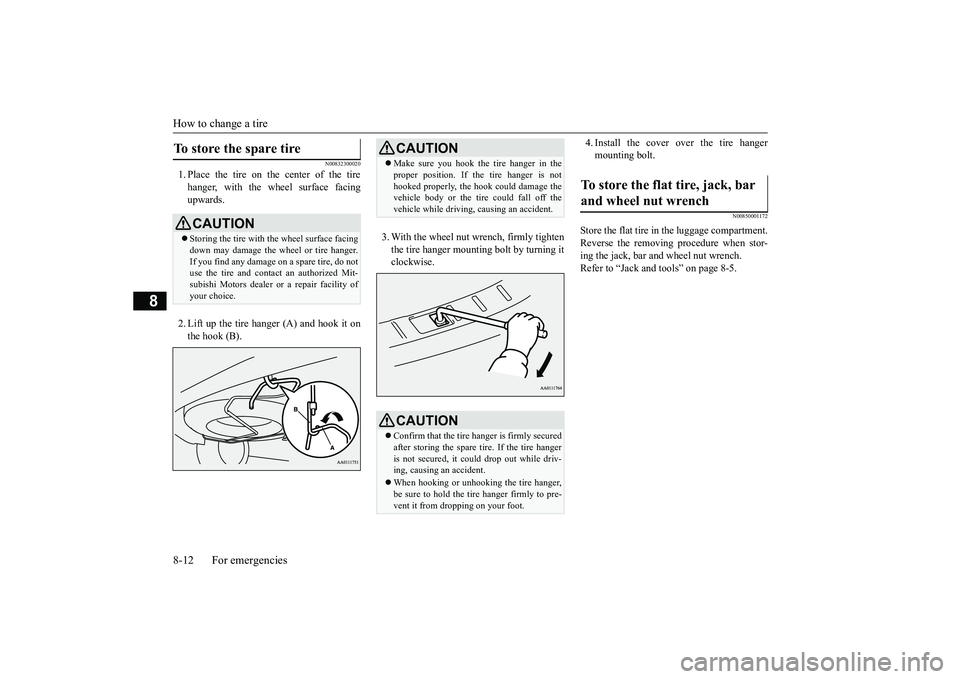
1. Place the tire on the center of the tirehanger, with the wheel surface facingupwards.2. Lift up the tire hanger (A) and hook it onthe hook (B).
3. With the wheel nut wrench, firmly tightenthe tire hanger mounti
ng bolt by turning it
clockwise.
4. Install the cover over the tire hangermounting bolt.
N00850001172
Store the flat tire in the luggage compartment.Reverse the removing procedure when stor-ing the jack, bar and wheel nut wrench.Refer to “Jack and t
ools” on page 8-5.
To store the spare tire
CAUTIONStoring the tire with the wheel surface facingdown may damage the wheel or tire hanger.If you find any damage
on a spare tire, do not
use the tire and contact an authorized Mit-subishi Motors dealer or a repair facility ofyour choice.
CAUTIONMake sure you hook the tire hanger in theproper position. If the tire hanger is nothooked properly, the hook
could damage the
vehicle body or the tire
could fall off the
vehicle while driving,
causing an accident.
CAUTIONConfirm that the tire hanger is firmly securedafter storing the spare
tire. If the tire hanger
is not secured, it c
ould drop out while driv-
ing, causing
an accident.
When hooking or unhooking the tire hanger,be sure to hold the tire hanger firmly to pre-vent it from dropping on your foot.
To store the flat tire, jack, bar and wheel nut wrench
BK0249100US.book 12 ページ 2017年5月10日 水曜日 午前8時49分
Page 377 of 441
Fuel Pump Shut-off System8-16 For emergencies
8
When driving on a road covered withsnow or ice, use s
now tires. Tire chains
cannot be used on your vehicle. Theremay be state or local regulations aboutusing snow tires. Al
ways check the regu-
lations in your local area before usingthem. Refer to “Snow tires” on page 9-21and “Tire chains” on page 9-22.Drive slowly. Do not make sudden startsor stops, sharp turns, or slam on thebrakes.Allow extra distance
between your vehi-
cle and the vehicle in front of you, andavoid sudden braking.If a skid occurs when the acceleratorpedal is depressed, take your foot off thepedal. Steer gently in the direction of theskid.Your vehicle is equipped with an anti-lockbraking system (ABS). Hold the brakepedal down firmly and keep it depressed.Do not pump the brake pedal which willresult in reduced braking performance.After parking on snowy or icy roads, itmay be difficult to move your vehicle dueto the brake being frozen. Depress theaccelerator pedal little by little to movethe vehicle when safe to do so.
Drive as slow as pos
sible when driving on
bumpy, rutted roads or over potholes.
N00860600031
In the event of a collision causing frontal air-bag deployment, the fuel pump shut-off sys-tem will activate to st
op fuel supply to the
engine.
On snowy or icy roads
CAUTIONDo not depress the acce
lerator pedal rapidly.
The vehicle could start moving when itbreaks free from the
ice, possibly resulting in
an accident.
On a bumpy or rutted road
CAUTIONDriving on bumpy, rutted roads or over pot-holes can damage th
e tires and wheels.
Wheels with low-profiles tires or under-inflated tires are especially at risk for dam-age.
Fuel Pump Shut-off System
WA R N I N GBefore attempting to restart the engineafter a collision, alw
ays inspect the ground
under the vehicle for leaking fuel. If a fuelleak is found or a fuel
odor is detected, do
not restart the engine.Mitsubishi Motors recommends that yourvehicle be inspected by
an author
ized Mit-
subishi Motors dealer
after any collision.
BK0249100US.book 16 ページ 2017年5月10日 水曜日 午前8時49分
Page 379 of 441
Service precautions9-2 Vehicle care and maintenance
9
N00937301498
Taking regular care of your vehicle will pre-serve its value and appe
arance as long as pos-
sible.You can do some of the maintenance workyourself, and the rest should only be per-formed by an authorized Mitsubishi Motorsdealer or a repair facility of your choice.If you discover a malfunction or other prob-lem, have it corrected by an authorized Mit-subishi Motors dealer or a repair facility ofyour choice.This section descri
bes the maintenance
inspections that you can do yourself, if you sodesire. Follow the instructions and precau-tions for each procedure.
Have you purchased the Mitsubishi MotorsDiamond Care Protection Plan? The Plansupplements your new
vehicle warranties.
See your authorized Mitsubishi Motors dealerfor details.
N00937401473
The catalytic converter requires you to useunleaded fuel only. Leaded gasoline willdestroy the emission-control effectiveness ofthe converter.
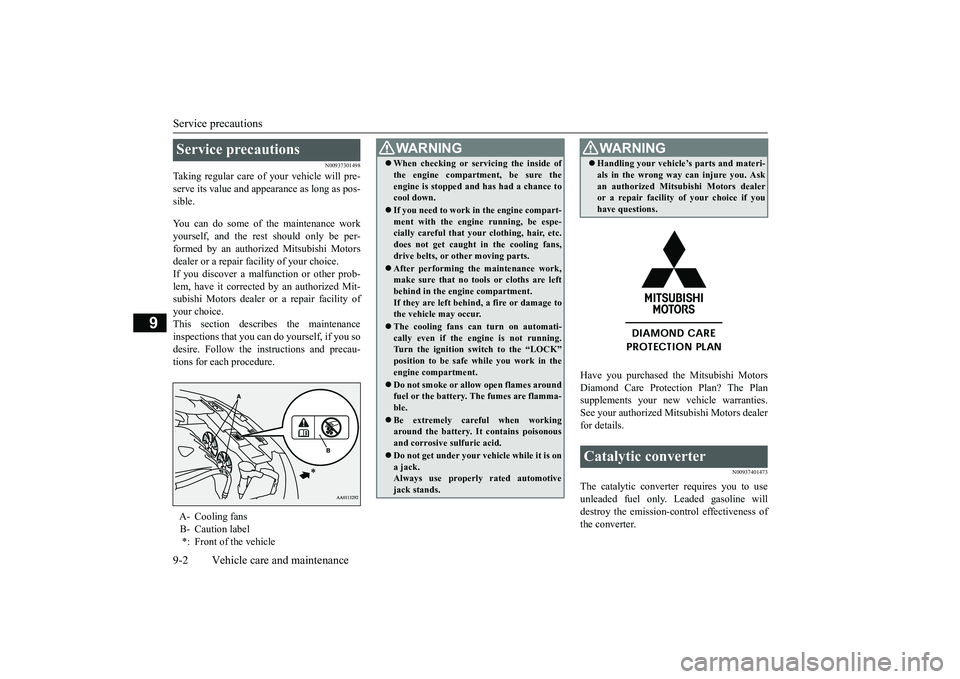
Service precautions A- Cooling fansB- Caution label*: Front of the vehicle
WA R N I N GWhen checking or servicing the inside ofthe engine compartment, be sure theengine is stopped and has had a chance tocool down.If you need to work
in the engine compart-
ment with the engine running, be espe-cially careful that your clothing, hair, etc.does not get caught in the cooling fans,drive belts, or other moving parts.After performing the maintenance work,make sure that no tools or cloths are leftbehind in the engine compartment.If they are left behind, a fire or damage tothe vehicle may occur.The cooling fans can turn on automati-cally even if the engine is not running.Turn the ignition switch to the “LOCK”position to be safe while you work in theengine compartment.Do not smoke or allow open flames aroundfuel or the battery. The fumes are flamma-ble.Be extremely careful when workingaround the battery. It
contains poisonous
and corrosive sulfuric acid.Do not get under your ve
hicle while it is on
a jack.Always use properly rated automotivejack stands.
Handling your vehicle’s parts and materi-als in the wrong way can injure you. Askan authorized Mitsub
ishi Motors dealer
or a repair facility of your choice if youhave questions.
Catalytic converter
WA R N I N G
BK0249100US.book 2 ページ 2017年5月10日 水曜日 午前8時49分
Page 380 of 441
Engine hood
Vehicle care and maintenance 9-3
9
Normally, the catalyti
c converter does not
require maintenance. However, it is importantto keep the engine properly tuned for the con-verter to continue to work properly.To reduce the possibili
ty of catalytic con-
verter damage:Use UNLEADED GASOLINE ONLY ofthe type of recommended in the “Fuelselection”.Do not drive with an extremely low fuellevel. Running out of gas could damagethe catalytic converter.
Do not try to start the engine by pushingor towing the vehicle. If the battery isweak or run down, use jumper cables toproperly start the engine.Do not idle the engine with any spark plugwires disconnected or removed, such aswhen performing
diagnosti
c tests.
Do not idle the engine
for a long time if it
is idling roughly or otherwise obviouslymalfunctioning.To prevent the catalytic converter frombeing damaged from unburned gas, do notrace the engine when turning off the igni-tion switch.Stop driving the vehicle if you think theperformance is noticeably low, or theengine has a malfunction such as with theignition, etc. If you are not able to stopdriving immediately,
slow down and drive
for only a short time. Have your vehiclechecked at an authorized MitsubishiMotors dealer or a repair facility of yourchoice as soon
as possible.
In unusual situations involving majorengine problems, a burning odor mayindicate severe and abnormal catalyticconverter overheating.
If this occurs, stop
in a safe place, shut the engine off and letthe vehicle cool. Once
the engine is cool,
immediately take
your vehicle to an
authorized Mitsubishi
Motors dealer or a
repair facility of your choice for service.
N00937501588
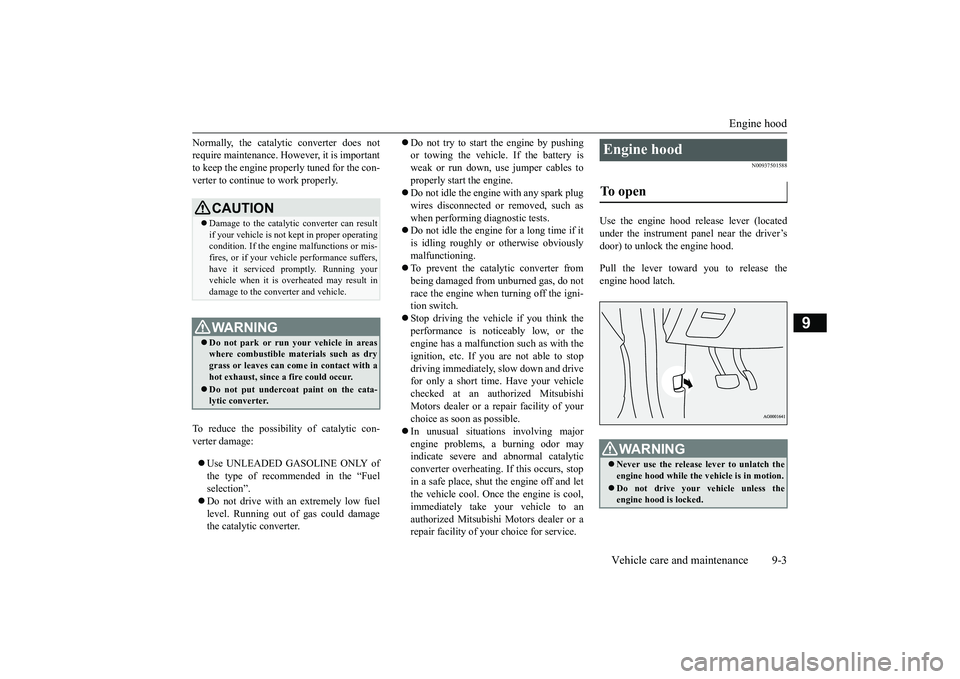
Use the engine hood release lever (locatedunder the instrument panel near the driver’sdoor) to unlock the engine hood.Pull the lever toward you to release theengine hood latch.
CAUTIONDamage to the catalyti
c converter can result
if your vehicle is not
kept in proper operating
condition. If the engine
malfunctions or mis-
fires, or if your vehi
cle performance suffers,
have it serviced promptly. Running yourvehicle when it is
overheated may result in
damage to the converter and vehicle.WA R N I N GDo not park or run your vehicle in areaswhere combustible materials such as drygrass or leaves can come
in contact with a
hot exhaust, since a fire could occur.Do not put undercoat paint on the cata-lytic converter.
Engine hood To open
WA R N I N GNever use the release lever to unlatch theengine hood while the
vehicle is in motion.
Do not drive your vehicle unless theengine hood is locked.
BK0249100US.book 3 ページ 2017年5月10日 水曜日 午前8時49分
Page 402 of 441
For cold and snowy weather
Vehicle care and maintenance 9-25
9
The underside or rear of the vehicle isdamaged
Also check the exhaust system each time thevehicle is raised for l
ubrication, oil changes,
or required service. A
ny open seams or loose
connections could le
t dangerous exhaust
fumes seep into the luggage and passengercompartments.Check for holes or exhaust gas leakscaused by corrosion or damage.Check the joints and connections forlooseness or exhaust gas leaks.Check the rubber hangers and brackets fordamage.
N00942300079
The timing belt should be replaced with anew one at the mileage listed in the “WAR-RANTY AND MAINTENANCE MAN-UAL”.
N00942501124
The hood lock release mechanism and hoodsafety catch should be checked, cleaned, andoiled when needed for easy movement and toprevent rust and wear. Use MultipurposeGrease NLGI Grade 2 sparingly for all slidingparts of the hood latch and release lever.Work the grease into the hood lock mecha-nism until all the movable surfaces are cov-ered.Also, put a light coat
of the same grease on
the safety catch wherever moving parts touch.
N00942600102
The ventilation slots in
front of the wind-
shield should be brushed clear after a heavysnowfall so that the operation of the heatingand ventilation systems will not be impaired.
To prevent freezing of the weatherstrippingon the doors, engine hood, etc., they shouldbe treated with
silicone grease.
It is a good idea to carry a shovel or a short-handled spade in the vehicle during the win-ter so that you can clear away snow if you getstranded. A small hand-brush for sweepingsnow off the vehicle a
nd a plastic scraper for
the windshield, side a
nd rear window are also
useful.
N00942700291
The fusible links will melt to prevent a fire ifa large current attempts to flow through cer-tain electrical systems.In case of a melted fusible link, see yourauthorized Mitsubishi Motors dealer or arepair facility of your choice for inspectionand replacement.For the fusible links, please refer to “Fuseload capacities” on page 9-27.
Check for any of the following conditions: Timing belt
Hood lock release mechanism and safety catch For cold and snowy weather Ventilation slots
Weatherstripping Additional equipment (For regions where snow is encoun-tered) Fusible links
BK0249100US.book 25 ページ 2017年5月10日 水曜日 午前8時49分