engine MITSUBISHI OUTLANDER III 2018 Owners Manual
[x] Cancel search | Manufacturer: MITSUBISHI, Model Year: 2018, Model line: OUTLANDER III, Model: MITSUBISHI OUTLANDER III 2018Pages: 441, PDF Size: 13.71 MB
Page 391 of 441
Battery9-14 Vehicle care and maintenance
9
Do not fill above the t
op line because a spill
during driving could cause damage.The battery is weaker in cold temperatures.This has to do with its chemical and physicalproperties and is why a very cold battery,especially one with a low charge, will have ahard time starting your vehicle.It is recommended that you have your batteryand charging system checked by an autho-rized Mitsubishi Motors dealer or a repairfacility of your choice before the start of coldweather. If necessary, have it charged. Thiswill provide more relia
ble starting, and longer
battery life.To disconnect the battery cable, stop theengine. Disconnect the
negative (-) terminal
first, then the positive (+) terminal. To recon-nect the battery, first
connect the positive (+)
terminal and then the negative (-) terminal,before starting the vehicle.During cold weather Disconnection and connection
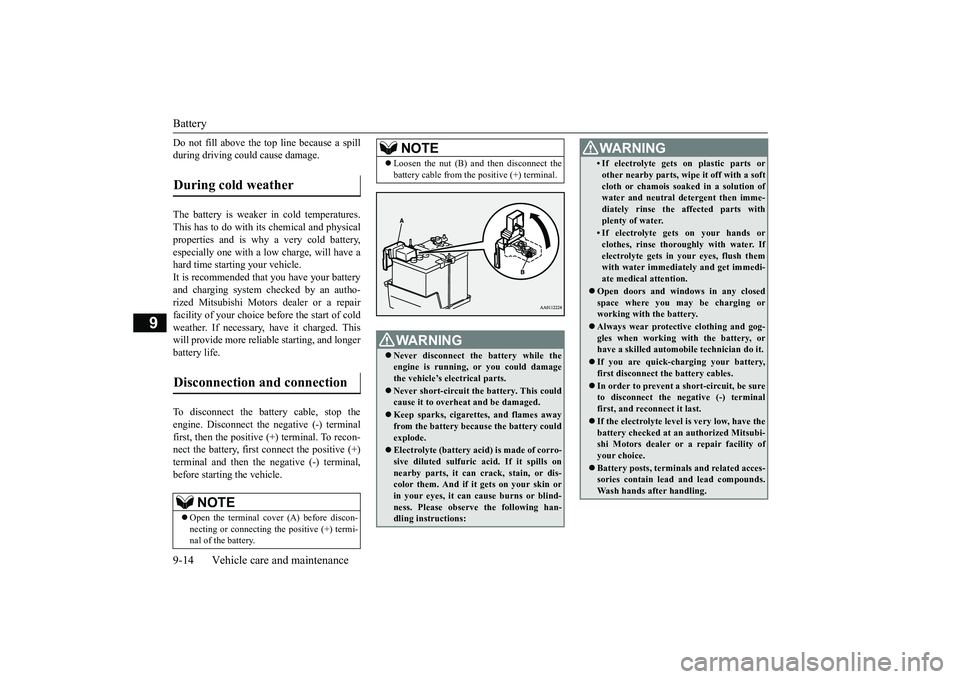
NOTE
Open the terminal cover (A) before discon-necting or connecting
the positive (+) termi-
nal of the battery.
Loosen the nut (B) and then disconnect thebattery cable from the positive (+) terminal.WA R N I N GNever disconnect the battery while theengine is running, or you could damagethe vehicle’s electrical parts.Never short-circuit the battery. This couldcause it to overheat and be damaged.Keep sparks, cigarettes, and flames awayfrom the battery because the battery couldexplode.Electrolyte (battery acid) is made of corro-sive diluted sulfuric acid. If it spills onnearby parts, it can crack, stain, or dis-color them. And if it gets on your skin orin your eyes, it can cause burns or blind-ness. Please observe the following han-dling instructions:NOTE
• If electrolyte gets on plastic parts orother nearby parts, wipe it off with a softcloth or chamois soak
ed in a solution of
water and neutral detergent then imme-diately rinse the affected parts withplenty of water.• If electrolyte gets on your hands orclothes, rinse thoroughly with water. Ifelectrolyte gets in
your eyes, flush them
with water immediately and get immedi-ate medical attention.
Open doors and wind
ows in any closed
space where you may be charging orworking with the battery.Always wear protective clothing and gog-gles when working with the battery, orhave a skilled automobile technician do it.If you are quick-ch
arging your battery,
first disconnect the battery cables.In order to prevent a
short-circuit, be sure
to disconnect the negative (-) terminalfirst, and reconnect it last.If the electrolyte level
is very low, have the
battery checked at an
authorized Mitsubi-
shi Motors dealer or
a repair facility of
your choice.Battery posts, terminals and related acces-sories contain lead
and lead compounds.
Wash hands after handling.WA R N I N G
BK0249100US.book 14 ページ 2017年5月10日 水曜日 午前8時49分
Page 399 of 441
Brake pedal free play9-22 Vehicle care and maintenance
9
N00940101139N00940300293
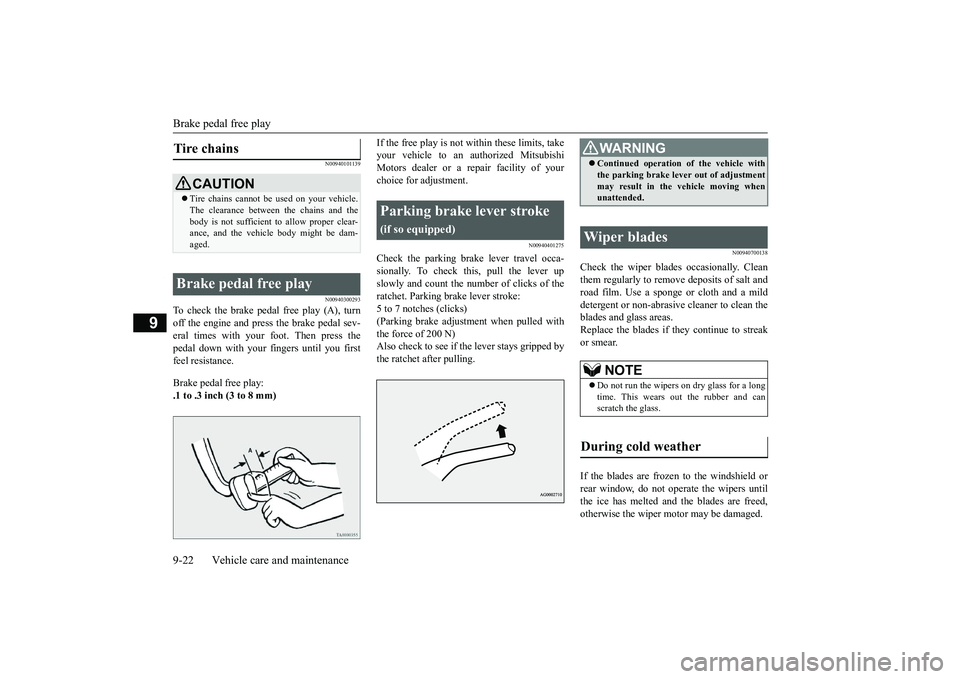
To check the brake pedal free play (A), turnoff the engine and press the brake pedal sev-eral times with your foot. Then press thepedal down with your fi
ngers until you first
feel resistance.Brake pedal free play:.1 to .3 inch (3 to 8 mm)
If the free play is not within these limits, takeyour vehicle to an
authorized Mitsubishi
Motors dealer or a repair facility of yourchoice for adjustment.
N00940401275
Check the parking brake lever travel occa-sionally. To check this, pull the lever upslowly and count the number of clicks of theratchet. Parking br
ake lever stroke:
5 to 7 notches (clicks)(Parking brake adjustment when pulled withthe force of 200 N)Also check to see if the lever stays gripped bythe ratchet after pulling.
N00940700138
Check the wiper blades occasionally. Cleanthem regularly to remove
deposits of salt and
road film. Use a sponge or cloth and a milddetergent or non-abrasive
cleaner to clean the
blades and glass areas.Replace the blades if th
ey continue to streak
or smear.If the blades are frozen to the windshield orrear window, do not operate the wipers untilthe ice has melted and the blades are freed,otherwise the wiper mo
tor may be damaged.
Tire chains
CAUTIONTire chains cannot be used on your vehicle.The clearance between
the chains and the
body is not sufficient to allow proper clear-ance, and the vehicle body might be dam-aged.
Brake pedal free play
Parking brake lever stroke
(if so equipped)
WA R N I N GContinued operation
of the vehicle with
the parking brake leve
r out of adjustment
may result in the
vehicle moving when
unattended.
Wiper blades
NOTE
Do not run the wipers on dry glass for a longtime. This wears out
the rubber and can
scratch the glass.
During cold weather
BK0249100US.book 22 ページ 2017年5月10日 水曜日 午前8時49分
Page 400 of 441
Emission-control system maintenanceVehicle care and maintenance 9-23
9
N00940800328
Your vehicle is equi
pped with an emission-
control system that meets all the requirementsof the U.S. Environm
ental Protection Agency
and Environment Cana
da. The emission-con-
trol system is made of:a positive crankcase
ventilation system
an evaporative emis
sion-control system
an exhaust emission-control system
To be sure the emissi
on-control system works
properly, have your vehicle inspected andmaintained by an authorized MitsubishiMotors dealer or a repair facility of yourchoice. This should be done at the time ormileage specified in the “WARRANTY ANDMAINTENANCE MANUAL”.These, and all the other “general” mainte-nance services listed in this manual, need tobe performed to keep
your vehicle running
properly and reliably.You should also have an inspection and ser-vice any time you suspect a malfunction.
N00940900231
Spark plugs must fire properly to ensureproper engine perfo
rmance and emission-
control.Do not reuse spark plugs by cleaning orregapping. Spark plugs should be replaced atthe mileage specified in the “WARRANTYAND MAINTENANCE MANUAL”.
Check the hose surfaces for any heat andmechanical damage, hard and brittle rubber,cracking, tears, cuts and abrasions. Pay spe-cial attention to the hos
es closest to high heat
sources such as the exhaust manifold. Checkall the hose connections
, such as clamps and
couplings, to make sure
they are secure and
that there are no leaks. If you see any wear ordamage, replace the
hoses immediately.
N00950100050
Have the valve clea
rance checked at an
authorized Mitsubishi Motors dealer at themileage specified in the “WARRANTY ANDMAINTENANCE MANUAL”.If the engine sounds abnormally loud, haveadjustments made by an authorizedMitsubishi Motors dealer.
N00941300173
Check these regularly for damage or leaks inthe fuel lines and connections. Check the fueltank filler cap for dama
ge or looseness. Pay
special attention to the fuel lines closest to
Emission-control system maintenance
NOTE
To meet government regulations and pro-mote cleaner air, your
vehicle is equipped
with an onboard dia
gnostic system (OBD).
The engine electronic control module thatcontrols OBD functions stores various data(especially a
bout the exhaust emissions).
This data will be erased if the battery cable isdisconnected, which c
ould make a rapid
diagnosis difficult.
Do not disconnect the
battery cable when the engine malfunctionindicator (“SERVICE ENGINE SOON” or“Check engine
light”) is ON.
Spark plugs
NOTE
Use the recommended or equivalent sparkplugs listed under “Engin
e specifications” on
page 11-6. Use of other plugs could causeengine damage, loss of performance or radionoise.
Fuel hoses Intake valve clearance Fuel system (tank, pipe line and connection, and fuel tank filler cap)
BK0249100US.book 23 ページ 2017年5月10日 水曜日 午前8時49分
Page 401 of 441
General maintenance9-24 Vehicle care and maintenance
9
high heat sources such
as the exhaust mani-
fold.
N00941400187
If the fuel-vapor vent line is clogged or dam-aged, the fuel-vapor mixture will escape, pol-luting the air.Have the system checked at an authorizedMitsubishi Motors dealer at the mileage spec-ified in the “WARRANTY AND MAINTE-NANCE MANUAL”.
N00941501299
The next pages list th
e maintenance service
recommended by Mitsubishi Motors Corpo-ration. In addition to the general maintenancethat needs to be performed at the times listed,
there are other parts which do not usuallyneed regular maintenance.But, if any of these parts stops working prop-erly, your vehicle performance could suffer.Have these items checked if you notice aproblem with them.If you have any questions, see your autho-rized Mitsubishi Motors
dealer for assistance.
N00941600059
Good brakes are essential for safe driving.Check the brake pads for wear. For goodbraking performance, replace the brake padswith the same type pa
ds as the originals.
N00941700076
Brake hoses and tubing should be checkedfor:Severe surface cracking, scuffing or wornspots. If the fabric casing of the hose isshowing through any cracks or worn spotsin the rubber hose cover, the hose shouldbe replaced. The brakes can fail if thehose wears through.Improper installati
on may cause twisting,
or wheel, tire or
chassis interference.
N00941800093
Check the following parts for damage andgrease leaks:Ball joint boots of the suspension andsteering linkageBellows on both ends of the drive shaft
N00942201118
The best way to keep carbon monoxide gasfrom entering inside your
vehicle is to have
the engine exhaust syst
em properly serviced.
Have a competent mechanic inspect the com-plete exhaust system
and nearby body areas
for broken, damaged, deteriorated, or mispo-sitioned parts if you no
tice any of the follow-
ing:A change in the sound of the exhaust sys-temThe smell of exhaust fumes inside thevehicle
WA R N I N GIf you see a fuel leak
or if you smell fuel,
do not run the engine. Any spark (includ-ing from the ignition
), flame or smoking
material could cause an explosion or fire.Call an authorized
Mitsubishi Motors
dealer or a repair fa
cility of your choice
for assistance.
Evaporative emission control system (except evaporative emission canister) General maintenance
Disc brake pads Brake hoses
Ball joint, steering linkage seals, drive shaft boots Exhaust system
WA R N I N GCarbon monoxide gas
from your vehicle’s
exhaust is poisonous. Breathing thesefumes can cause unconsciousness or death.
BK0249100US.book 24 ページ 2017年5月10日 水曜日 午前8時49分
Page 402 of 441
For cold and snowy weather
Vehicle care and maintenance 9-25
9
The underside or rear of the vehicle isdamaged
Also check the exhaust system each time thevehicle is raised for l
ubrication, oil changes,
or required service. A
ny open seams or loose
connections could le
t dangerous exhaust
fumes seep into the luggage and passengercompartments.Check for holes or exhaust gas leakscaused by corrosion or damage.Check the joints and connections forlooseness or exhaust gas leaks.Check the rubber hangers and brackets fordamage.
N00942300079
The timing belt should be replaced with anew one at the mileage listed in the “WAR-RANTY AND MAINTENANCE MAN-UAL”.
N00942501124
The hood lock release mechanism and hoodsafety catch should be checked, cleaned, andoiled when needed for easy movement and toprevent rust and wear. Use MultipurposeGrease NLGI Grade 2 sparingly for all slidingparts of the hood latch and release lever.Work the grease into the hood lock mecha-nism until all the movable surfaces are cov-ered.Also, put a light coat
of the same grease on
the safety catch wherever moving parts touch.
N00942600102
The ventilation slots in
front of the wind-
shield should be brushed clear after a heavysnowfall so that the operation of the heatingand ventilation systems will not be impaired.
To prevent freezing of the weatherstrippingon the doors, engine hood, etc., they shouldbe treated with
silicone grease.
It is a good idea to carry a shovel or a short-handled spade in the vehicle during the win-ter so that you can clear away snow if you getstranded. A small hand-brush for sweepingsnow off the vehicle a
nd a plastic scraper for
the windshield, side a
nd rear window are also
useful.
N00942700291
The fusible links will melt to prevent a fire ifa large current attempts to flow through cer-tain electrical systems.In case of a melted fusible link, see yourauthorized Mitsubishi Motors dealer or arepair facility of your choice for inspectionand replacement.For the fusible links, please refer to “Fuseload capacities” on page 9-27.
Check for any of the following conditions: Timing belt
Hood lock release mechanism and safety catch For cold and snowy weather Ventilation slots
Weatherstripping Additional equipment (For regions where snow is encoun-tered) Fusible links
BK0249100US.book 25 ページ 2017年5月10日 水曜日 午前8時49分
Page 403 of 441
Fuses9-26 Vehicle care and maintenance
9
N00942801954
To prevent damage to the electrical systemfrom short-circuiting or overloading, eachindividual circuit is e
quipped with a fuse. The
fuse blocks are located in the passenger com-partment and in the engine compartment.
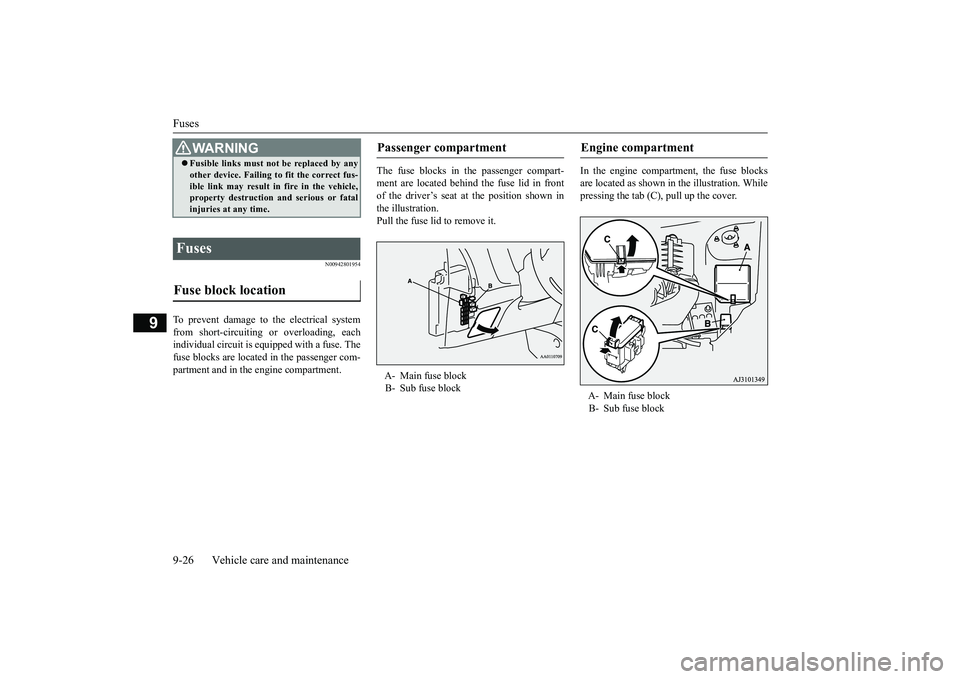
The fuse blocks in the passenger compart-ment are located behind the fuse lid in frontof the driver’s seat at the position shown inthe illustration.Pull the fuse lid to remove it.
In the engine compartment, the fuse blocksare located as shown in the illustration. Whilepressing the tab (C), pull up the cover.
WA R N I N GFusible links must not be replaced by anyother device. Failing to fit the correct fus-ible link may result in fire in the vehicle,property destruction and serious or fatalinjuries at any time.
Fuses Fuse block location
Passenger compartment A- Main fuse blockB- Sub fuse block
Engine compartment A- Main fuse blockB- Sub fuse block
BK0249100US.book 26 ページ 2017年5月10日 水曜日 午前8時49分
Page 404 of 441
Fuses
Vehicle care and maintenance 9-27
9
N00954801430
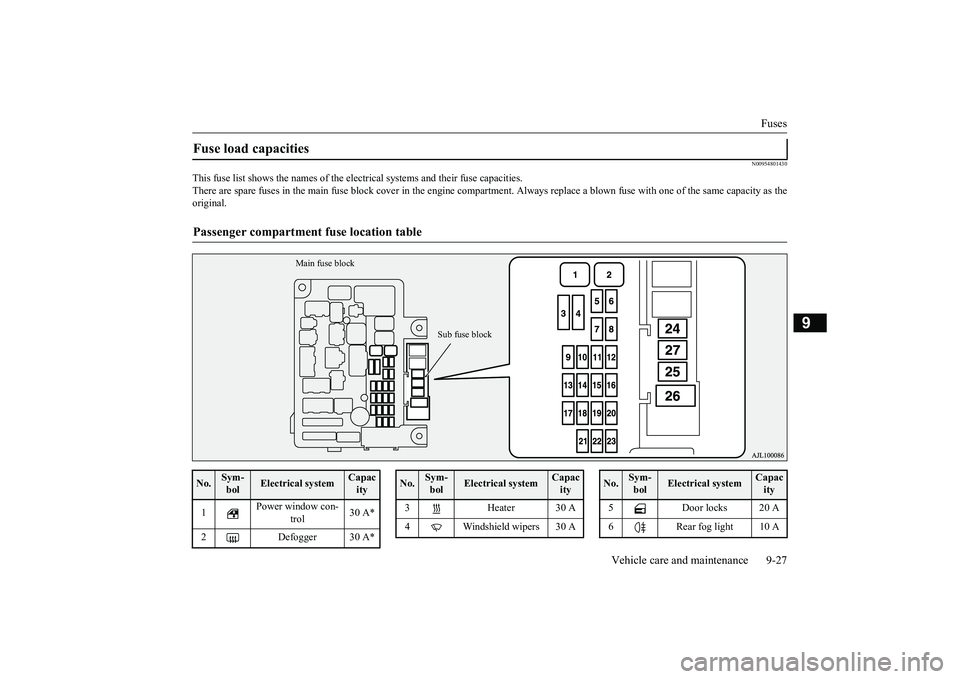
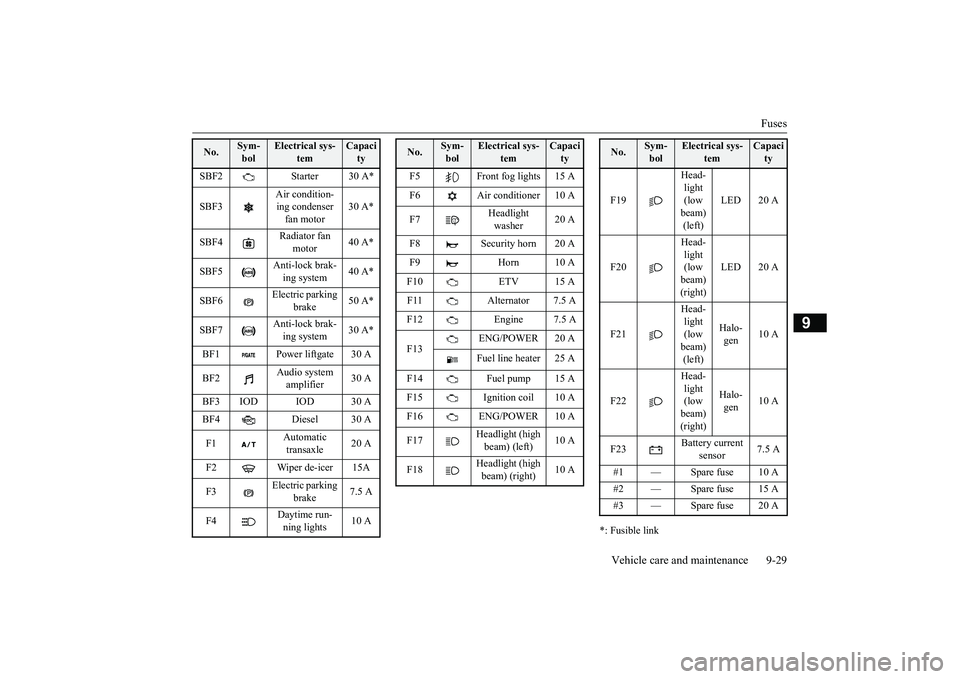
This fuse list shows the names of the elec
trical systems and their fuse capacities.
There are spare fuses in the main fuse block cover in the engine
compartment. Always replace a bl
own fuse with one of the same
capacity as the
original.Fuse load capacities Passenger compartment
fuse location table
Main fuse block
Sub fuse block
No.
Sym-bol
Electrical system
Capacity
1
Power window con-
trol
30 A*
2 Defogger 30 A*
3 Heater 30 A4 Windshield wipers 30 ANo.
Sym-bol
Electrical system
Capacity
5 Door locks 20 A6 Rear fog light 10 ANo.
Sym-bol
Electrical system
Capacity
BK0249100US.book 27 ページ 2017年5月10日 水曜日 午前8時49分
Page 405 of 441
Fuses9-28 Vehicle care and maintenance
9
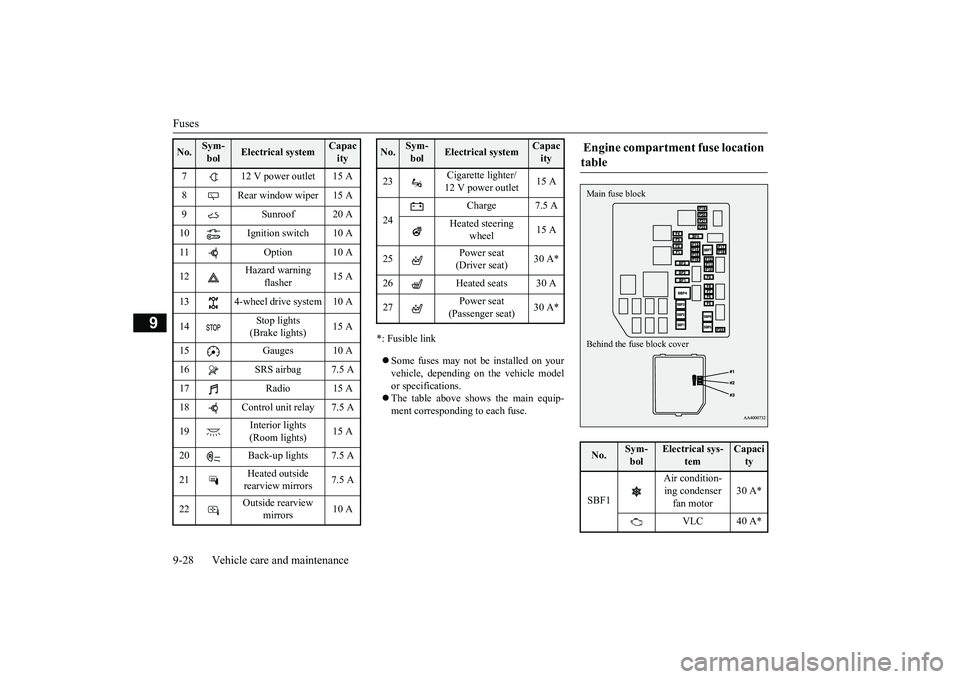
*: Fusible linkSome fuses may not be installed on yourvehicle, depending on
the vehicle model
or specifications.The table above show
s the main equip-
ment corresponding to each fuse.
7 12 V power outlet 15 A8 Rear window wiper 15 A9 Sunroof 20 A10 Ignition switch 10 A11 Option 10 A12
Hazard warning
flasher
15 A
13 4-wheel drive system 10 A14
Stop lights (Brake lights)
15 A
15 Gauges 10 A16 SRS airbag 7.5 A17 Radio 15 A18 Control unit relay 7.5 A19
Interior lights(Room lights)
15 A
20 Back-up lights 7.5 A21
Heated outside rearview mirrors
7.5 A
22
Outside rearview
mirrors
10 A
No.
Sym-bol
Electrical system
Capacity
23
Cigarette lighter/12 V power outlet
15 A
24
Charge 7.5 A
Heated steering
wheel
15 A
25
Power seat(Driver seat)
30 A*
26 Heated seats 30 A27
Power seat(Passenger seat)
No.
Sym-bol
Electrical system
Capacity
Engine compartment fuse location table No.
Sym-bol
Electrical sys-
tem
Capacity
SBF1
Air condition-ing condenser fan motor
30 A*
VLC 40 A*
Behind the fuse block coverMain fuse block
BK0249100US.book 28 ページ 2017年5月10日 水曜日 午前8時49分
Page 406 of 441
Fuses
Vehicle care and maintenance 9-29
9
*: Fusible link
SBF2 Starter 30 A*SBF3
Air condition-ing condenser fan motor
30 A*
SBF4
Radiator fan
motor
40 A*
SBF5
Anti-lock brak-ing system
40 A*
SBF6
Electric parking
brake
50 A*
SBF7
Anti-lock brak-ing system
30 A*
BF1 Power liftgate 30 ABF2
Audio system amplifier
30 A
BF3 IOD IOD 30 ABF4 Diesel 30 AF1
Automatic transaxle
20 A
F2 Wiper de-icer 15AF3
Electric parking
brake
7.5 A
F4
Daytime run-ning lights
10 A
No.
Sym-bol
Electrical sys-
tem
Capacity
F5 Front fog lights 15 AF6 Air conditioner 10 AF7
Headlight washer
20 A
F8 Security horn 20 AF9 Horn 10 AF10 ETV 15 AF11 Alternator 7.5 AF12 Engine 7.5 AF13
ENG/POWER 20 AFuel line heater 25 A
F14 Fuel pump 15 AF15 Ignition coil 10 AF16 ENG/POWER 10 AF17
Headlight (high beam) (left)
10 A
F18
Headlight (high beam) (right)
10 A
No.
Sym-bol
Electrical sys-
tem
Capacity
F19
Head-light (low beam) (left)
LED 20 A
F20
Head-light (low beam) (right)
LED 20 A
F21
Head-light (low beam) (left)
Halo-gen
10 A
F22
Head-light (low beam) (right)
Halo-gen
10 A
F23
Battery current
sensor
7.5 A
#1 — Spare fuse 10 A#2 — Spare fuse 15 A#3 — Spare fuse 20 ANo.
Sym-bol
Electrical sys-
tem
Capacity
BK0249100US.book 29 ページ 2017年5月10日 水曜日 午前8時49分
Page 407 of 441
Fuses9-30 Vehicle care and maintenance
9
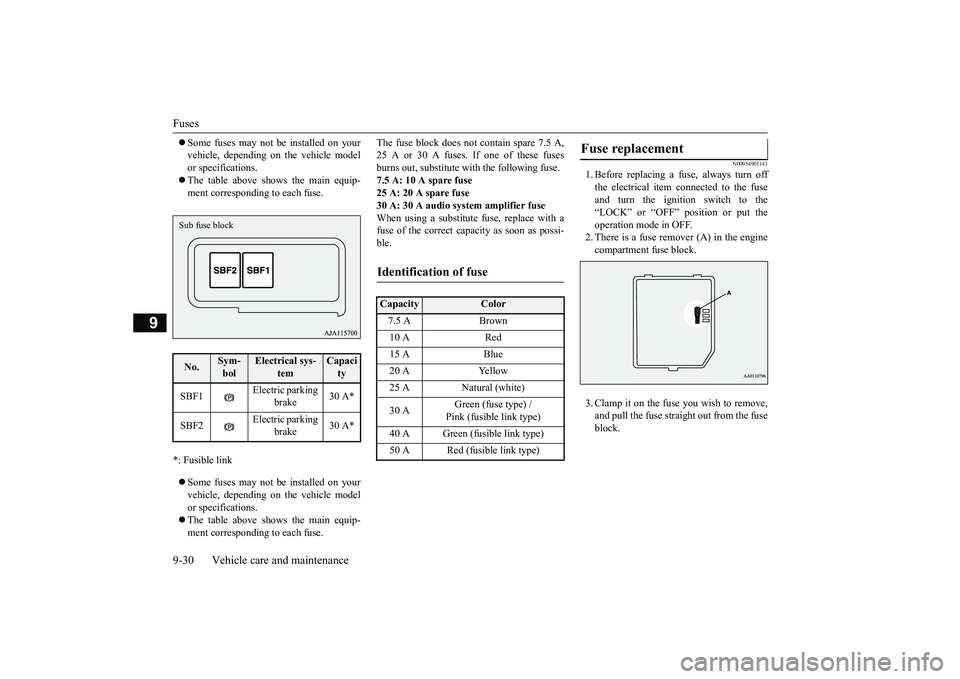
Some fuses may not be installed on yourvehicle, depending on the vehicle modelor specifications.The table above shows the main equip-ment corresponding to each fuse.
*: Fusible linkSome fuses may not be installed on yourvehicle, depending on the vehicle modelor specifications.The table above shows the main equip-ment corresponding to each fuse.
The fuse block does not contain spare 7.5 A,25 A or 30 A fuses. If one of these fusesburns out, substitute w
ith the following fuse.
7.5 A: 10 A spare fuse25 A: 20 A spare fuse30 A: 30 A audio system amplifier fuseWhen using a substitute
fuse, replace with a
fuse of the correct capa
city as soon as possi-
ble.
N00954901141
1. Before replacing a fuse, always turn offthe electrical item
connected to the fuse
and turn the ignition switch to the“LOCK” or “OFF” position or put theoperation mode in OFF.2. There is a fuse remover (A) in the enginecompartment fuse block.3. Clamp it on the fuse you wish to remove,and pull the fuse straight out from the fuseblock.
No.
Sym-bol
Electrical sys-
tem
Capacity
SBF1
Electric parking
brake
30 A*
SBF2
Electric parking
brake
30 A*
Sub fuse block
Identification of fuse Capacity
Color
7.5 A Brown10 A Red15 A Blue20 A Yellow25 A Natural (white)30 A
Green (fuse type) /Pink (fusible link type)
40 A Green (fusible link type)50 A Red (fusible link type)
Fuse replacement
BK0249100US.book 30 ページ 2017年5月10日 水曜日 午前8時49分