light MITSUBISHI OUTLANDER III 2018 Owners Manual
[x] Cancel search | Manufacturer: MITSUBISHI, Model Year: 2018, Model line: OUTLANDER III, Model: MITSUBISHI OUTLANDER III 2018Pages: 441, PDF Size: 13.71 MB
Page 355 of 441
Dual-zone automatic climate
control air conditioner
7-10 Comfort controls
7
• When the setting has changed fromenabled to disabled,
the system will beep
three times and the indicator light willflash three times.• When the setting has changed from dis-abled to enabled, the system will beeptwo times and the i
ndicator light will
flash three times.On vehicles equipped with the Smart-phone Link Display Audi
o, screen opera-
tions can also be used to change thesetting. Refer to th
e separate owner’s
manual for details.
N00737301467
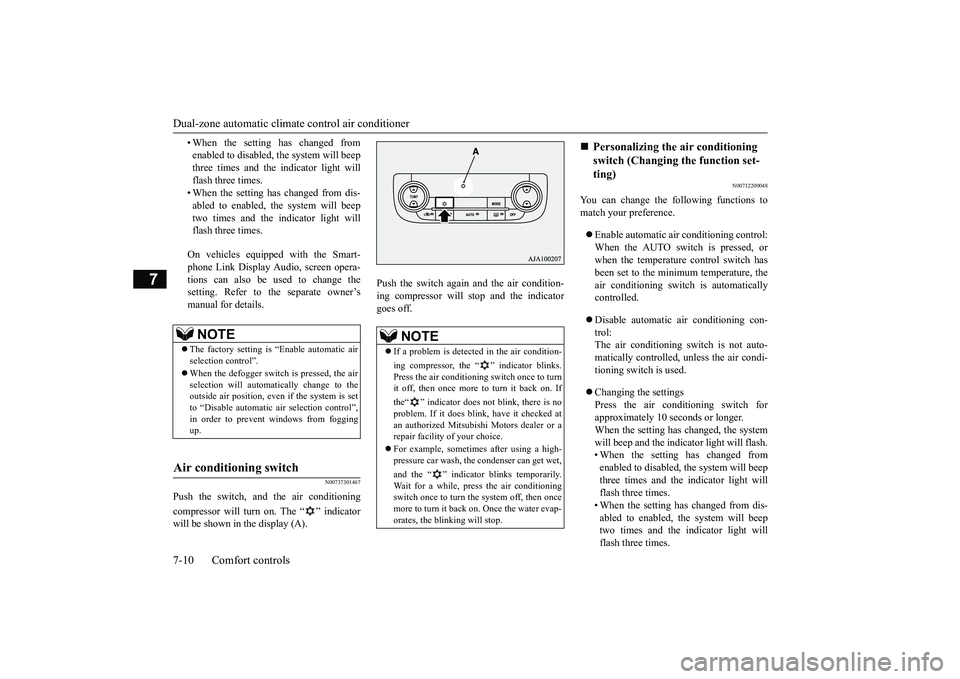
Push the switch, and the air conditioningcompressor will turn on. The “ ” indicatorwill be shown in the display (A).
Push the switch again and the air condition-ing compressor will st
op and the indicator
goes off.
N00712200048
You can change the following functions tomatch your preference.Enable automatic air conditioning control:When the AUTO switch is pressed, orwhen the temperature control switch hasbeen set to the minimum temperature, theair conditioning switch is automaticallycontrolled.Disable automatic air conditioning con-trol:The air conditioning switch is not auto-matically controlled,
unless the air condi-
tioning switch is used.Changing the settingsPress the air conditioning switch forapproximately 10
seconds or longer.
When the setting has changed, the systemwill beep and the indi
cator light will flash.
• When the setting has changed fromenabled to disabled, the system will beepthree times and the indicator light willflash three times.• When the setting has changed from dis-abled to enabled, the system will beeptwo times and the i
ndicator light will
flash three times.
NOTE
The factory setting is “Enable automatic airselection control”.When the defogger switch is pressed, the airselection will automatically change to theoutside air position, even if the system is setto “Disable automatic air selection control”,in order to prevent windows from foggingup.
Air conditioning switch
NOTE
If a problem is detect
ed in the air condition-
ing compressor, the “ ” indicator blinks.Press the air conditioni
ng switch once to turn
it off, then once more to turn it back on. Ifthe“ ” indicator does not blink, there is noproblem. If it does blink,
have it checked at
an authorized Mitsubish
i Motors dealer or a
repair facility of your choice.For example, sometimes after using a high-pressure car wash, the
condenser can get wet,
and the “ ” indicator blinks temporarily.Wait for a while, pres
s the air conditioning
switch once to turn the system off, then oncemore to turn it back on. Once the water evap-orates, the blinking will stop.
Personalizing the air conditioning switch (Changing the function set-ting)
BK0249100US.book 10 ページ 2017年5月10日 水曜日 午前8時49分
Page 356 of 441
Dual-zone automatic climat
e control air conditionerComfort controls 7-11
7
On vehicles equipped with the Smart-phone Link Display A
udio, screen opera-
tions can also be used to change thesetting. Refer to th
e separate owner’s
manual for details.
N00703501042
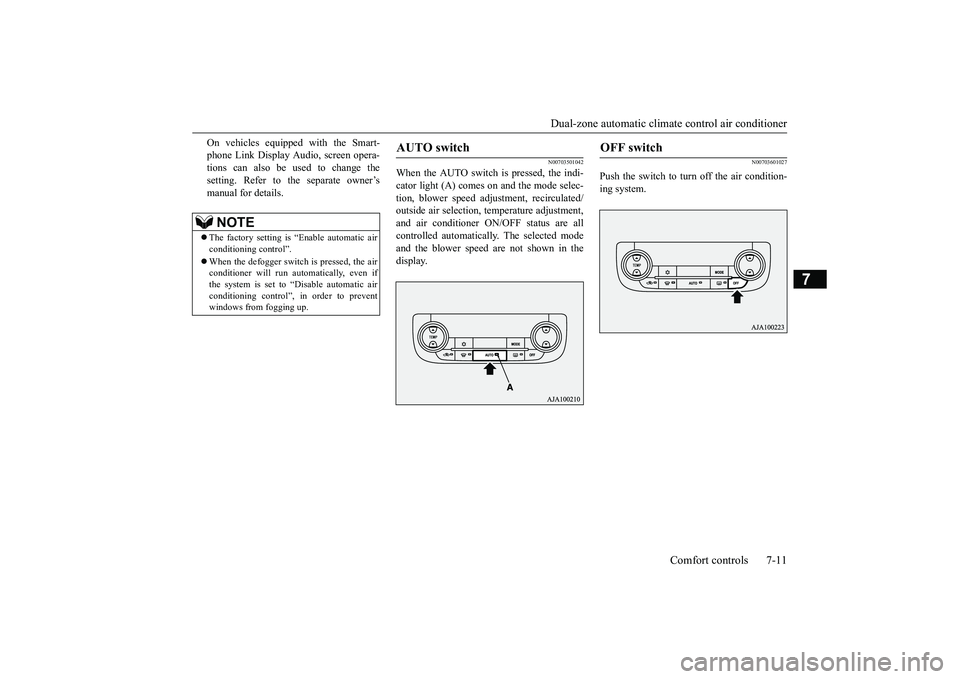
When the AUTO switch is pressed, the indi-cator light (A) comes on and the mode selec-tion, blower speed adju
stment, recirculated/
outside air selection,
temperature adjustment,
and air conditioner ON/OFF status are allcontrolled automatically. The selected modeand the blower speed are not shown in thedisplay.
N00703601027
Push the switch to turn off the air condition-ing system.
NOTE
The factory setting is
“Enable automatic air
conditioning control”.When the defogger switch
is pressed, the air
conditioner will run au
tomatically, even if
the system is set to “Disable automatic airconditioning control”, in order to preventwindows from fogging up.
AUTO switch
OFF switch
BK0249100US.book 11 ページ 2017年5月10日 水曜日 午前8時49分
Page 358 of 441
Important air conditioning operating tips
Comfort controls 7-13
7
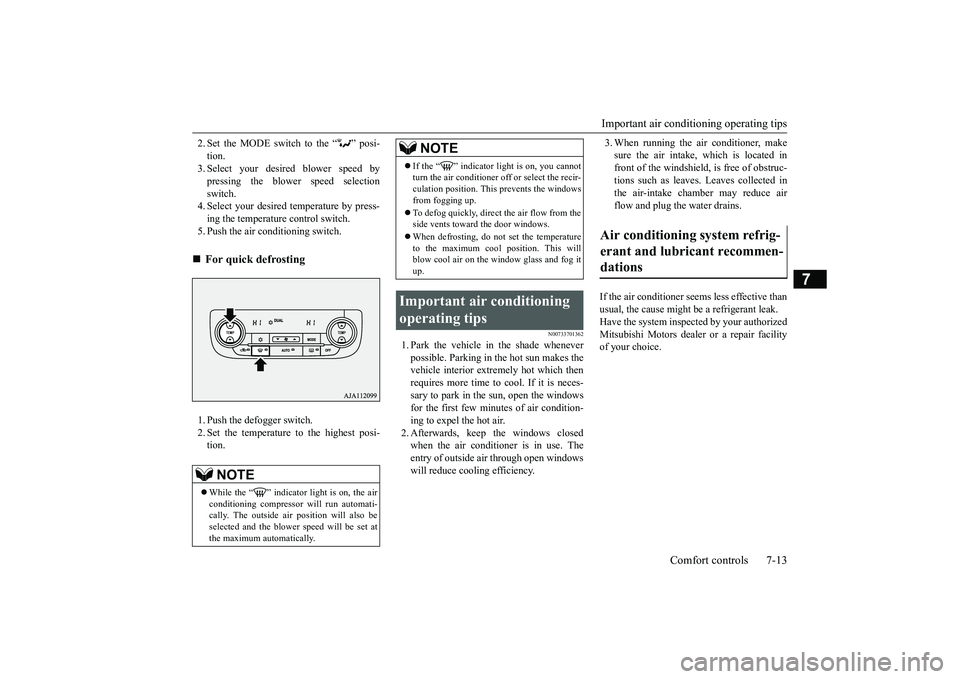
2. Set the MODE switch to the “ ” posi-tion.3. Select your desire
d blower speed by
pressing the blower speed selectionswitch.4. Select your desired temperature by press-ing the temperature control switch.5. Push the air conditioning switch.1. Push the defogger switch.2. Set the temperature to the highest posi-tion.
N00733701362
1. Park the vehicle in the shade wheneverpossible. Parking in the hot sun makes thevehicle interior extremely hot which thenrequires more time to cool. If it is neces-sary to park in the sun, open the windowsfor the first few minutes of air condition-ing to expel the hot air.2. Afterwards, keep the windows closedwhen the air conditioner is in use. Theentry of outside air through open windowswill reduce cooling efficiency.
3. When running the air conditioner, makesure the air intake, which is located infront of the windshield,
is free of obstruc-
tions such as leaves. Leaves collected inthe air-intake chamber may reduce airflow and plug the water drains.
If the air conditioner seems less effective thanusual, the cause might be a refrigerant leak.Have the system inspected by your authorizedMitsubishi Motors dealer or a repair facilityof your choice.
For quick defrosting NOTE
While the “ ” indicator light is on, the airconditioning compressor
will run automati-
cally. The outside air
position will also be
selected and the blower
speed will be set at
the maximum automatically.
If the “ ” indicator light is on, you cannotturn the air conditioner
off or select the recir-
culation position. This prevents the windowsfrom fogging up.To defog quickly, direct the air flow from theside vents toward the door windows.When defrosting, do not set the temperatureto the maximum cool position. This willblow cool air on the
window glass and fog it
up.
Important air conditioning operating tips
NOTE
Air conditioning system refrig-erant and lubricant recommen-dations
BK0249100US.book 13 ページ 2017年5月10日 水曜日 午前8時49分
Page 360 of 441
General information about your radio
Comfort controls 7-15
7
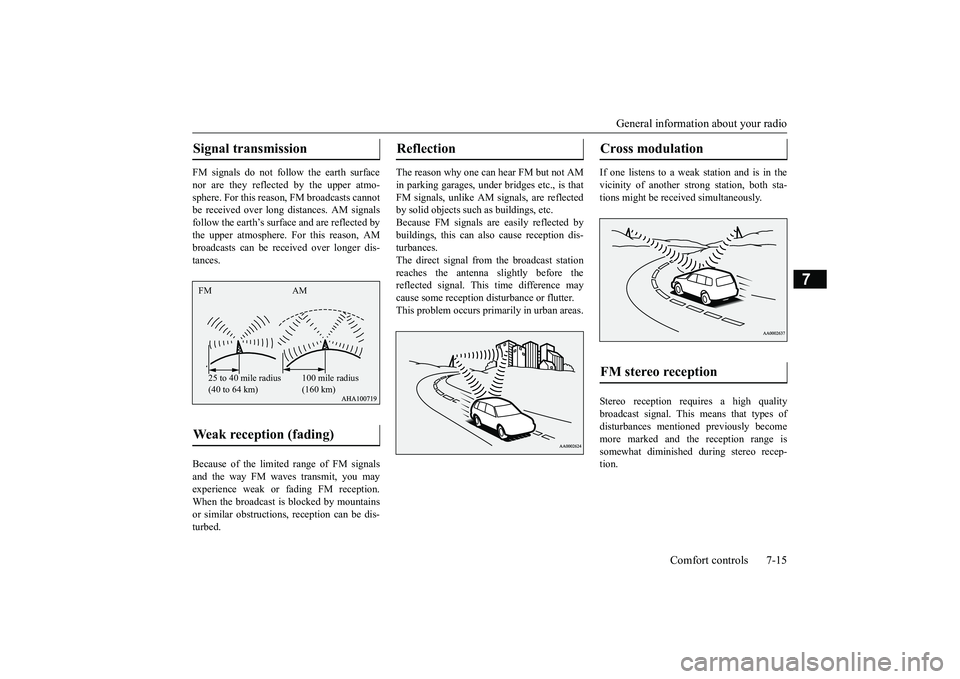
FM signals do not follow the earth surfacenor are they reflected by the upper atmo-sphere. For this reason,
FM broadcasts cannot
be received over long distances. AM signalsfollow the earth’s surface and are reflected bythe upper atmosphere. For this reason, AMbroadcasts can be received over longer dis-tances.Because of the limited
range of FM signals
and the way FM waves transmit, you mayexperience weak or
fading FM reception.
When the broadcast is
blocked by mountains
or similar obstructions,
reception can be dis-
turbed.
The reason why one can hear FM but not AMin parking garages, unde
r bridges etc., is that
FM signals, unlike AM
signals, are reflected
by solid objects such
as buildings, etc.
Because FM signals are easily reflected bybuildings, this can also
cause reception dis-
turbances.The direct signal from
the broadcast station
reaches the antenna slightly before thereflected signal. This time difference maycause some reception di
sturbance or flutter.
This problem occurs primarily in urban areas.
If one listens to a weak station and is in thevicinity of another st
rong station, both sta-
tions might be received simultaneously.Stereo reception re
quires a high quality
broadcast signal. This means that types ofdisturbances mentioned previously becomemore marked and the reception range issomewhat diminished during stereo recep-tion.
Signal transmission Weak reception (fading) FM AM25 to 40 mile radius(40 to 64 km)
100 mile radius(160 km)
Reflection
Cross modulation FM stereo reception
BK0249100US.book 15 ページ 2017年5月10日 水曜日 午前8時49分
Page 361 of 441
General information about your radio7-16 Comfort controls
7
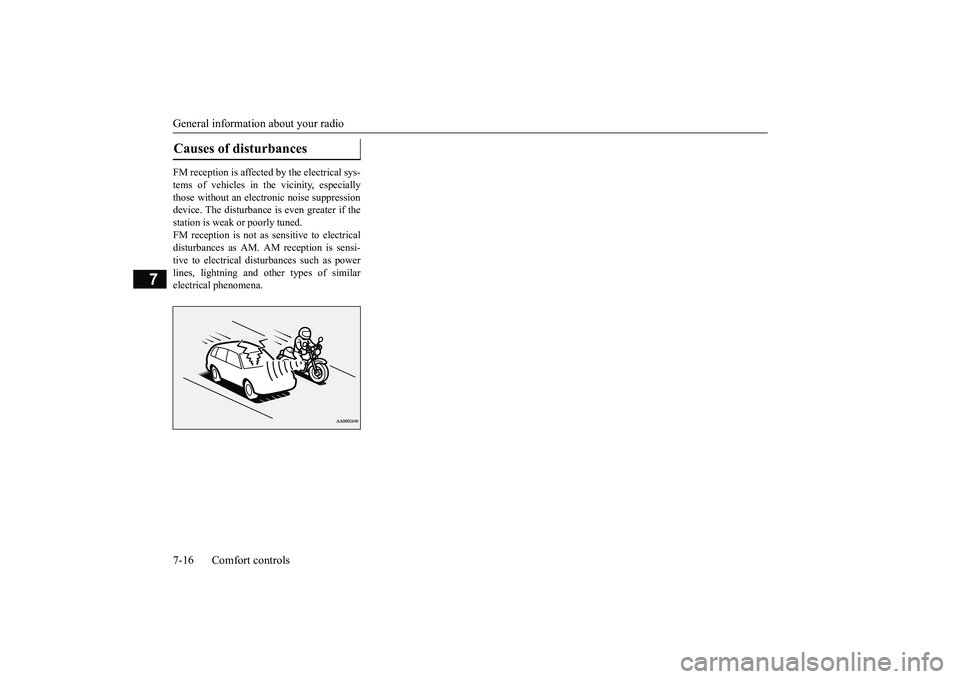
FM reception is affected by the electrical sys-tems of vehicles in the vicinity, especiallythose without an electr
onic noise suppression
device. The disturbance is even greater if thestation is weak or poorly tuned.FM reception is not as sensitive to electricaldisturbances as AM. AM
reception is sensi-
tive to electrical dist
urbances such as power
lines, lightning and ot
her types of similar
electrical phenomena.Causes of disturbances BK0249100US.book 16 ページ 2017年5月10日 水曜日 午前8時49分
Page 363 of 441
If the vehicle breaks down8-2 For emergencies
8
N00836301230
If your vehicle breaks down on the road,move to the shoulder and turn on the hazardwarning flashers. If there is no shoulder, orthe shoulder is not safe, drive in the right laneslowly with the hazard
lights flashing, until
you come to a safe stopping place. Keep theflashers flashing.If the engine stops, there will be no powerassist to the steering and brakes, making thesedifficult to use.The brake booster will not work, so thebrakes will not grip well. The brake pedalwill be harder to press than usual.Since there is no power steering assist, thesteering wheel will be hard to turn.
Get help from your passengers, bystanders,etc. to push the vehicle
and move it to a safe
area.
N00836401778
If the engine cannot be started because thebattery is weak or de
ad, you can start it with
the battery from anothe
r vehicle using jumper
cables.1. Take off any metal jewelry such as watchbands or bracelets th
at might create an
accidental electrical contact.2. Position the vehi
cles close enough
together so that the jumper cables canreach, but be sure the vehicles aren’ttouching each other.
3. Set the parking brake firmly on your vehi-cle and move the selector lever into the“P” (PARK) position.4. Set the parking brake firmly on the othervehicle. Put the automatic transaxle in “P”5. Turn the ignition switch (the engineswitch) on each vehicle to the “LOCK” or“OFF” position.6. Make sure your battery electrolyte is atthe proper level. (Refer to “Battery” onpage 9-13.)
If the vehicle breaks down If the engine stops/fails When the engine fails at the intersection
Jump-starting the engine
WA R N I N GTo reduce the risk of igniting flammablegas that may be emitted from the battery,carefully read this section before jump-starting the vehicle.Do not try to start you
r vehicle by pushing
or towing. This can cause an accidentresulting in serious
injury or death and
can damage the vehicle.NOTE
Do not use jumper cables if they have dam-age or corrosion.
CAUTIONCheck the other vehicle.
It must have a 12-
volt battery. If the other system isn’t 12-volt,both systems can be damaged.NOTE
Turn off all lights, heat
er, and othe
r electrical
loads. This will avoid sparks and help saveboth batteries.
BK0249100US.book 2 ページ 2017年5月10日 水曜日 午前8時49分
Page 365 of 441
Engine overheating8-4 For emergencies
8
If you drive your vehicl
e with a low battery
charge after the engine has been started byusing jumper cables, th
e engine may misfire.
This can cause the anti-lock braking systemwarning light to blink on
and off. This is only
due to the low battery voltage. It is not aproblem with the brake system. If this hap-pens, fully charge the battery and ensure thecharging system is operating properly.
N00836501375
When the engine is overheating, the warningwill be displayed in th
e instrument cluster as
follows.The information screen in the multi infor-mation display will be interrupted and theengine coolant temp
erature warning dis-
play will appear. Also “ ” will blink.(Color liquid crystal display type)lamp will illuminate.
(Mono-color liquid
crystal display type)
If these warnings are displayed:
1. Stop the vehicle in a safe place. Turn onthe hazard warning flashers.2. With the engine st
ill running, carefully
raise the engine hood to vent the enginecompartment.3. Check that the cooling fan is running. Ifthe fan is not turn
ing, stop the engine
immediately and cont
act an authorized
Mitsubishi Motors dealer or a repair facil-ity of your choice for assistance.4. If you see steam or spray coming fromunder the hood, turn off the engine.5. If you do not see steam or spray comingfrom under the hood, leave the engine onuntil the high coolant
temperature warn-
ing goes off. After the high coolant tem-perature warning has gone off, you canstart driving again. If the high coolanttemperature warning stays on, turn off theengine.
Charging the battery by using an external battery charger
WA R N I N GAlways remove the
battery from your
vehicle when the battery is charged by anexternal battery charger.Keep sparks, cigarette
s, and flames away
from the battery because the battery couldexplode.Keep your work area well vented whencharging or using
the battery in an
enclosed space.Remove all the caps before charging thebattery.Electrolyte (battery acid) is made of corro-sive diluted sulfuric acid. If electrolytecomes in contact with your hands, eyes,clothes, or the pain
ted surface of your
vehicle, thoroughly
flush with water. If
electrolyte gets in your eyes, flush themimmediately and thor
oughly with water,
and get prompt medical attention.Always wear protective clothing and gog-gles when working near the battery.Keep the battery out of the reach of chil-dren.
As your vehicle has anti-lock brakes Engine overheating
WA R N I N GTo avoid personal injury, keep hands, hair,jewelry and clothes aw
ay from the cooling
fan. The cooling fan ca
n start at any time.
BK0249100US.book 4 ページ 2017年5月10日 水曜日 午前8時49分
Page 366 of 441
Jack and tools
For emergencies 8-5
8
6. When you do not see any more steam orspray, open the hood. Look for obviousleaks, such as a split radiator hose. Becareful as components will be hot. Anyleak source must be repaired.7. If there is no obvious leak source, checkthe coolant level in the engine coolantreserve tank. If there is
none, or if it is too
low, slowly add coolant.8. If the engine coolant reserve tank needscoolant, you will probably also need toadd coolant to the radiator. Do not loosenor remove the radiator cap until the enginehas cooled down.
9. Start the engine, a
nd slowly add coolant,
up to the bottom of the filler neck. Useplain water if you have to (and replace itwith the right coolant as soon as possible).
10. Replace the radiator cap and tighten it
fully. Check the engine coolant tempera-ture display on the mu
lti information dis-
play (Color liquid crystal display type) orthe high coolant temperature warninglight (Mono-color liqui
d crystal display
type). You can start driving again whenthe high coolant temperature warningdoes not come on.
11. Have the system inspected by your autho-
rized Mitsubishi Motors
dealer or a repair
facility of your choice.
N00836601389
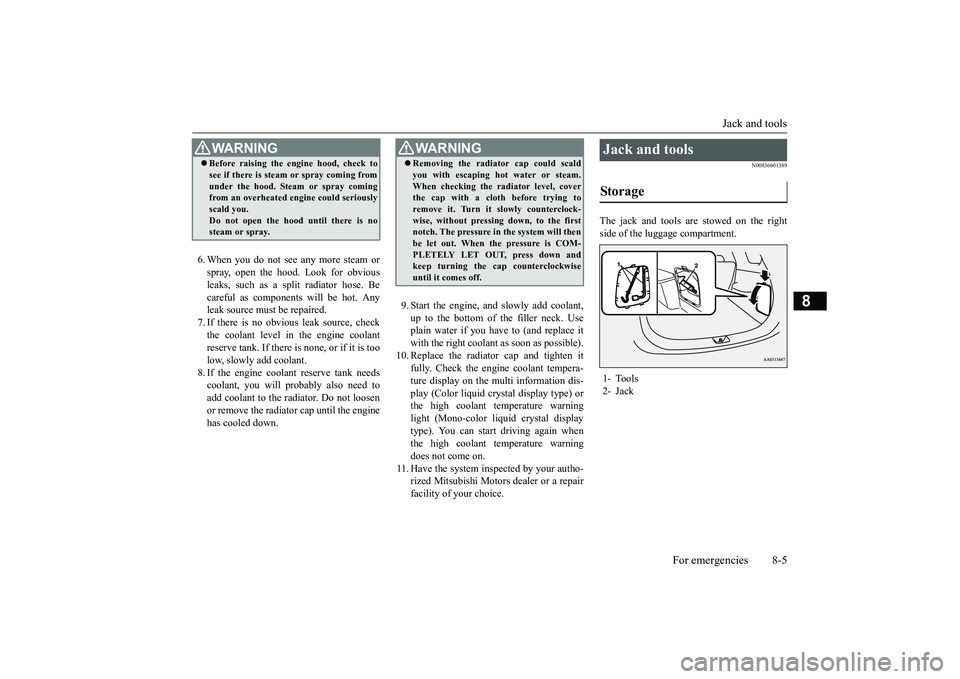
The jack and tools are stowed on the rightside of the luggage compartment.
WA R N I N GBefore raising the en
gine hood, check to
see if there is steam or spray coming fromunder the hood. Steam or spray comingfrom an overheated en
gine could seriously
scald you.Do not open the hood until there is nosteam or spray.
WA R N I N GRemoving the radiat
or cap could scald
you with escaping hot water or steam.When checking the radiator level, coverthe cap with a cloth before trying toremove it. Turn it slowly counterclock-wise, without pressing down, to the firstnotch. The pressure in the system will thenbe let out. When the pressure is COM-PLETELY LET OUT, press down andkeep turning the cap counterclockwiseuntil it comes off.
Jack and tools Storage 1- Tools2- Jack
BK0249100US.book 5 ページ 2017年5月10日 水曜日 午前8時49分
Page 368 of 441
How to change a tire
For emergencies 8-7
8
6. Get the jack, bar and wheel nut wrenchready.(Refer to “Jack and t
ools” on page 8-5.)
N00849600315
The compact spare tire is stowed below theluggage compartment fl
oor. It is designed to
save space in the luggage compartment. Itslighter weight makes it easier to use if a flattire occurs.
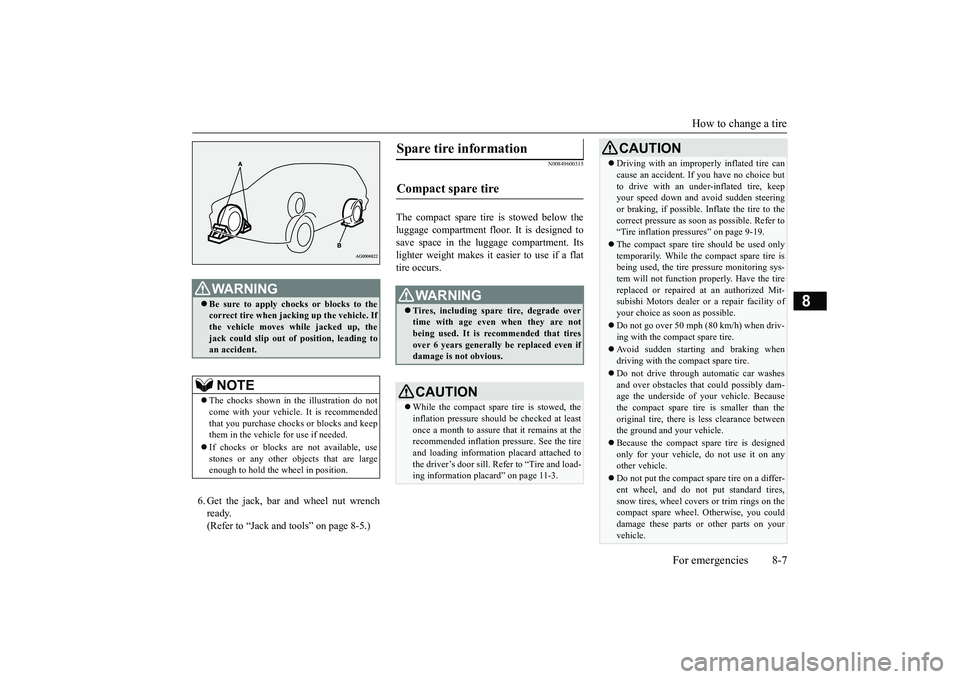
WA R N I N GBe sure to apply choc
ks or blocks to the
correct tire when jacking up the vehicle. Ifthe vehicle moves while jacked up, thejack could slip out of
position, leading to
an accident.NOTE
The chocks shown in the illustration do notcome with your vehicl
e. It is recommended
that you purchase chocks or blocks and keepthem in the vehicle for use if needed.If chocks or blocks
are not available, use
stones or any other obj
ects that are large
enough to hold the wheel in position.
Spare tire information Compact spare tire
WA R N I N GTires, including spar
e tire, degrade over
time with age even when they are notbeing used. It is recommended that tiresover 6 years generally
be replaced even if
damage is not obvious.CAUTIONWhile the compact spare tire is stowed, theinflation pressure shoul
d be checked at least
once a month to assure that it remains at therecommended inflation pressure. See the tireand loading informati
on placard attached to
the driver’s door sill. Refer to “Tire and load-ing information placard” on page 11-3.
Driving with an imprope
rly inflated tire can
cause an accident. If
you have no choice but
to drive with an under-inflated tire, keepyour speed down and avoid sudden steeringor braking, if possible. Inflate the tire to thecorrect pressure as s
oon as possible. Refer to
“Tire inflation pressures” on page 9-19.The compact spare tire should be used onlytemporarily. While the compact spare tire isbeing used, the tire pr
essure monitoring sys-
tem will not function pr
operly. Have the tire
replaced or repaired at an authorized Mit-subishi Motors dealer or
a repair facility of
your choice as soon as possible.Do not go over 50 mph (80 km/h) when driv-ing with the compact spare tire.Avoid sudden starting and braking whendriving with the compact spare tire.Do not drive through automatic car washesand over obstacles that
could possibly dam-
age the underside of your vehicle. Becausethe compact spare tire is smaller than theoriginal tire, there is less clearance betweenthe ground and your vehicle.Because the compact spare tire is designedonly for your vehicle, do not use it on anyother vehicle.Do not put the compact spare tire on a differ-ent wheel, and do not put standard tires,snow tires, wheel covers
or trim rings on the
compact spare wheel. Otherwise, you coulddamage these parts or other parts on yourvehicle.CAUTION
BK0249100US.book 7 ページ 2017年5月10日 水曜日 午前8時49分
Page 370 of 441
How to change a tire
For emergencies 8-9
8
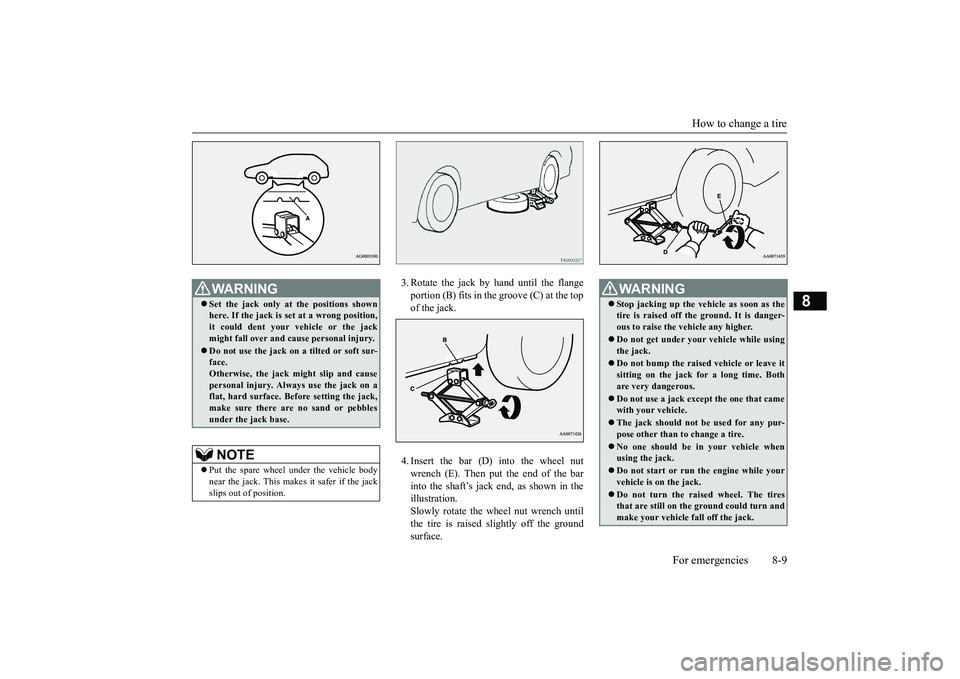
3. Rotate the jack by hand until the flangeportion (B) fits in the groove (C) at the topof the jack.4. Insert the bar (D) into the wheel nutwrench (E). Then put the end of the barinto the shaft’s jack end, as shown in theillustration.Slowly rotate the wheel nut wrench untilthe tire is raised slightly off the groundsurface.
WA R N I N GSet the jack only at
the positions shown
here. If the jack is se
t at a wrong position,
it could dent your vehicle or the jackmight fall over and ca
use personal injury.
Do not use the jack on a tilted or soft sur-face.Otherwise, the jack might slip and causepersonal injury. Always
use the jack on a
flat, hard surface. Before setting the jack,make sure there are no sand or pebblesunder the jack base.NOTE
Put the spare wheel under the vehicle bodynear the jack. This makes it safer if the jackslips out of position.
WA R N I N GStop jacking up the ve
hicle as soon as the
tire is raised off the ground. It is danger-ous to raise the ve
hicle any higher.
Do not get under your vehicle while usingthe jack.Do not bump the raised
vehicle or leave it
sitting on the jack for a long time. Bothare very dangerous.Do not use a jack except the one that camewith your vehicle.The jack should not
be used for any pur-
pose other than to change a tire.No one should be
in your vehicle when
using the jack.Do not start or run
the engine while your
vehicle is on the jack.Do not turn the raised wheel. The tiresthat are still on the ground could turn andmake your vehicle fall off the jack.
BK0249100US.book 9 ページ 2017年5月10日 水曜日 午前8時49分