light MITSUBISHI OUTLANDER III 2018 Owners Manual
[x] Cancel search | Manufacturer: MITSUBISHI, Model Year: 2018, Model line: OUTLANDER III, Model: MITSUBISHI OUTLANDER III 2018Pages: 441, PDF Size: 13.71 MB
Page 371 of 441
How to change a tire8-10 For emergencies
8
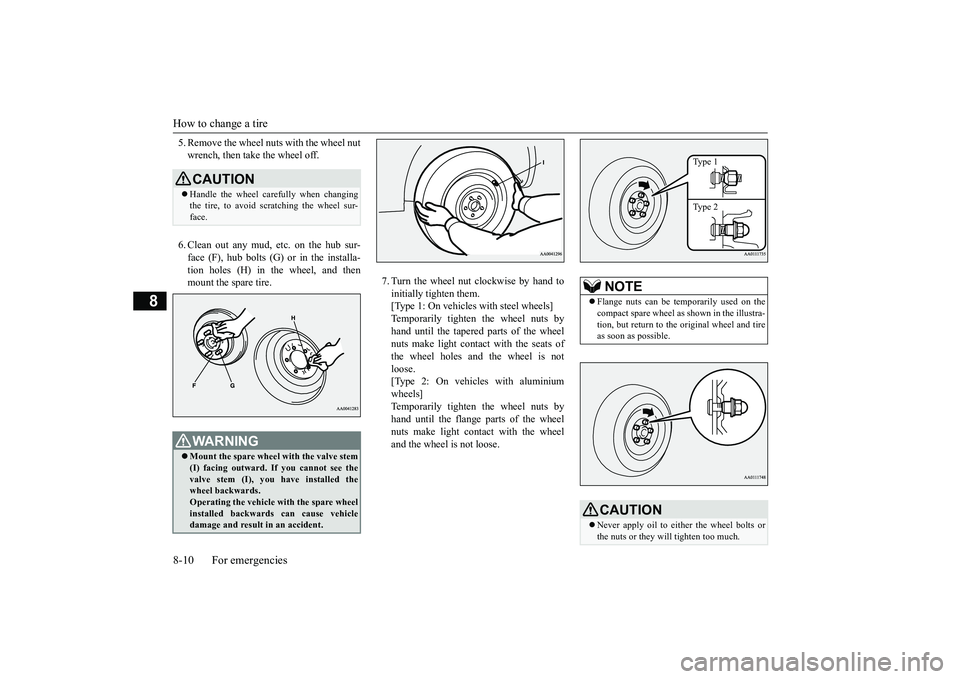
5. Remove the wheel nuts with the wheel nutwrench, then take the wheel off.6. Clean out any mud, etc. on the hub sur-face (F), hub bolts (G)
or in the installa-
tion holes (H) in the wheel, and thenmount the spare tire.
7. Turn the wheel nut clockwise by hand toinitially tighten them.[Type 1: On vehicles
with steel wheels]
Temporarily tighten the wheel nuts byhand until the tapered parts of the wheelnuts make light contac
t with the seats of
the wheel holes and the wheel is notloose.[Type 2: On vehicles with aluminiumwheels]Temporarily tighten the wheel nuts byhand until the flange parts of the wheelnuts make light cont
act with the wheel
and the wheel is not loose.
CAUTIONHandle the wheel carefully when changingthe tire, to avoid scratching the wheel sur-face.WA R N I N GMount the spare wheel with the valve stem(I) facing outward. If
you cannot see the
valve stem (I), you
have installed the
wheel backwards.Operating the vehicle with the spare wheelinstalled backwards can cause vehicledamage and result
in an ac
cident.
NOTE
Flange nuts can be te
mporarily used on the
compact spare wheel as shown in the illustra-tion, but return to the original wheel and tireas soon as possible.CAUTIONNever apply oil to either the wheel bolts orthe nuts or they will tighten too much.
Type 1Type 2
BK0249100US.book 10 ページ 2017年5月10日 水曜日 午前8時49分
Page 378 of 441
9
Vehicle care and maintenanceService precautions ..........................................................................9-2Catalytic converter ...........................................................................9-2Engine hood .........
...........
...........
............
...........
.........
........
.........
.....9-3
View of the engine compartment .....................................................9-5Engine oil and oil filter ....................................................................9-6Engine coolant .................................................................................9-8Air cleaner filter ...............................................................................9-9Automatic transaxle fluid (if so equipped) ..................................... 9-11Continuously variable transmission
(CVT) fluid (if so equipped) . 9-11
Transfer oil (All-wheel drive models) ...........................................9-12Rear axle oil (All-wheel drive models) .........................................9-12Washer fluid ...................................................................................9-12Brake fluid .....................................................................................9-13Battery ............................................................................................9-13Tires ...............................................................................................9-15Brake pedal free play .....................................................................9-22Parking brake lever stroke (if so equipped) ....................................9-22Wiper blades ..................................................................................9-22Emission-control system maintenance ..........................................9-23General maintenance .....................................................................9-24For cold and snowy weather ..........................................................9-25Fusible links ...................................................................................9-25Fuses ..............................................................................................9-26Replacement of light bulbs ............................................................9-31Vehicle care precautions ................................................................9-39Cleaning the inside of your vehicle .......
...........
...........
...........
.......9-40
Cleaning the outside of your vehicle .....
...........
...........
...........
.......9-41
BK0249100US.book 1 ページ 2017年5月10日 水曜日 午前8時49分
Page 381 of 441
Engine hood9-4 Vehicle care and maintenance
9
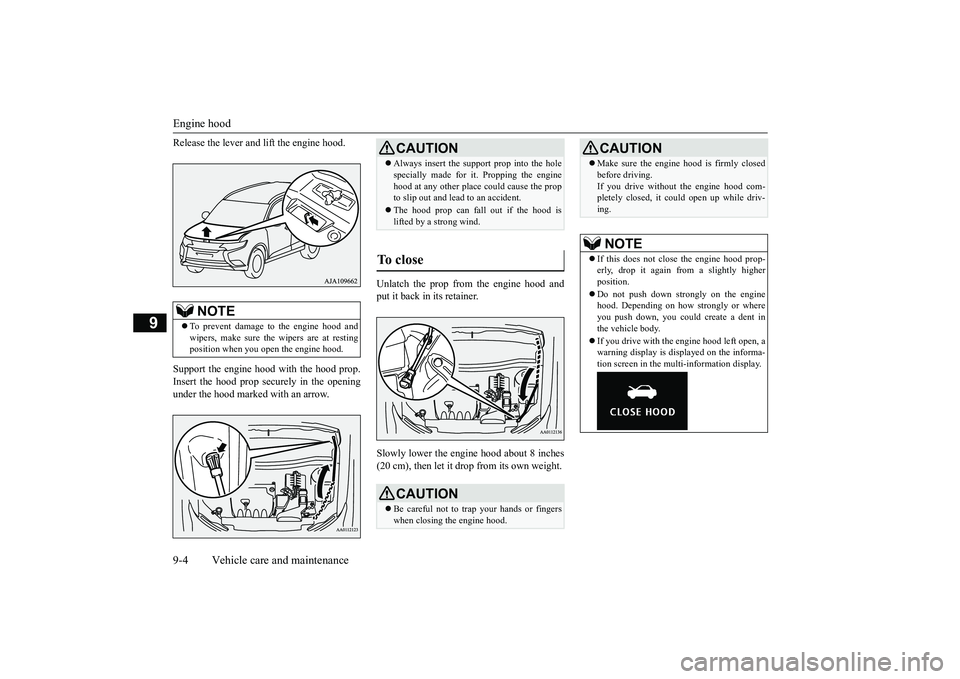
Release the lever and
lift the engine hood.
Support the engine hood with the hood prop.Insert the hood prop securely in the openingunder the hood marked with an arrow.
Unlatch the prop from the engine hood andput it back in its retainer.Slowly lower the engine hood about 8 inches(20 cm), then let it drop from its own weight.
NOTE
To prevent damage to the engine hood andwipers, make sure the
wipers are at resting
position when you open the engine hood.
CAUTIONAlways insert the support prop into the holespecially made for it. Propping the enginehood at any other place
could cause the prop
to slip out and lead
to an accident.
The hood prop can fall out if the hood islifted by a strong wind.
To close
CAUTIONBe careful not to trap your hands or fingerswhen closing the engine hood.
Make sure the engine hood is firmly closedbefore driving.If you drive without the engine hood com-pletely closed, it c
ould open up while driv-
ing.NOTE
If this does not clos
e the engine hood prop-
erly, drop it again from a slightly higherposition.Do not push down strongly on the enginehood. Depending on how strongly or whereyou push down, you could create a dent inthe vehicle body.If you drive with the e
ngine hood left open, a
warning display is displayed on the informa-tion screen in the multi-information display.CAUTION
BK0249100US.book 4 ページ 2017年5月10日 水曜日 午前8時49分
Page 390 of 441
Brake fluid
Vehicle care and maintenance 9-13
9
N00938701327
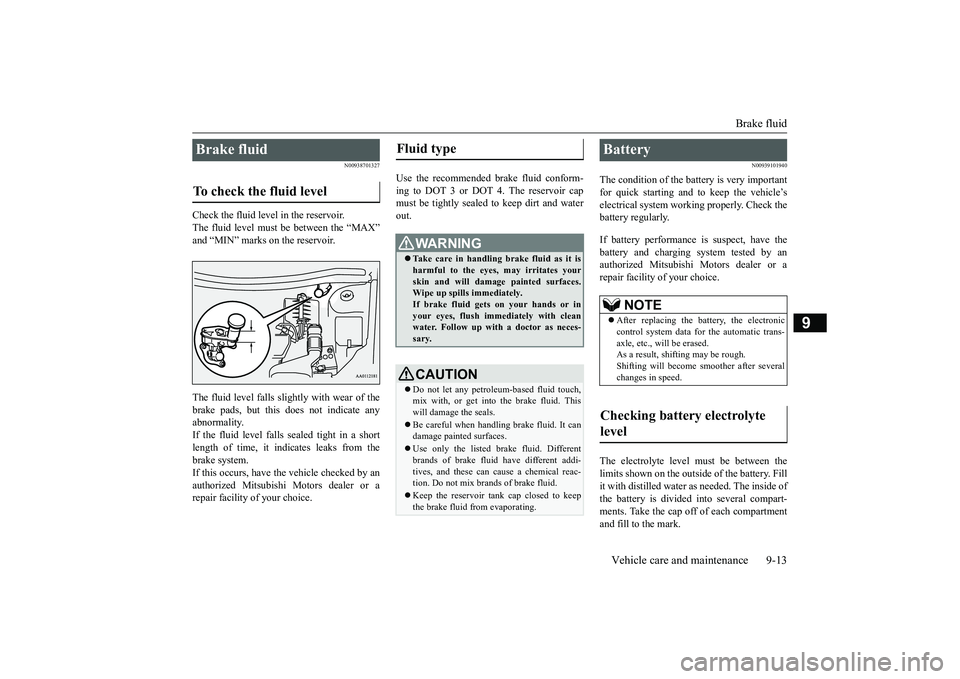
Check the fluid leve
l in the reservoir.
The fluid level must
be between the “MAX”
and “MIN” marks on the reservoir.The fluid level falls slightly with wear of thebrake pads, but this
does not indicate any
abnormality.If the fluid level falls sealed tight in a shortlength of time, it indi
cates leaks from the
brake system.If this occurs, have the vehicle checked by anauthorized Mitsubishi Motors dealer or arepair facility
of your choice.
Use the recommended brake fluid conform-ing to DOT 3 or DOT
4. The reservoir cap
must be tightly sealed to keep dirt and waterout.
N00939101940
The condition of the batte
ry is very important
for quick starting and to keep the vehicle’selectrical system work
ing properly. Check the
battery regularly.If battery performance is suspect, have thebattery and charging
system tested by an
authorized Mitsubishi Motors dealer or arepair facility
of your choice.
The electrolyte level
must be between the
limits shown on the outside of the battery. Fillit with distilled water as needed. The inside ofthe battery is divided into several compart-ments. Take the cap off of each compartmentand fill to the mark.
Brake fluid To check the fluid level
Fluid type
WA R N I N GTake care in handling brake fluid as it isharmful to the eyes, may irritates yourskin and will damage
painted surfaces.
Wipe up spills immediately.If brake fluid gets on your hands or inyour eyes, flush immediately with cleanwater. Follow up with a doctor as neces-sary.CAUTIONDo not let any petrol
eum-based fluid touch,
mix with, or get into
the brake fluid. This
will damage the seals.Be careful when handli
ng brake fluid. It can
damage painted surfaces.Use only the listed brak
e fluid. Different
brands of brake fluid
have different addi-
tives, and these can cause a chemical reac-tion. Do not mix brands of brake fluid.Keep the reservoir ta
nk cap closed to keep
the brake fluid from evaporating.
Battery
NOTE
After replacing the battery, the electroniccontrol system data for the automatic trans-axle, etc., will be erased.As a result, shifting may be rough.Shifting will become
smoother after several
changes in speed.
Checking battery electrolyte level
BK0249100US.book 13 ページ 2017年5月10日 水曜日 午前8時49分
Page 392 of 441
Tires
Vehicle care and maintenance 9-15
9
N00939201651
It is important to familiarize yourself with thefollowing terms:Cold tire pressure:• The measured pressure after the vehiclehas been parked for
at least three hours,
or• The measured pressure when the vehicleis driven less than 1 mile (1.6 km) afterhaving been parked for three hours.
Maximum pressure: the maximum per-missible cold tire inflation pressure forthis tire.Recommended inflation pressure: theinflation pressure for optimum tire perfor-mance.Intended outboard sidewall:• The sidewall that
contains a whitewall,
bears white lettering or bears manufac-turer, brand, and/or model name moldingthat is higher or deeper than the samemolding on the other sidewall of the tire,or
• The outward facing si
dewall of an asym-
metrical tire that has a particular sidethat must always face outward whenmounted on a vehicle.
Passenger car tire: a
tire intended for use
on passenger cars, multipurpose passen-ger vehicles, and trucks
that have a gross
vehicle weight rati
ng (GVWR) of 10,000
pounds or less.Light truck (LT) tire: a tire designated byits manufacturer as primarily intended foruse on lightweight truc
ks or multipurpose
passenger vehicles.Tread: portion of a ti
re that comes into
contact with the road.Tread rib: a tread se
ction running circum-
ferentially around a tire.Tread separation: pulling away of thetread from the tire carcass.Carcass: the tire structure, except treadand sidewall rubber wh
ich, when inflated,
bears the load.Sidewall: portion of
a tire between the
tread and bead.Section width: the lin
ear distance between
the exteriors of th
e sidewalls of an
inflated tire, excluding elevations due tolabeling, decoration,
or protective bands.
Bead: the part of the tire that is made ofsteel wires, wrapped or reinforced by plycords and that is shaped to fit the rim.
NOTE
Check each battery terminal for corrosion.You can prevent further corrosion by wash-ing with a solution of
baking soda and water.
Grease the posts and cl
amps after cleaning or
tightening them.Ensure the battery is securely installed andcannot be moved. Also
check each terminal
for tightness.If you will not be driv
ing your vehicle for a
long period of time, re
move the battery and
store it in a place where the battery fluid willnot freeze. The batter
y only should be stored
with a full charge.Before cleaning the battery, tighten all thefiller port caps to keep
dirt and moisture out.
Tires
WA R N I N GDriving with tires that are worn, damagedor improperly infl
ated is dangerous.
These type tire conditions will adverselyaffect vehicle performance.These type tire conditions can also cause atread separation or blowout which mayresult in an accident causing seriousinjury or death.
Tires, including spar
e tire, degrade over
time with age even when they are notbeing used.It is recommended that tires over 6 yearsgenerally be replaced
even if damage is
not obvious.WA R N I N G
BK0249100US.book 15 ページ 2017年5月10日 水曜日 午前8時49分
Page 393 of 441
Tires9-16 Vehicle care and maintenance
9
Ply: a layer of r
ubber-coated parallel
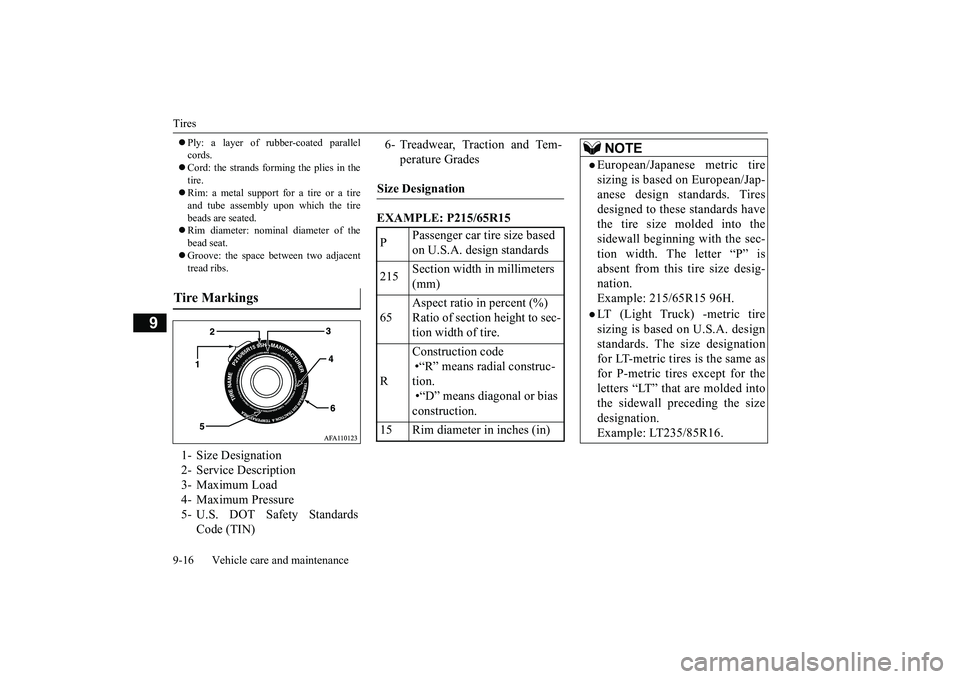
cords.Cord: the strands forming the plies in thetire.Rim: a metal support for a tire or a tireand tube assembly upon which the tirebeads are seated.Rim diameter: nominal diameter of thebead seat.Groove: the space between two adjacenttread ribs.
EXAMPLE: P215/65R15
Tire Markings 1- Size Designation2- Service Description3- Maximum Load4- Maximum Pressure5- U.S. DOT Safety Standards
Code (TIN)
6- Treadwear, Traction and Tem-
perature Grades
Size Designation P
Passenger car tire size based on U.S.A. design standards
215
Section width in millimeters (mm)
65
Aspect ratio in percent (%)Ratio of section height to sec-tion width of tire.
R
Construction code •“R” means radial construc-tion. •“D” means diagonal or bias construction.
15 Rim diameter in inches (in)
NOTE
European/Japanese metric tiresizing is based on European/Jap-anese design standards. Tiresdesigned to these standards havethe tire size molded into thesidewall beginning with the sec-tion width. The letter “P” isabsent from this tire size desig-nation.Example: 215/65R15 96H.LT (Light Truck) -metric tiresizing is based on U.S.A. designstandards. The size designationfor LT-metric tires is the same asfor P-metric tires except for theletters “LT” that are molded intothe sidewall preceding the sizedesignation.Example: LT235/85R16.
BK0249100US.book 16 ページ 2017年5月10日 水曜日 午前8時49分
Page 400 of 441
Emission-control system maintenanceVehicle care and maintenance 9-23
9
N00940800328
Your vehicle is equi
pped with an emission-
control system that meets all the requirementsof the U.S. Environm
ental Protection Agency
and Environment Cana
da. The emission-con-
trol system is made of:a positive crankcase
ventilation system
an evaporative emis
sion-control system
an exhaust emission-control system
To be sure the emissi
on-control system works
properly, have your vehicle inspected andmaintained by an authorized MitsubishiMotors dealer or a repair facility of yourchoice. This should be done at the time ormileage specified in the “WARRANTY ANDMAINTENANCE MANUAL”.These, and all the other “general” mainte-nance services listed in this manual, need tobe performed to keep
your vehicle running
properly and reliably.You should also have an inspection and ser-vice any time you suspect a malfunction.
N00940900231
Spark plugs must fire properly to ensureproper engine perfo
rmance and emission-
control.Do not reuse spark plugs by cleaning orregapping. Spark plugs should be replaced atthe mileage specified in the “WARRANTYAND MAINTENANCE MANUAL”.
Check the hose surfaces for any heat andmechanical damage, hard and brittle rubber,cracking, tears, cuts and abrasions. Pay spe-cial attention to the hos
es closest to high heat
sources such as the exhaust manifold. Checkall the hose connections
, such as clamps and
couplings, to make sure
they are secure and
that there are no leaks. If you see any wear ordamage, replace the
hoses immediately.
N00950100050
Have the valve clea
rance checked at an
authorized Mitsubishi Motors dealer at themileage specified in the “WARRANTY ANDMAINTENANCE MANUAL”.If the engine sounds abnormally loud, haveadjustments made by an authorizedMitsubishi Motors dealer.
N00941300173
Check these regularly for damage or leaks inthe fuel lines and connections. Check the fueltank filler cap for dama
ge or looseness. Pay
special attention to the fuel lines closest to
Emission-control system maintenance
NOTE
To meet government regulations and pro-mote cleaner air, your
vehicle is equipped
with an onboard dia
gnostic system (OBD).
The engine electronic control module thatcontrols OBD functions stores various data(especially a
bout the exhaust emissions).
This data will be erased if the battery cable isdisconnected, which c
ould make a rapid
diagnosis difficult.
Do not disconnect the
battery cable when the engine malfunctionindicator (“SERVICE ENGINE SOON” or“Check engine
light”) is ON.
Spark plugs
NOTE
Use the recommended or equivalent sparkplugs listed under “Engin
e specifications” on
page 11-6. Use of other plugs could causeengine damage, loss of performance or radionoise.
Fuel hoses Intake valve clearance Fuel system (tank, pipe line and connection, and fuel tank filler cap)
BK0249100US.book 23 ページ 2017年5月10日 水曜日 午前8時49分
Page 402 of 441
For cold and snowy weather
Vehicle care and maintenance 9-25
9
The underside or rear of the vehicle isdamaged
Also check the exhaust system each time thevehicle is raised for l
ubrication, oil changes,
or required service. A
ny open seams or loose
connections could le
t dangerous exhaust
fumes seep into the luggage and passengercompartments.Check for holes or exhaust gas leakscaused by corrosion or damage.Check the joints and connections forlooseness or exhaust gas leaks.Check the rubber hangers and brackets fordamage.
N00942300079
The timing belt should be replaced with anew one at the mileage listed in the “WAR-RANTY AND MAINTENANCE MAN-UAL”.
N00942501124
The hood lock release mechanism and hoodsafety catch should be checked, cleaned, andoiled when needed for easy movement and toprevent rust and wear. Use MultipurposeGrease NLGI Grade 2 sparingly for all slidingparts of the hood latch and release lever.Work the grease into the hood lock mecha-nism until all the movable surfaces are cov-ered.Also, put a light coat
of the same grease on
the safety catch wherever moving parts touch.
N00942600102
The ventilation slots in
front of the wind-
shield should be brushed clear after a heavysnowfall so that the operation of the heatingand ventilation systems will not be impaired.
To prevent freezing of the weatherstrippingon the doors, engine hood, etc., they shouldbe treated with
silicone grease.
It is a good idea to carry a shovel or a short-handled spade in the vehicle during the win-ter so that you can clear away snow if you getstranded. A small hand-brush for sweepingsnow off the vehicle a
nd a plastic scraper for
the windshield, side a
nd rear window are also
useful.
N00942700291
The fusible links will melt to prevent a fire ifa large current attempts to flow through cer-tain electrical systems.In case of a melted fusible link, see yourauthorized Mitsubishi Motors dealer or arepair facility of your choice for inspectionand replacement.For the fusible links, please refer to “Fuseload capacities” on page 9-27.
Check for any of the following conditions: Timing belt
Hood lock release mechanism and safety catch For cold and snowy weather Ventilation slots
Weatherstripping Additional equipment (For regions where snow is encoun-tered) Fusible links
BK0249100US.book 25 ページ 2017年5月10日 水曜日 午前8時49分
Page 404 of 441
Fuses
Vehicle care and maintenance 9-27
9
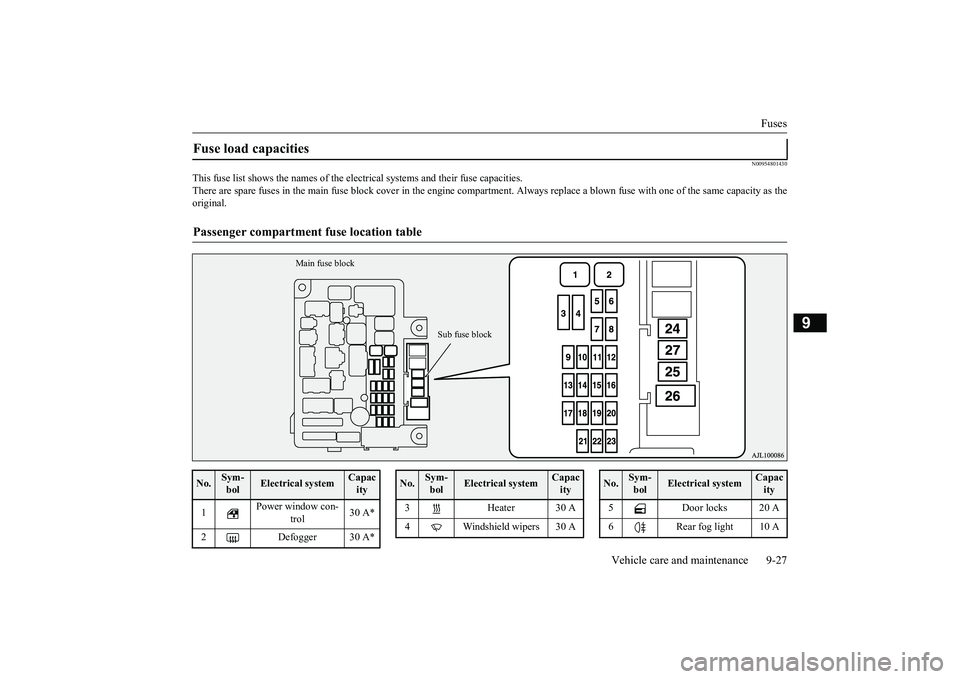
N00954801430
This fuse list shows the names of the elec
trical systems and their fuse capacities.
There are spare fuses in the main fuse block cover in the engine
compartment. Always replace a bl
own fuse with one of the same
capacity as the
original.Fuse load capacities Passenger compartment
fuse location table
Main fuse block
Sub fuse block
No.
Sym-bol
Electrical system
Capacity
1
Power window con-
trol
30 A*
2 Defogger 30 A*
3 Heater 30 A4 Windshield wipers 30 ANo.
Sym-bol
Electrical system
Capacity
5 Door locks 20 A6 Rear fog light 10 ANo.
Sym-bol
Electrical system
Capacity
BK0249100US.book 27 ページ 2017年5月10日 水曜日 午前8時49分
Page 405 of 441
Fuses9-28 Vehicle care and maintenance
9
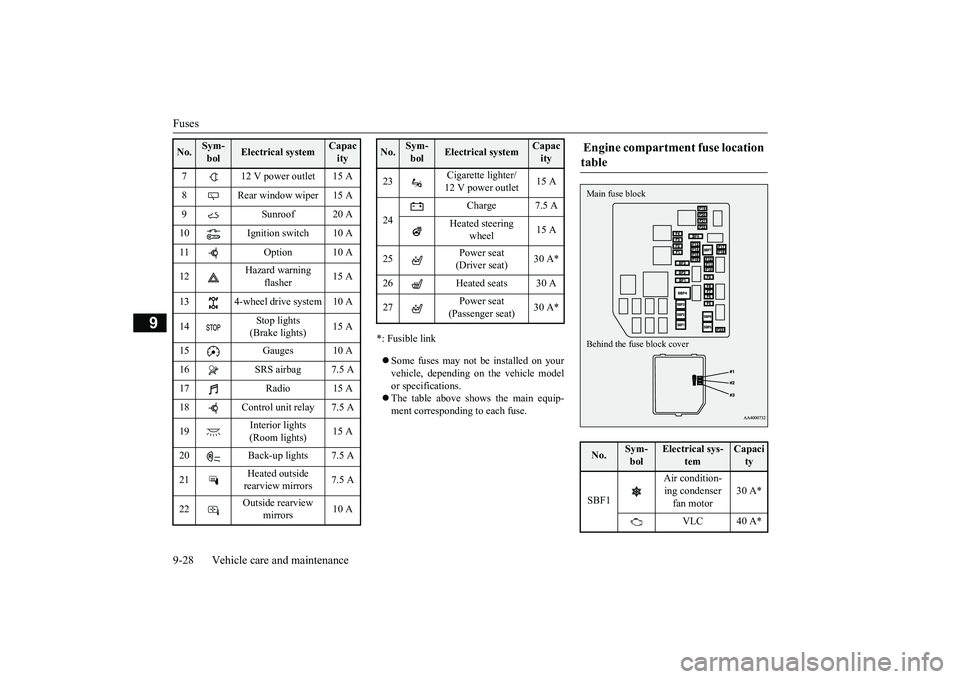
*: Fusible linkSome fuses may not be installed on yourvehicle, depending on
the vehicle model
or specifications.The table above show
s the main equip-
ment corresponding to each fuse.
7 12 V power outlet 15 A8 Rear window wiper 15 A9 Sunroof 20 A10 Ignition switch 10 A11 Option 10 A12
Hazard warning
flasher
15 A
13 4-wheel drive system 10 A14
Stop lights (Brake lights)
15 A
15 Gauges 10 A16 SRS airbag 7.5 A17 Radio 15 A18 Control unit relay 7.5 A19
Interior lights(Room lights)
15 A
20 Back-up lights 7.5 A21
Heated outside rearview mirrors
7.5 A
22
Outside rearview
mirrors
10 A
No.
Sym-bol
Electrical system
Capacity
23
Cigarette lighter/12 V power outlet
15 A
24
Charge 7.5 A
Heated steering
wheel
15 A
25
Power seat(Driver seat)
30 A*
26 Heated seats 30 A27
Power seat(Passenger seat)
No.
Sym-bol
Electrical system
Capacity
Engine compartment fuse location table No.
Sym-bol
Electrical sys-
tem
Capacity
SBF1
Air condition-ing condenser fan motor
30 A*
VLC 40 A*
Behind the fuse block coverMain fuse block
BK0249100US.book 28 ページ 2017年5月10日 水曜日 午前8時49分