parking brake MITSUBISHI OUTLANDER III 2018 Owner's Guide
[x] Cancel search | Manufacturer: MITSUBISHI, Model Year: 2018, Model line: OUTLANDER III, Model: MITSUBISHI OUTLANDER III 2018Pages: 441, PDF Size: 13.71 MB
Page 335 of 441
Parking6-6 Driving safety
6
On snowy roads, ice can form on the brakingsystem, making the brakes less effective.While driving in such conditions, pay closeattention to surrounding
vehicles and to the
condition of the road surface. From time totime, lightly depress the brake pedal andcheck how effective the brakes are.It is important to take
advantage of the engine
braking by downshifting while driving onsteep downhill roads in order to prevent thebrakes from overheating.
N00629601385
When parking on a hill, set the parking brake,and turn the front wheels toward the curb on adownhill, or away from
the curb on an uphill.
If necessary, apply chocks to the wheels.Be sure that the parki
ng brake is firmly set
when parked and that the selector lever is inthe “P” (PARK) position.
When parking on a hill, it is important to setthe parking brake befo
re moving the selector
lever to the “P” (PARK) position. This pre-vents loading the parking brake against thetransaxle. When this ha
ppens, it is difficult to
move the selector lever out of the “P”Never leave the engine running while youtake a short nap or rest. Also, never leave theengine running in a closed or poorly venti-lated place.Your front bumper can be damaged if youscrape it over curbs or parking stop blocks.Be careful when traveling up or down steepslopes where your bumper can scrape theroad.
Always carry the key and lock all doors andthe liftgate when leaving the vehicle unat-tended.Always try to park your vehicle in a well litarea.Move effort could be required to turn thesteering wheel.Refer to “Electric power steering system(EPS)” on page 5-99.
N00629901434
It is very important to know how muchweight your vehicle can carry. This weight iscalled the vehicle ca
pacity weight and
includes the weight of
all occupants, cargo
(including the roof load), non-factory-
When driving in cold weather When driving downhill Parking Parking on a hill
Parking with the engine run-ning
WA R N I N GLeaving the engine ru
nning risks injury or
death from accidentally moving the selec-tor lever or the accumulation of toxicexhaust fumes in the passenger compart-ment.
Where you park
WA R N I N GDo not park your vehicle in areas wherecombustible materials
such as dry grass or
leaves can come in contact with a hotexhaust, since a fire could occur.
When leaving the vehicle Do not keep the steering wheel fully turned for a long time Loading information
BK0249100US.book 6 ページ 2017年5月10日 水曜日 午前8時49分
Page 344 of 441
Trailer towing
Driving safety 6-15
6
You’ll need more passing distance up aheadwhen you’re towing a trailer. And, becauseyou’re a good deal longer, you’ll need to gomuch farther beyond the passed vehiclebefore you can return to your lane.Hold the bottom of the steering wheel withone hand. Then, to move the trailer to the left,just move that hand to the left. To move thetrailer to the right, move your hand to theright. Always back up sl
owly and, if possible,
have someone guide you.When you’re turning with a trailer, makewider than normal turns to help prevent thetrailer from striking shoulders, curbs, roadsigns, trees or other objects.
Avoid jerky or sudden maneuvers. Signalwell in advance.Towing a trailer puts additional burden on theengine and transaxle,
which may cause over-
heating. Following ar
e some suggestions to
reduce overheating:When towing at high al
titudes, engine coolant
and automatic transaxle oil will overheat at alower temperature than at normal altitudes.If you turn your engine off immediately aftertowing at high altitude
on steep uphill grades,
your vehicle may show
signs similar to over-
heating. To avoid this
, let the engine run
while parked (preferably on level ground)with the automatic transaxle in the “P”turning the engine off.
If the engine coolant temperature indica-tor flashes on the information screen inthe multi-information display or theengine power drops suddenly, refer to“Engine overheati
ng” on page 8-4.
If the warning display or warningdisplay illuminates, re
fer to “Warning dis-
play” on page 5-70, 5-78.
Reduce speed and downshift before you startdown a long or steep downgrade. If you don’tdownshift, over using the brakes can causereduced brake efficiency.You can tow in “D” (DRIVE) position. Youmay want to shift the selector lever to the 3rdor a lower position, under heavy loads or hillyconditions.Always place chocks or blocks under both thevehicle and trailer wheels when parking. Besure that the parking brake is firmly set andthat the selector lever is in the “P” (PARK)position. Avoid parki
ng on a hill with a
trailer, but if it cannot be avoided, do so onlyafter performing the following:
Passing Backing up Making turns
CAUTIONMaking sharp turns while towing a trailercould cause the
trailer to come in contact
with the vehicle. Your
vehicle could be dam-
aged. Avoid making sharp turns while tow-ing a trailer.
Overheating Cause of overheating
Solution
Air conditioning on Turn offHighway speeds Reduce speedGoing up hills Select lower gear posi-
tion
Stop-and-go city traf-fic
With the vehicle stopped, shift to the “N” (NEUTRAL) position and idle the engine at high idle.
Driving on hills Parking
BK0249100US.book 15 ページ 2017年5月10日 水曜日 午前8時49分
Page 345 of 441
Trailer towing6-16 Driving safety
6
1. Apply the brakes a
nd keep them applied.
2. Have someone plac
e chocks or blocks
under both the vehicle and trailer wheels.3. When the chocks or blocks are in place,release your brakes slowly until thechocks or blocks absorb the load.4. Apply the parking brake firmly.5. Set the selector lever to the
Page 363 of 441
If the vehicle breaks down8-2 For emergencies
8
N00836301230
If your vehicle breaks down on the road,move to the shoulder and turn on the hazardwarning flashers. If there is no shoulder, orthe shoulder is not safe, drive in the right laneslowly with the hazard
lights flashing, until
you come to a safe stopping place. Keep theflashers flashing.If the engine stops, there will be no powerassist to the steering and brakes, making thesedifficult to use.The brake booster will not work, so thebrakes will not grip well. The brake pedalwill be harder to press than usual.Since there is no power steering assist, thesteering wheel will be hard to turn.
Get help from your passengers, bystanders,etc. to push the vehicle
and move it to a safe
area.
N00836401778
If the engine cannot be started because thebattery is weak or de
ad, you can start it with
the battery from anothe
r vehicle using jumper
cables.1. Take off any metal jewelry such as watchbands or bracelets th
at might create an
accidental electrical contact.2. Position the vehi
cles close enough
together so that the jumper cables canreach, but be sure the vehicles aren’ttouching each other.
3. Set the parking brake firmly on your vehi-cle and move the selector lever into the“P” (PARK) position.4. Set the parking brake firmly on the othervehicle. Put the automatic transaxle in “P”5. Turn the ignition switch (the engineswitch) on each vehicle to the “LOCK” or“OFF” position.6. Make sure your battery electrolyte is atthe proper level. (Refer to “Battery” onpage 9-13.)
If the vehicle breaks down If the engine stops/fails When the engine fails at the intersection
Jump-starting the engine
WA R N I N GTo reduce the risk of igniting flammablegas that may be emitted from the battery,carefully read this section before jump-starting the vehicle.Do not try to start you
r vehicle by pushing
or towing. This can cause an accidentresulting in serious
injury or death and
can damage the vehicle.NOTE
Do not use jumper cables if they have dam-age or corrosion.
CAUTIONCheck the other vehicle.
It must have a 12-
volt battery. If the other system isn’t 12-volt,both systems can be damaged.NOTE
Turn off all lights, heat
er, and othe
r electrical
loads. This will avoid sparks and help saveboth batteries.
BK0249100US.book 2 ページ 2017年5月10日 水曜日 午前8時49分
Page 367 of 441
How to change a tire8-6 For emergencies
8
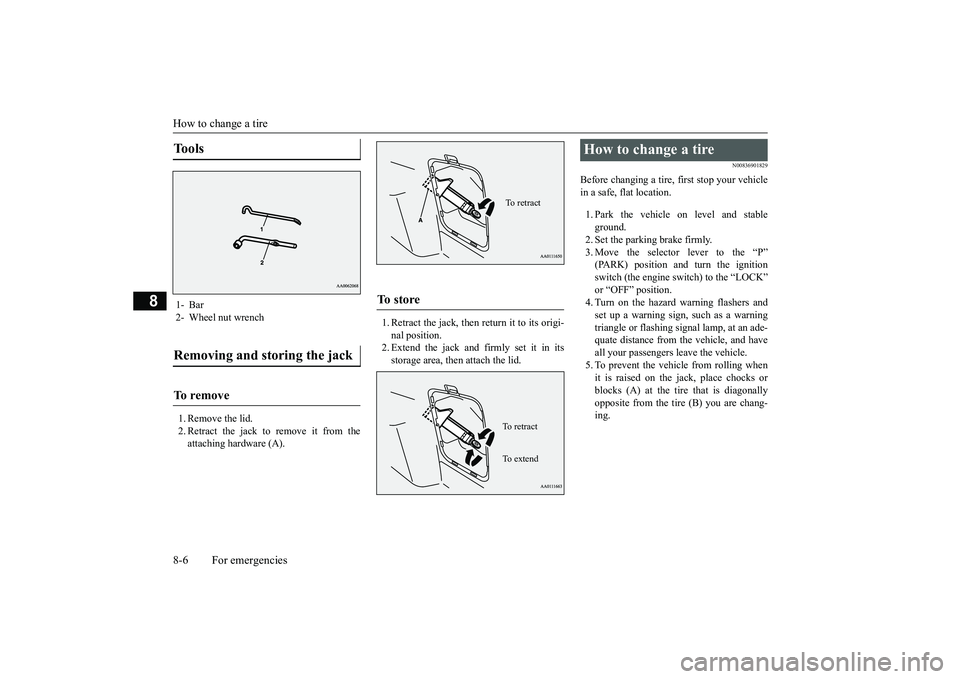
1. Remove the lid.2. Retract the jack to remove it from theattaching hardware (A).
1. Retract the jack, then return it to its origi-nal position.2. Extend the jack and firmly set it in itsstorage area, then attach the lid.
N00836901829
Before changing a tire, first stop your vehiclein a safe, flat location.1. Park the vehicle on level and stableground.2. Set the parking brake firmly.3. Move the selector
lever to the “P”
switch (the engine switch) to the “LOCK”or “OFF” position.4. Turn on the hazard warning flashers andset up a warning sign, such as a warningtriangle or flashing signal lamp, at an ade-quate distance from the vehicle, and haveall your passengers leave the vehicle.5. To prevent the vehicle from rolling whenit is raised on the jack, place chocks orblocks (A) at the ti
re that is diagonally
opposite from the tire (B) you are chang-ing.
Tools 1- Bar2- Wheel nut wrenchRemoving and storing the jack To r e m o v e
To s t o r e
To retractTo r e t r a c tTo e x t e n d
How to change a tire
BK0249100US.book 6 ページ 2017年5月10日 水曜日 午前8時49分
Page 376 of 441

Operation under adverse driving conditions
For emergencies 8-15
8
Release the parking brake.Set the selector lever to the
Page 377 of 441
Fuel Pump Shut-off System8-16 For emergencies
8
When driving on a road covered withsnow or ice, use s
now tires. Tire chains
cannot be used on your vehicle. Theremay be state or local regulations aboutusing snow tires. Al
ways check the regu-
lations in your local area before usingthem. Refer to “Snow tires” on page 9-21and “Tire chains” on page 9-22.Drive slowly. Do not make sudden startsor stops, sharp turns, or slam on thebrakes.Allow extra distance
between your vehi-
cle and the vehicle in front of you, andavoid sudden braking.If a skid occurs when the acceleratorpedal is depressed, take your foot off thepedal. Steer gently in the direction of theskid.Your vehicle is equipped with an anti-lockbraking system (ABS). Hold the brakepedal down firmly and keep it depressed.Do not pump the brake pedal which willresult in reduced braking performance.After parking on snowy or icy roads, itmay be difficult to move your vehicle dueto the brake being frozen. Depress theaccelerator pedal little by little to movethe vehicle when safe to do so.
Drive as slow as pos
sible when driving on
bumpy, rutted roads or over potholes.
N00860600031
In the event of a collision causing frontal air-bag deployment, the fuel pump shut-off sys-tem will activate to st
op fuel supply to the
engine.
On snowy or icy roads
CAUTIONDo not depress the acce
lerator pedal rapidly.
The vehicle could start moving when itbreaks free from the
ice, possibly resulting in
an accident.
On a bumpy or rutted road
CAUTIONDriving on bumpy, rutted roads or over pot-holes can damage th
e tires and wheels.
Wheels with low-profiles tires or under-inflated tires are especially at risk for dam-age.
Fuel Pump Shut-off System
WA R N I N GBefore attempting to restart the engineafter a collision, alw
ays inspect the ground
under the vehicle for leaking fuel. If a fuelleak is found or a fuel
odor is detected, do
not restart the engine.Mitsubishi Motors recommends that yourvehicle be inspected by
an author
ized Mit-
subishi Motors dealer
after any collision.
BK0249100US.book 16 ページ 2017年5月10日 水曜日 午前8時49分
Page 378 of 441
9
Vehicle care and maintenanceService precautions ..........................................................................9-2Catalytic converter ...........................................................................9-2Engine hood .........
...........
...........
............
...........
.........
........
.........
.....9-3
View of the engine compartment .....................................................9-5Engine oil and oil filter ....................................................................9-6Engine coolant .................................................................................9-8Air cleaner filter ...............................................................................9-9Automatic transaxle fluid (if so equipped) ..................................... 9-11Continuously variable transmission
(CVT) fluid (if so equipped) . 9-11
Transfer oil (All-wheel drive models) ...........................................9-12Rear axle oil (All-wheel drive models) .........................................9-12Washer fluid ...................................................................................9-12Brake fluid .....................................................................................9-13Battery ............................................................................................9-13Tires ...............................................................................................9-15Brake pedal free play .....................................................................9-22Parking brake lever stroke (if so equipped) ....................................9-22Wiper blades ..................................................................................9-22Emission-control system maintenance ..........................................9-23General maintenance .....................................................................9-24For cold and snowy weather ..........................................................9-25Fusible links ...................................................................................9-25Fuses ..............................................................................................9-26Replacement of light bulbs ............................................................9-31Vehicle care precautions ................................................................9-39Cleaning the inside of your vehicle .......
...........
...........
...........
.......9-40
Cleaning the outside of your vehicle .....
...........
...........
...........
.......9-41
BK0249100US.book 1 ページ 2017年5月10日 水曜日 午前8時49分
Page 397 of 441
Tires9-20 Vehicle care and maintenance
9
N00939700141
The following maintenance steps are recom-mended:Check tire pressures regularly.Have regular maintenance done on thewheel balance and front and rear suspen-sion alignment.Rotate your tires regul
arly as described in
the “Tire rotation” section on page 9-20.
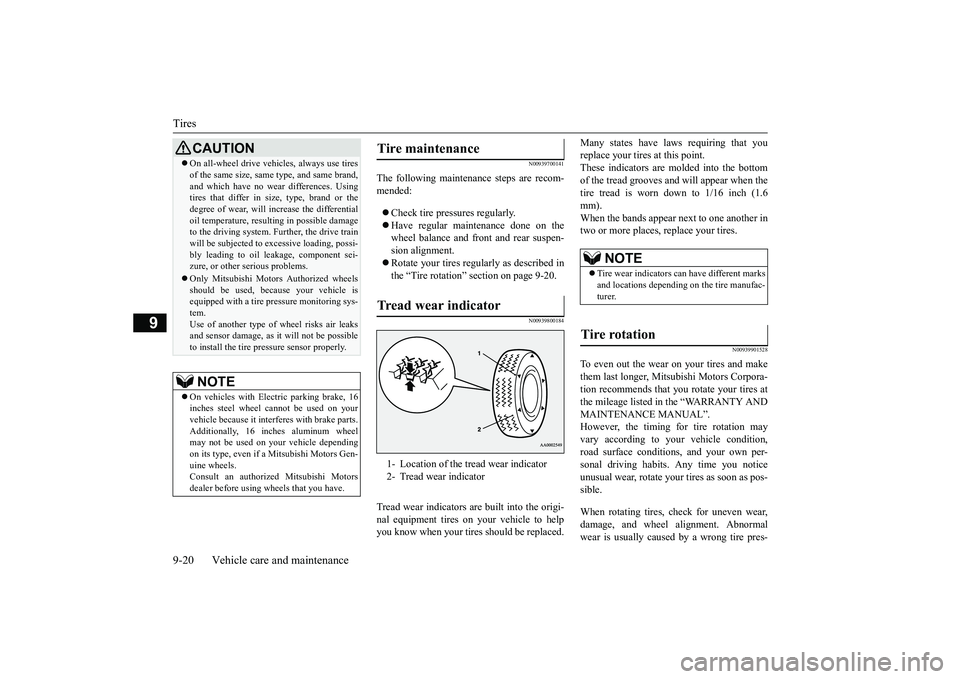
N00939800184
Tread wear indicators are built into the origi-nal equipment tires on
your vehicle to help
you know when your tires should be replaced.
Many states have la
ws requiring that you
replace your tires at this point.These indicators are molded into the bottomof the tread grooves and will appear when thetire tread is worn down to 1/16 inch (1.6mm).When the bands appear next to one another intwo or more places
, replace your tires.
N00939901528
To even out the wear on your tires and makethem last longer, Mitsubishi Motors Corpora-tion recommends that y
ou rotate your tires at
the mileage listed in the “WARRANTY ANDMAINTENANCE MANUAL”.However, the timing for tire rotation mayvary according to your vehicle condition,road surface conditions, and your own per-sonal driving habits. Any time you noticeunusual wear, rotate your tires as soon as pos-sible.When rotating tires,
check for uneven wear,
damage, and wheel alignment. Abnormalwear is usually caused by a wrong tire pres-
On all-wheel drive vehi
cles, always use tires
of the same size, same
type, and same brand,
and which have no wear differences. Usingtires that differ in si
ze, type, brand or the
degree of wear, will in
crease the differential
oil temperature, resul
ting in possible damage
to the driving system. Further, the drive trainwill be subjected to ex
cessive loading, possi-
bly leading to oil leakage, component sei-zure, or other serious problems.Only Mitsubishi Motors Authorized wheelsshould be used, beca
use your vehicle is
equipped with a tire pr
essure monitoring sys-
tem.Use of another type of
wheel risks air leaks
and sensor damage, as
it will not be possible
to install the tire pressure sensor properly.NOTE
On vehicles with Elec
tric parking brake, 16
inches steel wheel cannot be used on yourvehicle because it interfe
res with brake parts.
Additionally, 16 inches aluminum wheelmay not be used on your vehicle dependingon its type, even if a Mitsubishi Motors Gen-uine wheels.Consult an authorized Mitsubishi Motorsdealer before using
wheels that you have.
CAUTION
Tire maintenance Tread wear indicator 1- Location of the tread wear indicator2- Tread wear indicator
NOTE
Tire wear indicators ca
n have different marks
and locations depending
on the tire manufac-
turer.
Tire rotation
BK0249100US.book 20 ページ 2017年5月10日 水曜日 午前8時49分
Page 399 of 441
Brake pedal free play9-22 Vehicle care and maintenance
9
N00940101139N00940300293
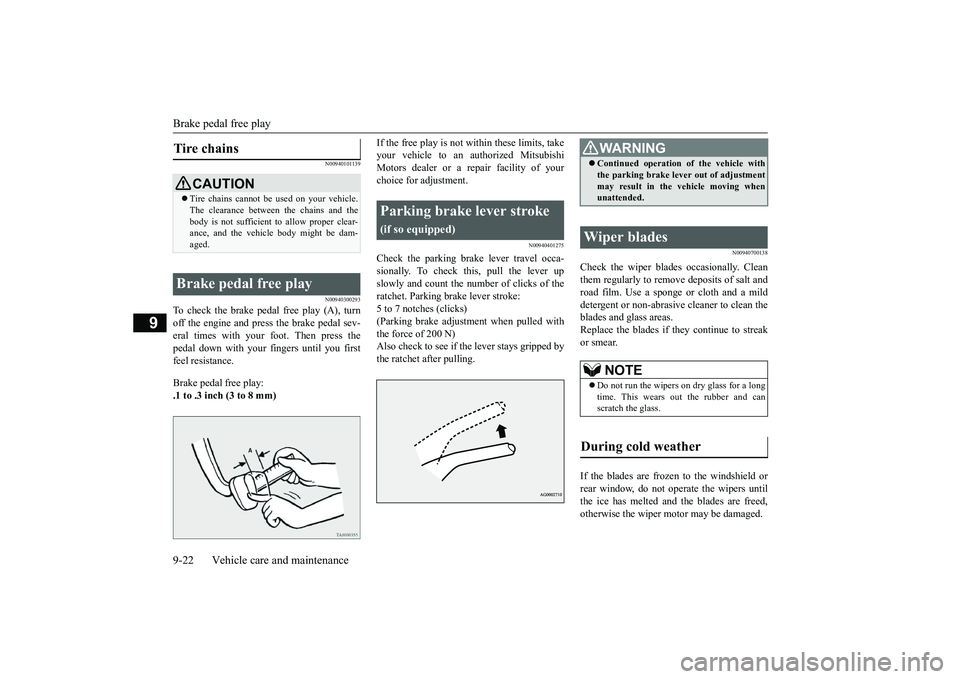
To check the brake pedal free play (A), turnoff the engine and press the brake pedal sev-eral times with your foot. Then press thepedal down with your fi
ngers until you first
feel resistance.Brake pedal free play:.1 to .3 inch (3 to 8 mm)
If the free play is not within these limits, takeyour vehicle to an
authorized Mitsubishi
Motors dealer or a repair facility of yourchoice for adjustment.
N00940401275
Check the parking brake lever travel occa-sionally. To check this, pull the lever upslowly and count the number of clicks of theratchet. Parking br
ake lever stroke:
5 to 7 notches (clicks)(Parking brake adjustment when pulled withthe force of 200 N)Also check to see if the lever stays gripped bythe ratchet after pulling.
N00940700138
Check the wiper blades occasionally. Cleanthem regularly to remove
deposits of salt and
road film. Use a sponge or cloth and a milddetergent or non-abrasive
cleaner to clean the
blades and glass areas.Replace the blades if th
ey continue to streak
or smear.If the blades are frozen to the windshield orrear window, do not operate the wipers untilthe ice has melted and the blades are freed,otherwise the wiper mo
tor may be damaged.
Tire chains
CAUTIONTire chains cannot be used on your vehicle.The clearance between
the chains and the
body is not sufficient to allow proper clear-ance, and the vehicle body might be dam-aged.
Brake pedal free play
Parking brake lever stroke
(if so equipped)
WA R N I N GContinued operation
of the vehicle with
the parking brake leve
r out of adjustment
may result in the
vehicle moving when
unattended.
Wiper blades
NOTE
Do not run the wipers on dry glass for a longtime. This wears out
the rubber and can
scratch the glass.
During cold weather
BK0249100US.book 22 ページ 2017年5月10日 水曜日 午前8時49分