belt MITSUBISHI OUTLANDER III 2018 Service Manual
[x] Cancel search | Manufacturer: MITSUBISHI, Model Year: 2018, Model line: OUTLANDER III, Model: MITSUBISHI OUTLANDER III 2018Pages: 441, PDF Size: 13.71 MB
Page 147 of 441
Starting the engine5-66 Features and controls
5
Remove the key at
the “LOCK” position.
Turn the steering wheel until it is locked.Turn the key to the “ACC” position whilemoving the steering
wheel slightly.
N00512601858
[For vehicles equipped with the Free-handAdvanced Security Transmitter (F.A.S.T.-key).]For information on operation for vehiclesequipped with the Free-hand Advanced Secu-rity Transmitter (F.A.S.T.-key), refer to
“Free-hand Advanced
Security Transmitter
(F.A.S.T.-key): Starting” on page 5-13.[Except for vehicles equipped with theFree-hand Advanced Se
curity Transmit-
ter (F.A.S.T.-key).]Do not operate the starter motor continu-ously for longer than 15 seconds as thiscould run the battery
down or damage the
starter motor. If the engine does not start,turn the ignition switch back to the “OFF”or “LOCK” position, wait a few seconds,and then try again. Trying repeatedly withthe engine or starter motor still turningwill damage the starter mechanism.If the engine will not
start because the bat-
tery is weak or discharged, refer to“Jump-starting the engine” (on page 8-2)for instructions.A longer warm up period will only con-sume extra fuel. The engine is warmed upenough for driving when the bar graph ofengine coolant temper
ature display starts
to move or the low coolant temperatureindicator goes out. Refer to “Engine cool-ant temperature display” on page 5-161 or“Low coolant temper
ature indicator” on
page 5-202.
This model is equipped with an electronicallycontrolled fuel injection system. This is a sys-tem that automatically controls fuel injection.There is usually no need to depress the accel-erator pedal when starting the engine.The starter should not be run for more than 15seconds at a time.To prevent battery drain, wait a few secondsbetween attempts to restart the engine.1. Make sure all occupants are properlyseated with seat belts fastened.
To l o c k
To u n l o c k
CAUTIONRemove the key when leaving the vehicle.NOTE
If the front wheels are turned, the anti-theftlock may sometimes make it difficult to turnthe key from “LOCK” to “ACC”. Firmlyturn the steering wheel to the left or to theright as you turn the key.
Starting the engine
Tips for starting
WA R N I N GNever run the engine in
a closed or poorly
ventilated area any longer than is neededto move your vehicle
out of the area. Car-
bon monoxide gas, wh
ich is odorless and
extremely poisonous, could build up andcause serious injury or death.CAUTIONDo not push-start the vehicle.Do not run the engine at high rpms or driveat high speeds until
the engine has had a
chance to warm up.Release the ignition sw
itch as soon as the
engine starts. Otherwis
e, the starter motor
will be damaged
Starting the engine
BK0249100US.book 66 ページ 2017年5月10日 水曜日 午前8時49分
Page 170 of 441
4-wheel drive operation
Features and controls 5-89
5
When turning a sharp corner in “4WDLOCK” (Electronically
controlled 4WD) or
“LOCK” (S-AWC) position at low speed, a
slight difference in
steering may be experi-
enced similar to feeling as if the brakes wereapplied. This is called tight corner brakingand results from each of the four tires being ata different distance from the corner. The phe-nomenon is typical of 4-wheel drive vehicles.If this occurs, either straighten out the steer-ing wheel or change to another mode.Set the drive mode-selector to “4WDAUTO”, “4WD LOCK” (Electronically con-trolled 4WD) or “SNOW” (S-AWC) in accor-dance with the road conditions, and thengradually depress the ac
celerator pedal for a
smooth start.
WA R N I N GDo not over-rely on th
e 4-wheel drive vehi-
cles. Even 4-wheel drive vehicles have lim-its to the system and ability to maintaincontrol and traction.
Reckless driving may
lead to accidents. Always drive carefully,taking account of the road conditions.Improperly operating
this vehicle on or
off-pavement can cause an accident orrollover in which you
and your passengers
could be seriously
injured or killed.
• Follow all instructions and guidelines inthe owner’s manual.• Keep your speed low and do not drivefaster than conditions.NOTE
Driving on rough roads can be hard on avehicle. Before you le
ave the pavement, be
sure all scheduled ma
intenance and service
has been done, and that
you have inspected
your vehicle. Pay spec
ial attention to the
condition of the ti
res, and check the tire pres-
sures.Mitsubishi Motors is not responsible to theoperator for any damage or injury caused orliability incurred by improper and negligentoperation of a vehicl
e. All techniques of
vehicle operation depend on the skill andexperience of the opera
tor and other partici-
pating parties. Any de
viation from the rec-
ommended operating instru
ctions above is at
their own risk.
Note that the stopping distance required ofthe 4-wheel drive vehicl
e differs very little
from that of the front-wheel drive vehicle.When driving on a snow-covered road or aslippery, muddy surface,
make sure that you
keep a sufficient dist
ance between your vehi-
cle and the one ahead of you.The driving posture should be more upright;adjust the seat to a good position for easysteering and pedal operati
on. Be sure to wear
the seat belt.After driving on rough roads, check eachpart of the vehicle and wash it thoroughlywith water. Refer to the “Inspection andmaintenance following rough road opera-tion” section and “Vehic
le care and Mainte-
nance” sections.CAUTIONSetting the drive mode-selector to “4WDLOCK” (Electronically
controlled 4WD) or
“LOCK” (S-AWC) position to drive on drypaved road will increa
se fuel consumption,
with possible noise generation.
Turning sharp corners
NOTE
On snowy or icy roads
NOTE
The use of snow tires is recommended.Maintain a safe distan
ce between
vehicles,
avoid sudden braking, and use engine brak-ing (downshifting).CAUTIONAvoid sudden braking,
sudden acceleration
and sharp turning. Sk
idding occurs and con-
trol of the vehicle could be lost.
BK0249100US.book 89 ページ 2017年5月10日 水曜日 午前8時49分
Page 174 of 441
Brake auto hold (if so equipped)
Features and controls 5-93
5
N00550700124
The disc brakes have an alarm that makes ametallic squeal when
the brake pads have
worn down enough to need service.If you hear this sound, have the brake padsreplaced at an authorized Mitsubishi Motorsdealer or a repair fa
cility of your choice.
N00592000035
When the vehicle is st
opped at traffic lights
etc., the vehicle can be
held stationary with
the brake auto hold system even if yourelease your foot from the brake pedal.When the accelerator pedal is depressed, thebrakes are released.
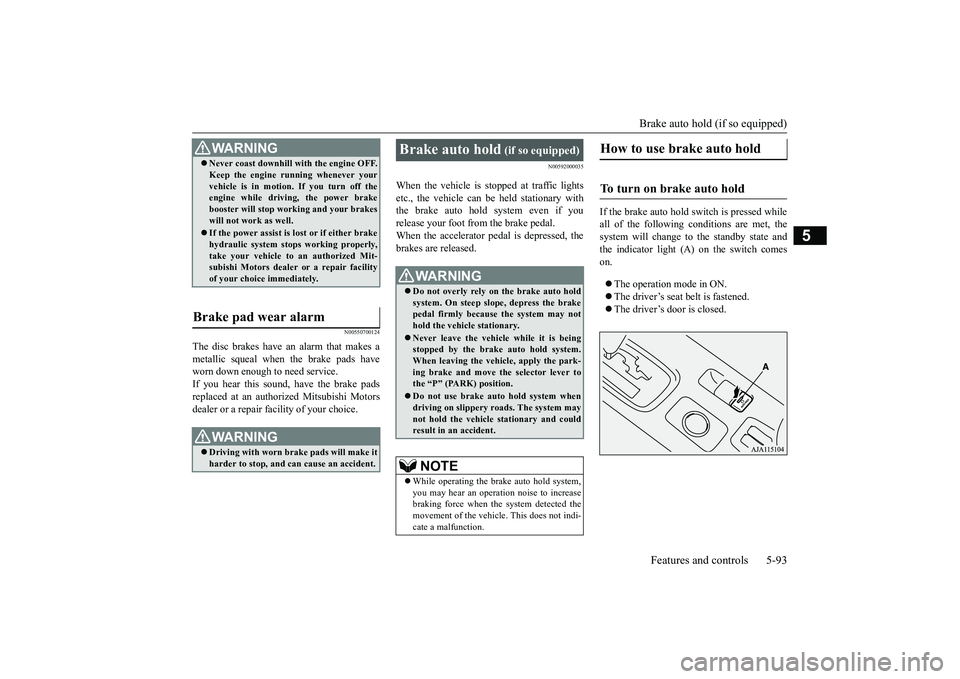
If the brake auto hold switch is pressed whileall of the following c
onditions are met, the
system will change to the standby state andthe indicator light (A) on the switch comeson.The operation mode in ON.The driver’s seat belt is fastened.The driver’s door is closed.
WA R N I N GNever coast downhill
with the engine OFF.
Keep the engine running whenever yourvehicle is in motion. If you turn off theengine while driving, the power brakebooster will stop wo
rking and your brakes
will not work as well.If the power assist is lost or if either brakehydraulic system stop
s working properly,
take your vehicle to
an authorized Mit-
subishi Motors dealer or a repair facilityof your choice immediately.
Brake pad wear alarm
WA R N I N GDriving with worn brake pads will make itharder to stop, and can cause an accident.
Brake auto hold
(if so equipped)
Do not overly rely on the brake auto holdsystem. On steep slope, depress the brakepedal firmly because the system may nothold the vehicle stationary.Never leave the vehicle while it is beingstopped by the brake auto hold system.When leaving the vehi
cle, apply the park-
ing brake and move th
e selector lever to
the “P” (PARK) position.Do not use brake auto hold system whendriving on slippery roads. The system maynot hold the vehicle stationary and couldresult in an accident. NOTE
While operating the brake auto hold system,you may hear an operation noise to increasebraking force when the system detected themovement of the vehicl
e. This does not indi-
cate a malfunction.
How to use brake auto hold
To turn on brake auto hold
BK0249100US.book 93 ページ 2017年5月10日 水曜日 午前8時49分
Page 175 of 441
Brake auto hold (if so equipped)5-94 Features and controls
5
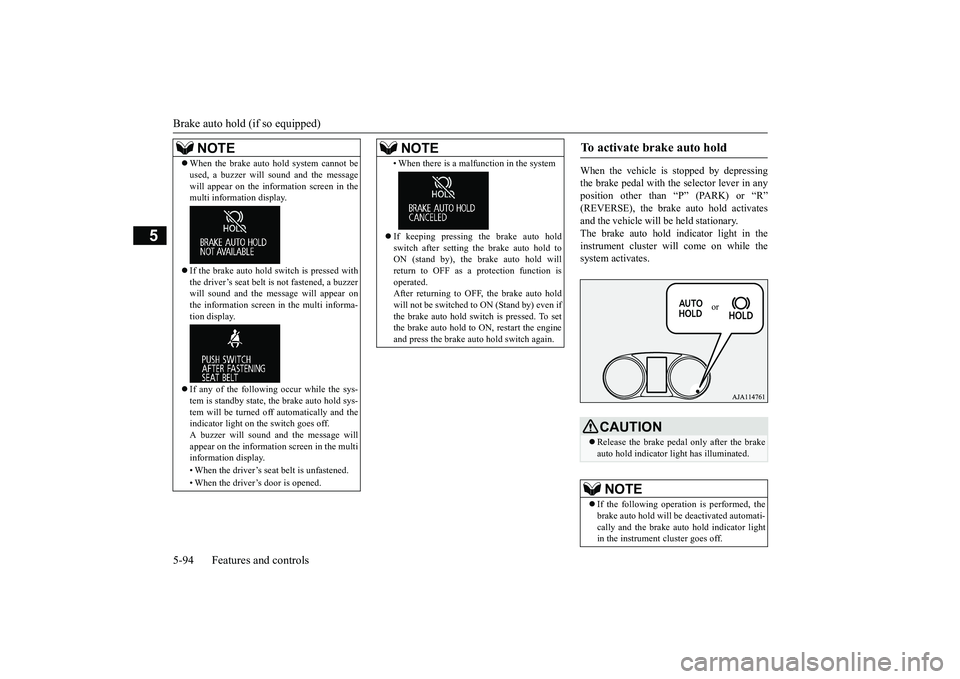
When the vehicle is
stopped by depressing
the brake pedal with the selector lever in anyposition other than “P” (PARK) or “R”and the vehicle will be
held stationary.
The brake auto hold indicator light in theinstrument cluster will come on while thesystem activates.
NOTE
When the brake auto hold system cannot beused, a buzzer will sound and the messagewill appear on the information screen in themulti information display.If the brake auto hold
switch is pressed with
the driver’s seat belt is not fastened, a buzzerwill sound and the me
ssage will appear on
the information screen in the multi informa-tion display.If any of the following occur while the sys-tem is standby state, the brake auto hold sys-tem will be turned off automatically and theindicator light on the switch goes off.A buzzer will sound
and the message will
appear on the information screen in the multiinformation display.• When the driver’s seat
belt is unfastened.
• When the driver’s door is opened.
• When there is a malfunction in the systemIf keeping pressing the brake auto holdswitch after setting the brake auto hold toON (stand by), the brake auto hold willreturn to OFF as a protection function isoperated.After returning to OFF, the brake auto holdwill not be switched to ON (Stand by) even ifthe brake auto hold switch is pressed. To setthe brake auto hold to ON, restart the engineand press the brake auto hold switch again.NOTE
To activate brake auto hold
CAUTIONRelease the brake pedal only after the brakeauto hold indicator li
ght has illuminated.
NOTE
If the following operation is performed, thebrake auto hold will be deactivated automati-cally and the brake au
to hold indicator light
in the instrument cluster goes off.
or
BK0249100US.book 94 ページ 2017年5月10日 水曜日 午前8時49分
Page 176 of 441
Hill start assist (if so equipped)Features and controls 5-95
5
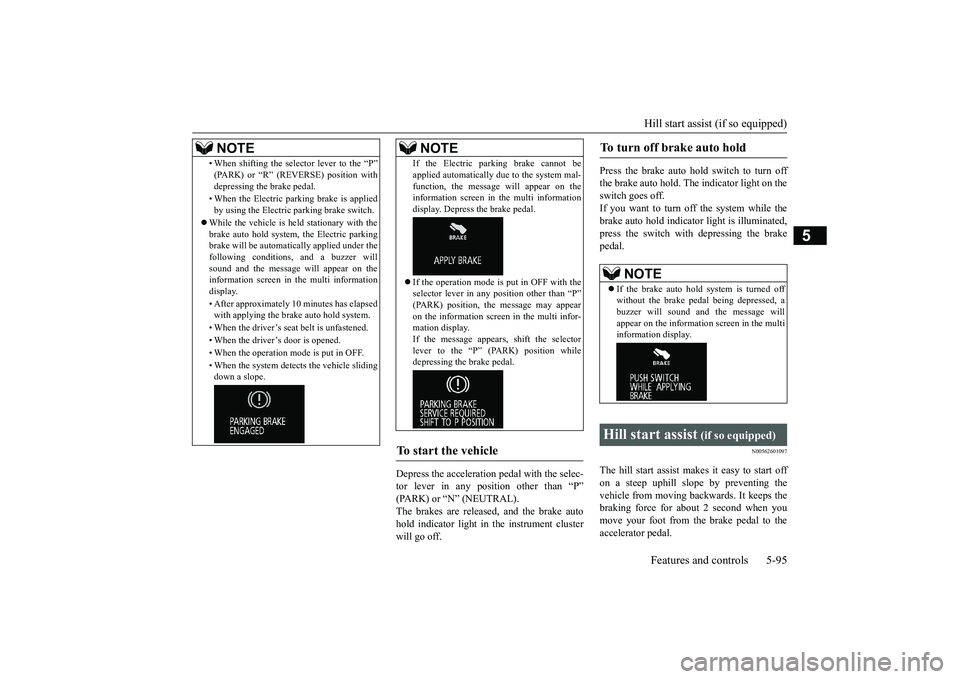
Depress the acceleration pedal with the selec-tor lever in any position other than “P”The brakes are released, and the brake autohold indicator light in the instrument clusterwill go off.
Press the brake auto hold switch to turn offthe brake auto hold. Th
e indicator light on the
switch goes off.If you want to turn off the system while thebrake auto hold indicato
r light is illuminated,
press the switch with
depressing the brake
pedal.
N00562601097
The hill start assist make
s it easy to start off
on a steep uphill slope by preventing thevehicle from moving back
wards. It keeps the
braking force for about 2 second when youmove your foot from the brake pedal to theaccelerator pedal.
• When shifting the selector lever to the “P”(PARK) or “R” (REVERSE) position withdepressing the brake pedal.• When the Electric park
ing brake is applied
by using the Electric
parking brake switch.
While the vehicle is held stationary with thebrake auto hold system, the Electric parkingbrake will be automatic
ally applied under the
following conditions
, and a buzzer will
sound and the message
will appear on the
information screen in the multi informationdisplay.• After approximately
10 minutes has elapsed
with applying the brake auto hold system.• When the driver’s seat
belt is unfastened.
• When the driver’s door is opened.• When the operation mode is put in OFF.• When the system detects the vehicle slidingdown a slope.NOTE
If the Electric park
ing brake cannot be
applied automatically due to the system mal-function, the message
will appear on the
information screen in the multi informationdisplay. Depress the brake pedal.If the operation mode is
put in OFF with the
selector lever in any
position other than “P”
(PARK) position, the message may appearon the information screen in the multi infor-mation display.If the message appears, shift the selectorlever to the “P” (P
ARK) position while
depressing the brake pedal.
To start the vehicle
NOTE
To turn off brake auto hold
NOTE
If the brake auto hold system is turned offwithout the brake peda
l being depressed, a
buzzer will sound and the message willappear on the information screen in the multiinformation display.
Hill start assist
(if so equipped)
BK0249100US.book 95 ページ 2017年5月10日 水曜日 午前8時49分
Page 263 of 441

Indicator light, warning light, and information screen display list (multi information display - Type 1)
5
N00557901119
When there is information to be announced,
such as light reminder, the
tone sounds and the screen sw
itches to the displays show
n below. Refer to
the appropriate page and ta
ke the necessary measures.
When the cause of the warning display is elimin
ated, the warning displa
y goes out automatically.
Refer to Warning disp
lay list on page 5-183.
Refer to Other interrupt displays on page 5-197.15- Seat belt remi
nder/warning light
P.4-23
16- Tire pressure monitoring system warn-
ing light
P.5-138
17- Brake auto hold indicator (if so
equipped)
P.5-93
18- Brake warning light (red)
P.5-203
19- Information screen display list
P.5-182
Information screen display list
NOTE
In the following cases, a warning may be
displayed on the information screen and th
e buzzer may sound for a
few seconds, at tim
es.
This is caused by the system picking up in
terference such as strong el
ectromagnetic waves
or noise, and is not a functional pro
blem.
• An extremely strong electrom
agnetic wave is received from a s
ource such as an illegal radio se
t, a spark from a wire, or a rad
ar station.
• Abnormal voltage or a static
electricity disc
harge is generated by the operation of
your vehicle’s electr
onics (including afte
r-market parts).
If the warning display has oc
curred a number of times, take your
vehicle to an author
ized Mitsubishi Motors
dealer or a repair
facility of your choice and
have the system checked.
BK0249100US.book 182 ページ 2017年5月10日 水曜日 午前8時49分
Page 269 of 441
Indicator light, warning light, and information screen display list (multi information display - Type 1)
5
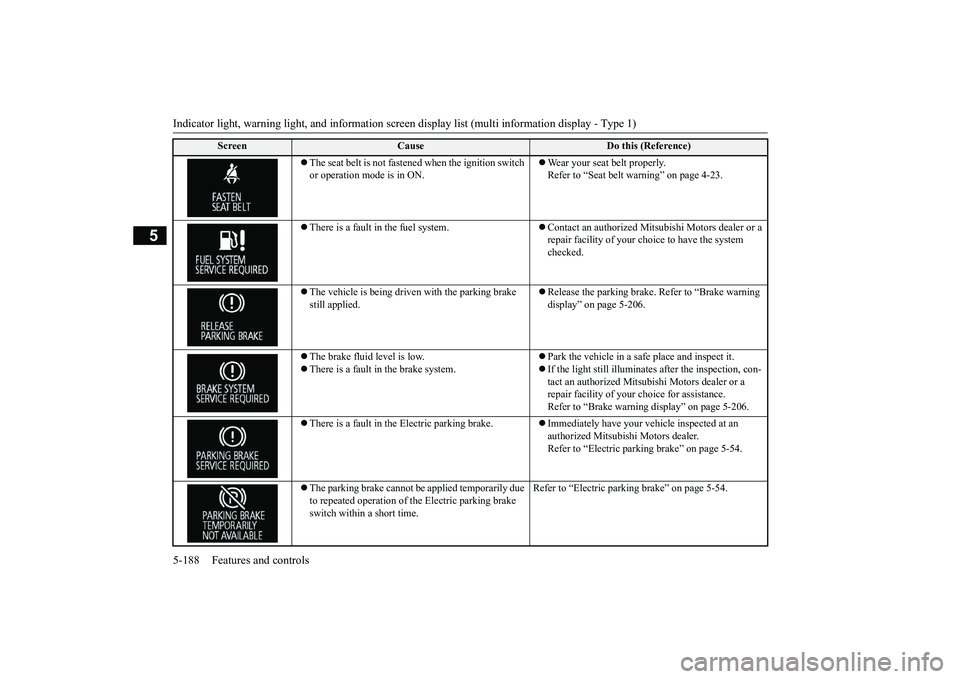
The seat belt is not fasten
ed when the ignition switch
or operation mode is in ON.
Wear your seat belt properly. Refer to “Seat belt
warning” on page 4-23.
There is a fault in the fuel system.
Contact an authorized Mits
ubishi Motors dealer or a
repair facility of your c
hoice to have the system
checked.
The vehicle is being driven with the parking brake still applied.
Release the parking brake. Refer to “Brake warning display” on page 5-206.
The brake fluid level is low.There is a fault in the brake system.
Park the vehicle in a safe place and inspect it.If the light still illuminates after the inspection, con-tact an authorized Mitsub
ishi Motors dealer or a
repair facility of your
choice for assistance.
Refer to “Brake warning
display” on page 5-206.
There is a fault in the Electric parking brake.
Immediately have your ve
hicle inspected at an
authorized Mitsubishi Motors dealer.Refer to “Electric parking brake” on page 5-54.
The parking brake cannot be
applied temporarily due
to repeated operation of the Electric parking brake switch within a short time.
Refer to “Electric parkin
g brake” on page 5-54.
Screen
Cause
Do this (Reference)
BK0249100US.book 188 ページ 2017年5月10日 水曜日 午前8時49分
Page 271 of 441
Indicator light, warning light, and information screen display list (multi information display - Type 1)
5
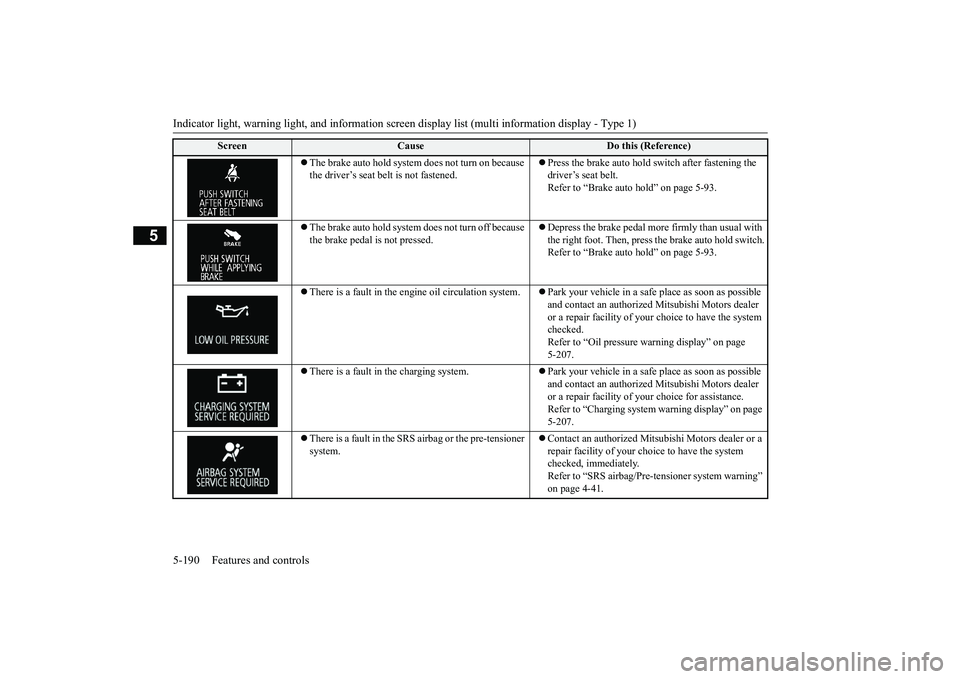
The brake auto hold system does not turn on because the driver’s seat belt is not fastened.
Press the brake auto hold switch after fastening the driver’s seat belt.Refer to “Brake auto hold” on page 5-93.
The brake auto hold system does not turn off because the brake pedal is not pressed.
Depress the brake pedal more firmly than usual with the right foot. Then, press
the brake auto hold switch.
Refer to “Brake auto hold” on page 5-93.
There is a fault in the engi
ne oil circulation system.
Park your vehicle in a safe place as soon as possible and contact an authorized
Mitsubishi Motors dealer
or a repair facility of your
choice to have the system
checked.Refer to “Oil pressure wa
rning display” on page
5-207.
There is a fault in the charging system.
Park your vehicle in a safe place as soon as possible and contact an authorized
Mitsubishi Motors dealer
or a repair facility of
your choice for assistance.
Refer to “Charging system
warning display” on page
5-207.
There is a fault in the SRS airbag or the pre-tensioner system.
Contact an authorized Mits
ubishi Motors dealer or a
repair facility of your c
hoice to have the system
checked, immediately.Refer to “SRS airbag/Pre-t
ensioner system warning”
on page 4-41.
Screen
Cause
Do this (Reference)
BK0249100US.book 190 ページ 2017年5月10日 水曜日 午前8時49分
Page 283 of 441
Indicators5-202 Features and controls
5
N00519900127N00520000216
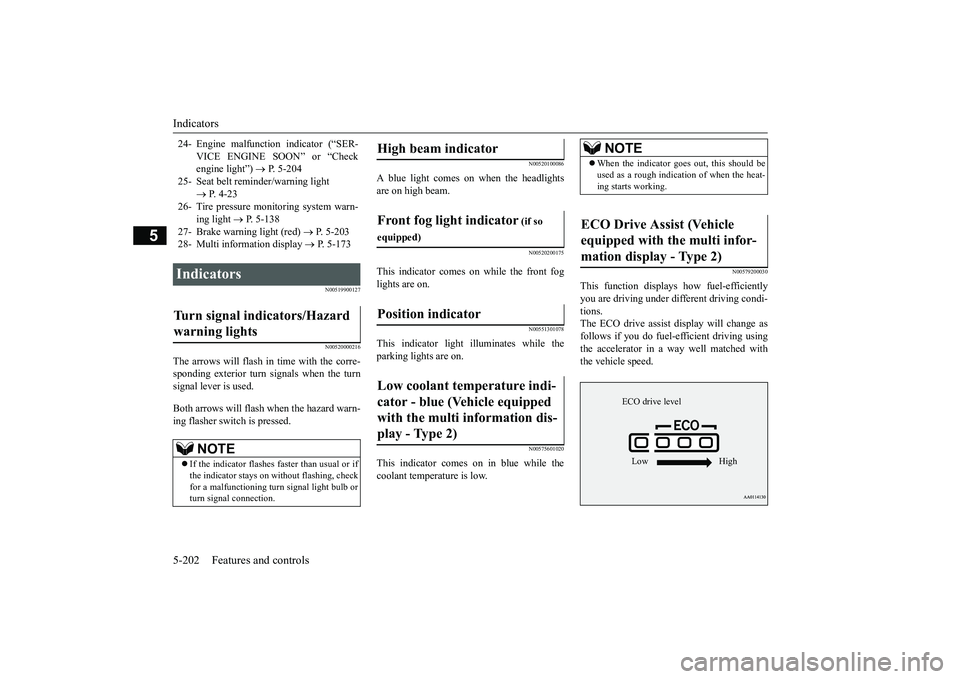
The arrows will flash in time with the corre-sponding exterior turn signals when the turnsignal lever is used.Both arrows will flash
when the hazard warn-
ing flasher swit
ch is pressed.
N00520100086
A blue light comes on when the headlightsare on high beam.
N00520200175
This indicator comes on while the front foglights are on.
N00551301078
This indicator light illuminates while theparking lights are on.
N00575601020
This indicator comes on in blue while thecoolant temperature is low.
N00579200030
This function displays
how fuel-efficiently
you are driving under different driving condi-tions.The ECO drive assist di
splay will change as
follows if you do fuel-efficient driving usingthe accelerator in a way well matched withthe vehicle speed.
24- Engine malfuncti
on indicator (“SER-
VICE ENGINE SOON” or “Checkengine light”)
P. 5-204
25- Seat belt remi
nder/warning light
P. 4-23
26- Tire pressure moni
toring system warn-
ing light
P. 5-138
27- Brake warning light (red)
P. 5-203
28- Multi information display
P. 5-173
Indicators Turn signal indicators/Hazard warning lights
NOTE
If the indicator flashes faster than usual or ifthe indicator stays on wi
thout flashing, check
for a malfunctioning turn signal light bulb orturn signal connection.
High beam indicator Front fog light indicator
(if so
equipped)Position indicator Low coolant temperature indi-cator - blue (Vehicle equipped with the multi information dis-play - Type 2)
NOTE
When the indicator go
es out, this should be
used as a rough indication of when the heat-ing starts working.
ECO Drive Assist (Vehicle equipped with the multi infor-mation display - Type 2)
ECO drive levelLow High
BK0249100US.book 202 ページ 2017年5月10日 水曜日 午前8時49分
Page 331 of 441
Driving precaution6-2 Driving safety
6
N00629301092
Your vehicle has been designed for both nor-mal and occasional off-road use. However,avoid driving the vehicle through areas wherethe tires may get stuck in deep sand or mud asyour vehicle is designe
d primarily for use on
pavement, unlike a conventional off-roadvehicle.Keep in mind that 2-wheel drive vehicles areless capable than 4-wh
eel drive vehicles for
driving on muddy, slippery, wet or snow-cov-ered roads.Utility vehicles have
higher ground clearance
and a narrower track, which enables them toperform in a wide variety of off-road situa-tions. Because of the higher ground clear-ance, these vehicles have a higher center ofgravity, which makes them handle differentlythan ordinary vehicles when driving on pave-ment. They are not designed to maneuver orcorner at the same speed on pavement as con-ventional 2-wheel driv
e passenger cars any
more than low-slung sports cars are designed
to perform satisfactorily in off-road condi-tions.Always drive safely
and steer the vehicle
carefully. Avoid operating the vehicle in amanner that might require sharp turns orabrupt maneuvers. As wi
th other vehicles of
this type, failure to operate this vehicle cor-rectly can result in lo
ss of control or vehicle
rollover.In a rollover crash, an unbelted person is sig-nificantly more likely to die than a personwearing a seat belt. Be
fore starting the vehi-
cle, always make cert
ain that you and all your
passengers are properly wearing their seatbelts (with children in the rear seat, in appro-priate restraints).
N00628801191
Fuel economy is depe
ndent on many factors.
Your personal driving habits can have a sig-nificant effect on your fuel consumption.Several recommendations
for achieving the
greatest fuel economy are listed below.Whenever accelerating from a stop,always accelerate
slowly and smoothly.
When parked for even a short period, donot idle the engine. Shut it off.Plan your trips to avoid unnecessarystops.
Keep your tires inflated to the recom-mended pressures.When driving a 4-wheel drive vehicle onhighways or dry improved roads, set thedrive mode to “4WD ECO” or “4WDAUTO” (Electronically controlled 4WD),or “AWC ECO” or “NORMAL” (S-AW C ) .For freeway driving, maintain a speed ofapproximately 50 mph (80 km/h) whentraffic, roadway and weather conditionssafely permit.Keep your air filter clean and your vehiclelubricated according
to the recommenda-
tions in this manual.Always keep your ve
hicle well main-
tained. A poorly maintained enginewastes fuel and costs money.Never overload your vehicle.
N00628900049
Drunk driving is one of the most frequentcauses of accidents.Your driving ability ca
n be seriously impaired
even with blood alcohol levels far below thelegal minimum. If you
have been drinking,
don’t drive. Ride with a designated non-drinking driver, call a cab or a friend, or usepublic transportation. Drinking coffee or tak-ing a cold shower will not make you sober.
Driving precaution
WA R N I N GUtility vehicles have
a significantly higher
rollover rate than othe
r types of vehicles.
Avoid abrupt maneuvers and excessivespeed. Always buckle up.
Fuel economy
Driving, alcohol and drugs
BK0249100US.book 2 ページ 2017年5月10日 水曜日 午前8時49分