wheel MITSUBISHI OUTLANDER III 2018 Manual Online
[x] Cancel search | Manufacturer: MITSUBISHI, Model Year: 2018, Model line: OUTLANDER III, Model: MITSUBISHI OUTLANDER III 2018Pages: 441, PDF Size: 13.71 MB
Page 377 of 441
Fuel Pump Shut-off System8-16 For emergencies
8
When driving on a road covered withsnow or ice, use s
now tires. Tire chains
cannot be used on your vehicle. Theremay be state or local regulations aboutusing snow tires. Al
ways check the regu-
lations in your local area before usingthem. Refer to “Snow tires” on page 9-21and “Tire chains” on page 9-22.Drive slowly. Do not make sudden startsor stops, sharp turns, or slam on thebrakes.Allow extra distance
between your vehi-
cle and the vehicle in front of you, andavoid sudden braking.If a skid occurs when the acceleratorpedal is depressed, take your foot off thepedal. Steer gently in the direction of theskid.Your vehicle is equipped with an anti-lockbraking system (ABS). Hold the brakepedal down firmly and keep it depressed.Do not pump the brake pedal which willresult in reduced braking performance.After parking on snowy or icy roads, itmay be difficult to move your vehicle dueto the brake being frozen. Depress theaccelerator pedal little by little to movethe vehicle when safe to do so.
Drive as slow as pos
sible when driving on
bumpy, rutted roads or over potholes.
N00860600031
In the event of a collision causing frontal air-bag deployment, the fuel pump shut-off sys-tem will activate to st
op fuel supply to the
engine.
On snowy or icy roads
CAUTIONDo not depress the acce
lerator pedal rapidly.
The vehicle could start moving when itbreaks free from the
ice, possibly resulting in
an accident.
On a bumpy or rutted road
CAUTIONDriving on bumpy, rutted roads or over pot-holes can damage th
e tires and wheels.
Wheels with low-profiles tires or under-inflated tires are especially at risk for dam-age.
Fuel Pump Shut-off System
WA R N I N GBefore attempting to restart the engineafter a collision, alw
ays inspect the ground
under the vehicle for leaking fuel. If a fuelleak is found or a fuel
odor is detected, do
not restart the engine.Mitsubishi Motors recommends that yourvehicle be inspected by
an author
ized Mit-
subishi Motors dealer
after any collision.
BK0249100US.book 16 ページ 2017年5月10日 水曜日 午前8時49分
Page 378 of 441
9
Vehicle care and maintenanceService precautions ..........................................................................9-2Catalytic converter ...........................................................................9-2Engine hood .........
...........
...........
............
...........
.........
........
.........
.....9-3
View of the engine compartment .....................................................9-5Engine oil and oil filter ....................................................................9-6Engine coolant .................................................................................9-8Air cleaner filter ...............................................................................9-9Automatic transaxle fluid (if so equipped) ..................................... 9-11Continuously variable transmission
(CVT) fluid (if so equipped) . 9-11
Transfer oil (All-wheel drive models) ...........................................9-12Rear axle oil (All-wheel drive models) .........................................9-12Washer fluid ...................................................................................9-12Brake fluid .....................................................................................9-13Battery ............................................................................................9-13Tires ...............................................................................................9-15Brake pedal free play .....................................................................9-22Parking brake lever stroke (if so equipped) ....................................9-22Wiper blades ..................................................................................9-22Emission-control system maintenance ..........................................9-23General maintenance .....................................................................9-24For cold and snowy weather ..........................................................9-25Fusible links ...................................................................................9-25Fuses ..............................................................................................9-26Replacement of light bulbs ............................................................9-31Vehicle care precautions ................................................................9-39Cleaning the inside of your vehicle .......
...........
...........
...........
.......9-40
Cleaning the outside of your vehicle .....
...........
...........
...........
.......9-41
BK0249100US.book 1 ページ 2017年5月10日 水曜日 午前8時49分
Page 389 of 441
Transfer oil (All-w
heel drive models)
9-12 Vehicle care and maintenance
9
Do not use any fluid additives to the trans-mission.
N00938401311
Whenever the transfer oil level is checked,add oil as necessary to maintain the properlevel. Fill with the oil according to the tablebelow.
N00915201309
Whenever the oil level is checked, add oil asnecessary to maintain the proper level.Fill with the oil according to the table below.
N00938601342
The windshield and rear window washer fluidreservoir is in the
engine compartment.
Check the washer fluid
level at regular inter-
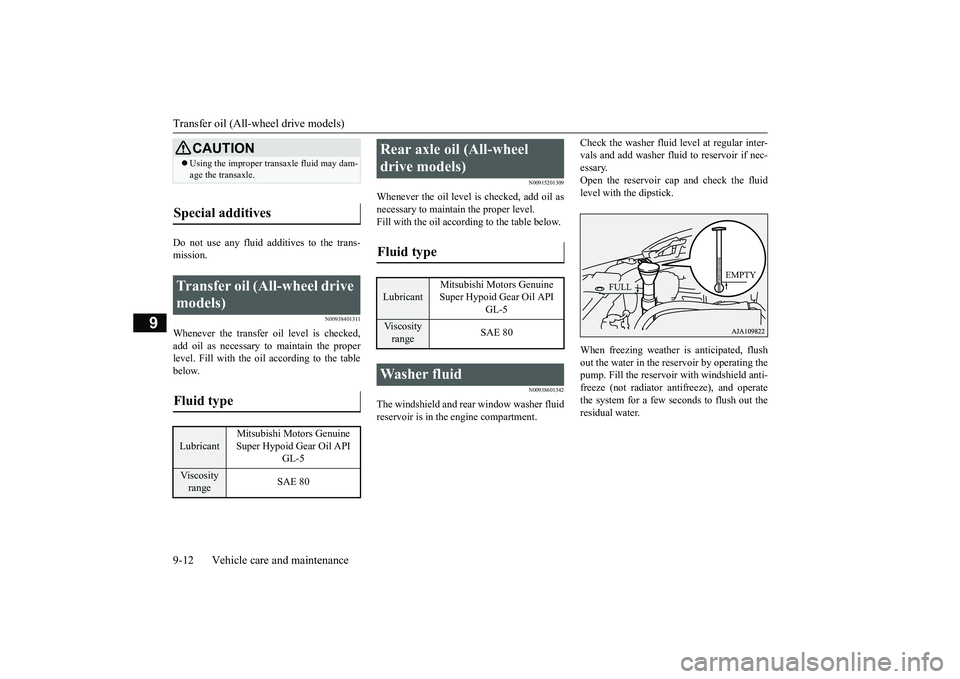
vals and add washer fluid to reservoir if nec-essary.Open the reservoir cap and check the fluidlevel with the dipstick.When freezing weather is anticipated, flushout the water in the reservoir by operating thepump. Fill the reservoi
r with windshield anti-
freeze (not radiator an
tifreeze), and operate
the system for a few seconds to flush out theresidual water.
CAUTIONUsing the improper transaxle fluid may dam-age the transaxle.
Special additives
Transfer oil (All-wheel drive models) Fluid type Lubricant
Mitsubishi Motors Genuine Super Hypoid Gear Oil API
GL-5
Viscosity range
SAE 80
Rear axle oil (All-wheel drive models) Fluid type Lubricant
Mitsubishi Motors Genuine Super Hypoid Gear Oil API
GL-5
Viscosity range
SAE 80
Washer fluid
FULL
EMPTY
BK0249100US.book 12 ページ 2017年5月10日 水曜日 午前8時49分
Page 395 of 441
Tires9-18 Vehicle care and maintenance
9
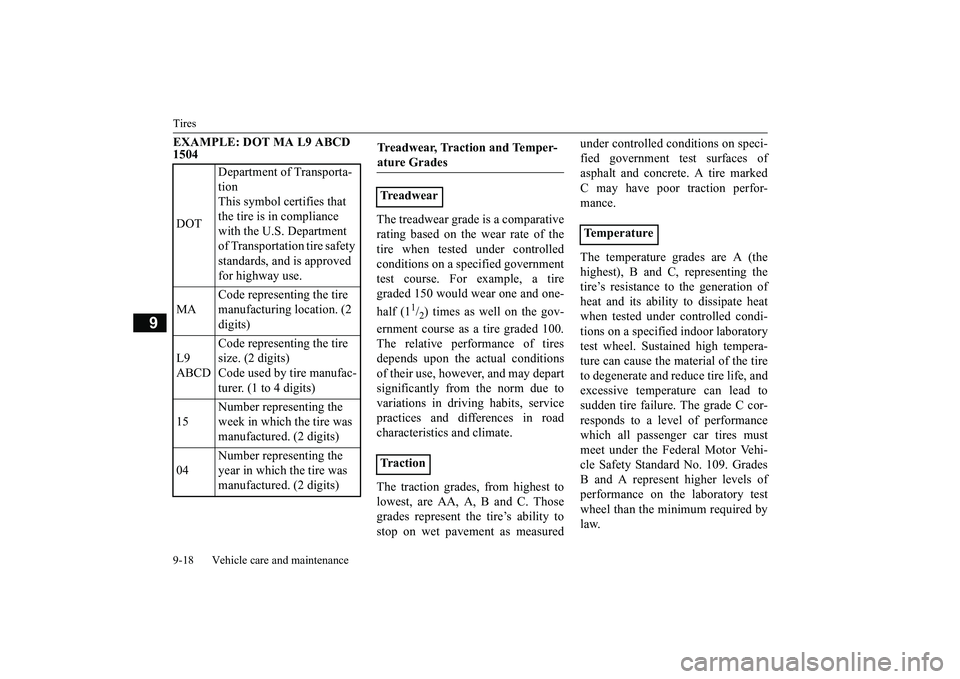
EXAMPLE: DOT MA L9 ABCD 1504
The treadwear grade is a comparativerating based on the wear rate of thetire when tested under controlledconditions on a specified governmenttest course. For example, a tiregraded 150 would wear one and one-half (1
1/2) times as well on the gov-
ernment course as a tire graded 100.The relative performance of tiresdepends upon the
actual conditions
of their use, however, and may departsignificantly from the norm due tovariations in driv
ing habits, service
practices and differences in roadcharacteristics and climate.The traction grades, from highest tolowest, are AA, A, B and C. Thosegrades represent the tire’s ability tostop on wet pavement as measured
under controlled co
nditions on speci-
fied government test surfaces ofasphalt and concrete. A tire markedC may have poor traction perfor-mance.The temperature grades are A (thehighest), B and C, representing thetire’s resistance to the generation ofheat and its ability to dissipate heatwhen tested under controlled condi-tions on a specified indoor laboratorytest wheel. Sustained high tempera-ture can cause the material of the tireto degenerate and reduce tire life, andexcessive temperature can lead tosudden tire failure. The grade C cor-responds to a level of performancewhich all passenger car tires mustmeet under the Federal Motor Vehi-cle Safety Standard No. 109. GradesB and A represent higher levels ofperformance on the laboratory testwheel than the minimum required bylaw.
DOT
Department of Transporta-tionThis symbol certifies that the tire is in compliance with the U.S. Department of Transportation tire safety standards, and is approved for highway use.
MA
Code representing the tire manufacturing location. (2 digits)
L9ABCD
Code representing the tire size. (2 digits)turer. (1 to 4 digits)
15
Number representing the week in which the tire was manufactured. (2 digits)
04
Number representing the year in which the tire was manufactured. (2 digits)
Treadwear, Traction and Temper-ature Grades Tr e a d w e a rTr a c t i o n
Te m p e r a t u r e
BK0249100US.book 18 ページ 2017年5月10日 水曜日 午前8時49分
Page 396 of 441
Tires
Vehicle care and maintenance 9-19
9
N00939301997
Proper tire inflation pre
ssure is essential for
the safe and satisfac
tory operation of your
vehicle. The wrong tire pressure will causeproblems in three major areas:SafetyToo little pressure increases flexing in thetire and can cause tire failure. Too muchpressure can cause a tire to lose its abilityto cushion shock. Objects on the road andpotholes could then ca
use tire damage that
may result in tire failure.EconomyThe wrong tire pressu
re can cause uneven
wear patterns in the tire tread. Theseabnormal wear patter
ns will reduce the
tread life, and the tire will have to bereplaced sooner.Too little pressure also makes it harder forthe tire to roll, and this uses up more fuel.Ride comfort and vehicle stabilityThe superior riding e
xperience built into
your vehicle partly de
pends on the correct
tire pressure. Too much pressure gives anuncomfortable and jarring ride. Too littlepressure feels as if
your vehicle is slow to
respond.Unequal tire pressure
s can make steering
your vehicle uneven
and unpredictable.
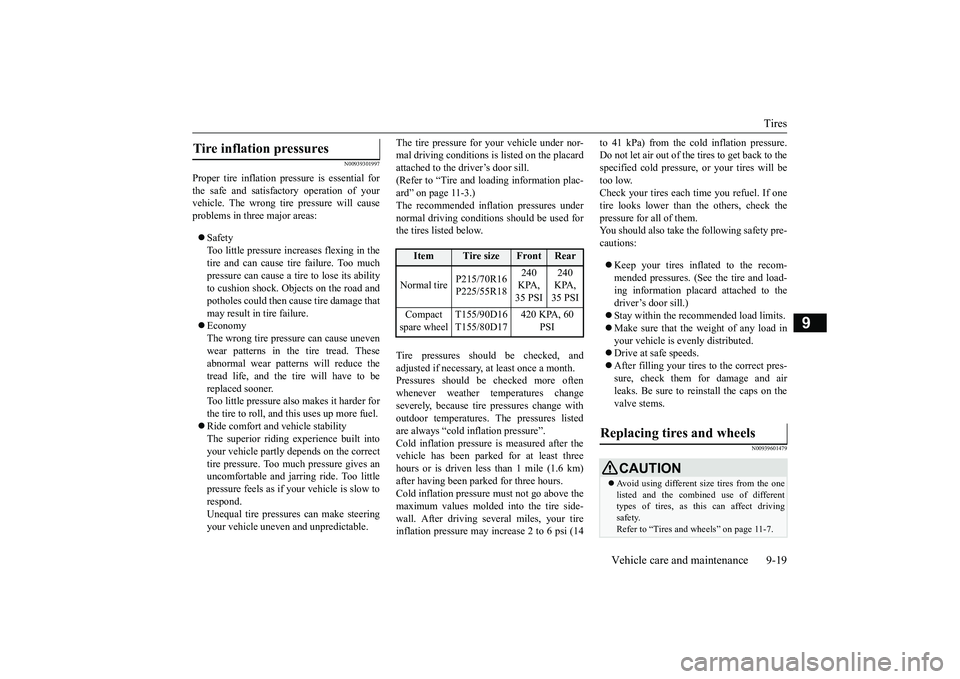
The tire pressure for your vehicle under nor-mal driving conditions is listed on the placardattached to the driver’s door sill.(Refer to “Tire and loading information plac-ard” on page 11-3.)The recommended inflation pressures undernormal driving conditions should be used forthe tires listed below.Tire pressures should be checked, andadjusted if necessary, at least once a month.Pressures should be checked more oftenwhenever weather temperatures changeseverely, becaus
e tire pressures change with
outdoor temperatures. The pressures listedare always “cold in
flation pressure”.
Cold inflation pressure is measured after thevehicle has been parked for at least threehours or is driven less than 1 mile (1.6 km)after having been parked for three hours.Cold inflation pressure must not go above themaximum values molded into the tire side-wall. After driving several miles, your tireinflation pressure may increase 2 to 6 psi (14
to 41 kPa) from the cold inflation pressure.Do not let air out of the tires to get back to thespecified cold pressure, or your tires will betoo low.Check your tires each t
ime you refuel. If one
tire looks lower than the others, check thepressure for all of them.You should also take the following safety pre-cautions:Keep your tires inflated to the recom-mended pressures. (See the tire and load-ing information placard attached to thedriver’s door sill.)Stay within the recommended load limits.Make sure that the weight of any load inyour vehicle is evenly distributed.Drive at safe speeds.After filling your tires to the correct pres-sure, check them for damage and airleaks. Be sure to reinstall the caps on thevalve stems.
N00939601479
Tire inflation pressures
Item
Tire size
Front
Rear
Normal tire
P215/70R16P225/55R18
240 KPA, 35 PSI
240 KPA, 35 PSI
Compact spare wheel
T155/90D16T155/80D17
420 KPA, 60
PSI
Replacing tires and wheels
CAUTIONAvoid using different size tires from the onelisted and the combined use of differenttypes of tires, as this can affect drivingsafety.Refer to “Tires and wheels” on page 11-7.
BK0249100US.book 19 ページ 2017年5月10日 水曜日 午前8時49分
Page 397 of 441
Tires9-20 Vehicle care and maintenance
9
N00939700141
The following maintenance steps are recom-mended:Check tire pressures regularly.Have regular maintenance done on thewheel balance and front and rear suspen-sion alignment.Rotate your tires regul
arly as described in
the “Tire rotation” section on page 9-20.
N00939800184
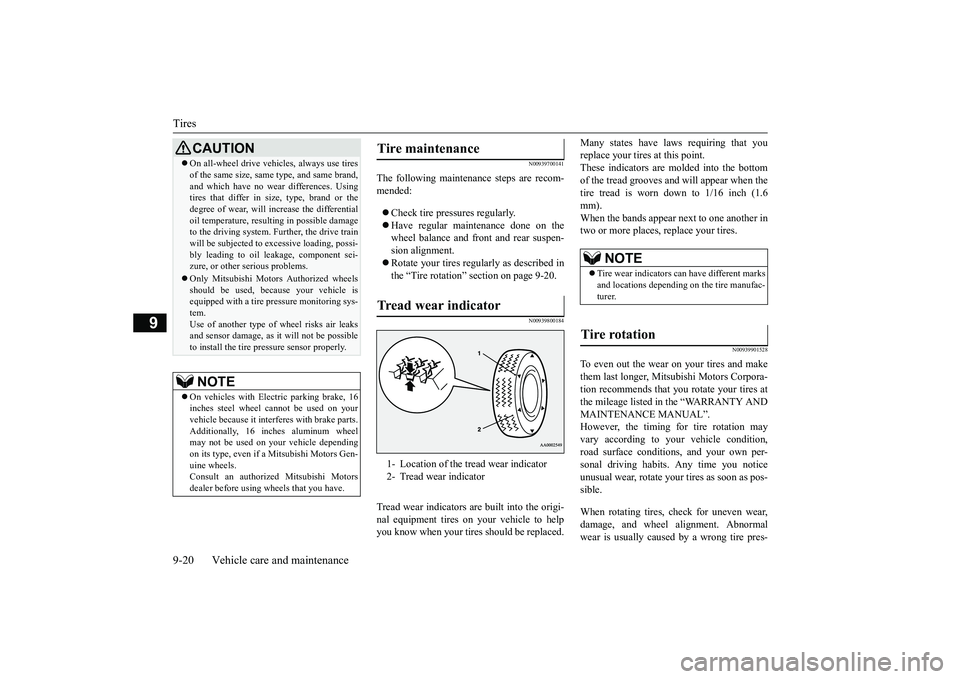
Tread wear indicators are built into the origi-nal equipment tires on
your vehicle to help
you know when your tires should be replaced.
Many states have la
ws requiring that you
replace your tires at this point.These indicators are molded into the bottomof the tread grooves and will appear when thetire tread is worn down to 1/16 inch (1.6mm).When the bands appear next to one another intwo or more places
, replace your tires.
N00939901528
To even out the wear on your tires and makethem last longer, Mitsubishi Motors Corpora-tion recommends that y
ou rotate your tires at
the mileage listed in the “WARRANTY ANDMAINTENANCE MANUAL”.However, the timing for tire rotation mayvary according to your vehicle condition,road surface conditions, and your own per-sonal driving habits. Any time you noticeunusual wear, rotate your tires as soon as pos-sible.When rotating tires,
check for uneven wear,
damage, and wheel alignment. Abnormalwear is usually caused by a wrong tire pres-
On all-wheel drive vehi
cles, always use tires
of the same size, same
type, and same brand,
and which have no wear differences. Usingtires that differ in si
ze, type, brand or the
degree of wear, will in
crease the differential
oil temperature, resul
ting in possible damage
to the driving system. Further, the drive trainwill be subjected to ex
cessive loading, possi-
bly leading to oil leakage, component sei-zure, or other serious problems.Only Mitsubishi Motors Authorized wheelsshould be used, beca
use your vehicle is
equipped with a tire pr
essure monitoring sys-
tem.Use of another type of
wheel risks air leaks
and sensor damage, as
it will not be possible
to install the tire pressure sensor properly.NOTE
On vehicles with Elec
tric parking brake, 16
inches steel wheel cannot be used on yourvehicle because it interfe
res with brake parts.
Additionally, 16 inches aluminum wheelmay not be used on your vehicle dependingon its type, even if a Mitsubishi Motors Gen-uine wheels.Consult an authorized Mitsubishi Motorsdealer before using
wheels that you have.
CAUTION
Tire maintenance Tread wear indicator 1- Location of the tread wear indicator2- Tread wear indicator
NOTE
Tire wear indicators ca
n have different marks
and locations depending
on the tire manufac-
turer.
Tire rotation
BK0249100US.book 20 ページ 2017年5月10日 水曜日 午前8時49分
Page 398 of 441
Tires
Vehicle care and maintenance 9-21
9
sure, wheels that are not aligned properly,wheels that are out-of-balance, or severebraking.Check with an authorized Mitsubishi Motorsdealer or a repair fac
ility of your choice to
find out the reason for uneven tread wear.The first tire rotation is the most importantone. It will allow all your tires to wear evenly.
N00940000320
In some areas of the country, snow tires arerequired for winter driving. If snow tires arerequired in your area, you must choose snowtires of the same size
and type as the original
tires provided with your
vehicle. Snow tires
should also be
installed on all four wheels.
Otherwise your safety
and vehicle handling
can be reduced.Even where laws may permit it, snow tiresshould not be operated
at sustained speeds
over 75 mph (120 km/h).
CAUTIONA compact spare tire can be installed tempo-rarily in place of a tir
e that has been removed
during the tire rotation. However, it must notbe included in the regular tire rotationsequence.
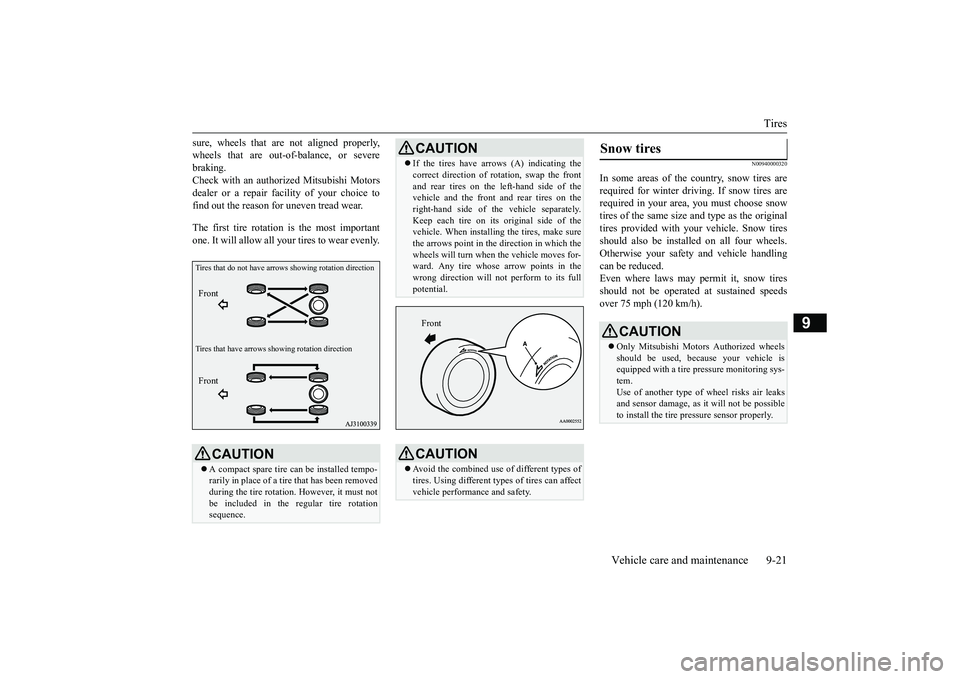
Tires that do not have arrows showing rotation directionTires that have arrows s
howing rotation direction
FrontFront
If the tires have arrows (A) indicating thecorrect direction of rotation, swap the frontand rear tires on the left-hand side of thevehicle and the front and rear tires on theright-hand side of th
e vehicle separately.
Keep each tire on its original side of thevehicle. When installing the tires, make surethe arrows point in the
direction in which the
wheels will turn when the vehicle moves for-ward. Any tire whose
arrow points in the
wrong direction will not
perform to its full
potential.CAUTIONAvoid the combined use of different types oftires. Using different t
ypes of tires can affect
vehicle performance and safety.CAUTIONFront
Snow tires
CAUTIONOnly Mitsubishi Motors Authorized wheelsshould be used, beca
use your vehicle is
equipped with a tire pr
essure monitoring sys-
tem.Use of another type of wheel risks air leaksand sensor damage, as it
will not be possible
to install the tire pressure sensor properly.
BK0249100US.book 21 ページ 2017年5月10日 水曜日 午前8時49分
Page 401 of 441
General maintenance9-24 Vehicle care and maintenance
9
high heat sources such
as the exhaust mani-
fold.
N00941400187
If the fuel-vapor vent line is clogged or dam-aged, the fuel-vapor mixture will escape, pol-luting the air.Have the system checked at an authorizedMitsubishi Motors dealer at the mileage spec-ified in the “WARRANTY AND MAINTE-NANCE MANUAL”.
N00941501299
The next pages list th
e maintenance service
recommended by Mitsubishi Motors Corpo-ration. In addition to the general maintenancethat needs to be performed at the times listed,
there are other parts which do not usuallyneed regular maintenance.But, if any of these parts stops working prop-erly, your vehicle performance could suffer.Have these items checked if you notice aproblem with them.If you have any questions, see your autho-rized Mitsubishi Motors
dealer for assistance.
N00941600059
Good brakes are essential for safe driving.Check the brake pads for wear. For goodbraking performance, replace the brake padswith the same type pa
ds as the originals.
N00941700076
Brake hoses and tubing should be checkedfor:Severe surface cracking, scuffing or wornspots. If the fabric casing of the hose isshowing through any cracks or worn spotsin the rubber hose cover, the hose shouldbe replaced. The brakes can fail if thehose wears through.Improper installati
on may cause twisting,
or wheel, tire or
chassis interference.
N00941800093
Check the following parts for damage andgrease leaks:Ball joint boots of the suspension andsteering linkageBellows on both ends of the drive shaft
N00942201118
The best way to keep carbon monoxide gasfrom entering inside your
vehicle is to have
the engine exhaust syst
em properly serviced.
Have a competent mechanic inspect the com-plete exhaust system
and nearby body areas
for broken, damaged, deteriorated, or mispo-sitioned parts if you no
tice any of the follow-
ing:A change in the sound of the exhaust sys-temThe smell of exhaust fumes inside thevehicle
WA R N I N GIf you see a fuel leak
or if you smell fuel,
do not run the engine. Any spark (includ-ing from the ignition
), flame or smoking
material could cause an explosion or fire.Call an authorized
Mitsubishi Motors
dealer or a repair fa
cility of your choice
for assistance.
Evaporative emission control system (except evaporative emission canister) General maintenance
Disc brake pads Brake hoses
Ball joint, steering linkage seals, drive shaft boots Exhaust system
WA R N I N GCarbon monoxide gas
from your vehicle’s
exhaust is poisonous. Breathing thesefumes can cause unconsciousness or death.
BK0249100US.book 24 ページ 2017年5月10日 水曜日 午前8時49分
Page 405 of 441
Fuses9-28 Vehicle care and maintenance
9
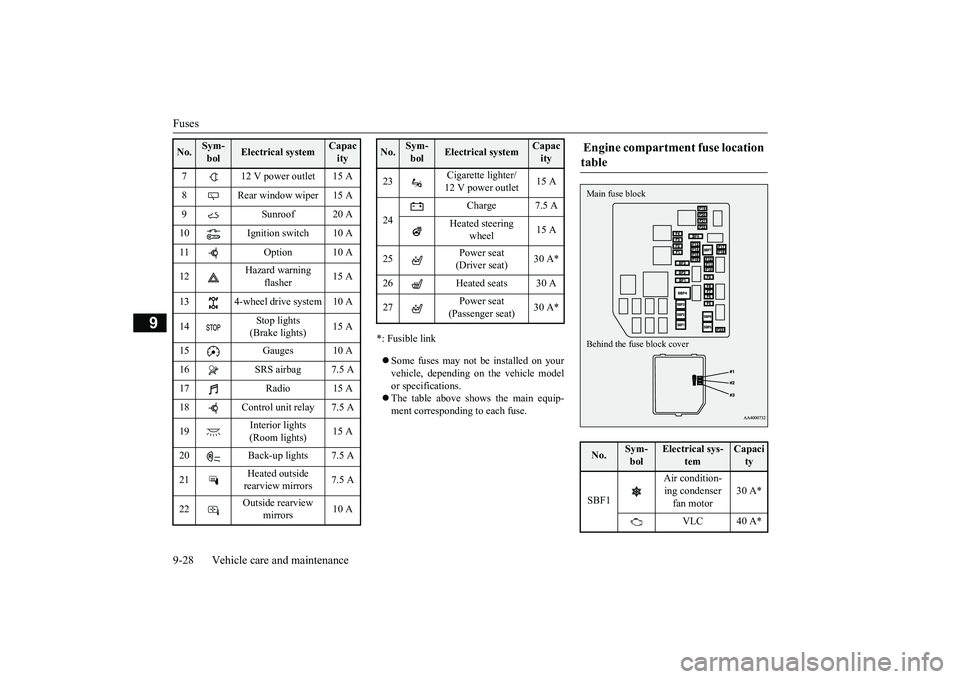
*: Fusible linkSome fuses may not be installed on yourvehicle, depending on
the vehicle model
or specifications.The table above show
s the main equip-
ment corresponding to each fuse.
7 12 V power outlet 15 A8 Rear window wiper 15 A9 Sunroof 20 A10 Ignition switch 10 A11 Option 10 A12
Hazard warning
flasher
15 A
13 4-wheel drive system 10 A14
Stop lights (Brake lights)
15 A
15 Gauges 10 A16 SRS airbag 7.5 A17 Radio 15 A18 Control unit relay 7.5 A19
Interior lights(Room lights)
15 A
20 Back-up lights 7.5 A21
Heated outside rearview mirrors
7.5 A
22
Outside rearview
mirrors
10 A
No.
Sym-bol
Electrical system
Capacity
23
Cigarette lighter/12 V power outlet
15 A
24
Charge 7.5 A
Heated steering
wheel
15 A
25
Power seat(Driver seat)
30 A*
26 Heated seats 30 A27
Power seat(Passenger seat)
No.
Sym-bol
Electrical system
Capacity
Engine compartment fuse location table No.
Sym-bol
Electrical sys-
tem
Capacity
SBF1
Air condition-ing condenser fan motor
30 A*
VLC 40 A*
Behind the fuse block coverMain fuse block
BK0249100US.book 28 ページ 2017年5月10日 水曜日 午前8時49分
Page 418 of 441
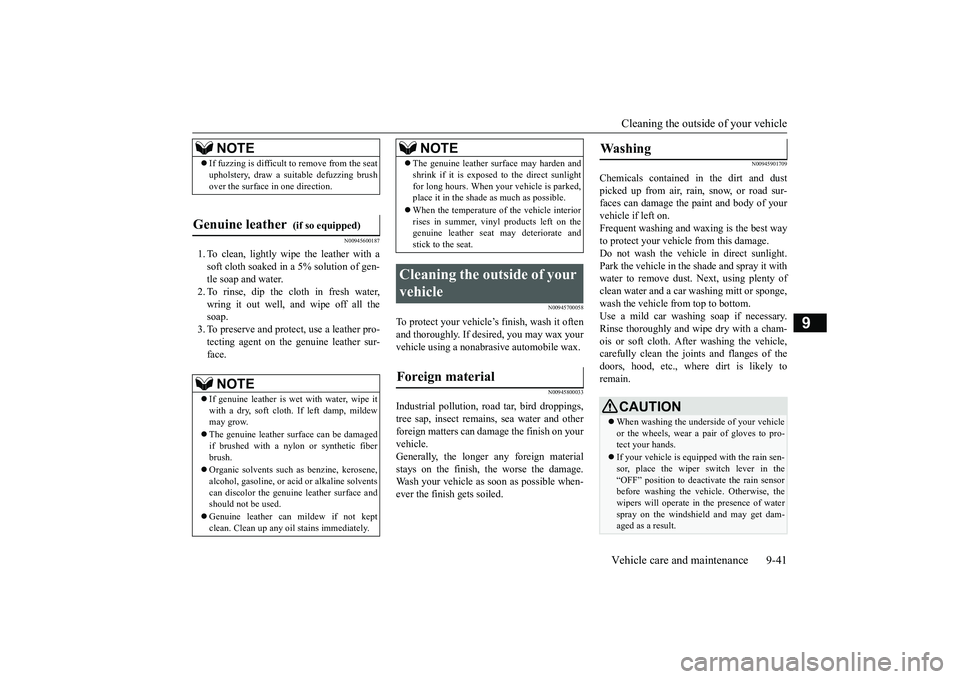
Cleaning the outside of your vehicleVehicle care and maintenance 9-41
9
N00945600187
1. To clean, lightly wi
pe the leather with a
soft cloth soaked in a 5% solution of gen-tle soap and water.2. To rinse, dip the cloth in fresh water,wring it out well, and wipe off all thesoap.3. To preserve and protect, use a leather pro-tecting agent on the genuine leather sur-face.
N00945700058
To protect your vehicle’s
finish, wash it often
and thoroughly. If desired, you may wax yourvehicle using a nonabrasive automobile wax.
N00945800033
Industrial pollution, road tar, bird droppings,tree sap, insect remain
s, sea water and other
foreign matters can damage the finish on yourvehicle.Generally, the longer any foreign materialstays on the finish, the worse the damage.Wash your vehicle as soon as possible when-ever the finish gets soiled.
N00945901709
Chemicals contained in the dirt and dustpicked up from air, rain, snow, or road sur-faces can damage the paint and body of yourvehicle if left on.Frequent washing and wa
xing is the best way
to protect your vehicle from this damage.Do not wash the vehicl
e in direct sunlight.
Park the vehicle in the shade and spray it withwater to remove dust.
Next, using plenty of
clean water and a car
washing mitt or sponge,
wash the vehicle from top to bottom.Use a mild car washing soap if necessary.Rinse thoroughly and wipe
dry with a cham-
ois or soft cloth. Af
ter washing the vehicle,
carefully clean the join
ts and flanges of the
doors, hood, etc., wher
e dirt is likely to
remain.
NOTE
If fuzzing is difficult to remove from the seatupholstery, draw a suitable defuzzing brushover the surface in
one direction.
Genuine leather
(if so equipped)
NOTE
If genuine leather is we
t with water, wipe it
with a dry, soft cloth. If left damp, mildewmay grow.The genuine leather su
rface can be damaged
if brushed with a nylon or synthetic fiberbrush.Organic solvents such as benzine, kerosene,alcohol, gasoline, or acid
or alkaline solvents
can discolor the genuine
leather surface and
should not be used.Genuine leather can
mildew if not kept
clean. Clean up any o
il stains immediately.
The genuine leather surface may harden andshrink if it is exposed to the direct sunlightfor long hours. When your vehicle is parked,place it in the shade as much as possible.When the temperature of the vehicle interiorrises in summer, vinyl products left on thegenuine leather seat
may deteriorate and
stick to the seat.
Cleaning the outside of your vehicle Foreign material
NOTE
Wa s h i n g
CAUTIONWhen washing the underside of your vehicleor the wheels, wear a pair of gloves to pro-tect your hands.If your vehicle is equipped with the rain sen-sor, place the wiper switch lever in the“OFF” position to
deactivate the rain sensor
before washing the vehi
cle. Otherwise, the
wipers will operate in
the presence of water
spray on the windshield and may get dam-aged as a result.
BK0249100US.book 41 ページ 2017年5月10日 水曜日 午前8時49分