heater MITSUBISHI OUTLANDER PHEV 2016 (in English) User Guide
[x] Cancel search | Manufacturer: MITSUBISHI, Model Year: 2016, Model line: OUTLANDER PHEV, Model: MITSUBISHI OUTLANDER PHEV 2016Pages: 490, PDF Size: 22.02 MB
Page 306 of 490
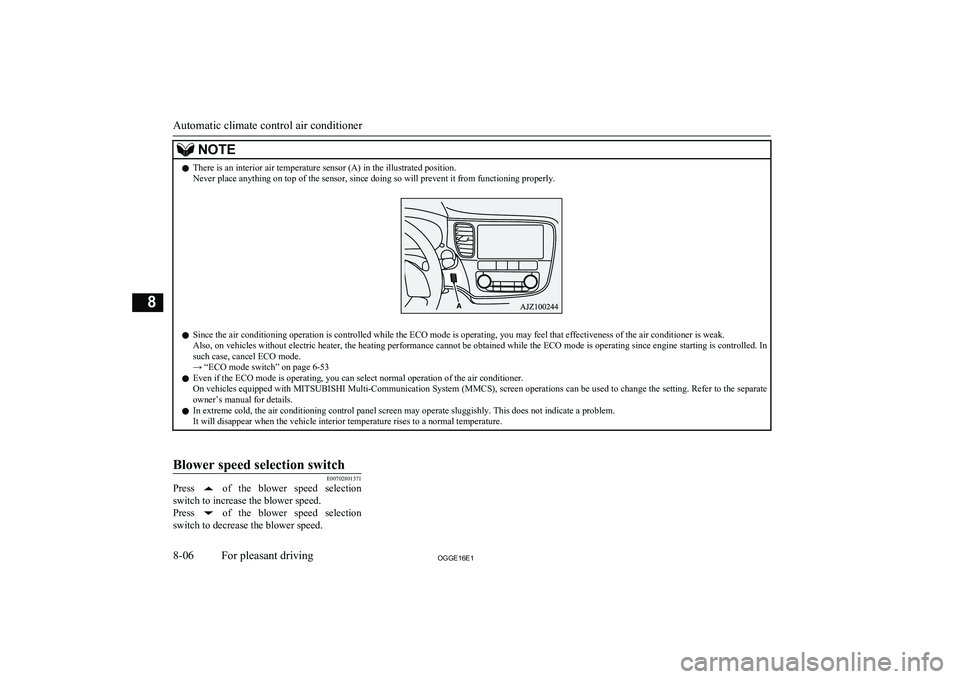
NOTElThere is an interior air temperature sensor (A) in the illustrated position.
Never place anything on top of the sensor, since doing so will prevent it from functioning properly.
l Since the air conditioning operation is controlled while the ECO mode is operating, you may feel that effectiveness of the air conditioner is weak.
Also, on vehicles without electric heater, the heating performance cannot be obtained while the ECO mode is operating since engine starting is controlled. In such case, cancel ECO mode.
→ “ECO mode switch” on page 6-53
l Even if the ECO mode is operating, you can select normal operation of the air conditioner.
On vehicles equipped with MITSUBISHI Multi-Communication System (MMCS), screen operations can be used to change the setting. Refer to the separate
owner’s manual for details.
l In extreme cold, the air conditioning control panel screen may operate sluggishly. This does not indicate a problem.
It will disappear when the vehicle interior temperature rises to a normal temperature.
Blower speed selection switch
E00702801371
Press of the blower speed selection
switch to increase the blower speed.
Press
of the blower speed selection
switch to decrease the blower speed.
Automatic climate control air conditioner
8-06OGGE16E1For pleasant driving8
Page 307 of 490
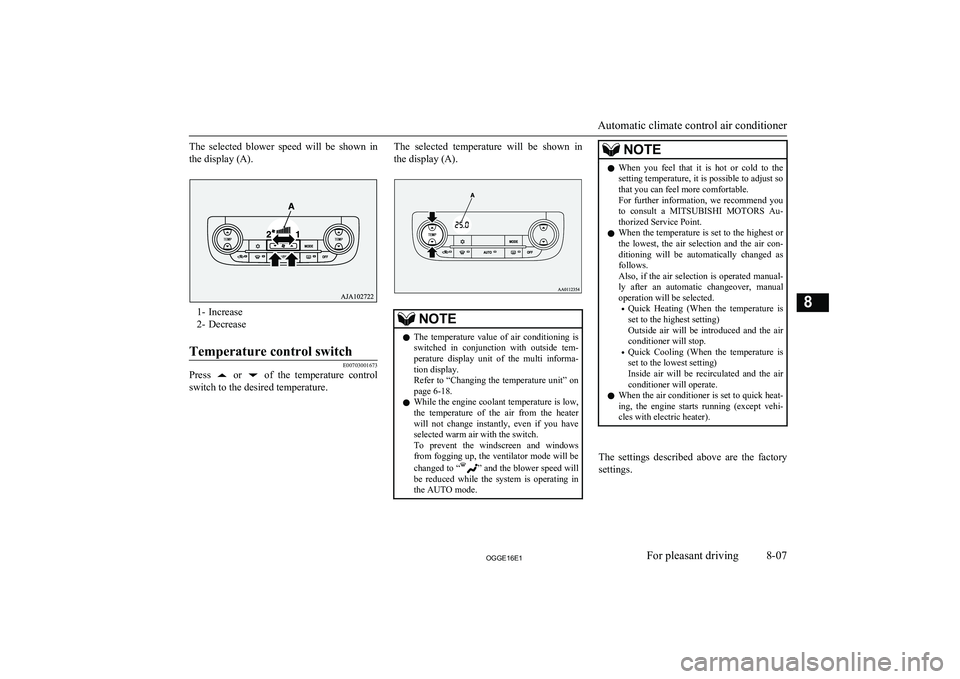
The selected blower speed will be shown inthe display (A).
1- Increase
2- Decrease
Temperature control switch
E00703001673
Press or of the temperature control
switch to the desired temperature.
The selected temperature will be shown in
the display (A).NOTEl The temperature value of air conditioning is
switched in conjunction with outside tem- perature display unit of the multi informa- tion display.
Refer to “Changing the temperature unit” on
page 6-18.
l While the engine coolant temperature is low,
the temperature of the air from the heaterwill not change instantly, even if you have selected warm air with the switch.
To prevent the windscreen and windows from fogging up, the ventilator mode will be
changed to “
” and the blower speed will
be reduced while the system is operating in the AUTO mode.
NOTEl When you feel that it is hot or cold to the
setting temperature, it is possible to adjust sothat you can feel more comfortable.
For further information, we recommend you
to consult a MITSUBISHI MOTORS Au-
thorized Service Point.
l When the temperature is set to the highest or
the lowest, the air selection and the air con- ditioning will be automatically changed as
follows.
Also, if the air selection is operated manual- ly after an automatic changeover, manualoperation will be selected.
• Quick Heating (When the temperature is
set to the highest setting)
Outside air will be introduced and the air conditioner will stop.
• Quick Cooling (When the temperature is
set to the lowest setting)
Inside air will be recirculated and the air
conditioner will operate.
l When the air conditioner is set to quick heat-
ing, the engine starts running (except vehi-
cles with electric heater).
The settings described above are the factory settings.
Automatic climate control air conditioner
8-07OGGE16E1For pleasant driving8
Page 311 of 490
MODE switch
E00703300031
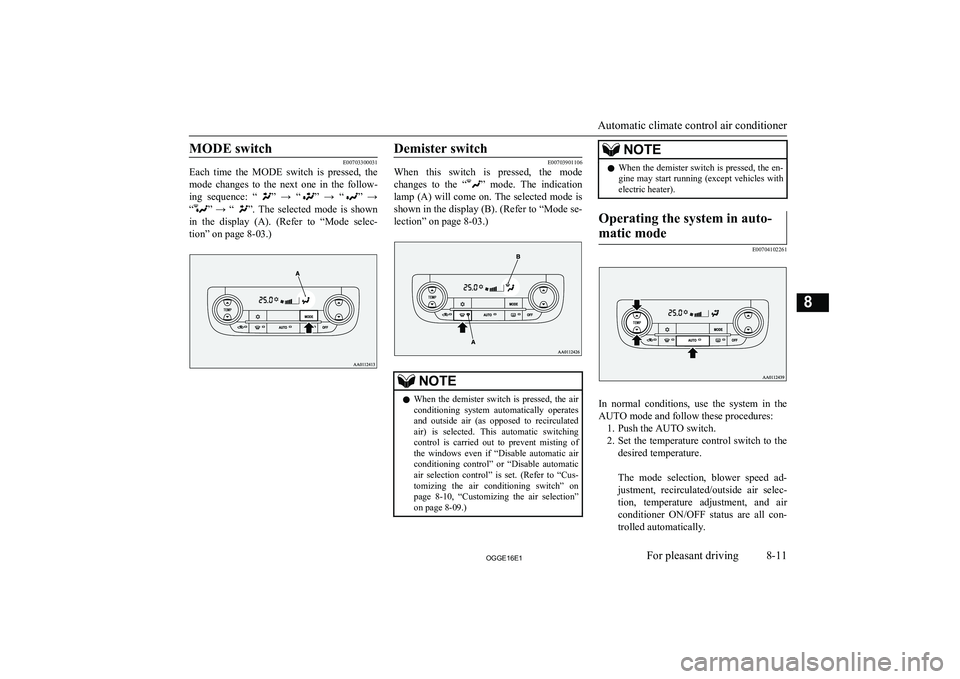
Each time the MODE switch is pressed, the
mode changes to the next one in the follow-
ing sequence: “
” → “” → “” →
“
” → “”. The selected mode is shown
in the display (A). (Refer to “Mode selec- tion” on page 8-03.)
Demister switch
E00703901106
When this switch is pressed, the mode
changes to the “
” mode. The indication
lamp (A) will come on. The selected mode is shown in the display (B). (Refer to “Mode se-lection” on page 8-03.)
NOTEl When the demister switch is pressed, the air
conditioning system automatically operates and outside air (as opposed to recirculated air) is selected. This automatic switching control is carried out to prevent misting of
the windows even if “Disable automatic air conditioning control” or “Disable automaticair selection control” is set. (Refer to “Cus-
tomizing the air conditioning switch” on page 8-10, “Customizing the air selection”
on page 8-09.)NOTEl When the demister switch is pressed, the en-
gine may start running (except vehicles with
electric heater).Operating the system in auto-
matic mode
E00704102261
In normal conditions, use the system in the
AUTO mode and follow these procedures: 1. Push the AUTO switch.
2. Set the temperature control switch to the
desired temperature.
The mode selection, blower speed ad- justment, recirculated/outside air selec-tion, temperature adjustment, and air
conditioner ON/OFF status are all con- trolled automatically.
Automatic climate control air conditioner
8-11OGGE16E1For pleasant driving8
Page 314 of 490
HeatingE00733901059
When heating, the engine starts running be-
cause the heating system uses the heat of en-
gine coolant.
On vehicles with electric heater, it can de-
crease the number of times engine starting because electrical power stored in the drive battery is also used when heating.LW/MW/FM radio/CD
player* E00708503387
The audio system can only be used when theoperation mode of the power switch is in ON
or ACC.
NOTEl To listen to the audio system while the Plug-
in Hybrid EV system is not operating, put the operation mode of the power switch in
ACC.
If the operation mode of the power switch is
left in ACC, the accessory power will auto- matically turn off after a certain period oftime and you will no longer be able to use
the audio system. The accessory power comes on again if the operation mode of the
power switch is operated with is in the ACC.
Refer to “ACC power auto-cutout function” on page 7-10.
l If a cellular phone is used inside the vehicle,
it may create noise from the audio equip-
ment. This does not mean that anything is wrong with your audio equipment. In such acase, use the cellular phone at a place as far
away as possible from the audio equipment.
l If foreign objects or water get into the audio
equipment, or if smoke or a strange odour comes from it, immediately turn off the au-
dio system. We recommend you to have it checked. Never try to repair it by yourself.
Avoid continuous usage without inspection
by a qualified person.Important Points on Usage
E00735500023
iPod/iPhone Playback Func- tion*
l This product supports audio playback
from iPod/iPhone devices, however dif-fering versions mean that playback can-
not be guaranteed.
l Please be aware that depending on the
iPod/iPhone model or version, operation
may differ.
How to Clean
E00735700025
l If the product becomes dirty, wipe with
a soft cloth.
l If very dirty, use a soft cloth dipped in
neutral detergent diluted in water, and then wrung out. Do not use benzene,
thinners, or other chemical wipes. This
may harm the surface.
Trademarks
E00735801238
l Product names and other proper names
are the trademarks or registered trade- marks of their respective owners.
l Furthermore, even if there is no specific
denotation of trademarks or registered
trademarks, these are to be observed in
their entirety.
Heating
8-14OGGE16E1For pleasant driving8
Page 318 of 490
Handling of DiscsE00735901040
This explains care that should be taken in the handling of discs.
Important Points on Handling
l Fingerprints or other marks on the read
surface of the disc may result in its con-
tent being more difficult to read. When
holding the disc, grip both edges, or one edge and the centre hole, in order that
the read surface is not touched.
l Do not affix paper or stickers, or other-
wise damage the disc.
l Do not forcefully insert a disc if another
is already within the device. This can re- sult in damage to discs, or malfunction.
Cleaning
l Periodically clean the read surface of the
disc. When cleaning, do not wipe in a
circular motion. Instead, wipe gently outwards from the centre of the disc to the outer edge.
l New discs may have burring around the
outer edge or in the hole in the centre.
Ensure you check for these. If there are burrs, these may lead to faulty operation,
therefore ensure these are removed.
Important Points on Storage
l When not using discs, ensure these are
kept in cases, and stored out of direct
sunlight.
l If discs are not going to be used for a
long period of time, remove these from
the product.
Disc Playback Environment
In cold environments such as in mid-winter when the interior of the vehicle is cold, turn-ing the heater on and immediately trying to
use the product may cause condensation (wa-
ter droplets) to form on the disc and internal optical components, and this may prevent the product from operating correctly.
In these conditions, remove the disc, and wait
a short time before use.
Copyright
Actions such as unauthorized reproduction,broadcast, public performance, or rental ofdiscs that comprise other than personal use
are prohibited by law.
Types of Disc That Can Be
Played Back
E00736001035
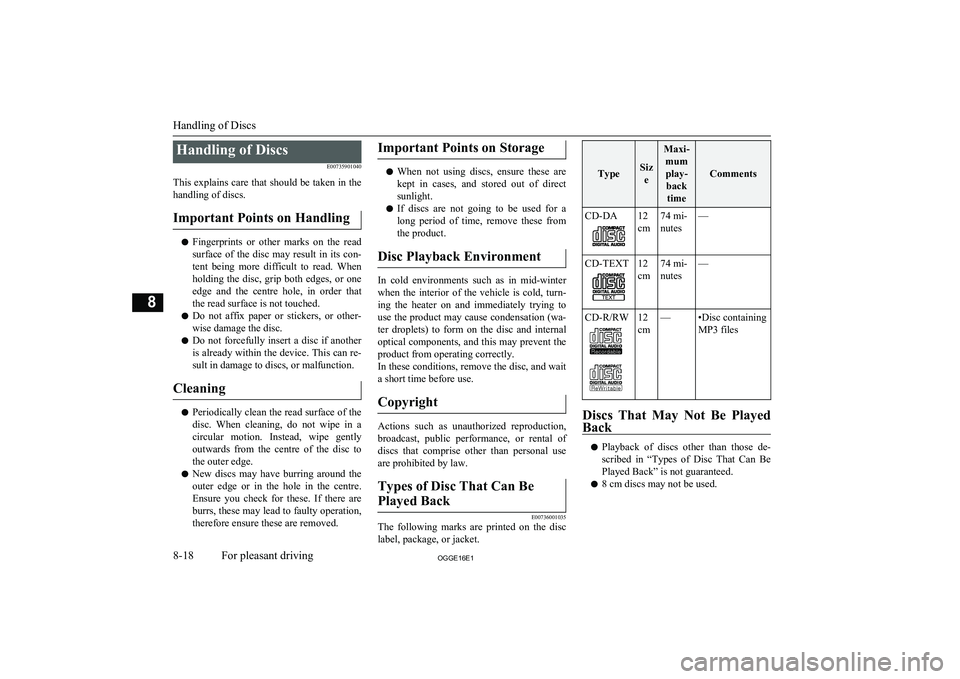
The following marks are printed on the disc label, package, or jacket.
TypeSiz e
Maxi-mumplay- back time
Comments
CD-DA12
cm74 mi-
nutes—CD-TEXT12
cm74 mi-
nutes—CD-R/RW12
cm—•Disc containing
MP3 files
Discs That May Not Be Played
Back
l Playback of discs other than those de-
scribed in “Types of Disc That Can Be
Played Back” is not guaranteed.
l 8 cm discs may not be used.
Handling of Discs
8-18OGGE16E1For pleasant driving8
Page 387 of 490
1.Get the vehicles close enough so the
jumper cables can reach, but be sure the vehicles aren’t touching each other.
2. Turn off all lamps, heater and other elec-
trical loads.
3. Set the parking brake firmly on each ve-
hicle. Set the gear of another vehicle in
“P” (PARK) position (with A/T) or in
“N” (Neutral) position (with M/T) and
stop the engine.WARNINGl When connecting the jumper cable, stop
the engine in the other vehicle. Otherwise, the cables or your clothes may be caught by the fan or drive belt and personal in-
jury could result.
l The cooling fan turns on and off depend-
ing on the coolant temperature. Do not bring your hands close to the fan while
the engine is running or the Plug-in Hy-
brid EV System is operating.
4. Open the bonnet, remove the fuse cover
of the main fuse block.
Refer to “Bonnet” on page 11-04 and
“Fuses: Engine compartment” on page
11-17.
5. Open the cover of the jumper cable ter-
minal in the main fuse block.
NOTEl You cannot rescue another vehicle’s dis-
charged battery by connecting jumper cables
while using this jumper cable terminal.
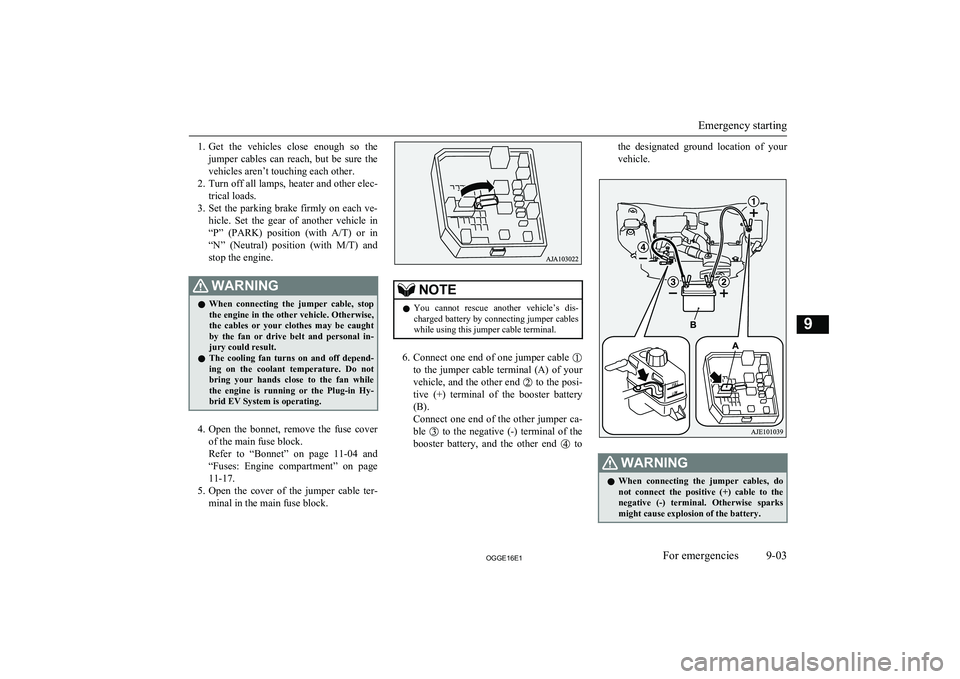
6. Connect one end of one jumper cable
to the jumper cable terminal (A) of your
vehicle, and the other end
to the posi-
tive (+) terminal of the booster battery (B).
Connect one end of the other jumper ca- ble
to the negative (-) terminal of the
booster battery, and the other end
to
the designated ground location of your
vehicle.WARNINGl When connecting the jumper cables, do
not connect the positive (+) cable to the
negative (-) terminal. Otherwise sparks
might cause explosion of the battery.
Emergency starting
9-03OGGE16E1For emergencies9
Page 410 of 490
Vehicle care precautionsE00900100548
In order to maintain the value of your vehi- cle, it is necessary to perform regular mainte- nance using the proper procedures.
Always maintain your vehicle in compliance
with environmental pollution control regula- tions.
Carefully select the materials used for wash- ing, etc., to be sure that they do not contain
corrosives.
If in doubt, we recommend you to consult a specialist for selection of these materials.CAUTIONl Cleaning products can be dangerous. Always
follow the instructions of the cleaning prod- uct supplier.
l To avoid damage, never use the following to
clean your vehicle,
• Petrol
• Paint Thinner
• Benzine
• Kerosene
• Turpentine
• Naphtha
• Lacquer Thinner
• Carbon Tetrachloride
• Nail Polish Remover
• AcetoneCleaning the interior of your
vehicle E00900200611
After cleaning the interior of your vehicle with water, cleaner or similar, wipe and dry
in a shady, well-ventilated area.NOTEl To clean the inside of the tailgate window,
always use a soft cloth and wipe the windowglass along the demister heater element so as
not to cause damage.CAUTIONl Do not use organic substances (solvents,
benzine, kerosene, alcohol, petrol, etc.) or alkaline or acidic solutions.
These chemicals can cause discolouring, staining or cracking of the surface.
If you use cleaners or polishing agents, make
sure their ingredients do not include the sub- stances mentioned above.Plastic, vinyl leather, fabric
and flocked parts
E00900301462
1. Lightly wipe these off with a soft cloth
soaked in a mild soap and water solu- tion.
2. Dip cloth in fresh water and wring it out
well. Using this cloth, wipe off the deter-
gent thoroughly.NOTEl Do not use cleaners, conditioners, and pro-
tectants containing silicons or wax.
Such products can cause discolouring and when applied to the instrument panels orother parts, may cause reflections on the windscreen and obscure vision.
Also, if such products get on the switches of
the electrical accessories, it may lead to fail-
ure of these accessories.
l Do not use synthetic fiber or dry cloth. They
can cause discolouring or damage the sur- face.
l Do not place a deodorizer on the instrument
panel or near lamps and instruments. The in-gredients for deodorizer can cause discolour-
ing or cracking.Upholstery
E00900500207
1. To maintain the value of your new vehi-
cle, handle the upholstery carefully and
keep the interior clean.
Use a vacuum cleaner and brush to clean
the seats. If stained, vinyl and synthetic leather should be cleaned with an appro- priate cleaner. Cloth fabrics can be cleaned with either upholstery cleaner or
a mild soap and water solution.
Vehicle care precautions
10-02OGGE16E1Vehicle care10
Page 414 of 490
NOTElTo clean the inside of the rear window, al-
ways use a soft cloth and wipe the window
glass along the demister heater element so as not to cause damage.Wiper blades
E00901701144
Use a soft cloth and glass cleaner to remove
grease, dead insects, etc., from the wiper blades. Replace the wiper blades when they
no longer wipe properly. (Refer to page 11-13.)
Cleaning the sunroof*
E00902200051
Use a soft cloth to clean the inner side of thesunroof. Hard deposits should be wiped away with a cloth dipped in warm, neutral deter- gent solution. Wipe away the solution with a
sponge dipped in fresh water.
NOTEl The surface treatment on the inside of the
glass may be removed if hard cloth or organ-
ic solvent (benzine, kerosene, thinner, etc.) is used.Engine compartment
E00902100308
Clean the engine compartment at the begin-
ning and end of winter. Pay particular atten- tion to flanges, crevices and peripheral parts where dust containing road chemicals and
other corrosive materials might collect.
If salt and other chemicals are used on the roads in your area, clean the engine compart- ment at least every three months.
Never spray or splash water on the electrical
components in the engine compartment, as
this may cause damage.
Do not bring the nearby parts, the plastic parts and so on into contact with sulphuric
acid (battery electrolyte) which may crack,
stain or discolour them.
If they are in contact, wipe off with soft cloth, chamois or the like and an aqueous sol-
ution of neutral detergent then immediately rinse the affected parts with plenty of water.
Cleaning the exterior of your vehicle
10-06OGGE16E1Vehicle care10
Page 421 of 490
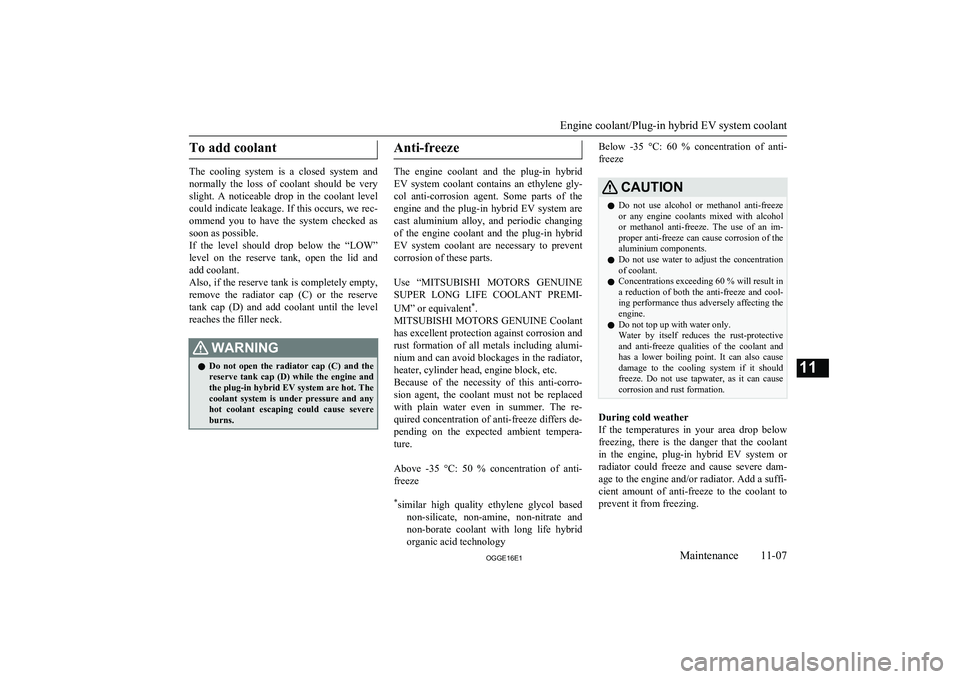
To add coolant
The cooling system is a closed system andnormally the loss of coolant should be very
slight. A noticeable drop in the coolant level
could indicate leakage. If this occurs, we rec- ommend you to have the system checked as
soon as possible.
If the level should drop below the “LOW” level on the reserve tank, open the lid and
add coolant.
Also, if the reserve tank is completely empty, remove the radiator cap (C) or the reservetank cap (D) and add coolant until the level reaches the filler neck.
WARNINGl Do not open the radiator cap (C) and the
reserve tank cap (D) while the engine andthe plug-in hybrid EV system are hot. The
coolant system is under pressure and any hot coolant escaping could cause severe burns.Anti-freeze
The engine coolant and the plug-in hybrid
EV system coolant contains an ethylene gly-col anti-corrosion agent. Some parts of the
engine and the plug-in hybrid EV system are
cast aluminium alloy, and periodic changing of the engine coolant and the plug-in hybridEV system coolant are necessary to prevent
corrosion of these parts.
Use “ MITSUBISHI MOTORS GENUINE
SUPER LONG LIFE COOLANT PREMI-
UM” or equivalent *
.
MITSUBISHI MOTORS GENUINE Coolant
has excellent protection against corrosion and rust formation of all metals including alumi-
nium and can avoid blockages in the radiator,
heater, cylinder head, engine block, etc.
Because of the necessity of this anti-corro- sion agent, the coolant must not be replaced
with plain water even in summer. The re-
quired concentration of anti-freeze differs de- pending on the expected ambient tempera-
ture.
Above -35 °C: 50 % concentration of anti- freeze
* similar high quality ethylene glycol based
non-silicate, non-amine, non-nitrate andnon-borate coolant with long life hybrid
organic acid technologyBelow -35 °C: 60 % concentration of anti-
freezeCAUTIONl Do not use alcohol or methanol anti-freeze
or any engine coolants mixed with alcohol or methanol anti-freeze. The use of an im-
proper anti-freeze can cause corrosion of the aluminium components.
l Do not use water to adjust the concentration
of coolant.
l Concentrations exceeding 60 % will result in
a reduction of both the anti-freeze and cool-
ing performance thus adversely affecting the engine.
l Do not top up with water only.
Water by itself reduces the rust-protective
and anti-freeze qualities of the coolant and has a lower boiling point. It can also causedamage to the cooling system if it should freeze. Do not use tapwater, as it can causecorrosion and rust formation.
During cold weather
If the temperatures in your area drop below
freezing, there is the danger that the coolant
in the engine, plug-in hybrid EV system or radiator could freeze and cause severe dam-age to the engine and/or radiator. Add a suffi-
cient amount of anti-freeze to the coolant to prevent it from freezing.
Engine coolant/Plug-in hybrid EV system coolant
11-07OGGE16E1Maintenance11
Page 432 of 490
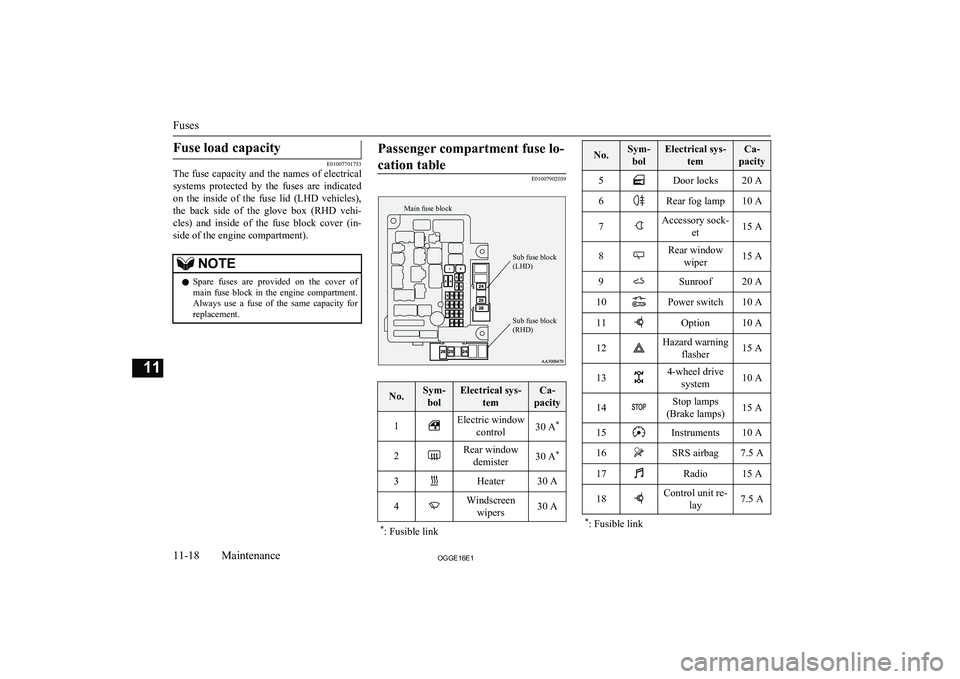
Fuse load capacity
E01007701753
The fuse capacity and the names of electrical
systems protected by the fuses are indicated
on the inside of the fuse lid (LHD vehicles), the back side of the glove box (RHD vehi-cles) and inside of the fuse block cover (in-
side of the engine compartment).
NOTEl Spare fuses are provided on the cover of
main fuse block in the engine compartment.
Always use a fuse of the same capacity for replacement.Passenger compartment fuse lo-
cation table
E01007902039
Main fuse blockSub fuse block
(LHD)Sub fuse block
(RHD)
No.Sym-
bolElectrical sys- temCa-
pacity1Electric window control30 A *2Rear window
demister30 A *3Heater30 A4Windscreen
wipers30 A*: Fusible linkNo.Sym-
bolElectrical sys- temCa-
pacity5Door locks20 A6Rear fog lamp10 A7Accessory sock- et15 A8Rear windowwiper15 A9Sunroof20 A10Power switch10 A11Option10 A12Hazard warning flasher15 A134-wheel drivesystem10 A14Stop lamps
(Brake lamps)15 A15Instruments10 A16SRS airbag7.5 A17Radio15 A18Control unit re- lay7.5 A*: Fusible link
Fuses
11-18OGGE16E1Maintenance11