belt MITSUBISHI OUTLANDER PHEV 2017 (in English) Workshop Manual
[x] Cancel search | Manufacturer: MITSUBISHI, Model Year: 2017, Model line: OUTLANDER PHEV, Model: MITSUBISHI OUTLANDER PHEV 2017Pages: 548, PDF Size: 25.5 MB
Page 251 of 548
CAUTIONlEffectiveness of the regenerative brake be-
comes weak when the drive battery is close
to full charge and loses its effect at the full
charge.
In this case, since the foot brake is effective,
use the foot brake and slow down your vehi-
cle speed beforehand.
The energy usage indicator stops swaying in the charge zone closer to full charge.
Refer to “Energy usage indicator” on page 6-02
In such case, drive at low speed in advance.
And if needed use the foot brake to slow
down the vehicle speed before the vehicle speed increases.
The regenerative brake comes to be effective if the drive battery remaining power is con-
sumed.
Brake pad
l Avoid hard braking situations.
New brakes need to be broken-in by
moderate use for the first 200 km
(124 miles).
l The disc brakes are provided with a
warning device which emits a shrieking
metallic sound while braking if the brake pads have reached their wear limit. Ifyou hear this sound, have the brake padsreplaced immediately.
WARNINGl Driving with worn brake pads will make
it harder to stop, and can cause an acci-
dent.Brake auto hold
E00652000051
When the vehicle is stopped at traffic signalsetc., the vehicle can be held stationary with
the brake auto hold system even if you re-
lease your foot from the brake pedal. When the accelerator pedal is depressed, the brakes are released.
WARNINGl Do not overly rely on the brake auto hold
system. On a steep slope, depress the brake pedal firmly because the systemmay not hold the vehicle stationary.
l Never leave the vehicle while it is being
stopped by the brake auto hold system.
When leaving the vehicle, apply the park- ing brake and put the select position to
the “P” (PARK) position.
l Do not use the brake auto hold system
when driving on slippery roads. The sys- tem may not hold the vehicle stationary
and an accident could occur.NOTEl While operating the brake auto hold system,
you may hear an operation noise to increasebraking force when the system detected the
movement of the vehicle. This does not indi- cate a malfunction.
How to use brake auto hold
To turn on brake auto hold
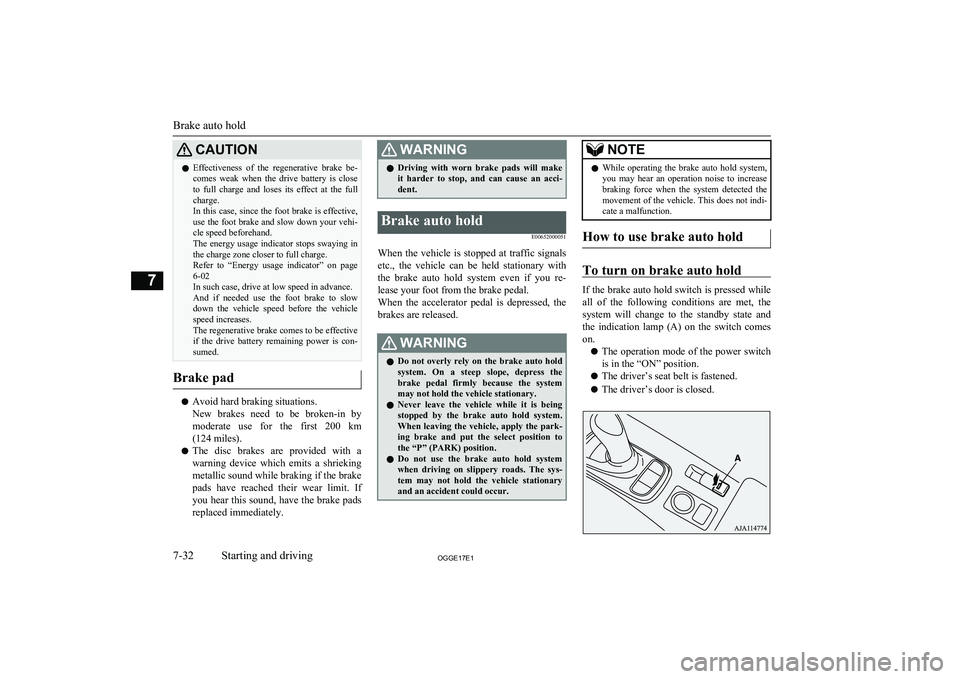
If the brake auto hold switch is pressed while
all of the following conditions are met, the system will change to the standby state and
the indication lamp (A) on the switch comes on.
l The operation mode of the power switch
is in the “ON” position.
l The driver’s seat belt is fastened.
l The driver’s door is closed.
Brake auto hold
7-32OGGE17E1Starting and driving7
Page 252 of 548
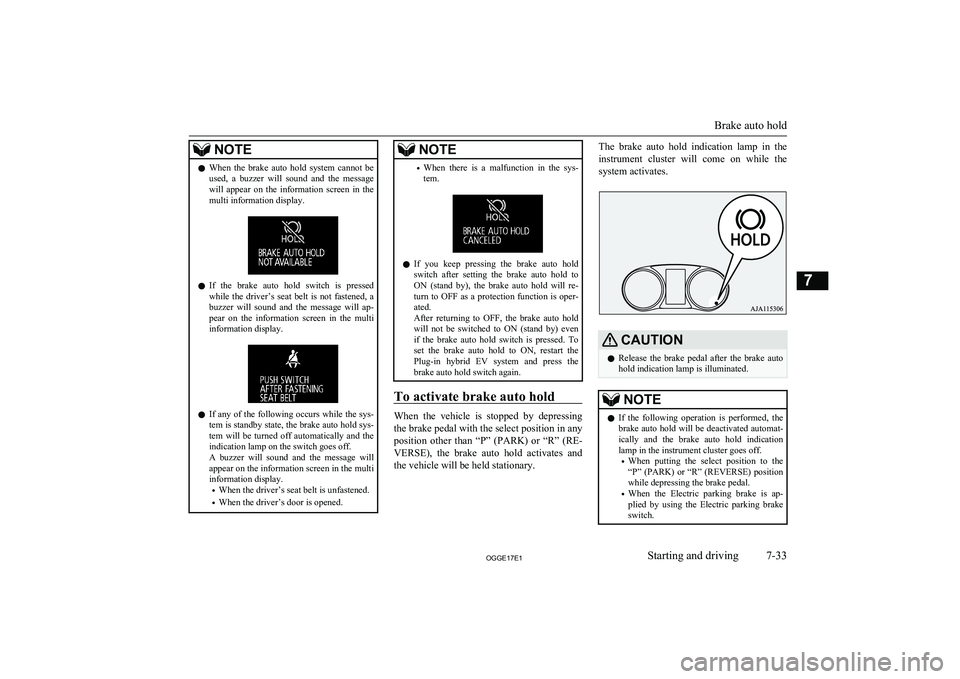
NOTElWhen the brake auto hold system cannot be
used, a buzzer will sound and the message will appear on the information screen in the
multi information display.
l If the brake auto hold switch is pressed
while the driver’s seat belt is not fastened, a buzzer will sound and the message will ap-
pear on the information screen in the multi
information display.
l If any of the following occurs while the sys-
tem is standby state, the brake auto hold sys-
tem will be turned off automatically and the indication lamp on the switch goes off.
A buzzer will sound and the message will
appear on the information screen in the multi information display.
• When the driver’s seat belt is unfastened.
• When the driver’s door is opened.
NOTE•When there is a malfunction in the sys-
tem.
l If you keep pressing the brake auto hold
switch after setting the brake auto hold toON (stand by), the brake auto hold will re-
turn to OFF as a protection function is oper- ated.
After returning to OFF, the brake auto hold will not be switched to ON (stand by) even
if the brake auto hold switch is pressed. To set the brake auto hold to ON, restart the
Plug-in hybrid EV system and press the
brake auto hold switch again.
To activate brake auto hold
When the vehicle is stopped by depressing
the brake pedal with the select position in any
position other than “P” (PARK) or “R” (RE-
VERSE), the brake auto hold activates and
the vehicle will be held stationary.
The brake auto hold indication lamp in the
instrument cluster will come on while the
system activates.CAUTIONl Release the brake pedal after the brake auto
hold indication lamp is illuminated.NOTEl If the following operation is performed, the
brake auto hold will be deactivated automat- ically and the brake auto hold indicationlamp in the instrument cluster goes off.
• When putting the select position to the
“P” (PARK) or “R” (REVERSE) position while depressing the brake pedal.
• When the Electric parking brake is ap-
plied by using the Electric parking brake switch.
Brake auto hold
7-33OGGE17E1Starting and driving7
Page 253 of 548
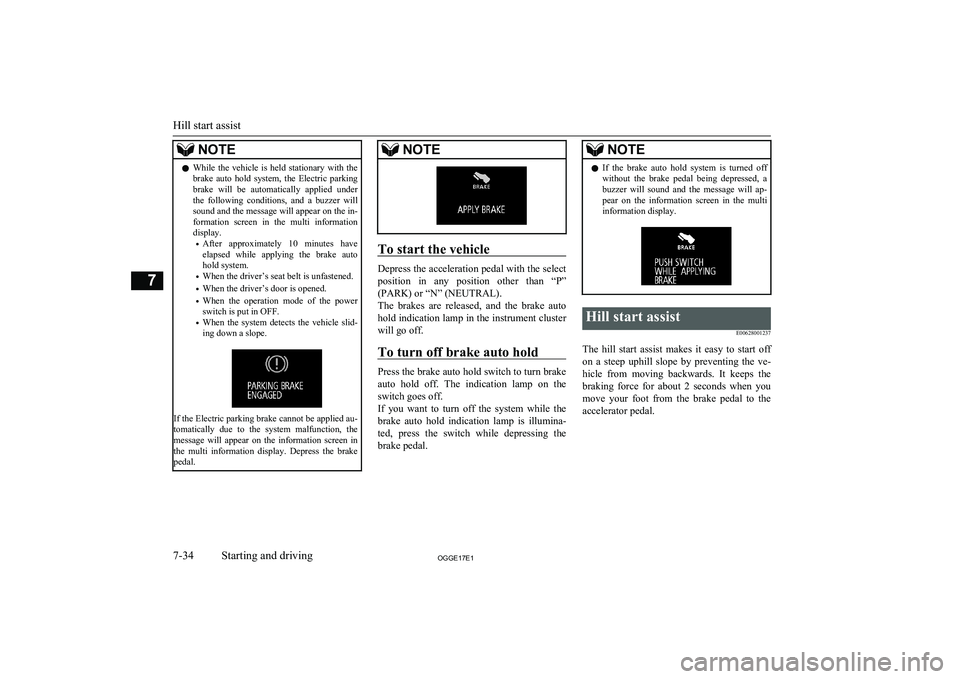
NOTElWhile the vehicle is held stationary with the
brake auto hold system, the Electric parking brake will be automatically applied under
the following conditions, and a buzzer will sound and the message will appear on the in-
formation screen in the multi information display.
• After approximately 10 minutes have
elapsed while applying the brake auto
hold system.
• When the driver’s seat belt is unfastened.
• When the driver’s door is opened.
• When the operation mode of the power
switch is put in OFF.
• When the system detects the vehicle slid-
ing down a slope.
If the Electric parking brake cannot be applied au- tomatically due to the system malfunction, the
message will appear on the information screen in
the multi information display. Depress the brake pedal.
NOTE
To start the vehicle
Depress the acceleration pedal with the select
position in any position other than “P” (PARK) or “N” (NEUTRAL).
The brakes are released, and the brake auto hold indication lamp in the instrument cluster
will go off.
To turn off brake auto hold
Press the brake auto hold switch to turn brake
auto hold off. The indication lamp on the switch goes off.
If you want to turn off the system while the brake auto hold indication lamp is illumina-
ted, press the switch while depressing the brake pedal.
NOTEl If the brake auto hold system is turned off
without the brake pedal being depressed, abuzzer will sound and the message will ap-
pear on the information screen in the multi
information display.Hill start assist
E00628001237
The hill start assist makes it easy to start offon a steep uphill slope by preventing the ve-
hicle from moving backwards. It keeps the
braking force for about 2 seconds when you move your foot from the brake pedal to the
accelerator pedal.
Hill start assist
7-34OGGE17E1Starting and driving7
Page 336 of 548
12583 mm
Operating hints
lBe sure that the driving speed does not
exceed 100 km/h (62 mph) for trailer op-
eration. It is also recommended that you obey the local regulations in case driving speed with a trailer is limited to less than
100 km/h (62 mph).
l To prevent shocks from the overrun
brake, depress the brake pedal lightly at first and then more strongly.
Overheating
This will normally occur as a result of some
mechanical failure. If your vehicle should overheat, stop and check for a loose or bro-ken water pump/alternator drive belt, a
blocked radiator air intake or a low coolant level. If these items are satisfactory the over-
heating could be caused by a number of me-
chanical causes that would have to be
checked at a competent service centre.
CAUTIONl If the engine overheats, reference should be
made to “Engine overheating” section of
“For emergencies” prior to taking any cor- rective action.Parking
It is not recommended to park on a steep
slope while towing trailer.
If parking on a steep slope cannot be avoided,
the road grade should be less than 12% and
the following procedure performed. 1. Apply the parking brake firmly on the
vehicle and the trailer (if fitted).
2. Put the select position in “P”.
3. Place chocks or blocks at the tyres on
both vehicle and trailer.
4. Turn the front wheels into the shoulder
of the road to prevent the vehicle from moving.
Driving on long up hills while towing trailer
When the remaining quantity of the drive bat-tery is low, or high-speed driving on long up
hills at high temperature, the drive battery
output is restricted and the vehicle speed may be decreased.
The vehicle speed may be recovered if the
drive battery quantity is recovered.
NOTEl In charge mode, if the remaining quantity of
the drive battery can be increased in ad-
vance, it can prevent the vehicle speed from
decreasing on long up hills.
Refer to “Battery charge mode switch” on page 7-28.
Trailer towing
7-117OGGE17E1Starting and driving7
Page 433 of 548

NOTElIf the auxiliary battery is disconnected, the
operation mode of the power switch is mem-
orized. When a booster battery is connected
by jumper cables, the operation mode re- turns to the state it had before the auxiliary
battery ran down.
Pay due attention if you do not know the op- eration mode before the auxiliary battery
was fully discharged.
l If the auxiliary battery is fully discharged
with the select position in the “P” (PARK)
position, the select position cannot be changed to other position from the “P”
(PARK) position in some cases. In such a case, the front wheels have been locked.
Therefore, the vehicle cannot be moved.
1. Get the vehicles close enough so the
jumper cables can reach, but be sure the vehicles aren’t touching each other.
2. Turn off all lamps, heater and other elec-
trical loads.
3. Set the parking brake firmly on each ve-
hicle. Set the gear of the other vehicle in
“P” (PARK) position (with A/T) or in
“N” (Neutral) position (with M/T) and
stop the engine.
WARNINGl When connecting the jumper cable, stop
the engine in the other vehicle. Otherwise,
the cables or your clothes may be caught by the fan or drive belt and personal in-jury could result.
l The cooling fan turns on and off depend-
ing on the coolant temperature. Do not bring your hands close to the fan while
the engine is running or the Plug-in Hy- brid EV System is operating.
4. Open the bonnet, remove the fuse cover
of the main fuse block.
Refer to “Bonnet” on page 11-04 and
“Fuses: Engine compartment” on page
11-17.
5. Open the cover of the jumper cable ter-
minal in the main fuse block.
NOTEl You cannot rescue another vehicle’s dis-
charged battery by connecting jumper cables
while using this jumper cable terminal.
6. Connect one end of one jumper cable
to the jumper cable terminal (A) of your
vehicle, and the other end
to the posi-
tive (+) terminal of the booster battery (B).
Connect one end of the other jumper ca- ble
to the negative (-) terminal of the
booster battery, and the other end
to
Emergency starting
9-08OGGE17E1For emergencies9
Page 436 of 548

4.Check the coolant level in the reserve
tank (B and C).
B: Reserve tank for engine cooling
C: Reserve tank for EV cooling system
5. Add coolant to the radiator and/or re-
serve tank if necessary. (Refer to the
“Maintenance” section.)
WARNINGl Make sure that the engine and the Plug-in
Hybrid EV system have cooled down be- fore removing the radiator cap (D) and
the reserve tank cap (E), because hot steam or boiling water will otherwise gush from the filler port and may scald you.CAUTIONl Do not add coolant while the engine is hot.
Suddenly adding cold coolant could damage the engine. Wait for the engine to cool
down, then add coolant a little at a time.
6. Examine the radiator hoses for coolant
leakage and the drive belt for looseness
or damage.
If there is anything wrong with the cool-
ing system or drive belt, we recommend
you to have it checked and repaired.
Tools and jack
E00800902507
Storage
The tools are stowed on the right side of the
luggage area.
The jack is stowed in the luggage floor box.
The storage location of the tools and jack
should be remembered in case of an emer-
gency.
1- Tools
2- Jack
Tools and jack
9-11OGGE17E1For emergencies9FullFull
Low Low
Page 462 of 548
WARNINGlIf it is necessary to do work in the engine
compartment with the plug-in hybrid EV
system starting, be especially careful that
your clothing, hair, etc., does not become caught by the cooling fans, drive belts, orother moving parts.
l After performing the maintenance, make
sure that no tools or cloths are left behind in the engine compartment. If they are left
behind, a fire or damage to the vehicle
may occur.
l The cooling fans can turn on automatical-
ly even if the plug-in hybrid EV system is
stopping. Put the operation mode of the
power switch in OFF to be safe while you work in the engine compartment.
l Make sure that the engine and Plug-in
Hybrid EV system has cooled down be- fore removing the radiator cap and EV cooling system reserve tank cap, because
hot steam or boiling water will otherwise
gush from the filler port and may scald you.
l Do not smoke, cause sparks or allow open
flames around fuel or auxiliary battery.
The fumes are flammable.
l Be extremely cautious when working
around the auxiliary battery. It contains
poisonous and corrosive sulphuric acid.
l Do not get under your vehicle with just
the body jack supporting it. Always use
automotive jack stands.WARNINGl Improper handling of components and
materials used in the vehicle can endangeryour personal safety. We recommend you to consult a specialist for necessary infor- mation.
l The components inside the engine room
might be very hot to the touch.
To avoid being burnt, make sure all com- ponents have sufficiently cooled before beginning an inspection. These compo-
nents are affixed with the label indicating precautions for handling. Follow the in-
structions on the label.
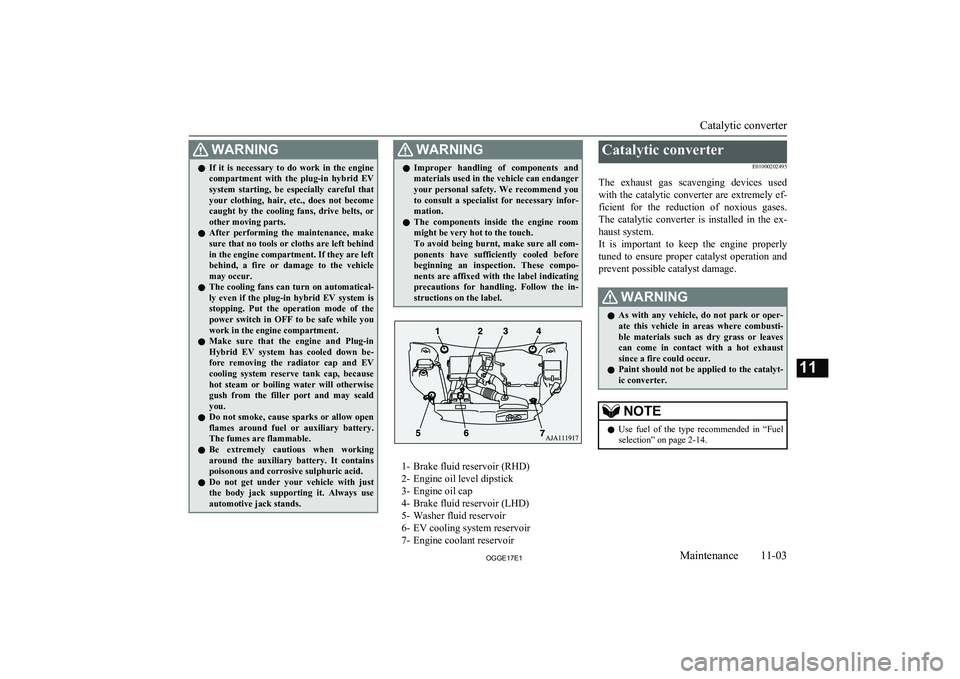
1- Brake fluid reservoir (RHD)
2- Engine oil level dipstick
3- Engine oil cap
4- Brake fluid reservoir (LHD)
5- Washer fluid reservoir
6- EV cooling system reservoir
7- Engine coolant reservoir
Catalytic converter
E01000202495
The exhaust gas scavenging devices used with the catalytic converter are extremely ef- ficient for the reduction of noxious gases.
The catalytic converter is installed in the ex- haust system.
It is important to keep the engine properly
tuned to ensure proper catalyst operation and prevent possible catalyst damage.WARNINGl As with any vehicle, do not park or oper-
ate this vehicle in areas where combusti- ble materials such as dry grass or leaves
can come in contact with a hot exhaust
since a fire could occur.
l Paint should not be applied to the catalyt-
ic converter.NOTEl Use fuel of the type recommended in
“Fuel
selection” on page 2-14.
Catalytic converter
11-03OGGE17E1Maintenance11
Page 507 of 548
Bulb capacity.............................................. 11-24
Power switch..................................................... 7-12
Precautions to observe when using wipers and washers.......................................... 6-68
Pregnant women restraint.................................. 5-15
Pretensioner....................................................... 5-15
Puncture Tyre repair kit............................................... 9-12
Q
Quick charging (charging methodwith quick charger).......................................... 3-16
R
Ready indicator................................................. 6-49
Rear combination lamps Bulb capacity.............................................. 11-24
Replacement................................................ 11-29
Rear Cross Traffic Alert.................................... 7-83
Rear fog lamp Bulb capacity.............................................. 11-24
Replacement................................................ 11-29
Switch........................................................... 6-63
Rear Motor coolant..........................................12-10
Rear room lamp................................................. 8-79 Bulb capacity.............................................. 11-25
Rear turn-signal lamps
Bulb capacity.............................................. 11-24
Replacement..................................... 11-27,11-29
Rear window demister switch........................... 6-69
Rear-view camera............................................7-102
Rear-view mirror
Inside............................................................. 7-07
Outside.......................................................... 7-09
Refill capacities............................................... 12-10
Regenerative braking level selector (paddle).... 7-19
Replacement of lamp bulbs............................. 11-23
Reversing lamp
Bulb capacity.............................................. 11-24
Replacement................................................ 11-29
Reversing sensor system................................... 7-94
Roof carrier precaution....................................7-115
Room lamp........................................................ 8-79
S
S-AWC (Super-All Wheel Control).................. 7-21
Safe driving techniques..................................... 7-02
Safety and disposal information for used engine oil................................................. 2-18
Seat belt Adjustable seat belt anchor........................... 5-12
Child restraint................................................5-16
Force limiter.................................................. 5-15
Inspection...................................................... 5-26
Pregnant women restraint............................. 5-15
Pretensioner...................................................5-15
Seat belt reminder..............................................5-11
Seat belts........................................................... 5-09
Seat Adjustment.................................................... 5-02
Front seats..................................................... 5-03
Head restraints.............................................. 5-05
Heated seats.................................................. 5-04
Making a flat seat.......................................... 5-08
Making a luggage area.................................. 5-07
Rear seat........................................................ 5-05
Security alarm system....................................... 4-27
Select position indicator.................................... 7-18
Selector lever (Joystick type)............................ 7-16
Service precaution........................................... 11-02
Side turn-signal lamps Bulb capacity.............................................. 11-24
Snow traction device (tyre chains).................. 11-13
Snow tyres....................................................... 11-12
Spark plug....................................................... 12-08
Specifications.................................................. 12-02
Speed Limiter.................................................... 7-47
Starting and stopping the Plug-in Hy- brid EV System................................................ 7-14
Steering Steering wheel height adjustment................. 7-07
Stop lamps
Bulb capacity.............................................. 11-24
Storage spaces................................................... 8-81
Sun visors.......................................................... 8-73
Sunglasses holder.............................................. 8-83
Sunroof.............................................................. 4-36
Super-All Wheel Control (S-AWC).................. 7-21
Supplemental restraint system...........................5-27
Caution for installing the child re-straint on vehicles with a front
passenger airbag.......................................... 5-16
Caution for installing the child re- straint on vehicles with front pas-
senger’s airbag............................................. 5-29
Servicing....................................................... 5-38
System check screen..........................................6-13
Alphabetical index
13- 4 OGGE17E1Alphabetical index