wipers MITSUBISHI OUTLANDER PHEV 2018 (in English) User Guide
[x] Cancel search | Manufacturer: MITSUBISHI, Model Year: 2018, Model line: OUTLANDER PHEV, Model: MITSUBISHI OUTLANDER PHEV 2018Pages: 538, PDF Size: 25.01 MB
Page 211 of 538
NOTElIf the operation mode is in ON or ACC and
the headlamps are on, the headlamp washer operates together with the windscreen wash-
er the first time the windscreen washer lever is pulled.Precautions to observe when
using wipers and washers
E00507601327
l If the moving wipers become blocked
partway through a sweep by ice or other deposits on the glass, the wipers maytemporarily stop operating to prevent the
motor from overheating. In this case,
park the vehicle in a safe place, put the operation mode in OFF, and then re-
move the ice or other deposits.
The wipers will start operating again af- ter the wiper motor cools down, so
check that the wipers operate before us- ing them.
l Do not use the wipers when the glass is
dry.
They may scratch the glass surface and the blades wear out prematurely.
l Before using the wipers in cold weather,
check that the wiper blades are not fro-
zen onto the glass. The motor may burn out if the wipers are used with the blades
frozen onto the glass.
l Avoid using the washer continuously for
more than 20 seconds. Do not operate the washer when the fluid reservoir isempty.
Otherwise, the motor may burn out.
l Periodically check the level of washer
fluid in the reservoir and refill if re- quired.
During cold weather, add a recommen- ded washer solution that will not freeze
in the washer reservoir. Failure to do so
could result in loss of washer function and frost damage to the system compo- nents.Wiper de-icer switch*
E00507701142
The rear window demister switch can be op-erated when the Plug-in Hybrid EV System is
operating.
When the front wipers have frozen to the
windscreen at the parked positions, turning
on this switch will heat the windscreen to
make the wipers operable. Press the rear win- dow demister switch and the deicer will oper-
ate.
NOTEl The wiper de-icer is activated/deactivated,
depending on the operation of the rear win-
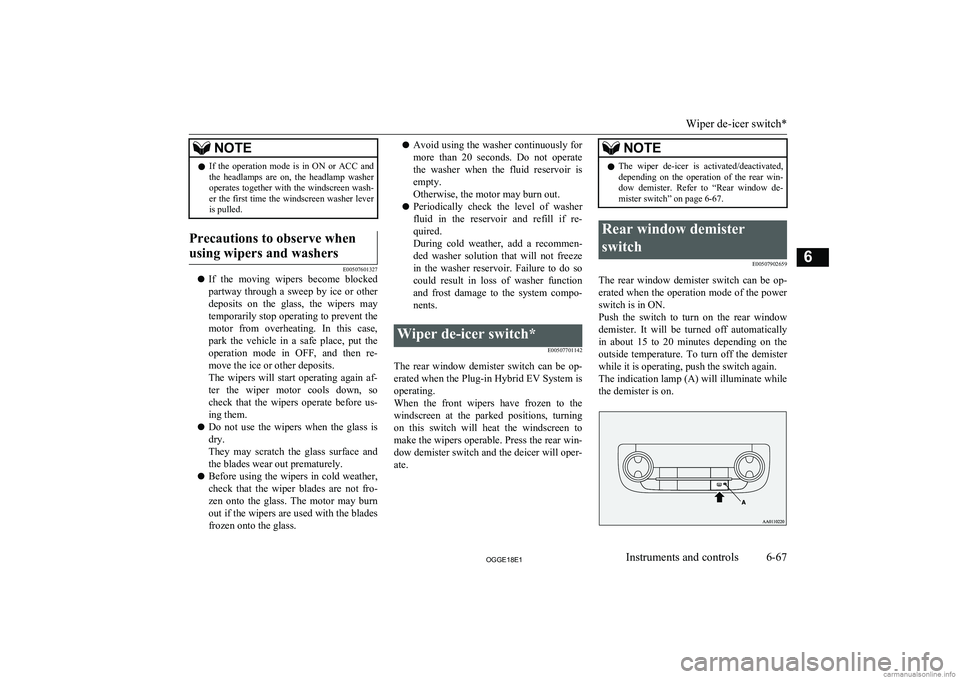
dow demister. Refer to “Rear window de- mister switch” on page 6-67.Rear window demister
switch E00507902659
The rear window demister switch can be op-erated when the operation mode of the power
switch is in ON.
Push the switch to turn on the rear window
demister. It will be turned off automatically
in about 15 to 20 minutes depending on the outside temperature. To turn off the demister
while it is operating, push the switch again. The indication lamp (A) will illuminate while the demister is on.
Wiper de-icer switch*
6-67OGGE18E1Instruments and controls6
Page 212 of 538
NOTElDo not use this switch when the ready indi-
cation lamp is not illuminated. The auxiliary battery could go flat, making it impossible to
start the Plug-in Hybrid EV System.
l Since the demister requires a significant
amount of power, stop the demister as soonas the window is demisted. Using it for along time may reduce the auxiliary battery
voltage, making it impossible to start the
Plug-in Hybrid EV System.
l When the rear window demister switch is
pressed, the outside rear-view mirrors are
defogged or defrosted. Refer to “Heated mir-
ror” on page 7-11.
l On vehicles equipped with the wiper de-icer,
when the rear window demister switch is pushed, the window glass becomes warm
and the wipers become operable. Refer to “Wiper de-icer switch” on page 6-67.NOTEl It is possible to change the setting to make
the rear window demister operate automati-
cally when ambient temperature becomes
low while the ready indication lamp is illu- minated, even if you do not push the rear
window demister switch.
It operates automatically only once after put-
ting the operation mode in ON.
If you choose this setting, the heated mirrors (if so equipped) and wiper de-icer (if so
equipped) will also operate automatically at the same time.
For further information, we recommend you
to consult a MITSUBISHI MOTORS Au-
thorized Service Point.
On vehicles equipped with the Smartphone
Link Display Audio or the MITSUBISHI
Multi-Communication System (MMCS), screen operations can be used to make the
adjustment. Refer to the separate owner’s
manual for details.
l The demister switch is not to melt snow but
to clear mist. Remove snow before use of the demister switch.
l When cleaning the inside of the rear win-
dow, use a soft cloth and wipe gently along
the heater wires, being careful not to damage the wires.
l Do not allow objects to touch the inside of
the rear window glass, damaged or broken wires may result.Heated windscreen switch*
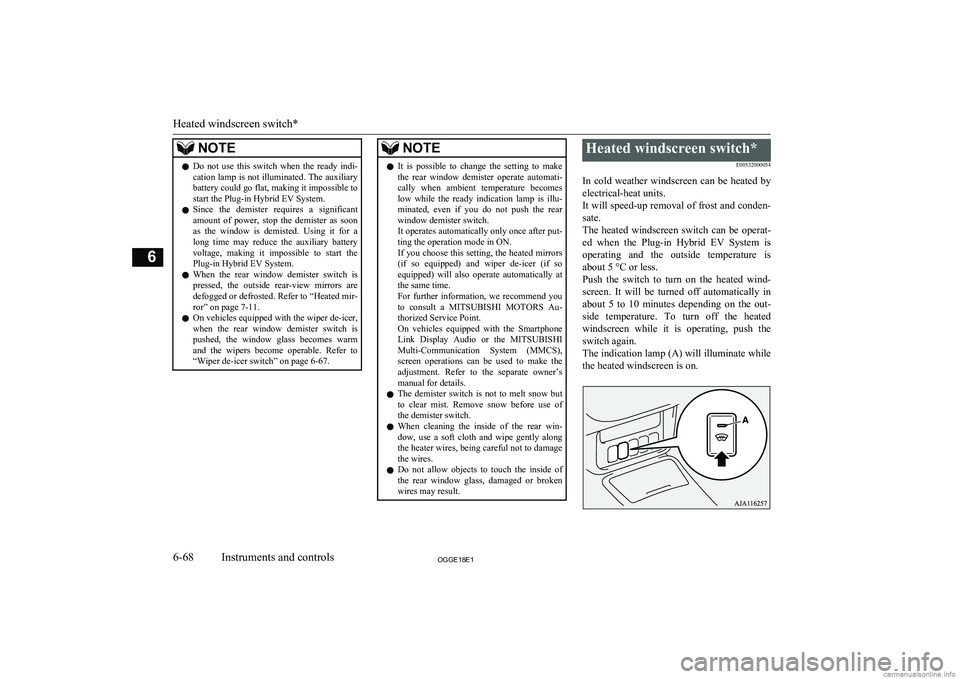
E00532000054
In cold weather windscreen can be heated by
electrical-heat units.
It will speed-up removal of frost and conden- sate.
The heated windscreen switch can be operat- ed when the Plug-in Hybrid EV System is operating and the outside temperature is
about 5 °C or less.
Push the switch to turn on the heated wind- screen. It will be turned off automatically in
about 5 to 10 minutes depending on the out- side temperature. To turn off the heatedwindscreen while it is operating, push the
switch again.
The indication lamp (A) will illuminate while the heated windscreen is on.
Heated windscreen switch*
6-68OGGE18E1Instruments and controls6
Page 281 of 538
CAUTION•When a road surface is surging, and there
is unevenness.
• When driving in dark areas, such as in a
tunnel or at night.
• When your vehicle changed lanes, and
your vehicle approached immediately be-
hind the vehicle in front.
• During a certain time after your vehicle
turns left or right.
• When you are carrying extremely heavy
loads in the rear seats or luggage area.
• After the Plug-in Hybrid EV System has
been running for an extended period of time.
• When using a windscreen washer.
• If windscreen wipers are not
MITSUBISHI MOTORS GENUINE
parts or equivalent.
• When the sensor becomes extremely hot
or cold.
• If the auxiliary battery becomes weak or
runs down.
• When the sensor is affected by strong
light, such as direct sunlight or the head-lamps of an oncoming vehicle.
• Under adverse weather conditions (rain,
snow, sand storms, etc.)
• When the windscreen of the sensor por-
tion is covered with dirt, water droplets,
snow and ice, etc.
• When water, snow or sand on the road are
extorted by the vehicle in front or an on- coming vehicle.CAUTIONl The FCM may not detect a pedestrian in cer-
tain situations. Some of these include:
• It the pedestrian is shorter than approxi-
mately 1 m or taller than approximately 2 m.
• If the pedestrian is wearing loose-fitting
clothes.
• If part of a pedestrian’s body is hidden,
such as when holding an umbrella, large
bag, etc.
• If a pedestrian bends forward, sits or lies
on the road.
• When a pedestrian is pushing/pulling
something, such as a stroller, bicycle or
wheelchair.
• When pedestrians gather in a group.
• When a pedestrian’s clothing appears to
be nearly the same colour or brightness as
its surroundings.
• When a pedestrian is very close to an ob-
ject, such as a vehicle.
• When a pedestrian is in a dark area, such
as at night or in a tunnel.
• When the pedestrian is walking fast or
running.
• When a pedestrian suddenly rushes in
front of the vehicle.
• When the position of a pedestrian is close
to the edge of the vehicle.CAUTIONl Factors such as the positional relationship
between your vehicle and a vehicle in front, driver’s own technique of steering the vehi-
cle and irregularly moving traffic due to ac-
cidents or vehicle trouble may deter the
FCM control and alarm from functioning.
l When the system recognizes driver’s steer-
ing or accelerating actions as evasive actions
to avoid collision, the FCM control and alarm functions may be cancelled.
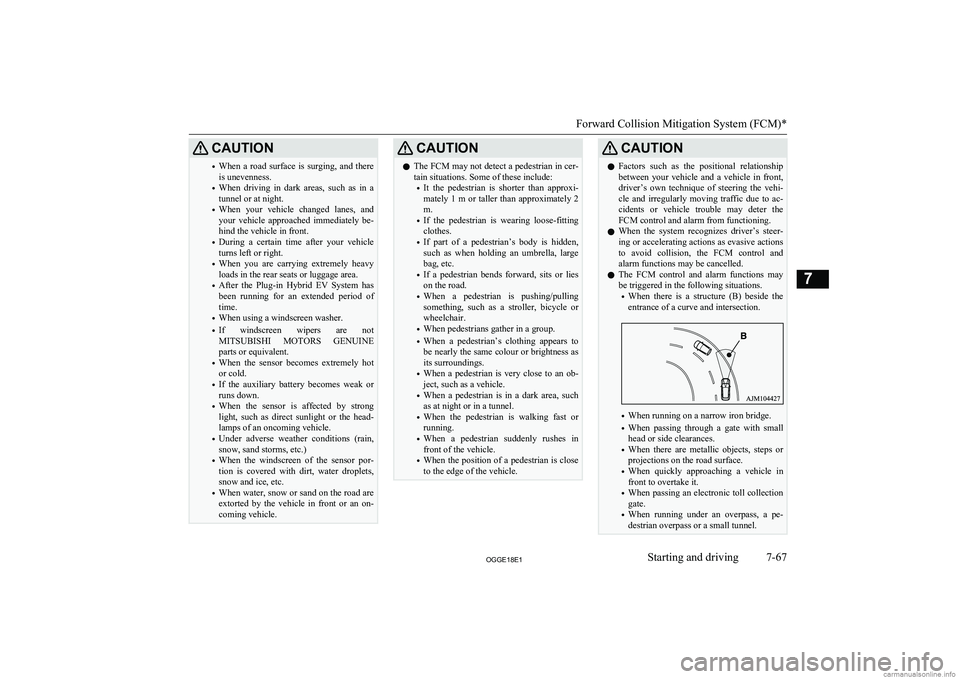
l The FCM control and alarm functions may
be triggered in the following situations.
• When there is a structure (B) beside the
entrance of a curve and intersection.
• When running on a narrow iron bridge.
• When passing through a gate with small
head or side clearances.
• When there are metallic objects, steps or
projections on the road surface.
• When quickly approaching a vehicle in
front to overtake it.
• When passing an electronic toll collection
gate.
• When running under an overpass, a pe-
destrian overpass or a small tunnel.
Forward Collision Mitigation System (FCM)*
7-67OGGE18E1Starting and driving7
Page 303 of 538
CAUTION•When driving on a slippery road covered
by rain water, snow, ice, etc.
• When passing through a place where the
brightness suddenly changes, like the inlet or outlet of a tunnel.
• When turning steep curves.
• When the road surface is reflecting the
light shining from the direction opposite
to the running direction.
• Vehicle largely lurches when it is running
over steps or other irregularities of the
road surface.
• When the headlamp illumination is inade-
quate because of contaminated or deterio-
rated lenses or improperly aimed head- lamps.
• When the vehicle is leaning much to one
side due to heavy luggage on it or improp-
erly adjusted tyre pressures.
• When oncoming vehicles’ headlamps
shine the sensor.
• When the vehicle is equipped with non-
standard tyres (including excessively worn tyres), is using a snow traction de-
vice (tyre chains), or has non-specified
components such as a modified suspen- sion.
• When the windscreen is covered with wa-
ter droplets, snow, dust, etc.
l Follow the instructions given below to keep
your LDW in good operating conditions.
• Always keep the windscreen clean.CAUTION•Avoid applying a strong shock or pressure
to the sensor. Do not attempt to detach or disassemble it.
• Do not put anything like a sticker on the
area in front of the sensor lens of the windscreen.
• Use only
MITSUBISHI MOTORS GEN-
UINE Parts when replacing the wind-
screen wipers.Tyre pressure monitoring
system (TPMS) E00637100282
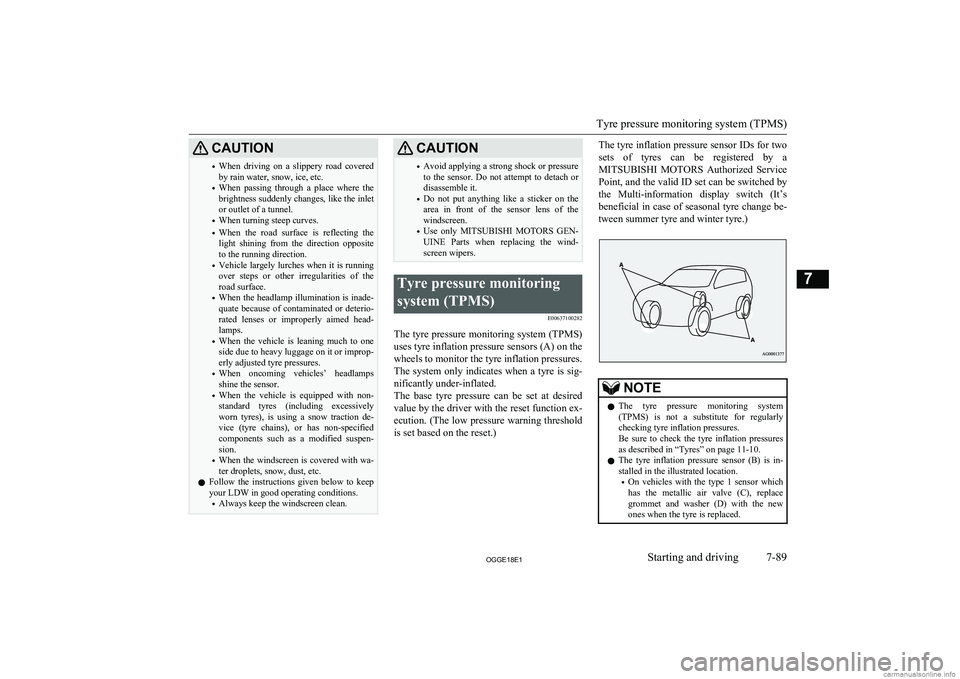
The tyre pressure monitoring system (TPMS)
uses tyre inflation pressure sensors (A) on the wheels to monitor the tyre inflation pressures.
The system only indicates when a tyre is sig-
nificantly under-inflated.
The base tyre pressure can be set at desired value by the driver with the reset function ex-
ecution. (The low pressure warning threshold is set based on the reset.)
The tyre inflation pressure sensor IDs for two
sets of tyres can be registered by aMITSUBISHI MOTORS Authorized Service
Point, and the valid ID set can be switched by the Multi-information display switch (It’s
beneficial in case of seasonal tyre change be-
tween summer tyre and winter tyre.)NOTEl The tyre pressure monitoring system
(TPMS) is not a substitute for regularlychecking tyre inflation pressures.
Be sure to check the tyre inflation pressures as described in “Tyres” on page 11-10.
l The tyre inflation pressure sensor (B) is in-
stalled in the illustrated location.
• On vehicles with the type 1 sensor which
has the metallic air valve (C), replace
grommet and washer (D) with the new ones when the tyre is replaced.
Tyre pressure monitoring system (TPMS)
7-89OGGE18E1Starting and driving7
Page 444 of 538
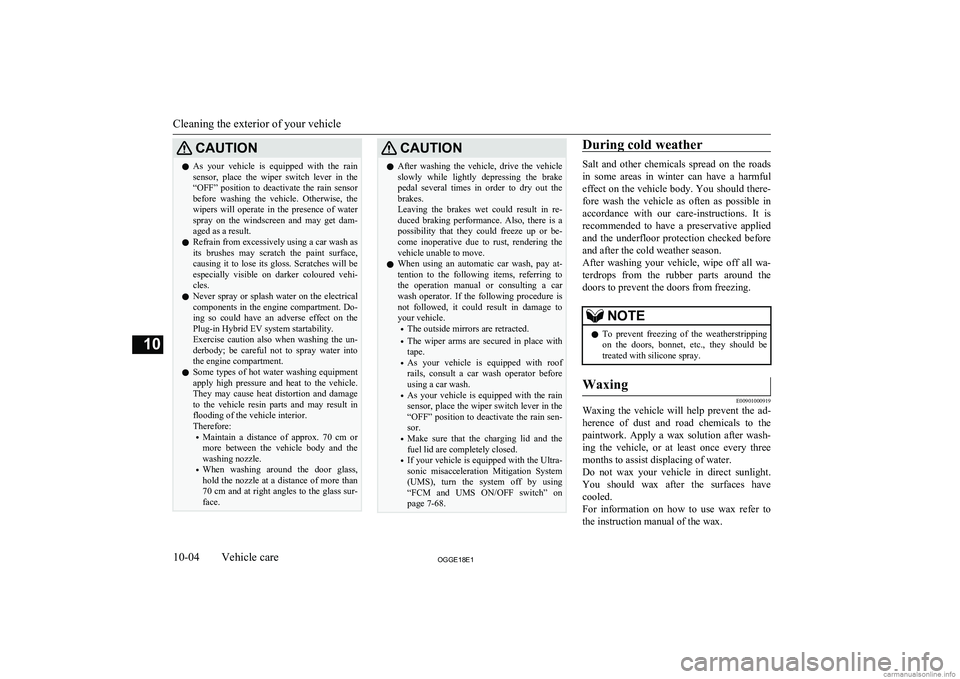
CAUTIONlAs your vehicle is equipped with the rain
sensor, place the wiper switch lever in the“OFF” position to deactivate the rain sensor
before washing the vehicle. Otherwise, the wipers will operate in the presence of waterspray on the windscreen and may get dam-
aged as a result.
l Refrain from excessively using a car wash as
its brushes may scratch the paint surface,
causing it to lose its gloss. Scratches will be
especially visible on darker coloured vehi-
cles.
l Never spray or splash water on the electrical
components in the engine compartment. Do- ing so could have an adverse effect on the
Plug-in Hybrid EV system startability.
Exercise caution also when washing the un-
derbody; be careful not to spray water into the engine compartment.
l Some types of hot water washing equipment
apply high pressure and heat to the vehicle. They may cause heat distortion and damage
to the vehicle resin parts and may result in flooding of the vehicle interior.
Therefore:
• Maintain a distance of approx. 70 cm or
more between the vehicle body and the washing nozzle.
• When washing around the door glass,
hold the nozzle at a distance of more than
70 cm and at right angles to the glass sur- face.CAUTIONl After washing the vehicle, drive the vehicle
slowly while lightly depressing the brake
pedal several times in order to dry out the
brakes.
Leaving the brakes wet could result in re- duced braking performance. Also, there is a possibility that they could freeze up or be-
come inoperative due to rust, rendering the vehicle unable to move.
l When using an automatic car wash, pay at-
tention to the following items, referring to the operation manual or consulting a car
wash operator. If the following procedure is not followed, it could result in damage to
your vehicle.
• The outside mirrors are retracted.
• The wiper arms are secured in place with
tape.
• As your vehicle is equipped with roof
rails, consult a car wash operator before using a car wash.
• As your vehicle is equipped with the rain
sensor, place the wiper switch lever in the“OFF” position to deactivate the rain sen-
sor.
• Make sure that the charging lid and the
fuel lid are completely closed.
• If your vehicle is equipped with the Ultra-
sonic misacceleration Mitigation System
(UMS), turn the system off by using “FCM and UMS ON/OFF switch” on page 7-68.During cold weather
Salt and other chemicals spread on the roads
in some areas in winter can have a harmful effect on the vehicle body. You should there-
fore wash the vehicle as often as possible in accordance with our care-instructions. It is
recommended to have a preservative applied
and the underfloor protection checked before and after the cold weather season.
After washing your vehicle, wipe off all wa- terdrops from the rubber parts around the
doors to prevent the doors from freezing.
NOTEl To prevent freezing of the weatherstripping
on the doors, bonnet, etc., they should be treated with silicone spray.Waxing
E00901000919
Waxing the vehicle will help prevent the ad-
herence of dust and road chemicals to the paintwork. Apply a wax solution after wash- ing the vehicle, or at least once every three
months to assist displacing of water.
Do not wax your vehicle in direct sunlight.
You should wax after the surfaces have
cooled.
For information on how to use wax refer to the instruction manual of the wax.
Cleaning the exterior of your vehicle
10-04OGGE18E1Vehicle care10
Page 450 of 538
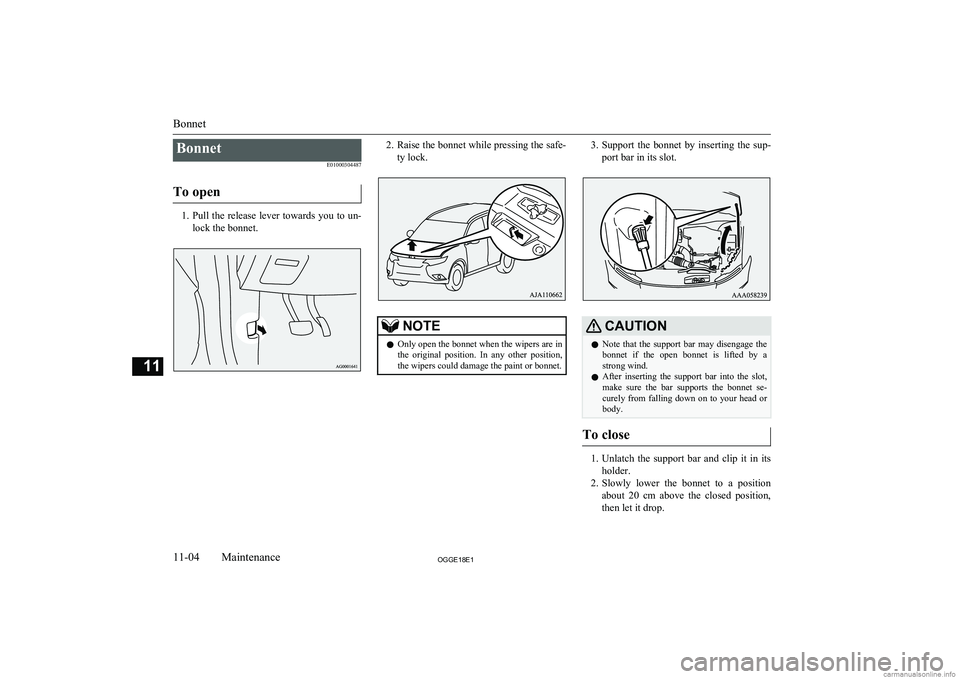
BonnetE01000304487
To open
1. Pull the release lever towards you to un-
lock the bonnet.
2. Raise the bonnet while pressing the safe-
ty lock.NOTEl Only open the bonnet when the wipers are in
the original position. In any other position,the wipers could damage the paint or bonnet.3. Support the bonnet by inserting the sup-
port bar in its slot.CAUTIONl Note that the support bar may disengage the
bonnet if the open bonnet is lifted by astrong wind.
l After inserting the support bar into the slot,
make sure the bar supports the bonnet se-
curely from falling down on to your head or body.
To close
1. Unlatch the support bar and clip it in its
holder.
2. Slowly lower the bonnet to a position
about 20 cm above the closed position,
then let it drop.
Bonnet
11-04OGGE18E1Maintenance11
Page 465 of 538
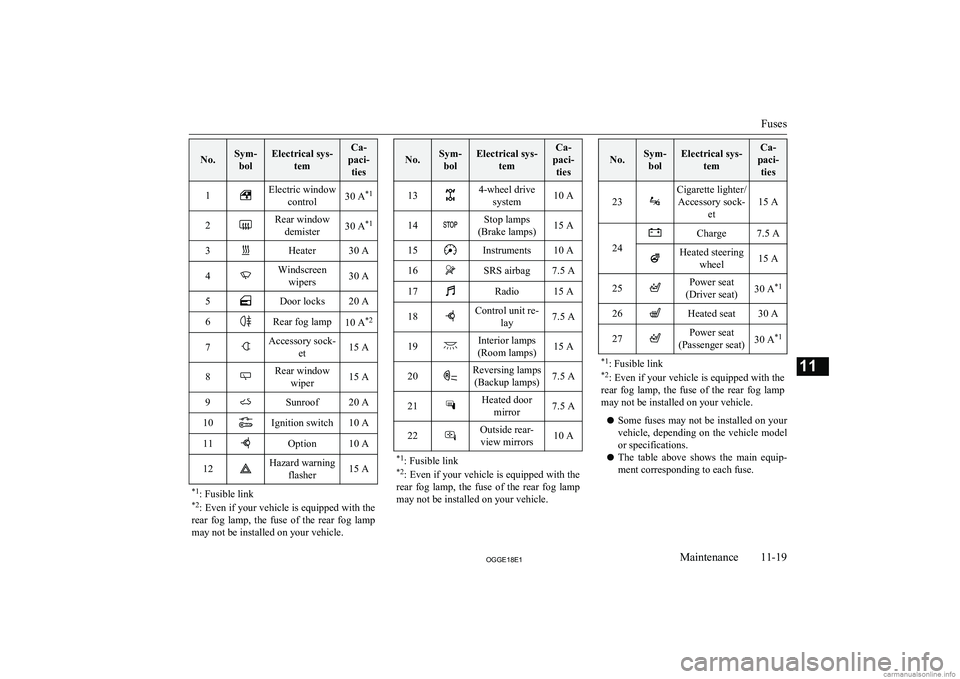
No.Sym-bolElectrical sys- temCa-
paci- ties1Electric window control30 A *12Rear window
demister30 A *13Heater30 A4Windscreen
wipers30 A5Door locks20 A6Rear fog lamp10 A *27Accessory sock-
et15 A8Rear windowwiper15 A9Sunroof20 A10Ignition switch10 A11Option10 A12Hazard warning flasher15 A*1: Fusible link
*2 : Even if your vehicle is equipped with the
rear fog lamp, the fuse of the rear fog lamp
may not be installed on your vehicle.
No.Sym- bolElectrical sys- temCa-
paci- ties134-wheel drive system10 A14Stop lamps
(Brake lamps)15 A15Instruments10 A16SRS airbag7.5 A17Radio15 A18Control unit re- lay7.5 A19Interior lamps
(Room lamps)15 A20Reversing lamps (Backup lamps)7.5 A21Heated door mirror7.5 A22Outside rear-view mirrors10 A*1 : Fusible link
*2 : Even if your vehicle is equipped with the
rear fog lamp, the fuse of the rear fog lamp
may not be installed on your vehicle.
No.Sym- bolElectrical sys- temCa-
paci- ties
23
Cigarette lighter/Accessory sock- et
15 A24
Charge7.5 AHeated steeringwheel15 A25Power seat
(Driver seat)30 A *126Heated seat30 A27Power seat
(Passenger seat)30 A *1*1
: Fusible link
*2 : Even if your vehicle is equipped with the
rear fog lamp, the fuse of the rear fog lamp
may not be installed on your vehicle.
l Some fuses may not be installed on your
vehicle, depending on the vehicle model
or specifications.
l The table above shows the main equip-
ment corresponding to each fuse.
Fuses
11-19OGGE18E1Maintenance11
Page 493 of 538
Heated windscreen switch................................. 6-68
Heating.............................................................. 8-13
High-mounted stop lamp................................. 11-24
Hill start assist................................................... 7-34
Hinges and latches lubrication........................ 11-15
Horn switch....................................................... 6-70
How to connect a USB memory........................8-69
I
If the vehicle breaks down................................ 9-02
In case of a collision.......................................... 2-06
Indication lamps................................................ 6-47
Information screen display................................ 6-51
Inside rear-view mirror......................................7-07
Inside tailgate release........................................ 4-27
Inspection and maintenance.............................. 2-08
Inspection and maintenance following rough road operation........................................ 7-24
Installation of accessories..................................2-15
Instruments........................................................ 6-02
Interior lamps.................................................... 8-78
J
Jack.................................................................... 9-06Storage.......................................................... 9-06
Jump starting (Emergency starting).................. 9-02
K
Keyless entry system......................................... 4-03
Keyless operation system.................................. 4-06
Keys...................................................................4-02
L
Labeling...........................................................12-02
Lamp monitor buzzer........................................ 6-54
Lane Departure Warning (LDW)...................... 7-85
Leakage (Fuel, engine coolant, oil and exhaust gas)............................................. 11-15
LED headlamp warning lamp........................... 6-53
Licence plate lamps Bulb capacity.............................................. 11-24
Replacement................................................ 11-30
Link System.......................................................8-49
Locking and unlocking the doors and tailgate.. 1-15
Low voltage electrical system......................... 12-08
Lubricants........................................................ 12-10
Luggage floor box............................................. 8-81
Luggage hooks.................................................. 8-85
Luggage room lamp.......................................... 8-79 Bulb capacity.............................................. 11-25
M
Making a flat seat.............................................. 5-08
Making a luggage area...................................... 5-06
Map lamps......................................................... 8-79 Bulb capacity.............................................. 11-25
Meter illumination control................................ 6-02
Mirror Inside rear-view mirror................................. 7-07
Outside rear-view mirror...............................7-09
MITSUBISHI Remote Control......................... 3-24
Modification/alterations to the electri- cal or fuel systems............................................2-16
Multi Around Monitor.....................................7-106
Multi information display..................................6-02
N
Normal charging (charging methodwith rated AC 220-240V outlet)...................... 3-10
O
OilEngine oil.......................................... 11-05,12-10
Operating sound under charging or remote climate control..................................... 2-06
Operation under adverse driving conditions..... 9-20
Outside rear-view mirrors................................. 7-09
Overheating....................................................... 9-04
P
Parking sensors..................................................7-98
Parking.............................................................. 7-06 Parking brake................................................ 7-03
Plug-in Hybrid EV System................................2-02
Coolant........................................................ 11-06
Plug-in Hybrid EV System warning lamp.........6-50
Position lamps Bulb capacity.............................................. 11-24
Power switch..................................................... 7-12
Precautions to observe when using wipers and washers.......................................... 6-67
Pregnant women restraint.................................. 5-14
Alphabetical index
13- 3
OGGE18E1Alphabetical index