oil MITSUBISHI OUTLANDER PHEV 2018 Owner's Manual (in English)
[x] Cancel search | Manufacturer: MITSUBISHI, Model Year: 2018, Model line: OUTLANDER PHEV, Model: MITSUBISHI OUTLANDER PHEV 2018Pages: 538, PDF Size: 25.01 MB
Page 2 of 538
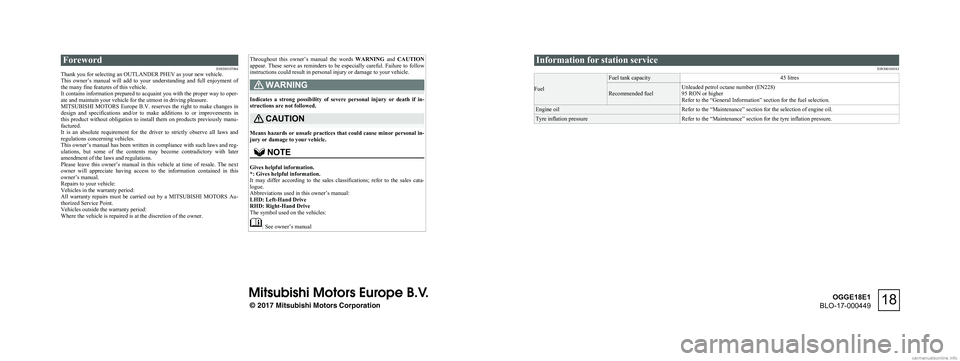
ForewordE09200107064
Thank you for selecting an OUTLANDER PHEV as your new vehicle.
This owner’s manual will add to your understanding and full enjoyment of
the many fine features of this vehicle.
It contains information prepared to acquaint you with the proper way to oper-
ate and maintain your vehicle for the utmost in driving pleasure.
MITSUBISHI MOTORS Europe B.V. reserves the right to make changes in
design and specifications and/or to make additions to or improvements in
this product without obligation to install them on products previously manu- factured.
It is an absolute requirement for the driver to strictly observe all laws and
regulations concerning vehicles.
This owner’s manual has been written in compliance with such laws and reg- ulations, but some of the contents may become contradictory with later amendment of the laws and regulations.
Please leave this owner’s manual in this vehicle at time of resale. The next
owner will appreciate having access to the information contained in this
owner’s manual.
Repairs to your vehicle:
Vehicles in the warranty period:
All warranty repairs must be carried out by a MITSUBISHI MOTORS Au-
thorized Service Point.
Vehicles outside the warranty period:
Where the vehicle is repaired is at the discretion of the owner.Throughout this owner’s manual the words WARNING and CAUTION
appear. These serve as reminders to be especially careful. Failure to follow
instructions could result in personal injury or damage to your vehicle.WARNING
Indicates a strong possibility of severe personal injury or death if in-
structions are not followed.
CAUTION
Means hazards or unsafe practices that could cause minor personal in- jury or damage to your vehicle.
NOTE
Gives helpful information.
*: Gives helpful information.
It may differ according to the sales classifications; refer to the sales cata- logue.
Abbreviations used in this owner’s manual: LHD: Left-Hand Drive
RHD: Right-Hand Drive
The symbol used on the vehicles:
: See owner’s manual
Information for station service
E09300104543
Fuel
Fuel tank capacity45 litresRecommended fuelUnleaded petrol octane number (EN228)
95 RON or higher
Refer to the “General Information” section for the fuel selection.Engine oilRefer to the “Maintenance” section for the selection of engine oil.Tyre inflation pressureRefer to the “Maintenance” section for the tyre inflation pressure.
© 2017 Mitsubishi Motors Corporation18
OGGE18E1
BLO-17-000449
Page 25 of 538
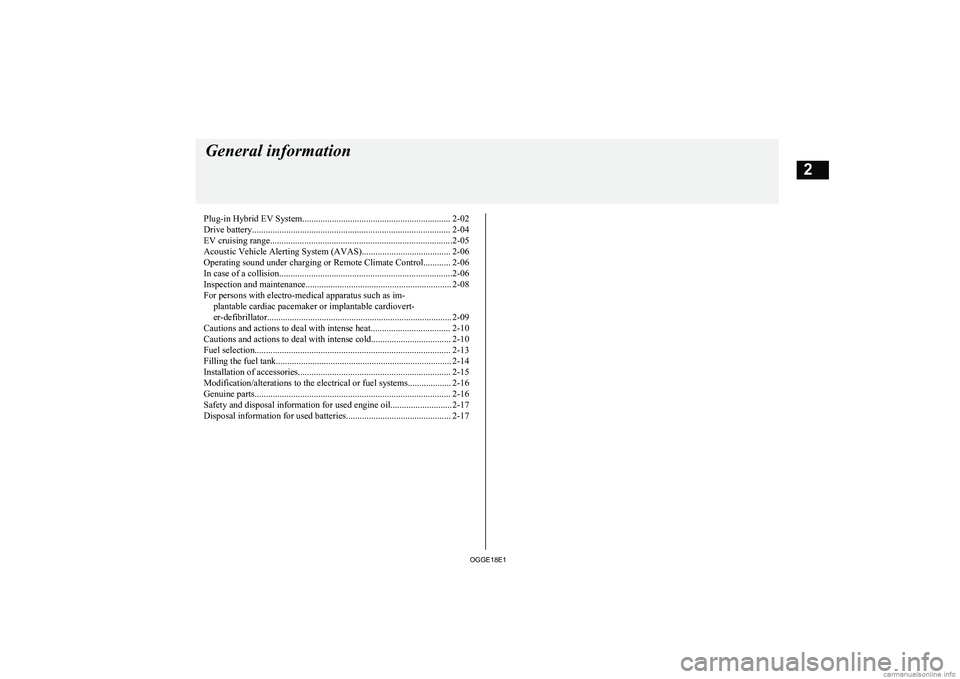
Plug-in Hybrid EV System................................................................. 2-02
Drive battery....................................................................................... 2-04
EV cruising range................................................................................2-05
Acoustic Vehicle Alerting System (AVAS)....................................... 2-06
Operating sound under charging or Remote Climate Control............ 2-06
In case of a collision............................................................................2-06
Inspection and maintenance................................................................ 2-08
For persons with electro-medical apparatus such as im- plantable cardiac pacemaker or implantable cardiovert-
er-defibrillator................................................................................. 2-09
Cautions and actions to deal with intense heat................................... 2-10 Cautions and actions to deal with intense cold................................... 2-10Fuel selection...................................................................................... 2-13Filling the fuel tank............................................................................. 2-14Installation of accessories................................................................... 2-15
Modification/alterations to the electrical or fuel systems................... 2-16
Genuine parts...................................................................................... 2-16 Safety and disposal information for used engine oil........................... 2-17
Disposal information for used batteries.............................................. 2-17General information
OGGE18E12
Page 41 of 538
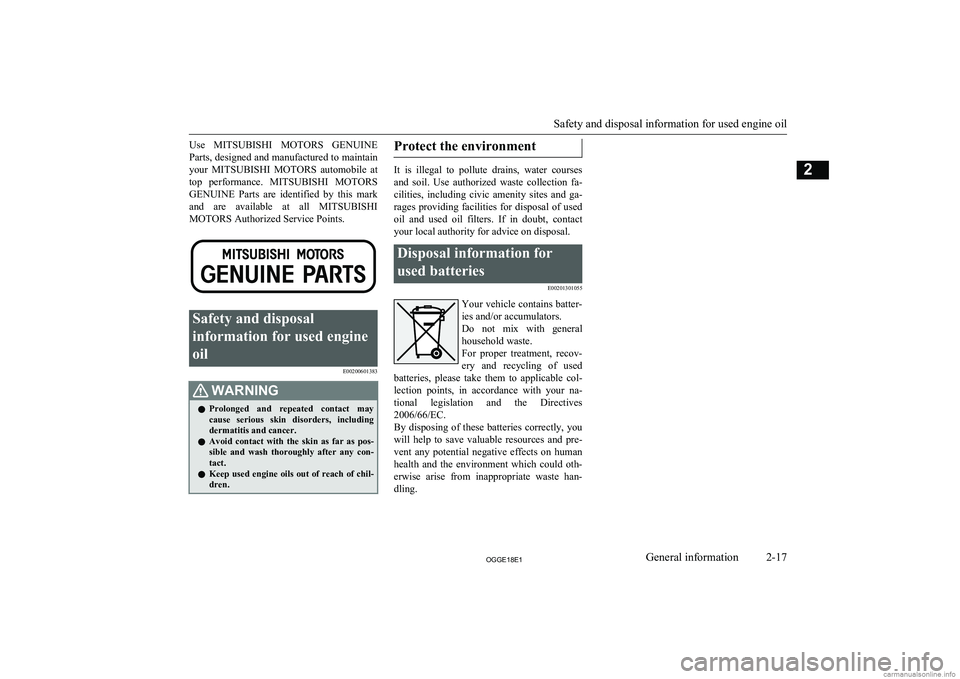
Use MITSUBISHI MOTORS GENUINE
Parts, designed and manufactured to maintain your MITSUBISHI MOTORS automobile at
top performance. MITSUBISHI MOTORS
GENUINE Parts are identified by this mark and are available at all MITSUBISHI
MOTORS Authorized Service Points.Safety and disposal
information for used engine
oil E00200601383WARNINGlProlonged and repeated contact may
cause serious skin disorders, including
dermatitis and cancer.
l Avoid contact with the skin as far as pos-
sible and wash thoroughly after any con- tact.
l Keep used engine oils out of reach of chil-
dren.Protect the environment
It is illegal to pollute drains, water courses
and soil. Use authorized waste collection fa-cilities, including civic amenity sites and ga- rages providing facilities for disposal of used
oil and used oil filters. If in doubt, contact your local authority for advice on disposal.
Disposal information for
used batteries E00201301055
Your vehicle contains batter-ies and/or accumulators.
Do not mix with general
household waste.
For proper treatment, recov-
ery and recycling of used
batteries, please take them to applicable col-
lection points, in accordance with your na- tional legislation and the Directives 2006/66/EC.
By disposing of these batteries correctly, you
will help to save valuable resources and pre-
vent any potential negative effects on human
health and the environment which could oth- erwise arise from inappropriate waste han- dling.
Safety and disposal information for used engine oil
2-17OGGE18E1General information2
Page 51 of 538
WARNINGlIf the POWER or CHARGING indicator does not illuminates or the FAULT indicator blinks or illuminates during normal charging, please contact
a MITSUBISHI MOTORS Authorized Service Point.
l Do not charge when the EV charging cable is coiled up.
The cable may be heated abnormally and resulting in fire.
l Do not alter or disassemble the EV charging cable. Doing so could cause fire, an electric shock or injury.
l Be sure to install the cap to the normal charge connector and store the EV charging cable in a place where the cable is not exposed to water or dust.
Entry of foreign matter such as water or dust in the metal terminal of the normal charge connector or charging cable plug may cause a fire or malfunction.
l Never force the connection if the EV charging cable or connector shows damage or is not easily connected due to foreign material entering the
connector or the outlet. And never use an outlet that is worn, damaged, or will not hold the plug firmly. Doing so could cause fire, an electric shock,
or short circuit.
l Pay attention to the following for handling the EV charging cable.
Damage to the cable could cause fire, an electric shock, or short circuit.
• Do not drop the cable or do not give strong impact to it.
• Do not pull or bend with undue force.
• Do not twist.
• Do not drag.
• Do not put an object on top.
• Do not put the cable close to a heating unit including heater.CAUTIONl Do not connect the normal charge cable to an outlet that has a lower rating than the current value described on the control box.NOTElAll indicators are illuminated momentarily for confirming operation when the charging cable plug is inserted into an outlet. After that the POWER indicator
and the CHARGING indicator is continuously illuminated.
l The CHARGING indicator will start to blink when the charging is completed. The POWER indicator is continuously illuminated while the charging cable
plug is inserted into an outlet.
EV charging cable*
3-09OGGE18E1Charging3
Page 53 of 538
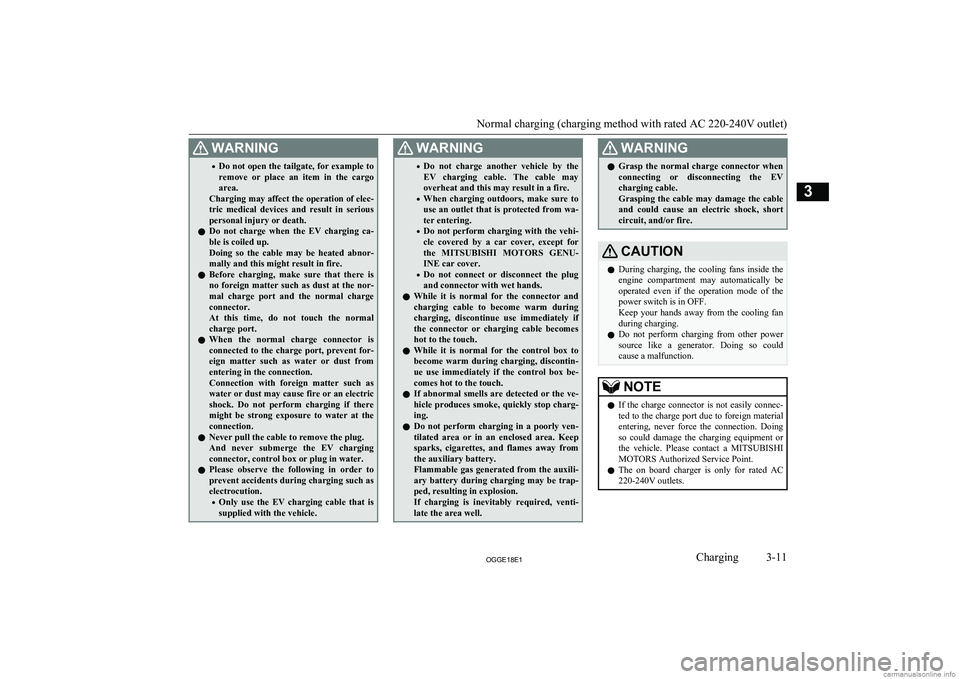
WARNING•Do not open the tailgate, for example to
remove or place an item in the cargo area.
Charging may affect the operation of elec-
tric medical devices and result in serious personal injury or death.
l Do not charge when the EV charging ca-
ble is coiled up.
Doing so the cable may be heated abnor- mally and this might result in fire.
l Before charging, make sure that there is
no foreign matter such as dust at the nor-
mal charge port and the normal charge connector.
At this time, do not touch the normal
charge port.
l When the normal charge connector is
connected to the charge port, prevent for- eign matter such as water or dust from
entering in the connection.
Connection with foreign matter such as
water or dust may cause fire or an electric shock. Do not perform charging if there
might be strong exposure to water at the connection.
l Never pull the cable to remove the plug.
And never submerge the EV charging
connector, control box or plug in water.
l Please observe the following in order to
prevent accidents during charging such as
electrocution.
• Only use the EV charging cable that is
supplied with the vehicle.WARNING• Do not charge another vehicle by the
EV charging cable. The cable may overheat and this may result in a fire.
• When charging outdoors, make sure to
use an outlet that is protected from wa-
ter entering.
• Do not perform charging with the vehi-
cle covered by a car cover, except for
the MITSUBISHI MOTORS GENU-
INE car cover.
• Do not connect or disconnect the plug
and connector with wet hands.
l While it is normal for the connector and
charging cable to become warm during charging, discontinue use immediately if
the connector or charging cable becomes hot to the touch.
l While it is normal for the control box to
become warm during charging, discontin-
ue use immediately if the control box be- comes hot to the touch.
l If abnormal smells are detected or the ve-
hicle produces smoke, quickly stop charg-
ing.
l Do not perform charging in a poorly ven-
tilated area or in an enclosed area. Keep
sparks, cigarettes, and flames away from
the auxiliary battery.
Flammable gas generated from the auxili- ary battery during charging may be trap- ped, resulting in explosion.
If charging is inevitably required, venti-
late the area well.WARNINGl Grasp the normal charge connector when
connecting or disconnecting the EVcharging cable.
Grasping the cable may damage the cable
and could cause an electric shock, short circuit, and/or fire.CAUTIONl During charging, the cooling fans inside the
engine compartment may automatically be operated even if the operation mode of the
power switch is in OFF.
Keep your hands away from the cooling fan during charging.
l Do not perform charging from other power
source like a generator. Doing so could cause a malfunction.NOTEl If the charge connector is not easily connec-
ted to the charge port due to foreign materialentering, never force the connection. Doing so could damage the charging equipment or
the vehicle. Please contact a MITSUBISHI
MOTORS Authorized Service Point.
l The on board charger is only for rated AC
220-240V outlets.
Normal charging (charging method with rated AC 220-240V outlet)
3-11OGGE18E1Charging3
Page 176 of 538
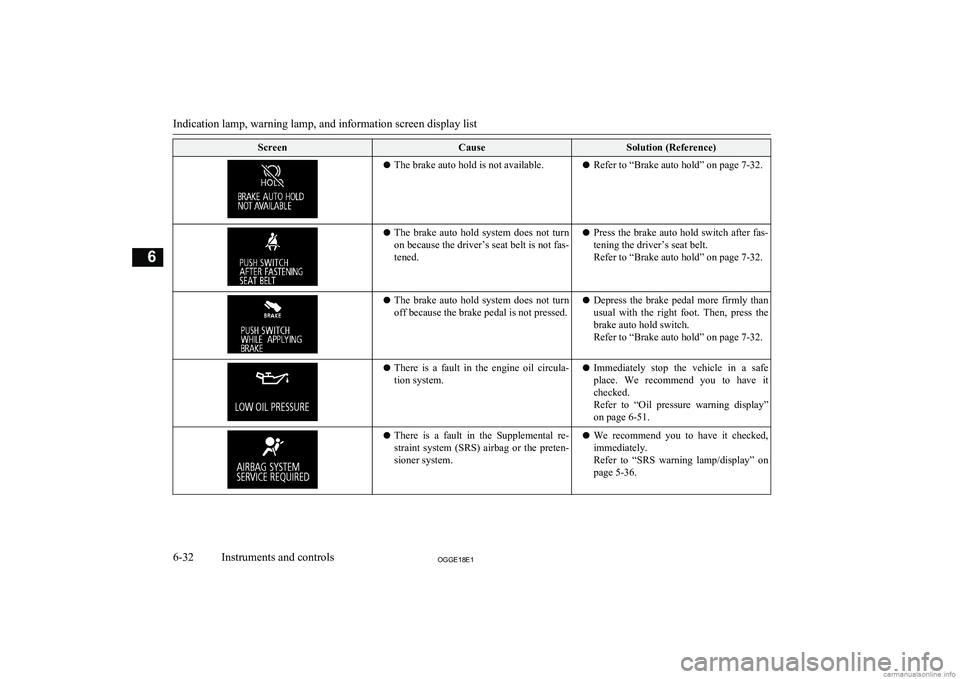
ScreenCauseSolution (Reference)lThe brake auto hold is not available.l Refer to “Brake auto hold” on page 7-32.lThe brake auto hold system does not turn
on because the driver’s seat belt is not fas-
tened.l Press the brake auto hold switch after fas-
tening the driver’s seat belt.
Refer to “Brake auto hold” on page 7-32.l The brake auto hold system does not turn
off because the brake pedal is not pressed.l Depress the brake pedal more firmly than
usual with the right foot. Then, press the
brake auto hold switch.
Refer to “Brake auto hold” on page 7-32.l There is a fault in the engine oil circula-
tion system.l Immediately stop the vehicle in a safe
place. We recommend you to have it checked.
Refer to “Oil pressure warning display” on page 6-51.l There is a fault in the Supplemental re-
straint system (SRS) airbag or the preten-
sioner system.l We recommend you to have it checked,
immediately.
Refer to “SRS warning lamp/display” on
page 5-36.
Indication lamp, warning lamp, and information screen display list
6-32OGGE18E1Instruments and controls6
Page 195 of 538
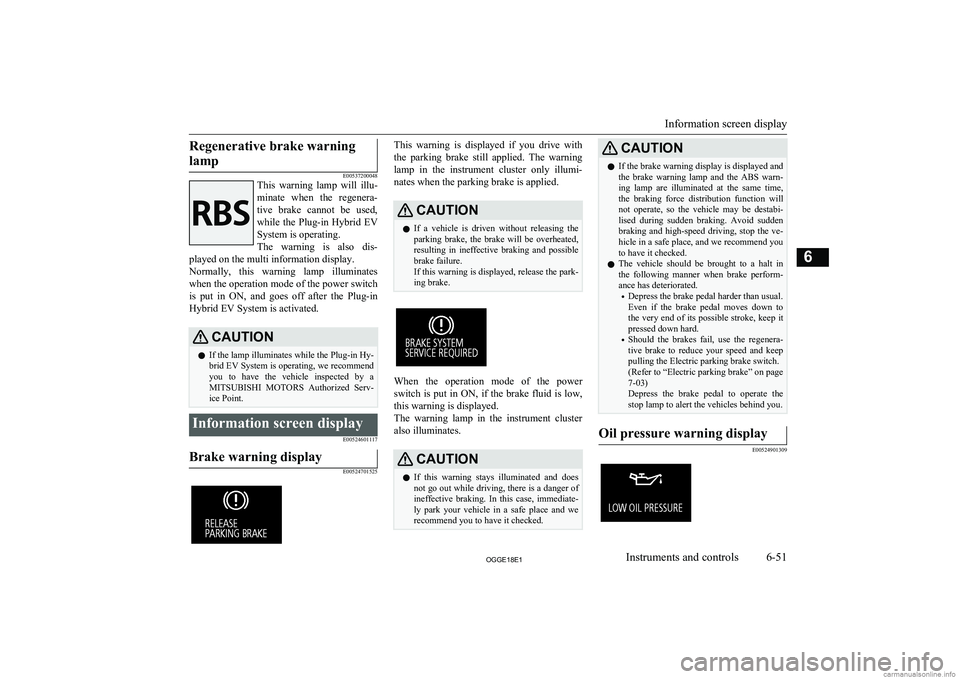
Regenerative brake warninglamp
E00537200048
This warning lamp will illu-
minate when the regenera-
tive brake cannot be used,
while the Plug-in Hybrid EV System is operating.
The warning is also dis-
played on the multi information display.
Normally, this warning lamp illuminates
when the operation mode of the power switch is put in ON, and goes off after the Plug-in
Hybrid EV System is activated.
CAUTIONl If the lamp illuminates while the Plug-in Hy-
brid EV System is operating, we recommend
you to have the vehicle inspected by a MITSUBISHI MOTORS Authorized Serv-
ice Point.Information screen display
E00524601117Brake warning display
E00524701525
This warning is displayed if you drive withthe parking brake still applied. The warning lamp in the instrument cluster only illumi-
nates when the parking brake is applied.CAUTIONl If a vehicle is driven without releasing the
parking brake, the brake will be overheated, resulting in ineffective braking and possiblebrake failure.
If this warning is displayed, release the park-
ing brake.
When the operation mode of the power
switch is put in ON, if the brake fluid is low,
this warning is displayed.
The warning lamp in the instrument cluster
also illuminates.
CAUTIONl If this warning stays illuminated and does
not go out while driving, there is a danger of ineffective braking. In this case, immediate-
ly park your vehicle in a safe place and we recommend you to have it checked.CAUTIONl If the brake warning display is displayed and
the brake warning lamp and the ABS warn-
ing lamp are illuminated at the same time,
the braking force distribution function will not operate, so the vehicle may be destabi-
lised during sudden braking. Avoid sudden braking and high-speed driving, stop the ve-
hicle in a safe place, and we recommend you
to have it checked.
l The vehicle should be brought to a halt in
the following manner when brake perform- ance has deteriorated.
• Depress the brake pedal harder than usual.
Even if the brake pedal moves down to
the very end of its possible stroke, keep it
pressed down hard.
• Should the brakes fail, use the regenera-
tive brake to reduce your speed and keep
pulling the Electric parking brake switch.
(Refer to “Electric parking brake” on page
7-03)
Depress the brake pedal to operate the
stop lamp to alert the vehicles behind you.Oil pressure warning display
E00524901309
Information screen display
6-51OGGE18E1Instruments and controls6
Page 196 of 538
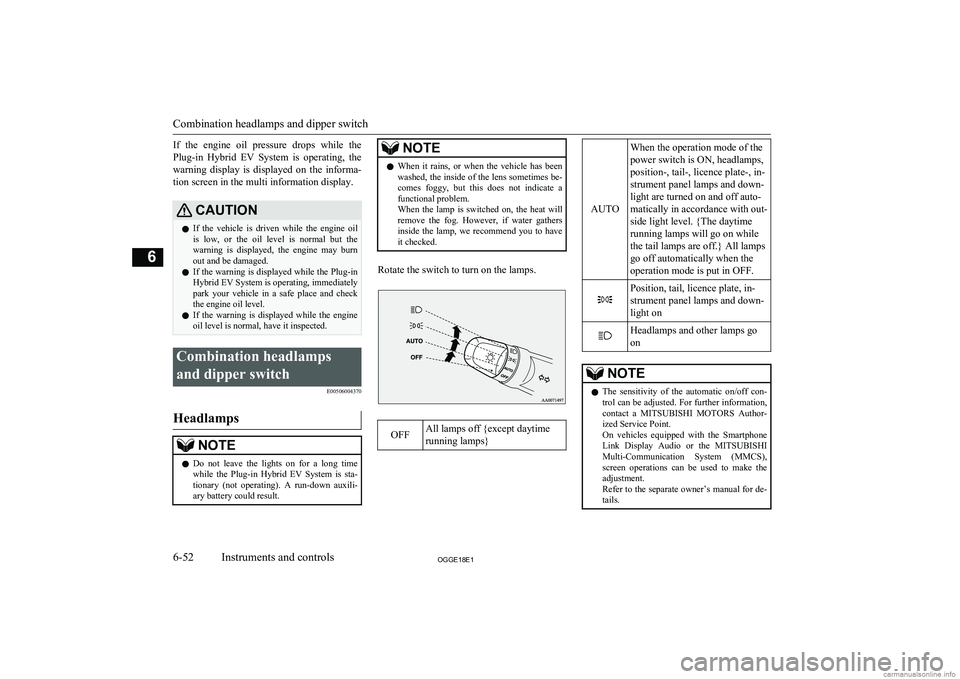
If the engine oil pressure drops while thePlug-in Hybrid EV System is operating, thewarning display is displayed on the informa-
tion screen in the multi information display.CAUTIONl If the vehicle is driven while the engine oil
is low, or the oil level is normal but the warning is displayed, the engine may burn
out and be damaged.
l If the warning is displayed while the Plug-in
Hybrid EV System is operating, immediately
park your vehicle in a safe place and check
the engine oil level.
l If the warning is displayed while the engine
oil level is normal, have it inspected.Combination headlamps
and dipper switch E00506004370
Headlamps
NOTElDo not leave the lights on for a long time
while the Plug-in Hybrid EV System is sta-tionary (not operating). A run-down auxili- ary battery could result.NOTEl When it rains, or when the vehicle has been
washed, the inside of the lens sometimes be-
comes foggy, but this does not indicate a functional problem.
When the lamp is switched on, the heat will
remove the fog. However, if water gathers inside the lamp, we recommend you to have
it checked.
Rotate the switch to turn on the lamps.
OFFAll lamps off {except daytime
running lamps}
AUTO
When the operation mode of the
power switch is ON, headlamps,
position-, tail-, licence plate-, in-
strument panel lamps and down-
light are turned on and off auto-
matically in accordance with out-
side light level. {The daytime
running lamps will go on while
the tail lamps are off.} All lamps
go off automatically when the
operation mode is put in OFF.Position, tail, licence plate, in-
strument panel lamps and down-
light onHeadlamps and other lamps go
onNOTEl The sensitivity of the automatic on/off con-
trol can be adjusted. For further information,contact a MITSUBISHI MOTORS Author-
ized Service Point.
On vehicles equipped with the Smartphone
Link Display Audio or the MITSUBISHI
Multi-Communication System (MMCS), screen operations can be used to make theadjustment.
Refer to the separate owner’s manual for de-
tails.
Combination headlamps and dipper switch
6-52OGGE18E1Instruments and controls6
Page 238 of 538
NOTElWhen moving out of mud, sand or fresh
snow, pressing the accelerator pedal may not
allow the Plug-in Hybrid EV system output to increase. In such situations, switching to
“4WD LOCK” with the 4WD lock switch and temporarily turning off the Active Sta- bility Control (ASC) with the “ASC OFF”
switch will make it easier to move out your vehicle.
Refer to “Operation under adverse driving
conditions: If your vehicle becomes stuck in sand, mud or snow” on page 9-20.
Climbing/descending sharp
grades
Your vehicle may not provide sufficient hill
climbing ability and regenerative brake on steep slope. Avoid driving on steep slopes
even though the vehicle is a 4-wheel drive vehicle.
Inspection and maintenance
following rough roadoperation E00606701407
After operating the vehicle in rough road
conditions, be sure to perform the following inspection and maintenance procedures:
l Check that the vehicle has not been dam-
aged by rocks, gravel, etc.
l Carefully wash the vehicle with water.
Drive the vehicle slowly while lightly
depressing the brake pedal in order to dry out the brakes. If the brakes still do
not function properly, we recommend you to have the brakes checked as soon
as possible.
l Remove the insects, dried grass, etc.
clogging the radiator core.
l Check the inside of the vehicle. If water
entry is found, dry the carpet etc.
l Inspect the headlamps. If the headlamp
bulb is flooded with water, we recom-
mend you to have it drained.Cautions on handling of 4-
wheel drive vehicles E00606801844
Tyres and wheels
Since the driving torque can be applied to the
4 wheels, the driving performance of the ve- hicle when operating in 4-wheel drive is
greatly affected by the condition of the tyres.
Pay close attention to the tyres.
l Install only the specified tyres on all
wheels. Refer to “Tyres and wheels” on page 12-08.
l Be sure all 4 tyres and wheels are the
same size and type.
When it is necessary to replace any of
the tyres or wheels, replace all 4 tyres.
l All tyres should be rotated before the
wear difference between the front and
rear tyres is recognizable.
Good vehicle performance cannot be expec- ted if there is a difference in wear between tyres. Refer to “Tyre rotation” on page 11-11.
l Check the tyre inflation pressure regular-
ly.CAUTIONl Always use tyres of the same size, same
type, and same brand, and which have no wear differences. Using tyres of differentsize, type, brands or degree of wear, will in-
crease the differential oil temperature, result-
ing in possible damage to the driving sys-
tem. Further, the drive train will be subjec- ted to excessive loading possibly leading tooil leakage, component seizure, or other seri-
ous faults.
Inspection and maintenance following rough road operation
7-24OGGE18E1Starting and driving7
Page 250 of 538
Emergency stop signal
system E00626001259
This is a device that reduces the possibility of rear end collisions by the rapid and automatic blinking of the hazard warning lamps to alert
vehicles approaching from behind during sudden braking. When the emergency stop
signal system operates, the hazard warning indication lamp in the instrument cluster
blinks rapidly at the same time.CAUTIONl If the ABS warning or ASC warning is dis-
played, the emergency stop signal system may not operate. Refer to “ABS warning
lamp/display” on page 7-37.
Refer to “ASC warning lamp/display” on page 7-42.NOTEl [Activating condition for the emergency stop
signal system]
It activates when all of the following condi-
tions are met.
• The vehicle speed is approximately
55 km/h (34 mph) or higher.NOTE• The brake pedal has been depressed, and
the system judges that it was sudden brak- ing from the vehicle deceleration and theoperating condition of the anti-lock brake
system (ABS).
[Deactivating condition for the emergency
stop signal system]
It deactivates when one of the following conditions is met.
• The brake pedal is released.
• The hazard warning flasher switch is
pressed.
• The system judges that it was not sudden
braking from the vehicle deceleration and
the operating condition of the anti-lock
brake system (ABS).Anti-lock brake system
(ABS) E00607102489
Environmental conditions can have an effect
on braking. During sudden braking when there is snow, ice, oil, water etc. on the road
surface, a skid may occur. In this situation, steering control and braking effectiveness is
reduced and the stopping distance is in-
creased. The vehicle may also go into an un- controlled spin.
The ABS helps prevent the wheels from lock-
ing during braking, thus maintaining direc-
tional stability, ensuring controllability and
providing optimum braking force.
Operating hints
l Always maintain the same distance from
the vehicle in front of you as you would for a vehicle not equipped with ABS.
Compared with vehicles not fitted with ABS, your vehicle may require a longer
stopping distance in the following cases: • Driving on gravel or snow-covered
roads.
• Driving with snow traction device
(tyre chains) installed.
• Driving on roads where the road sur-
face is pitted or has other differences in surface height.
• Driving on bumpy roads or other poor
driving surfaces.
l Operation of ABS is not restricted to sit-
uations where brakes are applied sud-
denly. This system may also operate to
prevent wheel lock when you are driving over manholes, steel road-work plates,
or the vehicle is driven over steps or lev-
el differences in the road, road markings, or other surfaces which are difficult for
the wheels to grip.
Emergency stop signal system
7-36OGGE18E1Starting and driving7