warning MITSUBISHI OUTLANDER PHEV 2018 Owner's Manual (in English)
[x] Cancel search | Manufacturer: MITSUBISHI, Model Year: 2018, Model line: OUTLANDER PHEV, Model: MITSUBISHI OUTLANDER PHEV 2018Pages: 538, PDF Size: 25.01 MB
Page 2 of 538
ForewordE09200107064
Thank you for selecting an OUTLANDER PHEV as your new vehicle.
This owner’s manual will add to your understanding and full enjoyment of
the many fine features of this vehicle.
It contains information prepared to acquaint you with the proper way to oper-
ate and maintain your vehicle for the utmost in driving pleasure.
MITSUBISHI MOTORS Europe B.V. reserves the right to make changes in
design and specifications and/or to make additions to or improvements in
this product without obligation to install them on products previously manu- factured.
It is an absolute requirement for the driver to strictly observe all laws and
regulations concerning vehicles.
This owner’s manual has been written in compliance with such laws and reg- ulations, but some of the contents may become contradictory with later amendment of the laws and regulations.
Please leave this owner’s manual in this vehicle at time of resale. The next
owner will appreciate having access to the information contained in this
owner’s manual.
Repairs to your vehicle:
Vehicles in the warranty period:
All warranty repairs must be carried out by a MITSUBISHI MOTORS Au-
thorized Service Point.
Vehicles outside the warranty period:
Where the vehicle is repaired is at the discretion of the owner.Throughout this owner’s manual the words WARNING and CAUTION
appear. These serve as reminders to be especially careful. Failure to follow
instructions could result in personal injury or damage to your vehicle.WARNING
Indicates a strong possibility of severe personal injury or death if in-
structions are not followed.
CAUTION
Means hazards or unsafe practices that could cause minor personal in- jury or damage to your vehicle.
NOTE
Gives helpful information.
*: Gives helpful information.
It may differ according to the sales classifications; refer to the sales cata- logue.
Abbreviations used in this owner’s manual: LHD: Left-Hand Drive
RHD: Right-Hand Drive
The symbol used on the vehicles:
: See owner’s manual
Information for station service
E09300104543
Fuel
Fuel tank capacity45 litresRecommended fuelUnleaded petrol octane number (EN228)
95 RON or higher
Refer to the “General Information” section for the fuel selection.Engine oilRefer to the “Maintenance” section for the selection of engine oil.Tyre inflation pressureRefer to the “Maintenance” section for the tyre inflation pressure.
© 2017 Mitsubishi Motors Corporation18
OGGE18E1
BLO-17-000449
Page 4 of 538
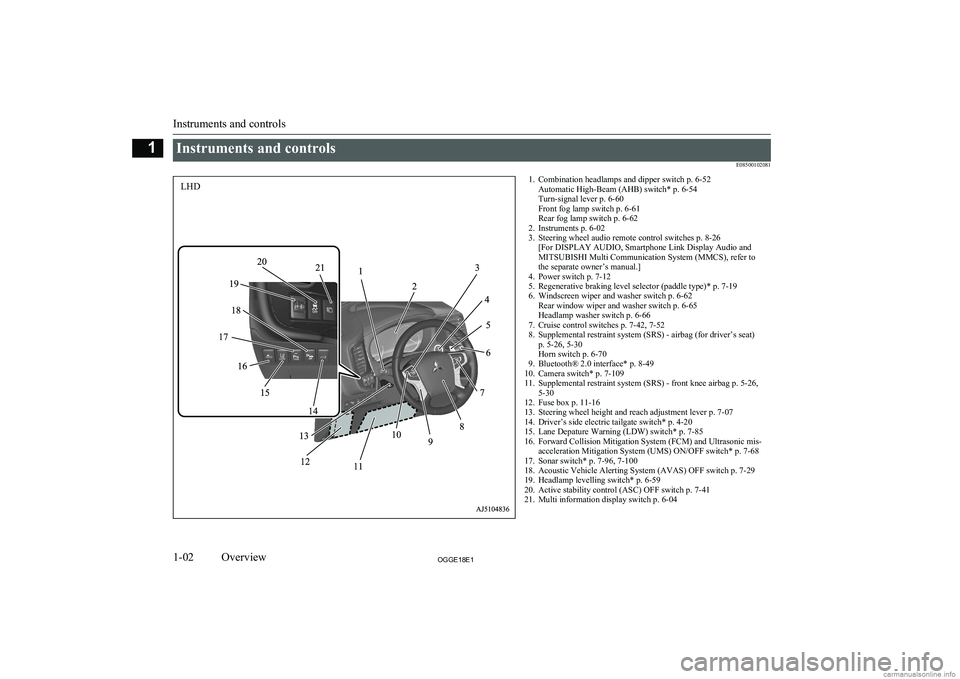
Instruments and controlsE085001020811. Combination headlamps and dipper switch p. 6-52Automatic High-Beam (AHB) switch* p. 6-54
Turn-signal lever p. 6-60
Front fog lamp switch p. 6-61
Rear fog lamp switch p. 6-62
2. Instruments p. 6-02
3. Steering wheel audio remote control switches p. 8-26 [For DISPLAY AUDIO, Smartphone Link Display Audio and
MITSUBISHI Multi Communication System (MMCS), refer to
the separate owner’s manual.]
4. Power switch p. 7-12
5. Regenerative braking level selector (paddle type)* p. 7-19
6. Windscreen wiper and washer switch p. 6-62 Rear window wiper and washer switch p. 6-65
Headlamp washer switch p. 6-66
7. Cruise control switches p. 7-42, 7-52
8. Supplemental restraint system (SRS) - airbag (for driver’s seat) p. 5-26, 5-30
Horn switch p. 6-70
9. Bluetooth® 2.0 interface* p. 8-49
10. Camera switch* p. 7-109
11. Supplemental restraint system (SRS) - front knee airbag p. 5-26, 5-30
12. Fuse box p. 11-16
13. Steering wheel height and reach adjustment lever p. 7-07
14. Driver’s side electric tailgate switch* p. 4-20
15. Lane Depature Warning (LDW) switch* p. 7-85
16. Forward Collision Mitigation System (FCM) and Ultrasonic mis- acceleration Mitigation System (UMS) ON/OFF switch* p. 7-68
17. Sonar switch* p. 7-96, 7-100
18. Acoustic Vehicle Alerting System (AVAS) OFF switch p. 7-29
19. Headlamp levelling switch* p. 6-59
20. Active stability control (ASC) OFF switch p. 7-41
21. Multi information display switch p. 6-04
Instruments and controls
1-02OGGE18E1Overview1LHD
Page 5 of 538
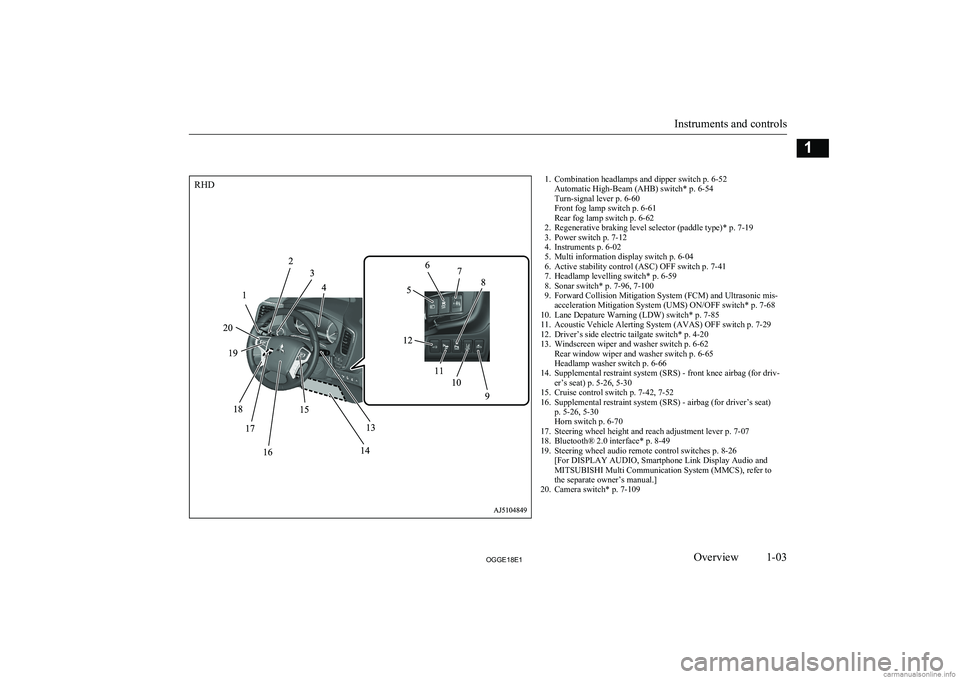
1. Combination headlamps and dipper switch p. 6-52Automatic High-Beam (AHB) switch* p. 6-54
Turn-signal lever p. 6-60
Front fog lamp switch p. 6-61
Rear fog lamp switch p. 6-62
2. Regenerative braking level selector (paddle type)* p. 7-19
3. Power switch p. 7-12
4. Instruments p. 6-02
5. Multi information display switch p. 6-04
6. Active stability control (ASC) OFF switch p. 7-41
7. Headlamp levelling switch* p. 6-59
8. Sonar switch* p. 7-96, 7-100
9. Forward Collision Mitigation System (FCM) and Ultrasonic mis- acceleration Mitigation System (UMS) ON/OFF switch* p. 7-68
10. Lane Depature Warning (LDW) switch* p. 7-85
11. Acoustic Vehicle Alerting System (AVAS) OFF switch p. 7-29
12. Driver’s side electric tailgate switch* p. 4-20
13. Windscreen wiper and washer switch p. 6-62 Rear window wiper and washer switch p. 6-65
Headlamp washer switch p. 6-66
14. Supplemental restraint system (SRS) - front knee airbag (for driv- er’s seat) p. 5-26, 5-30
15. Cruise control switch p. 7-42, 7-52
16. Supplemental restraint system (SRS) - airbag (for driver’s seat) p. 5-26, 5-30
Horn switch p. 6-70
17. Steering wheel height and reach adjustment lever p. 7-07
18. Bluetooth® 2.0 interface* p. 8-49
19. Steering wheel audio remote control switches p. 8-26 [For DISPLAY AUDIO, Smartphone Link Display Audio and
MITSUBISHI Multi Communication System (MMCS), refer to
the separate owner’s manual.]
20. Camera switch* p. 7-109
Instruments and controls
1-03OGGE18E1Overview1RHD
Page 6 of 538
![MITSUBISHI OUTLANDER PHEV 2018 Owners Manual (in English) 1. Multi Around Monitor* p. 7-106Audio* p. 8-13
[For DISPLAY AUDIO, Smartphone Link Display Audio and
MITSUBISHI Multi Communication System (MMCS), refer to
the separate owner’s manual.]
2. Hazard w](/img/19/34890/w960_34890-5.png "MITSUBISHI OUTLANDER PHEV 2018 Owners Manual (in English) 1. Multi Around Monitor* p. 7-106Audio* p. 8-13
[For DISPLAY AUDIO, Smartphone Link Display Audio and
MITSUBISHI Multi Communication System (MMCS), refer to
the separate owner’s manual.]
2. Hazard w")
1. Multi Around Monitor* p. 7-106Audio* p. 8-13
[For DISPLAY AUDIO, Smartphone Link Display Audio and
MITSUBISHI Multi Communication System (MMCS), refer to
the separate owner’s manual.]
2. Hazard warning flasher switch p. 6-60
3. ECO mode switch p. 6-61
4. Front passenger’s airbag indicator p. 5-29
5. Passenger’s ventilators p. 8-02
6. Accessory socket* p. 8-74 Cigarette lighter* p. 8-73
7. Electric tailgate power switch* p. 4-20
8. Key slot p. 7-15
9. 220-240 V AC power supply switch* p. 8-75
10. Blind Spot Warning (BSW) switch* p. 7-79
11. Heated steering wheel switch* p. 6-69
12. Heated windscreen switch* p. 6-68
13. Cup holder p. 8-82
14. Selector lever (Joystick type) p. 7-16
15. 220-240 V AC power supply* p. 8-75
16. Floor console box p. 8-81 Arm rest
Accessory socket p. 8-74
USB input terminal p. 8-69
17. Fuel tank filler door release lever p. 2-14
18. Bonnet release lever p. 11-04
19. Rear window demister switch p. 6-67 Wiper de-icer switch* p. 6-67
20. Air conditioner p. 8-04
21. Seat belt reminder p. 5-11
Instruments and controls
1-04OGGE18E1Overview1LHD
Page 7 of 538
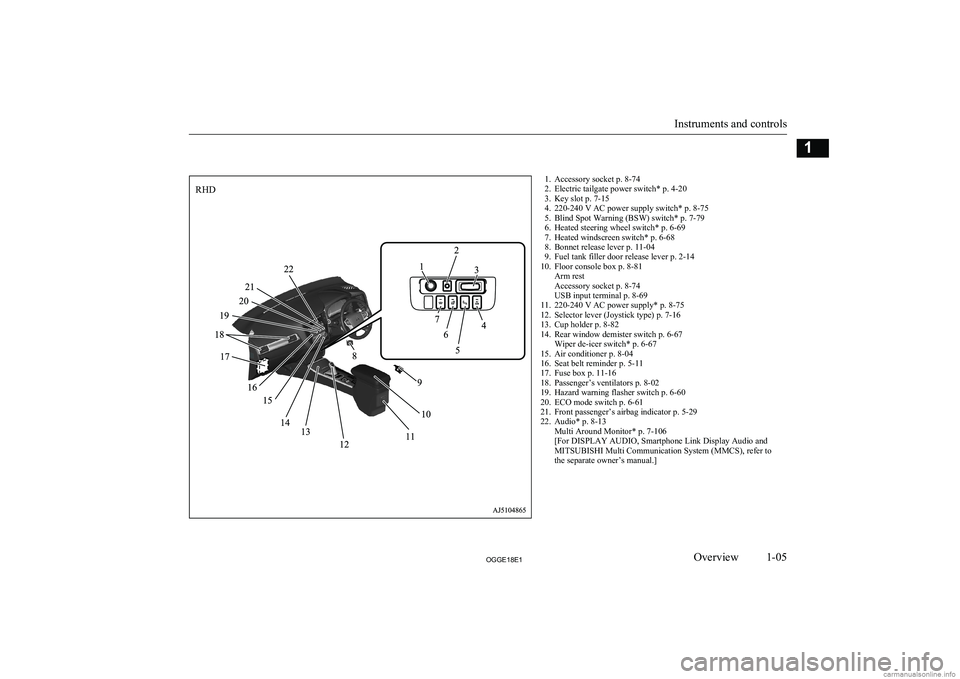
1. Accessory socket p. 8-74
2. Electric tailgate power switch* p. 4-20
3. Key slot p. 7-15
4. 220-240 V AC power supply switch* p. 8-75
5. Blind Spot Warning (BSW) switch* p. 7-79
6. Heated steering wheel switch* p. 6-69
7. Heated windscreen switch* p. 6-68
8. Bonnet release lever p. 11-04
9. Fuel tank filler door release lever p. 2-14
10. Floor console box p. 8-81 Arm rest
Accessory socket p. 8-74
USB input terminal p. 8-69
11. 220-240 V AC power supply* p. 8-75
12. Selector lever (Joystick type) p. 7-16
13. Cup holder p. 8-82
14. Rear window demister switch p. 6-67 Wiper de-icer switch* p. 6-67
15. Air conditioner p. 8-04
16. Seat belt reminder p. 5-11
17. Fuse box p. 11-16
18. Passenger’s ventilators p. 8-02
19. Hazard warning flasher switch p. 6-60
20. ECO mode switch p. 6-61
21. Front passenger’s airbag indicator p. 5-29
22. Audio* p. 8-13 Multi Around Monitor* p. 7-106
[For DISPLAY AUDIO, Smartphone Link Display Audio and
MITSUBISHI Multi Communication System (MMCS), refer to
the separate owner’s manual.]
Instruments and controls
1-05OGGE18E1Overview1RHD
Page 15 of 538
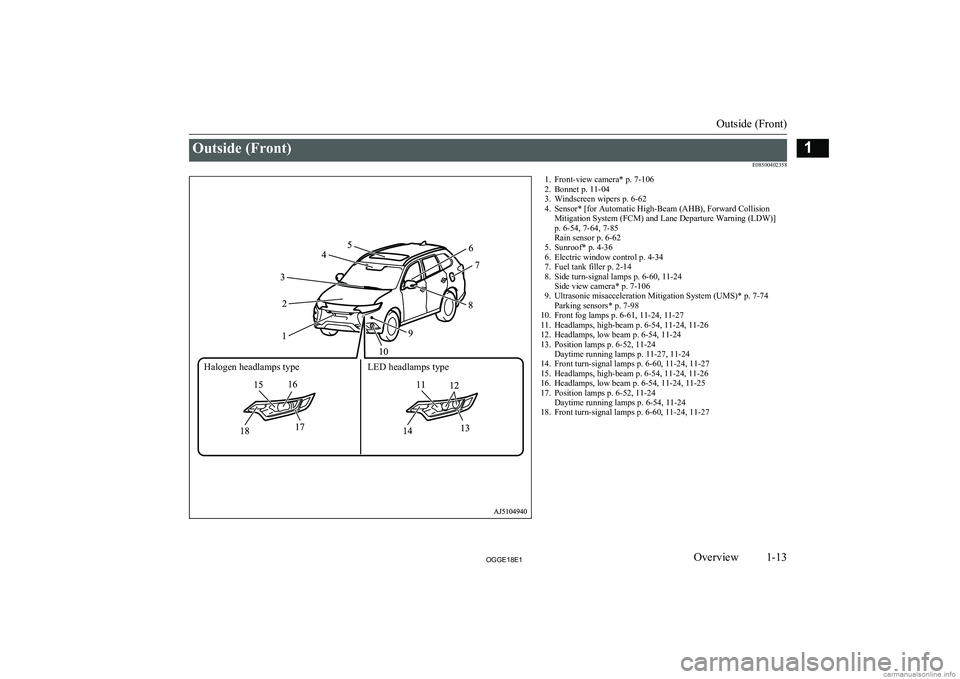
Outside (Front)E085004023581. Front-view camera* p. 7-1062. Bonnet p. 11-04
3. Windscreen wipers p. 6-62
4. Sensor* [for Automatic High-Beam (AHB), Forward Collision Mitigation System (FCM) and Lane Departure Warning (LDW)]
p. 6-54, 7-64, 7-85
Rain sensor p. 6-62
5. Sunroof* p. 4-36
6. Electric window control p. 4-34
7. Fuel tank filler p. 2-14
8. Side turn-signal lamps p. 6-60, 11-24 Side view camera* p. 7-106
9. Ultrasonic misacceleration Mitigation System (UMS)* p. 7-74 Parking sensors* p. 7-98
10. Front fog lamps p. 6-61, 11-24, 11-27
11. Headlamps, high-beam p. 6-54, 11-24, 11-26
12. Headlamps, low beam p. 6-54, 11-24
13. Position lamps p. 6-52, 11-24 Daytime running lamps p. 11-27, 11-24
14. Front turn-signal lamps p. 6-60, 11-24, 11-27
15. Headlamps, high-beam p. 6-54, 11-24, 11-26
16. Headlamps, low beam p. 6-54, 11-24, 11-25
17. Position lamps p. 6-52, 11-24 Daytime running lamps p. 6-54, 11-24
18. Front turn-signal lamps p. 6-60, 11-24, 11-27
Outside (Front)
1-13OGGE18E1Overview1Halogen headlamps type LED headlamps type
Page 22 of 538
You can shift the selector lever to “B” onlywhen the select position is in the “D”
(DRIVE) position.
Selector lever positions
“P” PARK
The wheel are locked. When you park your
vehicle, be sure to apply the parking brake and press the electrical parking switch.
“R” REVERSE
This position is to back up.
“N” NEUTRAL
No power is transmitted to the wheels. The wheels are not locked.
“D” DRIVE
This position is for normal driving.
“B” REGENERATIVE BRAKE
This position is for the regenerative braking.
You can adjust the regenerative braking force up to two levels.
Refer to “Selector lever (Joystick type)” on
page 7-16
Multi information display
E08501201284
Always stop the vehicle in a safe place before operating.
The following information is included on the multi information display: odometer, tripme-
ter, average fuel consumption etc.
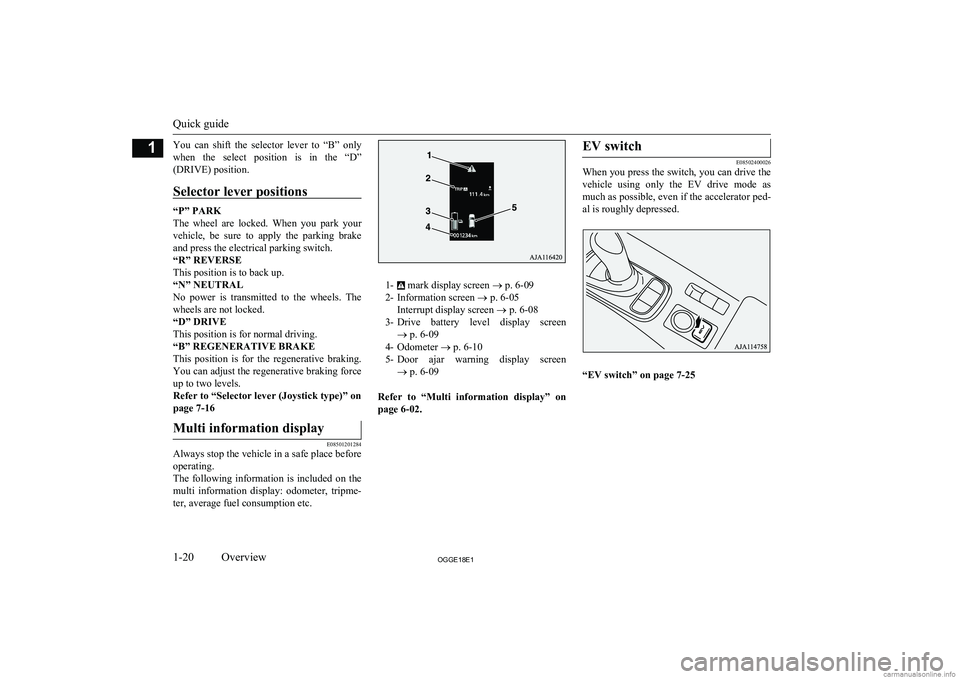
1- mark display screen ® p. 6-09
2- Information screen ® p. 6-05
Interrupt display screen ® p. 6-08
3- Drive battery level display screen
® p. 6-09
4- Odometer ® p. 6-10
5- Door ajar warning display screen
® p. 6-09
Refer to “Multi information display” on page 6-02.
EV switch
E08502400026
When you press the switch, you can drive the
vehicle using only the EV drive mode as
much as possible, even if the accelerator ped- al is roughly depressed.
“EV switch” on page 7-25
Quick guide
1-20OGGE18E1Overview1
Page 28 of 538
NOTElDepending on the usage of the vehicle, the
engine may not start for a long period of
time and unused fuel will remain in the fuel tank. Fuel can deteriorate over time, which
can adversely affect the engine and/or the
fuel system.
If the vehicle is not refueled with more than
15 litres at least once every 3 months, the engine will automatically start, while the ready indicator is illuminated, to help pre-vent deterioration of the fuel. At that time,
charging of the drive battery will start and the battery charge mode display will appear
on the information screen in the multi infor-
mation display. The charging will stop, how-
ever, before the drive battery is fully charg- ed.
The engine may also start even while the EV drive mode is selected or the vehicle is sta-
tionary.
To stop the engine from starting automati-
cally when the vehicle is operated on the drive battery power only for a long time,start the engine and drive the vehicle enough
to reduce the fuel level to approximately half
tank. Refill the fuel tank with at least 15 li- tres of unleaded petrol.Refueling (gasoline)
E00203800060
CAUTIONl If the warning display appears, refuel imme-
diately.
If the vehicle runs out of fuel, the engine will not start even in a situation need to be
generated electricity, the following condi- tions will occur.
• The driving performance falls (since only
the electrical power stored in the drive battery can be used for the driving).
• The heating performance is not available
(except vehicles with electric heater).
• The effectiveness of the heater is insuffi-
cient (vehicles with electric heater).
• The catalytic converter may be damaged
due to excessive high temperature.
Refer to “Filling the fuel tank” on page
2-14.
Refer to “Fuel remaining display screen” on page 6-09.CAUTIONl The fuel in the fuel tank may not be con-
sumed and it may stagnate for a long time
depending on the use situation of the vehi- cle, the quality of fuel may change, and it
may have a bad influence on the engine or the parts of a fuel system.
Observe the following instructions for pre-
vention.
• Press the battery charge mode switch to
start the engine within 3 months at once.
Refer to “Battery charge mode switch” on page 7-28.
• Refill the fuel more than 15 litres at once
within 3 months. If the fuel remaining dis-
play will be below half, you can refill the
fuel more than 15 litres certainly.
Refer to “Fuel remaining display screen” on page 6-09.Drive battery
E00205000066WARNINGlA sealed lithium ion high voltage battery
(drive battery) is adopted for OUTLAND-
ER PHEV . If the drive battery is disposed
of improperly, there is a risk of severe burns and electrical shock that may resultin serious injury or death and there is also
a risk of environmental damage.
l Never attempt to use the drive battery for
any other purpose.
Drive battery
2-04OGGE18E1General information2
Page 30 of 538
lSince the air conditioning (cooling or
heating) consumes power of the drive battery, its operation results in a shorterEV cruising range. Maintain an appro-
priate temperature.
l Put the selector lever to “B” (BRAKE)
position according to the road condition. To charge the drive battery with appro-priate use of the regenerative brake, it
can be increased the EV cruising range.Acoustic Vehicle Alerting
System (AVAS) E00205200042
The Acoustic Vehicle Alerting System(AVAS) is a device that uses sound to alert
pedestrians of the presence of the vehicle. The system operates when the vehicle speed
is about 35 km/h (22 mph) or less and the en-
gine is not running.
Refer to “Acoustic Vehicle Alerting System
(AVAS)” on page 7-29.
WARNINGl Even if the Acoustic Vehicle Alerting Sys-
tem (AVAS) sounds, pay special attention
to pedestrians.
Pedestrians may not notice the oncoming vehicle, which may cause an accident re-
sulting in serious personal injury or death.Operating sound under
charging or Remote ClimateControl E00205700050
Even if the operation mode of the powerswitch is OFF, you may hear an operating
sound such as the cooling fan for cooling the drive battery during charging, the air condi-
tioning compressor and for remote climate control (if so equipped).
This is not a malfunction.
Refer to “MITSUBISHI Remote control: Re-
mote Climate Control” on page 3-24.
In case of a collision
E00205300085
A crash or impact significant enough to re-
quire an emergency response for convention- al vehicles would also require the same re-sponse for Outlander PHEV.
Also follow the instructions described below
to avoid severe burns and electrical shock
that may result in serious injury or death.WARNINGl If your vehicle is drivable, pull your vehi-
cle off the road to a safe, nearby location
and remain on the scene.
Also, if possible, do the following opera- tions and stay out of the way of any on- coming traffic while awaiting the arrival
of emergency responders.
• Apply chocks to the wheels.
• Put the select position in “P” (PARK)
position.
• Apply the parking brake.
• Open the windows, doors and tailgate.
• Put the operation mode in OFF.
• Turn on the hazard warning flashers.
• Move the key away from the vehicle to
prevent unintended start-up of the sys- tem by inadvertent contact with a switch or impact from the crash.
l Never touch high-voltage wiring, connec-
tors, and other high-voltage parts, such as
the inverter unit and drive battery. An electric shock may occur if exposed elec-
tric wires are visible when viewed from inside or outside of your vehicle. For their locations, see “High-voltage components”
on page 2-08.
l If the vehicle receives a strong impact to
the floor while driving, stop the vehicle in
a safe place and check the floor.
Acoustic Vehicle Alerting System (AVAS)
2-06OGGE18E1General information2
Page 31 of 538
WARNINGlNever start the plug-in hybrid EV system
if you found a leak of a liquid (except wa-
ter of the air conditioner) while checking the outside of the vehicle because there is
possibility the fuel system has been dam- aged and causing of fire or exploding.
In such case, immediately contact your
MITSUBISHI MOTORS Authorized
Service Point.
l Leaks or damage to the drive battery may
result in a fire. If you discover them, con-
tact emergency services immediately.
Since the fluid leak may be lithium man- ganite from the Lithium-ion battery, nev- er touch any fluid leaking from the inside
or outside of the vehicle. If the fluid con- tacts your skin or eyes, wash it off imme-
diately with a large amount of water and receive immediate medical attention to
help avoid serious injury.
l If you are unable to safely assess the vehi-
cle due to vehicle damage, do not touch the vehicle. Leave the vehicle and contact
emergency services. Advise emergency responders that this is a Plug-in Hybrid
vehicle.WARNINGl If a fire occurs in this vehicle, leave the
vehicle as soon as possible and contact
emergency services. Do not attempt to ex- tinguish a fire by yourself. If the fire in-
volves a lithium-ion battery, it will re- quire large, sustained volumes of water for extinguishment. Using a small amount
of water or the incorrect fire extinguisher
can result in serious injury or death from electrical shock.
l When you leave the vehicle, if possible,
open the windows, doors and tailgate to
prevent accumulation of poisonous/ combustible gasses. This will also assist in
the rescue and fire fighting process.
l As with any vehicle fire, the byproducts of
combustion can be toxic. Do not inhale
smoke, vapors, or gas from the vehicle. Move to a safe distance upwind and uphill
from the vehicle fire and out of the way of any oncoming traffic while awaiting the
arrival of emergency responders.
l If you detect leaking fluids, sparks,
smoke, flames, gurgling, popping or hiss-
ing noises originating from the high volt- age battery compartment, contact emer-
gency services immediately. This may re- sult in a fire.
l Physical damage to the vehicle or high
voltage battery may result in immediate or delayed release of toxic and/or flamma- ble gases and fire.WARNINGl If your vehicle needs to be towed, trans-
port the vehicle on a flatbed truck or tow
the vehicle with all wheels off the ground.
If the any wheels are on the ground when towing, this may cause damage to the elec-
tric motors. This may also cause a fire, if
wiring in the electric motor unit room be- comes damaged. Refer to “Towing” on
page 9-17.
l Do not attempt to repair a damaged Plu-
gin Hybrid vehicle by yourself. Please contact a MITSUBISHI MOTORS Au-
thorized Service Point for service.
l In the event of an accident that requires
body repair and painting, the vehicle should be delivered to a MITSUBISHI
MOTORS Authorized Service Point to
have the drive battery and high voltage parts such as the inverter, including the
attached wiring harness, removed prior to
painting. If exposed to heat in the paint booth, the drive battery will experiencebattery capacity loss.
A damaged drive battery can also pose
safety risks to untrained mechanics and
repair personnel.NOTEl The emergency shut-off system will be acti-
vated and the high-voltage system will auto- matically turn off under the following condi-
tions:
In case of a collision
2-07OGGE18E1General information2