seats MITSUBISHI OUTLANDER SPORT 2017 3.G User Guide
[x] Cancel search | Manufacturer: MITSUBISHI, Model Year: 2017, Model line: OUTLANDER SPORT, Model: MITSUBISHI OUTLANDER SPORT 2017 3.GPages: 399, PDF Size: 14.61 MB
Page 33 of 399
Seat belts 4-12 Seat and restraint systems
4
N00406201500
All seats are equipped with a seat belt which uses one combined lap-and-shoulder belt withan emergency locking retractor. This system is designed to provide both com- fort and safety. It permits full extension and automatic retraction of the belts during nor-mal vehicle operation. A sensing deviceinside the belt retractor is designed to lock the retractor in the event of a sudden change in the vehicle’s motion.
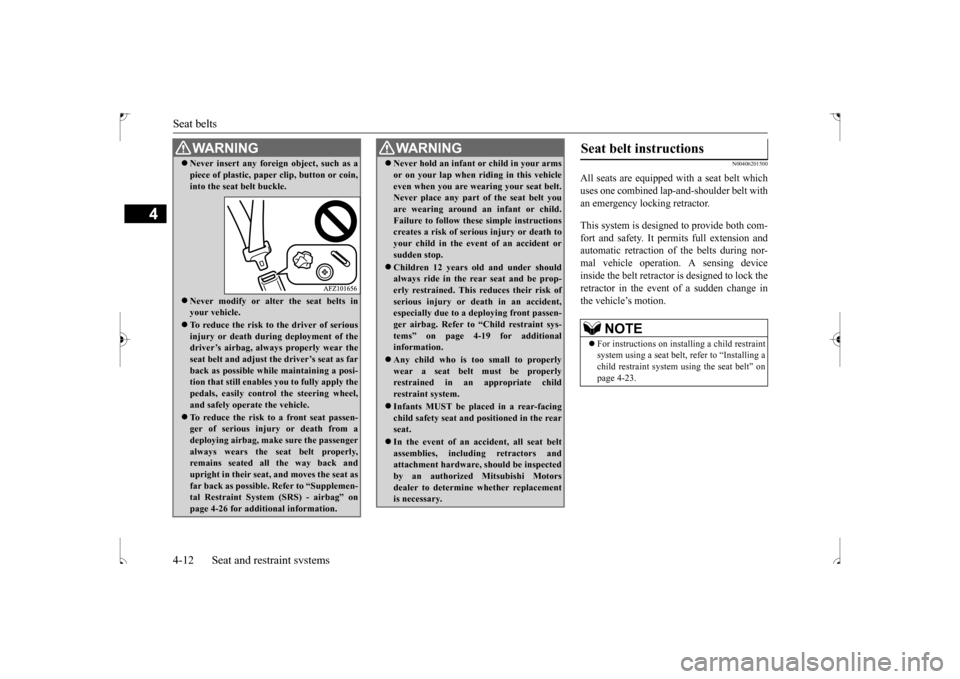
Never insert any foreign object, such as a piece of plastic, paper clip, button or coin, into the seat belt buckle. Never modify or alter the seat belts in your vehicle. To reduce the risk to the driver of serious injury or death during deployment of thedriver’s airbag, always properly wear the seat belt and adjust the driver’s seat as far back as possible while maintaining a posi-tion that still enables you to fully apply the pedals, easily control the steering wheel, and safely operate the vehicle. To reduce the risk to a front seat passen- ger of serious injury or death from adeploying airbag, make sure the passenger always wears the seat belt properly, remains seated all the way back and upright in their seat, and moves the seat as far back as possible. Refer to “Supplemen-tal Restraint System (SRS) - airbag” on page 4-26 for additional information.WA R N I N G
Never hold an infant or child in your arms or on your lap when riding in this vehicle even when you are wearing your seat belt. Never place any part of the seat belt you are wearing around an infant or child.Failure to follow these simple instructions creates a risk of serious injury or death to your child in the event of an accident orsudden stop. Children 12 years old and under should always ride in the rear seat and be prop- erly restrained. This reduces their risk of serious injury or death in an accident,especially due to a deploying front passen- ger airbag. Refer to “Child restraint sys- tems” on page 4-19 for additionalinformation. Any child who is too small to properly wear a seat belt must be properly restrained in an appropriate child restraint system. Infants MUST be placed in a rear-facing child safety seat and positioned in the rearseat. In the event of an accident, all seat belt assemblies, including retractors and attachment hardware, should be inspected by an authorized Mitsubishi Motors dealer to determine whether replacement is necessary.WA R N I N G
Seat belt instructions
NOTE
For instructions on installing a child restraint system using a seat belt, refer to “Installing a child restraint system using the seat belt” onpage 4-23.
BK0239500US.bo
ok 12 ページ 2016年5月13日 金曜日 午前8時53分
Page 34 of 399
Seat belts
Seat and restraint systems 4-13
4
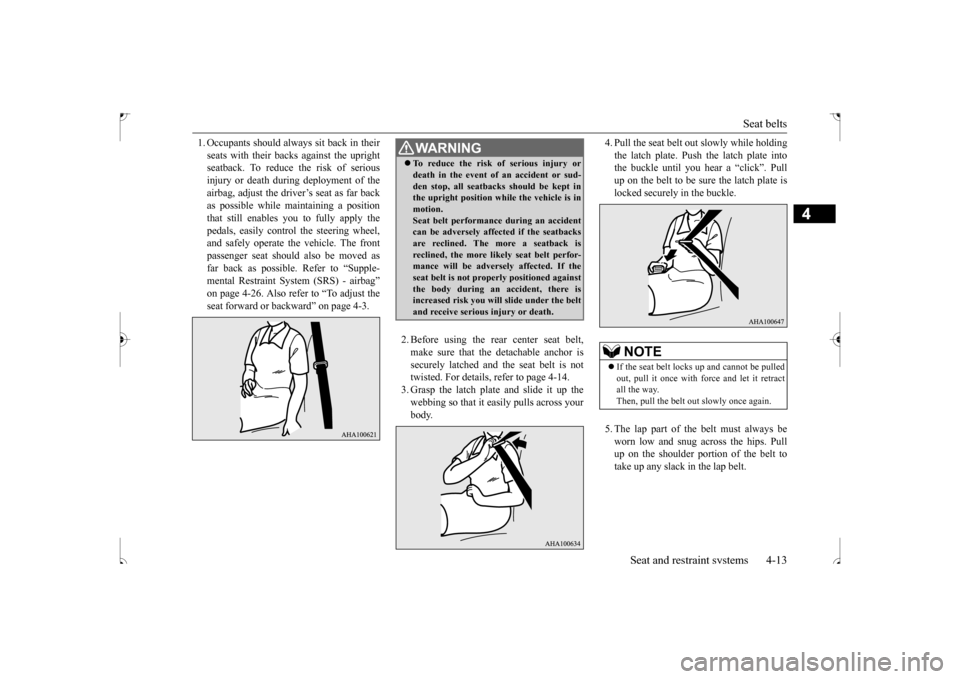
1. Occupants should always sit back in their seats with their backs against the upright seatback. To reduce the risk of serious injury or death during deployment of theairbag, adjust the driver’s seat as far back as possible while maintaining a position that still enables you to fully apply thepedals, easily control the steering wheel, and safely operate the vehicle. The front passenger seat should also be moved asfar back as possible. Refer to “Supple-mental Restraint System (SRS) - airbag” on page 4-26. Also refer to “To adjust the seat forward or backward” on page 4-3.
2. Before using the rear center seat belt, make sure that the detachable anchor issecurely latched and the seat belt is not twisted. For details, refer to page 4-14. 3. Grasp the latch plate and slide it up thewebbing so that it easily pulls across your body.
4. Pull the seat belt out slowly while holding the latch plate. Push the latch plate into the buckle until you hear a “click”. Pull up on the belt to be sure the latch plate islocked securely in the buckle. 5. The lap part of the belt must always be worn low and snug across the hips. Pull up on the shoulder portion of the belt to take up any slack in the lap belt.
WA R N I N G To reduce the risk of serious injury or death in the event of an accident or sud- den stop, all seatbacks should be kept in the upright position while the vehicle is in motion.Seat belt performance during an accident can be adversely affected if the seatbacks are reclined. The more a seatback isreclined, the more likely seat belt perfor- mance will be adversely affected. If the seat belt is not properly positioned againstthe body during an accident, there is increased risk you will slide under the belt and receive serious injury or death.
NOTE
If the seat belt locks up and cannot be pulled out, pull it once with force and let it retractall the way. Then, pull the belt out slowly once again.
BK0239500US.bo
ok 13 ページ 2016年5月13日 金曜日 午前8時53分
Page 38 of 399
Seat belt use during pregnancy
Seat and restraint systems 4-17
4
N00406300344
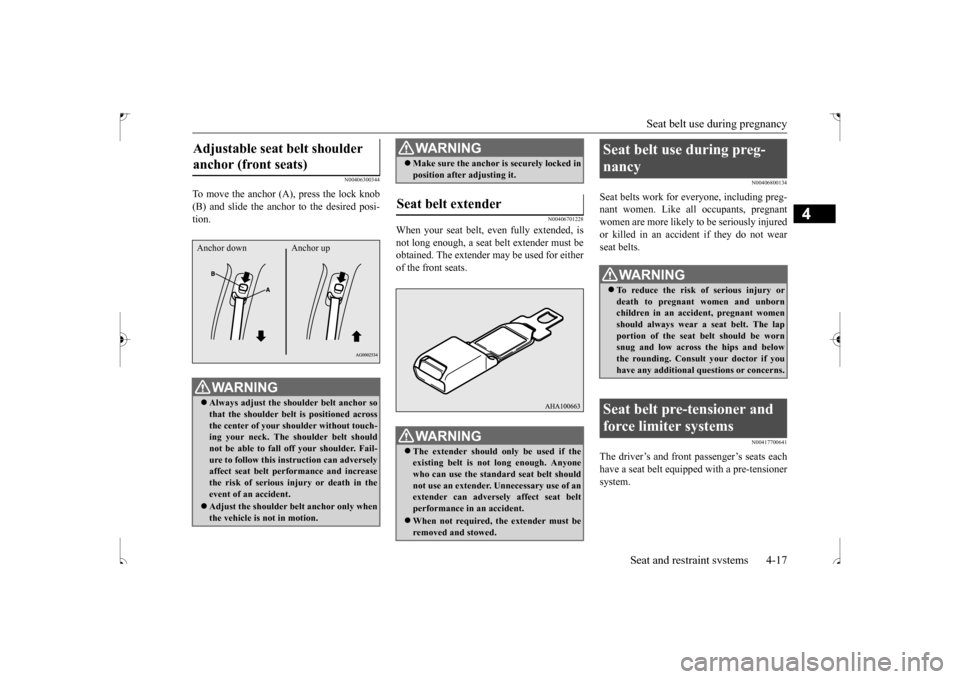
To move the anchor (A), press the lock knob (B) and slide the anchor to the desired posi- tion.
N00406701228
When your seat belt, even fully extended, is not long enough, a seat belt extender must be obtained. The extender may be used for either of the front seats.
N00406800134
Seat belts work for ev
eryone, including preg-
nant women. Like all occupants, pregnantwomen are more likely to be seriously injured or killed in an accident if they do not wear seat belts.
N00417700641
The driver’s and front passenger’s seats eachhave a seat belt equipped with a pre-tensioner system.
Adjustable seat belt shoulder anchor (front seats)
WA R N I N G Always adjust the shoulder belt anchor so that the shoulder belt is positioned acrossthe center of your shoulder without touch- ing your neck. The shoulder belt should not be able to fall off your shoulder. Fail-ure to follow this instruction can adversely affect seat belt performance and increase the risk of serious injury or death in theevent of an accident. Adjust the shoulder belt anchor only when the vehicle is not in motion.
Anchor down Anchor up
Make sure the anchor is securely locked in position after adjusting it.
Seat belt extender
WA R N I N G The extender should only be used if the existing belt is not long enough. Anyone who can use the standard seat belt shouldnot use an extender. Unnecessary use of an extender can adversely affect seat belt performance in an accident. When not required, the extender must be removed and stowed.WA R N I N G
Seat belt use during preg- nancy
WA R N I N G To reduce the risk of serious injury or death to pregnant women and unbornchildren in an accident, pregnant women should always wear a seat belt. The lap portion of the seat belt should be wornsnug and low across the hips and below the rounding. Consult your doctor if you have any additional questions or concerns.
Seat belt pre-tensioner and force limiter systems
BK0239500US.bo
ok 17 ページ 2016年5月13日 金曜日 午前8時53分
Page 40 of 399
Child restraint systems
Seat and restraint systems 4-19
4
N00408700081
This warning light tells you if there is a prob- lem involving the SRS airbags and the seatbelt pre-tensioner system. Refer to “SRS warning light/display” on page 4-32.
N00408900126
In the event of an accident, the seat belt force limiter system will help reduce the force applied to the driver and front seat passenger.
N00407101724
When transporting infants or small childrenin your vehicle, an appropriate child restraint system must always be used. This is requiredby law in the U.S. and Canada. Child restraint systems specifically designed for infants and small children are offered byseveral manufacturers. Choose only a child restraint system with a label certifying that it complies with Federal Motor Vehicle SafetyStandard 213 (FMVSS 213) or Motor Vehicle Restraint Systems and Booster Seats Safety Regulations (RSSR). Look for the manufac-turer’s statement of compliance on the box and child restraint system itself.
The child restraint system should be appropri- ate for your child’s weight and height, and should properly fit your vehicle’s seat. For detailed information, refer to the instruc-tion manual accompanying the child restraint system. All children should be properly restrained in a restraint device that offers the maximum protection for their size and age.Be sure to check local, state, or provincial requirements for child size and age that may vary from the recommendations listed below. Children less than 1 year old and who weigh 22 pounds (10 kg) or less MUST ride in a rear-facing child safety seat that MUST ONLY be used in the rear seat. Children older than 1
year of age and who
weigh less than 40 pounds (18 kg) or who are less than 40 inches (100 cm) tallMUST be in a forward-facing restraint that MUST ONLY be used in the rear seat.
Children who weigh more than 40 pounds (18 kg) or who are more than 40 inches (100 cm) tall, regardless of age, should use a suitable child seat or a booster seatin the rear seat until the vehicle’s lap-and- shoulder belt fits them properly.
SRS warning Force limiter system Child restraint systems
Guidelines for child restraint system selection
WA R N I N G All children must be seated in the rear seat, and properly restrained. Accident statistics show that children of all sizes and ages are safer when properlyrestrained in the rear seat, rather than in the front seat. Any child who is too large to use a child restraint system should ride in the rear seat and wear the lap-and-shoulder beltproperly. The shoulder belt must be posi- tioned over the shoulder and across the chest, not across their neck, and with thelap belt positioned low on the child’s hips, not across their stomach. If necessary, a booster seat should be used to help achievea proper seat belt fit. Follow the booster seat manufacturer’s instructions. Only use a booster seat that is certified as comply-ing with Federal Motor Vehicle Safety Standards or Motor Vehicle Restraint Systems and Booster Seats Safety Regula- tions.
BK0239500US.bo
ok 19 ページ 2016年5月13日 金曜日 午前8時53分
Page 43 of 399
Child restraint systems 4-22 Seat and restraint systems
4
N00418901214
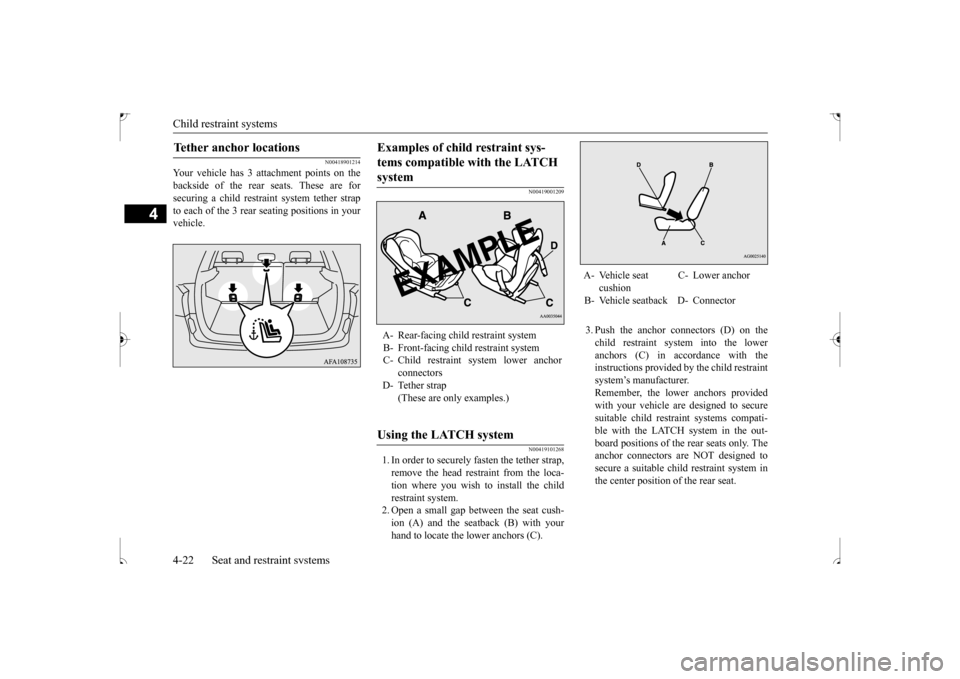
Your vehicle has 3 attachment points on the backside of the rear seats. These are forsecuring a child restraint system tether strap to each of the 3 rear seating positions in your vehicle.
N00419001209 N00419101268
1. In order to securely fasten the tether strap, remove the head restraint from the loca- tion where you wish to install the childrestraint system. 2. Open a small gap between the seat cush- ion (A) and the seatback (B) with yourhand to locate the lower anchors (C).
3. Push the anchor connectors (D) on the child restraint system into the loweranchors (C) in accordance with the instructions provided by the child restraint system’s manufacturer.Remember, the lower anchors providedwith your vehicle are designed to secure suitable child restraint systems compati- ble with the LATCH system in the out-board positions of the rear seats only. The anchor connectors are NOT designed to secure a suitable child restraint system inthe center position of the rear seat.
Tether anchor locations
Examples of child restraint sys- tems compatible with the LATCH system A- Rear-facing child restraint system B- Front-facing child restraint systemC- Child restraint system lower anchor
connectors
D- Tether strap
(These are only examples.)
Using the LATCH system
A- Vehicle seat
cushion
C- Lower anchor
B- Vehicle seatback D- Connector
BK0239500US.bo
ok 22 ページ 2016年5月13日 金曜日 午前8時53分
Page 46 of 399
Child restraint systems
Seat and restraint systems 4-25
4
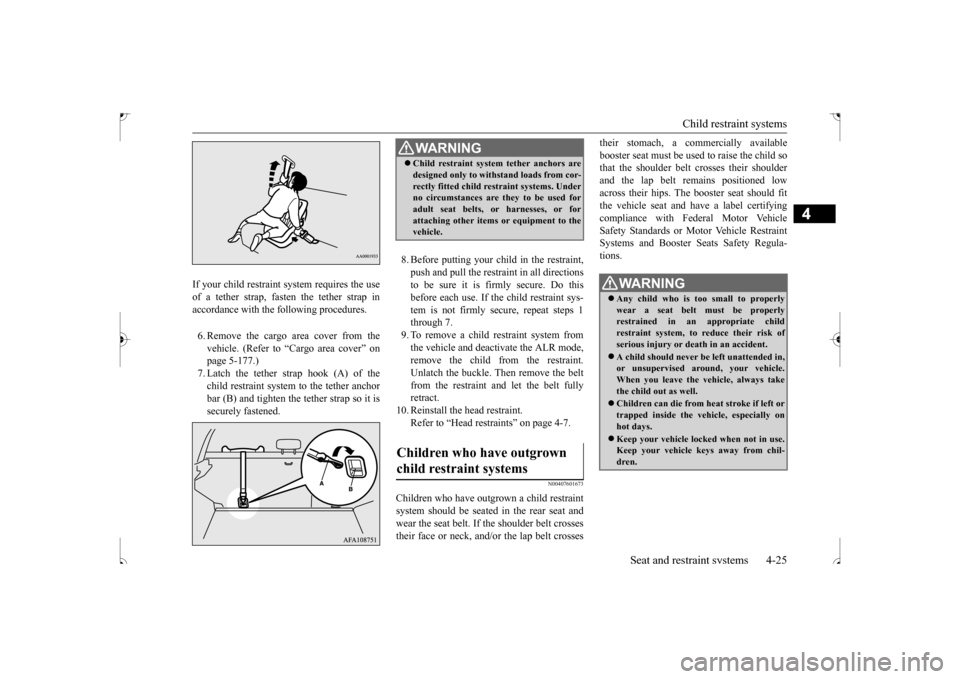
6. Remove the cargo area cover from the vehicle. (Refer to “Cargo area cover” on page 5-177.) 7. Latch the tether strap hook (A) of thechild restraint system to the tether anchorbar (B) and tighten the tether strap so it is securely fastened.
8. Before putting your child in the restraint, push and pull the restraint in all directions to be sure it is firmly secure. Do this before each use. If the child restraint sys-tem is not firmly secure, repeat steps 1 through 7. 9. To remove a child restraint system fromthe vehicle and deactivate the ALR mode, remove the child from the restraint. Unlatch the buckle. Then remove the beltfrom the restraint and let the belt fully retract.
10. Reinstall the head restraint.
Refer to “Head restraints” on page 4-7.
N00407601673
Children who have outgrown a child restraint system should be seated in the rear seat and wear the seat belt. If the shoulder belt crossestheir face or neck, and/or the lap belt crosses
their stomach, a commercially available booster seat must be used to raise the child so that the shoulder belt crosses their shoulder and the lap belt remains positioned lowacross their hips. The booster seat should fit the vehicle seat and have a label certifying compliance with Federal Motor VehicleSafety Standards or Motor Vehicle Restraint Systems and Booster Seats Safety Regula- tions.
If your child restraint system requires the use of a tether strap, fasten the tether strap in accordance with the following procedures.
WA R N I N G Child restraint system tether anchors are designed only to withstand loads from cor- rectly fitted child restraint systems. Under no circumstances are they to be used for adult seat belts, or harnesses, or forattaching other items or equipment to the vehicle.
Children who have outgrown child restraint systems
WA R N I N G Any child who is too small to properly wear a seat belt must be properlyrestrained in an appropriate child restraint system, to reduce their risk of serious injury or death in an accident. A child should never be left unattended in, or unsupervised around, your vehicle.When you leave the vehicle, always take the child out as well. Children can die from he
at stroke if left or
trapped inside the vehicle, especially on hot days. Keep your vehicle locked when not in use. Keep your vehicle keys away from chil- dren.
BK0239500US.bo
ok 25 ページ 2016年5月13日 金曜日 午前8時53分
Page 47 of 399
Maintenance and inspection of seat belts 4-26 Seat and restraint systems
4
N00407001374
Regularly check your seat belt buckles and their release mechanisms for positive engage-ment and release of the latch plate. Check the retractors for automatic locking when in the Automatic Locking Retractor function. The entire seat belt assembly should be replaced if the webbing shows any obviouscuts, tears, increase in thickness in any sec- tion of the webbing from broken fibers, or severe fading from sunlight. All of these con-ditions indicate a weakening of the belt, which may adversely affect seat belt perfor- mance in an accident.
N00407701762
This vehicle is equipped with a SupplementalRestraint System (SRS), which includes air-bags for the driver and passengers. The SRS front airbags are designed to supple- ment the primary protection of the driver and front passenger seat belt systems by provid-ing those occupants with protection against head and chest injuries in certain moderate to severe frontal collisions. The SRS front air-bags, together with sensors at the front of the vehicle and sensors attached to the front seats, form an advanced airbag system. The SRS driver’s knee airbag is designed to supplement the primary protection of the
driver’s seat belt system. It can reduce the forward movement of the driver’s lower legs and provide increased overall body protection in certain moderate to severe frontal colli-sions. The SRS side airbags and the curtain airbags are also designed to supplement the seat belts. The SRS side airbags provide the driver andfront passenger with protection against chest injuries by deploying the bag on the side impacted in moderate to severe side impactcollisions. The SRS curtain airbags providethe driver and the passengers on the front seat and the rear outboard seats with protection against head injuries by deploying the curtainairbag on the side impacted in moderate to severe side impact collisions and by deploy- ing both curtain airbags when a rollover isdetected. The curtain airbags are also designed to help reduce the risk of complete and partial ejection from the vehicle throughside windows in both side impact and roll- over type accidents. The SRS airbags are NOT
a substitute for use
of the seat belts. For maximum protection inall types of accidents, seat belts must ALWAYS be worn by everyone who drives or rides in this vehicl
e (with infants and small
children in an appropriate child restraint sys- tem in the rear seat, and older children buck- led in the rear seat). Refer to “Child restraint
Maintenance and inspection of seat belts
WA R N I N G Do not attempt to repair or replace any part of the seat belt assemblies. This work should be done by an authorizedMitsubishi Motors dealer. Failure to have an authorized Mitsubishi Motors dealer perform the work could reduce the effec- tiveness of the belts and could result in a serious injury or death in an accident.
Never use an organic solvent to clean the seat belt webbing. Do not attempt to bleach or re-dye the seat belt webbing. These may weaken the seat belt webbing, increasing risk of injury or death in anaccident. Clean seat belt webbing only with mild soap or detergent solution and rinse itwith lukewarm water, and dry the seat belt webbing completely before retracting it.
Supplemental Restraint Sys- tem (SRS) - airbag
WA R N I N G
BK0239500US.bo
ok 26 ページ 2016年5月13日 金曜日 午前8時53分
Page 51 of 399
Supplemental Restraint System (SRS) - airbag 4-30 Seat and restraint systems
4
The main purpose of an EDR is to record, in certain crash or near crash-like situations, such as an airbag deployment or hitting a road obstacle, data that will assist in under-standing how a vehicle’s systems performed. The EDR is designed to record data related to vehicle dynamics and safety systems for ashort period of time, typically 30 seconds or less. The EDR in this vehicle is designed to record such data as: How various systems in your vehicle were operating; Whether or not the driver and passenger safety belts were buckled/fastened; How far (if at all) the driver was depress- ing the accelerator and/or brake pedal; and, How fast the vehicle was traveling.
These data can help provide a better under- standing of the circumstances in which crashes and injuries occur.
To read data recorded by an EDR, special equipment is required, and access to the vehi- cle or the EDR is needed. In addition to the vehicle manufacturer, other parties, such aslaw enforcement, that have the special equip- ment, can read the information if they have access to the vehicle or the EDR.
N00417900177
The driver’s seat position sensor is attachedto the seat rail and provides the airbag controlunit with information on the seat’s fore-aft position. The airbag control unit controls deployment of the driver’s front airbag inaccordance with the information it receives from this sensor. If there is a problem involving the driver’sseat position sensor, the SRS warning light in the instrument panel will come on. Refer to
“SRS warning light/display” on page 4-32.
N00418000322
The passenger’s seat weight sensors are attached to the seat rails and provide the air- bag control unit with information regarding the weight on the front passenger seat. Theairbag control unit controls deployment of the passenger’s front airbag in accordance with the information it receives from this sensor.
NOTE
EDR data are recorded by your vehicle only if a non-trivial crash situation occurs; no data are recorded by the EDR under normal driv- ing conditions and no personal data (e.g., name, gender, age, and crash location) arerecorded. However, other parties, such as law enforcement, could combine the EDR data with the type of personally identifyingdata routinely acquired during a crash inves- tigation.
Driver’s seat position sensor
WA R N I N G If the SRS warning light or warning dis- play comes on, have the vehicle inspectedby an authorized Mitsubishi Motors dealer as soon as possible. Please observe the following instructions to ensure that the driver’s seat position sensor can operate correctly.• Adjust the seat to the correct position,and sit well back against the seatback.Refer to “Front seats” on page 4-3.• Do not recline the seatback more thannecessary when driving.• Do not place metallic objects or luggageunder the front seat.
If the vehicle is involved in a severe impact, have the SRS sensors inspected by an authorized Mitsubishi Motors dealer as soon as possible.
Passenger’s seat weight sensors
BK0239500US.bo
ok 30 ページ 2016年5月13日 金曜日 午前8時53分
Page 52 of 399
Supplemental Restraint System (SRS) - airbag
Seat and restraint systems 4-31
4
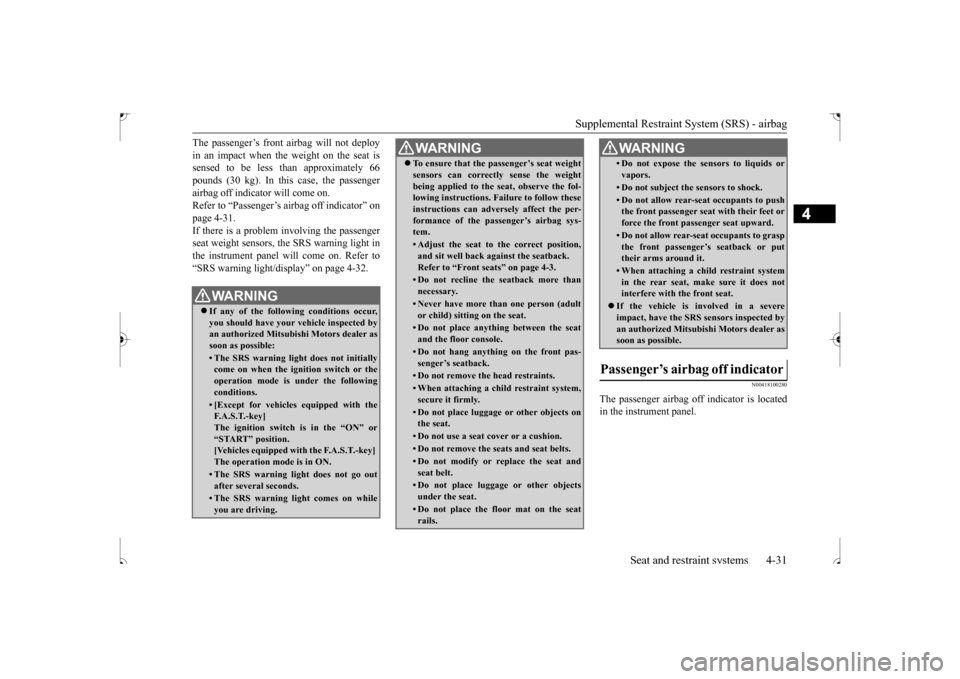
The passenger’s front airbag will not deploy in an impact when the weight on the seat is sensed to be less than approximately 66 pounds (30 kg). In this case, the passengerairbag off indicator will come on. Refer to “Passenger’s airbag off indicator” on page 4-31.If there is a problem involving the passenger seat weight sensors, the SRS warning light in the instrument panel will come on. Refer to“SRS warning light/display” on page 4-32.
N00418100280
The passenger airbag off indicator is located in the instrument panel.
WA R N I N G If any of the following conditions occur, you should have your vehicle inspected by an authorized Mitsubishi Motors dealer assoon as possible:• The SRS warning light does not initiallycome on when the ignition switch or the operation mode is under the following conditions.• [Except for vehicles equipped with theF. A . S . T. - k e y ]The ignition switch is in the “ON” or “START” position. [Vehicles equipped with the F.A.S.T.-key] The operation mode is in ON.• The SRS warning light does not go outafter several seconds.• The SRS warning light comes on whileyou are driving.
To ensure that the passenger’s seat weight sensors can correctly sense the weight being applied to the seat, observe the fol- lowing instructions. Failure to follow these instructions can adversely affect the per-formance of the passenger’s airbag sys- tem.• Adjust the seat to the correct position,and sit well back against the seatback. Refer to “Front seats” on page 4-3.• Do not recline the seatback more thannecessary.• Never have more than one person (adultor child) sitting on the seat.• Do not place anything between the seatand the floor console.• Do not hang anything on the front pas-senger’s seatback.• Do not remove the head restraints.• When attaching a child restraint system, secure it firmly.• Do not place luggage or other objects onthe seat.• Do not use a seat cover or a cushion.• Do not remove the seats and seat belts.• Do not modify or replace the seat and seat belt.• Do not place luggage or other objectsunder the seat.• Do not place the floor mat on the seatrails.WA R N I N G
• Do not expose the sensors to liquids or vapors.• Do not subject the sensors to shock.• Do not allow rear-seat occupants to pushthe front passenger seat with their feet or force the front passenger seat upward.• Do not allow rear-seat occupants to graspthe front passenger’s seatback or puttheir arms around it.• When attaching a child restraint systemin the rear seat, make sure it does not interfere with the front seat.
If the vehicle is involved in a severe impact, have the SRS sensors inspected by an authorized Mitsubishi Motors dealer assoon as possible.
Passenger’s airbag off indicator
WA R N I N G
BK0239500US.bo
ok 31 ページ 2016年5月13日 金曜日 午前8時53分
Page 59 of 399
Supplemental Restraint System (SRS) - airbag 4-38 Seat and restraint systems
4
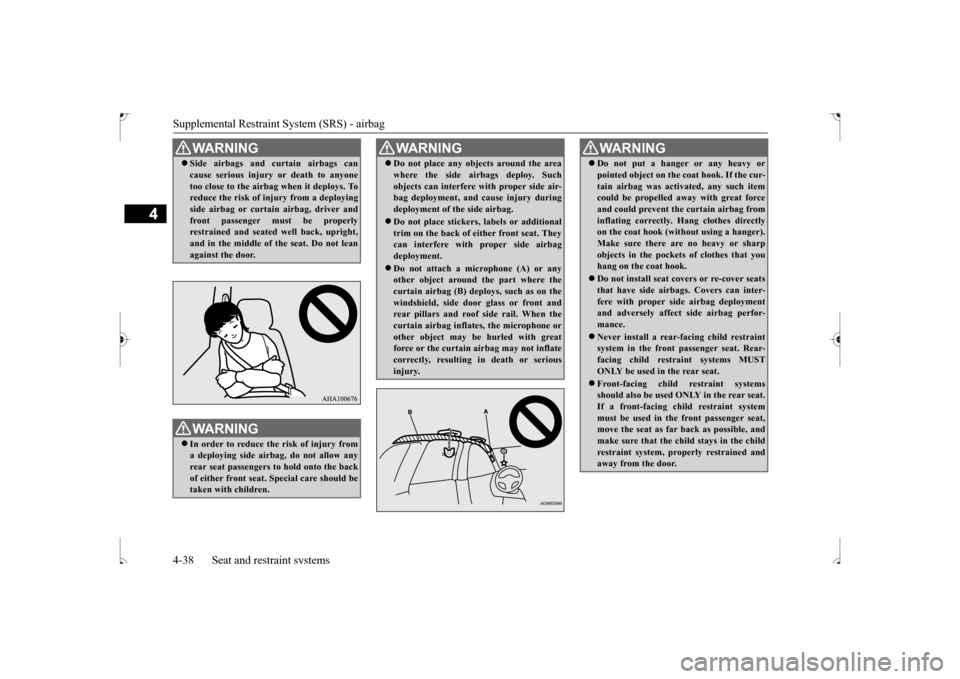
WA R N I N G Side airbags and curtain airbags can cause serious injury or death to anyone too close to the airbag when it deploys. To reduce the risk of injury from a deploying side airbag or curtain airbag, driver andfront passenger must be properly restrained and seated well back, upright, and in the middle of the seat. Do not leanagainst the door.WA R N I N G In order to reduce the risk of injury from a deploying side airbag, do not allow anyrear seat passengers to hold onto the back of either front seat. Special care should be taken with children.
Do not place any objects around the area where the side airbags deploy. Such objects can interfere with proper side air- bag deployment, and cause injury during deployment of the side airbag. Do not place stickers, labels or additional trim on the back of either front seat. Theycan interfere with proper side airbag deployment. Do not attach a microphone (A) or any other object around the part where the curtain airbag (B) deploys, such as on thewindshield, side door glass or front and rear pillars and roof side rail. When the curtain airbag inflates, the microphone orother object may be hurled with great force or the curtain airbag may not inflate correctly, resulting in death or seriousinjury.WA R N I N G
WA R N I N G Do not put a hanger or any heavy or pointed object on the coat hook. If the cur- tain airbag was activated, any such item could be propelled away with great force and could prevent the curtain airbag frominflating correctly. Hang clothes directly on the coat hook (without using a hanger). Make sure there are no heavy or sharpobjects in the pockets of clothes that you hang on the coat hook. Do not install seat covers or re-cover seats that have side airbags. Covers can inter- fere with proper side airbag deploymentand adversely affect side airbag perfor- mance. Never install a rear-facing child restraint system in the front passenger seat. Rear- facing child restraint systems MUSTONLY be used in the rear seat. Front-facing child restraint systems should also be used ONLY in the rear seat. If a front-facing child restraint system must be used in the front passenger seat,move the seat as far back as possible, and make sure that the child stays in the child restraint system, properly restrained andaway from the door.
BK0239500US.bo
ok 38 ページ 2016年5月13日 金曜日 午前8時53分