replace MITSUBISHI OUTLANDER SPORT 2017 3.G Service Manual
[x] Cancel search | Manufacturer: MITSUBISHI, Model Year: 2017, Model line: OUTLANDER SPORT, Model: MITSUBISHI OUTLANDER SPORT 2017 3.GPages: 399, PDF Size: 14.61 MB
Page 338 of 399
9
Vehicle care and maintenanceService precautions .........
.................................................................9-2
Catalytic converter
.................................................
..........................9-2
Engine hood ..............................
.......................................................9-3
View of the engine comp
artment .....................................................9-5
Engine oil and oil filt
er ................................
....................................9-5
Engine coolant ................
.................................................................9-7
Air cleaner filter ....
.................................................
..........................9-8
Manual transaxle oil (if so
equipped) ..............................................9-9
Continuously variable transmission (CVT) fluid (if so equipped)
.................................................
..........................9-9
Transfer oil (All-wheel dr
ive models) .............................................9-9
Rear axle oil (All-wheel dr
ive models) .........................................9-10
Washer fluid ....................
...............................................................9-10
Brake fluid/Clutch fluid (if so equipped).......................................9-10 Battery .......................................
..................................................... 9-11
Tires ..........................................
.....................................................9-14
Clutch pedal free play (if so equipped)..........................................9-21 Brake pedal free play
.............................................
........................9-21
Parking brake ..................
...............................................................9-21
Wiper blades ...................
...............................................................9-22
Emission-control system maintenance ..........................................9-22 General maintenance
.............................................
........................9-23
For cold and snowy weat
her ..........................................................9-24
Fusible links ....................
...............................................................9-25
Fuses .........................................
.....................................................9-25
Replacement of light bu
lbs ............................................................9-29
Vehicle care precautions
........................................
........................9-40
Cleaning the inside of your
vehicle ...............................................9-40
Cleaning the outside of your
vehicle ............................................. 9-41
BK0239500US.bo
ok 1 ページ 2016年5月13日 金曜日 午前8時53分
Page 343 of 399
Engine oil and oil filter 9-6 Vehicle care and maintenance
9
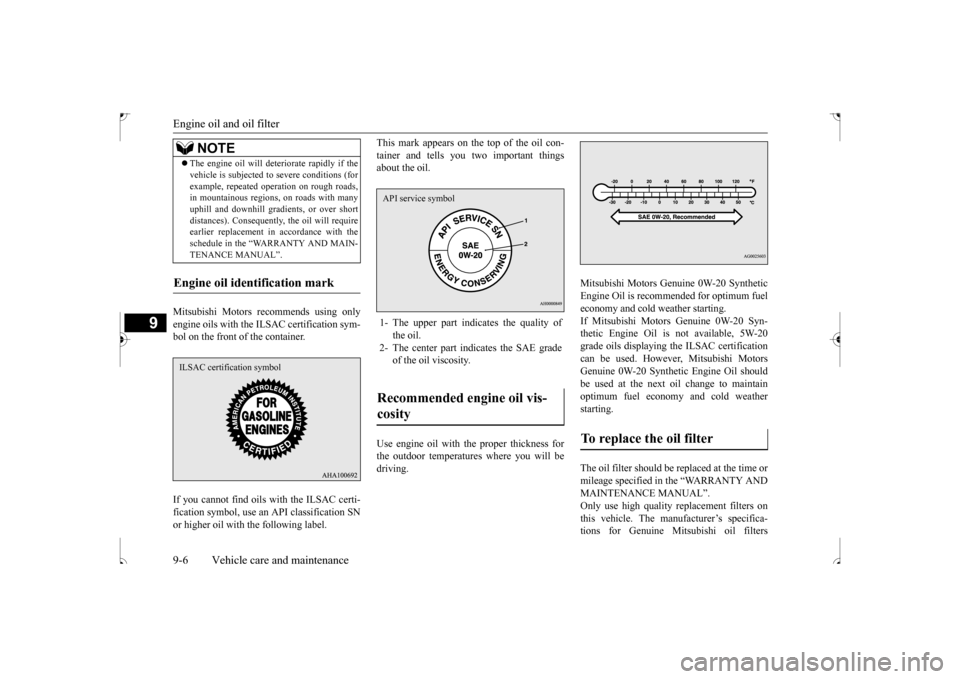
Mitsubishi Motors recommends using only engine oils with the ILSAC certification sym- bol on the front of the container. If you cannot find oils with the ILSAC certi- fication symbol, use an API classification SN or higher oil with the following label.
This mark appears on the top of the oil con- tainer and tells you two important things about the oil. Use engine oil with the proper thickness for the outdoor temperatures where you will bedriving.
Mitsubishi Motors Ge
nuine 0W-20 Synthetic
Engine Oil is recommended for optimum fuel economy and cold weather starting.If Mitsubishi Motors Genuine 0W-20 Syn- thetic Engine Oil is
not available, 5W-20
grade oils displaying the ILSAC certificationcan be used. However, Mitsubishi Motors Genuine 0W-20 Synthetic Engine Oil should be used at the next oil change to maintainoptimum fuel economy and cold weatherstarting. The oil filter should be
replaced at the time or
mileage specified in the “WARRANTY AND MAINTENANCE MANUAL”. Only use high quality replacement filters onthis vehicle. The manufacturer’s specifica- tions for Genuine Mitsubishi oil filters
The engine oil will deteriorate rapidly if the vehicle is subjected to severe conditions (for example, repeated operation on rough roads, in mountainous regions, on roads with many uphill and downhill gradients, or over shortdistances). Consequently, the oil will require earlier replacement in accordance with the schedule in the “WARRANTY AND MAIN-TENANCE MANUAL”.
Engine oil identification mark
NOTE
ILSAC certification symbol
1- The upper part indicates the quality of
the oil.
2- The center part indicates the SAE grade
of the oil viscosity.
Recommended engine oil vis- cosity API service symbol
To replace the oil filter
BK0239500US.bo
ok 6 ページ 2016年5月13日 金曜日 午前8時53分
Page 344 of 399
Engine coolant
Vehicle care and maintenance 9-7
9
require that the filter can withstand a pressure of 256 psi (1.8 MPa). A Genuine Mitsubishi oil filter is the best replacement filter. Follow the installation
instructions printed on
the filter.
N00937800584
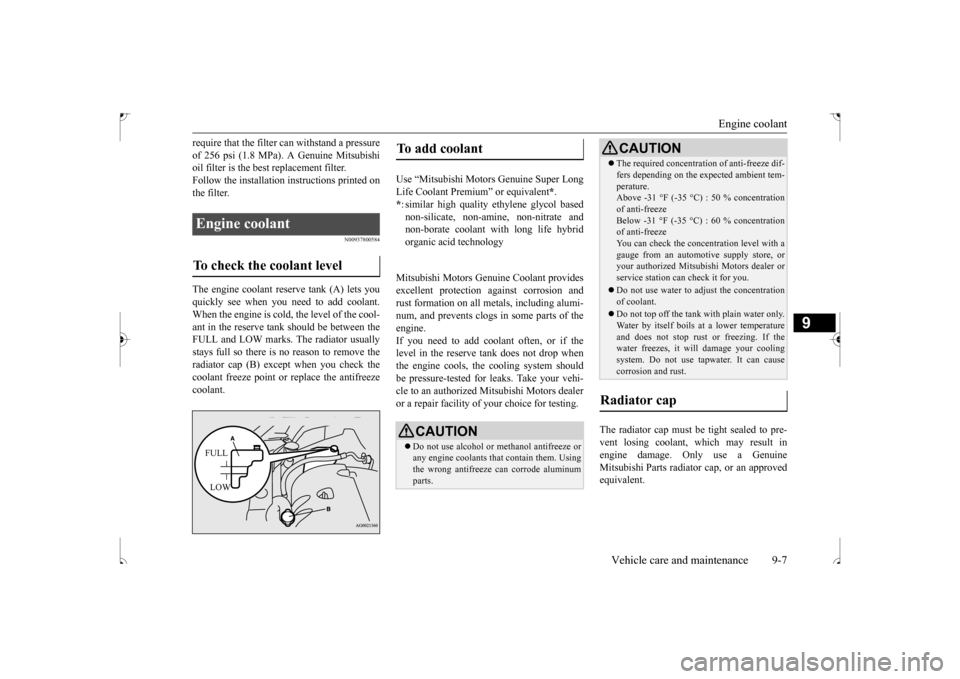
The engine coolant reserve tank (A) lets you quickly see when you need to add coolant. When the engine is cold, the level of the cool-ant in the reserve tank should be between the FULL and LOW marks. The radiator usually stays full so there is no reason to remove theradiator cap (B) except when you check the coolant freeze point or replace the antifreeze coolant.
Mitsubishi Motors Genuine Coolant provides excellent protection against corrosion andrust formation on all metals, including alumi- num, and prevents clogs in some parts of the engine.If you need to add co
olant often, or if the
level in the reserve tank does not drop when the engine cools, the cooling system shouldbe pressure-tested for leaks. Take your vehi- cle to an authorized
Mitsubishi Motors dealer
or a repair facility of your choice for testing.
The radiator cap must be tight sealed to pre- vent losing coolant, which may result in engine damage. Only use a GenuineMitsubishi Parts radiator cap, or an approved equivalent.
Engine coolant To check the coolant level
FULL LOW
To add coolant Use “Mitsubishi Motors Genuine Super LongLife Coolant Premium” or equivalent
*.
* : similar high quality ethylene glycol based non-silicate, non-amine, non-nitrate and non-borate coolant with long life hybrid organic acid technologyCAUTION Do not use alcohol or methanol antifreeze or any engine coolants that contain them. Using the wrong antifreeze can corrode aluminum parts.
The required concentration of anti-freeze dif- fers depending on the expected ambient tem- perature. Above -31 °F (-35 °C) : 50 % concentration of anti-freezeBelow -31 °F (-35 °C) : 60 % concentration of anti-freeze You can check the concentration level with agauge from an automotive supply store, or your authorized Mitsubishi Motors dealer or service station can check it for you. Do not use water to adjust the concentration of coolant. Do not top off the tank with plain water only. Water by itself boils at a lower temperatureand does not stop rust or freezing. If the water freezes, it will damage your cooling system. Do not use tapwater. It can causecorrosion and rust.
Radiator cap
CAUTION
BK0239500US.bo
ok 7 ページ 2016年5月13日 金曜日 午前8時53分
Page 345 of 399
Air cleaner filter 9-8 Vehicle care and maintenance
9
Do not overfill the reserve tank. Your vehicle uses a special radiator cap that stays sealed and lets the coolant flow from the reserve tank back to the radiatorwhen the engine cools down. If you need to change the cap, use the exact same kind. Check the coolant freeze point in the radi- ator with the proper gauge, and only when it is safe. If you add antifreeze, the con-tents of the reserve tank must be protected against freezing. Keep the front of the radiator and con- denser clean. If the engine coolant temperature does not rise after the engine is warmed-up, takeyour vehicle to an authorized Mitsubishi Motors dealer or a repair facility of your choice to have the thermostat checked,and replaced if necessary.
N00937901537
The air cleaner filter w
ill get dirty and dusty
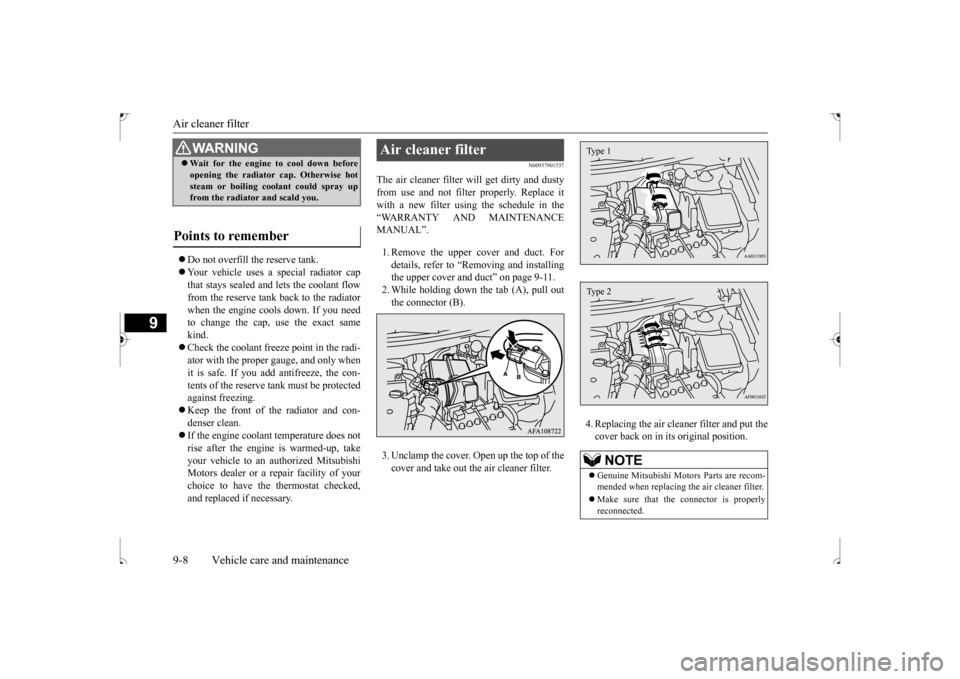
from use and not filter properly. Replace itwith a new filter using the schedule in the “WARRANTY AND MAINTENANCE MANUAL”. 1. Remove the upper cover and duct. For details, refer to “Removing and installingthe upper cover and duct” on page 9-11. 2. While holding down
the tab (A), pull out
the connector (B). 3. Unclamp the cover. Open up the top of the cover and take out the air cleaner filter.
4. Replacing the air cleaner filter and put the cover back on in its original position.
WA R N I N G Wait for the engine to cool down before opening the radiator cap. Otherwise hot steam or boiling coolant could spray up from the radiator and scald you.
Points to remember
Air cleaner filter
NOTE
Genuine Mitsubishi Moto
rs Parts are recom-
mended when replacing the air cleaner filter. Make sure that the connector is properly reconnected.Type 1Type 2
BK0239500US.bo
ok 8 ページ 2016年5月13日 金曜日 午前8時53分
Page 351 of 399
Tires 9-14 Vehicle care and maintenance
9
N00939201592
It is important to familiarize yourself with the following terms: Cold tire pressure: • The measured pressure after the vehicle has been parked for at least three hours,or • The measured pressure when the vehicle is driven less than 1 mile (1.6 km) afterhaving been parked for three hours.
Maximum pressure:the maximum permis- sible cold tire inflat
ion pressure for this
tire. Recommended inflation pressure: the inflation pressure for optimum tire perfor-mance. Intended outboard sidewall: • The sidewall that contains a whitewall,bears white lettering or bears manufac- turer, brand, and/or model name molding that is higher or deeper than the samemolding on the other sidewall of the tire, or
• The outward facing sidewall of an asym- metrical tire that has a particular side that must always face outward when mounted on a vehicle.
Passenger car tire: a tire intended for use on passenger cars,
multipurpose passen-
ger vehicles, and trucks, that have a grossvehicle weight rating (GVWR) of 10,000 pounds or less. Light truck (LT) tire: a tire designated by its manufacturer as primarily intended foruse on lightweight trucks or multipurpose passenger vehicles. Tread: portion of a tire that comes into contact with the road. Tread rib: a tread section running circum- ferentially around a tire. Tread separation: pulling away of the tread from the tire carcass. Carcass: the tire structure, except tread and sidewall rubber which, when inflated, bears the load. Sidewall: portion of a tire between the tread and bead. Section width: the linear distance between the exteriors of the sidewalls of aninflated tire, excluding elevations due to labeling, decoration, or protective bands. Bead: the part of the tire that is made of steel wires, wrapped or reinforced by ply cords and that is shaped to fit the rim.
NOTE
Check each battery terminal for corrosion. You can stop more corrosion by washing with a solution of baking soda and water. Grease the posts and clamps after cleaning or tightening them. Check to see that the battery is securely installed and cannot be moved. Also checkeach terminal for tightness. If you will not be driv
ing your vehicle for a
long period of time, remove the battery and store it in a place where the battery fluid will not freeze. The battery only should be storedwith a full charge. Before cleaning the battery, tighten all the filler port caps to keep dirt and moisture out.
Tires
WA R N I N G Driving with tires that are worn, damaged or improperly inflated is dangerous.These type tire conditions will adversely affect vehicle performance. These type tire conditions can also cause a tread separation or blowout which may result in an accident causing seriousinjury or death.
Tires, including spare tire, degrade over time with age even when they are not being used. It is recommended that tires over 6 years generally be replaced even if damage isnot obvious.WA R N I N G
BK0239500US.bo
ok 14 ページ 2016年5月13日 金曜日 午前8時53分
Page 355 of 399
Tires 9-18 Vehicle care and maintenance
9
N00939301955
Proper tire inflation pressure is essential for the safe and satisfactory operation of yourvehicle. The wrong tire pressure will cause problems in three major areas: Safety Too little pressure increases flexing in thetire and can cause tire failure. Too muchpressure can cause a tire to lose its ability to cushion shock. Objects on the road and potholes could then cause tire damage thatmay result in tire failure. Economy The wrong tire pressure can cause unevenwear patterns in the tire tread. These abnormal wear patterns will reduce the tread life, and the tire will have to bereplaced sooner. Too little pressure also makes it harder for the tire to roll, and this uses up more fuel. Ride comfort and vehicle stability The superior riding experience built into your vehicle partly depends on the correcttire pressure. Too much pressure gives an uncomfortable and jarring ride. Too little pressure feels as if your vehicle is slow torespond. Unequal tire pressures can make steering your vehicle uneven and unpredictable.
The tire pressure for your vehicle under nor- mal driving conditions is listed on the placard attached to the driver’s door sill. (Refer to “Tire and loading information plac-ard” on page 11-2.) The recommended infl
ation pressures under
normal driving conditions should be used forthe tires listed below. Tire pressures should be checked, and adjusted if necessary, at least once a month. Pressures should be checked more oftenwhenever weather temperatures change severely, because tire pressures change with outdoor temperatures. The pressures listedare always “cold inflation pressure”. Cold inflation pressure is measured after the vehicle has been parked for at least threehours or is driven less than 1 mile (1.6 km) after having been parked for three hours.
Cold inflation pressure must not go above the maximum values molded into the tire side- wall. After driving several miles, your tire inflation pressure may increase 2 to 6 psi (14to 41 kPa) from the cold inflation pressure. Do not let air out of the tires to get back to the specified cold pressure, or your tires will betoo low. Check your tires each time you refuel. If one tire looks lower than the others, check thepressure for all of them.You should also take the following safety precautions: Keep your tires inflated to the recom- mended pressures. (See the tire and load-ing information placard attached to the driver’s door sill.) Stay within the recommended load limits. Make sure that the weight of any load in your vehicle is evenly distributed. Drive at safe speeds. After filling your tires to the correct pres- sure, check them for damage and air leaks. Be sure to reinstall the caps on thevalve stems.
Tire inflation pressures
Item
Tire size
Front
Rear
Normal tire
P215/70R16
240 kPa, 35 psi
240 kPa, 35 psi
P225/55R18
230 kPa, 33 psi
230 kPa, 33 psi
Compact spare wheel
T155/90D16 420 kPa, 60 psi
BK0239500US.bo
ok 18 ページ 2016年5月13日 金曜日 午前8時53分
Page 356 of 399
Tires
Vehicle care and maintenance 9-19
9
N00939600241 N00939700141
The following maintenance steps are recom- mended:
Check tire pressures regularly. Have regular maintenance done on the wheel balance and front and rear suspen- sion alignment. Rotate your tires regularly as described in the “Tire rotation” section on page 9-19.
N00939800184
Tread wear indicators are built into the origi- nal equipment tires on your vehicle to helpyou know when your tires should be replaced. Many states have laws requiring that you replace your tires at this point.These indicators are molded into the bottom of the tread grooves and will appear when the tire tread is worn down to 1/16 inch (1.6mm).
When the bands appear next to one another in two or more places, replace your tires.
N00939901531
To even out the wear on your tires and makethem last longer, Mitsubishi Motors Corpora- tion recommends that you rotate your tires at the mileage listed in the “WARRANTY ANDMAINTENANCE MANUAL”. However, the timing for tire rotation may vary according to your vehicle condition,road surface conditions, and your own per- sonal driving habits. Any time you notice unusual wear, rotate your tires as soon as pos-sible. When rotating tires, check for uneven wear, damage, and wheel alignment. Abnormal wear is usually caused by a wrong tire pres-sure, wheels that are not aligned properly, wheels that are out-of-balance, or severe braking.Check with an authorized Mitsubishi Motors dealer or a repair faci
lity of your choice to
find out the reason for uneven tread wear.
Replacing tires and wheels
CAUTION Avoid using different size tires from the one listed and the combined use of different types of tires, as this can affect driving safety.Refer to “Tires and wheels” on page 11-5. On all-wheel drive vehicles, always use tires of the same size, same type, and same brand, and which have no wear differences. Using tires that differ in size, type, brand or thedegree of wear, will increase the differential oil temperature, resulting in possible damage to the driving system. Further, the drive trainwill be subjected to excessive loading, possi- bly leading to oil leakage, component sei- zure, or other serious problems. Only Mitsubishi Motors Authorized wheels should be used, because your vehicle isequipped with a tire pressure monitoring sys- tem. Use of another type of wheel risks air leaksand sensor damage, as it will not be possible to install the tire pressure sensor properly.
Tire maintenance
Tread wear indicator 1- Location of the tread wear indicator 2- Tread wear indicator
NOTE
Tire wear indicators can have different marks and locations depending on the tire manufacturer.
Tire rotation
BK0239500US.bo
ok 19 ページ 2016年5月13日 金曜日 午前8時53分
Page 359 of 399
Wiper blades 9-22 Vehicle care and maintenance
9
N00940700138
Check the wiper blades occasionally. Clean them regularly to remove deposits of salt androad film. Use a sponge or cloth and a mild detergent or non-abrasive cleaner to clean the blades and glass areas.Replace the blades if they continue to streak or smear. If the blades are frozen to the windshield or rear window, do not operate the wipers until the ice has melted and the blades are freed,otherwise the wiper motor may be damaged.
N00940800328
Your vehicle is equipped with an emission-control system that meets all the requirements of the U.S. Environmental Protection Agency
and Environment Canada. The emission-con- trol system is made of: a positive crankcase ventilation system an evaporative emission-control system an exhaust emission-control system
To be sure the emission-control system works properly, have your vehicle inspected and maintained by an authorized Mitsubishi Motors dealer or a repair facility of yourchoice. This should be done at the time ormileage specified in the “WARRANTY AND MAINTENANCE MANUAL”. These, and all the other “general” mainte-nance services listed in this manual, need to be performed to keep your vehicle running properly and reliably.You should also have an inspection and ser- vice any time you suspect a malfunction.
N00940900228
Spark plugs must fire properly for good engine performance and emission-control.Do not reuse them by cleaning or regapping. Change them at the mileage listed in the “WARRANTY AND MAINTENANCEMANUAL”.
Wiper blades
NOTE
Do not run the wipers on dry glass for a long time. This wears out the rubber and can scratch the glass.
During cold weather Emission-control system maintenance
NOTE
To meet government regulations and pro- mote cleaner air, your vehicle is equipped with an onboard diagnostic system (OBD). The engine electronic control module that controls OBD functions stores various data(especially about the exhaust emissions). This data will be erased if the battery cable is disconnected, which could make a rapiddiagnosis difficult. Do not disconnect the battery cable when the engine malfunction indicator (“SERVICE ENGINE SOON” or“Check engine light”) is ON.
Spark plugs
NOTE
Use the spark plugs listed under “Engine specifications” on page 11-4 or plugs that are exactly the same. Other plugs could causeengine damage, performance problems or radio noise.
BK0239500US.bo
ok 22 ページ 2016年5月13日 金曜日 午前8時53分
Page 360 of 399
General maintenance
Vehicle care and maintenance 9-23
9
N00941000040
Check the hose surfaces for any heat and mechanical damage, hard and brittle rubber,cracking, tears, cuts and abrasions. Pay spe- cial attention to the hoses closest to high heat sources such as the exhaust manifold. Checkall the hose connections, such as clamps and couplings, to make sure they are secure and that there are no leaks. If you see any wear ordamage, replace the hoses immediately.
N00950100050
Have the valve clearance checked at anauthorized Mitsubishi Motors dealer at themileage specified in the “WARRANTY AND MAINTENANCE MANUAL”. If the engine sounds abnormally loud, haveadjustments made by an authorized Mitsubishi Motors dealer.
N00941300173
Check these regularly for damage or leaks in the fuel lines and connections. Check the fuel tank filler cap for damage or looseness. Pay special attention to the fuel lines closest to
high heat sources such as the exhaust mani- fold.
N00941400187
If the fuel-vapor vent line is clogged or dam- aged, the fuel-vapor mixture will escape, pol- luting the air.Have the system checked at an authorized Mitsubishi Motors dealer at the mileage spec- ified in the “WARRANTY AND MAINTE-NANCE MANUAL”.
N00941500247
The next pages list the maintenance servicerecommended by Mitsubishi Motors Corpo- ration. In addition to the general maintenance that needs to be perfor
med at the times listed,
there are other parts which do not usually need regular maintenance. But, if any of these parts stops working prop- erly, your vehicle performance could suffer.Have these items checked if you notice a problem with them. See your authorized Mitsubishi Motors dealer for assistance, if you have any questions.
N00941600059
Good brakes are essential for safe driving. Check the brake pads for wear. For good braking performance, replace the brake padswith the same type pads as the originals.
N00941700076
Brake hoses and tubing should be checkedfor: Severe surface cracking, scuffing or worn spots. If the fabric casing of the hose is showing through any cracks or worn spotsin the rubber hose cover, the hose should be replaced. The brakes can fail if the hose wears through. Improper installation may cause twisting, or wheel, tire or chassis interference.
Fuel hoses Intake valve clearance Fuel system (tank, pipe line and connection, and fuel tank filler cap)
WA R N I N G If you see a fuel leak or if you smell fuel, do not run the engine. Any spark (includ- ing from the ignition), flame or smokingmaterial could cause an explosion or fire. Call an authorized Mitsubishi Motors dealer or a repair facility of your choicefor assistance.
Evaporative emission control system (except evaporative emission canister) General maintenance
Disc brake pads Brake hoses
BK0239500US.bo
ok 23 ページ 2016年5月13日 金曜日 午前8時53分
Page 362 of 399
Fusible links
Vehicle care and maintenance 9-25
9
the windshield, side and rear window are also useful.
N00942700305
The fusible links will melt
to prevent a fire if
a large current attempts to flow through cer- tain electrical systems. In case of a melted fusible link, see yourauthorized Mitsubishi Motors dealer or arepair facility of your choice for inspection and replacement. For the fusible links, please refer to “Fuseload capacities” on page 9-26.
N00942800856
To prevent damage to the electrical systemfrom short-circuiting or overloading, eachindividual circuit is equipped with a fuse. The
fuse blocks are located in the passenger com- partment and in the engine compartment. The fuse blocks in the passenger compart- ment are located behind the fuse lid. 1. Insert a screwdriver into the notch of the fuse lid and pry gently to remove it.
2. To put back the fuse lid, line up the fuse lid hook (A) with the clamp (B) on the instrument panel and push the lid back in.
Fusible links
WA R N I N G Fusible links must not be replaced by any other device. Failing to fit the correct fus- ible link may result in fire in the vehicle, property destruction and serious or fatalinjuries at any time.
Fuses Fuse block location
Passenger compartment A- Main fuse block B- Sub fuse block Main fuse block
BK0239500US.bo
ok 25 ページ 2016年5月13日 金曜日 午前8時53分