WEIGHT MITSUBISHI PAJERO IV 2011 User Guide
[x] Cancel search | Manufacturer: MITSUBISHI, Model Year: 2011, Model line: PAJERO IV, Model: MITSUBISHI PAJERO IV 2011Pages: 377, PDF Size: 29.43 MB
Page 290 of 377

To use the jack handle
E00802400023
1. While pushing the
snap pin (A), remove the
inside handle (B). 2. With the snap pin (C) pushed, insert the in-
side handle until it is locked. How to change a tyre
E00801201601
Before changing a
tyre, first stop your vehicle in a
safe, flat location. 1. Park the vehicle on level and stable ground.
2. Set the parking brake firmly.
3. On vehicles with M/T, turn the ignitionswitch to the “LOCK” position, move the
gearshift lever to the “R” (Reverse) position.
On vehicles with A/T, move the selector lev-
er to the “P” (PARK) position, turn the igni-
tion key to the “LOCK” position.
4. Turn on the hazard warning flashers and set up a warning triangle, flashing signal lamp,
etc., at an adequate distance from the vehi-
cle, and have all your passengers leave the ve-
hicle.
5. To prevent the vehicle from rolling when it is raised on the jack, place chocks or blocks
(A) at the tyre that is diagonally opposite
from the tyre (B) you are changing. WARNING
l Be sure to
apply chocks or blocks to the
correct tyre when jacking up the vehicle.
If the vehicle moves while jacked up, the
jack could slip out of position, leading to
an accident.
NOTE l The
chocks shown
in the illustration do not
come with your vehicle. It is recommended
that you keep one in the vehicle for use if nee-
ded.
l If chocks are not available, use stones or any
other objects that are large enough to hold
the wheel in position.
6. Get the spare wheel, jack, jack handle and wheel nut wrench ready. Refer to “Tool, jack
and jack handle” on page 6-07.
Spare wheel information E00803600266
Check the air pressure of the spare tyre frequently
and make sure
it is ready for emergency use at any
time.
Maintaining the spare wheel at the highest speci-
fied air pressure will ensure that it can always be
used under any conditions (city/high-speed driving,
varying load weight, etc.). For emergencies
6-09 6
OBKE12E1
Page 321 of 377
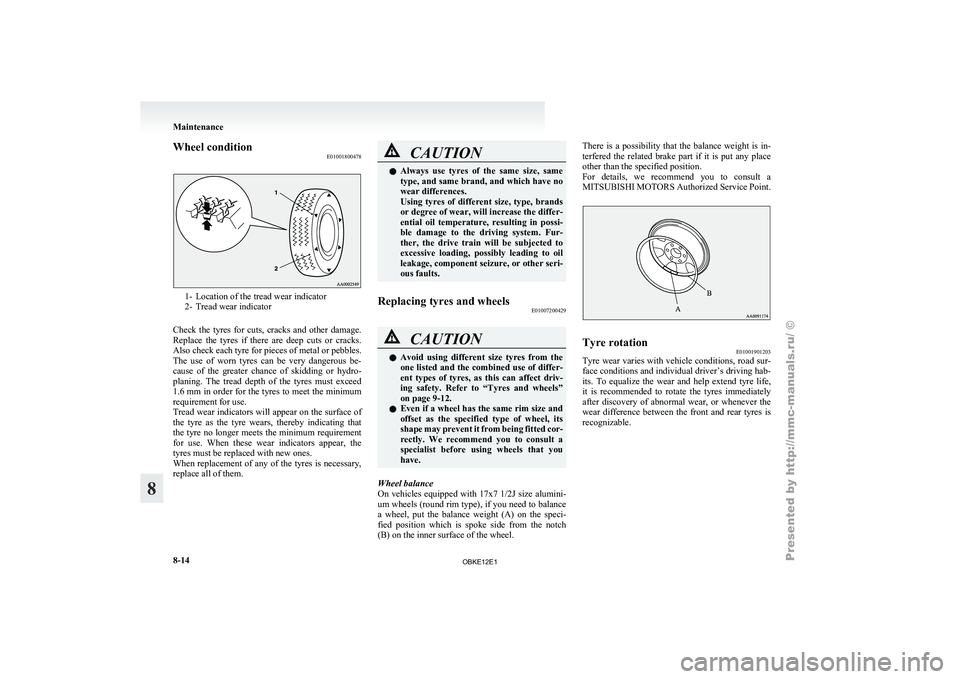
Wheel condition
E010018004781- Location of the tread wear indicator
2- Tread wear indicator
Check the
tyres for cuts, cracks and other damage.
Replace the tyres if there are deep cuts or cracks.
Also check each tyre for pieces of metal or pebbles.
The use of worn tyres can be very dangerous be-
cause of the greater chance of skidding or hydro-
planing. The tread depth of the tyres must exceed
1.6 mm in order for the tyres to meet the minimum
requirement for use.
Tread wear indicators will appear on the surface of
the tyre as the tyre wears, thereby indicating that
the tyre no longer meets the minimum requirement
for use. When these wear indicators appear, the
tyres must be replaced with new ones.
When replacement of any of the tyres is necessary,
replace all of them. CAUTION
l
Always use tyres
of the same size, same
type, and same brand, and which have no
wear differences.
Using tyres of different size, type, brands
or degree of wear, will increase the differ-
ential oil temperature, resulting in possi-
ble damage to the driving system. Fur-
ther, the drive train will be subjected to
excessive loading, possibly leading to oil
leakage, component seizure, or other seri-
ous faults.
Replacing tyres and wheels E01007200429 CAUTION
l
Avoid using different
size tyres from the
one listed and the combined use of differ-
ent types of tyres, as this can affect driv-
ing safety. Refer to “Tyres and wheels”
on page 9-12.
l Even if a wheel has the same rim size and
offset as the specified type of wheel, its
shape may prevent it from being fitted cor-
rectly. We recommend you to consult a
specialist before using wheels that you
have.
Wheel balance
On vehicles equipped
with 17x7 1/2J size alumini-
um wheels (round rim type), if you need to balance
a wheel, put the balance weight (A) on the speci-
fied position which is spoke side from the notch
(B) on the inner surface of the wheel. There is a possibility that the balance weight is in-
terfered the
related
brake part if it is put any place
other than the specified position.
For details, we recommend you to consult a
MITSUBISHI MOTORS Authorized Service Point. Tyre rotation
E01001901203
Tyre wear varies with vehicle conditions, road sur-
face conditions and
individual driver’s driving hab-
its. To equalize the wear and help extend tyre life,
it is recommended to rotate the tyres immediately
after discovery of abnormal wear, or whenever the
wear difference between the front and rear tyres is
recognizable. Maintenance
8-14
8
OBKE12E1
Page 340 of 377
Vehicle labeling
............................................................................ 9-02
Vehicle dimensions....................................................................... 9-04
Vehicle performance ..................................................................... 9-06
Vehicle weight .............................................................................. 9-07
Engine specifications .................................................................... 9-10
Electrical system ........................................................................... 9-11
Tyres and wheels
.......................................................................... 9-12
Fuel consumption ......................................................................... 9-13
Refill capacities ............................................................................ 9-15Specifications
9
OBKE12E1
Page 346 of 377
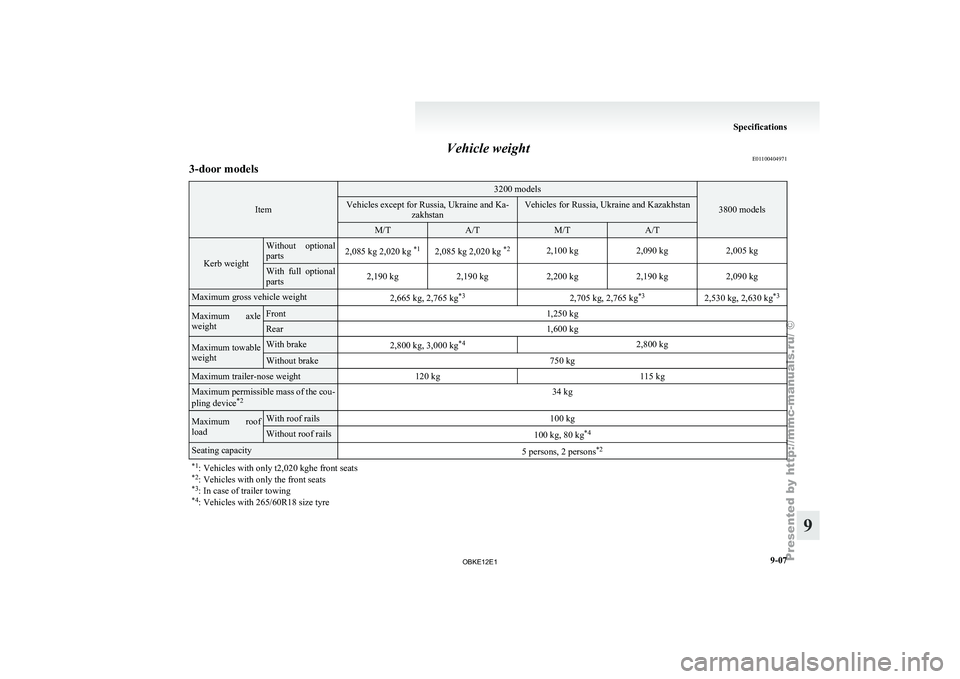
Vehicle weight
E01100404971
3-door models Item 3200 models
3800 modelsVehicles except for Russia, Ukraine and Ka-
zakhstan Vehicles for Russia, Ukraine and Kazakhstan
M/T A/T M/T A/T
Kerb weight Without optional
parts
2,085 kg 2,020 kg
*1
2,085 kg 2,020 kg *2
2,100 kg 2,090 kg2,005 kg With full optional
parts
2,190 kg
2,190 kg2,200 kg2,190 kg2,090 kgMaximum gross vehicle weight
2,665 kg, 2,765 kg*3
2,705 kg, 2,765 kg*3
2,530 kg, 2,630 kg *3Maximum axle
weight Front
1,250 kgRear
1,600 kgMaximum towable
weight With brake
2,800 kg, 3,000 kg*4
2,800 kgWithout brake
750 kgMaximum trailer-nose weight
120 kg 115 kgMaximum permissible mass of the cou-
pling device
*2 34 kgMaximum roof
load With roof rails
100 kgWithout roof rails
100 kg, 80 kg*4 Seating capacity
5 persons, 2 persons*2
*1 : Vehicles with only t2,020 kghe front seats
*2 : Vehicles with only the front seats
*3 : In case of trailer towing
*4 : Vehicles with 265/60R18 size tyre Specifications
9-07 9
OBKE12E1
Page 347 of 377
NOTE
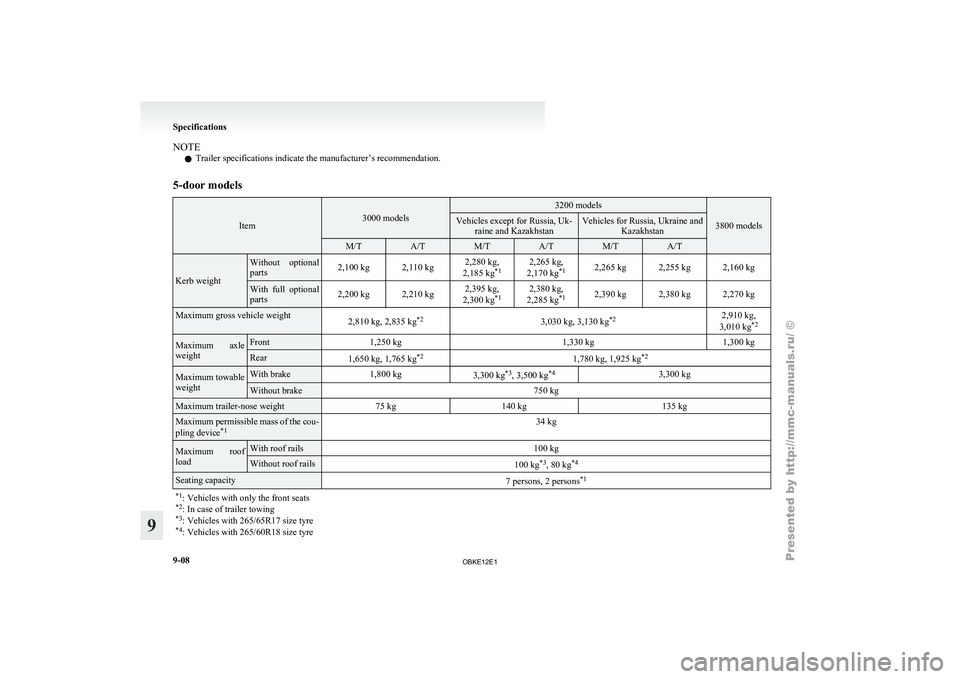
l Trailer specifications indicate the manufacturer’s recommendation.
5-door models Item 3000 models 3200 models
3800 modelsVehicles except for Russia, Uk-
raine and Kazakhstan Vehicles for Russia, Ukraine and
Kazakhstan M/T A/T M/T A/T M/T A/T
Kerb weight Without optional
parts
2,100 kg 2,110 kg 2,280 kg,
2,185 kg *1 2,265 kg,
2,170 kg *1
2,265 kg 2,255 kg 2,160 kg With full optional
parts
2,200 kg 2,210 kg 2,395 kg,
2,300 kg *1 2,380 kg,
2,285 kg *1
2,390 kg 2,380 kg 2,270 kgMaximum gross vehicle weight
2,810 kg, 2,835 kg*2
3,030 kg, 3,130 kg*2 2,910 kg,
3,010 kg *2 Maximum axle
weight Front
1,250 kg 1,330 kg1,300 kgRear
1,650 kg, 1,765 kg*2
1,780 kg, 1,925 kg*2Maximum towable
weight With brake
1,800 kg
3,300 kg*3
, 3,500 kg *4
3,300 kgWithout brake
750 kgMaximum trailer-nose weight
75 kg140 kg 135 kgMaximum permissible mass of the cou-
pling device
*1 34 kgMaximum roof
load With roof rails
100 kgWithout roof rails
100 kg*3
, 80 kg *4 Seating capacity
7 persons, 2 persons*1
*1 : Vehicles with only the front seats
*2 : In case of trailer towing
*3 : Vehicles with 265/65R17 size tyre
*4 : Vehicles with 265/60R18 size tyre Specifications
9-08
9
OBKE12E1
Page 361 of 377
Seat belt 2-20
Adjustable seat belt anchor 2-21Child restraint 2-23
Force limiter system 2-23
Inspection 2-33
Pregnant women restraint
2-22
Pretensioner system 2-23
Rear/second, third seat belt storage 2-22
Seat belt reminder/warning lamp 2-21
Seats Adjustment 2-05
Armrest 2-08,2-10
Front seats 2-05
Head restraints 2-11
Heated seats 2-08
Lumbar support 2-07
Making a flat seat 2-18
Making a luggage area 2-12
Rear seats 2-09
Seat arrangement 2-03
Second seats 2-09
Third seat 2-11
Security alarm system 1-10
Service precaution 8-02
Service reminder 3-02,3-03
Side airbag system 2-40
Side box 5-93
Snow tyres 8-15
Spark plug 9-11
Specifications 9-02
Starting 4-14
Steering Power steering fluid 8-10,9-15
Power steering system 4-41
Steering wheel height adjustment 4-08
Steering wheel lock 4-13
Steering wheel remote control switch 5-57
Stop lamps Bulb capacity 8-24 Replacement 8-27
Storage spaces 5-91
Sun visors 5-84
Sunglasses holder 5-94
Sunroof 1-17 Lock switch 1-18
Safety mechanism 1-18
Sunshade 1-19
Super select 4WD II 4-24
Supplemental restraint system 2-33 How the Supplemental Restraint System
works 2-34
Servicing 2-43
Warning lamp 2-43
T Tachometer 3-02
Tail lamps
Bulb capacity 8-24
Replacement 8-27
Tank capacity
03
Third seat 2-11
Tools 6-07 Storage 6-07
Towing 6-15
Trailer towing 4-57
Transfer oil 9-15
Transmission Automatic transmission 4-19
Manual transmission 4-16
Tripmeter 3-02
Turn-signal indication lamps 3-08
Turn-signal lever 3-35
Tyres 8-12 How to change a tyre 6-09
Inflation pressures 8-13
Rotation 8-14
Size (tyre and wheel) 9-12 Snow tyres 8-15
Spare wheel information 6-09
Tyre chains 8-15
U USB input terminal 5-82
Used engine
oils
safety instructions and disposal in-
formation 06
V Vanity mirror 5-84
Vanity mirror lamps
Bulb capacity 8-24
Replacement 8-31
Vehicle care precautions
7-02
Vehicle dimensions 9-04
Vehicle identification number 9-02
Vehicle identification number plate 9-02
Vehicle information code plate 9-02
Vehicle labeling 9-02
Vehicle performance 9-06
Vehicle weight 9-07
Ventilators 5-02
W Warning lamps 3-09
Washer
Fluid 8-07,9-15
Switch 3-37,3-41
Washing 7-03
Water temperature gauge 3-05
Waxing 7-04
Weatherstripping 8-19
Weight 9-07
Wheel condition
8-14
Wheel Alphabetical index
4
OBKE12E1