4WD MITSUBISHI PAJERO IV 2011 Owners Manual
[x] Cancel search | Manufacturer: MITSUBISHI, Model Year: 2011, Model line: PAJERO IV, Model: MITSUBISHI PAJERO IV 2011Pages: 377, PDF Size: 29.43 MB
Page 88 of 377
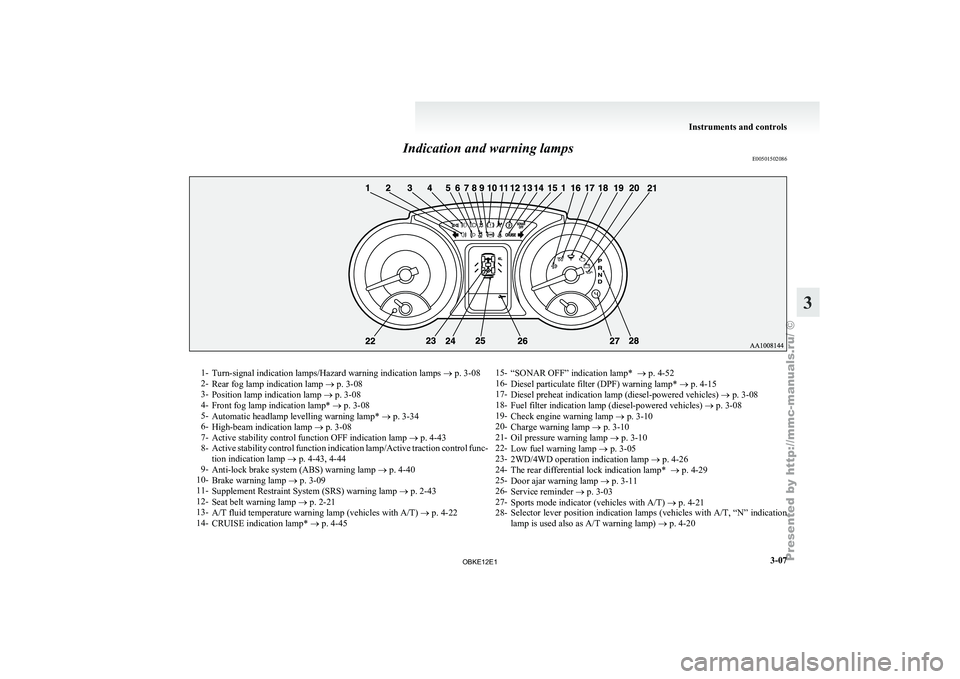
Indication and warning lamps
E005015020861-
Turn-signal indication lamps/Hazard warning indication lamps ® p. 3-08
2- Rear fog lamp indication lamp
® p. 3-08
3- Position lamp indication lamp ® p. 3-08
4- Front fog lamp indication lamp* ® p. 3-08
5- Automatic headlamp levelling warning lamp* ® p. 3-34
6- High-beam indication lamp ® p. 3-08
7- Active stability control function OFF indication lamp ® p. 4-43
8- Active stability control function indication lamp/Active traction control func-
tion indication lamp ® p. 4-43, 4-44
9- Anti-lock brake system (ABS) warning lamp ® p. 4-40
10- Brake warning lamp ® p. 3-09
11- Supplement Restraint System (SRS) warning lamp ® p. 2-43
12- Seat belt warning lamp ® p. 2-21
13- A/T fluid temperature warning lamp (vehicles with A/T) ® p. 4-22
14- CRUISE indication lamp* ® p. 4-45 15-
“SONAR OFF” indication lamp* ® p. 4-52
16- Diesel particulate filter (DPF) warning lamp* ®
p. 4-15
17- Diesel preheat indication lamp (diesel-powered vehicles) ® p. 3-08
18- Fuel filter indication lamp (diesel-powered vehicles) ® p. 3-08
19- Check engine warning lamp ® p. 3-10
20- Charge warning lamp ® p. 3-10
21- Oil pressure warning lamp ® p. 3-10
22- Low fuel warning lamp ® p. 3-05
23- 2WD/4WD operation indication lamp ® p. 4-26
24- The rear differential lock indication lamp* ® p. 4-29
25- Door ajar warning lamp ® p. 3-11
26- Service reminder ® p. 3-03
27- Sports mode indicator (vehicles with A/T) ® p. 4-21
28- Selector lever position indication lamps (vehicles with A/T, “N” indication
lamp is used also as A/T warning lamp) ® p. 4-20 Instruments and controls
3-07 3
OBKE12E1
Page 126 of 377
Economical driving.......................................................................4-02
Driving, alcohol and drugs
........................................................... 4-02
Safe driving techniques ................................................................ 4-03
Running-in recommendations....................................................... 4-04
Parking brake
................................................................................ 4-06
Parking.......................................................................................... 4-07
Steering wheel height adjustment .................................................4-08
Inside rear-view mirror ................................................................. 4-08
Outside rear-view mirrors ............................................................. 4-10
Ignition switch .............................................................................. 4-12
Steering wheel lock ...................................................................... 4-13
Starting.......................................................................................... 4-14
Diesel particulate filter (DPF)* .................................................... 4-15
Manual transmission ..................................................................... 4-16
Automatic transmission INVECS-II Sports Mode 5A/T (Intelligent & Innovative Vehicle Electronic Control
System II)................................................................................. 4-19
Super select 4WD II (SS4 II)........................................................ 4-24
Rear differential lock* .................................................................. 4-29
4-wheel drive operation ................................................................ 4-32
Inspection and maintenance following rough road oper- ation.......................................................................................... 4-35
Cautions on handling of 4-wheel drive vehicles ..........................4-35
Braking......................................................................................... 4-37
Brake assist system....................................................................... 4-38
Anti-lock brake system (ABS) ..................................................... 4-39
Power steering system.................................................................. 4-41
Active stability & traction control (ASTC) ..................................4-41
Cruise control* ............................................................................. 4-45
Reversing sensor system*............................................................. 4-49 Rear-view camera*
....................................................................... 4-52
Cargo loads................................................................................... 4-56
Trailer towing ............................................................................... 4-57Starting and driving
4
OBKE12E1
Page 149 of 377
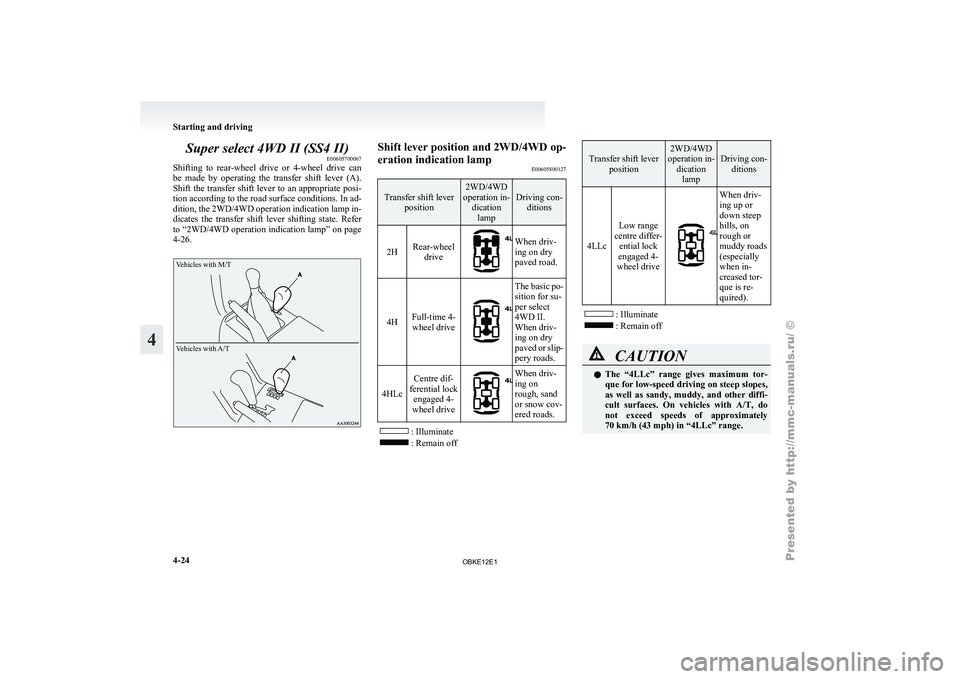
Super select 4WD II (SS4 II)
E00605700067
Shifting to rear-wheel
drive or 4-wheel drive can
be made by operating the transfer shift lever (A).
Shift the transfer shift lever to an appropriate posi-
tion according to the road surface conditions. In ad-
dition, the 2WD/4WD operation indication lamp in-
dicates the transfer shift lever shifting state. Refer
to “2WD/4WD operation indication lamp” on page
4-26.
Vehicles with M/T
Vehicles with A/T Shift lever position and 2WD/4WD op-
eration indication lamp
E00605800127 Transfer shift lever
position 2WD/4WD
operation in- dicationlamp Driving con-
ditions
2H Rear-wheel
drive When driv-
ing on dry
paved road.
4H Full-time 4-
wheel drive The basic po-
sition for su-
per select
4WD II.
When driv-
ing on dry
paved or
slip-
pery roads.
4HLc Centre dif-
ferential lock engaged 4-
wheel drive When driv-
ing on
rough, sand
or snow cov-
ered roads.
: Illuminate
: Remain off Transfer shift lever
position 2WD/4WD
operation in- dicationlamp Driving con-
ditions
4LLc Low range
centre differ- ential lock
engaged 4-
wheel drive When driv-
ing up or
down steep
hills, on
rough or
muddy roads
(especially
when in-
creased tor-
que is re-
quired).
: Illuminate
: Remain off
CAUTION
l
The “4LLc”
range
gives maximum tor-
que for low-speed driving on steep slopes,
as well as sandy, muddy, and other diffi-
cult surfaces. On vehicles with A/T, do
not exceed speeds of approximately
70 km/h (43 mph) in “4LLc” range. Starting and driving
4-24
4
OBKE12E1
Page 150 of 377
CAUTION
l
Do not drive your vehicle in the “4HLc”
or “4LLc” position on dry paved roads
and highways. Doing so may result in ex-
cessive tyre wear, increased fuel consump-
tion, and possible noise generation. It
may also increase the differential oil tem-
perature, which may damage the drive sys-
tem. Further, the drive train will be sub-
jected to excessive loading, resulting in oil
leakage, component seizure, or other seri-
ous problems. On dry paved roads and
highways, drive the vehicle in “2H” or
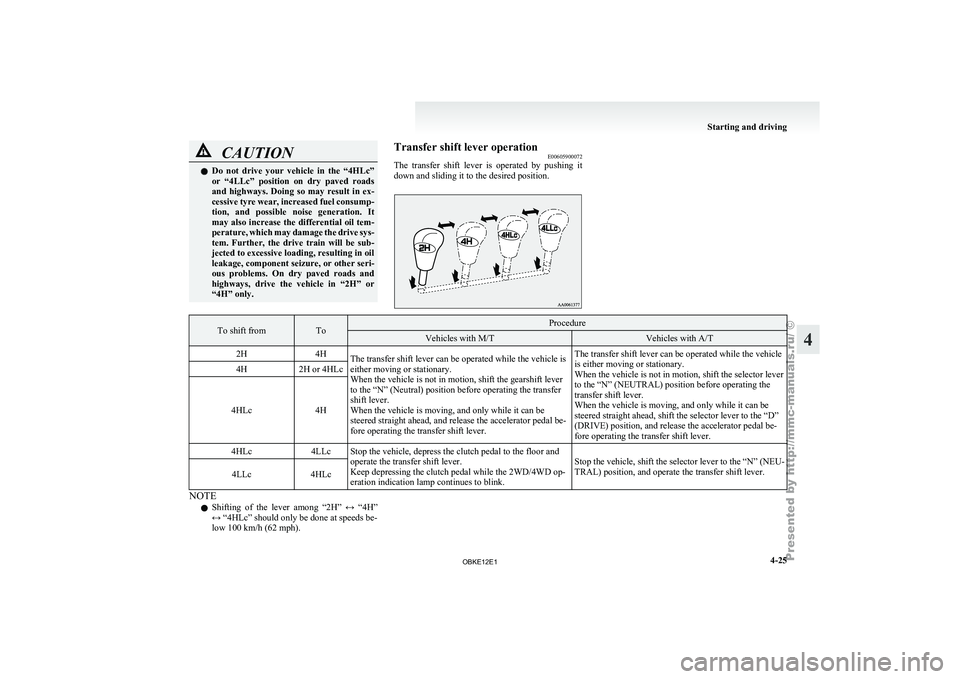
“4H” only. Transfer shift lever operation
E00605900072
The transfer shift
lever is operated by pushing it
down and sliding it to the desired position. To shift from To Procedure
Vehicles with M/T Vehicles with A/T
2H 4H
The transfer shift lever can be operated while the vehicle is
either moving or stationary.
When the vehicle is not in motion, shift the gearshift lever
to the “N” (Neutral) position before operating the transfer
shift lever.
When the vehicle is moving, and only while it can be
steered straight ahead, and release the accelerator pedal be-
fore operating the transfer shift lever. The transfer shift lever can be operated while the vehicle
is either moving or stationary.
When the vehicle is not in motion, shift the selector lever
to the “N” (NEUTRAL) position before operating the
transfer shift lever.
When the vehicle is moving, and only while it can be
steered straight ahead, shift the selector lever to the “D”
(DRIVE) position, and release the accelerator pedal be-
fore operating the transfer shift lever.
4H
2H or 4HLc
4HLc 4H
4HLc 4LLc Stop the vehicle, depress the clutch pedal to the floor and
operate the transfer shift lever.
Keep depressing the clutch pedal while the 2WD/4WD op-
eration indication lamp continues to blink. Stop the vehicle, shift the selector lever to the “N” (NEU-
TRAL) position, and operate the transfer shift lever.
4LLc 4HLcNOTE
l Shifting
of the
lever among “2H” ↔ “4H”
↔ “4HLc” should only be done at speeds be-
low 100 km/h (62 mph). Starting and driving
4-25 4
OBKE12E1
Page 151 of 377
l
When shifting
from “2H” to “4H” in cold
weather while the vehicle is in motion, the
transmission gear may make some noise. In
cold weather, try to shift the gear while the
vehicle is stopped.
l When the lever is shifted between “2H” ↔
“4H” or “4H” ↔ “4HLc” while the vehicle
is stopped, the 2WD/4WD operation indica-
tion lamp blinks while the selection is in proc-
ess. Drive slowly and normally after confirm-
ing that the lamp is illuminated. Refer to
“2WD/4WD operation indication lamp” on
page 4-26.
l Do not move the selector lever while the 2WD/
4WD operation indication lamp is blinking.
l On vehicles with cruise control, when the lev-
er is shifted among “2H” ↔ “4H” ↔
“4HLc” while the cruise control is activated,
the transfer gear may make some noise. CAUTION
l
Do not
operate
the transfer shift lever
while the rear wheels of the vehicle are
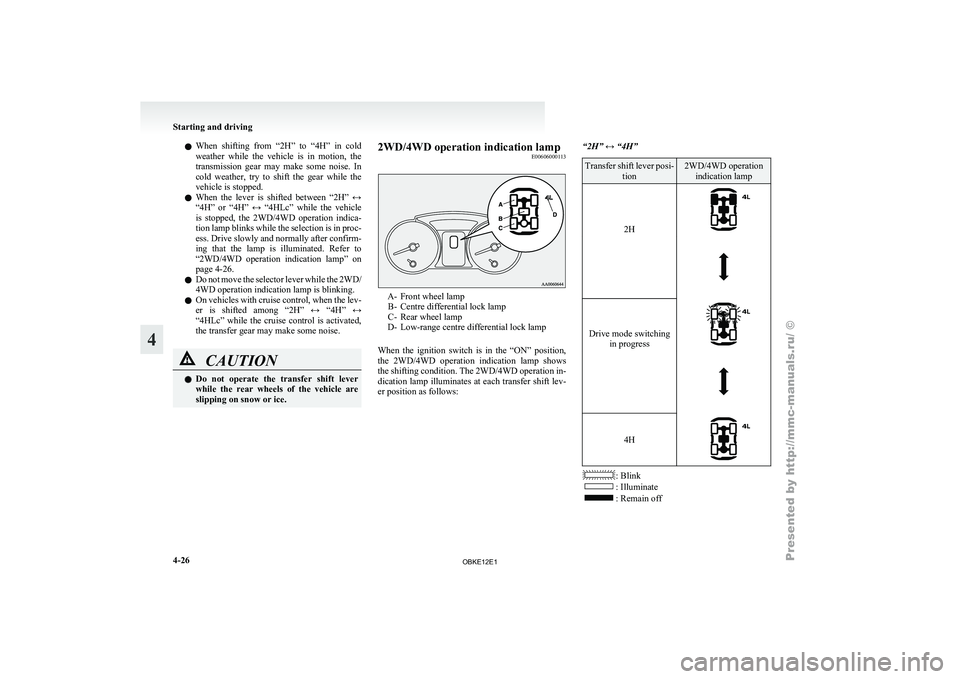
slipping on snow or ice. 2WD/4WD operation indication lamp
E00606000113 A- Front wheel lamp
B- Centre differential lock lampC- Rear wheel lamp
D-
Low-range centre differential lock lamp
When the ignition switch is in the “ON” position,
the 2WD/4WD operation indication lamp shows
the shifting condition. The 2WD/4WD operation in-
dication lamp illuminates at each transfer shift lev-
er position as follows: “2H” ↔ “4H” Transfer shift lever posi-
tion 2WD/4WD operation
indication lamp
2H
Drive mode switching
in progress
4H
: Blink
: Illuminate
: Remain offStarting and driving
4-26
4
OBKE12E1
Page 152 of 377
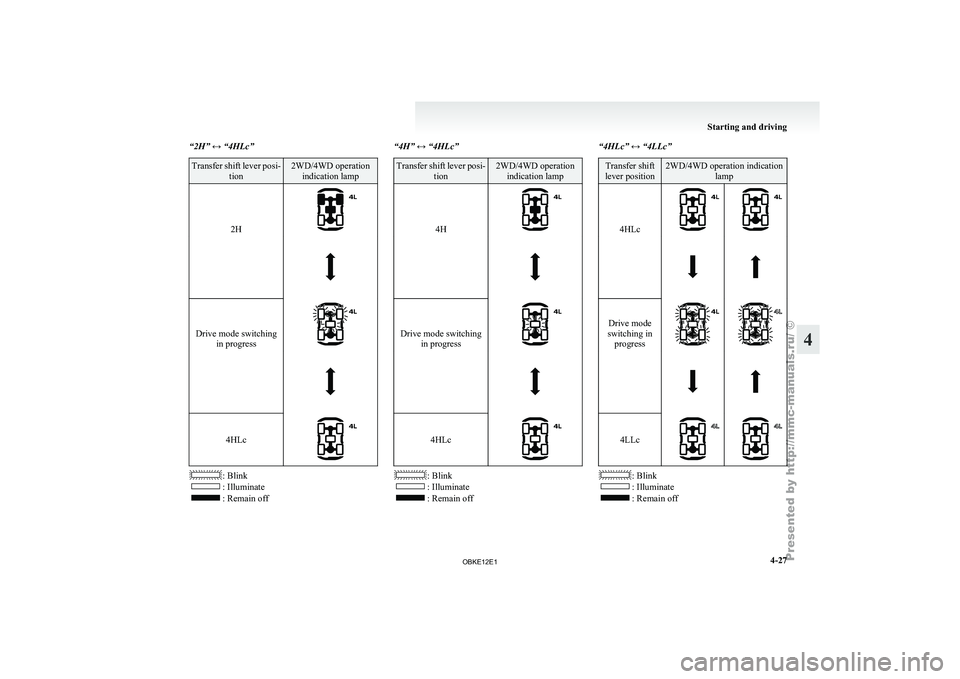
“2H” ↔ “4HLc”
Transfer shift lever posi-
tion 2WD/4WD operation
indication lamp
2H
Drive mode switching
in progress
4HLc
: Blink
: Illuminate
: Remain off “4H” ↔ “4HLc” Transfer shift lever posi-
tion 2WD/4WD operation
indication lamp
4H
Drive mode switching
in progress
4HLc
: Blink
: Illuminate
: Remain off“4HLc” ↔ “4LLc” Transfer shift
lever position 2WD/4WD operation indication
lamp
4HLc
Drive mode
switching in progress
4LLc
: Blink
: Illuminate
: Remain off Starting and driving
4-27 4
OBKE12E1
Page 153 of 377
NOTE
l The
2WD/4WD operation
indication lamp
blinks while the selection is in process. Take
the following precautions when the indica-
tion lamp is blinking. • Keep the steering wheel in the straightahead position while making range selec-
tions. If you attempt to drive forward
with the steering wheel turned, gear rat-
tling may occur and the desired range
may not actually be selected.
• If the front wheel and/or centre differen- tial lock lamps continue blinking after a
“2H” ↔ “4H” ↔ “4HLc” selection has
been made with the vehicle moving, hold
the steering wheel in the straight ahead po-
sition and slowly depress the accelerator
pedal several times.
• If, after a “4HLc” ↔ “4LLc” selection has been made, the front and rear wheel
lamps continue blinking and the desired
range is not actually selected, return the
transfer shift lever to its previous posi-
tion. Place the steering wheel in the
straight ahead position, drive the vehicle
forward, and release the accelerator ped-
al. Next, hold down the clutch pedal
(with M/T) or place the selector lever in
the “N” (NEUTRAL) position (with A/T)
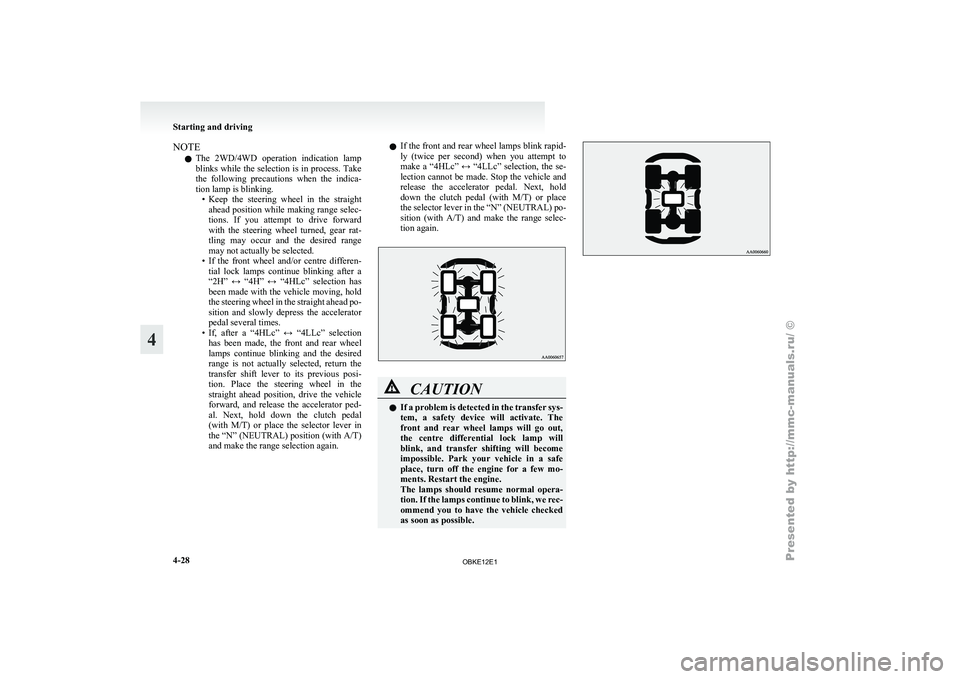
and make the range selection again. l
If
the
front and rear wheel lamps blink rapid-
ly (twice per second) when you attempt to
make a “4HLc” ↔ “4LLc” selection, the se-
lection cannot be made. Stop the vehicle and
release the accelerator pedal. Next, hold
down the clutch pedal (with M/T) or place
the selector lever in the “N” (NEUTRAL) po-
sition (with A/T) and make the range selec-
tion again. CAUTION
l
If a
problem
is detected in the transfer sys-
tem, a safety device will activate. The
front and rear wheel lamps will go out,
the centre differential lock lamp will
blink, and transfer shifting will become
impossible. Park your vehicle in a safe
place, turn off the engine for a few mo-
ments. Restart the engine.
The lamps should resume normal opera-
tion. If the lamps continue to blink, we rec-
ommend you to have the vehicle checked
as soon as possible. Starting and driving
4-28
4
OBKE12E1
Page 154 of 377
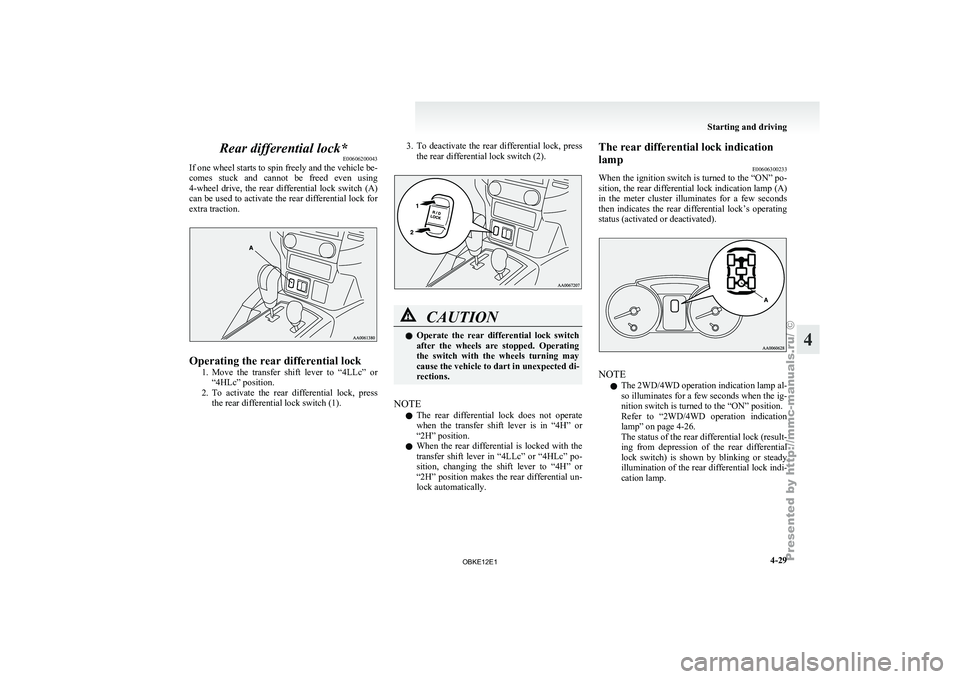
Rear differential lock*
E00606200043
If one wheel
starts to spin freely and the vehicle be-
comes stuck and cannot be freed even using
4-wheel drive, the rear differential lock switch (A)
can be used to activate the rear differential lock for
extra traction. Operating the rear differential lock
1. Move the transfer
shift lever to “4LLc” or
“4HLc” position.
2. To activate the rear differential lock, press the rear differential lock switch (1). 3. To deactivate the rear differential lock, press
the rear differential lock switch (2). CAUTION
l
Operate the rear
differential lock switch
after the wheels are stopped. Operating
the switch with the wheels turning may
cause the vehicle to dart in unexpected di-
rections.
NOTE l The
rear differential
lock does not operate
when the transfer shift lever is in “4H” or
“2H” position.
l When the rear differential is locked with the
transfer shift lever in “4LLc” or “4HLc” po-
sition, changing the shift lever to “4H” or
“2H” position makes the rear differential un-
lock automatically. The rear differential lock indication
lamp
E00606300233
When the ignition
switch is turned to the “ON” po-
sition, the rear differential lock indication lamp (A)
in the meter cluster illuminates for a few seconds
then indicates the rear differential lock’s operating
status (activated or deactivated). NOTE
l The
2WD/4WD operation
indication lamp al-
so illuminates for a few seconds when the ig-
nition switch is turned to the “ON” position.
Refer to “2WD/4WD operation indication
lamp” on page 4-26.
The status of the rear differential lock (result-
ing from depression of the rear differential
lock switch) is shown by blinking or steady
illumination of the rear differential lock indi-
cation lamp. Starting and driving
4-29 4
OBKE12E1
Page 155 of 377
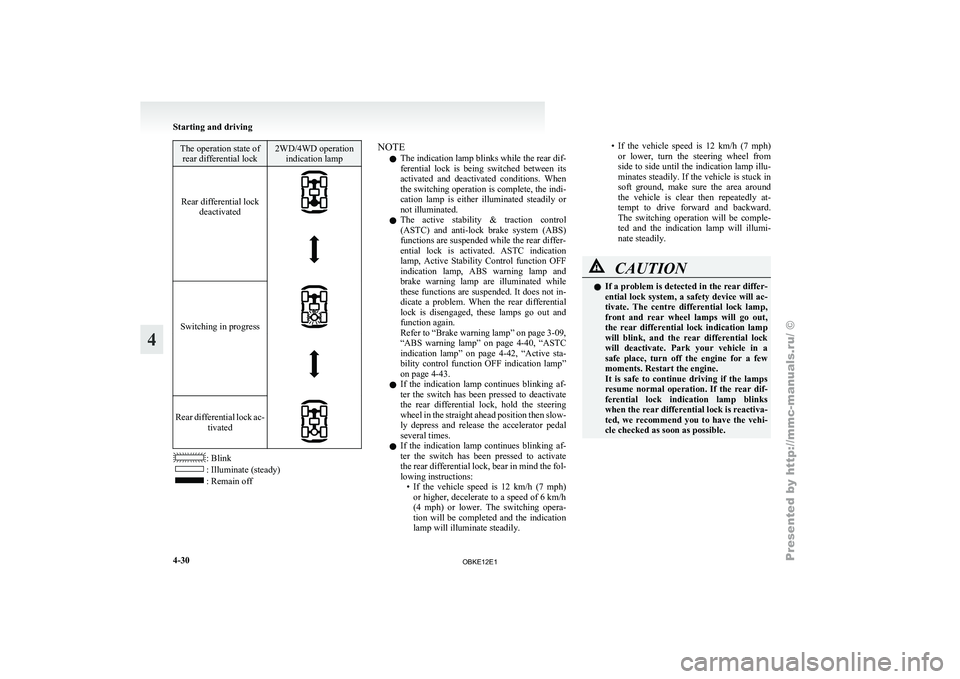
The operation state of
rear differential lock 2WD/4WD operation
indication lamp
Rear differential lock deactivated
Switching in progress
Rear differential lock ac-
tivated : Blink
: Illuminate (steady)
: Remain off NOTE
l The indication lamp blinks while the rear dif-
ferential
lock is
being switched between its
activated and deactivated conditions. When
the switching operation is complete, the indi-
cation lamp is either illuminated steadily or
not illuminated.
l The active stability & traction control
(ASTC) and anti-lock brake system (ABS)
functions are suspended while the rear differ-
ential lock is activated. ASTC indication
lamp, Active Stability Control function OFF
indication lamp, ABS warning lamp and
brake warning lamp are illuminated while
these functions are suspended. It does not in-
dicate a problem. When the rear differential
lock is disengaged, these lamps go out and
function again.
Refer to “Brake warning lamp” on page 3-09,
“ABS warning lamp” on page 4-40, “ASTC
indication lamp” on page 4-42, “Active sta-
bility control function OFF indication lamp”
on page 4-43.
l If the indication lamp continues blinking af-
ter the switch has been pressed to deactivate
the rear differential lock, hold the steering
wheel in the straight ahead position then slow-
ly depress and release the accelerator pedal
several times.
l If the indication lamp continues blinking af-
ter the switch has been pressed to activate
the rear differential lock, bear in mind the fol-
lowing instructions:
• If the vehicle speed is 12 km/h (7 mph)or higher, decelerate to a speed of 6 km/h
(4 mph) or lower. The switching opera-
tion will be completed and the indication
lamp will illuminate steadily. • If the vehicle speed is 12 km/h (7 mph)
or lower,
turn the steering wheel from
side to side until the indication lamp illu-
minates steadily. If the vehicle is stuck in
soft ground, make sure the area around
the vehicle is clear then repeatedly at-
tempt to drive forward and backward.
The switching operation will be comple-
ted and the indication lamp will illumi-
nate steadily. CAUTION
l
If a
problem
is detected in the rear differ-
ential lock system, a safety device will ac-
tivate. The centre differential lock lamp,
front and rear wheel lamps will go out,
the rear differential lock indication lamp
will blink, and the rear differential lock
will deactivate. Park your vehicle in a
safe place, turn off the engine for a few
moments. Restart the engine.
It is safe to continue driving if the lamps
resume normal operation. If the rear dif-
ferential lock indication lamp blinks
when the rear differential lock is reactiva-
ted, we recommend you to have the vehi-
cle checked as soon as possible. Starting and driving
4-30
4
OBKE12E1
Page 157 of 377
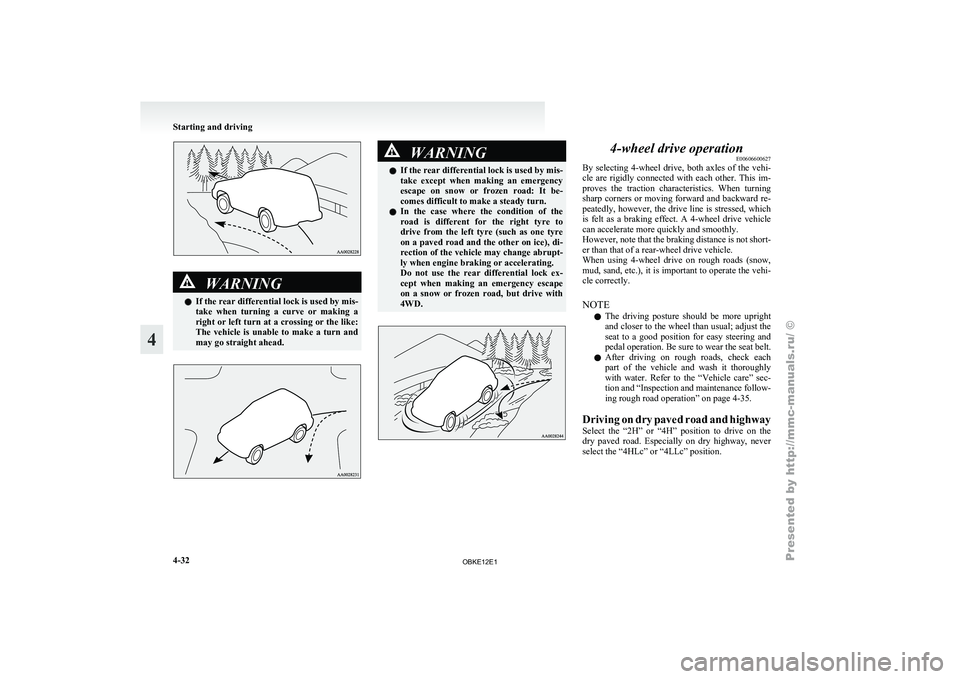
WARNING
l If the
rear differential lock is used by mis-
take when turning a curve or making a
right or left turn at a crossing or the like:
The vehicle is unable to make a turn and
may go straight ahead. WARNING
l If the rear
differential lock is used by mis-
take except when making an emergency
escape on snow or frozen road: It be-
comes difficult to make a steady turn.
l In the case where the condition of the
road is different for the right tyre to
drive from the left tyre (such as one tyre
on a paved road and the other on ice), di-
rection of the vehicle may change abrupt-
ly when engine braking or accelerating.
Do not use the rear differential lock ex-
cept when making an emergency escape
on a snow or frozen road, but drive with
4WD. 4-wheel drive operation
E00606600627
By selecting 4-wheel
drive, both axles of the vehi-
cle are rigidly connected with each other. This im-
proves the traction characteristics. When turning
sharp corners or moving forward and backward re-
peatedly, however, the drive line is stressed, which
is felt as a braking effect. A 4-wheel drive vehicle
can accelerate more quickly and smoothly.
However, note that the braking distance is not short-
er than that of a rear-wheel drive vehicle.
When using 4-wheel drive on rough roads (snow,
mud, sand, etc.), it is important to operate the vehi-
cle correctly.
NOTE
l The driving posture should be more upright
and closer to the wheel than usual; adjust the
seat to a good position for easy steering and
pedal operation. Be sure to wear the seat belt.
l After driving on rough roads, check each
part of the vehicle and wash it thoroughly
with water. Refer to the “Vehicle care” sec-
tion and “Inspection and maintenance follow-
ing rough road operation” on page 4-35.
Driving on dry paved road and highway
Select the “2H” or “4H” position to drive on the
dry paved road. Especially on dry highway, never
select the “4HLc” or “4LLc” position. Starting and driving
4-32
4
OBKE12E1