height MITSUBISHI PAJERO IV 2011 Owners Manual
[x] Cancel search | Manufacturer: MITSUBISHI, Model Year: 2011, Model line: PAJERO IV, Model: MITSUBISHI PAJERO IV 2011Pages: 377, PDF Size: 29.43 MB
Page 3 of 377
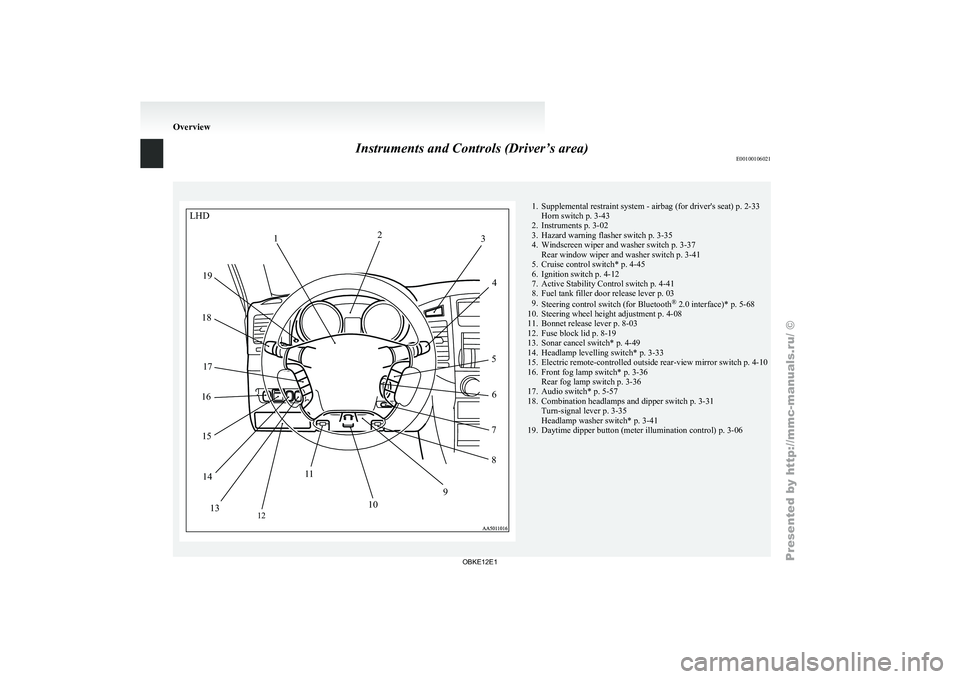
Instruments and Controls (Driver’s area)
E00100106021 1. Supplemental restraint system - airbag (for driver's seat) p. 2-33
Horn switch p. 3-43
2. Instruments p. 3-02
3. Hazard warning flasher switch p. 3-35
4.
Windscreen wiper and washer switch p. 3-37Rear window wiper and washer switch p. 3-41
5. Cruise control switch* p. 4-45
6. Ignition switch p. 4-12
7. Active Stability Control switch p. 4-41
8. Fuel tank filler door release lever p. 03
9. Steering control switch (for Bluetooth ®
2.0 interface)* p. 5-68
10. Steering wheel height adjustment p. 4-08
11. Bonnet release lever p. 8-03
12. Fuse block lid p. 8-19
13. Sonar cancel switch* p. 4-49
14. Headlamp levelling switch* p. 3-33
15. Electric remote-controlled outside rear-view mirror switch p. 4-10
16. Front fog lamp switch* p. 3-36 Rear fog lamp switch p. 3-36
17. Audio switch* p. 5-57
18. Combination headlamps and dipper switch p. 3-31 Turn-signal lever p. 3-35
Headlamp washer switch* p. 3-41
19. Daytime dipper button (meter illumination control) p. 3-06 OverviewLHD
2
1 3
4
5 6
7
8
9
10
1
1
12
13
14
15
16
17
18
19
OBKE12E1
Page 4 of 377
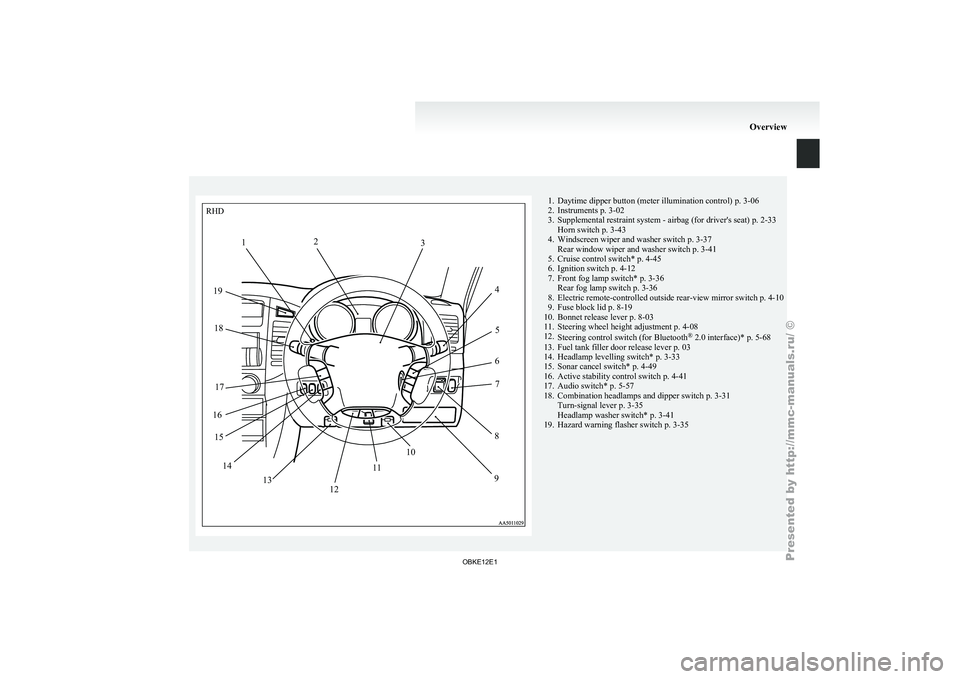
1. Daytime dipper button (meter illumination control) p. 3-06
2. Instruments p. 3-02
3. Supplemental restraint system - airbag (for driver's seat)
p. 2-33
Horn switch p. 3-43
4. Windscreen wiper and washer switch p. 3-37 Rear window wiper and washer switch p. 3-41
5. Cruise control switch* p. 4-45
6. Ignition switch p. 4-12
7. Front fog lamp switch* p. 3-36 Rear fog lamp switch p. 3-36
8. Electric remote-controlled outside rear-view mirror switch p. 4-10
9. Fuse block lid p. 8-19
10. Bonnet release lever p. 8-03
11. Steering wheel height adjustment p. 4-08
12. Steering control switch (for Bluetooth ®
2.0 interface)* p. 5-68
13. Fuel tank filler door release lever p. 03
14. Headlamp levelling switch* p. 3-33
15. Sonar cancel switch* p. 4-49
16. Active stability control switch p. 4-41
17. Audio switch* p. 5-57
18. Combination headlamps and dipper switch p. 3-31 Turn-signal lever p. 3-35
Headlamp washer switch* p. 3-41
19. Hazard warning flasher switch p. 3-35 OverviewRHD
1 2
3
45
6 7
8
9
12 10
1
1
13
14
15
16 17
18
19
OBKE12E1
Page 39 of 377
Seats
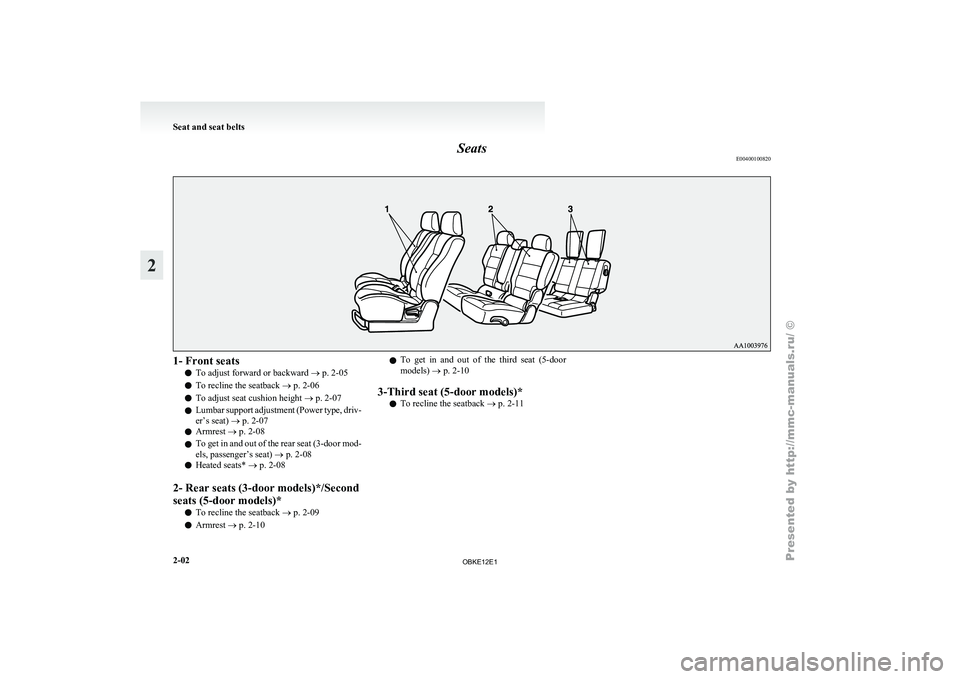
E004001008201- Front seats
l To adjust forward or backward
® p. 2-05
l To recline the seatback
® p. 2-06
l To adjust seat cushion height
® p. 2-07
l Lumbar support adjustment (Power type, driv-
er’s seat) ® p. 2-07
l Armrest ® p. 2-08
l To get in and out of the rear seat (3-door mod-
els, passenger’s seat) ® p. 2-08
l Heated seats*
® p. 2-08
2- Rear seats (3-door models)*/Second
seats (5-door models)* l To recline the seatback
® p. 2-09
l Armrest ® p. 2-10 l
To get
in and out of the third seat (5-door
models) ® p. 2-10
3-Third seat (5-door models)* l To recline the seatback
® p. 2-11Seat and seat belts
2-02
2
OBKE12E1
Page 44 of 377
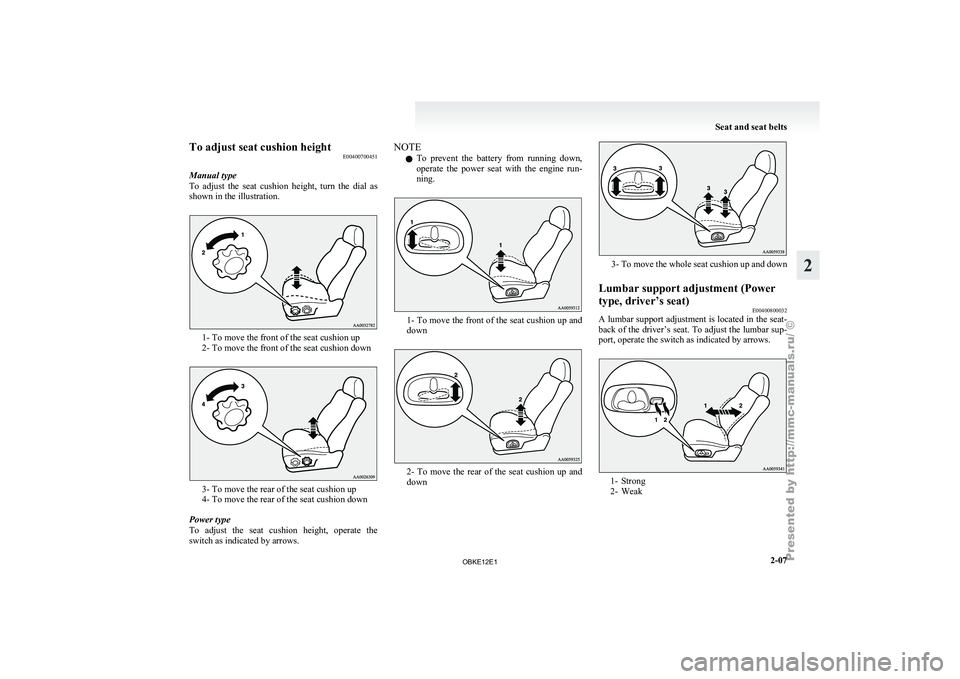
To adjust seat cushion height
E00400700451
Manual type
To adjust the
seat cushion height, turn the dial as
shown in the illustration. 1- To move the front of the seat cushion up
2- To move the front of the seat cushion down
3- To move the rear of the seat cushion up
4- To move the rear of the seat cushion down
Power type
To adjust the
seat cushion height, operate the
switch as indicated by arrows. NOTE
l To
prevent the
battery from running down,
operate the power seat with the engine run-
ning. 1- To move the front of the seat cushion up and
down
2- To move the rear of the seat cushion up and
down 3- To move the whole seat cushion up and down
Lumbar support adjustment (Power
type, driver’s seat) E00400800032
A lumbar support adjustment is located in the seat-
back of the
driver’s seat. To adjust the lumbar sup-
port, operate the switch as indicated by arrows. 1- Strong
2- Weak Seat and seat belts
2-07 2
OBKE12E1
Page 46 of 377
CAUTION
l
If the following types of persons use the
heated seats, they might become too hot
or receive minor burns (red skin, heat blis-
ters, etc.): • Children, elderly or ill people
• People with sensitive skin
• Excessively tired people
• People under the influence of alcoholor sleep inducing medication (cold
medicine, etc.)
l Do not place heavy objects on the seat or
stick pins, needles, or other pointed ob-
jects into it.
l Do not use a blanket, cushion, or other ma-
terial with high heat insulation properties
on the seat while using the heater; this
might cause the heater element to overheat
l When cleaning the seat, do not use ben-
zene, kerosene, petrol, alcohol, or other or-
ganic solvents; these might damage the
surface of the seat and also the heater ele-
ment.
l If water or any other liquid is spilled on
the seat, allow it to dry thoroughly before
attempting to use the heater.
l Turn the heater off immediately if it ap-
pears to be malfunctioning during use. Rear seats (3-door models)*/
Second seats (5-door models)* E00402000184 WARNING
l When a
person
is sitting in the middle seat-
ing position of the rear seats (3-door mod-
els)/second seats (5-door models), pull up
the head restraint to a height at which it
locks in position. Be sure to make this ad-
justment before starting to drive. Serious
injuries could otherwise be suffered as
the result of an impact. Refer to “Head re-
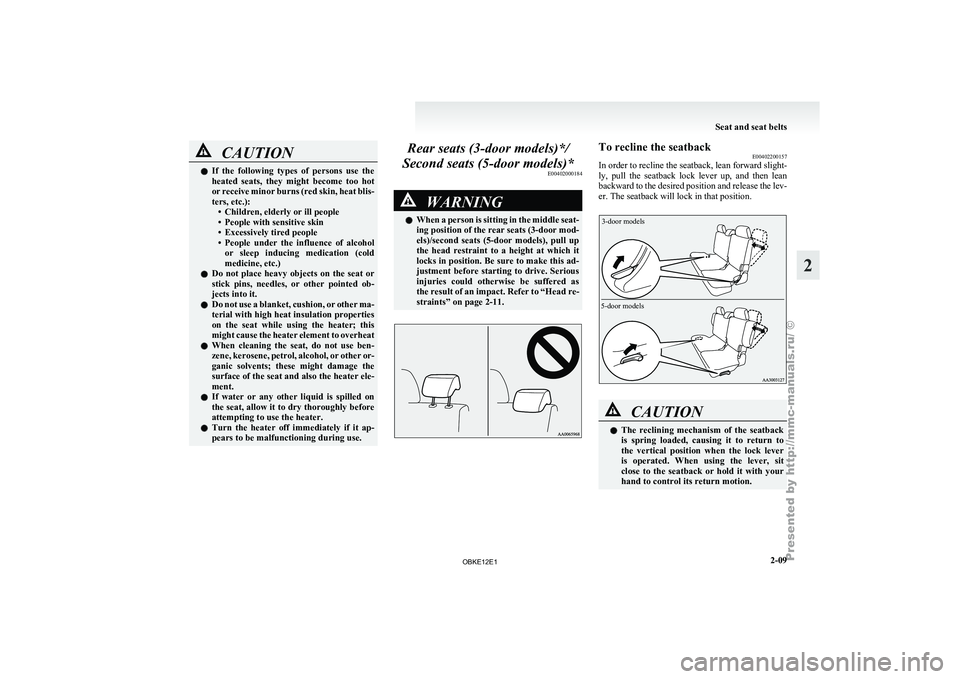
straints” on page 2-11. To recline the seatback
E00402200157
In order to
recline the seatback, lean forward slight-
ly, pull the seatback lock lever up, and then lean
backward to the desired position and release the lev-
er. The seatback will lock in that position.
3-door models
5-door models CAUTION
l
The reclining mechanism
of the seatback
is spring loaded, causing it to return to
the vertical position when the lock lever
is operated. When using the lever, sit
close to the seatback or hold it with your
hand to control its return motion. Seat and seat belts
2-09 2
OBKE12E1
Page 48 of 377
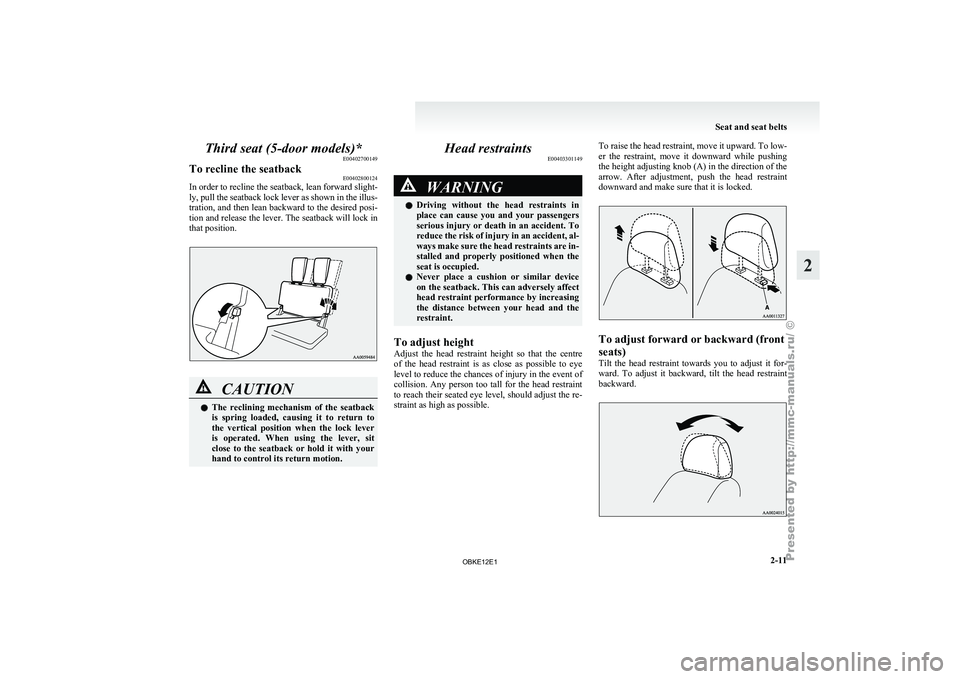
Third seat (5-door models)*
E00402700149
To recline the seatback E00402800124
In order to recline the seatback, lean forward slight-
ly, pull the
seatback lock lever as shown in the illus-
tration, and then lean backward to the desired posi-
tion and release the lever. The seatback will lock in
that position. CAUTION
l
The reclining
mechanism
of the seatback
is spring loaded, causing it to return to
the vertical position when the lock lever
is operated. When using the lever, sit
close to the seatback or hold it with your
hand to control its return motion. Head restraints
E00403301149 WARNING
l Driving without
the
head restraints in
place can cause you and your passengers
serious injury or death in an accident. To
reduce the risk of injury in an accident, al-
ways make sure the head restraints are in-
stalled and properly positioned when the
seat is occupied.
l Never place a cushion or similar device
on the seatback. This can adversely affect
head restraint performance by increasing
the distance between your head and the
restraint.
To adjust height
Adjust the head
restraint height so that the centre
of the head restraint is as close as possible to eye
level to reduce the chances of injury in the event of
collision. Any person too tall for the head restraint
to reach their seated eye level, should adjust the re-
straint as high as possible. To raise the head restraint, move it upward. To low-
er the
restraint,
move it downward while pushing
the height adjusting knob (A) in the direction of the
arrow. After adjustment, push the head restraint
downward and make sure that it is locked. To adjust forward or backward (front
seats)
Tilt
the
head
restraint towards you to adjust it for-
ward. To adjust it backward, tilt the head restraint
backward. Seat and seat belts
2-11 2
OBKE12E1
Page 49 of 377
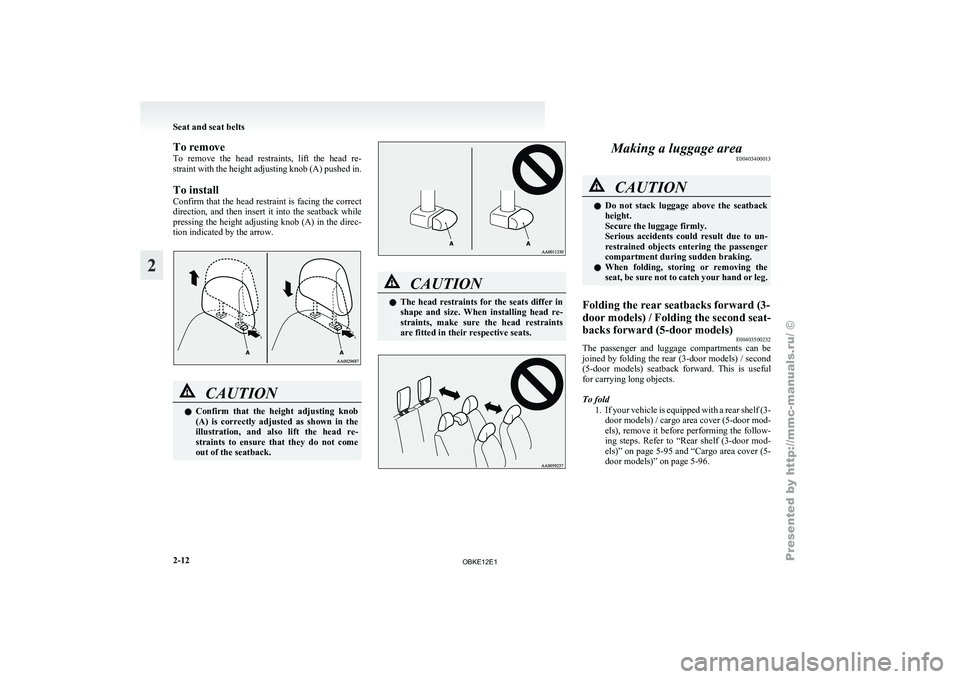
To remove
To remove
the
head restraints, lift the head re-
straint with the height adjusting knob (A) pushed in.
To install
Confirm that the head restraint is facing the correct
direction, and then insert it into the seatback while
pressing the height adjusting knob (A) in the direc-
tion indicated by the arrow. CAUTION
l
Confirm that
the
height adjusting knob
(A) is correctly adjusted as shown in the
illustration, and also lift the head re-
straints to ensure that they do not come
out of the seatback. CAUTION
l
The head
restraints
for the seats differ in
shape and size. When installing head re-
straints, make sure the head restraints
are fitted in their respective seats. Making a luggage area
E00403400013 CAUTION
l
Do not
stack
luggage above the seatback
height.
Secure the luggage firmly.
Serious accidents could result due to un-
restrained objects entering the passenger
compartment during sudden braking.
l When folding, storing or removing the
seat, be sure not to catch your hand or leg.
Folding the rear seatbacks forward (3-
door models) /
Folding the second seat-
backs forward (5-door models) E00403500232
The passenger and luggage compartments can be
joined by folding
the rear (3-door models) / second
(5-door models) seatback forward. This is useful
for carrying long objects.
To fold
1. If your vehicle is equipped with a rear shelf (3-door models) / cargo area cover (5-door mod-
els), remove it before performing the follow-
ing steps. Refer to “Rear shelf (3-door mod-
els)” on page 5-95 and “Cargo area cover (5-
door models)” on page 5-96. Seat and seat belts
2-12
2
OBKE12E1
Page 58 of 377
WARNING
l The seat belts must not be twisted when
worn.
3. Pull the belt slightly to adjust slackness as de-
sired.
To unfasten
Hold the
latch plate and push the button on the buck-
le. NOTE
l As
the belt
retracts automatically, keep hold-
ing the latch plate while retracting so that the
belt stows slowly. Failure to do this could
damage the vehicle. Seat belt reminder/warning lamp
E00409800338
The seat belt
warning lamp is located on the instru-
ment panel. A tone and warning lamp are used to
remind the driver to fasten the seat belt. When the ignition key is turned to the “ON” posi-
tion, the warning
lamp will come on and a tone
will sound for about 6 seconds. If the driver’s seat
belt remains unfastened for approximately 1 mi-
nute later, the warning lamp will flash and the tone
sound intermittently (each 12 times) when the vehi-
cle is driven. If the driver subsequently unfastens
the seat belt while driving, the warning lamp and
tone will issue further warnings. And if the seat
belt remains unfastened, the warning lamp and tone
will issue further warnings each time the vehicle
starts moving from a stop. When the seat belt is fas-
tened, the warnings will stop.
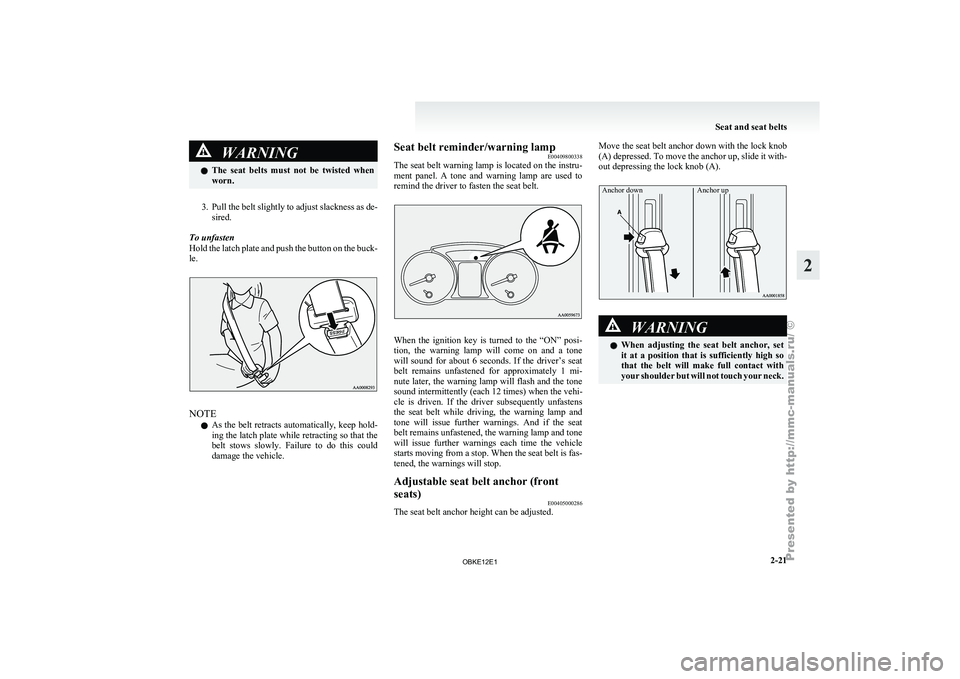
Adjustable seat belt anchor (front
seats) E00405000286
The seat belt anchor height can be adjusted. Move the seat belt anchor down with the lock knob
(A) depressed. To
move the anchor up, slide it with-
out depressing the lock knob (A).
Anchor down Anchor up WARNING
l When adjusting
the
seat belt anchor, set
it at a position that is sufficiently high so
that the belt will make full contact with
your shoulder but will not touch your neck. Seat and seat belts
2-21 2
OBKE12E1
Page 61 of 377
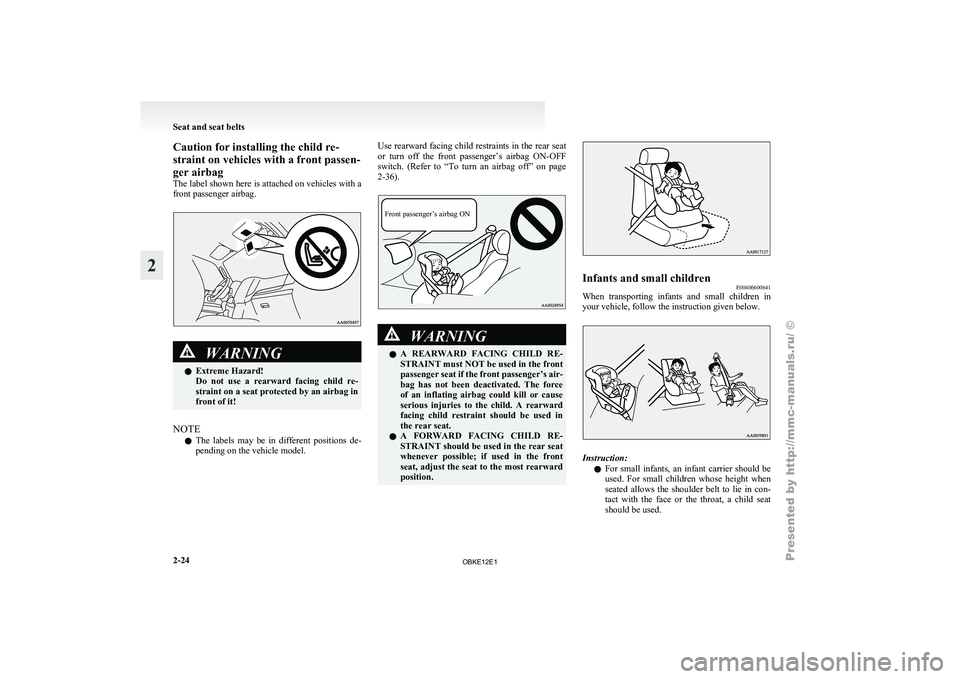
Caution for installing the child re-
straint on vehicles with a front passen-
ger airbag
The label
shown
here is attached on vehicles with a
front passenger airbag. WARNING
l Extreme Hazard!
Do not
use
a rearward facing child re-
straint on a seat protected by an airbag in
front of it!
NOTE l The
labels may
be in different positions de-
pending on the vehicle model. Use rearward facing child restraints in the rear seat
or
turn
off
the front passenger’s airbag ON-OFF
switch. (Refer to “To turn an airbag off” on page
2-36).
Front passenger’s airbag ON WARNING
l A REARWARD
FACING
CHILD RE-
STRAINT must NOT be used in the front
passenger seat if the front passenger’s air-
bag has not been deactivated. The force
of an inflating airbag could kill or cause
serious injuries to the child. A rearward
facing child restraint should be used in
the rear seat.
l A FORWARD FACING CHILD RE-
STRAINT should be used in the rear seat
whenever possible; if used in the front
seat, adjust the seat to the most rearward
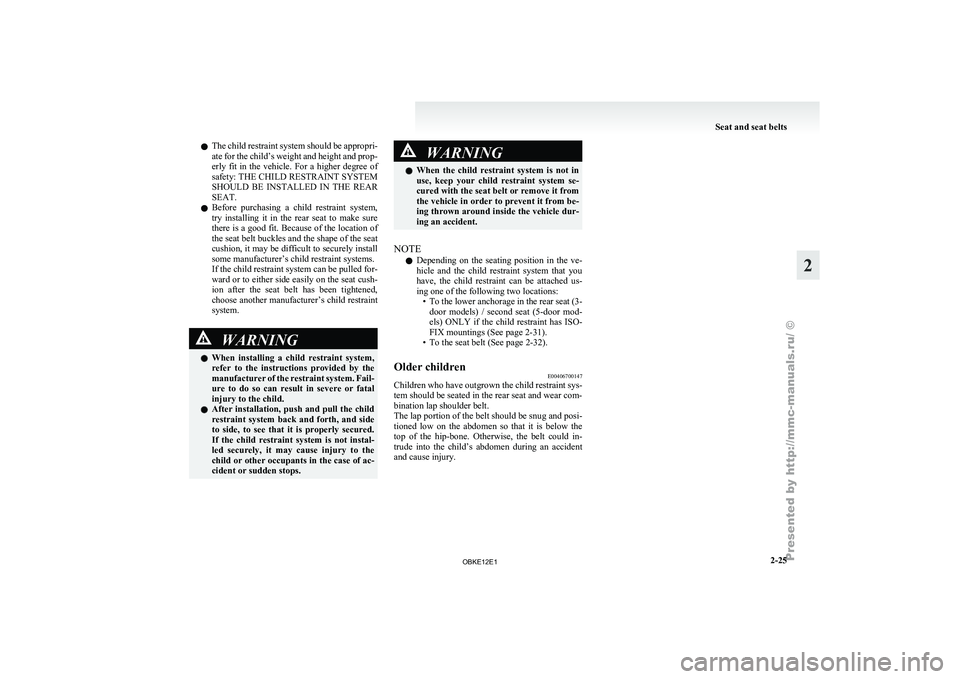
position. Infants and small children
E00406600641
When transporting infants and small children in
your vehicle, follow the instruction given below. Instruction:
l For small
infants,
an infant carrier should be
used. For small children whose height when
seated allows the shoulder belt to lie in con-
tact with the face or the throat, a child seat
should be used. Seat and seat belts
2-24
2
OBKE12E1
Page 62 of 377
l
The child
restraint system should be appropri-
ate for the child’s weight and height and prop-
erly fit in the vehicle. For a higher degree of
safety: THE CHILD RESTRAINT SYSTEM
SHOULD BE INSTALLED IN THE REAR
SEAT.
l Before purchasing a child restraint system,
try installing it in the rear seat to make sure
there is a good fit. Because of the location of
the seat belt buckles and the shape of the seat
cushion, it may be difficult to securely install
some manufacturer’s child restraint systems.
If the child restraint system can be pulled for-
ward or to either side easily on the seat cush-
ion after the seat belt has been tightened,
choose another manufacturer’s child restraint
system. WARNING
l When installing
a
child restraint system,
refer to the instructions provided by the
manufacturer of the restraint system. Fail-
ure to do so can result in severe or fatal
injury to the child.
l After installation, push and pull the child
restraint system back and forth, and side
to side, to see that it is properly secured.
If the child restraint system is not instal-
led securely, it may cause injury to the
child or other occupants in the case of ac-
cident or sudden stops. WARNING
l When the child
restraint system is not in
use, keep your child restraint system se-
cured with the seat belt or remove it from
the vehicle in order to prevent it from be-
ing thrown around inside the vehicle dur-
ing an accident.
NOTE l Depending
on the
seating position in the ve-
hicle and the child restraint system that you
have, the child restraint can be attached us-
ing one of the following two locations: • To the lower anchorage in the rear seat (3-door models) / second seat (5-door mod-
els) ONLY if the child restraint has ISO-
FIX mountings (See page 2-31).
• To the seat belt (See page 2-32).
Older children E00406700147
Children who have outgrown the child restraint sys-
tem should be seated in the rear seat and wear com-
bination lap shoulder belt.
The lap portion of the belt should be snug and posi-
tioned low on
the abdomen so that it is below the
top of the hip-bone. Otherwise, the belt could in-
trude into the child’s abdomen during an accident
and cause injury. Seat and seat belts
2-25 2
OBKE12E1