height MITSUBISHI PAJERO IV 2011 User Guide
[x] Cancel search | Manufacturer: MITSUBISHI, Model Year: 2011, Model line: PAJERO IV, Model: MITSUBISHI PAJERO IV 2011Pages: 377, PDF Size: 29.43 MB
Page 63 of 377
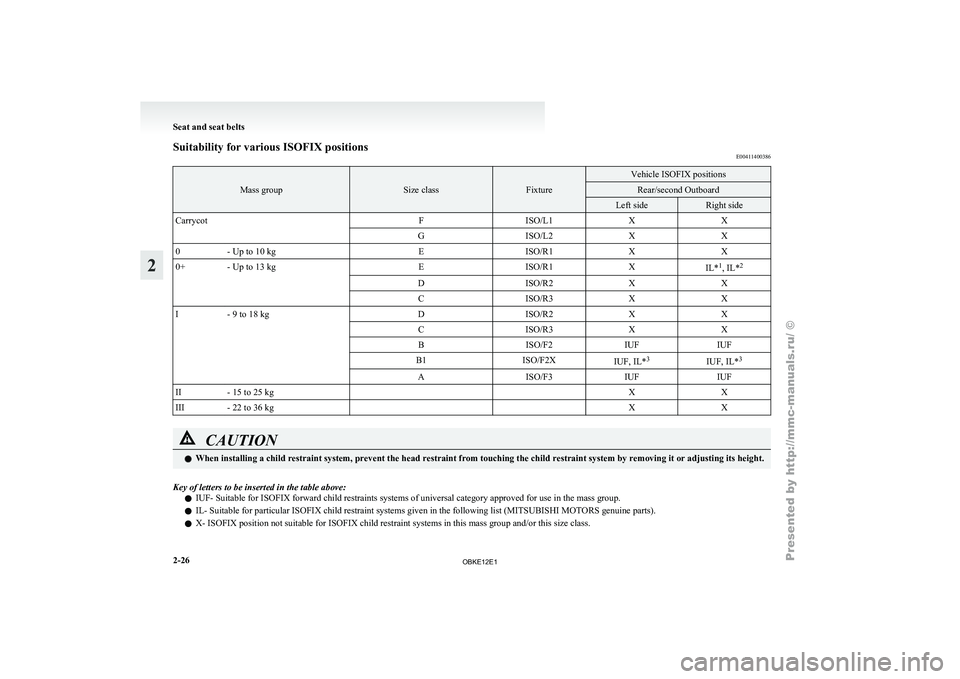
Suitability for various ISOFIX positions
E00411400386Mass group Size class Fixture Vehicle ISOFIX positions
Rear/second Outboard
Left side Right side
Carrycot FISO/L1XX
G ISO/L2XX
0 - Up to 10 kg EISO/R1XX
0+ - Up to 13 kg EISO/R1X
IL*1
, IL* 2
D ISO/R2XX
C ISO/R3XX
I - 9 to 18 kg DISO/R2XX
C ISO/R3XX
B ISO/F2IUFIUF
B1 ISO/F2X
IUF, IL*3
IUF, IL*3
A ISO/F3IUFIUF
II - 15 to 25 kg X X
III - 22 to 36 kg X XCAUTION
l
When installing a child restraint system, prevent the head restraint from touching the child restraint system by removing it or adjusting its height.
Key of letters to be inserted in the table above: l IUF- Suitable for ISOFIX forward child restraints systems of universal category approved for use in the mass group.
l IL- Suitable for particular ISOFIX child restraint systems given in the following list (
MITSUBISHI MOTORS genuine parts).
l X- ISOFIX position not suitable for ISOFIX child restraint systems in this mass group and/or this size class. Seat and seat belts
2-26
2
OBKE12E1
Page 65 of 377
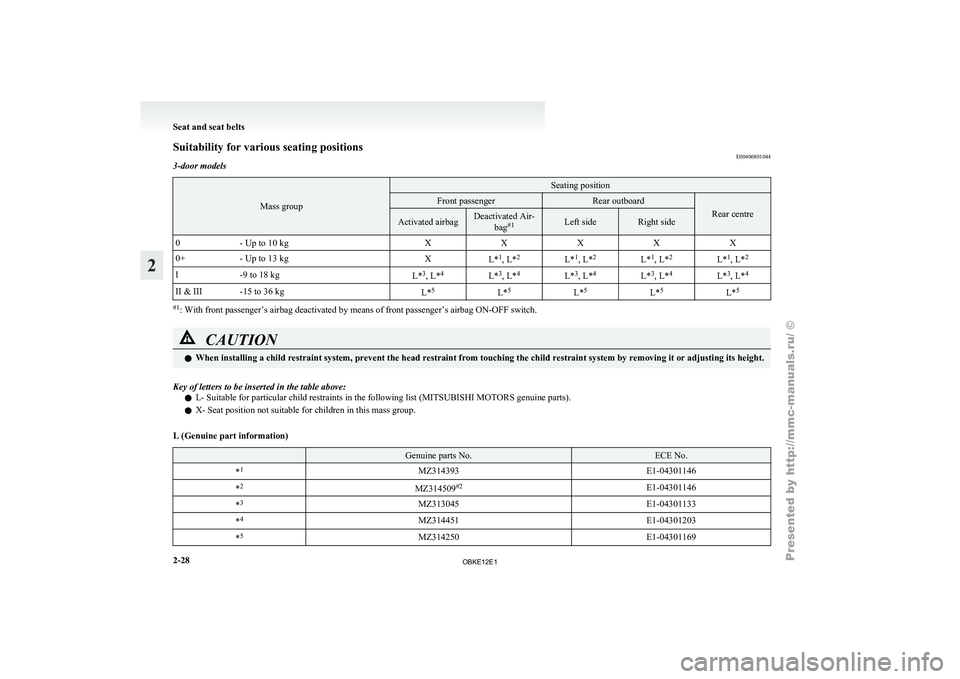
Suitability for various seating positions
E00406801044
3-door models Mass group Seating position
Front passenger Rear outboard
Rear centre
Activated airbag Deactivated Air-
bag#1 Left side Right side
0 - Up to 10 kg XXXXX
0+ - Up to 13 kg
XL*1
, L* 2
L*1
, L* 2
L*1
, L* 2
L*1
, L* 2
I -9 to 18 kg
L*3
, L* 4
L*3
, L* 4
L*3
, L* 4
L*3
, L* 4
L*3
, L* 4
II & III -15 to 36 kg L*5
L*5
L*5
L*5
L*5 #1
: With front passenger’s airbag deactivated by means of front passenger’s airbag ON-OFF switch. CAUTION
l
When installing a child restraint system, prevent the head restraint from touching the child restraint system by removing it or adjusting its height.
Key of letters to be inserted in the table above: l L- Suitable for particular child restraints in the following list (
MITSUBISHI MOTORS genuine parts).
l X- Seat position not suitable for children in this mass group.
L (Genuine part information) Genuine parts No. ECE No.
* 1
MZ314393 E1-04301146
* 2
MZ314509#2
E1-04301146
* 3
MZ313045 E1-04301133
* 4
MZ314451 E1-04301203
* 5
MZ314250 E1-04301169Seat and seat belts
2-28
2
OBKE12E1
Page 66 of 377
#2
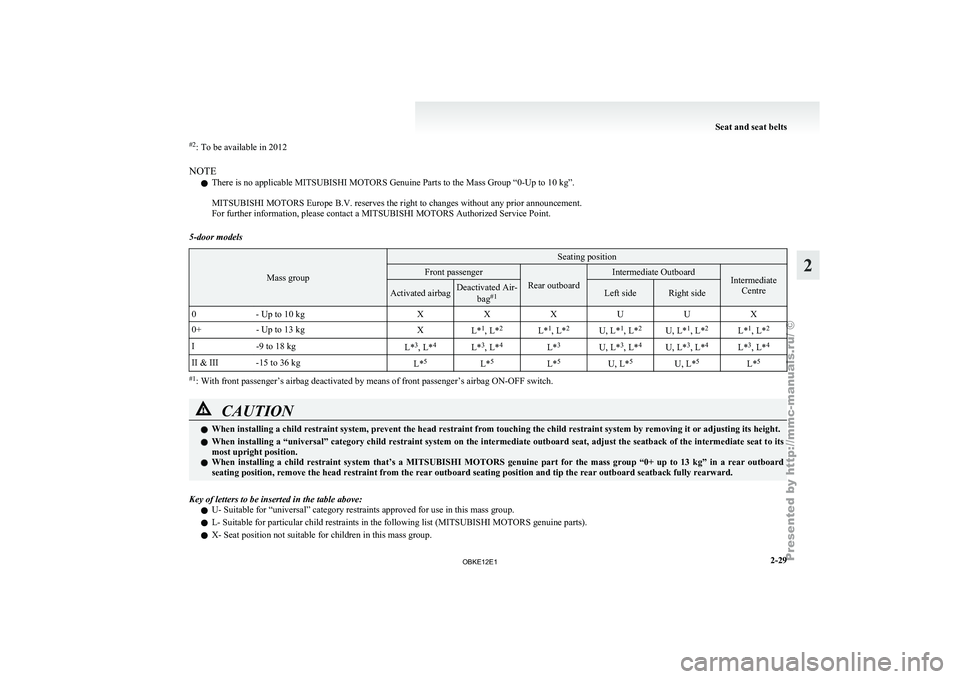
: To be available in 2012
NOTE l There is no applicable MITSUBISHI MOTORS
Genuine Parts to the Mass Group “0-Up to 10 kg”.
MITSUBISHI MOTORS
Europe B.V. reserves the right to changes without any prior announcement.
For further information, please contact a MITSUBISHI MOTORS Authorized Service Point.
5-door models Mass group Seating position
Front passenger
Rear outboard Intermediate Outboard
Intermediate
Centre Activated airbag Deactivated Air-
bag#1 Left side Right side
0 - Up to 10 kg XXXUUX
0+ - Up to 13 kg
XL*1
, L* 2
L*1
, L* 2
U, L*1
, L* 2
U, L*1
, L* 2
L*1
, L* 2
I -9 to 18 kg
L*3
, L* 4
L*3
, L* 4
L*3
U, L*3
, L* 4
U, L*3
, L* 4
L*3
, L* 4
II & III -15 to 36 kg L*5
L*5
L*5
U, L*5
U, L*5
L*5 #1
: With front passenger’s airbag deactivated by means of front passenger’s airbag ON-OFF switch. CAUTION
l
When installing a child restraint system, prevent the head restraint from touching the child restraint system by removing it or adjusting its height.
l When installing
a
“universal” category child restraint system on the intermediate outboard seat, adjust the seatback of the intermediate seat to its
most upright position.
l When installing a child restraint system that’s a MITSUBISHI MOTORS genuine part for the mass group “0+ up to 13 kg” in a rear outboard
seating position, remove the head restraint from the rear outboard seating position and tip the rear outboard seatback fully rearward.
Key of letters to be inserted in the table above: l U- Suitable for “universal” category restraints approved for use in this mass group.
l L- Suitable for particular child restraints in the following list (
MITSUBISHI MOTORS genuine parts).
l X- Seat position not suitable for children in this mass group. Seat and seat belts
2-29 2
OBKE12E1
Page 126 of 377
Economical driving.......................................................................4-02
Driving, alcohol and drugs
........................................................... 4-02
Safe driving techniques ................................................................ 4-03
Running-in recommendations....................................................... 4-04
Parking brake
................................................................................ 4-06
Parking.......................................................................................... 4-07
Steering wheel height adjustment .................................................4-08
Inside rear-view mirror ................................................................. 4-08
Outside rear-view mirrors ............................................................. 4-10
Ignition switch .............................................................................. 4-12
Steering wheel lock ...................................................................... 4-13
Starting.......................................................................................... 4-14
Diesel particulate filter (DPF)* .................................................... 4-15
Manual transmission ..................................................................... 4-16
Automatic transmission INVECS-II Sports Mode 5A/T (Intelligent & Innovative Vehicle Electronic Control
System II)................................................................................. 4-19
Super select 4WD II (SS4 II)........................................................ 4-24
Rear differential lock* .................................................................. 4-29
4-wheel drive operation ................................................................ 4-32
Inspection and maintenance following rough road oper- ation.......................................................................................... 4-35
Cautions on handling of 4-wheel drive vehicles ..........................4-35
Braking......................................................................................... 4-37
Brake assist system....................................................................... 4-38
Anti-lock brake system (ABS) ..................................................... 4-39
Power steering system.................................................................. 4-41
Active stability & traction control (ASTC) ..................................4-41
Cruise control* ............................................................................. 4-45
Reversing sensor system*............................................................. 4-49 Rear-view camera*
....................................................................... 4-52
Cargo loads................................................................................... 4-56
Trailer towing ............................................................................... 4-57Starting and driving
4
OBKE12E1
Page 133 of 377
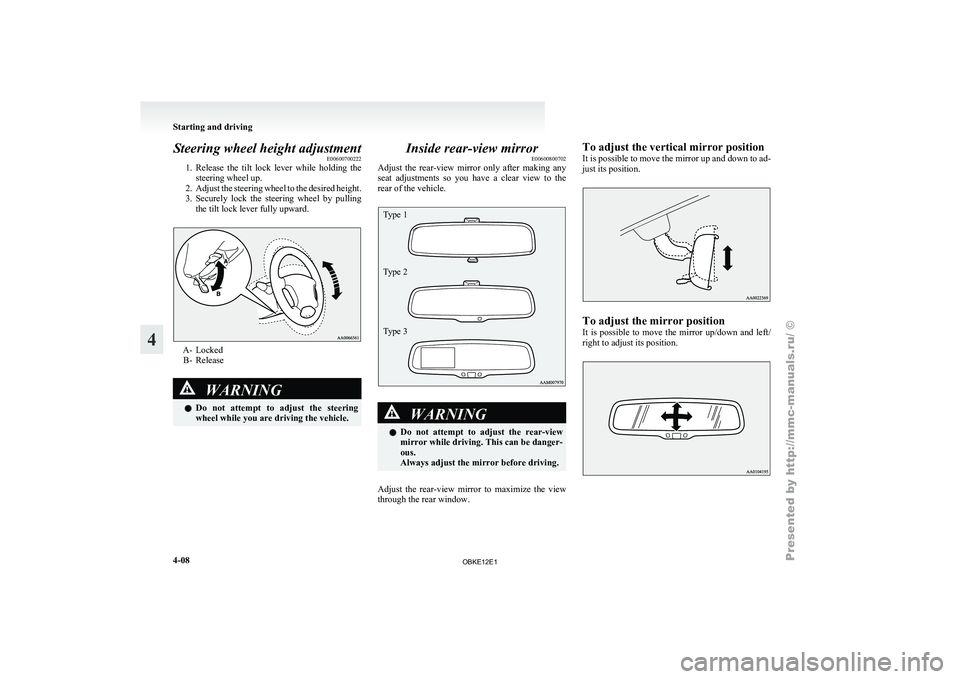
Steering wheel height adjustment
E00600700222
1. Release the tilt
lock lever while holding the
steering wheel up.
2. Adjust the steering wheel to the desired height.
3. Securely lock the steering wheel by pulling the tilt lock lever fully upward. A- Locked
B- Release WARNING
l Do not attempt
to adjust the steering
wheel while you are driving the vehicle. Inside rear-view mirror
E00600800702
Adjust the rear-view
mirror only after making any
seat adjustments so you have a clear view to the
rear of the vehicle.
Type 1
Type 2
Type 3 WARNING
l Do not attempt
to adjust the rear-view
mirror while driving. This can be danger-
ous.
Always adjust the mirror before driving.
Adjust the rear-view mirror to maximize the view
through the rear window. To adjust the vertical mirror position
It
is possible
to move the mirror up and down to ad-
just its position. To adjust the mirror position
It is
possible
to move the mirror up/down and left/
right to adjust its position. Starting and driving
4-08
4
OBKE12E1
Page 164 of 377
Anti-lock brake system (ABS)
E00607101248
Environmental conditions can
have an effect on
braking. During sudden braking when there is
snow, ice, oil, water etc. on the road surface, a skid
may occur. In this situation, steering control and
braking effectiveness is reduced and the stopping
distance is increased. The vehicle may also go into
an uncontrolled spin.
The ABS helps prevent the wheels from locking dur-
ing braking, thus maintaining directional stability,
ensuring controllability and providing optimum
braking force.
Driving hints
l Always maintain the same distance from the
vehicle in front of you as you would for a ve-
hicle not equipped with ABS.
Compared with vehicles not fitted with ABS,
your vehicle may require a longer stopping
distance in the following cases:
• Driving on gravel or snow-covered roads.
• Driving with tyre chains installed.
• Driving on roads where the road surfaceis pitted or has other differences in sur-
face height.
• Driving on bumpy roads or other poor driv- ing surfaces.
l In order to ensure that the ABS will operate
correctly in situations where tyre chains have
been fitted, drive in the “4H”, “4HLc”, or
“4LLc” position. l
Operation of
ABS is not restricted to situa-
tions where brakes are applied suddenly.
This system may also operate to prevent
wheel lock when you are driving over man-
holes, steel road-work plates, or the vehicle
is driven over steps or level differences in
the road, road markings, or other surfaces
which are difficult for the wheels to grip.
l When the ABS is activated, you may feel the
brake pedal pulsation and the vibrations of
the vehicle body and steering wheel. You
may also hear a characteristic noise. At this
time, you may feel as if the pedal attempts to
resist being depressed.
This is a normal result of the ABS operation,
and does not indicate a problem.
In this situation, to let the ABS work for
you, just hold the brake pedal down more
firmly. Do not pump the brake. This will
result in reduced braking performance.
l When the engine starts and after starting to
drive, you might hear operation noise from
the engine compartment or feel a shock from
the brake pedal. This is normal. The ABS is
performing self-check.
l The ABS will operate after the vehicle has ac-
celerated to a speed in excess of approximate-
ly 10 km/h (6 mph). It stops operating when
the vehicle decelerates to a speed below
about 5 km/h (3 mph). CAUTION
l
Even the ABS
cannot prevent the natural
laws of physics from acting on the vehi-
cle. It cannot for instance avoid accidents
that may result from excessive speed on
bends or following another vehicle too
closely or aquaplaning. It should remain
the driver’s task to observe safety precau-
tions to judge speeds and brake applica-
tions correctly in such conditions.
l Be sure to use tyres of the same type and
size on 4 wheels.
If tyre types or sizes are mixed, ABS may
not function normally.
l Never install a limited-slip differential,
which is not a MITSUBISHI MOTORS
genuine part, as the ABS may not func-
tion normally.
We recommend you to consult a
MITSUBISHI MOTORS Authorized
Service Point. Starting and driving
4-39 4
OBKE12E1
Page 175 of 377
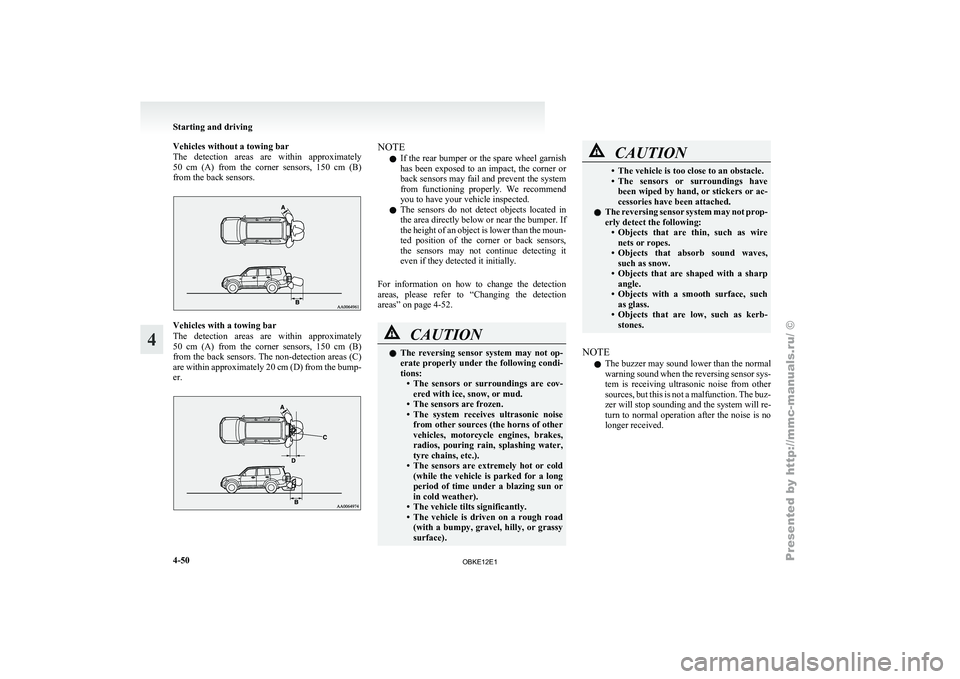
Vehicles without a towing bar
The detection areas
are within approximately
50 cm (A) from the corner sensors, 150 cm (B)
from the back sensors. Vehicles with a towing bar
The detection
areas
are within approximately
50 cm (A) from the corner sensors, 150 cm (B)
from the back sensors. The non-detection areas (C)
are within approximately 20 cm (D) from the bump-
er. NOTE
l If
the rear
bumper or the spare wheel garnish
has been exposed to an impact, the corner or
back sensors may fail and prevent the system
from functioning properly. We recommend
you to have your vehicle inspected.
l The sensors do not detect objects located in
the area directly below or near the bumper. If
the height of an object is lower than the moun-
ted position of the corner or back sensors,
the sensors may not continue detecting it
even if they detected it initially.
For information on how to change the detection
areas, please refer to “Changing the detection
areas” on page 4-52. CAUTION
l
The reversing
sensor
system may not op-
erate properly under the following condi-
tions: • The sensors or surroundings are cov-ered with ice, snow, or mud.
• The sensors are frozen.
• The system receives ultrasonic noise from other sources (the horns of other
vehicles, motorcycle engines, brakes,
radios, pouring rain, splashing water,
tyre chains, etc.).
• The sensors are extremely hot or cold (while the vehicle is parked for a long
period of time under a blazing sun or
in cold weather).
• The vehicle tilts significantly.
• The vehicle is driven on a rough road (with a bumpy, gravel, hilly, or grassy
surface). CAUTION
• The vehicle is too close to an obstacle.
• The sensors
or
surroundings have
been wiped by hand, or stickers or ac-
cessories have been attached.
l The reversing sensor system may not prop-
erly detect the following:
• Objects that are thin, such as wirenets or ropes.
• Objects that absorb sound waves, such as snow.
• Objects that are shaped with a sharp angle.
• Objects with a smooth surface, such as glass.
• Objects that are low, such as kerb- stones.
NOTE l The
buzzer may
sound lower than the normal
warning sound when the reversing sensor sys-
tem is receiving ultrasonic noise from other
sources, but this is not a malfunction. The buz-
zer will stop sounding and the system will re-
turn to normal operation after the noise is no
longer received. Starting and driving
4-50
4
OBKE12E1
Page 280 of 377
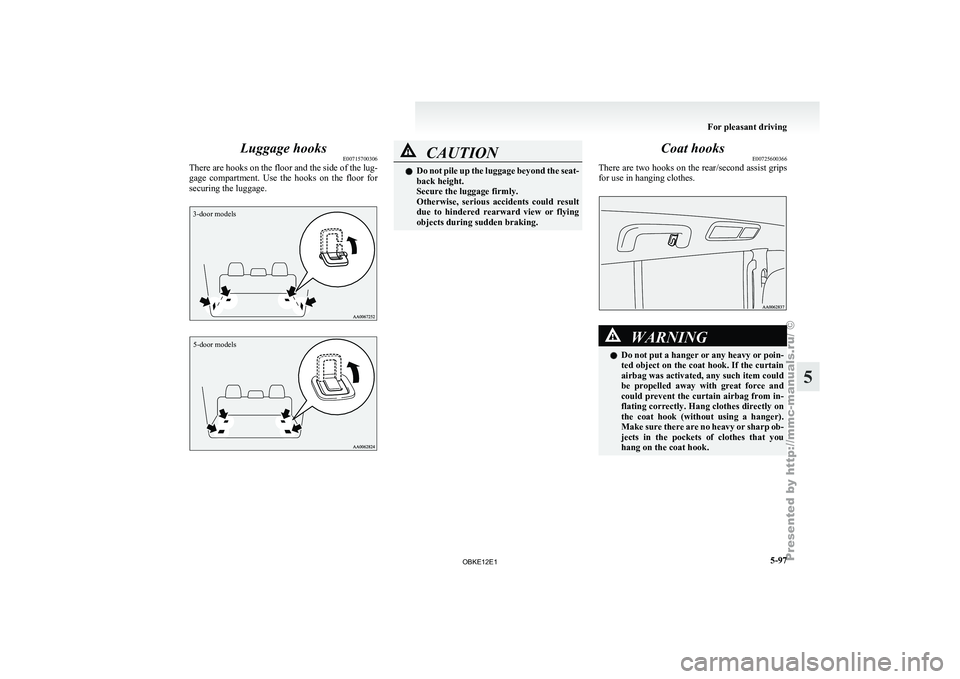
Luggage hooks
E00715700306
There are hooks
on the floor and the side of the lug-
gage compartment. Use the hooks on the floor for
securing the luggage.
3-door models
5-door models CAUTION
l
Do not pile
up the luggage beyond the seat-
back height.
Secure the luggage firmly.
Otherwise, serious accidents could result
due to hindered rearward view or flying
objects during sudden braking. Coat hooks
E00725600366
There are two
hooks on the rear/second assist grips
for use in hanging clothes. WARNING
l Do not
put
a hanger or any heavy or poin-
ted object on the coat hook. If the curtain
airbag was activated, any such item could
be propelled away with great force and
could prevent the curtain airbag from in-
flating correctly. Hang clothes directly on
the coat hook (without using a hanger).
Make sure there are no heavy or sharp ob-
jects in the pockets of clothes that you
hang on the coat hook. For pleasant driving
5-97 5
OBKE12E1
Page 322 of 377
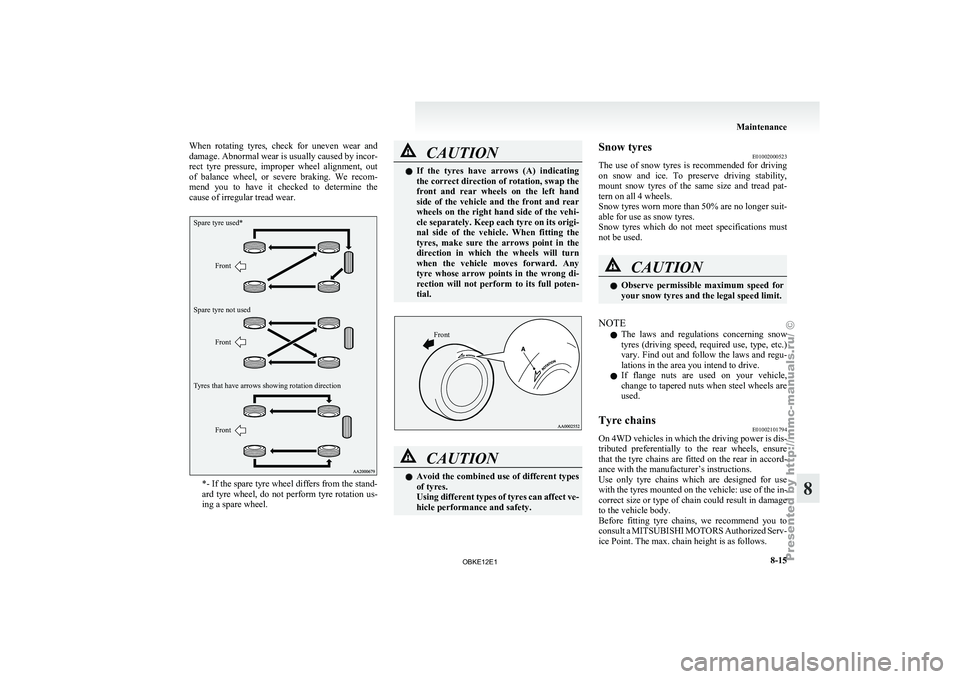
When rotating tyres, check for uneven wear and
damage. Abnormal wear
is usually caused by incor-
rect tyre pressure, improper wheel alignment, out
of balance wheel, or severe braking. We recom-
mend you to have it checked to determine the
cause of irregular tread wear.
Spare tyre used*
Spare tyre not used
Tyres that have arrows showing rotation direction Front
Front
Front
*- If the spare tyre wheel differs from the stand-
ard tyre
wheel,
do not perform tyre rotation us-
ing a spare wheel. CAUTION
l
If the tyres
have arrows (A) indicating
the correct direction of rotation, swap the
front and rear wheels on the left hand
side of the vehicle and the front and rear
wheels on the right hand side of the vehi-
cle separately. Keep each tyre on its origi-
nal side of the vehicle. When fitting the
tyres, make sure the arrows point in the
direction in which the wheels will turn
when the vehicle moves forward. Any
tyre whose arrow points in the wrong di-
rection will not perform to its full poten-
tial.
Front CAUTION
l
Avoid the
combined
use of different types
of tyres.
Using different types of tyres can affect ve-
hicle performance and safety. Snow tyres
E01002000523
The use of
snow tyres is recommended for driving
on snow and ice. To preserve driving stability,
mount snow tyres of the same size and tread pat-
tern on all 4 wheels.
Snow tyres worn more than 50% are no longer suit-
able for use as snow tyres.
Snow tyres which do not meet specifications must
not be used. CAUTION
l
Observe permissible
maximum
speed for
your snow tyres and the legal speed limit.
NOTE l The
laws and
regulations concerning snow
tyres (driving speed, required use, type, etc.)
vary. Find out and follow the laws and regu-
lations in the area you intend to drive.
l If flange nuts are used on your vehicle,
change to tapered nuts when steel wheels are
used.
Tyre chains E01002101794
On 4WD vehicles in which the driving power is dis-
tributed preferentially to
the rear wheels, ensure
that the tyre chains are fitted on the rear in accord-
ance with the manufacturer’s instructions.
Use only tyre chains which are designed for use
with the tyres mounted on the vehicle: use of the in-
correct size or type of chain could result in damage
to the vehicle body.
Before fitting tyre chains, we recommend you to
consult a MITSUBISHI MOTORS Authorized Serv-
ice Point. The max. chain height is as follows. Maintenance
8-15 8
OBKE12E1
Page 323 of 377
![MITSUBISHI PAJERO IV 2011 User Guide Tyre size Wheel size Max. chain
height[mm]
265/65R17 112H
265/65R17 112S 17 x 7 1/2 J
22
265/60R18 110H 18 x 7 1/2 JThe speed limit for tyre chain is 50 km/h (30 mph)
and
remove
the tyre chains a](/img/19/58151/w960_58151-322.png "MITSUBISHI PAJERO IV 2011 User Guide Tyre size Wheel size Max. chain
height[mm]
265/65R17 112H
265/65R17 112S 17 x 7 1/2 J
22
265/60R18 110H 18 x 7 1/2 JThe speed limit for tyre chain is 50 km/h (30 mph)
and
remove
the tyre chains a")
Tyre size Wheel size Max. chain
height[mm]
265/65R17 112H
265/65R17 112S 17 x 7 1/2 J
22
265/60R18 110H 18 x 7 1/2 JThe speed limit for tyre chain is 50 km/h (30 mph)
and
remove
the tyre chains as soon as possible on
snow free roads. CAUTION
l
As your vehicle is equipped with anti-lock
brake system
(ABS),
in order to ensure
that the anti-lock brake system (ABS)
will operate correctly in situations where
tyre chains have been fitted, drive in
“4H”, “4HLc” or “4LLc”.
l Practice fitting the chains before you
need them.
Don’t expect help from other people in
the cold.
l Choose a clear straight stretch of road
where you can pull over and still be seen
while you are fitting the chains.
l Do not fit chains before you need them.
This will wear out your tyres and the
road surface.
l After driving around 100-300 metres,
stop and retighten the chains. CAUTION
l
Drive carefully and
do not exceed
50 km/h (30 mph). Remember, fitting
chains is not going to stop accidents from
happening.
l When tyre chains are installed, take care
that they do not damage the disc wheel or
body.
l An aluminium wheel can be damaged by
a tyre chain while driving. When fitting a
tyre chain on an aluminium wheel, take
care that any part of the chain and fitting
cannot be brought into contact with the
wheel.
l When installing or removing the tyre
chains, take care that hands and other
parts of your body are not injured by the
sharp edges of the vehicle body.
NOTE l The
laws and
regulations concerning the use
of tyre chains vary. Always follow local laws
and regulations.
In most countries, it is prohibited by law to
use tyre chains on roads without snow. Parking brake break-in
E01008300010
Break-in the parking
brake linings whenever the
brake performance of the parking brake is insuffi-
cient or whenever the parking brake linings and/or
discs are replaced, in order to assure the best brake
performance.
This procedure is described in the vehicle service
manual and can be carried out by a MITSUBISHI
MOTORS Authorized Service Point. Maintenance
8-16
8
OBKE12E1