servo MITSUBISHI PAJERO IV 2011 Owners Manual
[x] Cancel search | Manufacturer: MITSUBISHI, Model Year: 2011, Model line: PAJERO IV, Model: MITSUBISHI PAJERO IV 2011Pages: 377, PDF Size: 29.43 MB
Page 90 of 377
Warning lamps
E00502400017Brake warning lamp (brake
warning buzzer)
E00502501712
This lamp illuminates
when the ignition
switch is turned to the “ON” position,
and goes off after a few seconds.
Always make sure that the lamp goes off
before driving.
With the ignition switch in the “ON” po-
sition, the brake warning lamp illumi-
nates under the following conditions:
l When the parking brake lever has
been engaged.
l When the brake fluid level in the
reservoir falls to a low level.
l When the brake force distribution
function or the brake system is not
operating correctly.
Brake warning buzzer
When there is a danger of brake perform-
ance becoming compromised,
a buzzer
will sound to alert the driver. If this buz-
zer should continue to sound, park your
vehicle in a safe place and we recom-
mend you to have it checked. NOTE
l Depressing
the brake
pedal repeat-
edly may turn on the brake warn-
ing lamp, ABS warning lamp and
brake warning buzzer. It is normal
if the lamp goes out and the buz-
zer stops sounding after a few sec-
onds. CAUTION
l
In the
situations
listed below,
brake performance may be com-
promised or the vehicle may be-
come unstable if brakes are ap-
plied suddenly; consequently,
avoid driving at high speeds or
applying the brakes suddenly.
Furthermore, the vehicle
should be brought to a stop in a
safe location and to have it
checked. • The brake warning lampdoes not illuminate when
the parking brake is applied
or does not turn off when
the parking brake is re-
leased.
• The ABS warning lamp and brake warning lamp illumi-
nate at the same time.
For details, refer to “ABS
warning lamp” on page
4-40.
• The brake warning buzzer does not turn off.
l The vehicle should be brought
to a halt in the following man- CAUTION
ner when brake performance
has deteriorated.
• Depress the brake
pedal
harder than usual.
Even if the brake pedal
moves down to the very end
of its possible stroke, keep it
pressed down hard.
• Should the brakes fail, use engine braking to reduce
your speed and pull the park-
ing brake lever.
Depress the brake pedal to
operate the stop lamp to
alert the vehicles behind you.
NOTE l In
certain cases
immediately after
the engine has been started or
when the brake pedal is depressed
repeatedly, a noise generated by
operation of brake devices may be
heard coming from the engine com-
partment. At this time, you may
feel a shock from the brake pedal
if you depress it. This type of
noise or shock is normal and there
is no need for concern. In fact,
they indicate that the correspond-
ing devices are operating normally.
l The brake system uses brake fluid
pressurized by the pump.
Please refer to “Braking” on page
4-37. Instruments and controls
3-09 3
OBKE12E1
Page 123 of 377
l
Before using
the wipers in cold weather,
check that the wiper blades are not frozen on-
to the glass. The motor may burn out if the
wipers are used with the blades frozen onto
the glass.
l Avoid using the washer continuously for
more than 20 seconds. Do not operate the
washer when the fluid reservoir is empty.
Otherwise, the motor may burn out.
l Periodically check the level of washer fluid
in the reservoir and refill if required.
During cold weather, add a recommended
washer solution that will not freeze in the
washer reservoir. Failure to do so could re-
sult in loss of washer function and frost dam-
age to the system components. Wiper de-icer switch*
E00507700103
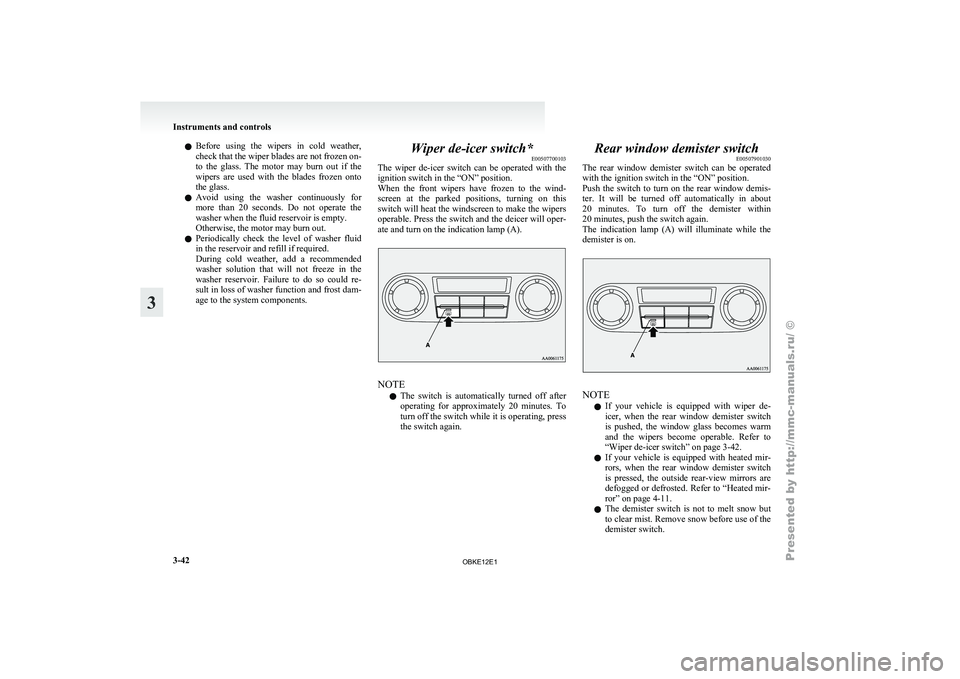
The wiper de-icer
switch can be operated with the
ignition switch in the “ON” position.
When the front wipers have frozen to the wind-
screen at the parked positions, turning on this
switch will heat the windscreen to make the wipers
operable. Press the switch and the deicer will oper-
ate and turn on the indication lamp (A). NOTE
l The
switch is
automatically turned off after
operating for approximately 20 minutes. To
turn off the switch while it is operating, press
the switch again. Rear window demister switch
E00507901030
The rear window
demister switch can be operated
with the ignition switch in the “ON” position.
Push the switch to turn on the rear window demis-
ter. It will be turned off automatically in about
20 minutes. To turn off the demister within
20 minutes, push the switch again.
The indication lamp (A) will illuminate while the
demister is on. NOTE
l If
your vehicle
is equipped with wiper de-
icer, when the rear window demister switch
is pushed, the window glass becomes warm
and the wipers become operable. Refer to
“Wiper de-icer switch” on page 3-42.
l If your vehicle is equipped with heated mir-
rors, when the rear window demister switch
is pressed, the outside rear-view mirrors are
defogged or defrosted. Refer to “Heated mir-
ror” on page 4-11.
l The demister switch is not to melt snow but
to clear mist. Remove snow before use of the
demister switch. Instruments and controls
3-42
3
OBKE12E1
Page 138 of 377
To remove the key
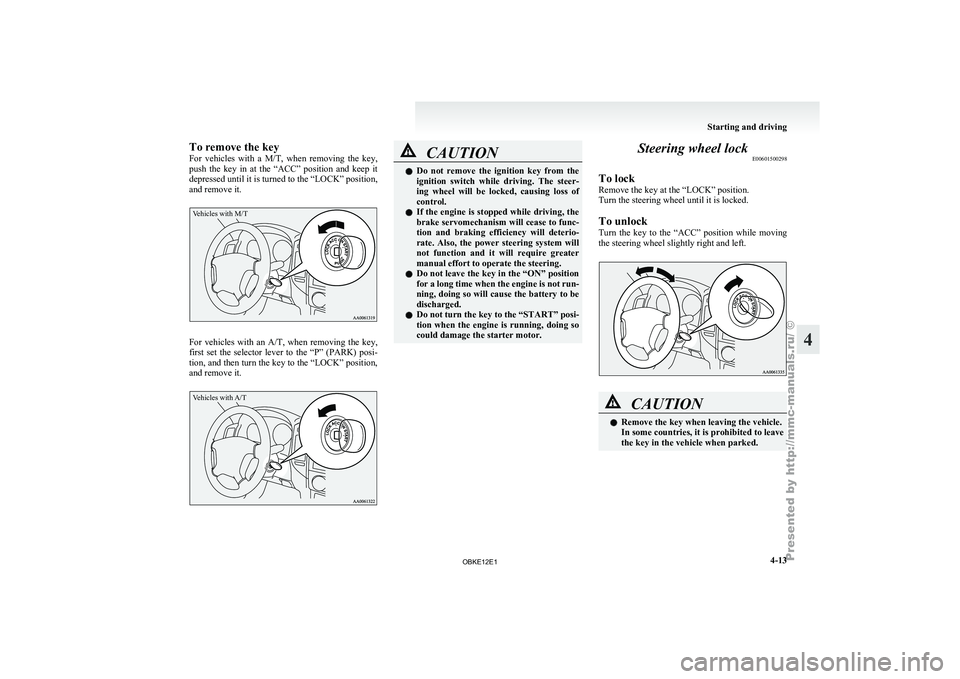
For vehicles
with
a M/T, when removing the key,
push the key in at the “ACC” position and keep it
depressed until it is turned to the “LOCK” position,
and remove it.
Vehicles with M/T For vehicles with an A/T, when
removing
the key,
first set the selector lever to the “P” (PARK) posi-
tion, and then turn the key to the “LOCK” position,
and remove it.
Vehicles with A/T CAUTION
l
Do not remove
the ignition key from the
ignition switch while driving. The steer-
ing wheel will be locked, causing loss of
control.
l If the engine is stopped while driving, the
brake servomechanism will cease to func-
tion and braking efficiency will deterio-
rate. Also, the power steering system will
not function and it will require greater
manual effort to operate the steering.
l Do not leave the key in the “ON” position
for a long time when the engine is not run-
ning, doing so will cause the battery to be
discharged.
l Do not turn the key to the “START” posi-
tion when the engine is running, doing so
could damage the starter motor. Steering wheel lock
E00601500298
To lock
Remove the key at the “LOCK” position.
Turn the steering wheel until it is locked.
To unlock
Turn the key
to the “ACC” position while moving
the steering wheel slightly right and left. CAUTION
l
Remove the key when leaving the vehicle.
In some countries, it is prohibited to leave
the key in the vehicle when parked. Starting and driving
4-13 4
OBKE12E1
Page 314 of 377
WARNING
l Do not open the radiator cap while the en-
gine is hot.
The coolant system is under pressure and
any hot coolant escaping could cause se-
vere burns.
Anti-freeze
The engine coolant
contains an ethylene glycol anti-
corrosion agent. The cylinder head and water pump
housing are cast aluminium alloy, and periodic
changing of the engine coolant is necessary to pre-
vent corrosion of these parts.
Use “DIA QUEEN SUPER LONG LIFE COOL-
ANT” or equivalent.
MITSUBISHI Genuine Coolant has excellent pro-
tection against corrosion and rust formation of all
metals including aluminium and can avoid block-
ages in the radiator, heater, cylinder head, engine
block, etc.
Because of the necessity of this anti-corrosion
agent, the coolant must not be replaced with plain
water even in summer. The required concentration
of anti-freeze differs depending on the expected am-
bient temperature. Ambient
temperature (mini-
mum) °C -15 -20 -25 -30 -35 -50 Anti-freeze
concentra- tion % 30 35 40 45 50 60 CAUTION
l
Do not use
alcohol or methanol anti-
freeze or any engine coolants mixed with
alcohol or methanol anti-freeze. The use
of an improper anti-freeze can cause cor-
rosion of the aluminium components.
l For effective anti-corrosion and anti-
freeze performance, keep the anti-freeze
concentration within the range of 30 to
60 %.
Concentrations exceeding 60 % will re-
sult in a reduction of both the anti-freeze
and cooling performance thus adversely
affecting the engine.
l Do not top up with water only.
During cold weather
The concentration should
be checked before the
start of cold weather and anti-freeze added to the
system if necessary to prevent damage to engine
and radiator due to freezing. Washer fluid
E01000700656
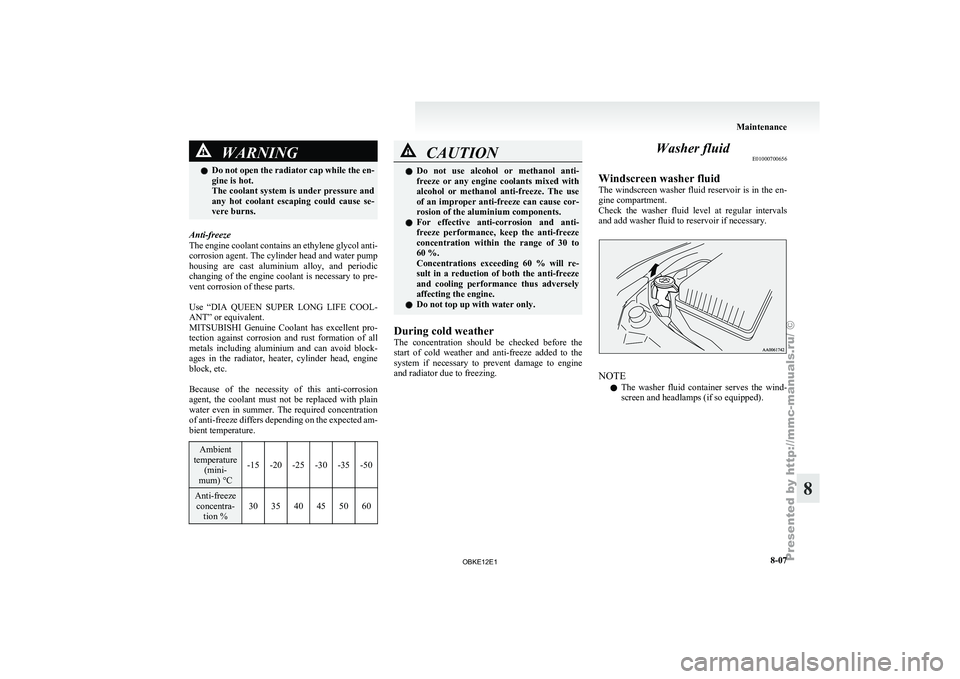
Windscreen washer fluid
The windscreen washer
fluid reservoir is in the en-
gine compartment.
Check the washer fluid level at regular intervals
and add washer fluid to reservoir if necessary. NOTE
l The
washer fluid
container serves the wind-
screen and headlamps (if so equipped). Maintenance
8-07 8
OBKE12E1
Page 315 of 377
Rear window washer fluid
E01006500063
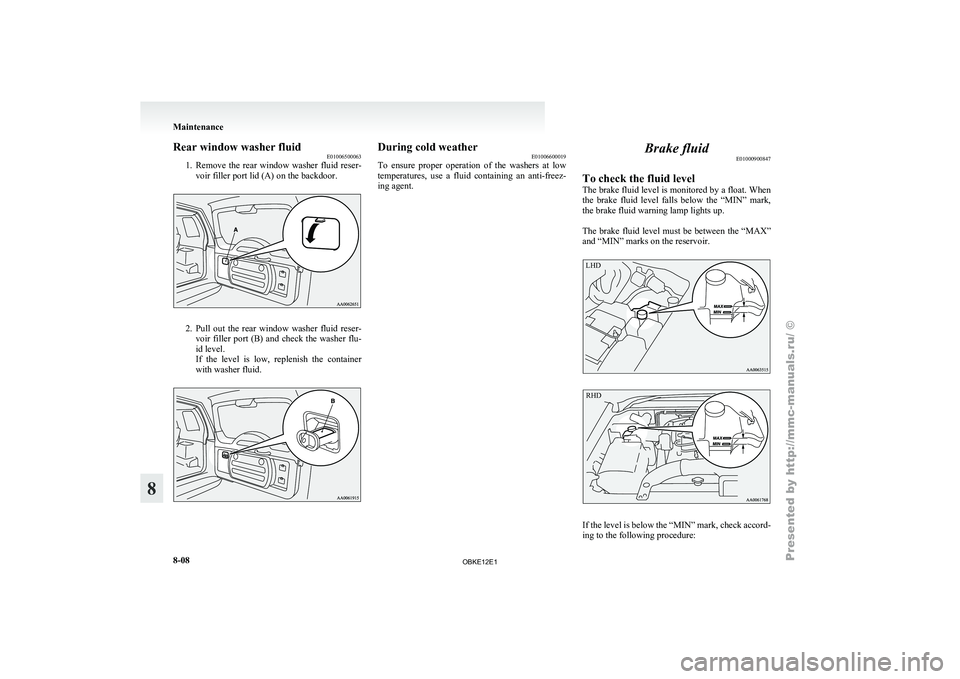
1. Remove the rear
window washer fluid reser-
voir filler port lid (A) on the backdoor. 2. Pull out the rear window washer fluid reser-
voir filler
port (B) and check the washer flu-
id level.
If the level is low, replenish the container
with washer fluid. During cold weather
E01006600019
To ensure proper
operation of the washers at low
temperatures, use a fluid containing an anti-freez-
ing agent. Brake fluid
E01000900847
To check the fluid level
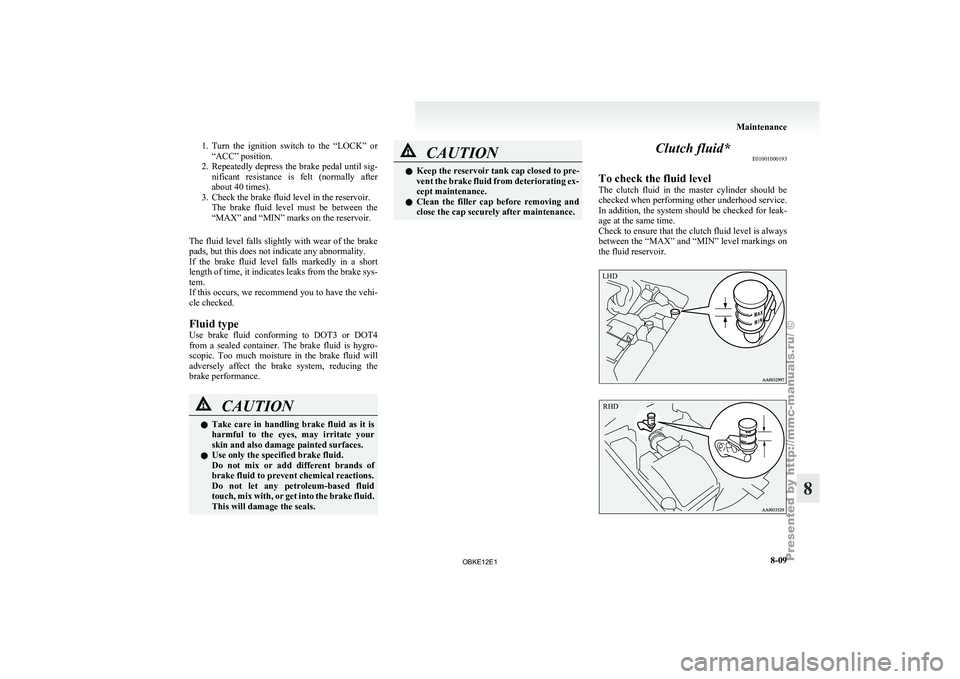
The brake fluid
level is monitored by a float. When
the brake fluid level falls below the “MIN” mark,
the brake fluid warning lamp lights up.
The brake fluid level must be between the “MAX”
and “MIN” marks on the reservoir.
LHD
RHD If the level is below the “MIN” mark, check accord-
ing to the following procedure:Maintenance
8-08
8
OBKE12E1
Page 316 of 377
1. Turn the ignition switch to the “LOCK” or
“ACC” position.
2. Repeatedly
depress the brake pedal until sig-
nificant resistance is felt (normally after
about 40 times).
3. Check the brake fluid level in the reservoir. The brake fluid level must be between the
“MAX” and “MIN” marks on the reservoir.
The fluid level falls slightly with wear of the brake
pads, but this does not indicate any abnormality.
If the brake fluid level falls markedly in a short
length of time, it indicates leaks from the brake sys-
tem.
If this occurs, we recommend you to have the vehi-
cle checked.
Fluid type
Use brake fluid conforming to DOT3 or DOT4
from a sealed container. The brake fluid is hygro-
scopic. Too much moisture in the brake fluid will
adversely affect the brake system, reducing the
brake performance. CAUTION
l
Take care
in
handling brake fluid as it is
harmful to the eyes, may irritate your
skin and also damage painted surfaces.
l Use only the specified brake fluid.
Do not mix or add different brands of
brake fluid to prevent chemical reactions.
Do not let any petroleum-based fluid
touch, mix with, or get into the brake fluid.
This will damage the seals. CAUTION
l
Keep the reservoir tank cap closed to pre-
vent the brake
fluid from deteriorating ex-
cept maintenance.
l Clean the filler cap before removing and
close the cap securely after maintenance. Clutch fluid*
E01001000193
To check the fluid level
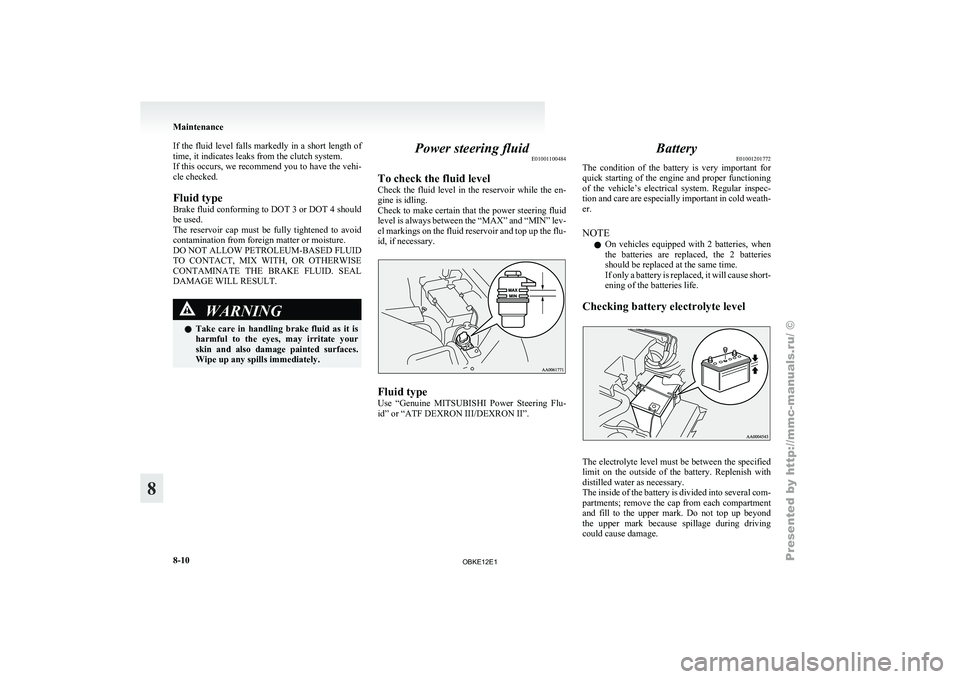
The clutch fluid
in the master cylinder should be
checked when performing other underhood service.
In addition, the system should be checked for leak-
age at the same time.
Check to ensure that the clutch fluid level is always
between the “MAX” and “MIN” level markings on
the fluid reservoir.
LHD
RHD Maintenance
8-09 8
OBKE12E1
Page 317 of 377
If the fluid level falls markedly in a short length of
time, it indicates leaks from the clutch system.
If this occurs,
we recommend you to have the vehi-
cle checked.
Fluid type
Brake fluid conforming to DOT 3 or DOT 4 should
be used.
The reservoir cap must be fully tightened to avoid
contamination from foreign matter or moisture.
DO NOT ALLOW PETROLEUM-BASED FLUID
TO CONTACT, MIX WITH, OR OTHERWISE
CONTAMINATE THE BRAKE FLUID. SEAL
DAMAGE WILL RESULT. WARNING
l Take
care
in
handling brake fluid as it is
harmful to the eyes, may irritate your
skin and also damage painted surfaces.
Wipe up any spills immediately. Power steering fluid
E01001100484
To check the fluid level
Check the fluid
level in the reservoir while the en-
gine is idling.
Check to make certain that the power steering fluid
level is always between the “MAX” and “MIN” lev-
el markings on the fluid reservoir and top up the flu-
id, if necessary. Fluid type
Use “Genuine
MITSUBISHI
Power Steering Flu-
id” or “ATF DEXRON III/DEXRON II”. Battery
E01001201772
The condition of
the battery is very important for
quick starting of the engine and proper functioning
of the vehicle’s electrical system. Regular inspec-
tion and care are especially important in cold weath-
er.
NOTE
l On vehicles equipped with 2 batteries, when
the batteries are replaced, the 2 batteries
should be replaced at the same time.
If only a battery is replaced, it will cause short-
ening of the batteries life.
Checking battery electrolyte level The electrolyte level must be between the specified
limit on the
outside of the battery. Replenish with
distilled water as necessary.
The inside of the battery is divided into several com-
partments; remove the cap from each compartment
and fill to the upper mark. Do not top up beyond
the upper mark because spillage during driving
could cause damage. Maintenance
8-10
8
OBKE12E1