sport mode MITSUBISHI SHOGUN 2003 Owner's Manual (in English)
[x] Cancel search | Manufacturer: MITSUBISHI, Model Year: 2003, Model line: SHOGUN, Model: MITSUBISHI SHOGUN 2003Pages: 392, PDF Size: 14.34 MB
Page 65 of 392
G28E067A
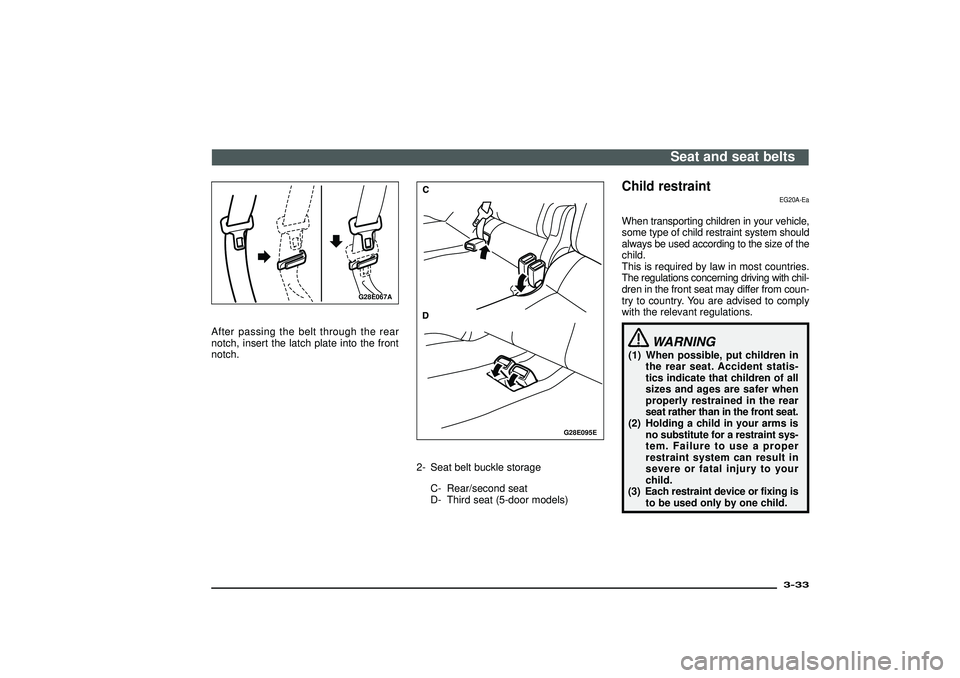
After passing the belt through the rear
notch, insert the latch plate into the front
notch.
G28E095E
2- Seat belt buckle storage
C- Rear/second seat
D- Third seat (5-door models)
Child restraint
EG20A-Ea
When transporting children in your vehicle,
some type of child restraint system should
always be used according to the size of the
child.
This is required by law in most countries.
The regulations concerning driving with chil-
dren in the front seat may differ from coun-
try to country. You are advised to comply
with the relevant regulations.
WARNING
(1) When possible, put children in
the rear seat. Accident statis-
tics indicate that children of all
sizes and ages are safer when
properly restrained in the rear
seat rather than in the front seat.
(2) Holding a child in your arms is
no substitute for a restraint sys-
tem. Failure to use a proper
restraint system can result in
severe or fatal injury to your
child.
(3) Each restraint device or fixing is
to be used only by one child.
Seat and seat belts
3-33
Div:
Out put date:
Page 159 of 392
Starting and driving
Running-in recommendations ......................................... 5- 2
Fuel selection .................................................................... 5- 3
Filling the fuel tank ........................................................... 5- 4
Catalytic converter ............................................................ 5- 6
Economical driving ........................................................... 5- 7
Trailer towing ..................................................................... 5- 8
Ignition switch ................................................................... 5-11
Starting .............................................................................. 5-12
Manual transmission ........................................................ 5-15
Automatic transmission INVECS—II Sport
Mode 5A/T
(Intelligent & Innovative Vehicle
Electronic Control System II) ...................................... 5-17
Part time 4WD.................................................................... 5-24
Super select 4WD II (SS4 II) ............................................. 5-28
Rear differential lock ........................................................ 5-34
Correct 4-wheel drive operation ...................................... 5-38
Cautions on handling of 4WD vehicles .......................... 5-42
Parking brake .................................................................... 5-42
Parking .............................................................................. 5-43
Braking ............................................................................... 5-44
Anti - lock brake system (ABS) ....................................... 5-45
Limited-slip differential..................................................... 5-48
Steering wheel height adjustment................................... 5-49
Power steering system ..................................................... 5-49
Inside rear-view mirror ..................................................... 5-50
Outside rear-view mirror .................................................. 5-50
Manual outside rear-view mirrors ................................... 5-51
Electric remote-controlled outside
rear-view mirrors .......................................................... 5-51
Auto-speed (cruise) control ............................................. 5-53
MITSUBISHI active stability &
traction control system (M-ASTC) ............................... 5-57
Div:
Out put date:
Page 168 of 392
mm
3-door models 5-door models
1 512.5 794
2 526*
1, 476*
2
526*
1, 476*
2
3 15*
1, 35*
2
15*
1, 35*
2
4 124 179
5 131 131
644 44
755 55
8 - 149
9 86*
1, 136.8*
2
75*
1, 125.3*
2
10 516.5*
1, 465.7*
2
531*
1, 480.3*
2
11 499.7 499.7
12 538 538
13 - 547
14 576.3 576.3
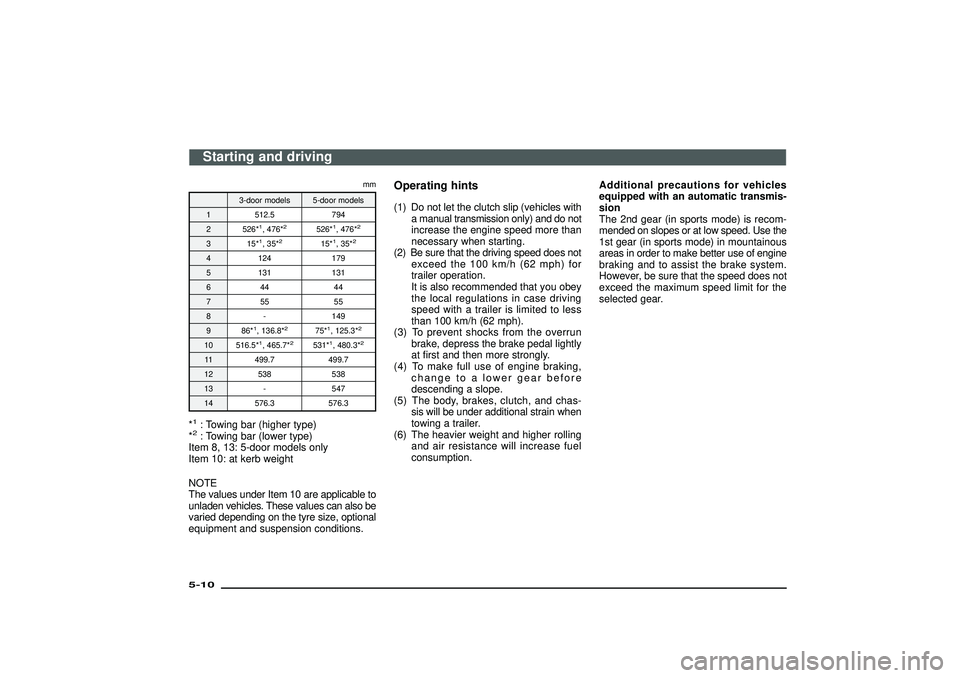
*1: Towing bar (higher type)
*2: Towing bar (lower type)
Item 8, 13: 5-door models only
Item 10: at kerb weight
NOTE
The values under Item 10 are applicable to
unladen vehicles. These values can also be
varied depending on the tyre size, optional
equipment and suspension conditions.
Operating hints(1) Do not let the clutch slip (vehicles with
a manual transmission only) and do not
increase the engine speed more than
necessary when starting.
(2) Be sure that the driving speed does not
exceed the 100 km/h (62 mph) for
trailer operation.
It is also recommended that you obey
the local regulations in case driving
speed with a trailer is limited to less
than 100 km/h (62 mph).
(3) To prevent shocks from the overrun
brake, depress the brake pedal lightly
at first and then more strongly.
(4) To make full use of engine braking,
change to a lower gear before
descending a slope.
(5) The body, brakes, clutch, and chas-
sis will be under additional strain when
towing a trailer.
(6) The heavier weight and higher rolling
and air resistance will increase fuel
consumption.Additional precautions for vehicles
equipped with an automatic transmis-
sion
The 2nd gear (in sports mode) is recom-
mended on slopes or at low speed. Use the
1st gear (in sports mode) in mountainous
areas in order to make better use of engine
braking and to assist the brake system.
However, be sure that the speed does not
exceed the maximum speed limit for the
selected gear.
Starting and driving
5-10Div:
Out put date:
Page 175 of 392
Automatic transmission
INVECS—II Sport Mode 5A/T(Intelligent & Innovative Vehicle
Electronic Control System II)
EI28A-Pb
Designed for optimum control and
equipped with adaptive control capabili-
ties, the electronically controlled transmis-
sion optimally matches gear shifts to almost
all driving and road conditions.
CAUTION
This system is strictly intended to
provide supplementary functions.
When travelling downhill under cer-
tain conditions or immediately after
starting off when the automatic trans-
mission is cold, no automatic shift-
down may be made. The driver
should shiftdown to a lower gear to
use engine braking. Try to drive
safely at all times.NOTE
During running-in period or immediately
after reconnection of the battery cable,
there may be a case where gear shifts are
not made smoothly. This does not indi-
cate a faulty transmission.
Gear shifts will become smooth after the
transmission has been shifted several times
by the electronic control system.
I04B005A
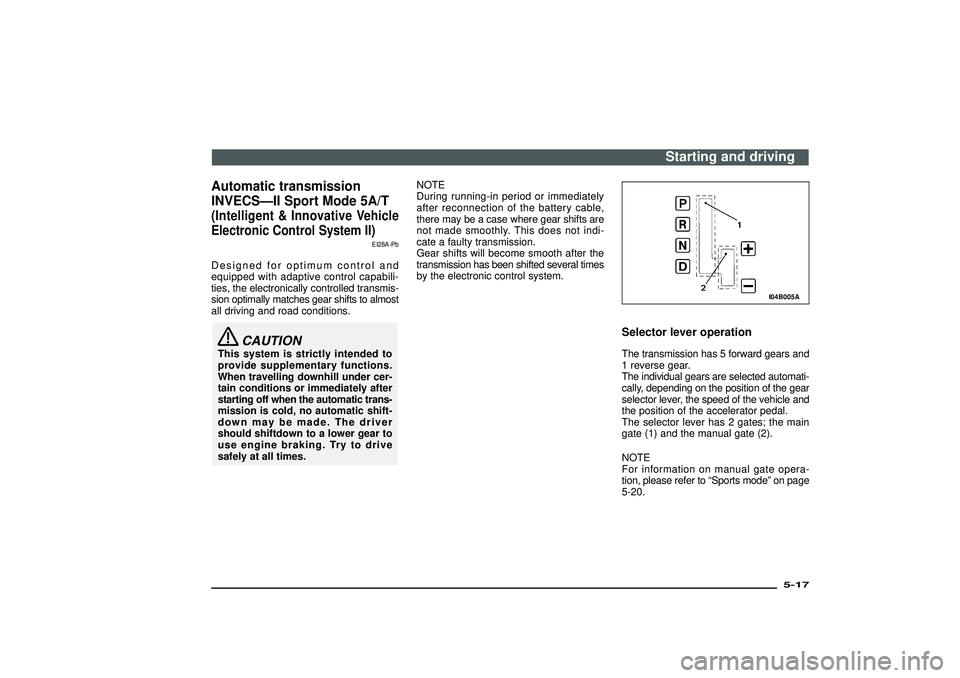
Selector lever operationThe transmission has 5 forward gears and
1 reverse gear.
The individual gears are selected automati-
cally, depending on the position of the gear
selector lever, the speed of the vehicle and
the position of the accelerator pedal.
The selector lever has 2 gates; the main
gate (1) and the manual gate (2).
NOTE
For information on manual gate opera-
tion, please refer to“Sports mode”on page
5-20.
Starting and driving
5-17
Div:
Out put date:
Page 178 of 392
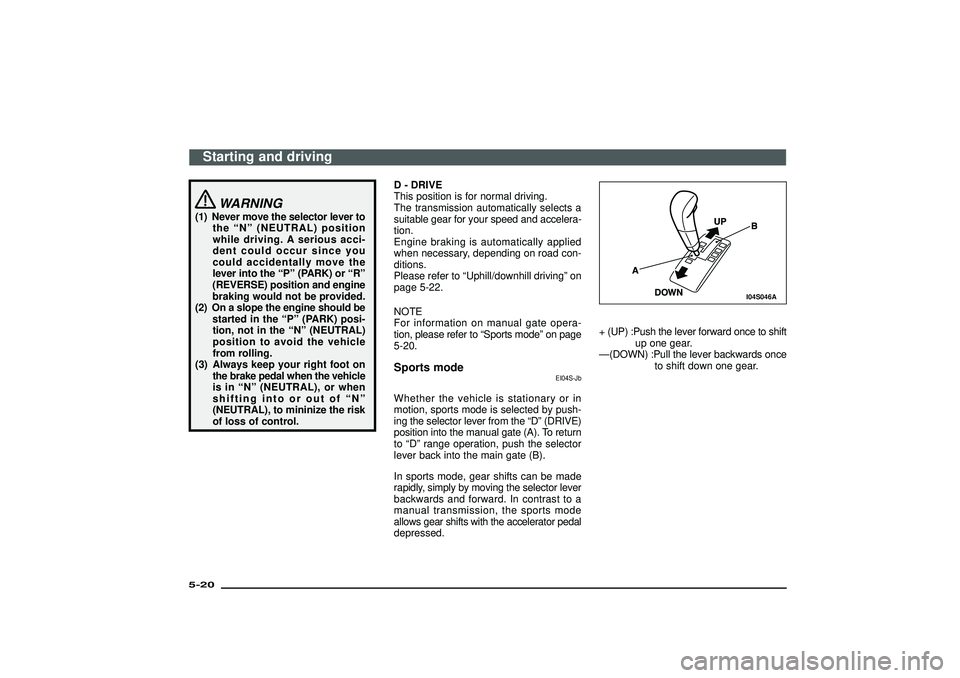
WARNING
(1) Never move the selector lever to
the“N”(NEUTRAL) position
while driving. A serious acci-
dent could occur since you
could accidentally move the
lever into the“P”(PARK) or“R”
(REVERSE) position and engine
braking would not be provided.
(2) On a slope the engine should be
started in the“P”(PARK) posi-
tion, not in the“N”(NEUTRAL)
position to avoid the vehicle
from rolling.
(3) Always keep your right foot on
the brake pedal when the vehicle
is in“N”(NEUTRAL), or when
shifting into or out of“N”
(NEUTRAL), to mininize the risk
of loss of control.D - DRIVE
This position is for normal driving.
The transmission automatically selects a
suitable gear for your speed and accelera-
tion.
Engine braking is automatically applied
when necessary, depending on road con-
ditions.
Please refer to“Uphill/downhill driving”on
page 5-22.
NOTE
For information on manual gate opera-
tion, please refer to“Sports mode”on page
5-20.
Sports mode
EI04S-Jb
Whether the vehicle is stationary or in
motion, sports mode is selected by push-
ing the selector lever from the“D”(DRIVE)
position into the manual gate (A). To return
to“D”range operation, push the selector
lever back into the main gate (B).
In sports mode, gear shifts can be made
rapidly, simply by moving the selector lever
backwards and forward. In contrast to a
manual transmission, the sports mode
allows gear shifts with the accelerator pedal
depressed.
I04S046A
+ (UP) :Push the lever forward once to shift
up one gear.
—(DOWN) :Pull the lever backwards once
to shift down one gear.
Starting and driving
5-20Div:
Out put date:
Page 179 of 392
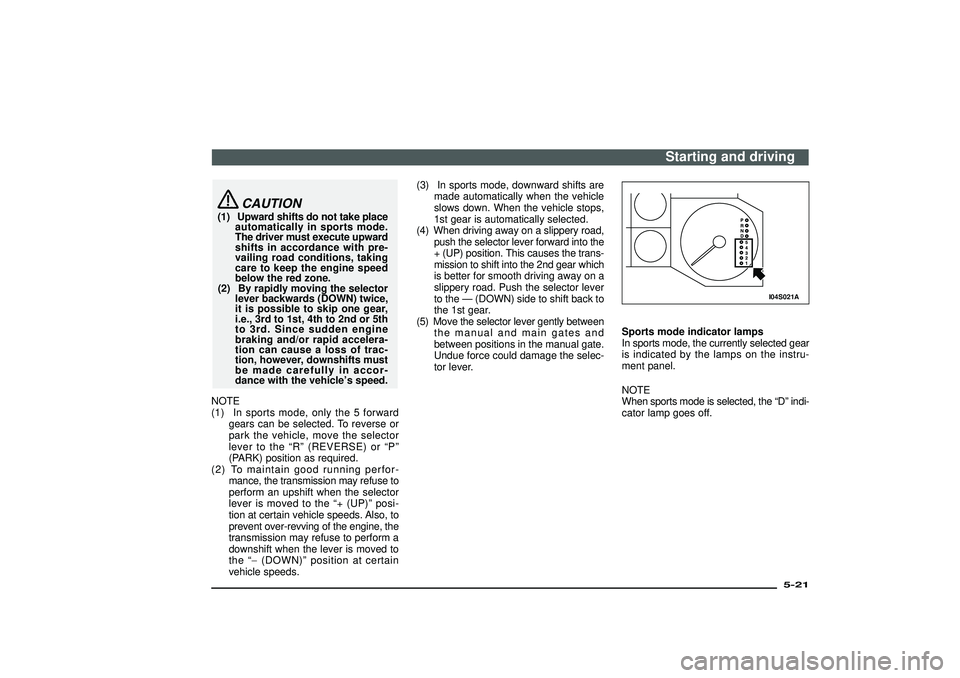
CAUTION
(1) Upward shifts do not take place
automatically in sports mode.
The driver must execute upward
shifts in accordance with pre-
vailing road conditions, taking
care to keep the engine speed
below the red zone.
(2) By rapidly moving the selector
lever backwards (DOWN) twice,
it is possible to skip one gear,
i.e., 3rd to 1st, 4th to 2nd or 5th
to 3rd. Since sudden engine
braking and/or rapid accelera-
tion can cause a loss of trac-
tion, however, downshifts must
be made carefully in accor-
dance with the vehicle’s speed.
NOTE
(1) In sports mode, only the 5 forward
gears can be selected. To reverse or
park the vehicle, move the selector
lever to the“R”(REVERSE) or“P”
(PARK) position as required.
(2) To maintain good running perfor-
mance, the transmission may refuse to
perform an upshift when the selector
lever is moved to the“+ (UP)”posi-
tion at certain vehicle speeds. Also, to
prevent over-revving of the engine, the
transmission may refuse to perform a
downshift when the lever is moved to
the“−(DOWN)”position at certain
vehicle speeds.(3) In sports mode, downward shifts are
made automatically when the vehicle
slows down. When the vehicle stops,
1st gear is automatically selected.
(4) When driving away on a slippery road,
push the selector lever forward into the
+ (UP) position. This causes the trans-
mission to shift into the 2nd gear which
is better for smooth driving away on a
slippery road. Push the selector lever
to the—(DOWN) side to shift back to
the 1st gear.
(5) Move the selector lever gently between
the manual and main gates and
between positions in the manual gate.
Undue force could damage the selec-
tor lever.
I04S021A
Sports mode indicator lamps
In sports mode, the currently selected gear
is indicated by the lamps on the instru-
ment panel.
NOTE
When sports mode is selected, the“D”indi-
cator lamp goes off.
Starting and driving
5-21
Div:
Out put date:
Page 180 of 392
Operation of the automatic trans-
mission INVECS II Sport Mode 5A/T
EI04D-Ch
CAUTION
(1) Before selecting a gear with the
engine running and the vehicle
stationary, fully depress the
brake pedal to prevent the
vehicle from creeping.
The vehicle will begin to move
as soon as the gear is engaged,
especially when the engine
speed is high, at fast idle or with
the air conditioning operating,
the brakes should only be
released when you are ready to
drive away.
(2) Depress the brake pedal with the
right foot at all times.
Using the left foot could cause
driver movement delay in case
of an emergency.
(3) To prevent sudden accelera-
tion, never race the engine when
shifting from the“P”(PARK) or
“N”(NEUTRAL).
CAUTION
(4) Operating the accelerator pedal
while the other foot is resting on
the brake pedal will affect brak-
ing efficiency and may cause
premature wear of brake pads.
Do not race the engine with
brake pedal pressed.
This can damage the transmis-
sion.Passing acceleration
EI04F-P
To gain extra acceleration in“D”(DRIVE)
position (when passing another vehicle)
push the accelerator to the floor. The auto-
matic transmission will automatically down-
shift.
NOTE
In sports mode, downshifts do not take
place when the accelerator is depressed all
the way to the floor.
Uphill/downhill driving
EI04O-Ia
DRIVING UPHILL
The transmission may not upshift to a
higher gear if the computer determines the
current speed cannot be maintained once
a higher gear is engaged.
For smoother vehicle performance, if you
release the throttle while climbing a steep
grade, the transmission may not upshift.
This is normal, as the computer is tempo-
rarily preventing shifting. After reaching the
top of the hill, normal gear shift function will
resume.
DRIVING DOWNHILL
When travelling down steep grades, the
computer may automatically select a lower
gear. This function assists engine brak-
ing efforts, reducing the need for using the
brakes.
Starting and driving
5-22Div:
Out put date:
Page 181 of 392
Waiting
EI04G-Ee
For short waiting periods, such as at traf-
fic signal, the vehicle can be left in gear and
held stationary with the service brake.
For longer waiting periods with the engine
running, the selector lever should be placed
in the“N”(NEUTRAL) position.
CAUTION
(1) Never hold the vehicle station-
ary while in gear on a hill with
the accelerator, always apply the
parking brake and/or service
brake.
(2) Unexpected acceleration may
occur if the selector lever is in a
position other than“P”(PARK)
or“N”(NEUTRAL).
Prior to moving off after having
stopped the vehicle, make sure
that the selector lever is in“D”
(DRIVE) or“Sports mode”posi-
tion.
Parking
EI04H-Be
To park the vehicle, first bring it to a com-
plete stop, fully engage the parking brake,
and then move the selector lever to the“P”
(PARK) position.
If you are going to leave the vehicle unat-
tended, always switch off the engine and
remove the ignition key.
NOTE
On a slope, be sure to apply the parking
brake before moving the selector lever to
the“P”(PARK) position. If you move the
selector lever to the“P”(PARK) position
without first applying the parking brake, a
stronger than normal resistance force may
be encountered. In this situation, move the
selector lever strongly when you next wish
to drive.
Starting and driving
5-23
Div:
Out put date:
Page 300 of 392
If the vehicle breaks down
EN40B-Bc
If the vehicle breaks down on the road,
move it to the shoulder and use the haz-
ard warning flashers.If the engine stops/failsVehicle operation and control are affected
if the engine stops. Before moving the
vehicle to a safe area be aware of the
following:
1. The brake booster becomes inopera-
tive and the pedal effort will increase.
Press down the brake pedal harder than
usual.
2. Since the power steering pump is no
longer operative, the steering wheel
feels heavy when turning it. Turn the
wheel with more effort than usual.
Operation under adverse driv-
ing conditions
EI43AAKa
If your vehicle is stuck in sand, mud
or snowIf the vehicle becomes stuck in snow, sand,
or mud, it can often be moved with a rock-
ing motion. Move the selector lever alter-
nately between the Sports-mode and “R”
(REVERSE) position (with manual trans-
mission, between 1st and Reverse), while
applying slight pressure to the accelera-
tor pedal.
Avoid racing the engine or spinning the
wheels. Prolonged efforts to free a stuck
vehicle may result in overheating and trans-
mission failure. Allow the engine to idle for
a few minutes to let the transmission cool
between rocking attempts.
If the vehicle remains stuck after several
rocking attempts, seek other assistance.
WARNING
When attempting to rock your vehicle
out of a stuck position, be sure that
the area around the vehicle is clear of
people and physical objects. The
rocking motion may cause the
vehicle to suddenly launch forward
or backward, causing injury or dam-
age to nearby people or objects.
For emergencies
8-2Div:
Out put date:
Page 316 of 392
CAUTION
(1) This vehicle must not be towedby a tow truck using sling lift
type equipment (Type A) as illus-
trated. Using a sling lift will dam-
age the bumper and front end.
(2) In case the vehicle with an auto- matic transmission must be
towe d farthe r tha n 50k m (3 1
miles) ,transpor tth evehicl ewith
all wheels off the ground (Type B
or C) or with rear wheels off the
ground (Type E) as illustrated.
(3) If the transmission is dam- aged, transport the vehicle with
all wheels off the ground (Type B
or C) as illustrated.
(4) Be sure to shift the transfer shift lever to “2H ”position. Never try
to tow with the transfer shift
lever in “4H ”or “4L ”positions
(part time 4WD models), “4H ”,
“ 4HLc ”,or “4LLc ”positions
(super select 4WD II models) and
with any of the wheels on the
ground (Type D or E). This could
result in damage to the vehi-
cle ’s driving system, or the
vehicle could become sepa-
rated from the tow truck and
unexpected accident might
result. Towing with front wheels off the ground
(Type D)
Place the gear shift lever (manual
transmission) or the selector lever
(automatic transmission) in the
“Neutral ”or
“N” (NEUTRAL) position. Release the park-
ing brake.
Towing with rear wheels off the ground
(Type E)
Turn the ignition switch to the “ACC ”posi-
tion and secure the steering wheel in a
straight-ahead position with a rope or
tie-down strap.
Never place the ignition switch in the
“ LOCK ”position. It is dangerous as the
steering wheel may lock.
CAUTION
[Fo rvehicles equippe dwit hthe
MITSUBISH Iactiv estabilit y &trac-
tio ncontro lsyste m(M-ASTC)]
I f th evehicl eis towe dwit hth eigni-
tion switch in to the “ON ”position
and only the front wheels or only the
rear wheels raised off the ground, the
activ etractio ncontro lsyste mmay
operate, resulting in a an accident.
N25A335A
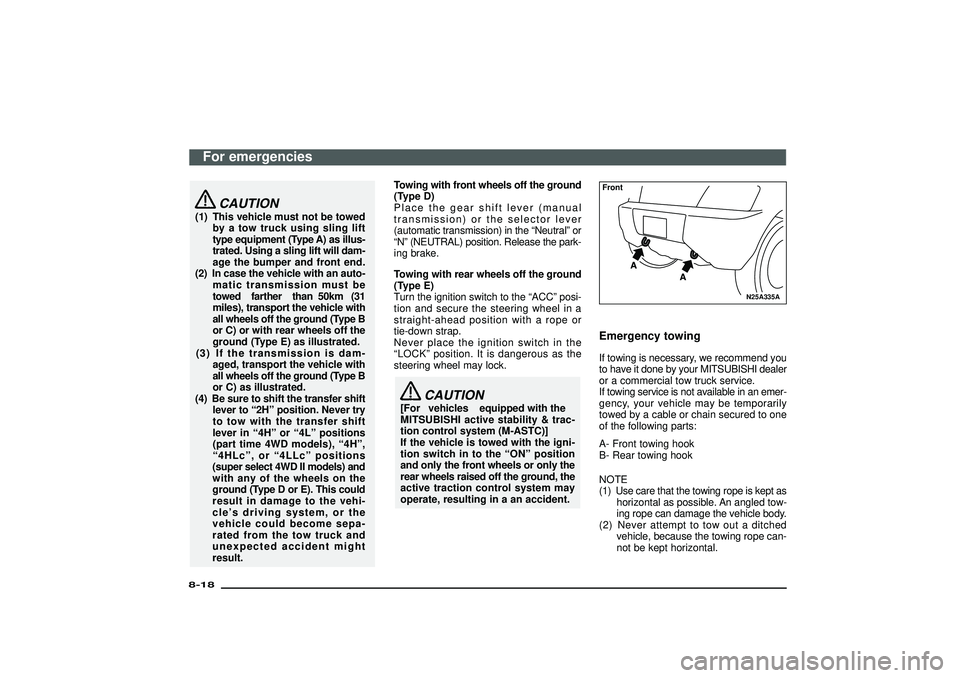
FrontEmergency towingIf towing is necessary, we recommend you
to have it done by your MITSUBISHI dealer
or a commercial tow truck service.
If towing service is not available in an emer-
gency, your vehicle may be temporarily
towed by a cable or chain secured to one
of the following parts:
A- Front towing hook
B- Rear towing hook
NOTE
(1) Use care that the towing rope is kept as horizontal as possible. An angled tow-
ing rope can damage the vehicle body.
(2) Never attempt to tow out a ditched vehicle, because the towing rope can-
not be kept horizontal.
For emergencies
8-18Div:
Out put date: