air condition MITSUBISHI SHOGUN 2017 (in English) Owner's Guide
[x] Cancel search | Manufacturer: MITSUBISHI, Model Year: 2017, Model line: SHOGUN, Model: MITSUBISHI SHOGUN 2017Pages: 394, PDF Size: 19 MB
Page 210 of 394

Operating the system in auto-matic mode
E00704102506
In normal conditions, use the system in the
AUTO mode and follow these procedures: 1. Push the AUTO switch.
2. Select the temperature control dial to the
desired temperature.
The mode selection, blower speed ad-
justment, recirculated/outside air selec- tion, temperature adjustment, and air
conditioner ON/OFF status are all con- trolled automatically.
CAUTIONl While the vehicle is stationary, fully depress
the brake pedal to prevent the vehicle from
creeping caused by slightly increased idling
speed when the air conditioning compressor
is switched on automatically.NOTEl When the temperature is set to the highest or
the lowest setting under the AUTO opera-
tion, the air selection and the air condition- ing will be automatically changed as fol-
lows.
Also, if the air selection is operated manual- ly after an automatic changeover, manualoperation will be selected.
• Quick Heating (When the temperature is
set to the highest setting)
Outside air will be introduced.
• Quick Cooling (When the temperature is
set to the lowest setting)
Inside air will be recirculated and the air
conditioning will operate.Operating the system in man-
ual mode
E00704200154
Blower speed and ventilator mode may be
controlled manually by setting the blower speed selection dial and the MODE switch to the desired positions.
To return to automatic operation, set the AU-
TO operation.
Demisting of the windscreen
and door windows
E00704301992
To remove frost or mist from the windscreen
and door windows, use the MODE switch or
Demister switch (“
” or “”).
CAUTIONl For safety, make sure you have a clear view
through all the windows.
Front automatic air conditioning
7-08OVWX17E1For pleasant driving7
Page 211 of 394

For ordinary demisting
Use this setting to keep the windscreen anddoor windows clear of mist, and to keep the
leg area heated.
1. Set the air selection switch (A) to the outside position.
2. Set the MODE switch (B) to the “
”
position.
3. Select your desired blower speed by turning the blower speed selection dial.
4. Select your desired temperature by turn- ing the temperature control dial.
5. Push the air conditioning switch (C).
For quick demisting
1. Push the demister switch (A) to change
to the “
” position.
2. Set the blower to the maximum speed.
3. Set the temperature to the highest posi- tion.
NOTEl When the demister switch is pressed, the air
conditioning will operate automatically and the outside air position will also be selected
automatically.
(In this case, the air conditioning indication
lamp will not change.)
l To demist effectively, direct the air flow
from the side ventilators towards the door
windows.
l Do not set the temperature control dial to the
max. cool position. Cool air will blow
against the window glasses and prevent de- misting.Rear air conditioning*
E00704600073
The rear air conditioning can only be used while the engine is running and the front air
conditioning is switched on.
When the front air conditioning is not switch-
ed on, only blower operation without cooling is possible.Control panel
E00704700058
1- Blower speed selection dial2- Main switch
3- Temperature control dial
Rear air conditioning*
7-09OVWX17E1For pleasant driving7
Page 212 of 394
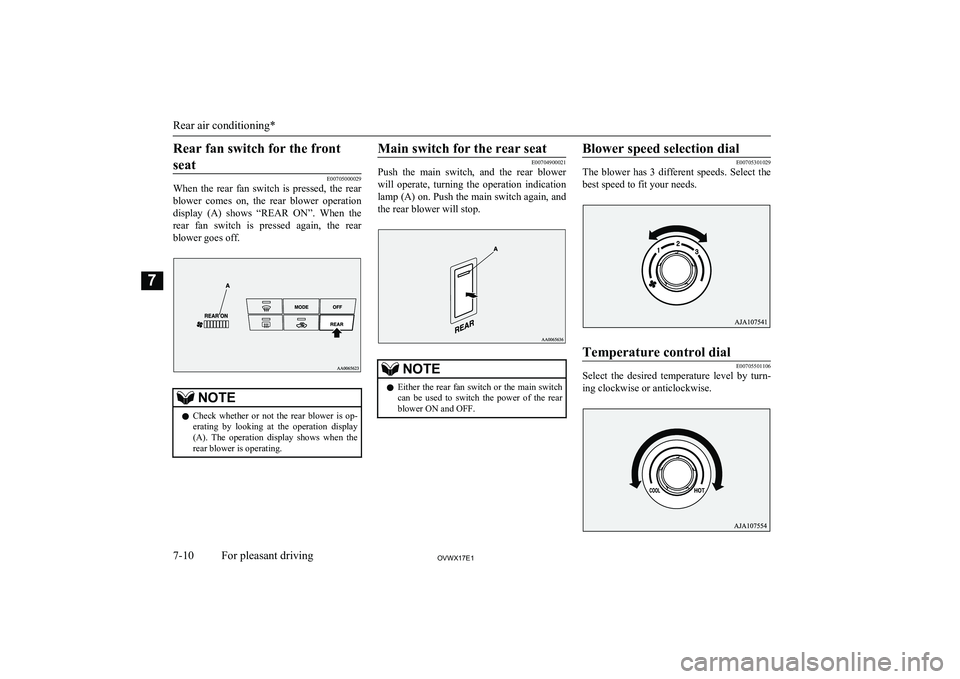
Rear fan switch for the frontseat
E00705000029
When the rear fan switch is pressed, the rear
blower comes on, the rear blower operation display (A) shows “REAR ON”. When the
rear fan switch is pressed again, the rear blower goes off.
NOTEl Check whether or not the rear blower is op-
erating by looking at the operation display
(A). The operation display shows when the rear blower is operating.Main switch for the rear seat
E00704900021
Push the main switch, and the rear blower
will operate, turning the operation indication
lamp (A) on. Push the main switch again, and the rear blower will stop.NOTEl Either the rear fan switch or the main switch
can be used to switch the power of the rear
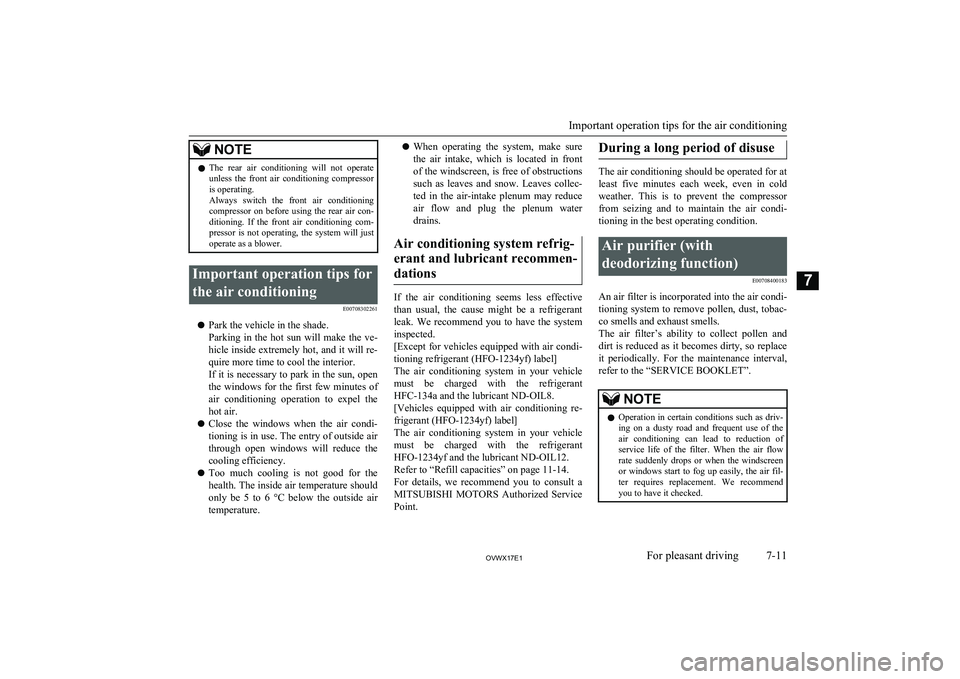
blower ON and OFF.Blower speed selection dial
E00705301029
The blower has 3 different speeds. Select the
best speed to fit your needs.
Temperature control dial
E00705501106
Select the desired temperature level by turn-
ing clockwise or anticlockwise.
Rear air conditioning*
7-10OVWX17E1For pleasant driving7
Page 213 of 394
NOTElThe rear air conditioning will not operate
unless the front air conditioning compressor
is operating.
Always switch the front air conditioning
compressor on before using the rear air con- ditioning. If the front air conditioning com-
pressor is not operating, the system will just operate as a blower.Important operation tips for
the air conditioning E00708302261
lPark the vehicle in the shade.
Parking in the hot sun will make the ve-
hicle inside extremely hot, and it will re-
quire more time to cool the interior.
If it is necessary to park in the sun, open the windows for the first few minutes of
air conditioning operation to expel the
hot air.
l Close the windows when the air condi-
tioning is in use. The entry of outside air
through open windows will reduce the cooling efficiency.
l Too much cooling is not good for the
health. The inside air temperature should
only be 5 to 6 °C below the outside air temperature.
l When operating the system, make sure
the air intake, which is located in front
of the windscreen, is free of obstructions such as leaves and snow. Leaves collec- ted in the air-intake plenum may reduce
air flow and plug the plenum water
drains.
Air conditioning system refrig- erant and lubricant recommen-dations
If the air conditioning seems less effective than usual, the cause might be a refrigerant
leak. We recommend you to have the system inspected.
[Except for vehicles equipped with air condi- tioning refrigerant (HFO-1234yf) label]
The air conditioning system in your vehicle must be charged with the refrigerant
HFC-134a and the lubricant ND-OIL8.
[Vehicles equipped with air conditioning re- frigerant (HFO-1234yf) label]
The air conditioning system in your vehicle must be charged with the refrigerant
HFO-1234yf and the lubricant ND-OIL12.
Refer to “Refill capacities” on page 11-14.
For details, we recommend you to consult a
MITSUBISHI MOTORS Authorized Service
Point.
During a long period of disuse
The air conditioning should be operated for at
least five minutes each week, even in cold weather. This is to prevent the compressor
from seizing and to maintain the air condi- tioning in the best operating condition.
Air purifier (with
deodorizing function) E00708400183
An air filter is incorporated into the air condi-tioning system to remove pollen, dust, tobac-
co smells and exhaust smells.
The air filter’s ability to collect pollen and
dirt is reduced as it becomes dirty, so replace it periodically. For the maintenance interval, refer to the “SERVICE BOOKLET”.
NOTEl Operation in certain conditions such as driv-
ing on a dusty road and frequent use of the air conditioning can lead to reduction of
service life of the filter. When the air flow rate suddenly drops or when the windscreenor windows start to fog up easily, the air fil-
ter requires replacement. We recommend
you to have it checked.
Important operation tips for the air conditioning
7-11OVWX17E1For pleasant driving7
Page 297 of 394
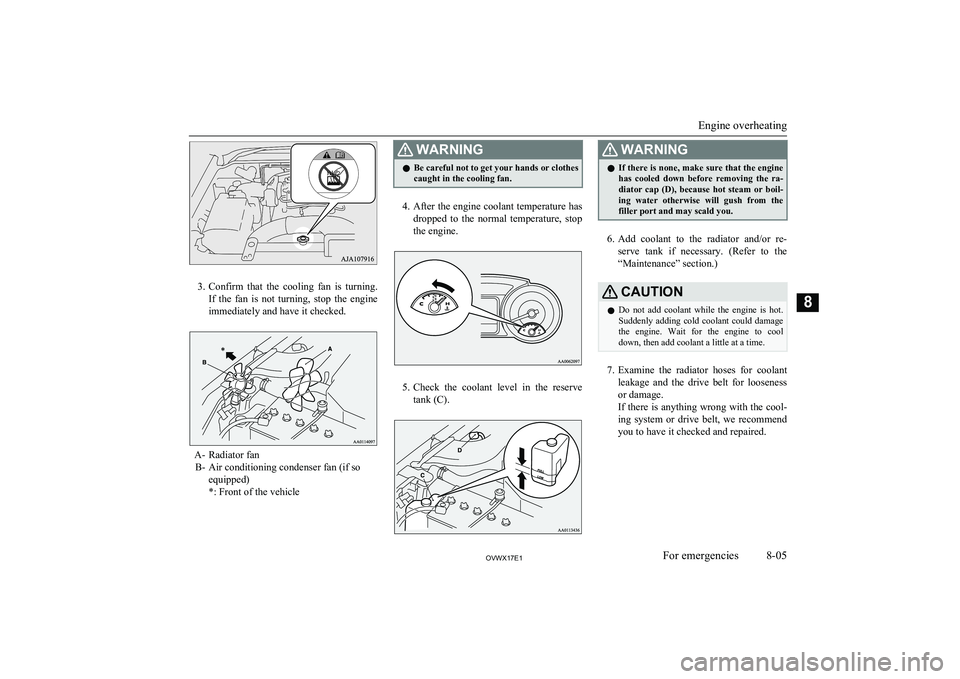
3.Confirm that the cooling fan is turning.
If the fan is not turning, stop the engine
immediately and have it checked.
A- Radiator fan B- Air conditioning condenser fan (if so equipped)
*: Front of the vehicle
WARNINGl Be careful not to get your hands or clothes
caught in the cooling fan.
4. After the engine coolant temperature has
dropped to the normal temperature, stop the engine.
5. Check the coolant level in the reserve
tank (C).
WARNINGl If there is none, make sure that the engine
has cooled down before removing the ra-
diator cap (D), because hot steam or boil- ing water otherwise will gush from the filler port and may scald you.
6. Add coolant to the radiator and/or re-
serve tank if necessary. (Refer to the
“Maintenance” section.)
CAUTIONl Do not add coolant while the engine is hot.
Suddenly adding cold coolant could damage
the engine. Wait for the engine to cool
down, then add coolant a little at a time.
7. Examine the radiator hoses for coolant
leakage and the drive belt for looseness
or damage.
If there is anything wrong with the cool-
ing system or drive belt, we recommend
you to have it checked and repaired.
Engine overheating
8-05OVWX17E1For emergencies8
Page 302 of 394

WARNINGlBe sure to apply chocks or blocks to the
correct tyre when jacking up the vehicle.If the vehicle moves while jacked up, the
jack could slip out of position, leading to
an accident.NOTEl The chocks shown in the illustration do not
come with your vehicle. It is recommended
that you keep one in the vehicle for use if needed.
l If chocks are not available, use stones or any
other objects that are large enough to hold the wheel in position.
6. Get the spare wheel, jack, jack handle
and wheel nut wrench ready.
Refer to “Tool, jack and jack handle” on page 8-07.
Spare wheel information
E00803600266
Check the air pressure of the spare tyre fre-quently and make sure it is ready for emer-
gency use at any time.
Maintaining the spare wheel at the highest specified air pressure will ensure that it can
always be used under any conditions (city/ high-speed driving, varying load weight,etc.).
The spare wheel is stored on the outside of
the backdoor. (Refer to “To remove the spare wheel” on page 8-10).
1- Spare wheel
CAUTIONl The tyre pressure should be periodically
checked and maintained at the specified
pressure while the tyre is stowed.
Driving with an insufficient tyre pressure can lead to an accident. If you have nochoice but to drive with an insufficient tyre
pressure, keep your speed down and inflate the tyre to the correct pressure as soon as
possible. (Refer to “Tyre inflation pressures”
on page 10-11.)To remove the spare wheel
E00803500177
CAUTIONl Grasp the spare wheel firmly when remov-
ing or attaching it.
l When removing the spare wheel, put on
gloves. Removing the spare wheel with your
bare hands may cause injury to the fingers.
1. Open the backdoor.
2. Open the lids (A) inside of the backdoor.
How to change a tyre
8-10OVWX17E1For emergencies8
Page 311 of 394
NOTElDo not tow a vehicle heavier than your own
vehicle.Operation under adverse
driving conditions E00801704160
If your vehicle becomes stuck
in sand, mud or snow
If the vehicle becomes stuck in snow, sand,
or mud, it can often be moved with a rocking
motion. Move the selector lever alternately
between the Sports mode and “R” (RE- VERSE) position, while applying slight pres-sure to the accelerator pedal.
Avoid racing the engine or spinning the
wheels. Prolonged efforts to free a stuck ve-hicle may result in overheating, transmission
and drivetrain failure. Allow the engine to idle for a few minutes to let the transmissioncool between rocking attempts.
If the vehicle remains stuck after several rocking attempts, seek other assistance.WARNINGl When attempting to rock your vehicle out
of a stuck position, be sure that the area around the vehicle is clear of people and
physical objects. The rocking motion may cause the vehicle to suddenly launch for-ward or backward, causing injury or
damage to nearby people or objects.
On a flooded road
l Avoid flooded roads. In the event driv-
ing flooded roads, doing so may causethe following serious damage to the ve-
hicle. • Engine stalling
• Short in electrical components
• Engine damage caused by water im-
mersion
After driving on flooded roads, be sure
to have an inspection at an Authorized MITSUBISHI MOTORS dealer and takethe necessary measures or repair.
l When driving in rain, or water-covered
roads, or through a car wash, water could enter the brake discs, resulting in
temporarily ineffective brakes.
In such cases, lightly depress the brake
pedal to see if the brakes operate proper- ly. If they do not, lightly depress the pedal several times while driving in or-
der to dry the brake pads.
l When driving in rain or on a road with
many puddles a layer of water may form
between the tyres and the road surface.
This reduces a tyre’s frictional resistance
on the road, resulting in loss of steering
stability and braking capability.
To cope with this, observe the following items: (a)Drive your vehicle at slow
speed. (b)Do not drive on worn tyres. (c)Always maintain the specified
tyre inflation pressures.
On a snow-covered or frozen
road
l When driving on a snow-covered or fro-
zen road, it is recommended that you use snow tyres or tyre chains.
Operation under adverse driving conditions
8-19OVWX17E1For emergencies8
Page 320 of 394

Service precautionsE01000102696
Adequate care of your vehicle at regular in- tervals serves to preserve the value and ap-
pearance as long as possible.
Maintenance items as described in this own- er’s manual can be performed by the owner.We recommend you to have the periodic in-
spection and maintenance performed by a MITSUBISHI MOTORS Authorized Service
Point or another specialist. In the event a malfunction or other problem is discovered,
we recommend you to have it checked and repaired. This section contains information on inspection maintenance procedures that you can do yourself. Follow the instructions
and cautions for each of the various proce-
dures.WARNINGl When checking or servicing the inside of
the engine compartment, make sure the engine is switched off and has had achance to cool down.
l If it is necessary to do work in the engine
compartment with the engine running, be
especially careful that your clothing, hair, etc., does not become caught by the fans,
drive belts, or other moving parts.WARNINGl After performing the maintenance, make
sure that no tools or cloths are left behindin the engine compartment.
If they are left behind, a fire or damage to
the vehicle may occur.
l The air conditioning condenser fan (if so
equipped) can turn on automatically evenif the engine is not running. Turn the igni-
tion switch to the “LOCK” position to be
safe while you work in the engine com- partment.
A- Radiator fan
B- Air conditioning condenser fan (if so
equipped)
C- Caution label (Vehicle with air condi-
tioning condenser fan)
*: Front of the vehicle
WARNINGl Do not smoke, cause sparks or allow open
flames around fuel or battery. The fumesare flammable.
l Be extremely cautious when working
around the battery. It contains poisonous
and corrosive sulphuric acid.
l Do not get under your vehicle with just
the body jack supporting it. Always use
automotive jack stands.
l Improper handling of components and
materials used in the vehicle can endanger
your personal safety. We recommend you
to consult a specialist for necessary infor- mation.Catalytic converter
E01000201355
For ordinary use, there are no particular pre-cautions except that of using unleaded petrol.
The exhaust gas scavenging devices used
with the catalytic converter are extremely ef- ficient for the reduction of noxious gases.
The catalytic converter is installed in the ex- haust system.
It is important to keep the engine properly tuned to ensure proper catalyst operation andprevent possible catalyst damage.
Service precautions
10-02OVWX17E1Maintenance10
Page 330 of 394
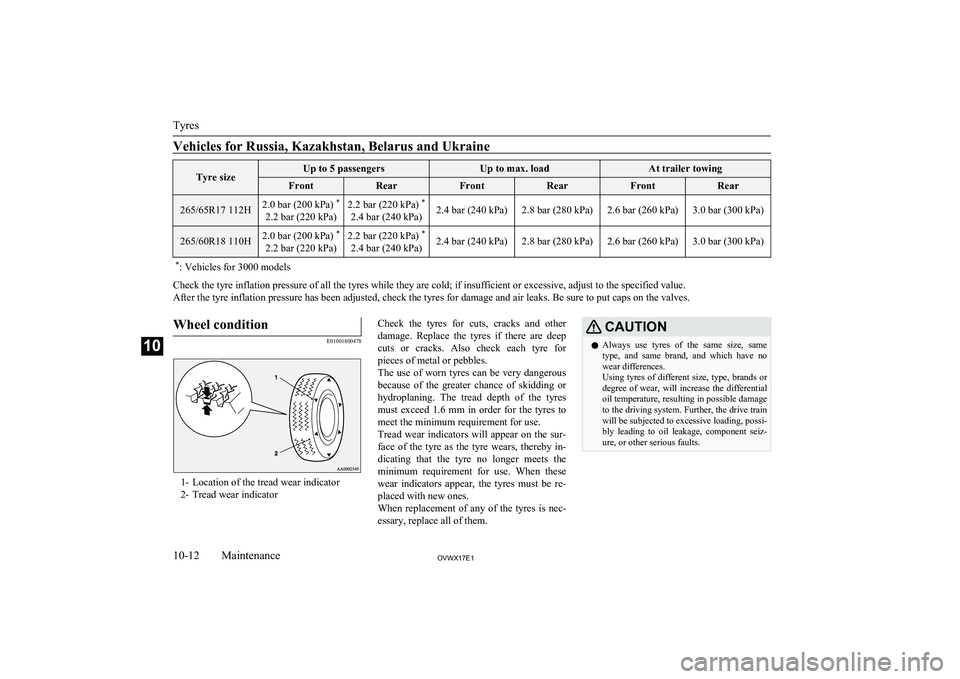
Vehicles for Russia, Kazakhstan, Belarus and UkraineTyre sizeUp to 5 passengersUp to max. loadAt trailer towingFrontRearFrontRearFrontRear265/65R17 112H2.0 bar (200 kPa) *
2.2 bar (220 kPa)2.2 bar (220 kPa) *
2.4 bar (240 kPa)2.4 bar (240 kPa)2.8 bar (280 kPa)2.6 bar (260 kPa)3.0 bar (300 kPa)265/60R18 110H2.0 bar (200 kPa) *
2.2 bar (220 kPa)2.2 bar (220 kPa) *
2.4 bar (240 kPa)2.4 bar (240 kPa)2.8 bar (280 kPa)2.6 bar (260 kPa)3.0 bar (300 kPa)* : Vehicles for 3000 models
Check the tyre inflation pressure of all the tyres while they are cold; if insufficient or excessive, adjust to the specified value.
After the tyre inflation pressure has been adjusted, check the tyres for damage and air leaks. Be sure to put caps on the valves.
Wheel condition
E01001800478
1- Location of the tread wear indicator
2- Tread wear indicator
Check the tyres for cuts, cracks and other
damage. Replace the tyres if there are deep
cuts or cracks. Also check each tyre for pieces of metal or pebbles.
The use of worn tyres can be very dangerous
because of the greater chance of skidding or
hydroplaning. The tread depth of the tyres
must exceed 1.6 mm in order for the tyres to meet the minimum requirement for use.
Tread wear indicators will appear on the sur-
face of the tyre as the tyre wears, thereby in-
dicating that the tyre no longer meets the
minimum requirement for use. When these
wear indicators appear, the tyres must be re-
placed with new ones.
When replacement of any of the tyres is nec- essary, replace all of them.CAUTIONl Always use tyres of the same size, same
type, and same brand, and which have no wear differences.
Using tyres of different size, type, brands or
degree of wear, will increase the differential
oil temperature, resulting in possible damage to the driving system. Further, the drive train
will be subjected to excessive loading, possi- bly leading to oil leakage, component seiz-ure, or other serious faults.
Tyres
10-12OVWX17E1Maintenance10
Page 331 of 394
Replacing tyres and wheels
E01007201530
CAUTIONlAvoid using different size tyres from the one
listed and the combined use of different
types of tyres, as this can affect driving safe- ty.
Refer to “Tyres and wheels” on page
11-11.
l Even if a wheel has the same rim size and
offset as the specified type of wheel, its
shape may prevent it from being fitted cor- rectly. We recommend you to consult a spe-
cialist before using wheels that you have.
l If your vehicle is equipped with a tyre pres-
sure monitoring system, only MITSUBISHI
MOTORS genuine wheels should be used.
Use of another type of wheel risks air leaks and sensor damage, as it will not be possible
to install the tyre pressure sensor properly.
Refer to “Tyre pressure monitoring system
(TPMS)” on page 6-48.
Wheel balance
On vehicles equipped with 17x7 1/2J size
aluminium wheels (round rim type), if you
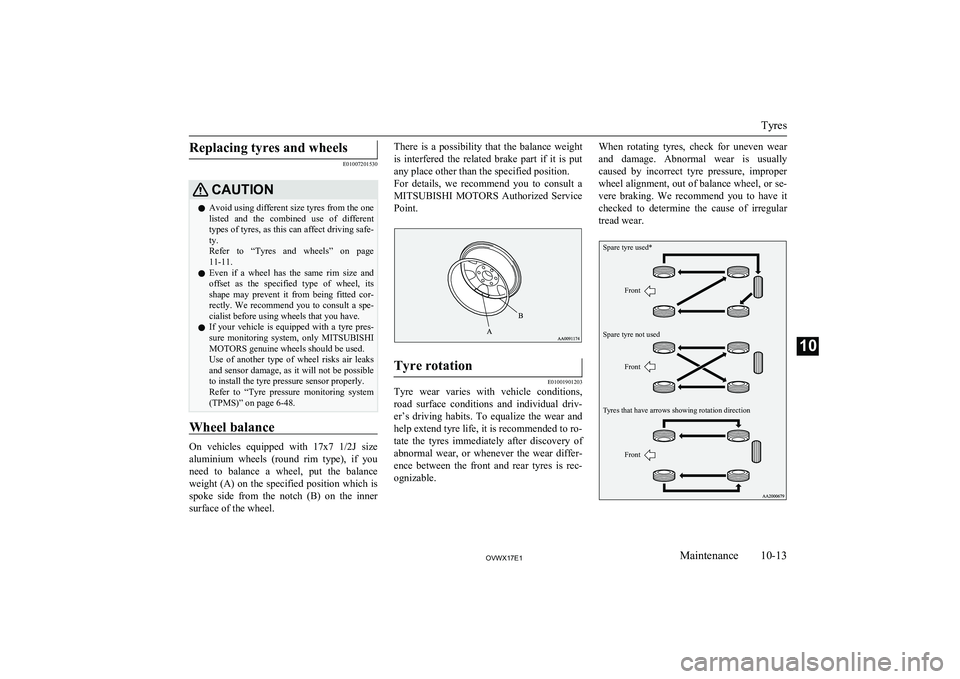
need to balance a wheel, put the balance weight (A) on the specified position which is
spoke side from the notch (B) on the inner surface of the wheel.
There is a possibility that the balance weight
is interfered the related brake part if it is put
any place other than the specified position.
For details, we recommend you to consult a MITSUBISHI MOTORS Authorized Service
Point.Tyre rotation
E01001901203
Tyre wear varies with vehicle conditions,
road surface conditions and individual driv- er’s driving habits. To equalize the wear andhelp extend tyre life, it is recommended to ro-
tate the tyres immediately after discovery of
abnormal wear, or whenever the wear differ- ence between the front and rear tyres is rec-
ognizable.
When rotating tyres, check for uneven wear
and damage. Abnormal wear is usually caused by incorrect tyre pressure, improper wheel alignment, out of balance wheel, or se-
vere braking. We recommend you to have it checked to determine the cause of irregular
tread wear.Spare tyre used*Spare tyre not usedTyres that have arrows showing rotation directionFrontFrontFront
Tyres
10-13OVWX17E1Maintenance10