ABS MITSUBISHI SHOGUN 2017 Owner's Manual (in English)
[x] Cancel search | Manufacturer: MITSUBISHI, Model Year: 2017, Model line: SHOGUN, Model: MITSUBISHI SHOGUN 2017Pages: 394, PDF Size: 19 MB
Page 2 of 394
ForewordE09200106777
Thank you for selecting a SHOGUN as your new vehicle.
This owner’s manual will add to your understanding and full enjoyment of
the many fine features of this vehicle.
It contains information prepared to acquaint you with the proper way to oper-
ate and maintain your vehicle for the utmost in driving pleasure.
MITSUBISHI MOTORS Europe B.V. reserves the right to make changes in
design and specifications and/or to make additions to or improvements in
this product without obligation to install them on products previously manu- factured.
It is an absolute requirement for the driver to strictly observe all laws and
regulations concerning vehicles.
This owner’s manual has been written in compliance with such laws and reg- ulations, but some of the contents may become contradictory with later amendment of the laws and regulations.
Please leave this owner’s manual in this vehicle at time of resale. The next
owner will appreciate having access to the information contained in this
owner’s manual.
Repairs to your vehicle:
Vehicles in the warranty period:
All warranty repairs must be carried out by a MITSUBISHI MOTORS Au-
thorized Service Point.
Vehicles outside the warranty period:
Where the vehicle is repaired is at the discretion of the owner.
Throughout this owner’s manual the words WARNING and CAUTION
appear.
These serve as reminders to be especially careful. Failure to follow instruc-
tions could result in personal injury or damage to your vehicle.WARNING
indicates a strong possibility of severe personal injury or death if in- structions are not followed.
CAUTION
means hazards or unsafe practices that could cause minor personal in-
jury or damage to your vehicle.
You will see another important symbol:
NOTE:gives helpful information.*:indicates optional equipment.
It may differ according to the sales classification; refer to the sales catalogue.
Abbreviations used in this owner’s manual:
LHD: Left-Hand Drive
RHD: Right-Hand Drive
M/T: Manual transmission
A/T: Automatic Transmission
The symbol used on the vehicles:
: See owner’s manual
Information for station service
E09300104338
Fuel
Capacity3-door models69 litres5-door models88 litres
Fuel requirements
Petrol-powered vehiclesUnleaded petrol octane number (EN228)90 RON or higher
If the “PREMIUM FUEL ONLY” label is attached to the fuel tank filler door,
fill it up with premium fuel.
Diesel-powered vehicles Cetane number (EN590)51 or higher
Refer to “General information” section for the fuel selection.Engine oilRefer to the “Maintenance”section for the selection of engine oil.Tyre inflation pressureRefer to the “Maintenance” section for the tyre inflation pressure.
© 2016 Mitsubishi Motors Corporation
17
OVWX17E1
BLO-16-000629
Page 66 of 394
SRS warning lamp
E00405900083
This warning lamp is shared by the SRS air-
bags and the pretensioner seat belts. Refer to
“SRS warning lamp” on page 4-47.
Force limiter system
E00406000153
In the event of a collision, each force limiter
system will effectively absorb the load ap- plied to the seat belt to minimize the impact
to the passenger.
Child restraint
E00406403233
When transporting children in your vehicle,some type of child restraint system should al-
ways be used according to the size of the child. This is required by law in most coun-
tries.
The regulations concerning driving with chil- dren in the front seat may differ from country
to country. You are advised to comply with the relevant regulations.
WARNINGl When possible, put children in the rear
seat. Accident statistics indicate that chil- dren of all sizes and ages are safer when
properly restrained in the rear seat rather than in the front seat.WARNINGl Holding a child in your arms is no substi-
tute for a restraint system. Failure to use
a proper restraint system can result in se- vere or fatal injury to the child.
l Each child restraint device or fixing is to
be used only by one child.
l When attaching a child restraint system
to the rear seat, prevent the front seat- backs from touching the child restraintsystem.
Otherwise, the child could be seriously in-
jured in the event of hard braking or a
collision.
Caution for installing the child
restraint on vehicle with frontpassenger’s airbag
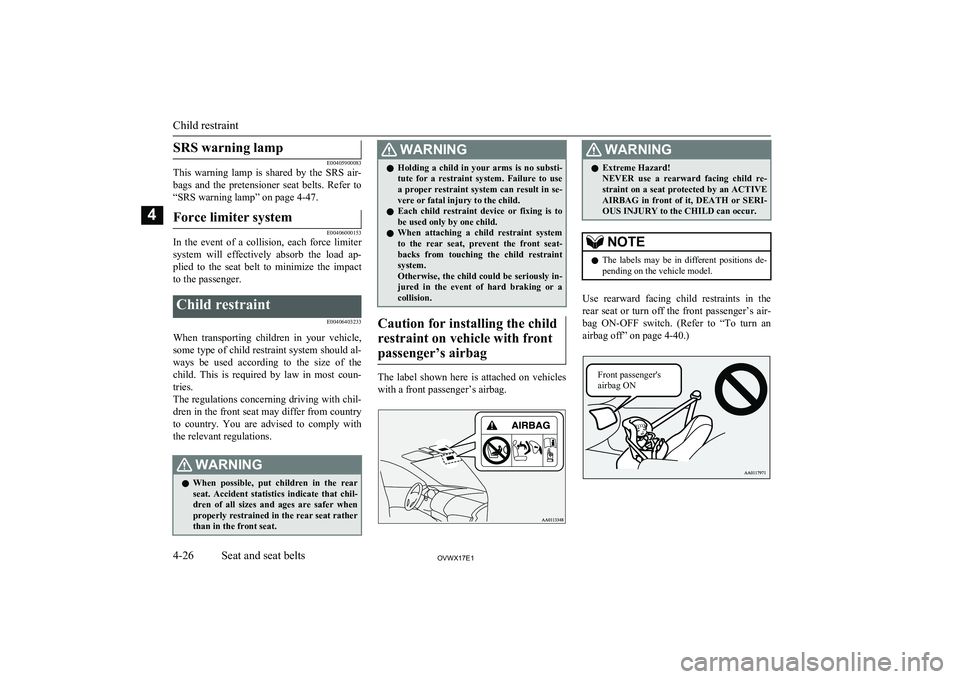
The label shown here is attached on vehicles
with a front passenger’s airbag.
WARNINGl Extreme Hazard!
NEVER use a rearward facing child re- straint on a seat protected by an ACTIVEAIRBAG in front of it, DEATH or SERI- OUS INJURY to the CHILD can occur.NOTEl The labels may be in different positions de-
pending on the vehicle model.
Use rearward facing child restraints in the
rear seat or turn off the front passenger’s air- bag ON-OFF switch. (Refer to “To turn an airbag off” on page 4-40.)
Child restraint
4-26OVWX17E1Seat and seat belts4 Front passenger's airbag ON
Page 82 of 394
The front airbags will deploy if the severityof impact is above the designed threshold
level, comparable to an approximately
25 km/h (16 mph) collision when impacting straight into a solid wall that does not move
or deform. If the severity of the impact is be- low the above threshold level, the front air- bags may not deploy. However, this thresh- old speed will be considerably higher if the
vehicle strikes an object that absorbs the im-
pact by either deforming or moving (for ex-
ample, another stationary vehicle, pole or a guard rail).
Because frontal collisions can easily move you out of position, it is important to always
properly wear your seat belts. Your seat belts will help keep you in a safe distance from the
steering wheel and instrument panel during
the initial stages of airbag deployment. The initial stage of airbag inflation is the most
forceful, and can possibly cause serious or fa- tal injuries. Moreover, the seat belts in your
vehicle are your primary means of protection in a collision. The SRS airbags are designed
to provide additional protection. Therefore,
for your safety and the safety of all occu- pants, be sure to always properly wear your
seat belts.The front airbags MAY NOT
DEPLOY when…
With certain types of frontal collisions, the
vehicle’s body structure is designed to absorb the shock to help protect the occupants fromharm. (The vehicle body’s front area may de-form significantly as it absorbs the impact.) Under such circumstances, the front airbags
may not deploy irrespective of the deforma- tion and damage to the vehicle body.
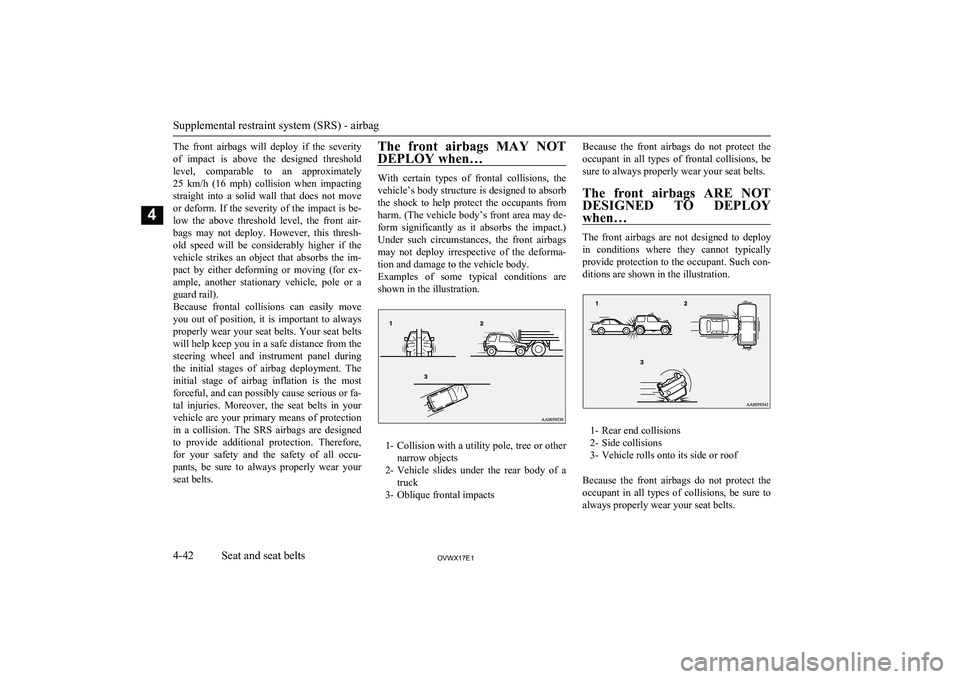
Examples of some typical conditions are
shown in the illustration.
1- Collision with a utility pole, tree or other
narrow objects
2- Vehicle slides under the rear body of a
truck
3- Oblique frontal impacts
Because the front airbags do not protect the
occupant in all types of frontal collisions, be
sure to always properly wear your seat belts.
The front airbags ARE NOT DESIGNED TO DEPLOY
when…
The front airbags are not designed to deploy
in conditions where they cannot typically provide protection to the occupant. Such con-ditions are shown in the illustration.
1- Rear end collisions
2- Side collisions
3- Vehicle rolls onto its side or roof
Because the front airbags do not protect the occupant in all types of collisions, be sure to
always properly wear your seat belts.
Supplemental restraint system (SRS) - airbag
4-42OVWX17E1Seat and seat belts4
Page 85 of 394
The side airbags and curtainairbags MAY NOT DEPLOY
when…
With certain types of side collisions, the ve-
hicle’s body structure is designed to absorb
the shock to help protect the occupants fromharm. (The vehicle body’s side area may de-form significantly as it absorbs the impact.) Under such circumstances, the side airbags and curtain airbags may not deploy irrespec-tive of the deformation and damage to the ve-
hicle body. Also, depending on the location
of the impact, the side airbags and curtain air-
bags may not deploy simultaneously.
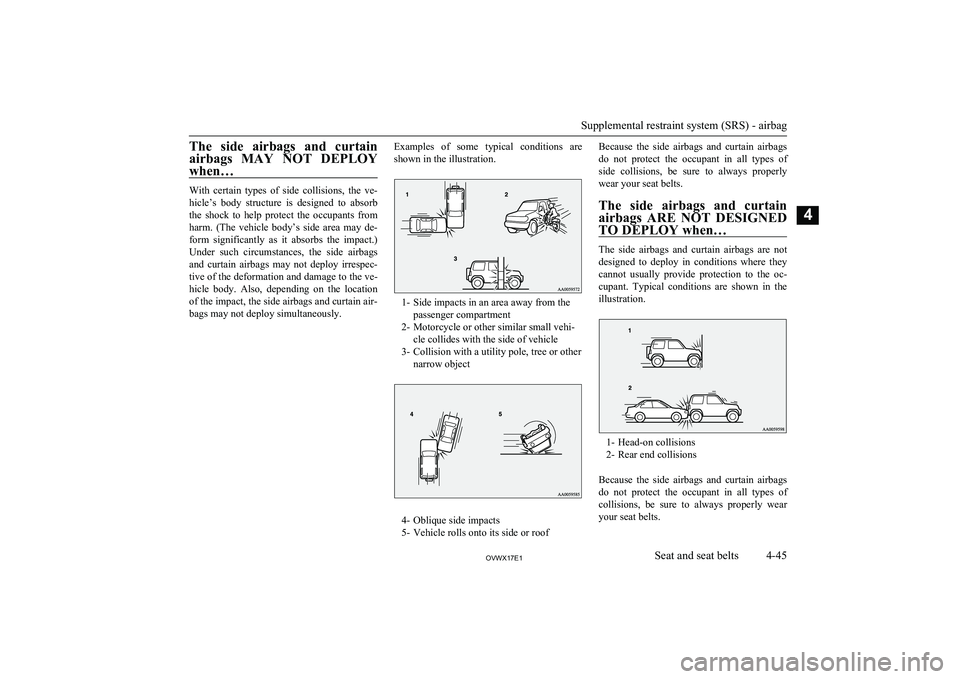
Examples of some typical conditions are
shown in the illustration.
1- Side impacts in an area away from the passenger compartment
2- Motorcycle or other similar small vehi- cle collides with the side of vehicle
3- Collision with a utility pole, tree or other narrow object
4- Oblique side impacts
5- Vehicle rolls onto its side or roof
Because the side airbags and curtain airbags
do not protect the occupant in all types of side collisions, be sure to always properlywear your seat belts.
The side airbags and curtain
airbags ARE NOT DESIGNED TO DEPLOY when…
The side airbags and curtain airbags are notdesigned to deploy in conditions where they
cannot usually provide protection to the oc- cupant. Typical conditions are shown in the
illustration.
1- Head-on collisions
2- Rear end collisions
Because the side airbags and curtain airbags do not protect the occupant in all types of collisions, be sure to always properly wearyour seat belts.
Supplemental restraint system (SRS) - airbag
4-45OVWX17E1Seat and seat belts4
Page 96 of 394
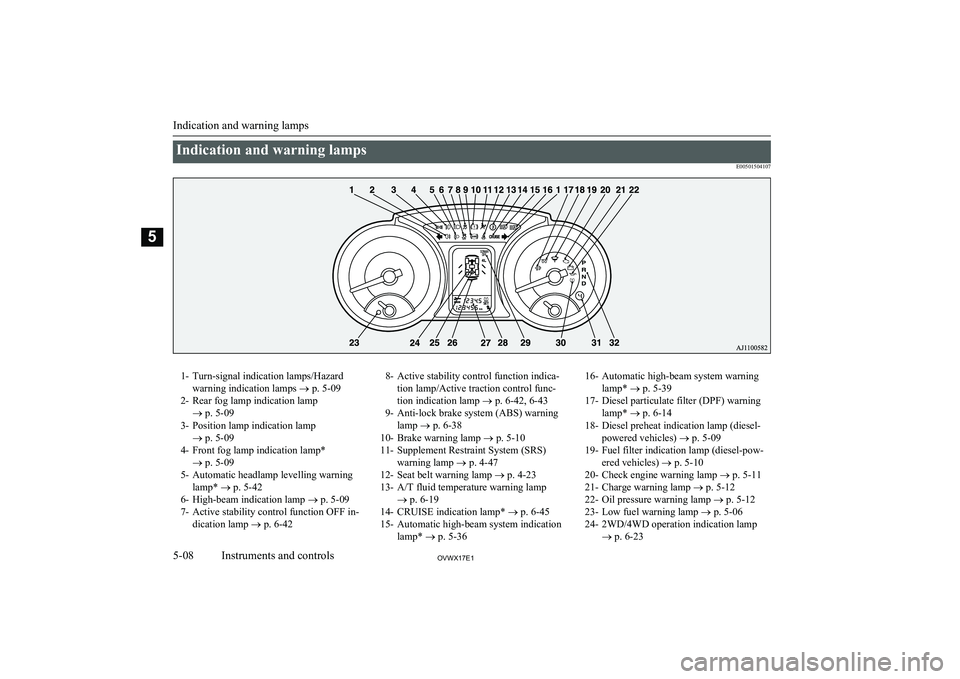
Indication and warning lampsE005015041071- Turn-signal indication lamps/Hazardwarning indication lamps ® p. 5-09
2- Rear fog lamp indication lamp ® p. 5-09
3- Position lamp indication lamp ® p. 5-09
4- Front fog lamp indication lamp* ® p. 5-09
5- Automatic headlamp levelling warning lamp* ® p. 5-42
6- High-beam indication lamp ® p. 5-09
7- Active stability control function OFF in- dication lamp ® p. 6-428- Active stability control function indica-
tion lamp/Active traction control func-
tion indication lamp ® p. 6-42, 6-43
9- Anti-lock brake system (ABS) warning lamp ® p. 6-38
10- Brake warning lamp ® p. 5-10
11- Supplement Restraint System (SRS) warning lamp ® p. 4-47
12- Seat belt warning lamp ® p. 4-23
13- A/T fluid temperature warning lamp ® p. 6-19
14- CRUISE indication lamp* ® p. 6-45
15- Automatic high-beam system indication lamp* ® p. 5-3616- Automatic high-beam system warning
lamp* ® p. 5-39
17- Diesel particulate filter (DPF) warning lamp* ® p. 6-14
18- Diesel preheat indication lamp (diesel- powered vehicles) ® p. 5-09
19- Fuel filter indication lamp (diesel-pow- ered vehicles) ® p. 5-10
20- Check engine warning lamp ® p. 5-11
21- Charge warning lamp ® p. 5-12
22- Oil pressure warning lamp ® p. 5-12
23- Low fuel warning lamp ® p. 5-06
24- 2WD/4WD operation indication lamp ® p. 6-23
Indication and warning lamps
5-08OVWX17E1Instruments and controls5
Page 98 of 394
CAUTIONlIf the diesel preheat indication lamp comes
on after the engine is started, the engine speed may not rise above the idling speedbecause of fuel freezing. In this case, keep
the engine idling for about ten minutes, then turn off the ignition switch and immediately
turn it on again to confirm that the diesel
preheat indication lamp is off.NOTEl If the engine is cold, the diesel preheat indi-
cation lamp is on for a longer time.
l When the engine has not been started within
about 5 seconds after the diesel preheat indi- cation lamp went out, return the ignition
switch to the “LOCK” position. Then, turn
the switch to the “ON” position to preheat the engine again.
l When the engine is warm, the diesel preheat
indication lamp does not come on even if the
ignition switch is placed in the “ON” posi-
tion.Fuel filter indication lamp (die-
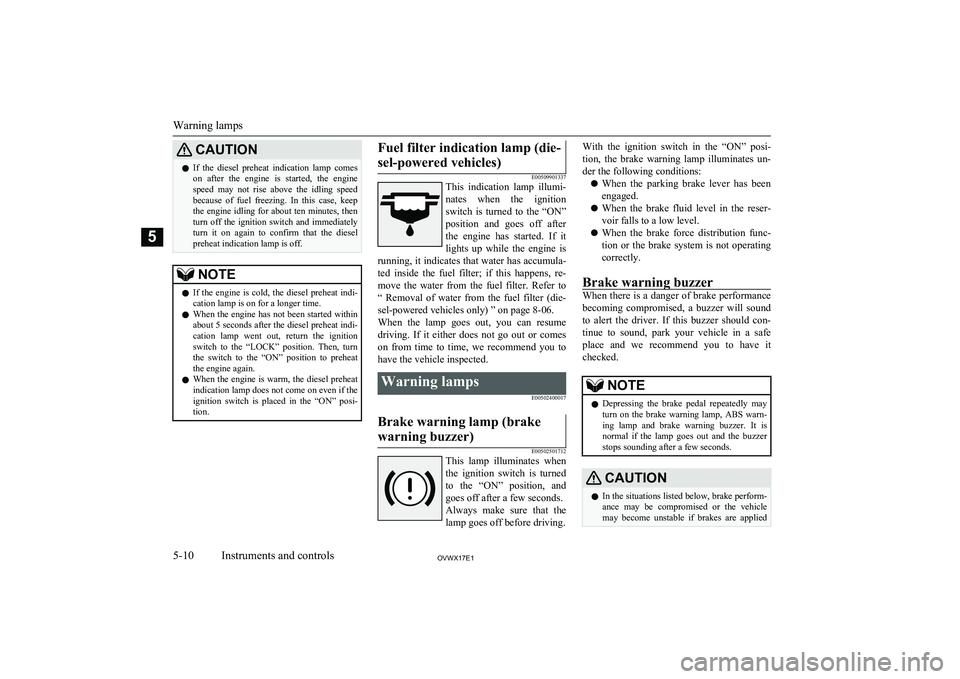
sel-powered vehicles)
E00509901337
This indication lamp illumi-
nates when the ignition
switch is turned to the “ON” position and goes off after
the engine has started. If it lights up while the engine is
running, it indicates that water has accumula-
ted inside the fuel filter; if this happens, re- move the water from the fuel filter. Refer to
“ Removal of water from the fuel filter (die- sel-powered vehicles only) ” on page 8-06.
When the lamp goes out, you can resume
driving. If it either does not go out or comes on from time to time, we recommend you to
have the vehicle inspected.
Warning lamps
E00502400017Brake warning lamp (brake
warning buzzer)
E00502501712
This lamp illuminates when
the ignition switch is turned to the “ON” position, and goes off after a few seconds.
Always make sure that the
lamp goes off before driving.
With the ignition switch in the “ON” posi-
tion, the brake warning lamp illuminates un- der the following conditions:
l When the parking brake lever has been
engaged.
l When the brake fluid level in the reser-
voir falls to a low level.
l When the brake force distribution func-
tion or the brake system is not operating
correctly.Brake warning buzzer
When there is a danger of brake performance
becoming compromised, a buzzer will sound
to alert the driver. If this buzzer should con-
tinue to sound, park your vehicle in a safe place and we recommend you to have itchecked.
NOTEl Depressing the brake pedal repeatedly may
turn on the brake warning lamp, ABS warn-ing lamp and brake warning buzzer. It is
normal if the lamp goes out and the buzzer stops sounding after a few seconds.CAUTIONl In the situations listed below, brake perform-
ance may be compromised or the vehicle may become unstable if brakes are applied
Warning lamps
5-10OVWX17E1Instruments and controls5
Page 99 of 394
CAUTIONsuddenly; consequently, avoid driving athigh speeds or applying the brakes suddenly.
Furthermore, the vehicle should be brought
to a stop in a safe location and to have it checked.
• The brake warning lamp does not illumi-
nate when the parking brake is applied ordoes not turn off when the parking brake
is released.
• The ABS warning lamp and brake warn-
ing lamp illuminate at the same time.
For details, refer to “ABS warning lamp” on page 6-38.
• The brake warning lamp remains illumi-
nated during driving.
• The brake warning buzzer does not turn
off.
l The vehicle should be brought to a halt in
the following manner when brake perform-
ance has deteriorated.
• Depress the brake pedal harder than usual.
Even if the brake pedal moves down to
the very end of its possible stroke, keep it pressed down hard.
• Should the brakes fail, use engine braking
to reduce your speed and pull the parking
brake lever.
Depress the brake pedal to operate the
stop lamp to alert the vehicles behind you.NOTEl In certain cases immediately after the engine
has been started or when the brake pedal is
depressed repeatedly, a noise generated by operation of brake devices may be heard coming from the engine compartment. At
this time, you may feel a shock from the brake pedal if you depress it. This type of
noise or shock is normal and there is no need for concern. In fact, they indicate that the
corresponding devices are operating normal- ly.
l The brake system uses brake fluid pressur-
ized by the pump.
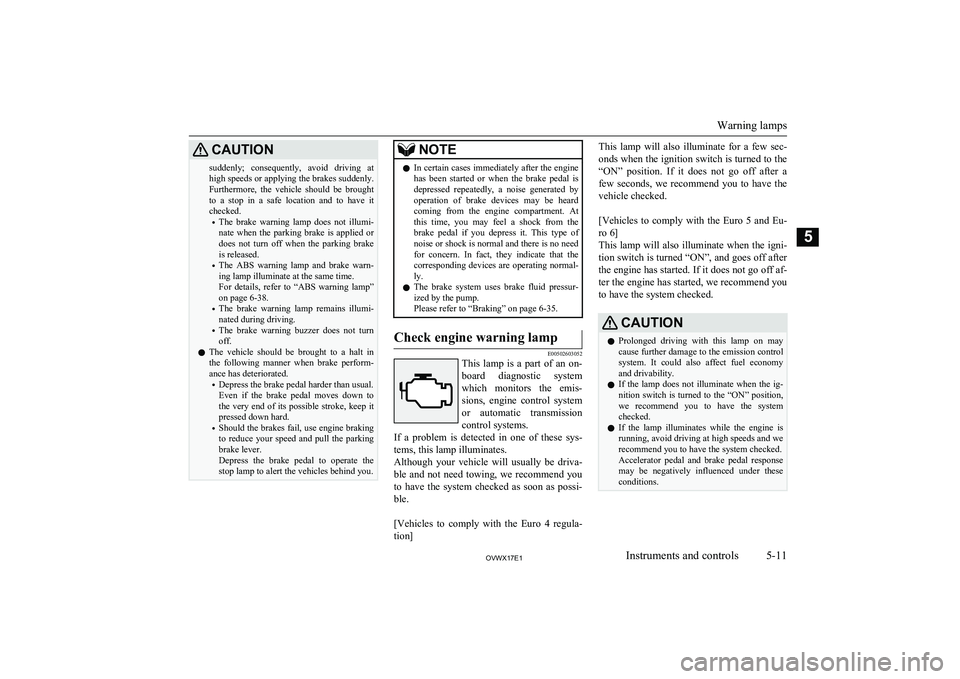
Please refer to “Braking” on page 6-35.Check engine warning lamp
E00502603052
This lamp is a part of an on-
board diagnostic system
which monitors the emis-
sions, engine control system or automatic transmission
control systems.
If a problem is detected in one of these sys-
tems, this lamp illuminates.
Although your vehicle will usually be driva-
ble and not need towing, we recommend you to have the system checked as soon as possi-
ble.
[Vehicles to comply with the Euro 4 regula-
tion]
This lamp will also illuminate for a few sec-
onds when the ignition switch is turned to the
“ON” position. If it does not go off after a few seconds, we recommend you to have the vehicle checked.
[Vehicles to comply with the Euro 5 and Eu-
ro 6]
This lamp will also illuminate when the igni-
tion switch is turned “ON”, and goes off after the engine has started. If it does not go off af- ter the engine has started, we recommend youto have the system checked.CAUTIONl Prolonged driving with this lamp on may
cause further damage to the emission control system. It could also affect fuel economy
and drivability.
l If the lamp does not illuminate when the ig-
nition switch is turned to the “ON” position,
we recommend you to have the system
checked.
l If the lamp illuminates while the engine is
running, avoid driving at high speeds and we recommend you to have the system checked.
Accelerator pedal and brake pedal response may be negatively influenced under these
conditions.
Warning lamps
5-11OVWX17E1Instruments and controls5
Page 139 of 394
Economical driving............................................................................. 6-02
Driving, alcohol and drugs.................................................................. 6-02
Safe driving techniques....................................................................... 6-03
Running-in recommendations............................................................. 6-04 Parking brake...................................................................................... 6-04
Parking................................................................................................ 6-05
Steering wheel height adjustment....................................................... 6-06
Inside rear-view mirror....................................................................... 6-07 Outside rear-view mirrors................................................................... 6-08
Ignition switch.....................................................................................6-10 Steering wheel lock............................................................................. 6-12
Starting................................................................................................ 6-12 NOx trap catalyst (dieselpowered vehicles)*......................................6-14
Diesel particulate filter (DPF)*........................................................... 6-14 Automatic transmission INVECS-II Sports Mode 5A/T (Intelligent & Innovative Vehicle Electronic Control System II)...6-15
Super select 4WD II (SS4 II).............................................................. 6-21
Rear differential lock*........................................................................ 6-26 4-wheel drive operation...................................................................... 6-30
Inspection and maintenance following rough road operation............. 6-33
Cautions on handling of 4-wheel drive vehicles................................. 6-33
Braking................................................................................................ 6-35
Brake assist system............................................................................. 6-36
Anti-lock brake system (ABS)............................................................ 6-37
Power steering system.........................................................................6-39
Active stability & traction control (ASTC).........................................6-40
Cruise control*.................................................................................... 6-44
Tyre pressure monitoring system (TPMS)*........................................ 6-48 Reversing sensor system*................................................................... 6-52Rear-view camera*............................................................................. 6-56
Cargo loads......................................................................................... 6-59Trailer towing......................................................................................6-60Starting and driving
OVWX17E16
Page 152 of 394
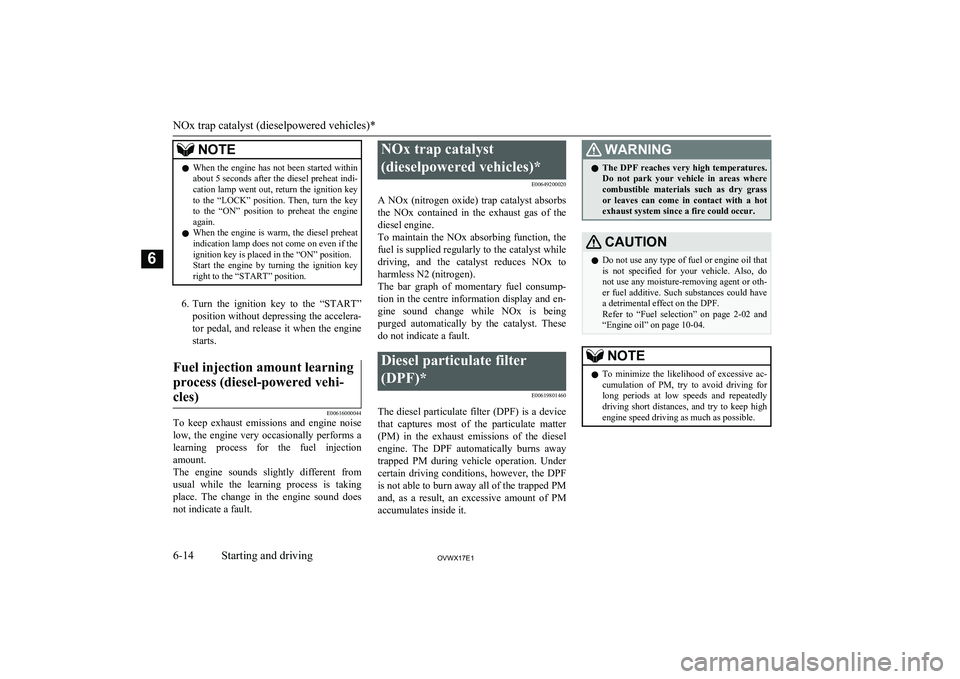
NOTElWhen the engine has not been started within
about 5 seconds after the diesel preheat indi-
cation lamp went out, return the ignition key to the “LOCK” position. Then, turn the key
to the “ON” position to preheat the engine
again.
l When the engine is warm, the diesel preheat
indication lamp does not come on even if the
ignition key is placed in the “ON” position. Start the engine by turning the ignition key
right to the “START” position.
6. Turn the ignition key to the “START”
position without depressing the accelera- tor pedal, and release it when the engine
starts.
Fuel injection amount learning
process (diesel-powered vehi-cles)
E00616000044
To keep exhaust emissions and engine noise low, the engine very occasionally performs a
learning process for the fuel injection
amount.
The engine sounds slightly different from
usual while the learning process is taking place. The change in the engine sound does
not indicate a fault.
NOx trap catalyst
(dieselpowered vehicles)* E00649200020
A NOx (nitrogen oxide) trap catalyst absorbs
the NOx contained in the exhaust gas of the diesel engine.
To maintain the NOx absorbing function, the
fuel is supplied regularly to the catalyst while
driving, and the catalyst reduces NOx to harmless N2 (nitrogen).
The bar graph of momentary fuel consump-
tion in the centre information display and en- gine sound change while NOx is being
purged automatically by the catalyst. These
do not indicate a fault.Diesel particulate filter
(DPF)* E00619801460
The diesel particulate filter (DPF) is a devicethat captures most of the particulate matter
(PM) in the exhaust emissions of the diesel
engine. The DPF automatically burns away trapped PM during vehicle operation. Under
certain driving conditions, however, the DPF is not able to burn away all of the trapped PM
and, as a result, an excessive amount of PM accumulates inside it.
WARNINGl The DPF reaches very high temperatures.
Do not park your vehicle in areas where
combustible materials such as dry grass
or leaves can come in contact with a hot exhaust system since a fire could occur.CAUTIONl Do not use any type of fuel or engine oil that
is not specified for your vehicle. Also, do not use any moisture-removing agent or oth-
er fuel additive. Such substances could have a detrimental effect on the DPF.
Refer to “Fuel selection” on page 2-02 and
“Engine oil” on page 10-04.NOTEl To minimize the likelihood of excessive ac-
cumulation of PM, try to avoid driving for long periods at low speeds and repeatedly
driving short distances, and try to keep high
engine speed driving as much as possible.
NOx trap catalyst (dieselpowered vehicles)*
6-14OVWX17E1Starting and driving6
Page 165 of 394
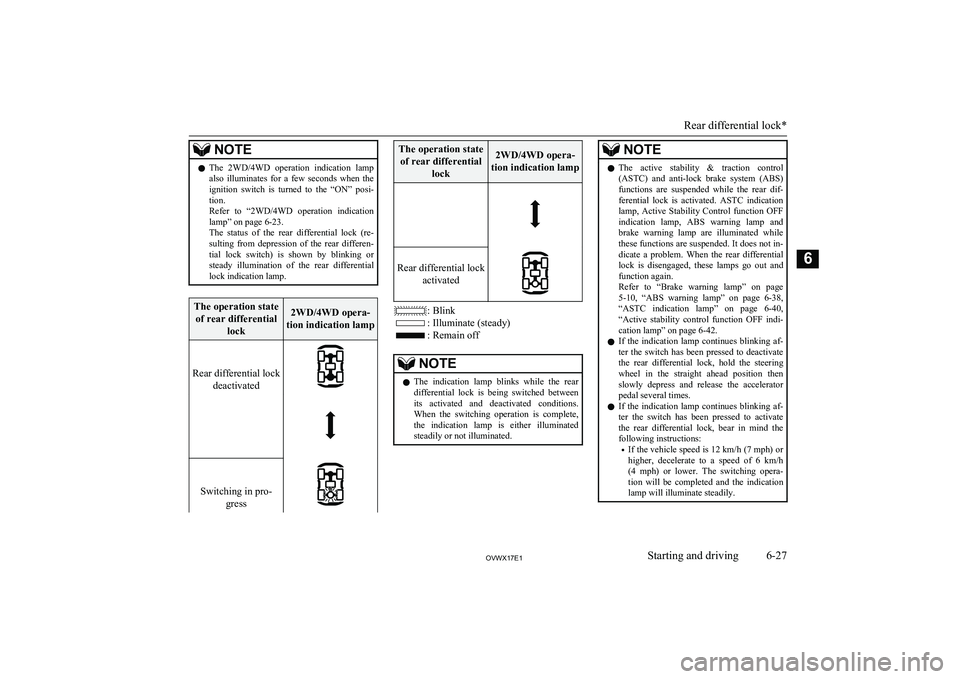
NOTElThe 2WD/4WD operation indication lamp
also illuminates for a few seconds when the
ignition switch is turned to the “ON” posi- tion.
Refer to “2WD/4WD operation indication
lamp” on page 6-23.
The status of the rear differential lock (re- sulting from depression of the rear differen-
tial lock switch) is shown by blinking or steady illumination of the rear differential
lock indication lamp.The operation state
of rear differential lock2WD/4WD opera-
tion indication lamp
Rear differential lock deactivated Switching in pro- gress
The operation stateof rear differential lock2WD/4WD opera-
tion indication lamp
Rear differential lock activated
: Blink
: Illuminate (steady)
: Remain off
NOTElThe indication lamp blinks while the rear
differential lock is being switched between
its activated and deactivated conditions. When the switching operation is complete,
the indication lamp is either illuminated steadily or not illuminated.NOTEl The active stability & traction control
(ASTC) and anti-lock brake system (ABS)
functions are suspended while the rear dif- ferential lock is activated. ASTC indication
lamp, Active Stability Control function OFF indication lamp, ABS warning lamp and
brake warning lamp are illuminated while
these functions are suspended. It does not in- dicate a problem. When the rear differential lock is disengaged, these lamps go out and
function again.
Refer to “Brake warning lamp” on page
5-10 , “ABS warning lamp” on page 6-38,
“ASTC indication lamp” on page 6-40,
“Active stability control function OFF indi- cation lamp” on page 6-42.
l If the indication lamp continues blinking af-
ter the switch has been pressed to deactivate the rear differential lock, hold the steering
wheel in the straight ahead position then
slowly depress and release the accelerator pedal several times.
l If the indication lamp continues blinking af-
ter the switch has been pressed to activate the rear differential lock, bear in mind thefollowing instructions:
• If the vehicle speed is
12 km/h (7 mph) or
higher, decelerate to a speed of 6 km/h (4 mph) or lower. The switching opera-tion will be completed and the indication lamp will illuminate steadily.
Rear differential lock*
6-27OVWX17E1Starting and driving6