check engine MITSUBISHI SPYDER 1990 Service Repair Manual
[x] Cancel search | Manufacturer: MITSUBISHI, Model Year: 1990, Model line: SPYDER, Model: MITSUBISHI SPYDER 1990Pages: 2103, PDF Size: 68.98 MB
Page 814 of 2103
Engine (Turbo) Engine>
Vacuum
Enginespeed
TSB Revision
Vacuum
Engine speed
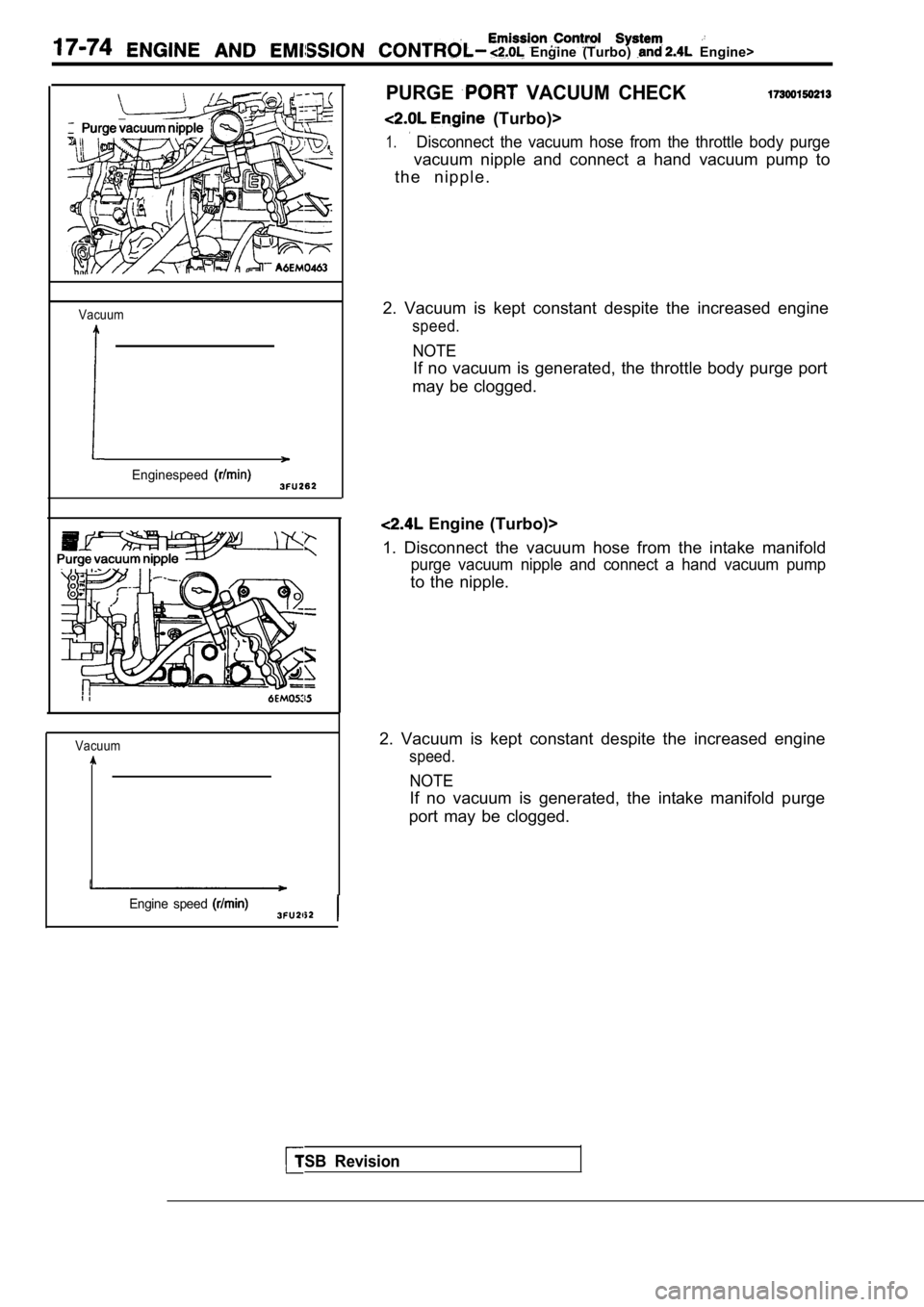
PURGE VACUUM CHECK
(Turbo)>
1. Disconnect the vacuum hose from the throttle body purge
vacuum nipple and connect a hand vacuum pump to
t h e n i p p l e .
2. Vacuum is kept constant despite the increased en gine
speed.
NOTE
If no vacuum is generated, the throttle body purge port
may be clogged.
Engine (Turbo)>
1. Disconnect the vacuum hose from the intake manif old
purge vacuum nipple and connect a hand vacuum pump
to the nipple.
2. Vacuum is kept constant despite the increased en gine
speed.
NOTE
If no vacuum is generated, the intake manifold purge
port may be clogged.
Page 815 of 2103
Engine (Turbo)>
Engine (Turbo)>
Engine>
.
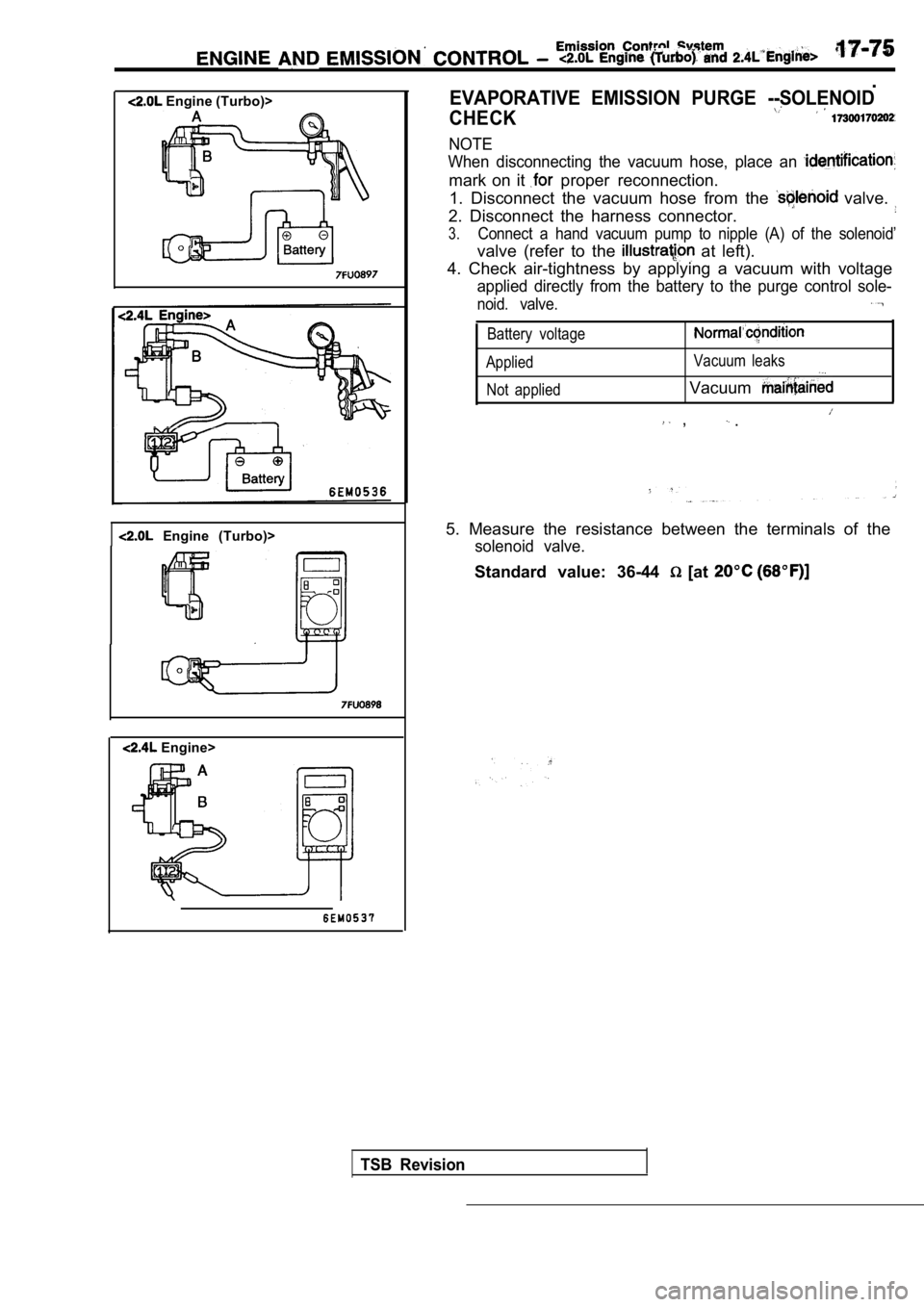
EVAPORATIVE EMISSION PURGE --SOLENOID
CHECK
NOTE
When disconnecting the vacuum hose, place an
mark on it proper reconnection.
1. Disconnect the vacuum hose from the
valve.
2. Disconnect the harness connector.
3.Connect a hand vacuum pump to nipple (A) of the sol enoid’
valve (refer to the at left).
4. Check air-tightness by applying a vacuum with vo ltage
applied directly from the battery to the purge control sole-
noid. valve.
Battery voltage
Applied Not applied
Vacuum leaks
Vacuum
, .
5. Measure the resistance between the terminals of the
solenoid valve.
Standard value: 36-44 [at
TSB Revision
Page 816 of 2103
AND C O N T R O L (Turbo) and Engine>
Valve
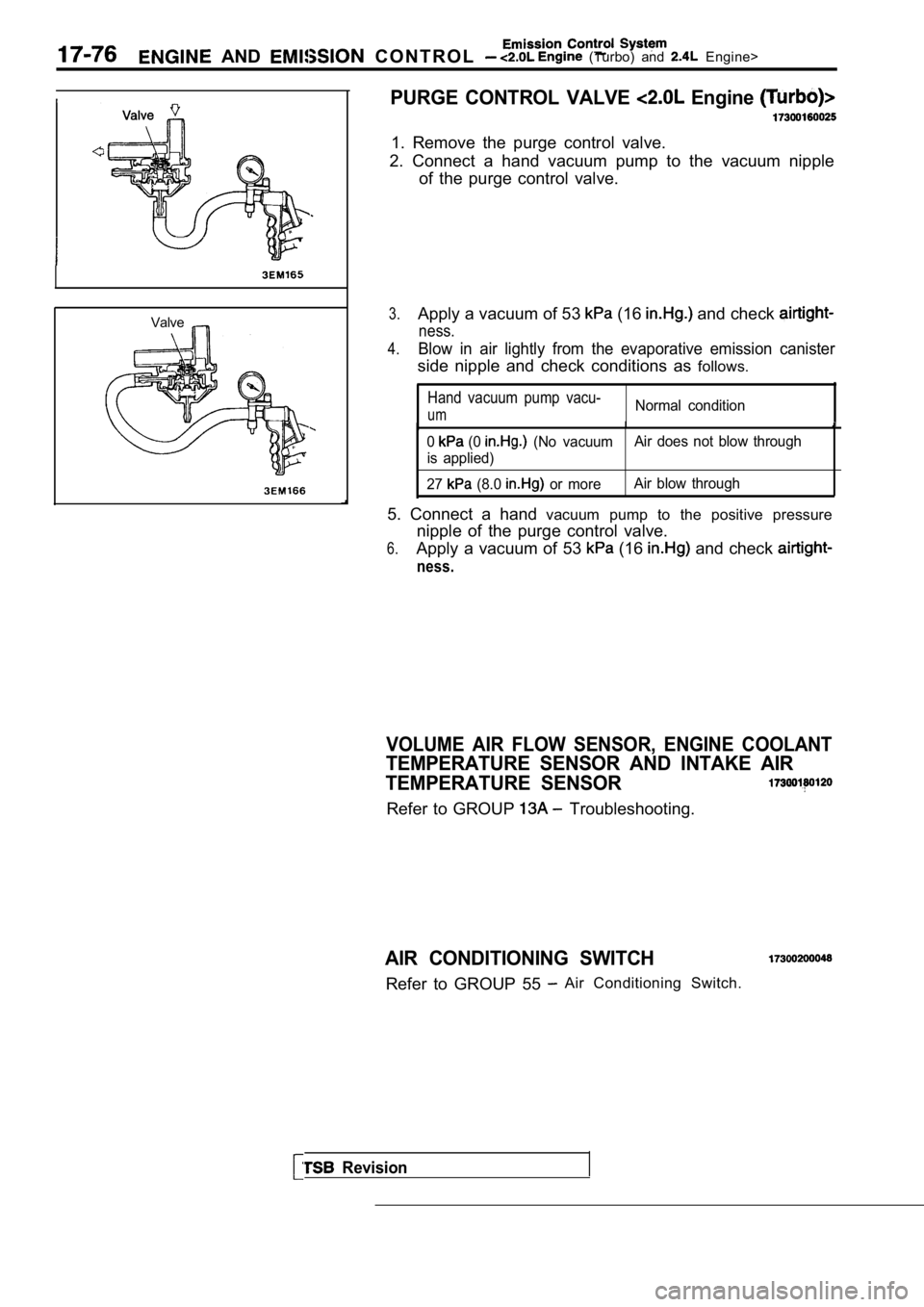
PURGE CONTROL VALVE Engine
1. Remove the purge control valve.
2. Connect a hand vacuum pump to the vacuum nipple of the purge control valve.
3.Apply a vacuum of 53 (16 and check
ness.
4.Blow in air lightly from the evaporative emission c anister
side nipple and check conditions as follows.
Hand vacuum pump vacu-
umNormal condition
0 (0 (No vacuumAir does not blow through
is applied)
27
(8.0 or more Air blow through
5. Connect a hand
vacuum pump to the positive pressure
nipple of the purge control valve.
6.Apply a vacuum of 53 (16 and check
ness.
Revision
VOLUME AIR FLOW SENSOR, ENGINE COOLANT
TEMPERATURE SENSOR AND INTAKE AIR
TEMPERATURE SENSOR
Refer to GROUP Troubleshooting.
AIR CONDITIONING SWITCH
Refer to GROUP 55 Air Conditioning Switch.
Page 817 of 2103
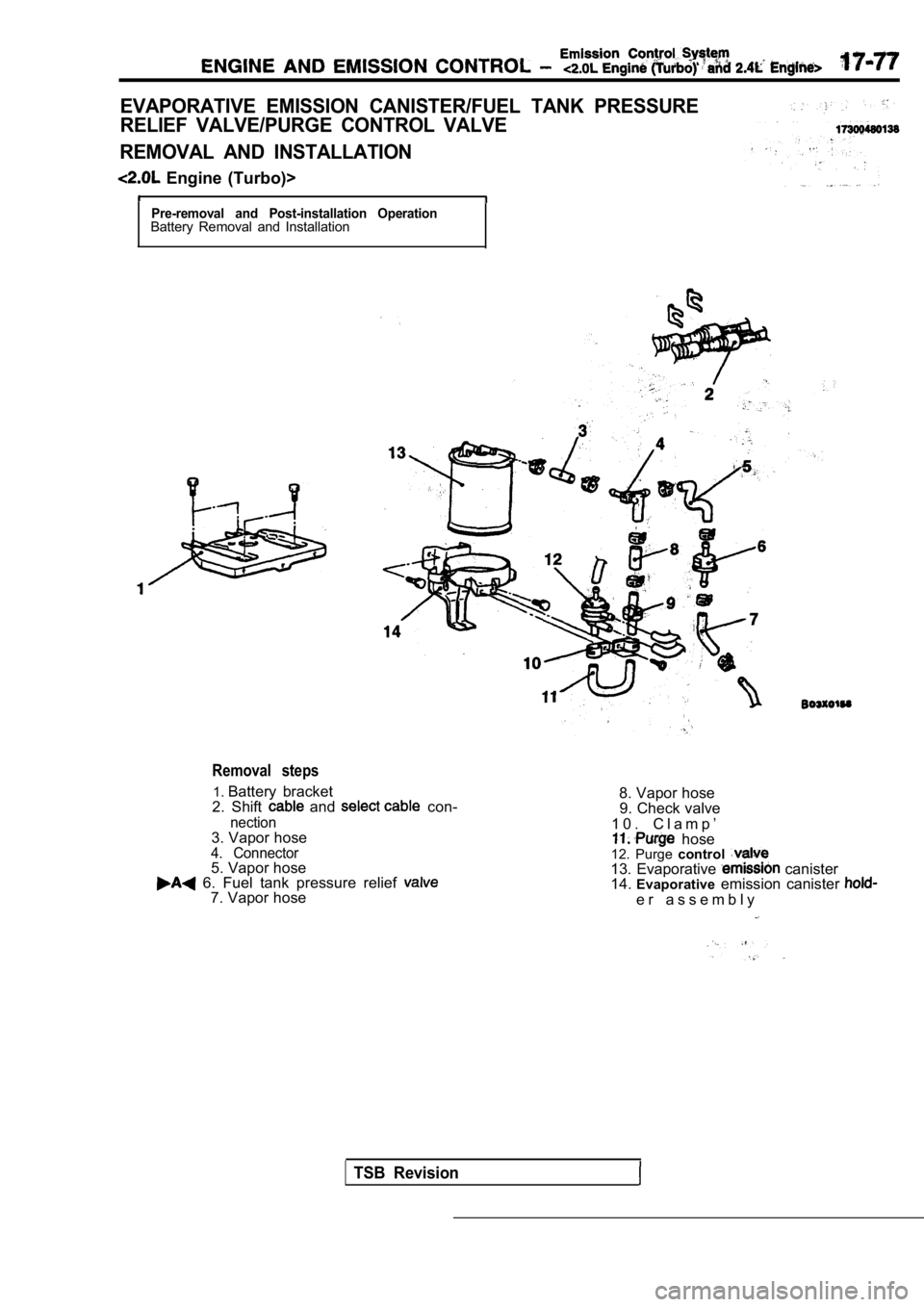
EVAPORATIVE EMISSION CANISTER/FUEL TANK PRESSURE
RELIEF VALVE/PURGE CONTROL VALVE
REMOVAL AND INSTALLATION
Engine (Turbo)>
Pre-removal and Post-installation OperationBattery Removal and Installation
Removal steps
1. Battery bracket
2. Shift and con-
nection3. Vapor hose4. Connector5. Vapor hose 6. Fuel tank pressure relief 7. Vapor hose 8. Vapor hose
9. Check valve
1 0 . C l a m p ’
hose
12. Purge control
13. Evaporative canister
14. Evaporative emission canister
e r a s s e m b l y
TSB Revision
Page 820 of 2103
(Turbo) and Engine>
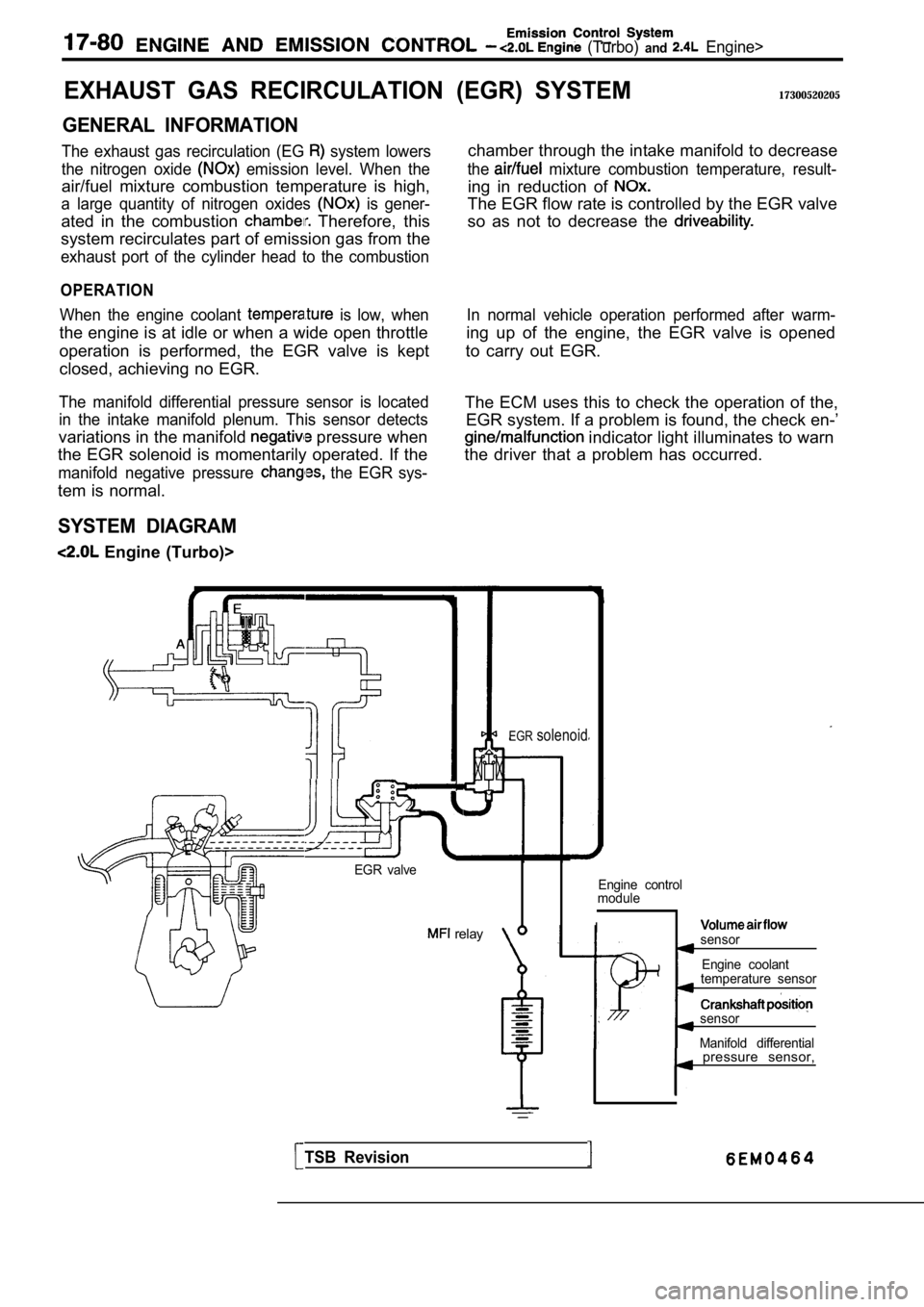
EXHAUST GAS RECIRCULATION
GENERAL INFORMATION
The exhaust gas recirculation (EG system lowers
the nitrogen oxide
emission level. When the
air/fuel mixture combustion temperature is high,
a large quantity of nitrogen oxides is gener-
ated in the combustion Therefore, this
system recirculates part of emission gas from the
exhaust port of the cylinder head to the combustion
OPERATION
When the engine coolant is low, when
the engine is at idle or when a wide open throttle
operation is performed, the EGR valve is kept
closed, achieving no EGR.
The manifold differential pressure sensor is locate d
in the intake manifold plenum. This sensor detects
variations in the manifold pressure when
the EGR solenoid is momentarily operated. If the
manifold negative pressure the EGR sys-
tem is normal.
SYSTEM DIAGRAM
Engine (Turbo)>
(EGR) SYSTEM17300520205
chamber through the intake manifold to decrease
the mixture combustion temperature, result-
ing in reduction of
The EGR flow rate is controlled by the EGR valve
so as not to decrease the
In normal vehicle operation performed after warm-
ing up of the engine, the EGR valve is opened
to carry out EGR.
The ECM uses this to check the operation of the, EGR system. If a problem is found, the check en-’
indicator light illuminates to warn
the driver that a problem has occurred.
EGR valve
relay
EGRsolenoid
Engine control
module
Isensor
Engine coolant
temperature sensor
sensor
Manifold differential
TSB Revision
pressure sensor,
Page 823 of 2103
Emission Control
ENGINE AND EMISSION CONTROL Engine
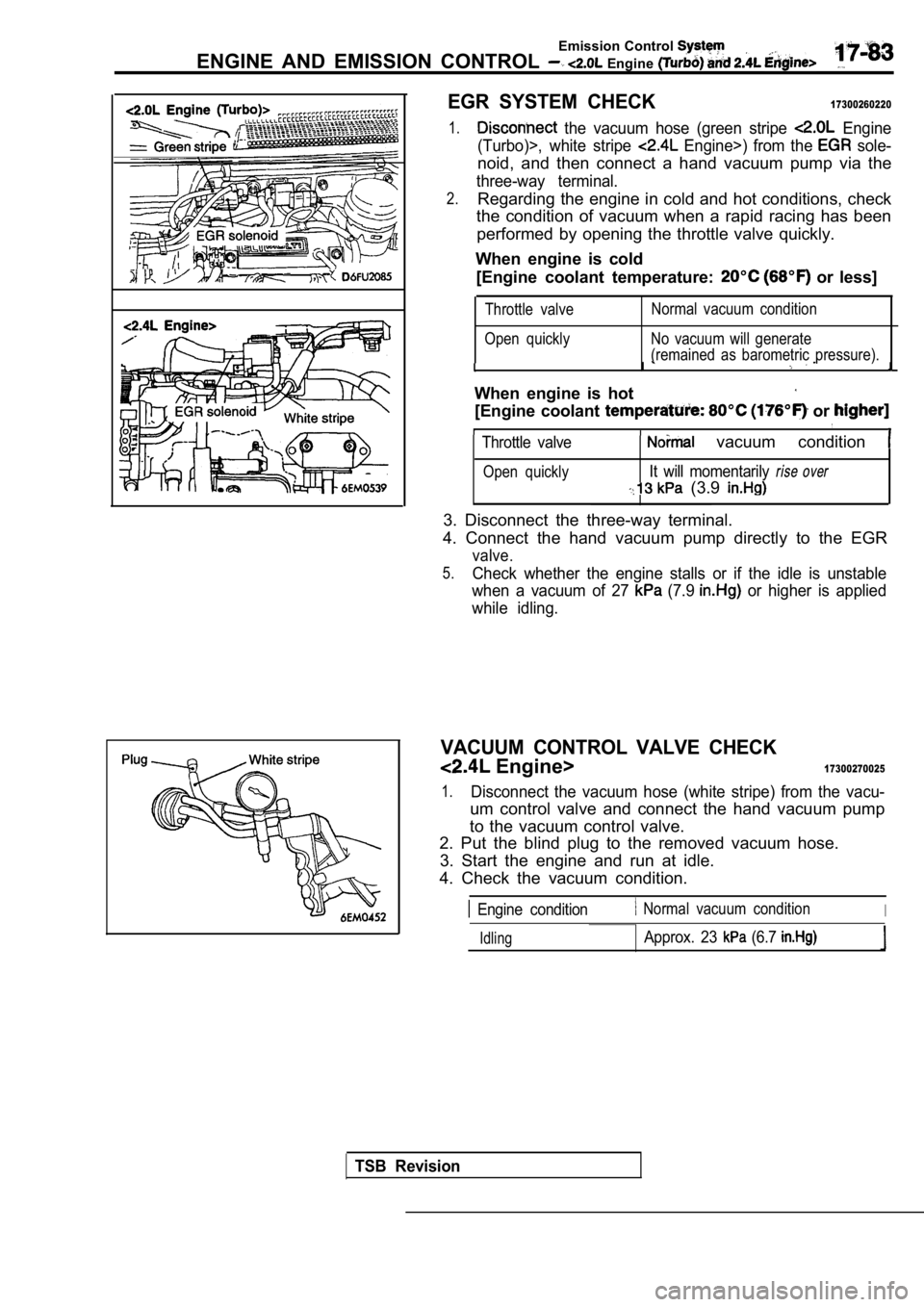
EGR SYSTEM CHECK17300260220
1. the vacuum hose (green stripe Engine
(Turbo)>, white stripe
Engine>) from the sole-
noid, and then connect a hand vacuum pump via the
three-way terminal.
2.Regarding the engine in cold and hot conditions, ch eck
the condition of vacuum when a rapid racing has bee n
performed by opening the throttle valve quickly.
When engine is cold [Engine coolant temperature:
or less]
Throttle valve
Open quickly Normal vacuum condition
No vacuum will generate
(remained as barometric pressure).
I
When engine is hot
[Engine coolant or
Throttle valve vacuum condition
Open quicklyIt will momentarily rise over
(3.9
3. Disconnect the three-way terminal.
4. Connect the hand vacuum pump directly to the EGR
valve.
5.Check whether the engine stalls or if the idle is u nstable
when a vacuum of 27
(7.9 or higher is applied
while idling.
VACUUM CONTROL VALVE CHECK
Engine>17300270025
1.Disconnect the vacuum hose (white stripe) from the vacu-
um control valve and connect the hand vacuum pump
to the vacuum control valve.
2. Put the blind plug to the removed vacuum hose.
3. Start the engine and run at idle.
4. Check the vacuum condition.
Engine condition Normal vacuum conditionI
IdlingApprox. 23 (6.7
TSB Revision
Page 824 of 2103
(Turbo) and Engine>
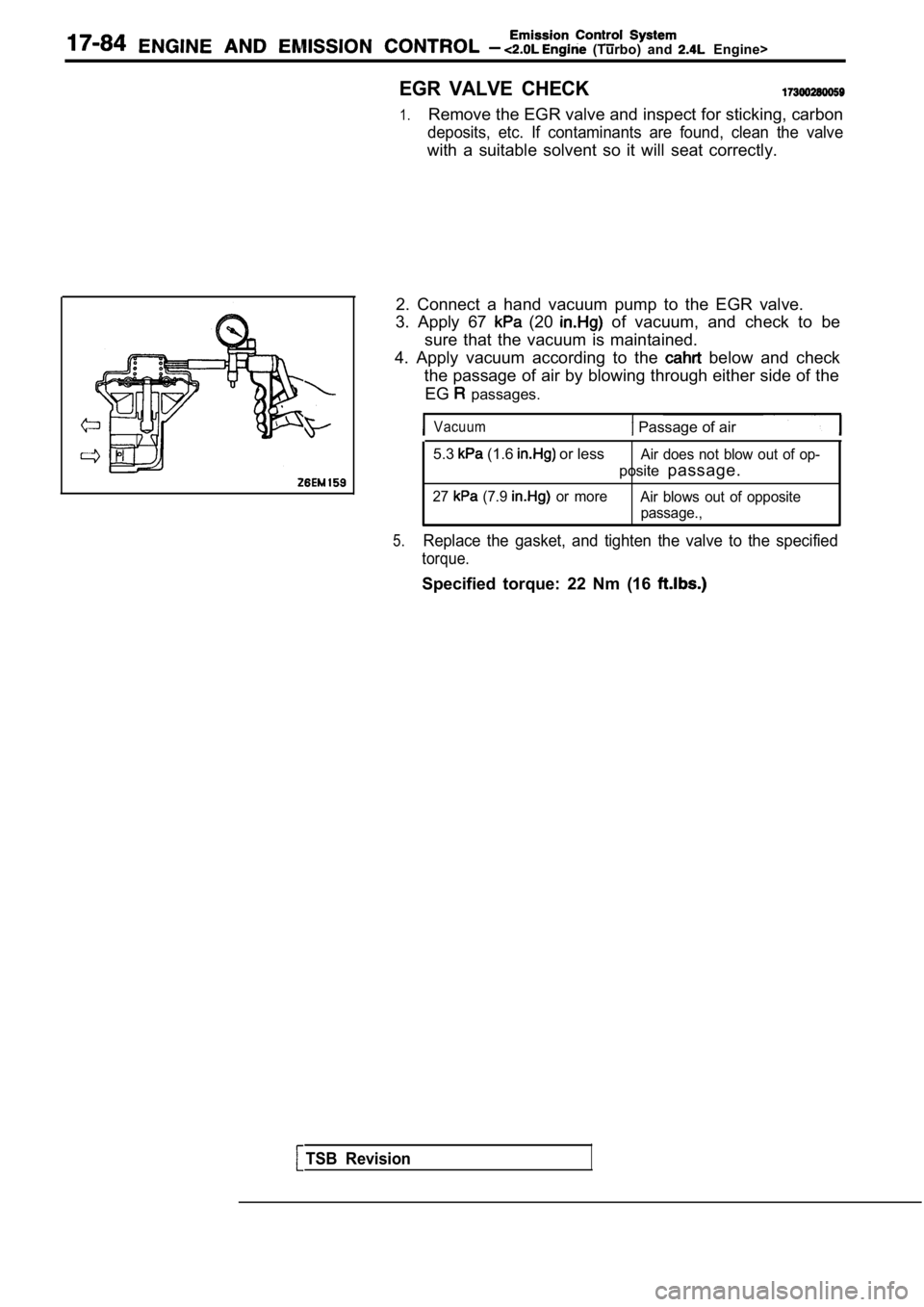
EGR VALVE CHECK
1.Remove the EGR valve and inspect for sticking, carbon
deposits, etc. If contaminants are found, clean the valve
with a suitable solvent so it will seat correctly.
2. Connect a hand vacuum pump to the EGR valve.
3. Apply 67
(20 of vacuum, and check to be
sure that the vacuum is maintained.
4. Apply vacuum according to the
below and check
the passage of air by blowing through either side o f the
EG
passages.
Vacuum Passage of air
5.3 (1.6 or lessAir does not blow out of op-
posite passage.
27 (7.9 or more
Air blows out of opposite
passage.,
5.Replace the gasket, and tighten the valve to the sp ecified
torque.
Specified torque: 22 Nm (16
TSB Revision
Page 825 of 2103
and
Engine
Engine>
Vacuum
Enginespeed
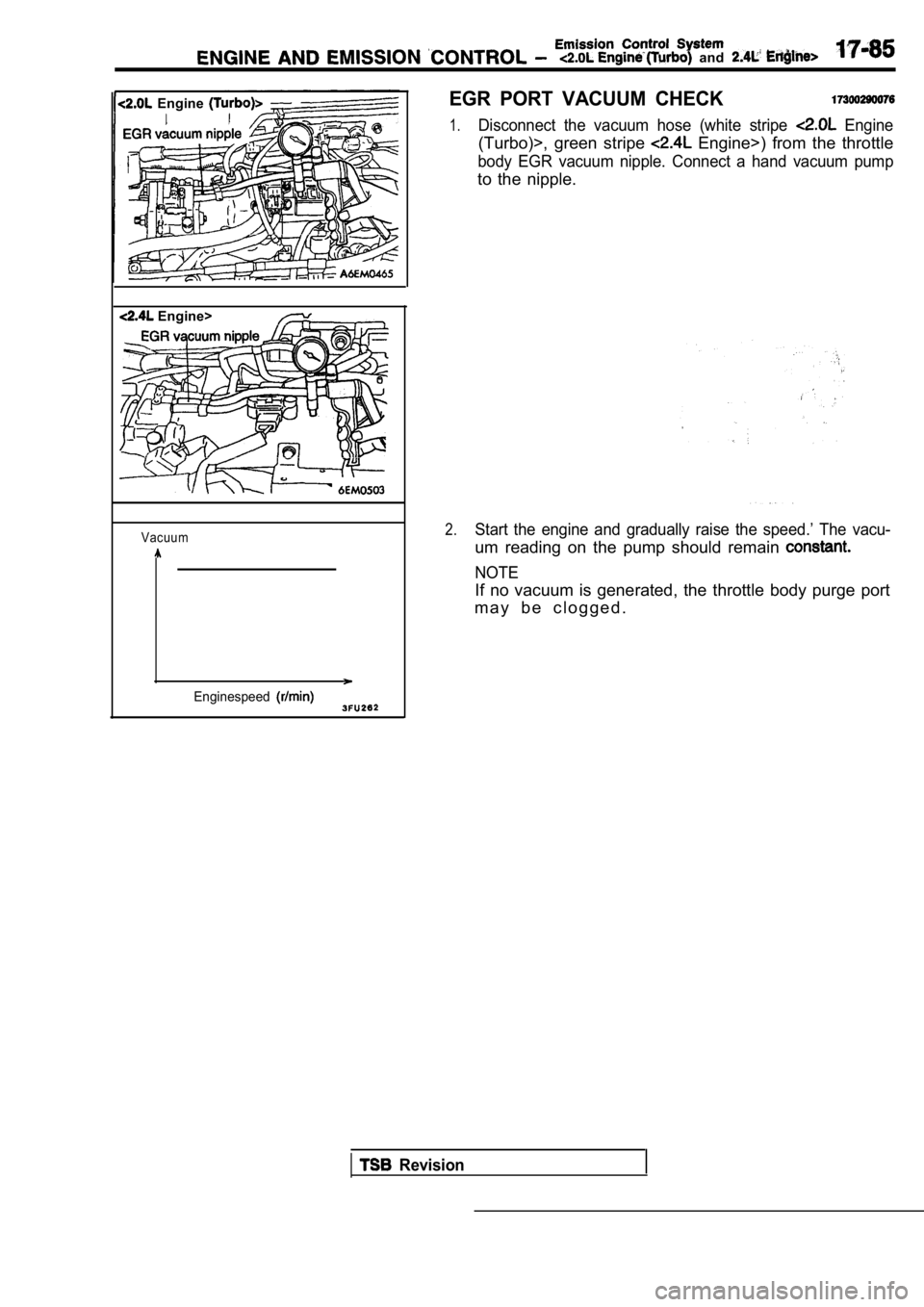
EGR PORT VACUUM CHECK
1.Disconnect the vacuum hose (white stripe Engine
(Turbo)>, green stripe Engine>) from the throttle
body EGR vacuum nipple. Connect a hand vacuum pump
to the nipple.
2.Start the engine and gradually raise the speed.’ The vacu-
um reading on the pump should remain
NOTE
If no vacuum is generated, the throttle body purge port
m a y b e c l o g g e d .
Revision
Page 826 of 2103
E N G I N E A N D E M I S S I O N C O N T R O L ( T u r b o )
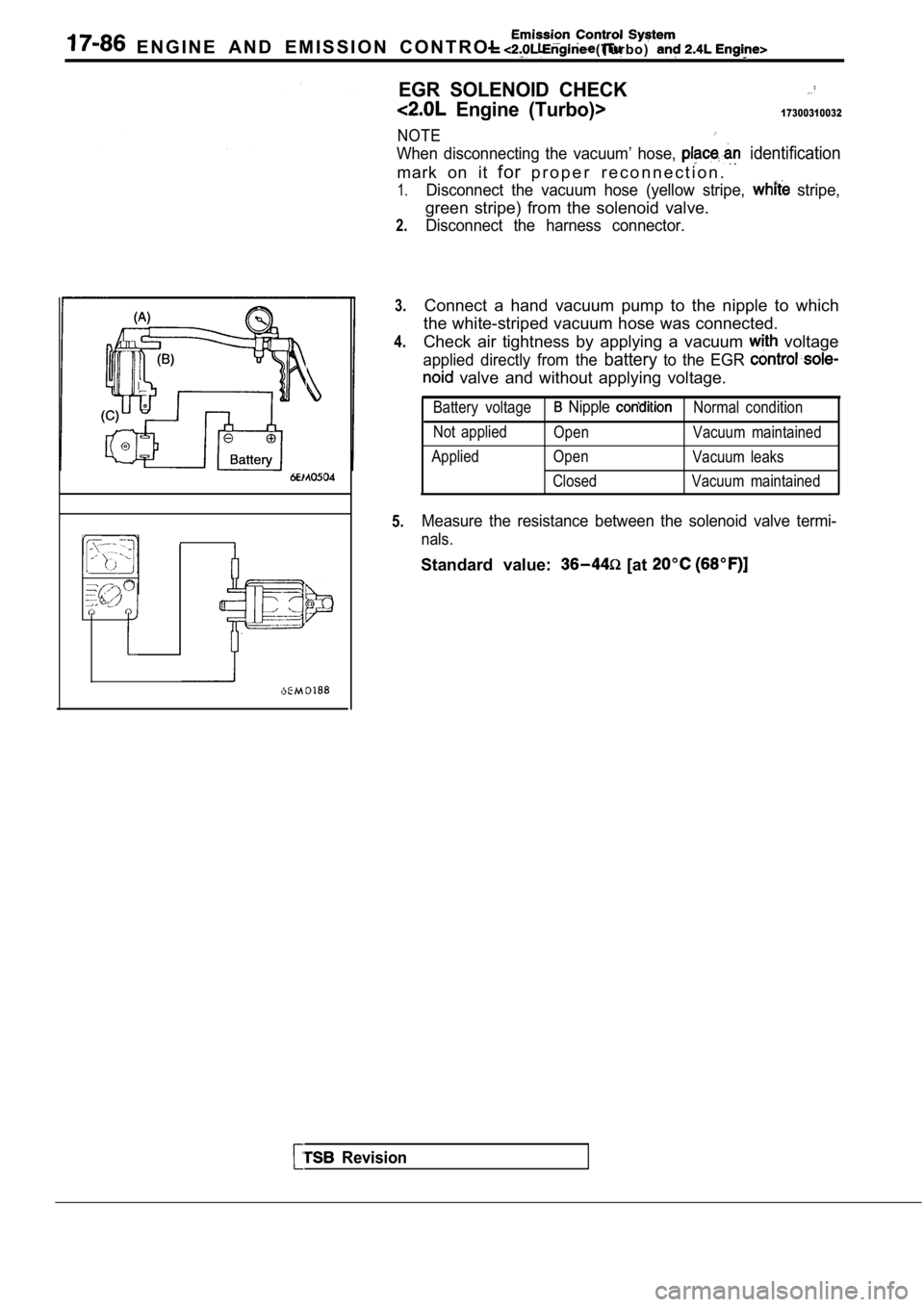
EGR SOLENOID CHECK
Engine (Turbo)>17300310032
NOTE
When disconnecting the vacuum’ hose, identification
mark on it forp r o p e r r e c o n n e c t i o n .
1.
2.
3.
4.
5.
Disconnect the vacuum hose (yellow stripe, stripe,
green stripe) from the solenoid valve.
Disconnect the harness connector.
Connect a hand vacuum pump to the nipple to which
the white-striped vacuum hose was connected.
Check air tightness by applying a vacuum
voltage
applied directly from the batteryto the EGR
valve and without applying voltage.
Battery voltage Nipple Normal condition
Not applied Open Vacuum maintained
Applied Open Vacuum leaks
Closed Vacuum maintained
Measure the resistance between the solenoid valve t ermi-
nals.
Standard value: [at
Revision
Page 827 of 2103
AND EMISSION CONTROL
Emission Engine
27
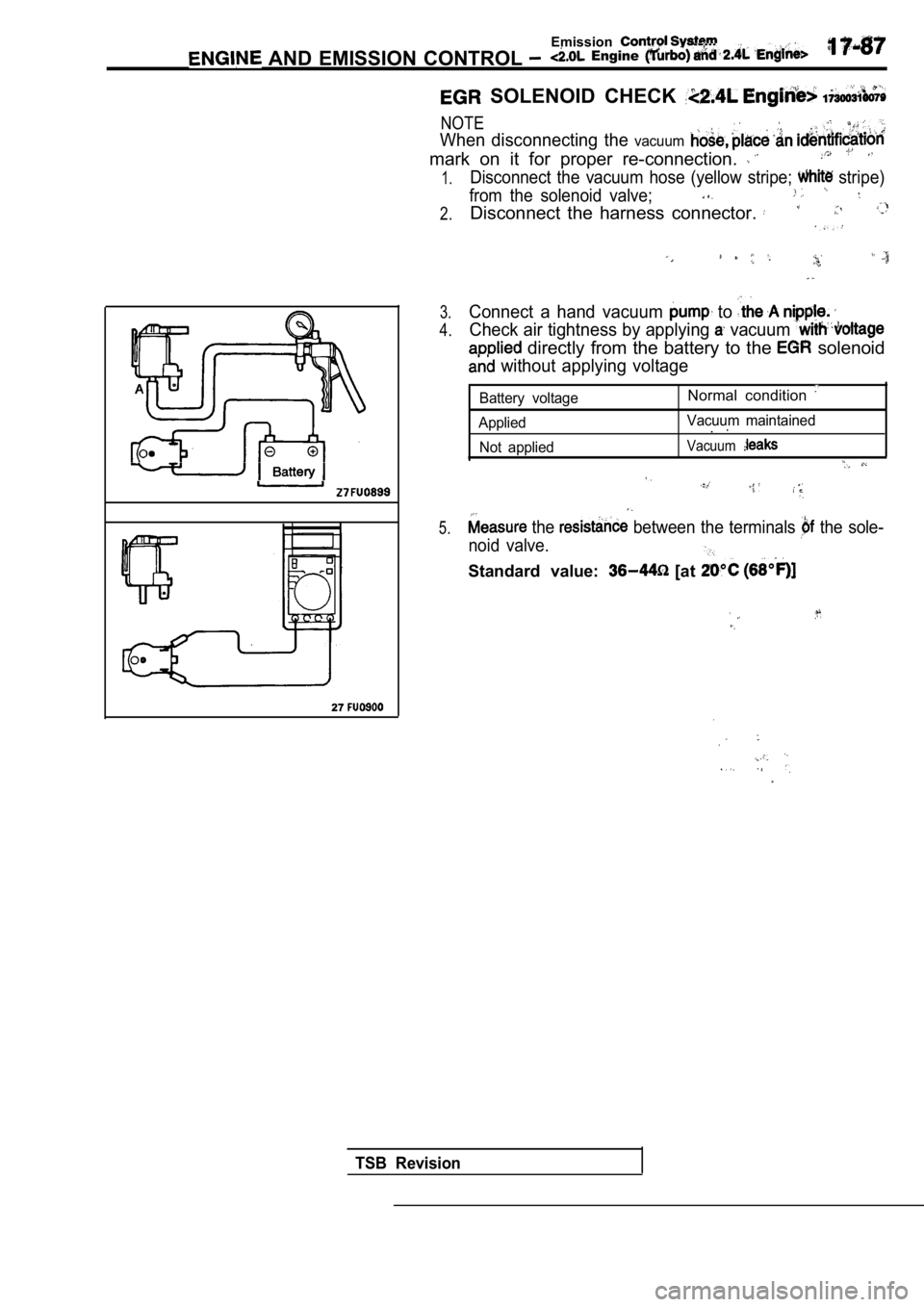
SOLENOID CHECK
NOTE,
When disconnecting the vacuum
mark on it for proper re-connection.
Disconnect the vacuum hose (yellow stripe; stripe)1.
2.
3.
4.
5.
from the solenoid valve;
Disconnect the harness connector.
Connect a hand vacuum to
Check air tightness by applying vacuum
directly from the battery to the solenoid
without applying voltage
Battery voltage
Applied Not appliedNormal condition
Vacuum maintained.
Vacuum
the between the terminals the sole-
noid valve.
Standard value: [at
.
,
TSB Revision