Lamp MITSUBISHI TRITON 2011 Owners Manual
[x] Cancel search | Manufacturer: MITSUBISHI, Model Year: 2011, Model line: TRITON, Model: MITSUBISHI TRITON 2011Pages: 369, PDF Size: 26.15 MB
Page 269 of 369
CAUTION
l
Do not attempt to start the engine by pull-
ing or pushing the vehicle.
It could damage your vehicle.
l Always wear protective eye goggles when
working near the battery.
l Keep the battery out of the reach of chil-
dren.
NOTE l On
vehicles with anti-lock brake
system, if
the vehicle is put in motion without fully
charging the battery, it might cause the loss
of smooth engine operation and the antilock
brake warning lamp to illuminate.
Refer to “Anti-lock brake system (ABS)” on
page 4-44. Engine overheating
E00800601985
If the water temperature gauge
indication remains
in the overheating zone for a long time, the engine
may be overheating. If this occurs, take the follow-
ing corrective measures: 1. Stop the vehicle in a safe place.
2. Check whether steam is coming from the en-gine compartment.
[If steam does not come from the engine com-
partment]
With the engine still running, raise the bon-
net to ventilate the engine compartment.
[If steam is coming from the engine compart-
ment]
Stop the engine, and when the steam stops,
raise the bonnet to ventilate the engine com-
partment. Restart the engine. WARNING
l Do not open the
bonnet
while steam is com-
ing from the engine compartment. It
could cause steam or hot water to spurt
out, causing burns. Hot water could spurt
out even when there is no steam coming
out, and some parts will be very hot. Be
very careful when opening the bonnet.
l Be careful of hot steam, which could be
blowing off the reserve tank cap.
l Do not attempt to remove the radiator
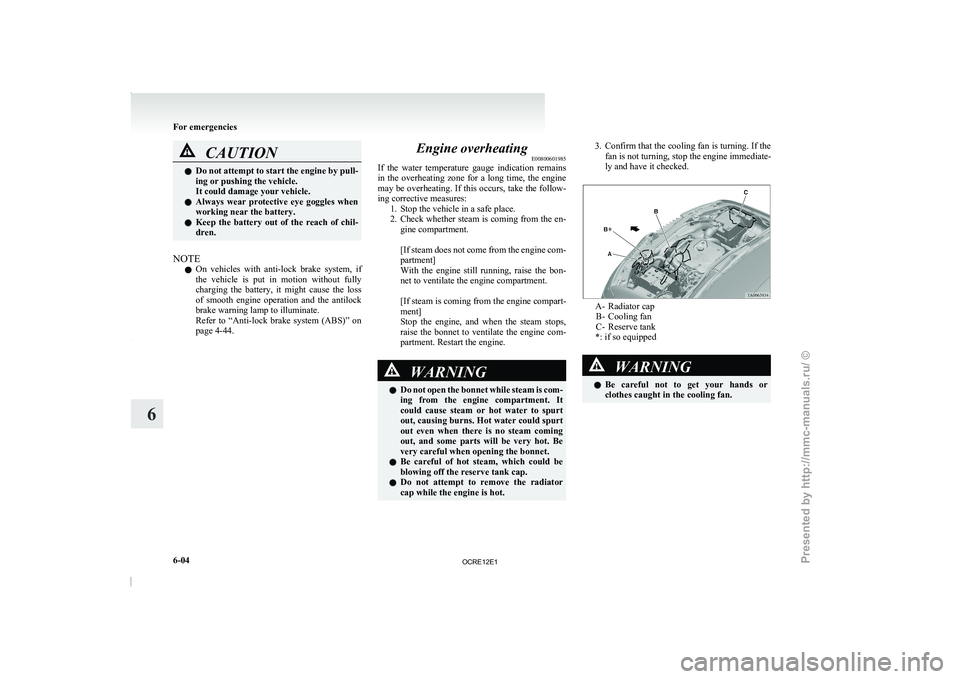
cap while the engine is hot. 3. Confirm that the cooling fan is turning. If the
fan is not turning, stop the engine immediate-
ly and have it checked. A- Radiator cap
B- Cooling fan
C- Reserve tank
*: if so equipped WARNING
l Be careful not to
get your hands or
clothes caught in the cooling fan. For emergencies
6-04
6
OCRE12E1
Presented by http://mmc-manuals.ru/ \251
Page 271 of 369
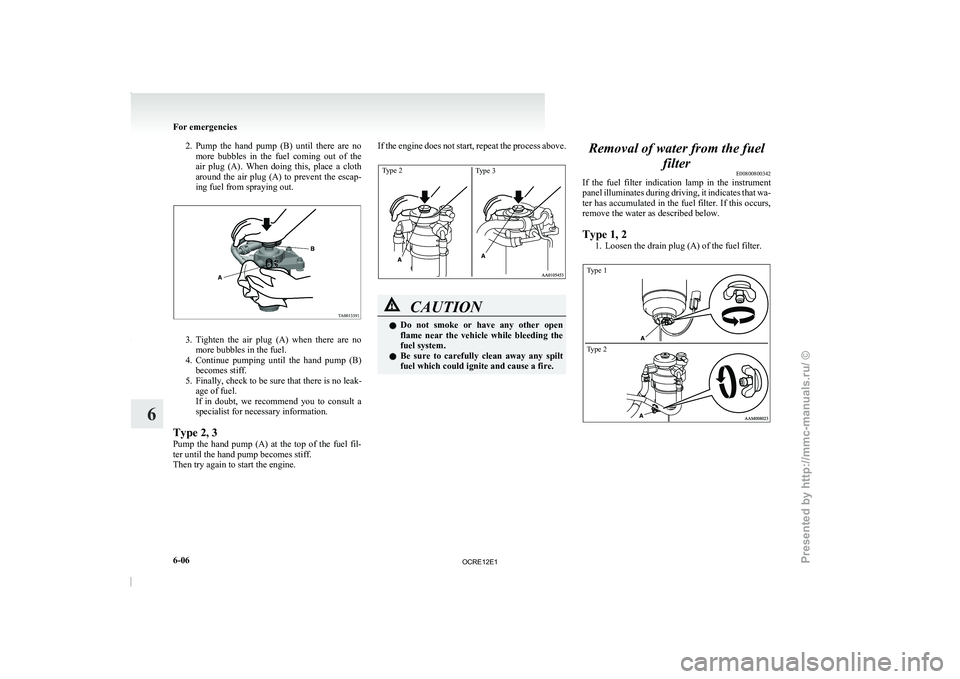
2. Pump the hand pump (B) until there are no
more bubbles in the fuel coming out of the
air plug (A). When doing this, place a cloth
around the air plug (A) to prevent the escap-
ing fuel from spraying out. 3. Tighten the air plug (A) when there are no
more bubbles in the fuel.
4. Continue pumping until
the hand pump (B)
becomes stiff.
5. Finally, check to be sure that there is no leak- age of fuel.
If in doubt, we recommend you to consult a
specialist for necessary information.
Type 2, 3
Pump the hand pump (A) at the top of the fuel fil-
ter until the hand pump becomes stiff.
Then try again to start the engine. If the engine does not start, repeat the process above.
Type 2
Type 3 CAUTION
l
Do not smoke or
have
any other open
flame near the vehicle while bleeding the
fuel system.
l Be sure to carefully clean away any spilt
fuel which could ignite and cause a fire. Removal of water from the fuel
filterE00800800342
If the fuel filter indication
lamp in the instrument
panel illuminates during driving, it indicates that wa-
ter has accumulated in the fuel filter. If this occurs,
remove the water as described below.
Type 1, 2
1. Loosen the drain plug (A) of the fuel filter.
Type 1
Type 2 For emergencies
6-06
6
OCRE12E1
Presented by http://mmc-manuals.ru/ \251
Page 272 of 369
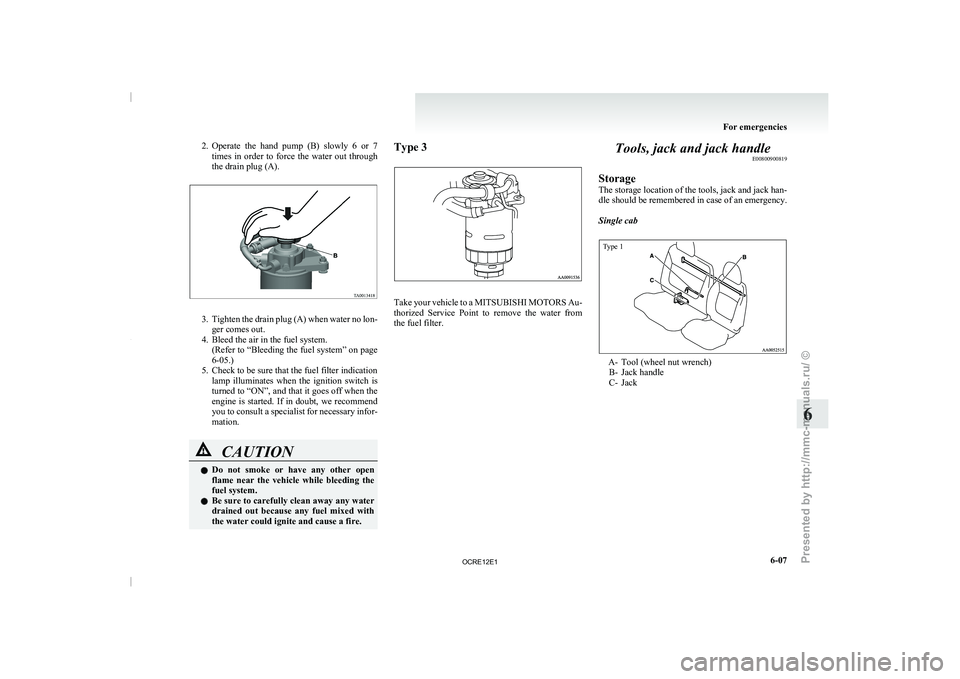
2. Operate the hand pump (B) slowly 6 or 7
times in order to force the water out through
the drain plug (A). 3. Tighten the drain plug (A) when water no lon-
ger comes out.
4. Bleed the air in the fuel system. (Refer to “Bleeding
the fuel system” on page
6-05.)
5. Check to be sure that the fuel filter indication lamp illuminates when the ignition switch is
turned to “ON”, and that it goes off when the
engine is started. If in doubt, we recommend
you to consult a specialist for necessary infor-
mation. CAUTION
l
Do not smoke or
have
any other open
flame near the vehicle while bleeding the
fuel system.
l Be sure to carefully clean away any water
drained out because any fuel mixed with
the water could ignite and cause a fire. Type 3
Take your vehicle to a MITSUBISHI MOTORS Au-
thorized Service Point to
remove the water from
the fuel filter. Tools, jack and jack handle
E00800900819
Storage
The storage location of the
tools, jack and jack han-
dle should be remembered in case of an emergency.
Single cab
Type 1 A- Tool (wheel nut wrench)
B- Jack handle
C- Jack For emergencies
6-07 6
OCRE12E1
Presented by http://mmc-manuals.ru/ \251
Page 278 of 369
Jacking up the vehicle
E00801001436
1. Park the vehicle on level and stable ground.
2. Set the parking brake firmly.
3. On vehicles
with manual transmission, turn
the ignition key to the “LOCK” position,
move the gearshift lever to the “R” (Reverse)
position.
On vehicles with automatic transmission,
move the selector lever to the “P” (PARK) po-
sition, turn the ignition key to the “LOCK”
position.
4. Turn on the hazard warning flashers and set up a warning triangle, flashing signal lamp,
etc., at an adequate distance from the vehi-
cle, and have all your passengers leave the ve-
hicle.
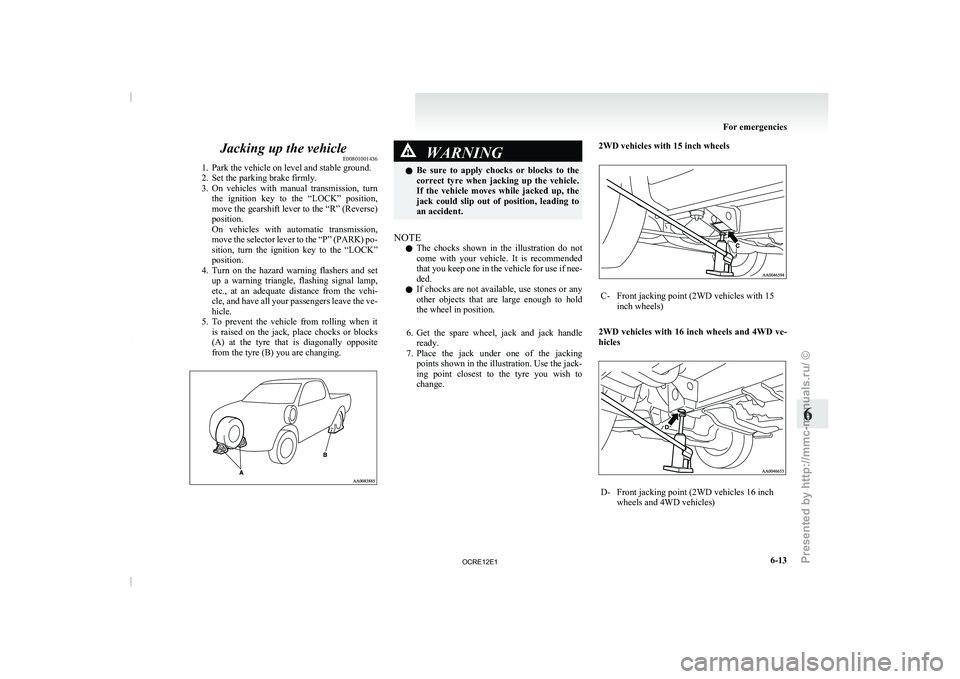
5. To prevent the vehicle from rolling when it is raised on the jack, place chocks or blocks
(A) at the tyre that is diagonally opposite
from the tyre (B) you are changing. WARNING
l Be sure to apply chocks
or blocks to the
correct tyre when jacking up the vehicle.
If the vehicle moves while jacked up, the
jack could slip out of position, leading to
an accident.
NOTE l The
chocks shown in the
illustration do not
come with your vehicle. It is recommended
that you keep one in the vehicle for use if nee-
ded.
l If chocks are not available, use stones or any
other objects that are large enough to hold
the wheel in position.
6. Get the spare wheel, jack and jack handle ready.
7. Place the jack under one of the jacking points shown in the illustration. Use the jack-
ing point closest to the tyre you wish to
change. 2WD vehicles with 15 inch wheels C- Front jacking point (2WD vehicles with 15
inch wheels)
2WD vehicles with 16 inch wheels and 4WD ve-
hicles D- Front jacking point (2WD vehicles 16 inch
wheels and 4WD vehicles) For emergencies
6-13 6
OCRE12E1
Presented by http://mmc-manuals.ru/ \251
Page 282 of 369
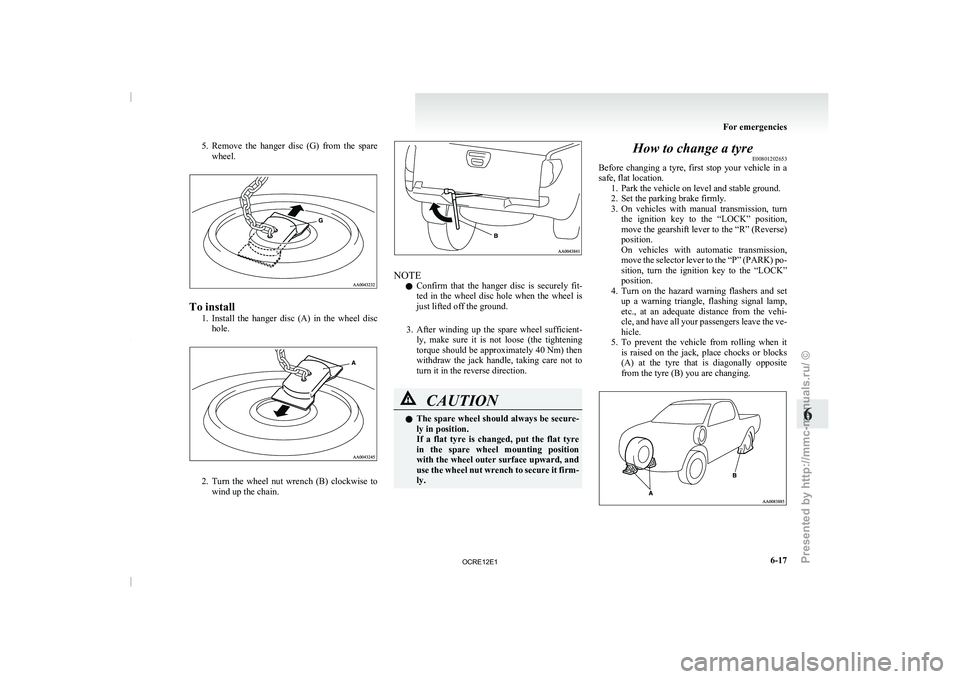
5. Remove the hanger disc (G) from the spare
wheel. To install
1. Install the hanger disc (A) in the wheel disc
hole. 2. Turn the wheel nut wrench (B) clockwise to
wind up the chain. NOTE
l Confirm
that the hanger disc
is securely fit-
ted in the wheel disc hole when the wheel is
just lifted off the ground.
3. After winding up the spare wheel sufficient- ly, make sure it is not loose (the tightening
torque should be approximately 40 Nm) then
withdraw the jack handle, taking care not to
turn it in the reverse direction. CAUTION
l
The spare wheel should
always
be secure-
ly in position.
If a flat tyre is changed, put the flat tyre
in the spare wheel mounting position
with the wheel outer surface upward, and
use the wheel nut wrench to secure it firm-
ly. How to change a tyre
E00801202653
Before changing a tyre, first
stop your vehicle in a
safe, flat location. 1. Park the vehicle on level and stable ground.
2. Set the parking brake firmly.
3. On vehicles with manual transmission, turnthe ignition key to the “LOCK” position,
move the gearshift lever to the “R” (Reverse)
position.
On vehicles with automatic transmission,
move the selector lever to the “P” (PARK) po-
sition, turn the ignition key to the “LOCK”
position.
4. Turn on the hazard warning flashers and set up a warning triangle, flashing signal lamp,
etc., at an adequate distance from the vehi-
cle, and have all your passengers leave the ve-
hicle.
5. To prevent the vehicle from rolling when it is raised on the jack, place chocks or blocks
(A) at the tyre that is diagonally opposite
from the tyre (B) you are changing. For emergencies
6-17 6
OCRE12E1
Presented by http://mmc-manuals.ru/ \251
Page 287 of 369
Towing with rear wheels off the ground (Type C)
Place the gearshift lever in
the “N” (Neutral) posi-
tion (manual transmission) or the selector lever in
the “N” (NEUTRAL) position (automatic transmis-
sion). Turn the ignition key to the “ACC” position
and secure the steering wheel in a straight ahead po-
sition with a rope or tie-down strap. Never place
the ignition switch in the “LOCK” position when
towing.
Emergency towing
If towing service is not available in an emergency,
your vehicle may be temporarily towed by a cable
or chain secured to the towing hook.
If your vehicle is to be towed by another vehicle,
pay careful attention to the following points.
If your vehicle is to be towed by anoth-
er vehicle
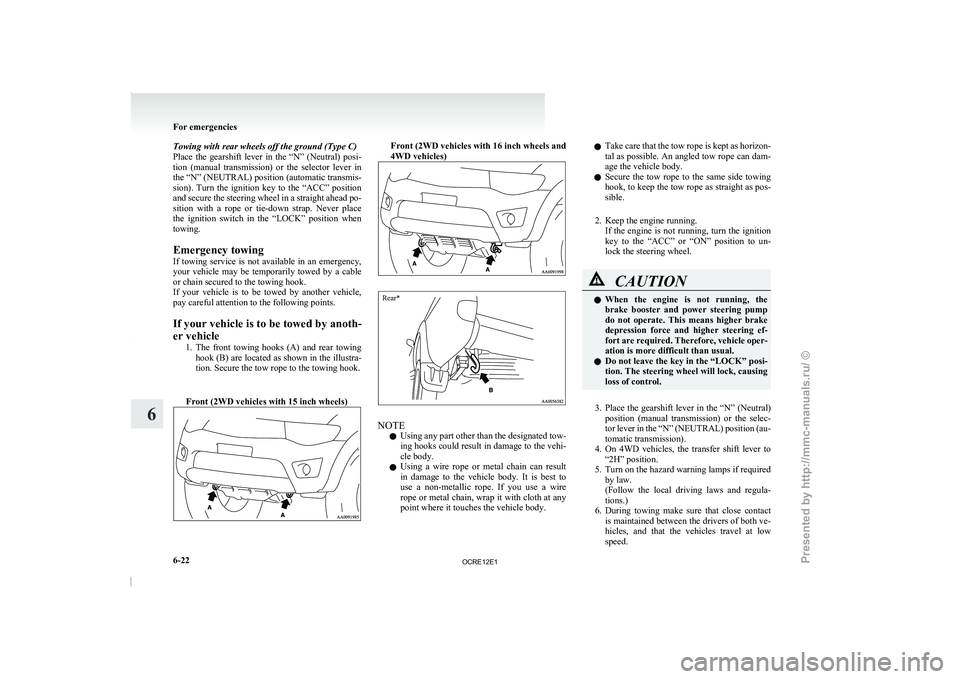
1. The front towing hooks (A) and rear towinghook (B) are located as shown in the illustra-
tion. Secure the tow rope to the towing hook.
Front (2WD vehicles with 15 inch wheels) Front (2WD vehicles with 16 inch wheels and
4WD vehicles)
Rear*
NOTE
l Using
any part other than
the designated tow-
ing hooks could result in damage to the vehi-
cle body.
l Using a wire rope or metal chain can result
in damage to the vehicle body. It is best to
use a non-metallic rope. If you use a wire
rope or metal chain, wrap it with cloth at any
point where it touches the vehicle body. l
Take
care
that the
tow
rope is kept as horizon-
tal as possible. An angled tow rope can dam-
age the vehicle body.
l Secure the tow rope to the same side towing
hook, to keep the tow rope as straight as pos-
sible.
2. Keep the engine running. If the engine is not running, turn the ignition
key to the “ACC” or “ON” position to un-
lock the steering wheel. CAUTION
l
When the engine is
not
running, the
brake booster and power steering pump
do not operate. This means higher brake
depression force and higher steering ef-
fort are required. Therefore, vehicle oper-
ation is more difficult than usual.
l Do not leave the key in the “LOCK” posi-
tion. The steering wheel will lock, causing
loss of control.
3. Place the gearshift lever in the “N” (Neutral)
position (manual
transmission) or
the selec-
tor lever in the “N” (NEUTRAL) position (au-
tomatic transmission).
4. On 4WD vehicles, the transfer shift lever to “2H” position.
5. Turn on the hazard warning lamps if required by law.
(Follow the local driving laws and regula-
tions.)
6. During towing make sure that close contact is maintained between the drivers of both ve-
hicles, and that the vehicles travel at low
speed. For emergencies
6-22
6
OCRE12E1
Presented by http://mmc-manuals.ru/ \251
Page 295 of 369
CAUTION
l
After washing the vehicle, drive the vehi-
cle slowly while lightly depressing the
brake pedal several times in order to dry
out the brakes.
Leaving the brakes wet could result in re-
duced braking performance. Also, there
is a possibility that they could freeze up
or become inoperative due to rust, render-
ing the vehicle unable to move.
l When using an automatic car wash, pay
attention to the following items, referring
to the operation manual or consulting a
car wash operator. If the following proce-
dure is not followed, it could result in dam-
age to your vehicle.
• The outside mirrors are retracted.
• If your vehicle is equipped with the pil-lar antenna, it can be retracted.
• If your vehicle is equipped with the roof antenna, it can be removed.
During cold weather
Salt and other chemicals spread
on the roads in
some areas in winter can have a harmful effect on
the vehicle body. You should therefore wash the ve-
hicle as often as possible in accordance with our
care-instructions. It is recommended to have a pres-
ervative applied and the underfloor protection
checked before and after the cold weather season.
After washing your vehicle, wipe off all water-
drops from the rubber parts around the doors to pre-
vent the doors from freezing. NOTE
l To
prevent freezing
of the
weatherstripping
on the doors, bonnet, etc., they should be trea-
ted with silicone spray.
Waxing E00901000687
Waxing the vehicle will help prevent the adherence
of dust and road chemicals
to the paintwork. Apply
a wax solution after washing the vehicle, or at least
once every three months to assist displacing of water.
Do not wax your vehicle in direct sunlight. You
should wax after the surfaces have cooled. CAUTION
l
Waxes containing high abrasive
com-
pounds
should not be used. Such waxes re-
move rust and stains effectively from the
paintwork but they are harmful to the lus-
tre on the painted surface and the plated
surface.
Further, they are harmful to glossy surfa-
ces such as grille, garnish, mouldings, etc.
l Do not use petrol or paint thinners to re-
move road tar or other contamination to
the vehicle surface.
l Do not apply wax on the areas having
black mat coating as it can cause uneven
discolouration, patches, blurs, etc. If
stained with wax, immediately wipe off
with a piece of soft cloth and warm water. CAUTION
l
On vehicles with a sunroof,
be careful
when waxing the area around the sunroof
opening, not to put any wax on the weath-
erstrip (black rubber). If stained with
wax, the weatherstrip cannot maintain a
weatherproof seal with the sunroof.
Polishing E00901100011
The vehicle should only be polished if the paint-
work has become stained or lost its lustre. Matt-fin-
ish parts and
plastic bumpers
must not be polished,
polishing these parts will stain them or damage
their finish.
Damaged paint E00901200155
Small cracks and scratches in the paint coat should
be touched up as soon
as possible with
MITSUBISHI touch-up paint to prevent corrosion.
Check body areas facing the road or the tyres care-
fully for damage to the paint coat caused by flying
stones, etc. The paint code number for your vehicle
can be found on the vehicle information code plate.
(Refer to “Vehicle labeling” on page 9-02.)
Cleaning plastic parts E00901300446
Use a sponge or chamois leather.
If a car wax adheres
on a grey or black rough sur-
face of the bumper, moulding or lamps, the surface
becomes white. In such a case, wipe it off using
lukewarm water and soft cloth or chamois leather. Vehicle care
7-04
7
OCRE12E1
Presented by http://mmc-manuals.ru/ \251
Page 298 of 369
Service precautions
....................................................................... 8-02
Catalytic converter ........................................................................ 8-02
Bonnet...........................................................................................8-03
Engine oil ......................................................................................8-04
Engine coolant .............................................................................. 8-06
Automatic transmission fluid*......................................................8-07 Washer fluid ................................................................................. 8-08
Brake fluid .................................................................................... 8-08
Clutch fluid* ................................................................................. 8-09
Power steering fluid ...................................................................... 8-09
Battery .......................................................................................... 8-10
Tyres............................................................................................. 8-11
Clutch pedal free play* ................................................................. 8-15
Brake pedal free play .................................................................... 8-16
Parking brake lever stroke ............................................................ 8-16
Wiper blades ................................................................................. 8-17
General maintenance .................................................................... 8-18
For cold and snowy weather ......................................................... 8-19
Fusible links
.................................................................................. 8-19
Fuses............................................................................................. 8-20
Replacement of lamp bulbs .......................................................... 8-23Maintenance
8
OCRE12E1
Presented by http://mmc-manuals.ru/ \251
Page 305 of 369
Washer fluid
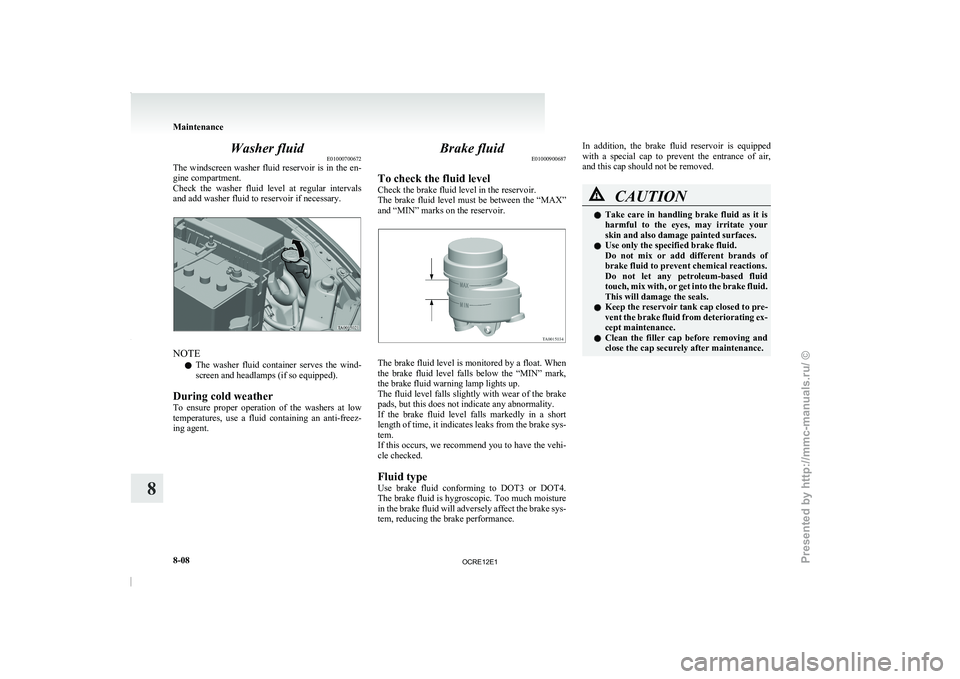
E01000700672
The windscreen washer fluid reservoir
is in the en-
gine compartment.
Check the washer fluid level at regular intervals
and add washer fluid to reservoir if necessary. NOTE
l The
washer fluid container serves
the wind-
screen and headlamps (if so equipped).
During cold weather
To ensure proper operation of the washers at low
temperatures, use a fluid containing an anti-freez-
ing agent. Brake fluid
E01000900687
To check the fluid level
Check the brake fluid level in the reservoir.
The brake fluid level must
be between the “MAX”
and “MIN” marks on the reservoir. The brake fluid level is monitored by a float. When
the brake fluid level
falls
below the “MIN” mark,
the brake fluid warning lamp lights up.
The fluid level falls slightly with wear of the brake
pads, but this does not indicate any abnormality.
If the brake fluid level falls markedly in a short
length of time, it indicates leaks from the brake sys-
tem.
If this occurs, we recommend you to have the vehi-
cle checked.
Fluid type
Use brake fluid conforming to DOT3 or DOT4.
The brake fluid is hygroscopic. Too much moisture
in the brake fluid will adversely affect the brake sys-
tem, reducing the brake performance. In addition, the brake fluid reservoir is equipped
with a special cap
to
prevent the entrance of air,
and this cap should not be removed. CAUTION
l
Take care in handling
brake
fluid as it is
harmful to the eyes, may irritate your
skin and also damage painted surfaces.
l Use only the specified brake fluid.
Do not mix or add different brands of
brake fluid to prevent chemical reactions.
Do not let any petroleum-based fluid
touch, mix with, or get into the brake fluid.
This will damage the seals.
l Keep the reservoir tank cap closed to pre-
vent the brake fluid from deteriorating ex-
cept maintenance.
l Clean the filler cap before removing and
close the cap securely after maintenance. Maintenance
8-08
8
OCRE12E1
Presented by http://mmc-manuals.ru/ \251
Page 315 of 369
NOTE
l Do
not allow the wiper
arm to fall onto the
windscreen; it could damage the glass.
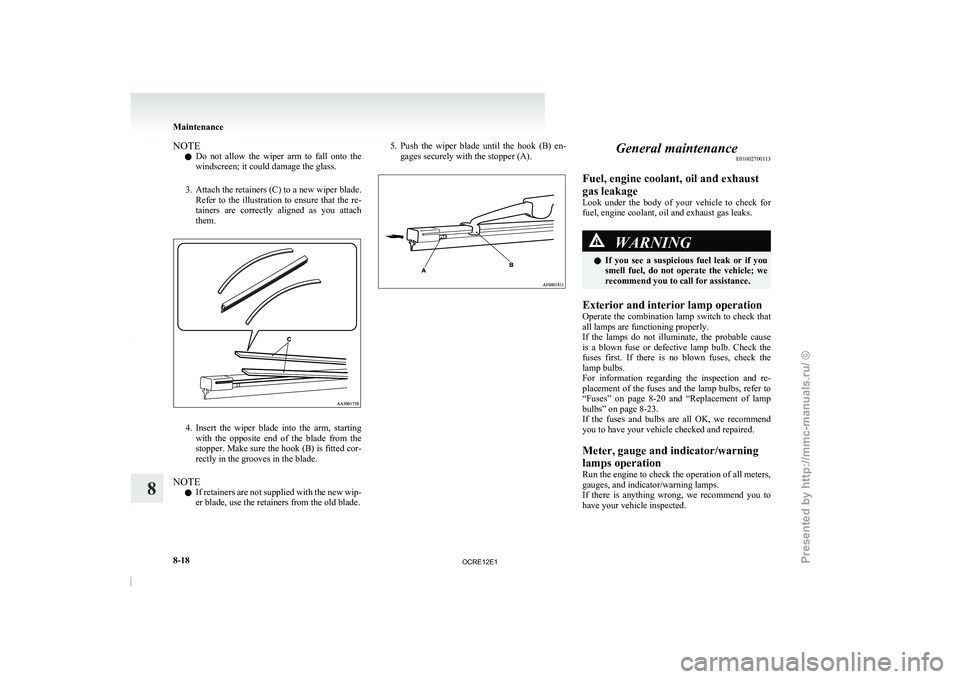
3. Attach the retainers (C) to a new wiper blade. Refer to the illustration to ensure that the re-
tainers are correctly aligned as you attach
them. 4. Insert the wiper blade into the arm, starting
with the opposite end
of the blade from the
stopper. Make sure the hook (B) is fitted cor-
rectly in the grooves in the blade.
NOTE l If retainers are not supplied with the new wip-
er blade, use the retainers from the old blade. 5. Push the wiper blade until the hook (B) en-
gages securely with the stopper (A). General maintenance
E01002700113
Fuel, engine coolant, oil and exhaust
gas leakage
Look under the body of
your vehicle to check for
fuel, engine coolant, oil and exhaust gas leaks. WARNING
l If
you
see a
suspicious
fuel leak or if you
smell fuel, do not operate the vehicle; we
recommend you to call for assistance.
Exterior and interior lamp operation
Operate the combination lamp switch
to check that
all lamps are functioning properly.
If the lamps do not illuminate, the probable cause
is a blown fuse or defective lamp bulb. Check the
fuses first. If there is no blown fuses, check the
lamp bulbs.
For information regarding the inspection and re-
placement of the fuses and the lamp bulbs, refer to
“Fuses” on page 8-20 and “Replacement of lamp
bulbs” on page 8-23.
If the fuses and bulbs are all OK, we recommend
you to have your vehicle checked and repaired.
Meter, gauge and indicator/warning
lamps operation
Run the engine to check the operation of all meters,
gauges, and indicator/warning lamps.
If there is anything wrong, we recommend you to
have your vehicle inspected. Maintenance
8-18
8
OCRE12E1
Presented by http://mmc-manuals.ru/ \251