headlamp MITSUBISHI TRITON 2011 User Guide
[x] Cancel search | Manufacturer: MITSUBISHI, Model Year: 2011, Model line: TRITON, Model: MITSUBISHI TRITON 2011Pages: 369, PDF Size: 26.15 MB
Page 119 of 369
l
It is possible to
activate the following func-
tions. For further information, we recom-
mend you to consult a MITSUBISHI
MOTORS Authorized Service Point. • Flashing of the turn-signal lamps and theindication lamp in the instrument cluster
when the lever is operated with the igni-
tion switch in the “ACC” position
• Flashing of the turn-signal lamps and the indication lamp in the instrument cluster
three times when you move the lever to
(2) slightly then release it
• The time required to operate the lever for the 3-flash function can be adjusted. Hazard warning flasher switch
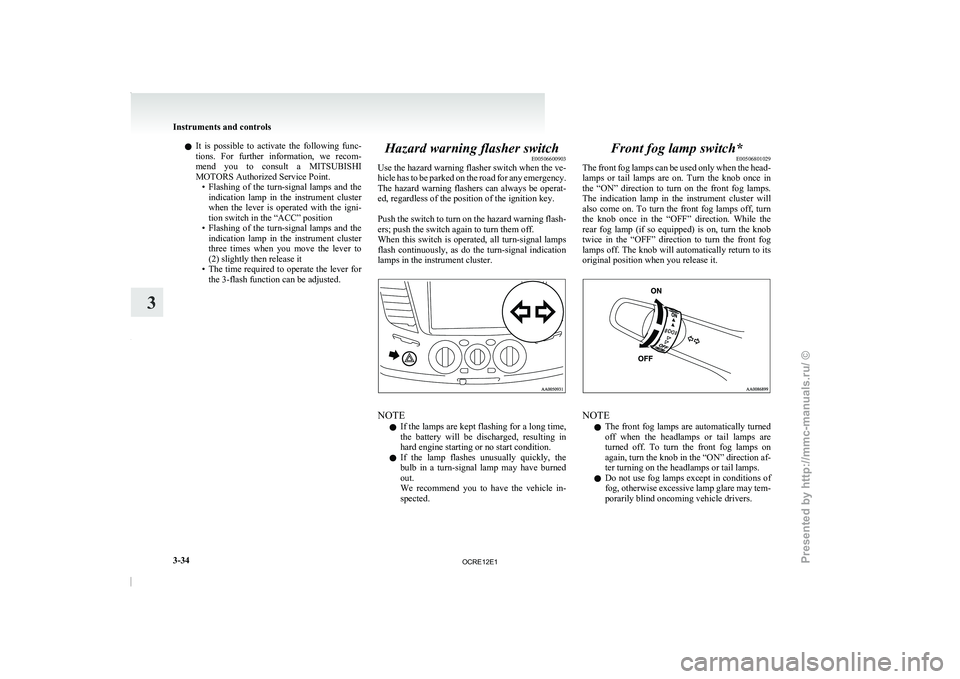
E00506600903
Use the hazard warning flasher
switch when the ve-
hicle has to be parked on the road for any emergency.
The hazard warning flashers can always be operat-
ed, regardless of the position of the ignition key.
Push the switch to turn on the hazard warning flash-
ers; push the switch again to turn them off.
When this switch is operated, all turn-signal lamps
flash continuously, as do the turn-signal indication
lamps in the instrument cluster. NOTE
l If
the lamps are kept
flashing for a long time,
the battery will be discharged, resulting in
hard engine starting or no start condition.
l If the lamp flashes unusually quickly, the
bulb in a turn-signal lamp may have burned
out.
We recommend you to have the vehicle in-
spected. Front fog lamp switch*
E00506801029
The front fog lamps
can
be used only when the head-
lamps or tail lamps are on. Turn the knob once in
the “ON” direction to turn on the front fog lamps.
The indication lamp in the instrument cluster will
also come on. To turn the front fog lamps off, turn
the knob once in the “OFF” direction. While the
rear fog lamp (if so equipped) is on, turn the knob
twice in the “OFF” direction to turn the front fog
lamps off. The knob will automatically return to its
original position when you release it. NOTE
l The
front fog lamps are
automatically turned
off when the headlamps or tail lamps are
turned off. To turn the front fog lamps on
again, turn the knob in the “ON” direction af-
ter turning on the headlamps or tail lamps.
l Do not use fog lamps except in conditions of
fog, otherwise excessive lamp glare may tem-
porarily blind oncoming vehicle drivers. Instruments and controls
3-34
3
OCRE12E1
Presented by http://mmc-manuals.ru/ \251
Page 120 of 369
l
In case of vehicles
with Daytime Running
Lamp, the front fog lamp can be operated
even if the lamp switch is set to the “OFF”
position, because the low beam of the head-
lamps, tail lamps, etc. illuminate when the ig-
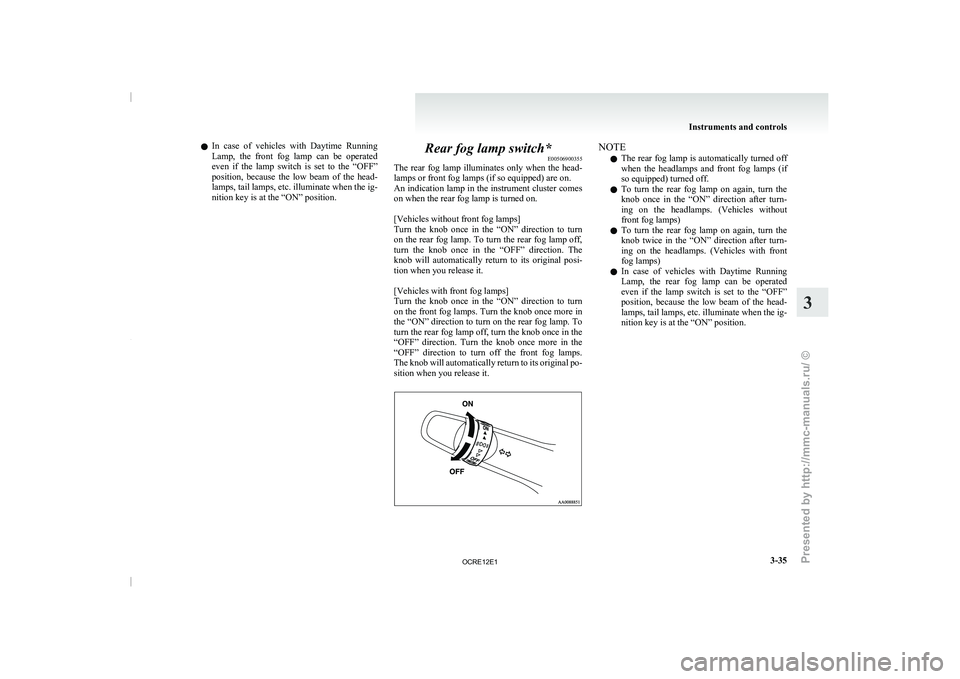
nition key is at the “ON” position. Rear fog lamp switch*
E00506900355
The rear fog lamp illuminates
only when the head-
lamps or front fog lamps (if so equipped) are on.
An indication lamp in the instrument cluster comes
on when the rear fog lamp is turned on.
[Vehicles without front fog lamps]
Turn the knob once in the “ON” direction to turn
on the rear fog lamp. To turn the rear fog lamp off,
turn the knob once in the “OFF” direction. The
knob will automatically return to its original posi-
tion when you release it.
[Vehicles with front fog lamps]
Turn the knob once in the “ON” direction to turn
on the front fog lamps. Turn the knob once more in
the “ON” direction to turn on the rear fog lamp. To
turn the rear fog lamp off, turn the knob once in the
“OFF” direction. Turn the knob once more in the
“OFF” direction to turn off the front fog lamps.
The knob will automatically return to its original po-
sition when you release it. NOTE
l The
rear fog lamp is
automatically turned off
when the headlamps and front fog lamps (if
so equipped) turned off.
l To turn the rear fog lamp on again, turn the
knob once in the “ON” direction after turn-
ing on the headlamps. (Vehicles without
front fog lamps)
l To turn the rear fog lamp on again, turn the
knob twice in the “ON” direction after turn-
ing on the headlamps. (Vehicles with front
fog lamps)
l In case of vehicles with Daytime Running
Lamp, the rear fog lamp can be operated
even if the lamp switch is set to the “OFF”
position, because the low beam of the head-
lamps, tail lamps, etc. illuminate when the ig-
nition key is at the “ON” position. Instruments and controls
3-35 3
OCRE12E1
Presented by http://mmc-manuals.ru/ \251
Page 124 of 369
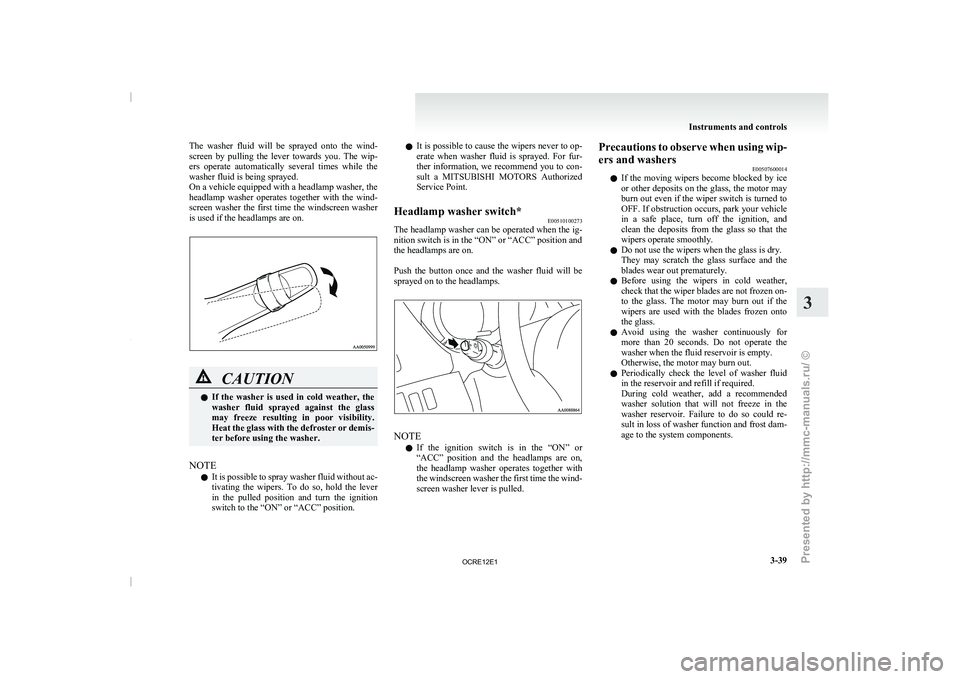
The washer fluid will be sprayed onto the wind-
screen by pulling the lever
towards you. The wip-
ers operate automatically several times while the
washer fluid is being sprayed.
On a vehicle equipped with a headlamp washer, the
headlamp washer operates together with the wind-
screen washer the first time the windscreen washer
is used if the headlamps are on. CAUTION
l
If the washer is
used
in cold weather, the
washer fluid sprayed against the glass
may freeze resulting in poor visibility.
Heat the glass with the defroster or demis-
ter before using the washer.
NOTE l It
is possible to spray
washer fluid without ac-
tivating the wipers. To do so, hold the lever
in the pulled position and turn the ignition
switch to the “ON” or “ACC” position. l
It is possible to
cause
the wipers never to op-
erate when washer fluid is sprayed. For fur-
ther information, we recommend you to con-
sult a MITSUBISHI MOTORS Authorized
Service Point.
Headlamp washer switch* E00510100273
The headlamp washer can be operated when the ig-
nition switch is in the “ON” or “ACC” position and
the headlamps are on.
Push the button once and
the washer fluid will be
sprayed on to the headlamps. NOTE
l If
the ignition switch is
in the “ON” or
“ACC” position and the headlamps are on,
the headlamp washer operates together with
the windscreen washer the first time the wind-
screen washer lever is pulled. Precautions to observe when using wip-
ers and washers
E00507600014
l If the moving wipers
become
blocked by ice
or other deposits on the glass, the motor may
burn out even if the wiper switch is turned to
OFF. If obstruction occurs, park your vehicle
in a safe place, turn off the ignition, and
clean the deposits from the glass so that the
wipers operate smoothly.
l Do not use the wipers when the glass is dry.
They may scratch the glass surface and the
blades wear out prematurely.
l Before using the wipers in cold weather,
check that the wiper blades are not frozen on-
to the glass. The motor may burn out if the
wipers are used with the blades frozen onto
the glass.
l Avoid using the washer continuously for
more than 20 seconds. Do not operate the
washer when the fluid reservoir is empty.
Otherwise, the motor may burn out.
l Periodically check the level of washer fluid
in the reservoir and refill if required.
During cold weather, add a recommended
washer solution that will not freeze in the
washer reservoir. Failure to do so could re-
sult in loss of washer function and frost dam-
age to the system components. Instruments and controls
3-39 3
OCRE12E1
Presented by http://mmc-manuals.ru/ \251
Page 134 of 369
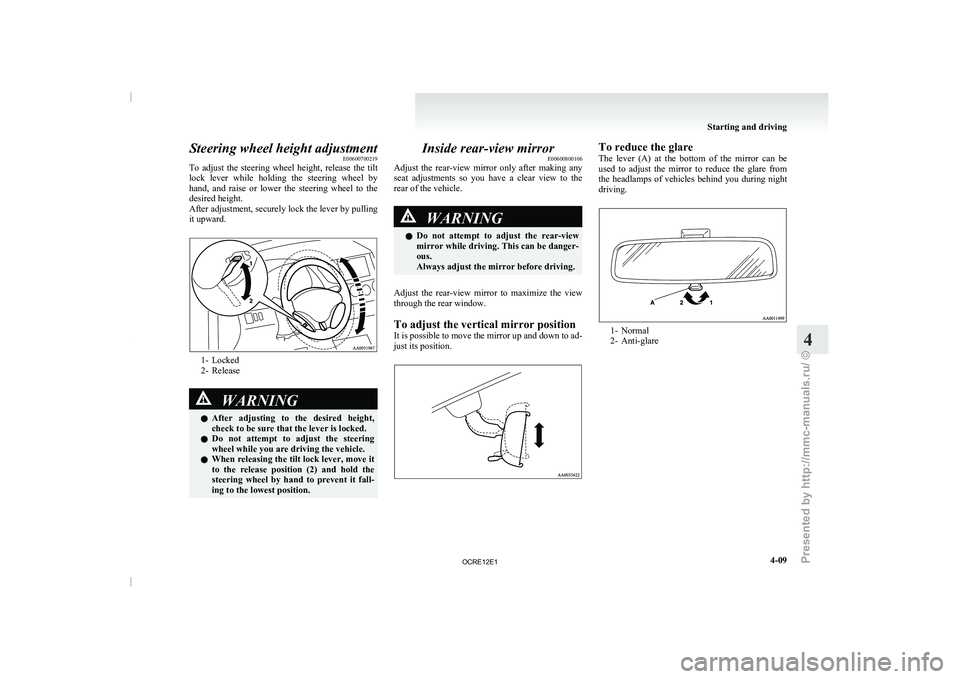
Steering wheel height adjustment
E00600700219
To adjust the steering wheel
height, release the tilt
lock lever while holding the steering wheel by
hand, and raise or lower the steering wheel to the
desired height.
After adjustment, securely lock the lever by pulling
it upward. 1- Locked
2- Release
WARNING
l After adjusting to the
desired
height,
check to be sure that the lever is locked.
l Do not attempt to adjust the steering
wheel while you are driving the vehicle.
l When releasing the tilt lock lever, move it
to the release position (2) and hold the
steering wheel by hand to prevent it fall-
ing to the lowest position. Inside rear-view mirror
E00600800106
Adjust the rear-view mirror only
after making any
seat adjustments so you have a clear view to the
rear of the vehicle. WARNING
l Do not attempt to
adjust
the rear-view
mirror while driving. This can be danger-
ous.
Always adjust the mirror before driving.
Adjust the rear-view mirror to maximize the view
through the rear window.
To adjust the vertical mirror position
It is possible
to move
the mirror up and down to ad-
just its position. To reduce the glare
The lever (A) at
the
bottom of the mirror can be
used to adjust the mirror to reduce the glare from
the headlamps of vehicles behind you during night
driving. 1- Normal
2- Anti-glare Starting and driving
4-09 4
OCRE12E1
Presented by http://mmc-manuals.ru/ \251
Page 137 of 369
NOTE
l If
your vehicle is equipped
with the Daytime
Running Lamp, when the ignition switch is
in the “ON”, the headlamp low beams etc.
are turned on.
Refer to “Headlamps” on page 3-30.
l Your vehicle is equipped with an electronic
immobilizer.
To start the engine, the ID code which the
transponder inside the key sends must match
the one registered in the immobilizer comput-
er.
Refer to “Electronic immobilizer” on page
1-03.
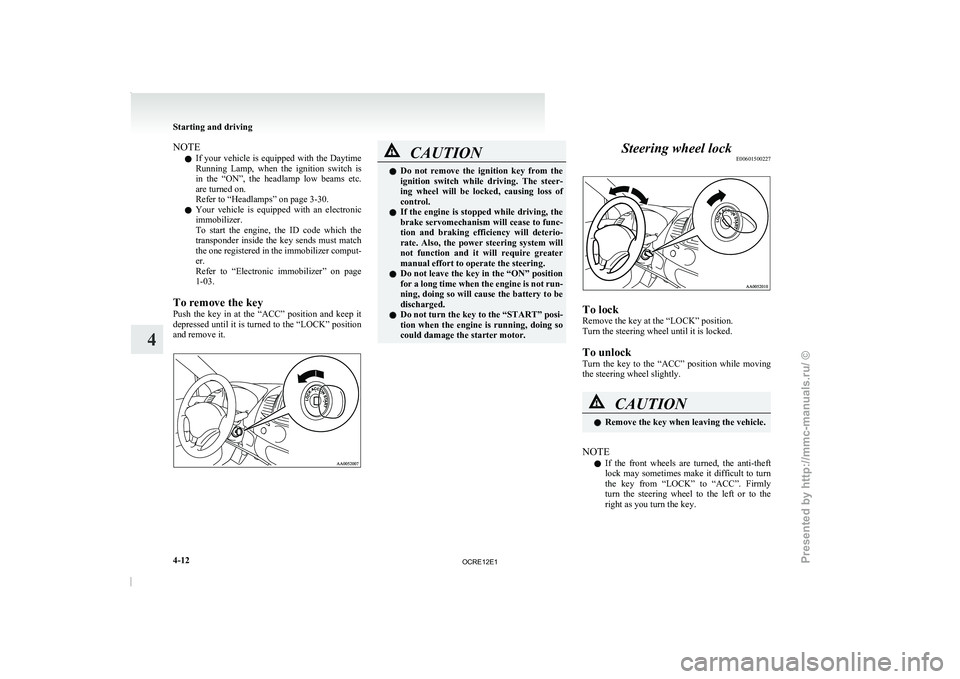
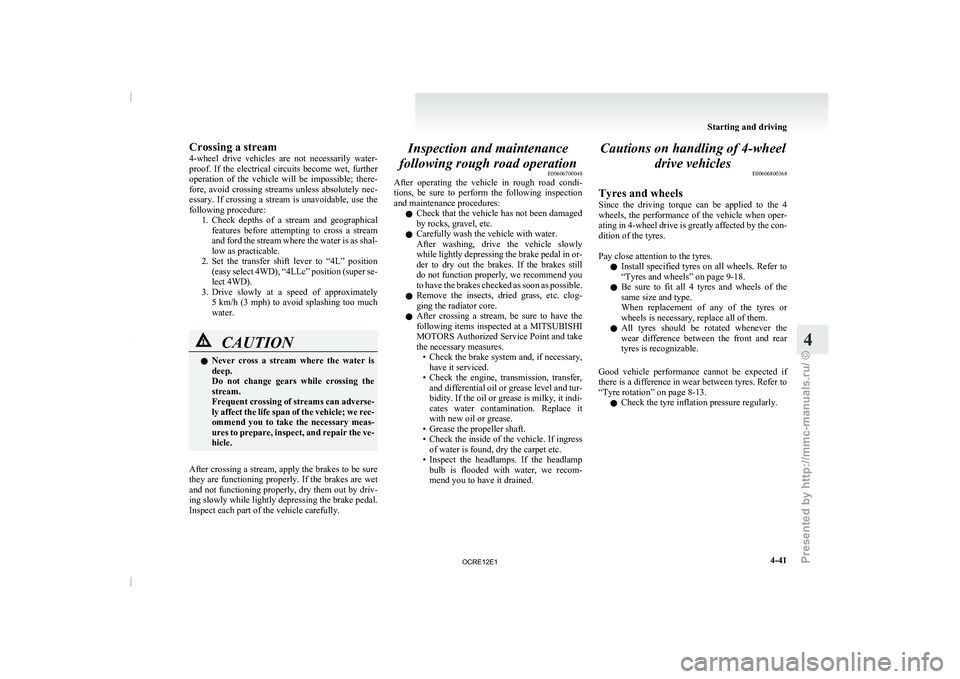
To remove the key
Push the key in at the “ACC” position and keep it
depressed until it is turned to the “LOCK” position
and remove it. CAUTION
l
Do not remove the ignition
key from the
ignition switch while driving. The steer-
ing wheel will be locked, causing loss of
control.
l If the engine is stopped while driving, the
brake servomechanism will cease to func-
tion and braking efficiency will deterio-
rate. Also, the power steering system will
not function and it will require greater
manual effort to operate the steering.
l Do not leave the key in the “ON” position
for a long time when the engine is not run-
ning, doing so will cause the battery to be
discharged.
l Do not turn the key to the “START” posi-
tion when the engine is running, doing so
could damage the starter motor. Steering wheel lock
E00601500227 To lock
Remove the key at the “LOCK” position.
Turn the steering wheel until it is locked.
To unlock
Turn the key to
the
“ACC” position while moving
the steering wheel slightly. CAUTION
l
Remove the key when leaving the vehicle.
NOTE l If
the front wheels are
turned, the anti-theft
lock may sometimes make it difficult to turn
the key from “LOCK” to “ACC”. Firmly
turn the steering wheel to the left or to the
right as you turn the key. Starting and driving
4-12
4
OCRE12E1
Presented by http://mmc-manuals.ru/ \251
Page 166 of 369
Crossing a stream
4-wheel drive vehicles are
not
necessarily water-
proof. If the electrical circuits become wet, further
operation of the vehicle will be impossible; there-
fore, avoid crossing streams unless absolutely nec-
essary. If crossing a stream is unavoidable, use the
following procedure: 1. Check depths of a stream and geographicalfeatures before attempting to cross a stream
and ford the stream where the water is as shal-
low as practicable.
2. Set the transfer shift lever to “4L” position (easy select 4WD), “4LLc” position (super se-
lect 4WD).
3. Drive slowly at a speed of approximately 5 km/h (3 mph) to avoid splashing too much
water. CAUTION
l
Never cross a stream
where
the water is
deep.
Do not change gears while crossing the
stream.
Frequent crossing of streams can adverse-
ly affect the life span of the vehicle; we rec-
ommend you to take the necessary meas-
ures to prepare, inspect, and repair the ve-
hicle.
After crossing a stream, apply the brakes to be sure
they are functioning
properly. If
the brakes are wet
and not functioning properly, dry them out by driv-
ing slowly while lightly depressing the brake pedal.
Inspect each part of the vehicle carefully. Inspection and maintenance
following rough road operation E00606700048
After operating
the vehicle
in
rough road condi-
tions, be sure to perform the following inspection
and maintenance procedures:
l Check that the vehicle has not been damaged
by rocks, gravel, etc.
l Carefully wash the vehicle with water.
After washing, drive the vehicle slowly
while lightly depressing the brake pedal in or-
der to dry out the brakes. If the brakes still
do not function properly, we recommend you
to have the brakes checked as soon as possible.
l Remove the insects, dried grass, etc. clog-
ging the radiator core.
l After crossing a stream, be sure to have the
following items inspected at a MITSUBISHI
MOTORS Authorized Service Point and take
the necessary measures.
• Check the brake system and, if necessary,have it serviced.
• Check the engine, transmission, transfer, and differential oil or grease level and tur-
bidity. If the oil or grease is milky, it indi-
cates water contamination. Replace it
with new oil or grease.
• Grease the propeller shaft.
• Check the inside of the vehicle. If ingress of water is found, dry the carpet etc.
• Inspect the headlamps. If the headlamp bulb is flooded with water, we recom-
mend you to have it drained. Cautions on handling of 4-wheel
drive vehicles E00606800368
Tyres and wheels
Since the driving torque can
be applied to the 4
wheels, the performance of the vehicle when oper-
ating in 4-wheel drive is greatly affected by the con-
dition of the tyres.
Pay close attention to the tyres.
l Install specified tyres on all wheels. Refer to
“Tyres and wheels” on page 9-18.
l Be sure to fit all 4 tyres and wheels of the
same size and type.
When replacement of any of the tyres or
wheels is necessary, replace all of them.
l All tyres should be rotated whenever the
wear difference between the front and rear
tyres is recognizable.
Good vehicle performance cannot be expected if
there is a difference in wear between tyres. Refer to
“Tyre rotation” on page 8-13. l Check the tyre inflation pressure regularly. Starting and driving
4-41 4
OCRE12E1
Presented by http://mmc-manuals.ru/ \251
Page 258 of 369
Door courtesy lamps*
E00717500034
Each door courtesy lamp comes
on when the rele-
vant door is opened and goes off when the door is
closed. Centre console downlight
E00733300043
The centre console downlight go on when the lamp
switch is in the “ ” or the “ ” position.
Refer to “Combination headlamps and
dipper
switch” on page 3-30.
Type 1
Type 2 Storage spaces
E00713101404 CAUTION
l
Never leave lighters, cans
of
carbonated
drink, and spectacles in the cabin when
parking the vehicle in hot sunshine. The
cabin will become extremely hot, so light-
ers and other flammable items may catch
fire and unopened drink cans (including
beer cans) may rupture. The heat may al-
so deform or crack plastic spectacle len-
ses and other spectacle parts that are
made of plastic.
l Keep the lids of storage spaces closed
while driving the vehicle. A lid or the con-
tents of a storage space could otherwise
cause injuries.
NOTE l Do
not leave valuables in
any storage space
when leaving the vehicle. For pleasant driving
5-75 5
OCRE12E1
Presented by http://mmc-manuals.ru/ \251
Page 259 of 369
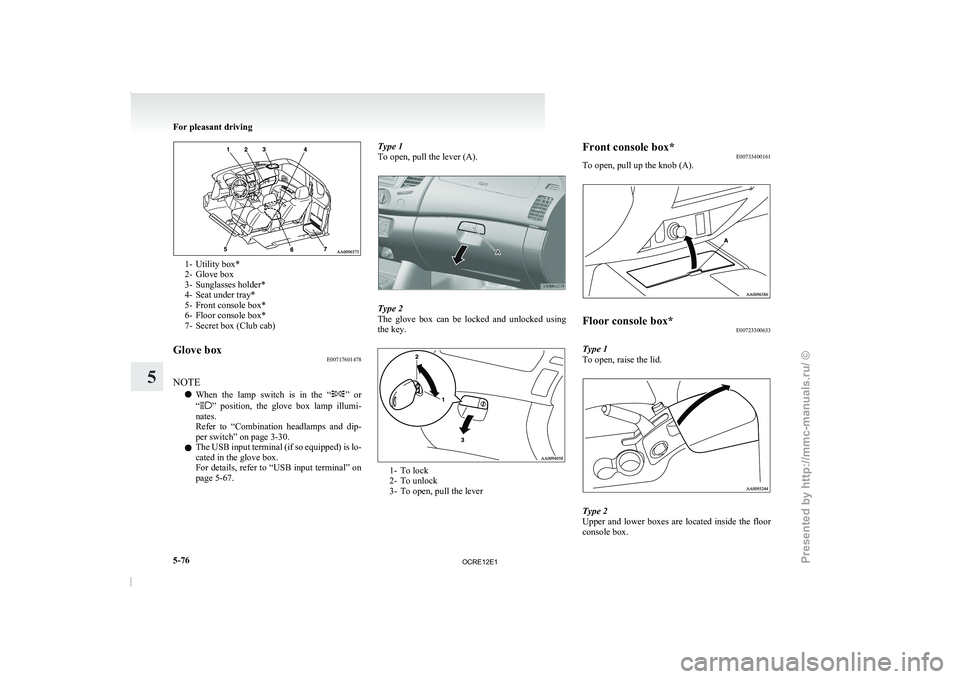
1- Utility box*
2- Glove box
3- Sunglasses holder*
4- Seat under tray*
5-
Front console box*
6-
Floor console box*
7- Secret box (Club cab)
Glove box E00717601478
NOTE l When
the lamp switch is
in the “ ” or
“ ” position, the glove box lamp illumi-
nates.
Refer to “Combination headlamps
and dip-
per switch” on page 3-30.
l The USB input terminal (if so equipped) is lo-
cated in the glove box.
For details, refer to “USB input terminal” on
page 5-67. Type 1
To open, pull the lever (A).
Type 2
The glove box can
be
locked and unlocked using
the key. 1- To lock
2- To unlock
3- To open, pull the leverFront console box*
E00733400161
To open, pull up the knob (A). Floor console box*
E00723300633
Type 1
To open, raise the lid. Type 2
Upper and lower boxes
are
located inside the floor
console box. For pleasant driving
5-76
5
OCRE12E1
Presented by http://mmc-manuals.ru/ \251
Page 305 of 369
Washer fluid
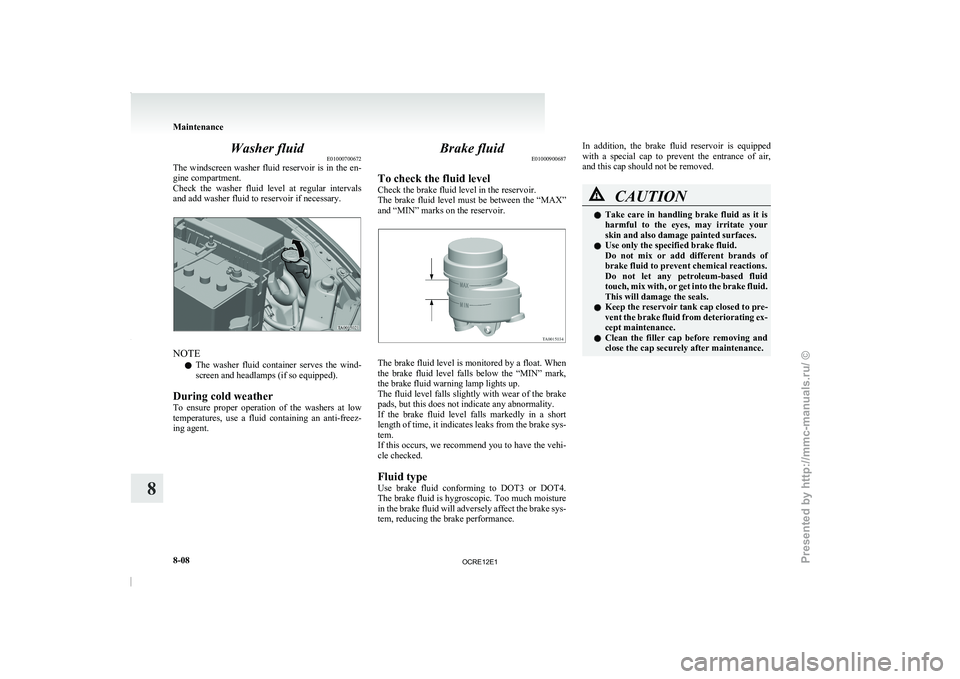
E01000700672
The windscreen washer fluid reservoir
is in the en-
gine compartment.
Check the washer fluid level at regular intervals
and add washer fluid to reservoir if necessary. NOTE
l The
washer fluid container serves
the wind-
screen and headlamps (if so equipped).
During cold weather
To ensure proper operation of the washers at low
temperatures, use a fluid containing an anti-freez-
ing agent. Brake fluid
E01000900687
To check the fluid level
Check the brake fluid level in the reservoir.
The brake fluid level must
be between the “MAX”
and “MIN” marks on the reservoir. The brake fluid level is monitored by a float. When
the brake fluid level
falls
below the “MIN” mark,
the brake fluid warning lamp lights up.
The fluid level falls slightly with wear of the brake
pads, but this does not indicate any abnormality.
If the brake fluid level falls markedly in a short
length of time, it indicates leaks from the brake sys-
tem.
If this occurs, we recommend you to have the vehi-
cle checked.
Fluid type
Use brake fluid conforming to DOT3 or DOT4.
The brake fluid is hygroscopic. Too much moisture
in the brake fluid will adversely affect the brake sys-
tem, reducing the brake performance. In addition, the brake fluid reservoir is equipped
with a special cap
to
prevent the entrance of air,
and this cap should not be removed. CAUTION
l
Take care in handling
brake
fluid as it is
harmful to the eyes, may irritate your
skin and also damage painted surfaces.
l Use only the specified brake fluid.
Do not mix or add different brands of
brake fluid to prevent chemical reactions.
Do not let any petroleum-based fluid
touch, mix with, or get into the brake fluid.
This will damage the seals.
l Keep the reservoir tank cap closed to pre-
vent the brake fluid from deteriorating ex-
cept maintenance.
l Clean the filler cap before removing and
close the cap securely after maintenance. Maintenance
8-08
8
OCRE12E1
Presented by http://mmc-manuals.ru/ \251
Page 319 of 369
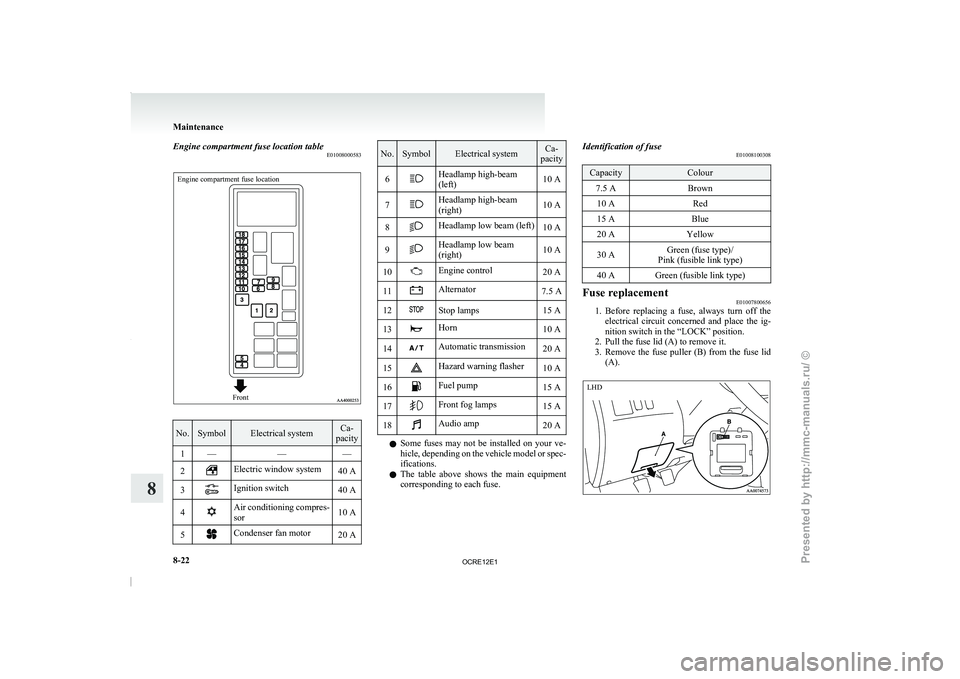
Engine compartment fuse location table
E01008000583Engine compartment fuse location
FrontNo. Symbol Electrical system Ca-
pacity
1 — ——
2 Electric window system
40 A
3 Ignition switch
40 A
4 Air conditioning compres-
sor
10 A
5 Condenser fan motor
20 A No. Symbol Electrical system Ca-
pacity
6 Headlamp high-beam
(left)
10 A
7 Headlamp high-beam
(right)
10 A
8 Headlamp low beam (left)
10 A
9 Headlamp low beam
(right)
10 A
10 Engine control
20 A
11 Alternator
7.5 A
12 Stop lamps
15 A
13 Horn
10 A
14 Automatic transmission
20 A
15 Hazard warning flasher
10 A
16 Fuel pump
15 A
17 Front fog lamps
15 A
18 Audio amp
20 A l
Some fuses may not
be
installed on your ve-
hicle, depending on the vehicle model or spec-
ifications.
l The table above shows the main equipment
corresponding to each fuse. Identification of fuse
E01008100308 Capacity Colour
7.5 A Brown
10 A Red
15 A Blue
20 A Yellow
30 A Green (fuse type)/
Pink (fusible link type)
40 A Green (fusible link type) Fuse replacement
E01007800656
1. Before replacing a fuse, always turn off the
electrical circuit concerned and
place the ig-
nition switch in the “LOCK” position.
2. Pull the fuse lid (A) to remove it.
3. Remove the fuse puller (B) from the fuse lid (A). Maintenance
8-22
8 LHD
OCRE12E1
Presented by http://mmc-manuals.ru/ \251