Lamp MITSUBISHI TRITON 2011 Owner's Manual
[x] Cancel search | Manufacturer: MITSUBISHI, Model Year: 2011, Model line: TRITON, Model: MITSUBISHI TRITON 2011Pages: 369, PDF Size: 26.15 MB
Page 33 of 369
Keyless entry system*
E00300301860
Press the remote control switch,
and all doors will
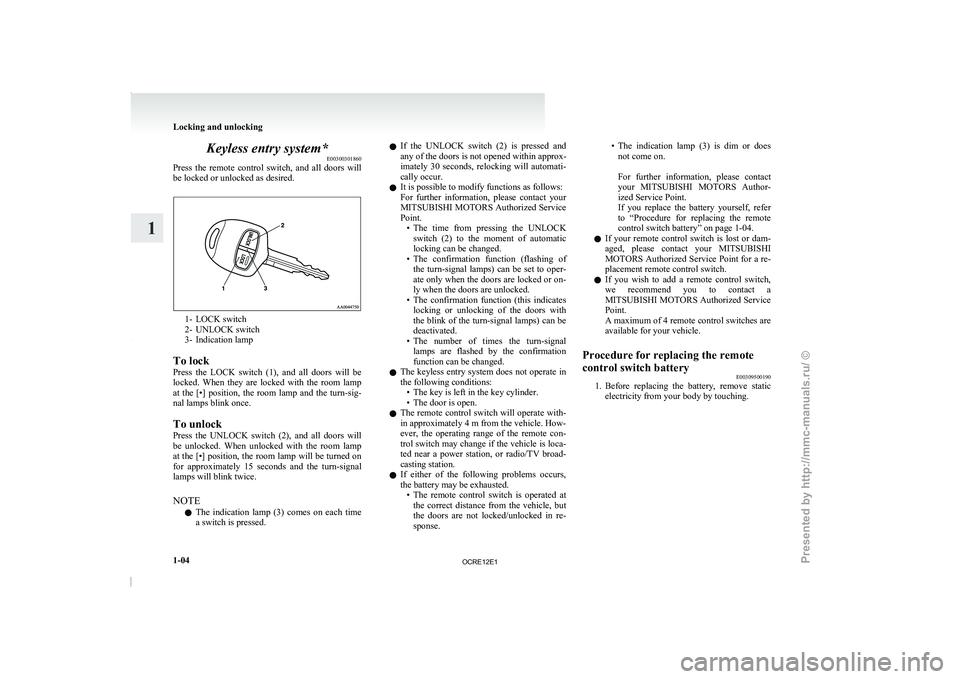
be locked or unlocked as desired. 1- LOCK switch
2- UNLOCK switch
3- Indication lamp
To lock
Press the LOCK
switch (1), and all doors will be
locked. When they are locked with the room lamp
at the [•] position, the room lamp and the turn-sig-
nal lamps blink once.
To unlock
Press the UNLOCK switch (2), and all doors will
be unlocked. When unlocked with the room lamp
at the [•] position, the room lamp will be turned on
for approximately 15 seconds and the turn-signal
lamps will blink twice.
NOTE
l The indication lamp (3) comes on each time
a switch is pressed. l
If the UNLOCK switch
(2)
is pressed and
any of the doors is not opened within approx-
imately 30 seconds, relocking will automati-
cally occur.
l It is possible to modify functions as follows:
For further information, please contact your
MITSUBISHI MOTORS Authorized Service
Point.
• The time from pressing the UNLOCKswitch (2) to the moment of automatic
locking can be changed.
• The confirmation function (flashing of the turn-signal lamps) can be set to oper-
ate only when the doors are locked or on-
ly when the doors are unlocked.
• The confirmation function (this indicates locking or unlocking of the doors with
the blink of the turn-signal lamps) can be
deactivated.
• The number of times the turn-signal lamps are flashed by the confirmation
function can be changed.
l The keyless entry system does not operate in
the following conditions:
• The key is left in the key cylinder.
• The door is open.
l The remote control switch will operate with-
in approximately 4 m from the vehicle. How-
ever, the operating range of the remote con-
trol switch may change if the vehicle is loca-
ted near a power station, or radio/TV broad-
casting station.
l If either of the following problems occurs,
the battery may be exhausted.
• The remote control switch is operated atthe correct distance from the vehicle, but
the doors are not locked/unlocked in re-
sponse. • The indication lamp (3) is dim or does
not come on.
For further information, please
contact
your MITSUBISHI MOTORS Author-
ized Service Point.
If you replace the battery yourself, refer
to “Procedure for replacing the remote
control switch battery” on page 1-04.
l If your remote control switch is lost or dam-
aged, please contact your MITSUBISHI
MOTORS Authorized Service Point for a re-
placement remote control switch.
l If you wish to add a remote control switch,
we recommend you to contact a
MITSUBISHI MOTORS Authorized Service
Point.
A maximum of 4 remote control switches are
available for your vehicle.
Procedure for replacing the remote
control switch battery E00309500190
1. Before replacing the battery, remove static
electricity from your body by touching. Locking and unlocking
1-04
1
OCRE12E1
Presented by http://mmc-manuals.ru/ \251
Page 51 of 369
When the lever or pedal is used, the seatback will
tilt forward and at the
same time the entire seat will
move forward. To return the seat, slide the entire
seat rearward and then raise the seatback rearward
to lock the seat in position. WARNING
l Do not drive the vehicle with the seatback
folded forward. The seat
is
not retained
position if it is not kept in an upright posi-
tion, so serious injuries could be suffered
in the event of hard braking or a collision. CAUTION
l
The reclining mechanism of the
seatback
is spring loaded, causing it to return to
the vertical position when the lock lever
is operated. When using the lever, sit
close to the seatback or hold it with your
hand.
l Use a foot to operate the pedal (2).
Folding the seatback forward (Single
cab, passenger’s seat)* E00410400031
To access the onboard tool kit, fold forward the seat-
back of the passenger’s seat.
Refer to “Tools, jack and
jack handle” on page
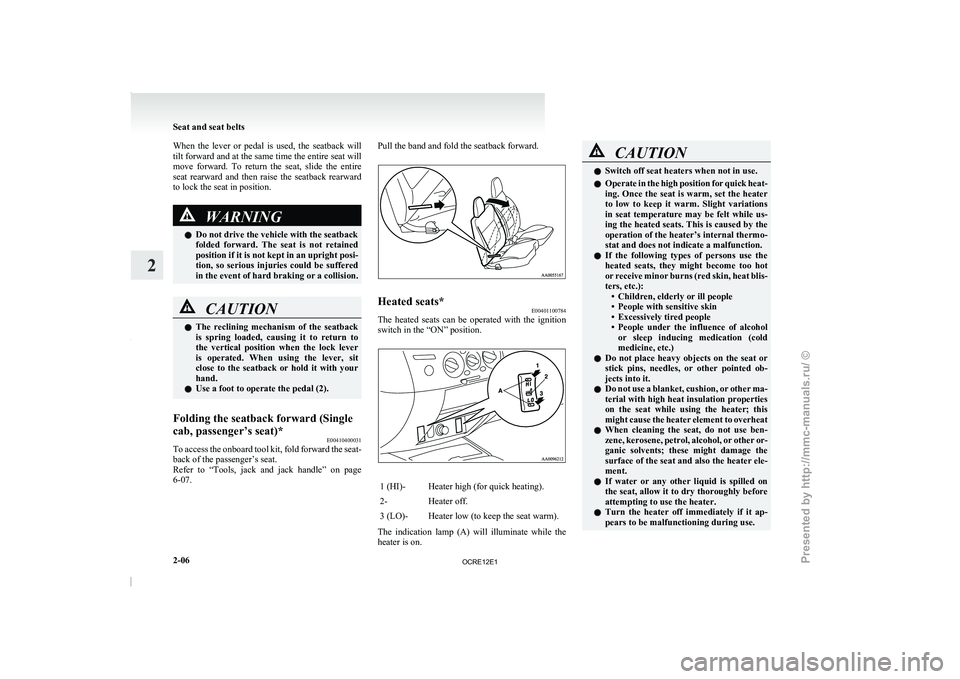
6-07. Pull the band and fold the seatback forward.
Heated seats*
E00401100784
The heated seats can be operated with the ignition
switch in the “ON” position. 1 (HI)- Heater high (for quick heating).
2- Heater off.
3 (LO)- Heater low (to keep the seat warm).
The indication lamp (A) will illuminate while the
heater is on. CAUTION
l
Switch off seat heaters when not in use.
l Operate in the high position
for quick heat-
ing. Once the seat is warm, set the heater
to low to keep it warm. Slight variations
in seat temperature may be felt while us-
ing the heated seats. This is caused by the
operation of the heater’s internal thermo-
stat and does not indicate a malfunction.
l If the following types of persons use the
heated seats, they might become too hot
or receive minor burns (red skin, heat blis-
ters, etc.):
• Children, elderly or ill people
• People with sensitive skin
• Excessively tired people
• People under the influence of alcoholor sleep inducing medication (cold
medicine, etc.)
l Do not place heavy objects on the seat or
stick pins, needles, or other pointed ob-
jects into it.
l Do not use a blanket, cushion, or other ma-
terial with high heat insulation properties
on the seat while using the heater; this
might cause the heater element to overheat
l When cleaning the seat, do not use ben-
zene, kerosene, petrol, alcohol, or other or-
ganic solvents; these might damage the
surface of the seat and also the heater ele-
ment.
l If water or any other liquid is spilled on
the seat, allow it to dry thoroughly before
attempting to use the heater.
l Turn the heater off immediately if it ap-
pears to be malfunctioning during use. Seat and seat belts
2-06
2
OCRE12E1
Presented by http://mmc-manuals.ru/ \251
Page 55 of 369
NOTE
l You
can check if the
belt locks by pulling it
forward quickly.
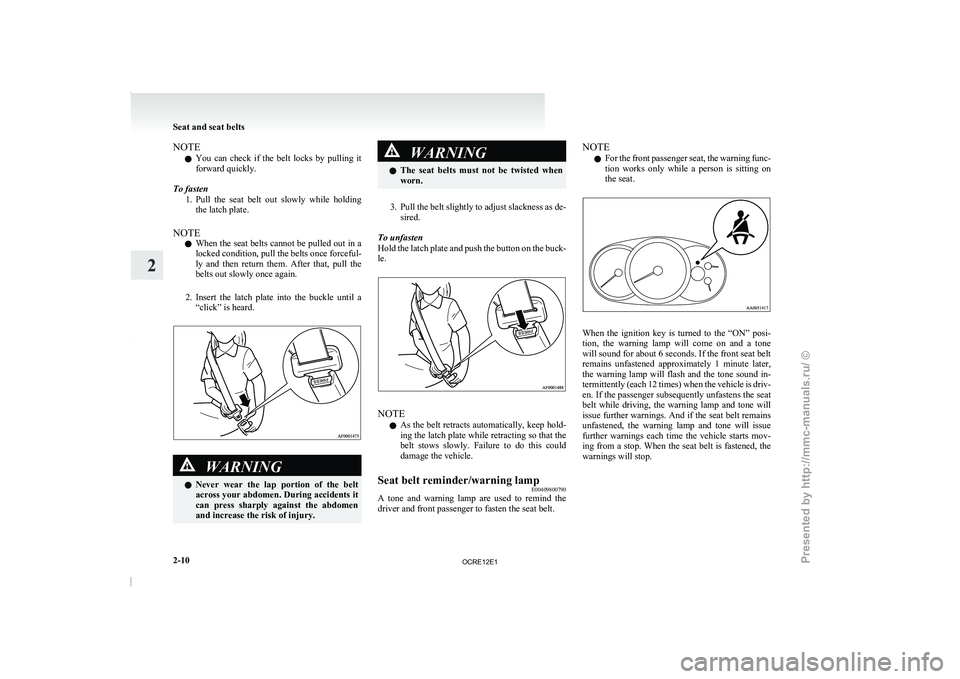
To fasten 1. Pull the seat belt out slowly while holdingthe latch plate.
NOTE l When the seat belts cannot be pulled out in a
locked condition, pull the belts once forceful-
ly and then return them. After that, pull the
belts out slowly once again.
2. Insert the latch plate into the buckle until a “click” is heard. WARNING
l Never wear the lap
portion
of the belt
across your abdomen. During accidents it
can press sharply against the abdomen
and increase the risk of injury. WARNING
l The seat belts must not
be twisted when
worn.
3. Pull the belt slightly to adjust slackness as de-
sired.
To unfasten
Hold the
latch plate
and push the button on the buck-
le. NOTE
l As
the belt retracts automatically,
keep hold-
ing the latch plate while retracting so that the
belt stows slowly. Failure to do this could
damage the vehicle.
Seat belt reminder/warning lamp E00409800790
A tone and warning lamp are used to remind the
driver and front passenger to fasten the seat belt. NOTE
l For
the front passenger seat,
the warning func-
tion works only while a person is sitting on
the seat. When the ignition key is turned to the “ON” posi-
tion, the warning lamp will
come on and a tone
will sound for about 6 seconds. If the front seat belt
remains unfastened approximately 1 minute later,
the warning lamp will flash and the tone sound in-
termittently (each 12 times) when the vehicle is driv-
en. If the passenger subsequently unfastens the seat
belt while driving, the warning lamp and tone will
issue further warnings. And if the seat belt remains
unfastened, the warning lamp and tone will issue
further warnings each time the vehicle starts mov-
ing from a stop. When the seat belt is fastened, the
warnings will stop. Seat and seat belts
2-10
2
OCRE12E1
Presented by http://mmc-manuals.ru/ \251
Page 56 of 369
WARNING
l In order to reduce the risk of serious or fa-
tal injury in an accident, always wear
your own seat belt. Do not allow anyone
to ride in your vehicle unless he or she is
also seated and wearing a seat belt. Chil-
dren should additionally be restrained in
a secure child restraint system.
NOTE l When
luggage is placed on
the front passen-
ger seat, a sensor in the seat cushion may, de-
pending on the weight and position of the lug-
gage, cause the warning tone to sound and
the warning lamp to come on (Double cab).
Adjustable seat belt anchor (front
seats)* E00405000299
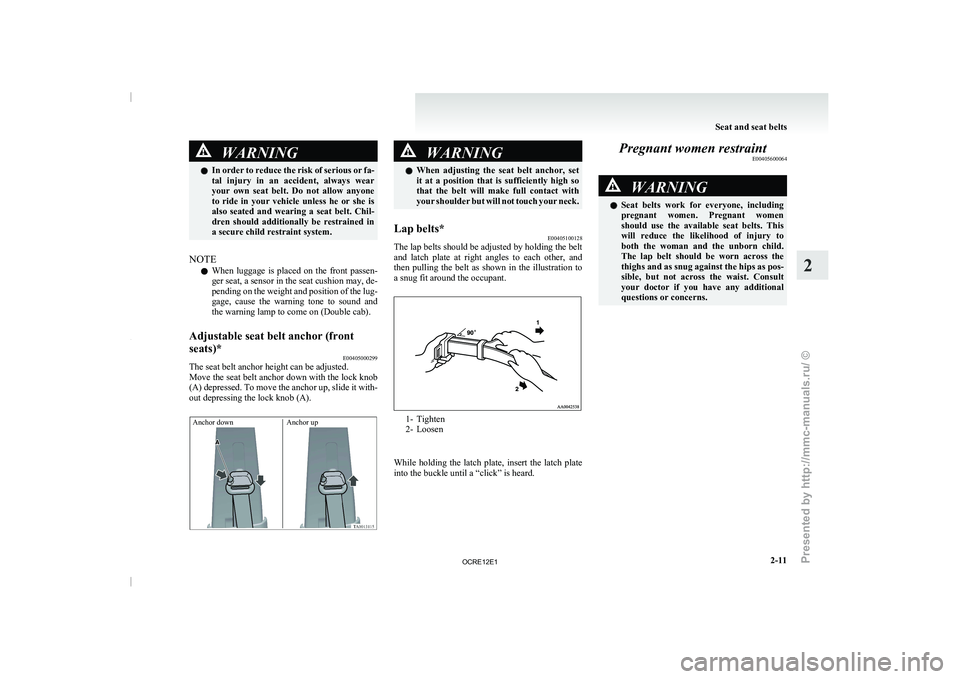
The seat belt anchor height can be adjusted.
Move the seat belt anchor
down with the lock knob
(A) depressed. To move the anchor up, slide it with-
out depressing the lock knob (A).
Anchor down Anchor up WARNING
l When adjusting the seat belt
anchor, set
it at a position that is sufficiently high so
that the belt will make full contact with
your shoulder but will not touch your neck.
Lap belts* E00405100128
The lap belts should be adjusted by holding the belt
and latch plate
at right
angles to each other, and
then pulling the belt as shown in the illustration to
a snug fit around the occupant. 1- Tighten
2- Loosen
While holding the latch
plate, insert the latch plate
into the buckle until a “click” is heard. Pregnant women restraint
E00405600064 WARNING
l Seat belts work for
everyone,
including
pregnant women. Pregnant women
should use the available seat belts. This
will reduce the likelihood of injury to
both the woman and the unborn child.
The lap belt should be worn across the
thighs and as snug against the hips as pos-
sible, but not across the waist. Consult
your doctor if you have any additional
questions or concerns. Seat and seat belts
2-11 2
OCRE12E1
Presented by http://mmc-manuals.ru/ \251
Page 57 of 369
Seat belt pretensioner system and
force limiter system* E00405700283
The driver’s and front passenger’s
seat equipped
with an airbag has a pretensioner seat belt.
Pretensioner system E00405801089
The pretensioner system will retract their respec-
tive seat belts instantaneously, thus
maximizing the
seat belt’s effectiveness, if there is a frontal impact
severe enough to injure the driver and/or front pas-
senger and the ignition switch is in the “ON” or
“START” position.
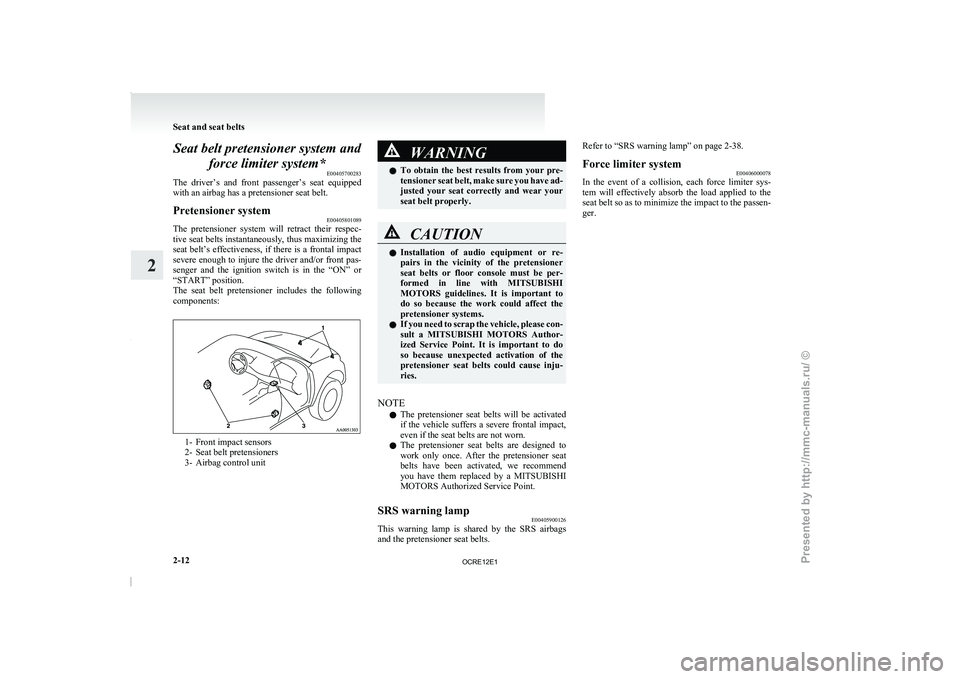
The seat belt pretensioner includes the following
components: 1- Front impact sensors
2- Seat belt pretensioners
3- Airbag control unit WARNING
l To obtain the best results
from your pre-
tensioner seat belt, make sure you have ad-
justed your seat correctly and wear your
seat belt properly. CAUTION
l
Installation
of audio
equipment or
re-
pairs in the vicinity of the pretensioner
seat belts or floor console must be per-
formed in line with MITSUBISHI
MOTORS guidelines. It is important to
do so because the work could affect the
pretensioner systems.
l If you need to scrap the vehicle, please con-
sult a MITSUBISHI MOTORS Author-
ized Service Point. It is important to do
so because unexpected activation of the
pretensioner seat belts could cause inju-
ries.
NOTE l The
pretensioner seat belts will
be activated
if the vehicle suffers a severe frontal impact,
even if the seat belts are not worn.
l The pretensioner seat belts are designed to
work only once. After the pretensioner seat
belts have been activated, we recommend
you have them replaced by a MITSUBISHI
MOTORS Authorized Service Point.
SRS warning lamp E00405900126
This warning lamp is shared by the SRS airbags
and the pretensioner seat belts. Refer to “SRS warning lamp” on page 2-38.
Force limiter system
E00406000078
In the event of a collision, each force limiter sys-
tem will effectively absorb the
load applied to the
seat belt so as to minimize the impact to the passen-
ger. Seat and seat belts
2-12
2
OCRE12E1
Presented by http://mmc-manuals.ru/ \251
Page 74 of 369
WARNING
l A FORWARD FACING CHILD RE-
STRAINT should not be used in the front
passenger seat whenever possible; if used
in the front passenger seat, adjust the
seat to the most rearward position. Fail-
ure to do so could kill or cause serious in-
juries to the child. WARNING
l Older children should be
seated,
properly
wearing the seat belt, with an appropri-
ate booster seat if needed. Caution for installing the child re-
straint on vehicles with a front passen-
ger airbag
E00408800272
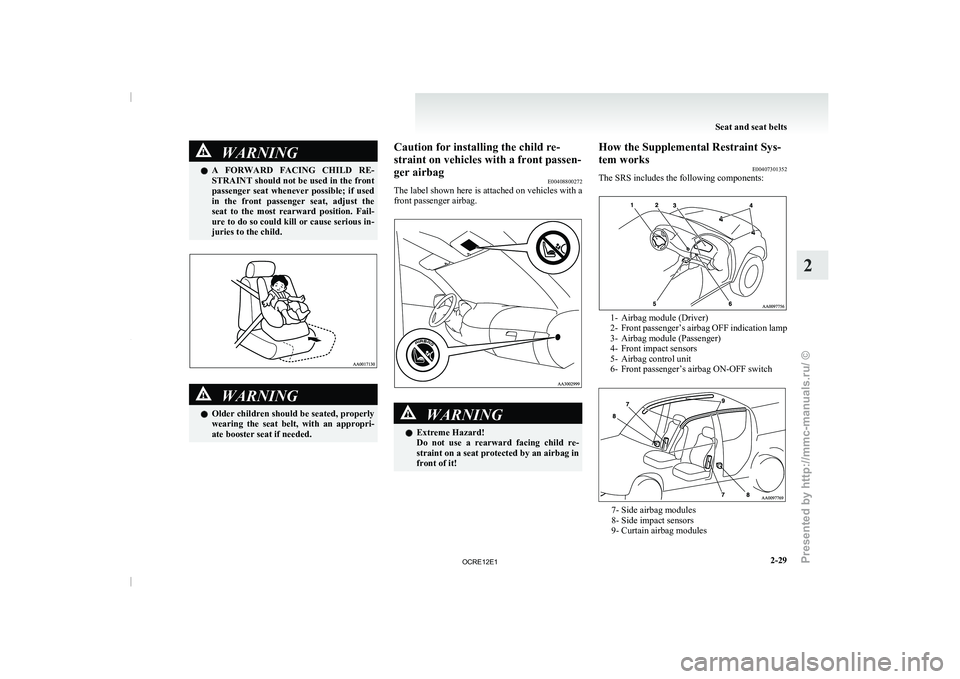
The label shown here is
attached on vehicles with a
front passenger airbag. WARNING
l Extreme Hazard!
Do not use a
rearward
facing child re-
straint on a seat protected by an airbag in
front of it! How the Supplemental Restraint Sys-
tem works
E00407301352
The SRS includes the following components: 1- Airbag module (Driver)
2- Front passenger’s airbag OFF
indication
lamp
3- Airbag module (Passenger)
4- Front impact sensors
5- Airbag control unit
6- Front passenger’s airbag ON-OFF switch 7- Side airbag modules
8- Side impact sensors
9- Curtain airbag modules Seat and seat belts
2-29 2
OCRE12E1
Presented by http://mmc-manuals.ru/ \251
Page 75 of 369
The airbags will operate only when the ignition
switch is in the “ON” or “START” position.
When the airbag control unit
detect an impact of suf-
ficient frontal or side force, it sends an ignition sig-
nal to the airbag modules to ignite materials in the
inflator and generate gas and inflate the airbags.
The airbags deployment produces a sudden, loud
noise, and releases some smoke and powder, but
these conditions are not injurious, and do not indi-
cate a fire in the vehicle. People with respiratory
problems may feel some temporary irritation from
chemicals used to produce the deployment; open
the windows after airbag deployment, if safe to do
so.
The airbags deflate very rapidly after deployment,
so there is little danger of obscured vision.
The time required from the sensors detecting an im-
pact to deflation of the airbags after deployment is
shorter than a blink of an eye. CAUTION
l
Airbags inflate at an
extremely
rapid
speed. In certain situations, contact with
inflating airbags can result in abrasions,
light cuts, bruises, and the like.
Front passenger’s airbag ON-OFF
switch E00410100184
The front passenger’s airbag ON-OFF switch can
be used to
disable the
front passenger’s airbag. If
you have a rearward facing child restraint system
that cannot be fitted to any seat other than the front
passenger seat, be sure to turn OFF the front passen-
ger’s airbag ON-OFF switch before using it. (Refer
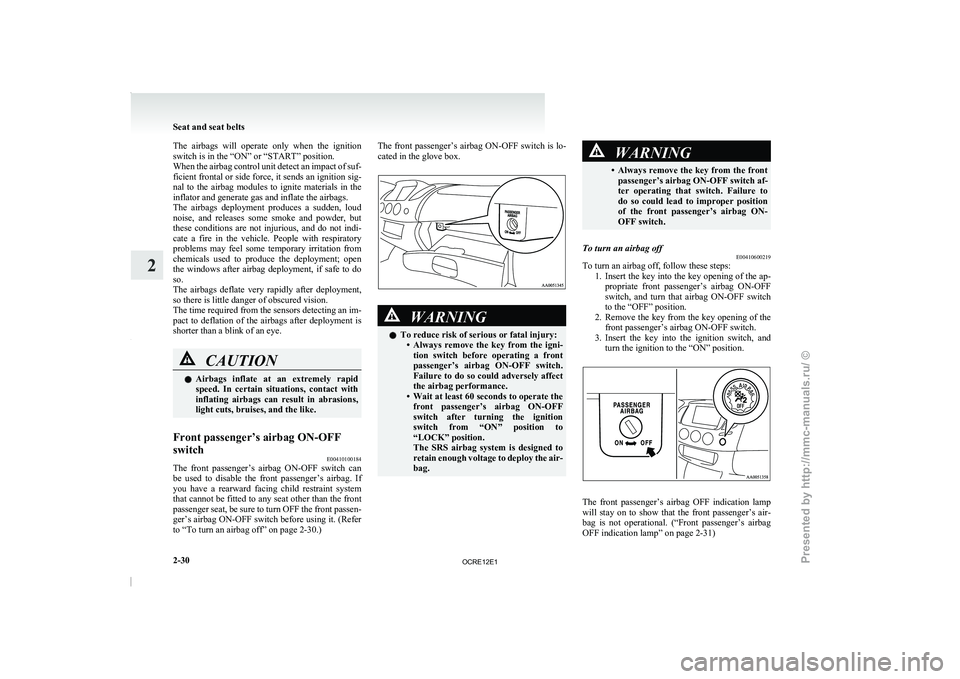
to “To turn an airbag off” on page 2-30.) The front passenger’s airbag ON-OFF switch is lo-
cated in the glove box.
WARNING
l To reduce risk of serious or fatal injury:
• Always remove the key from
the igni-
tion switch before operating a front
passenger’s airbag ON-OFF switch.
Failure to do so could adversely affect
the airbag performance.
• Wait at least 60 seconds to operate the front passenger’s airbag ON-OFF
switch after turning the ignition
switch from “ON” position to
“LOCK” position.
The SRS airbag system is designed to
retain enough voltage to deploy the air-
bag. WARNING
• Always remove the key from the front passenger’s airbag ON-OFF switch af-
ter operating that switch.
Failure to
do so could lead to improper position
of the front passenger’s airbag ON-
OFF switch.
To turn an airbag off E00410600219
To turn an airbag off, follow these steps:
1. Insert the key into the
key opening of the ap-
propriate front passenger’s airbag ON-OFF
switch, and turn that airbag ON-OFF switch
to the “OFF” position.
2. Remove the key from the key opening of the front passenger’s airbag ON-OFF switch.
3. Insert the key into the ignition switch, and turn the ignition to the “ON” position. The front passenger’s airbag OFF indication lamp
will stay on to
show
that the front passenger’s air-
bag is not operational. (“Front passenger’s airbag
OFF indication lamp” on page 2-31) Seat and seat belts
2-30
2
OCRE12E1
Presented by http://mmc-manuals.ru/ \251
Page 76 of 369
That airbag will remain OFF, and will NOT de-
ploy, until it is turned ON again.
WARNING
l To reduce risk of serious or fatal injury:
• If the indication lamp does
not come
on when the front passenger’s airbag
ON-OFF switch is turned OFF, do not
fit a rearward facing child restraint
system to the front passenger seat.
• Do not turn OFF the front passen- ger’s airbag ON-OFF switch except
when a rearward facing child re-
straint system is fitted to the front pas-
senger seat.
To turn an airbag on E00410700106
To turn an airbag on, follow these steps:
1. Insert the key
into the
key opening of the ap-
propriate front passenger’s airbag ON-OFF
switch, and turn that airbag ON-OFF switch
to “ON” position.
2. Remove the key from the key opening of that front passenger’s airbag ON-OFF switch. 3. Insert the key into the ignition switch, and
turn the ignition to the “ON” position. The front passenger’s airbag OFF indication lamp
goes off to show
that
the front passenger’s airbag is
operational.
That airbag will remain ON, and will be ready to
deploy, until it is again turned OFF. WARNING
l To reduce risk of serious or fatal injury:
• Turn ON
the front
passenger’s
airbag
ON-OFF switch immediately after re-
moving a rearward facing child re-
straint system from the front passen-
ger seat.
• If the indication lamp remains on when the front passenger’s airbag
ON-OFF switch is turned ON, do not
allow anyone to sit on the front passen-
ger seat. Front passenger’s airbag OFF indica-
tion lamp
E00410200257
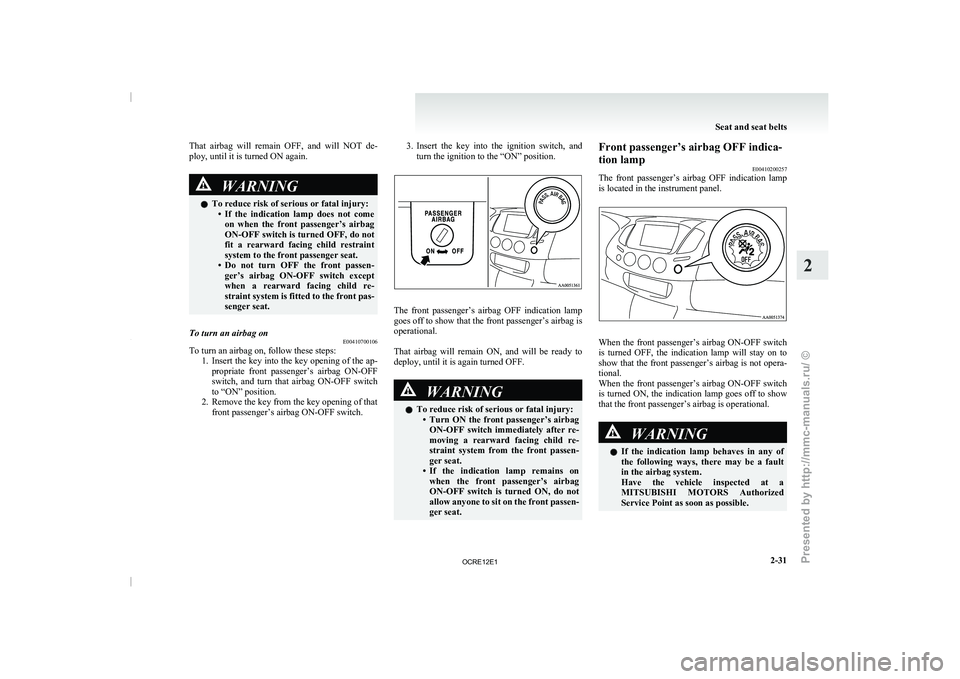
The front passenger’s airbag OFF
indication lamp
is located in the instrument panel. When the front passenger’s airbag ON-OFF switch
is turned OFF, the
indication
lamp will stay on to
show that the front passenger’s airbag is not opera-
tional.
When the front passenger’s airbag ON-OFF switch
is turned ON, the indication lamp goes off to show
that the front passenger’s airbag is operational. WARNING
l If
the
indication lamp
behaves
in any of
the following ways, there may be a fault
in the airbag system.
Have the vehicle inspected at a
MITSUBISHI MOTORS Authorized
Service Point as soon as possible. Seat and seat belts
2-31 2
OCRE12E1
Presented by http://mmc-manuals.ru/ \251
Page 77 of 369
WARNING
• The indication lamp does not come on when the front passenger’s
airbag ON-
OFF switch is turned OFF.
• The indication lamp stays on when the front passenger’s airbag ON-OFF
switch is turned ON. WARNING
l Do not fit any accessory that makes the in-
dication lamp impossible to see, and do
not cover the indication lamp with a stick-
er. You would not be able to verify the sta-
tus of the passenger airbag system.
Driver’s and passenger’s front airbag
system E00407400330
The driver’s airbag is located under the padded cov-
er in the
middle of
the steering wheel. The front pas-
senger’s airbag is contained in the instrument panel
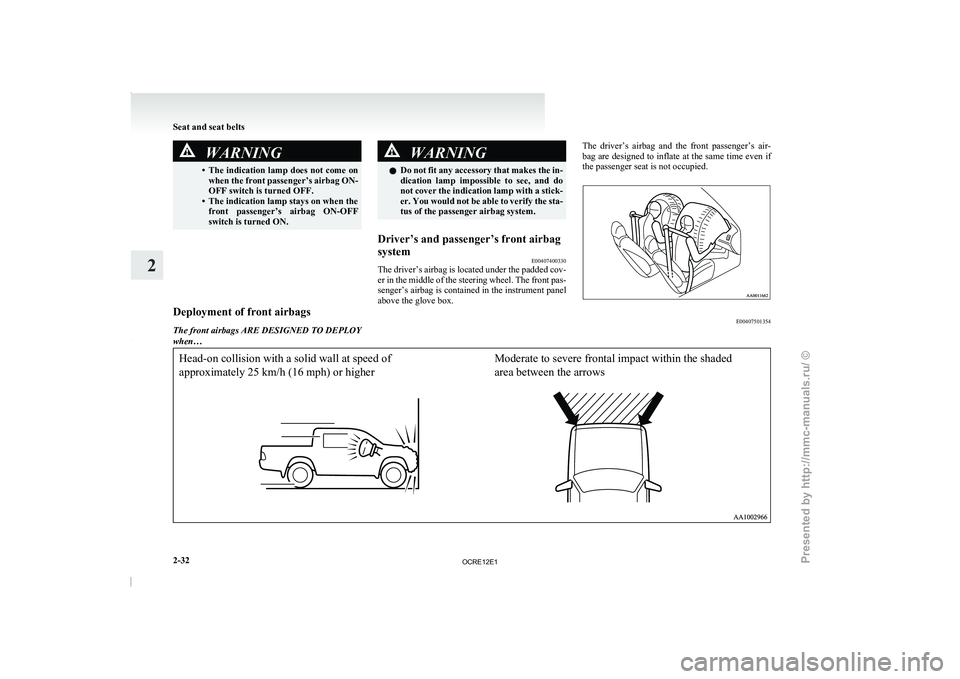
above the glove box. The driver’s airbag and the front passenger’s air-
bag
are
designed to
inflate
at the same time even if
the passenger seat is not occupied. Deployment of front airbags
E00407501354
The front airbags ARE DESIGNED TO DEPLOY
when…
Head-on collision with a solid wall at speed of
approximately 25 km/h (16 mph) or higher Moderate to severe frontal impact within the shaded
area between the arrowsSeat and seat belts
2-32
2
OCRE12E1
Presented by http://mmc-manuals.ru/ \251
Page 83 of 369
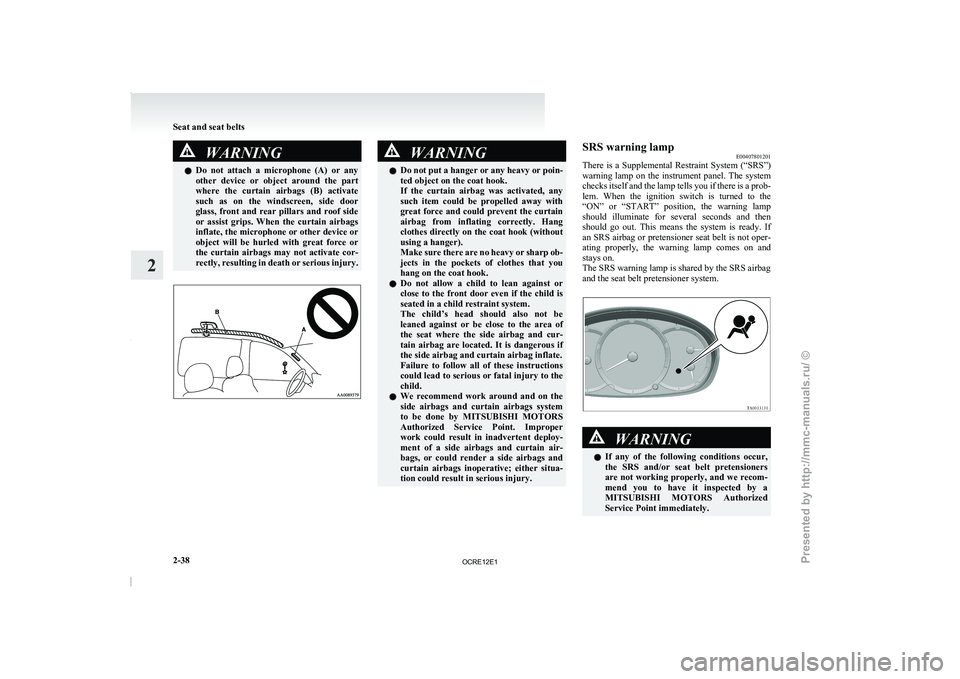
WARNING
l Do not attach a microphone (A) or any
other device or object around the part
where the curtain airbags (B) activate
such as on the windscreen, side door
glass, front and rear pillars and roof side
or assist grips. When the curtain airbags
inflate, the microphone or other device or
object will be hurled with great force or
the curtain airbags may not activate cor-
rectly, resulting in death or serious injury. WARNING
l Do not put a hanger or any heavy or poin-
ted object on the coat hook.
If the curtain airbag was activated, any
such item could be propelled away with
great force and could prevent the curtain
airbag from inflating correctly. Hang
clothes directly on the coat hook (without
using a hanger).
Make sure there are no heavy or sharp ob-
jects in the pockets of clothes that you
hang on the coat hook.
l Do not allow a child to lean against or
close to the front door even if the child is
seated in a child restraint system.
The child’s head should also not be
leaned against or be close to the area of
the seat where the side airbag and cur-
tain airbag are located. It is dangerous if
the side airbag and curtain airbag inflate.
Failure to follow all of these instructions
could lead to serious or fatal injury to the
child.
l We recommend work around and on the
side airbags and curtain airbags system
to be done by MITSUBISHI MOTORS
Authorized Service Point. Improper
work could result in inadvertent deploy-
ment of a side airbags and curtain air-
bags, or could render a side airbags and
curtain airbags inoperative; either situa-
tion could result in serious injury. SRS warning lamp
E00407801201
There is a Supplemental Restraint
System (“SRS”)
warning lamp on the instrument panel. The system
checks itself and the lamp tells you if there is a prob-
lem. When the ignition switch is turned to the
“ON” or “START” position, the warning lamp
should illuminate for several seconds and then
should go out. This means the system is ready. If
an SRS airbag or pretensioner seat belt is not oper-
ating properly, the warning lamp comes on and
stays on.
The SRS warning lamp is shared by the SRS airbag
and the seat belt pretensioner system. WARNING
l If any of the
following
conditions occur,
the SRS and/or seat belt pretensioners
are not working properly, and we recom-
mend you to have it inspected by a
MITSUBISHI MOTORS Authorized
Service Point immediately. Seat and seat belts
2-38
2
OCRE12E1
Presented by http://mmc-manuals.ru/ \251