belt MITSUBISHI TRITON 2011 Service Manual
[x] Cancel search | Manufacturer: MITSUBISHI, Model Year: 2011, Model line: TRITON, Model: MITSUBISHI TRITON 2011Pages: 369, PDF Size: 26.15 MB
Page 77 of 369
WARNING
• The indication lamp does not come on when the front passenger’s
airbag ON-
OFF switch is turned OFF.
• The indication lamp stays on when the front passenger’s airbag ON-OFF
switch is turned ON. WARNING
l Do not fit any accessory that makes the in-
dication lamp impossible to see, and do
not cover the indication lamp with a stick-
er. You would not be able to verify the sta-
tus of the passenger airbag system.
Driver’s and passenger’s front airbag
system E00407400330
The driver’s airbag is located under the padded cov-
er in the
middle of
the steering wheel. The front pas-
senger’s airbag is contained in the instrument panel
above the glove box. The driver’s airbag and the front passenger’s air-
bag
are
designed to
inflate
at the same time even if
the passenger seat is not occupied. Deployment of front airbags
E00407501354
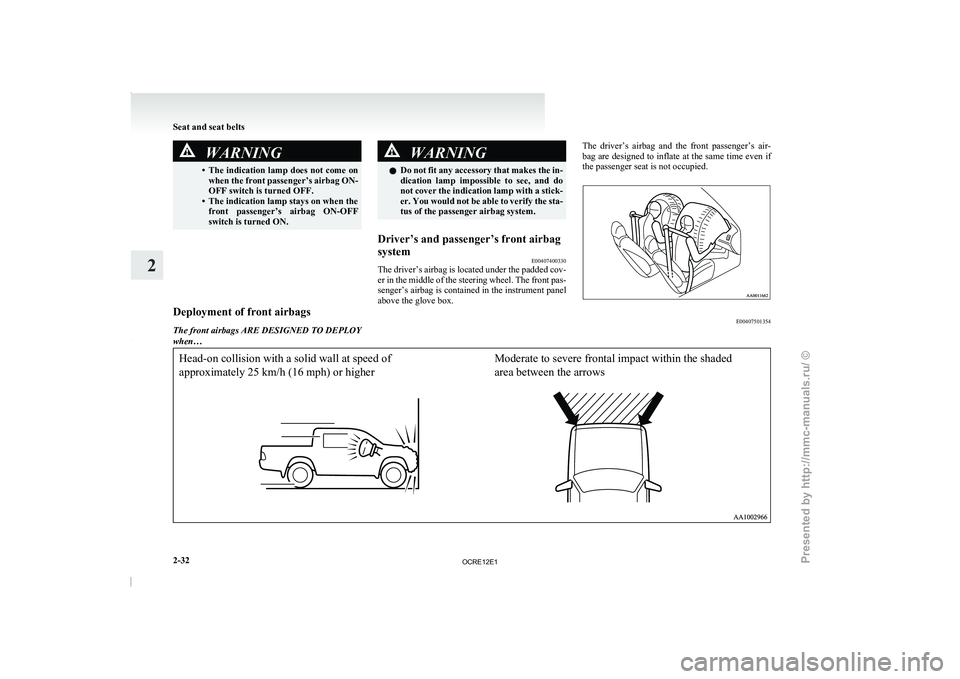
The front airbags ARE DESIGNED TO DEPLOY
when…
Head-on collision with a solid wall at speed of
approximately 25 km/h (16 mph) or higher Moderate to severe frontal impact within the shaded
area between the arrowsSeat and seat belts
2-32
2
OCRE12E1
Presented by http://mmc-manuals.ru/ \251
Page 78 of 369
The front airbags are designed to deploy when the
vehicle suffers a moderate to
severe frontal impact.
A typical condition is shown in the illustration.
The front airbags will deploy if the severity of im-
pact is above the designed threshold level, compa-
rable to an approximately 25 km/h (16 mph) colli-
sion when impacting straight into a solid wall that
does not move or deform. If the severity of the im-
pact is below the above threshold level, the front air-
bags may not deploy. However, this threshold
speed will be considerably higher if the vehicle
strikes an object that absorbs the impact by either
deforming or moving (for example, another station-
ary vehicle, pole or a guard rail).
Because frontal collisions can easily move you out
of position, it is important to always properly wear
your seat belts. Your seat belts will help keep you
in a safe distance from the steering wheel and in-
strument panel during the initial stages of airbag de-
ployment. The initial stage of airbag inflation is the
most forceful, and can possibly cause serious or fa-
tal injuries. Moreover, the seat belts in your vehicle
are your primary means of protection in a collision.
The SRS airbags are designed to provide additional
protection. Therefore, for your safety and the safe-
ty of all occupants, be sure to always properly wear
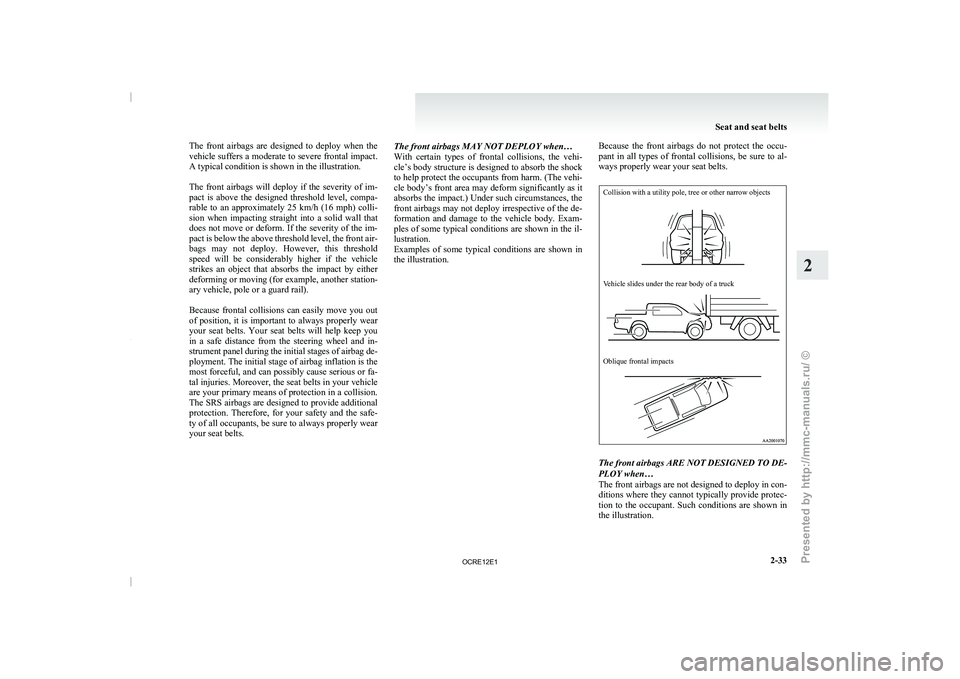
your seat belts. The front airbags MAY NOT DEPLOY when…
With certain types of frontal
collisions, the vehi-
cle’s body structure is designed to absorb the shock
to help protect the occupants from harm. (The vehi-
cle body’s front area may deform significantly as it
absorbs the impact.) Under such circumstances, the
front airbags may not deploy irrespective of the de-
formation and damage to the vehicle body. Exam-
ples of some typical conditions are shown in the il-
lustration.
Examples of some typical conditions are shown in
the illustration.
Because the front airbags do not protect the occu-
pant in all types of
frontal collisions, be sure to al-
ways properly wear your seat belts.
Collision with a utility pole, tree or other narrow objects
Vehicle slides under the rear body of a truck
Oblique frontal impacts The front airbags ARE NOT DESIGNED TO DE-
PLOY when…
The
front
airbags are
not
designed to deploy in con-
ditions where they cannot typically provide protec-
tion to the occupant. Such conditions are shown in
the illustration.
Seat and seat belts
2-33 2
OCRE12E1
Presented by http://mmc-manuals.ru/ \251
Page 79 of 369
Because the front airbags do not protect the occu-
pant in all types of
collisions, be sure to always prop-
erly wear your seat belts.
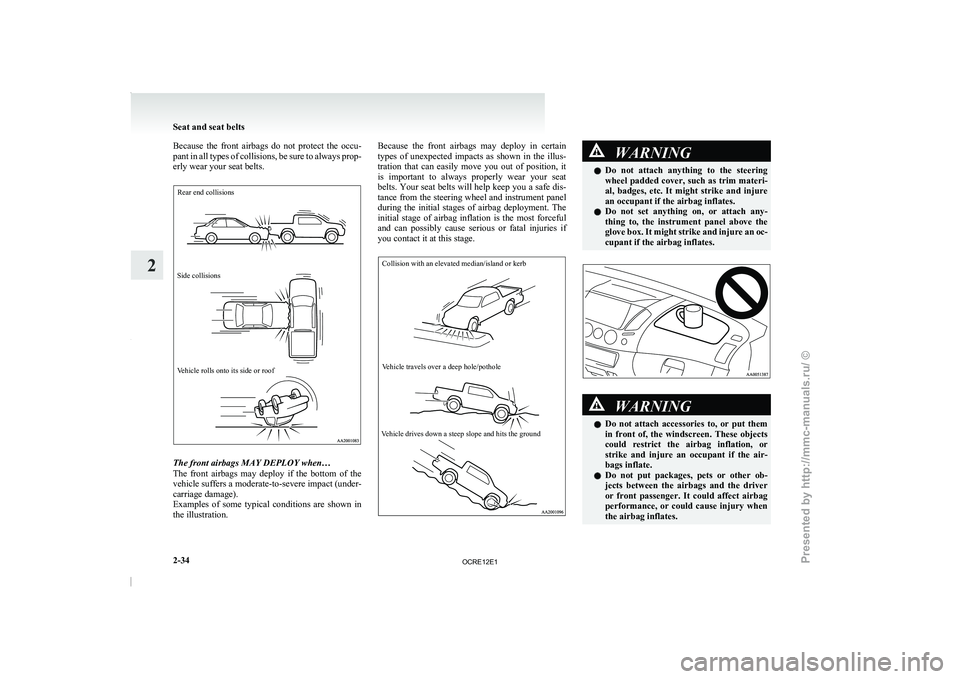
Rear end collisions
Side collisions
Vehicle rolls onto its side or roof The front airbags MAY DEPLOY when…
The
front
airbags may
deploy
if the bottom of the
vehicle suffers a moderate-to-severe impact (under-
carriage damage).
Examples of some typical conditions are shown in
the illustration.
Because the front airbags may deploy in certain
types
of
unexpected impacts
as
shown in the illus-
tration that can easily move you out of position, it
is important to always properly wear your seat
belts. Your seat belts will help keep you a safe dis-
tance from the steering wheel and instrument panel
during the initial stages of airbag deployment. The
initial stage of airbag inflation is the most forceful
and can possibly cause serious or fatal injuries if
you contact it at this stage.
Collision with an elevated median/island or kerb
Vehicle travels over a deep hole/pothole
Vehicle drives down a steep slope and hits the ground WARNING
l Do not attach anything to
the steering
wheel padded cover, such as trim materi-
al, badges, etc. It might strike and injure
an occupant if the airbag inflates.
l Do not set anything on, or attach any-
thing to, the instrument panel above the
glove box. It might strike and injure an oc-
cupant if the airbag inflates. WARNING
l Do not attach accessories
to,
or put them
in front of, the windscreen. These objects
could restrict the airbag inflation, or
strike and injure an occupant if the air-
bags inflate.
l Do not put packages, pets or other ob-
jects between the airbags and the driver
or front passenger. It could affect airbag
performance, or could cause injury when
the airbag inflates. Seat and seat belts
2-34
2
OCRE12E1
Presented by http://mmc-manuals.ru/ \251
Page 80 of 369
WARNING
l Right after the airbag inflation, several
airbag system components will be hot. Do
not touch them; you could be burned.
l The airbag system is designed to work on-
ly once. Once the airbags have deployed,
they will not work again. They must
promptly be replaced, and we recom-
mend you to have the entire airbag sys-
tem inspected by a MITSUBISHI
MOTORS Authorized Service Point.
Side airbag system E00407600374
The side airbags (A) are contained in the driver and
front passenger seatbacks.
The side airbag
is designed
to inflate only on the
side of the vehicle that is impacted, even with no
passenger in the front seat. The label shown here is attached to the seatbacks
with a side airbag.
Curtain airbag system
E00409100474
The curtain airbags are contained in the front pil-
lars and roof side rail.
The curtain airbag is de-
signed to inflate only on the side of the vehicle that
is impacted, even with no passenger in the front
seat or rear seat. Deployment of side airbags and cur-
tain airbags
E00407701011
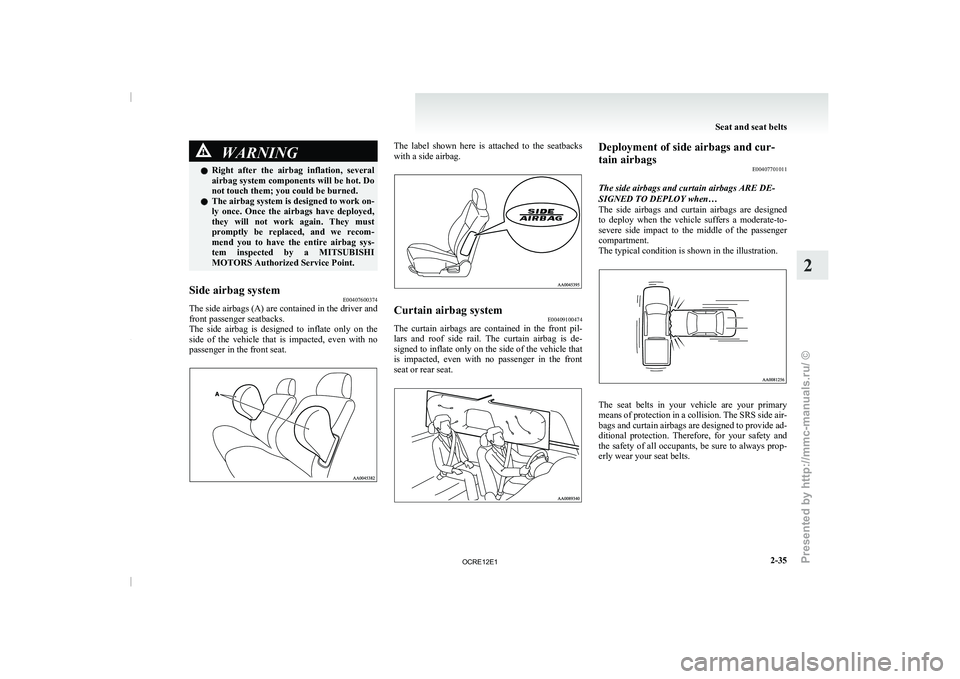
The side airbags and curtain airbags ARE DE-
SIGNED TO DEPLOY when…
The side airbags and curtain
airbags are designed
to deploy when the vehicle suffers a moderate-to-
severe side impact to the middle of the passenger
compartment.
The typical condition is shown in the illustration. The seat belts in your vehicle are your primary
means of protection in
a
collision. The SRS side air-
bags and curtain airbags are designed to provide ad-
ditional protection. Therefore, for your safety and
the safety of all occupants, be sure to always prop-
erly wear your seat belts. Seat and seat belts
2-35 2
OCRE12E1
Presented by http://mmc-manuals.ru/ \251
Page 81 of 369
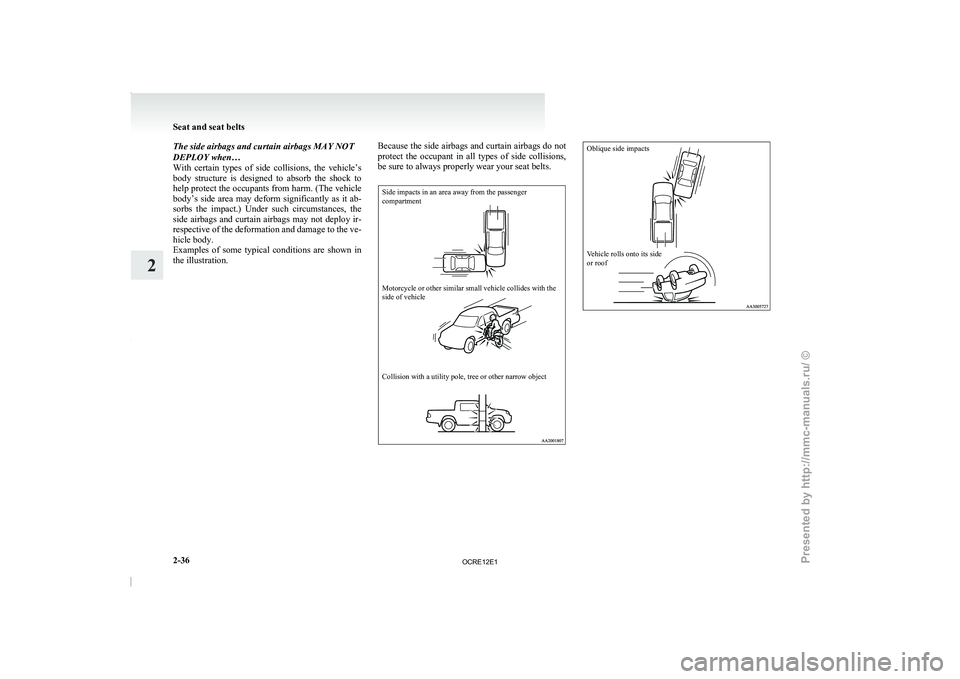
The side airbags and curtain airbags MAY NOT
DEPLOY when…
With certain types of side
collisions, the vehicle’s
body structure is designed to absorb the shock to
help protect the occupants from harm. (The vehicle
body’s side area may deform significantly as it ab-
sorbs the impact.) Under such circumstances, the
side airbags and curtain airbags may not deploy ir-
respective of the deformation and damage to the ve-
hicle body.
Examples of some typical conditions are shown in
the illustration.
Because the side airbags and curtain airbags do not
protect the occupant in all
types of side collisions,
be sure to always properly wear your seat belts.
Side impacts in an area away from the passenger
compartment
Motorcycle or other similar small vehicle collides with the
side of vehicle
Collision with a utility pole, tree or other narrow object
Oblique side impacts
Vehicle rolls onto its side
or roof Seat and seat belts
2-36
2
OCRE12E1
Presented by http://mmc-manuals.ru/ \251
Page 82 of 369
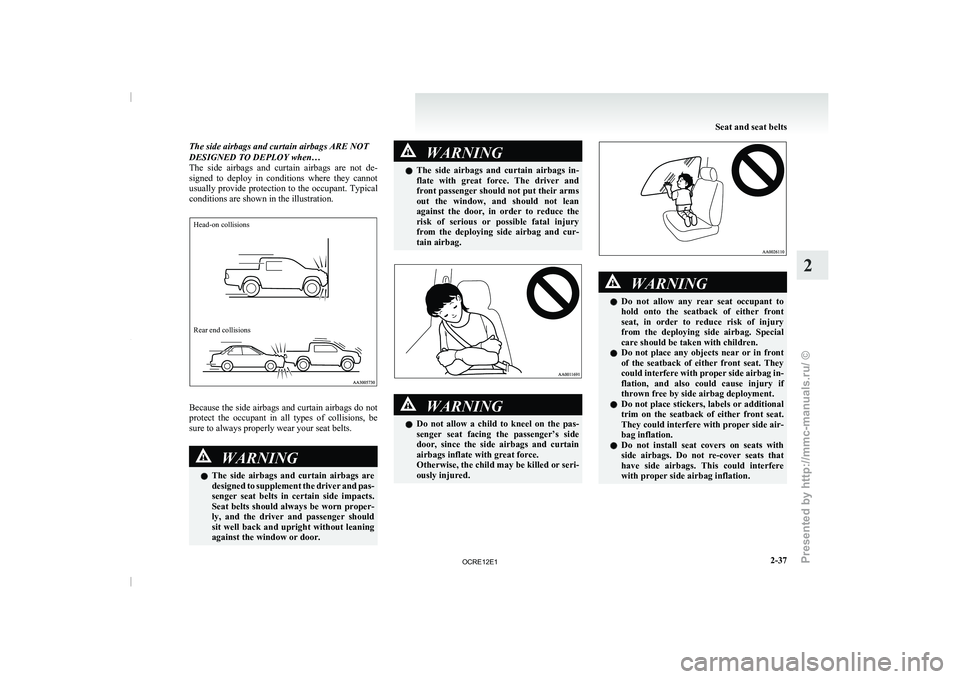
The side airbags and curtain airbags ARE NOT
DESIGNED TO DEPLOY when…
The side airbags and curtain
airbags are not de-
signed to deploy in conditions where they cannot
usually provide protection to the occupant. Typical
conditions are shown in the illustration.
Head-on collisions
Rear end collisions Because the side airbags and curtain airbags do not
protect the occupant in
all
types of collisions, be
sure to always properly wear your seat belts. WARNING
l The side airbags and
curtain
airbags are
designed to supplement the driver and pas-
senger seat belts in certain side impacts.
Seat belts should always be worn proper-
ly, and the driver and passenger should
sit well back and upright without leaning
against the window or door. WARNING
l The side airbags and curtain
airbags in-
flate with great force. The driver and
front passenger should not put their arms
out the window, and should not lean
against the door, in order to reduce the
risk of serious or possible fatal injury
from the deploying side airbag and cur-
tain airbag. WARNING
l Do not allow a
child
to kneel on the pas-
senger seat facing the passenger’s side
door, since the side airbags and curtain
airbags inflate with great force.
Otherwise, the child may be killed or seri-
ously injured. WARNING
l Do not allow any
rear
seat occupant to
hold onto the seatback of either front
seat, in order to reduce risk of injury
from the deploying side airbag. Special
care should be taken with children.
l Do not place any objects near or in front
of the seatback of either front seat. They
could interfere with proper side airbag in-
flation, and also could cause injury if
thrown free by side airbag deployment.
l Do not place stickers, labels or additional
trim on the seatback of either front seat.
They could interfere with proper side air-
bag inflation.
l Do not install seat covers on seats with
side airbags. Do not re-cover seats that
have side airbags. This could interfere
with proper side airbag inflation. Seat and seat belts
2-37 2
OCRE12E1
Presented by http://mmc-manuals.ru/ \251
Page 83 of 369
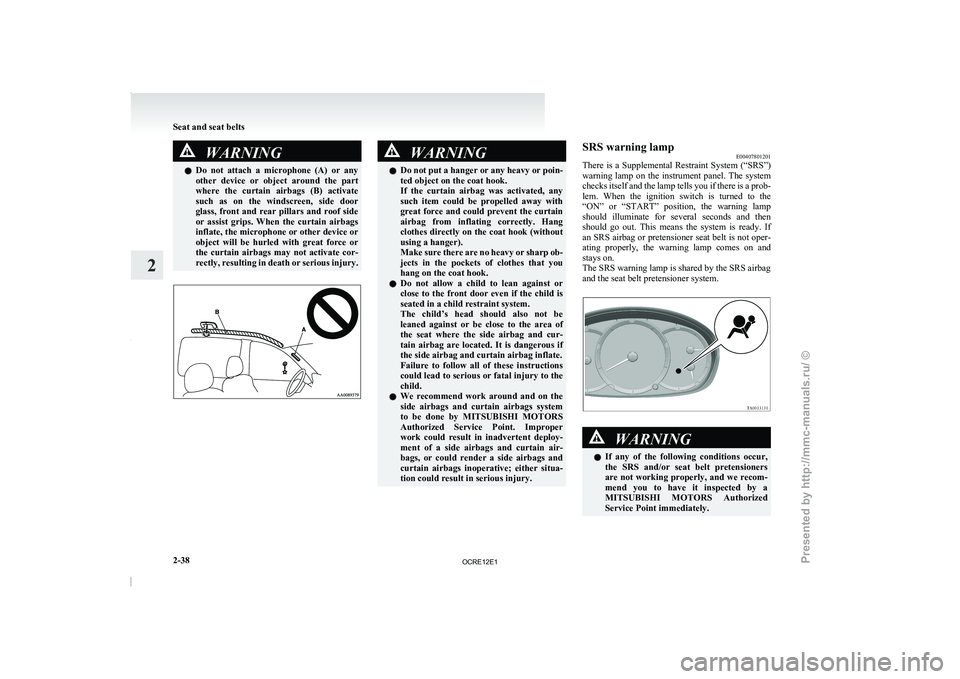
WARNING
l Do not attach a microphone (A) or any
other device or object around the part
where the curtain airbags (B) activate
such as on the windscreen, side door
glass, front and rear pillars and roof side
or assist grips. When the curtain airbags
inflate, the microphone or other device or
object will be hurled with great force or
the curtain airbags may not activate cor-
rectly, resulting in death or serious injury. WARNING
l Do not put a hanger or any heavy or poin-
ted object on the coat hook.
If the curtain airbag was activated, any
such item could be propelled away with
great force and could prevent the curtain
airbag from inflating correctly. Hang
clothes directly on the coat hook (without
using a hanger).
Make sure there are no heavy or sharp ob-
jects in the pockets of clothes that you
hang on the coat hook.
l Do not allow a child to lean against or
close to the front door even if the child is
seated in a child restraint system.
The child’s head should also not be
leaned against or be close to the area of
the seat where the side airbag and cur-
tain airbag are located. It is dangerous if
the side airbag and curtain airbag inflate.
Failure to follow all of these instructions
could lead to serious or fatal injury to the
child.
l We recommend work around and on the
side airbags and curtain airbags system
to be done by MITSUBISHI MOTORS
Authorized Service Point. Improper
work could result in inadvertent deploy-
ment of a side airbags and curtain air-
bags, or could render a side airbags and
curtain airbags inoperative; either situa-
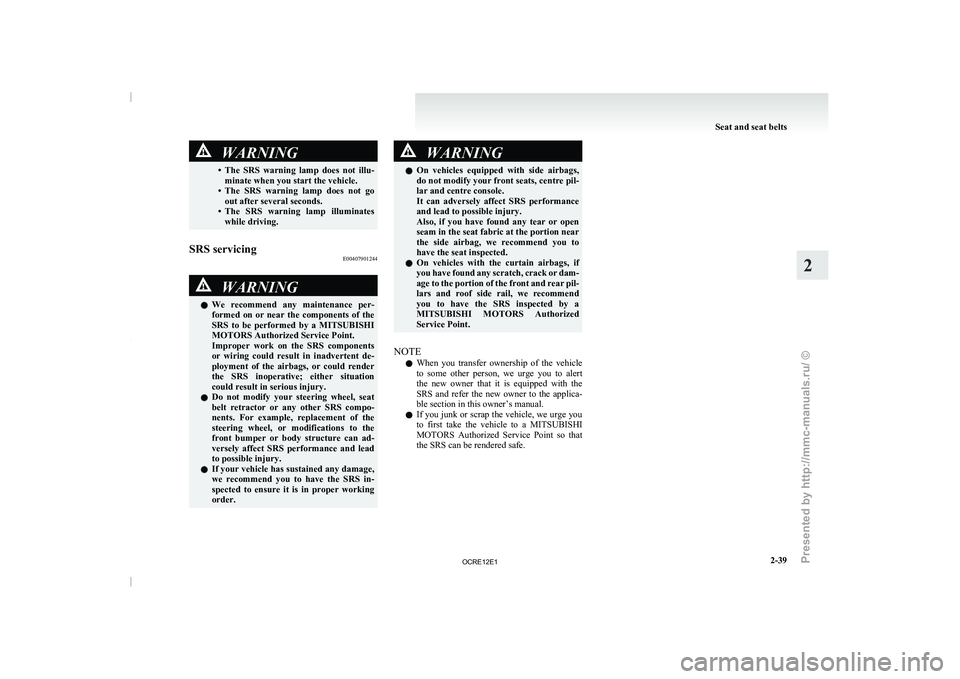
tion could result in serious injury. SRS warning lamp
E00407801201
There is a Supplemental Restraint
System (“SRS”)
warning lamp on the instrument panel. The system
checks itself and the lamp tells you if there is a prob-
lem. When the ignition switch is turned to the
“ON” or “START” position, the warning lamp
should illuminate for several seconds and then
should go out. This means the system is ready. If
an SRS airbag or pretensioner seat belt is not oper-
ating properly, the warning lamp comes on and
stays on.
The SRS warning lamp is shared by the SRS airbag
and the seat belt pretensioner system. WARNING
l If any of the
following
conditions occur,
the SRS and/or seat belt pretensioners
are not working properly, and we recom-
mend you to have it inspected by a
MITSUBISHI MOTORS Authorized
Service Point immediately. Seat and seat belts
2-38
2
OCRE12E1
Presented by http://mmc-manuals.ru/ \251
Page 84 of 369
WARNING
• The SRS warning lamp does not illu- minate when you start the vehicle.
• The SRS warning
lamp does not go
out after several seconds.
• The SRS warning lamp illuminates while driving.
SRS servicing E00407901244WARNING
l We recommend any maintenance
per-
formed
on or near the components of the
SRS to be performed by a MITSUBISHI
MOTORS Authorized Service Point.
Improper work on the SRS components
or wiring could result in inadvertent de-
ployment of the airbags, or could render
the SRS inoperative; either situation
could result in serious injury.
l Do not modify your steering wheel, seat
belt retractor or any other SRS compo-
nents. For example, replacement of the
steering wheel, or modifications to the
front bumper or body structure can ad-
versely affect SRS performance and lead
to possible injury.
l If your vehicle has sustained any damage,
we recommend you to have the SRS in-
spected to ensure it is in proper working
order. WARNING
l On vehicles equipped with side
airbags,
do not modify your front seats, centre pil-
lar and centre console.
It can adversely affect SRS performance
and lead to possible injury.
Also, if you have found any tear or open
seam in the seat fabric at the portion near
the side airbag, we recommend you to
have the seat inspected.
l On vehicles with the curtain airbags, if
you have found any scratch, crack or dam-
age to the portion of the front and rear pil-
lars and roof side rail, we recommend
you to have the SRS inspected by a
MITSUBISHI MOTORS Authorized
Service Point.
NOTE l When
you transfer ownership of
the vehicle
to some other person, we urge you to alert
the new owner that it is equipped with the
SRS and refer the new owner to the applica-
ble section in this owner’s manual.
l If you junk or scrap the vehicle, we urge you
to first take the vehicle to a MITSUBISHI
MOTORS Authorized Service Point so that
the SRS can be rendered safe. Seat and seat belts
2-39 2
OCRE12E1
Presented by http://mmc-manuals.ru/ \251
Page 91 of 369
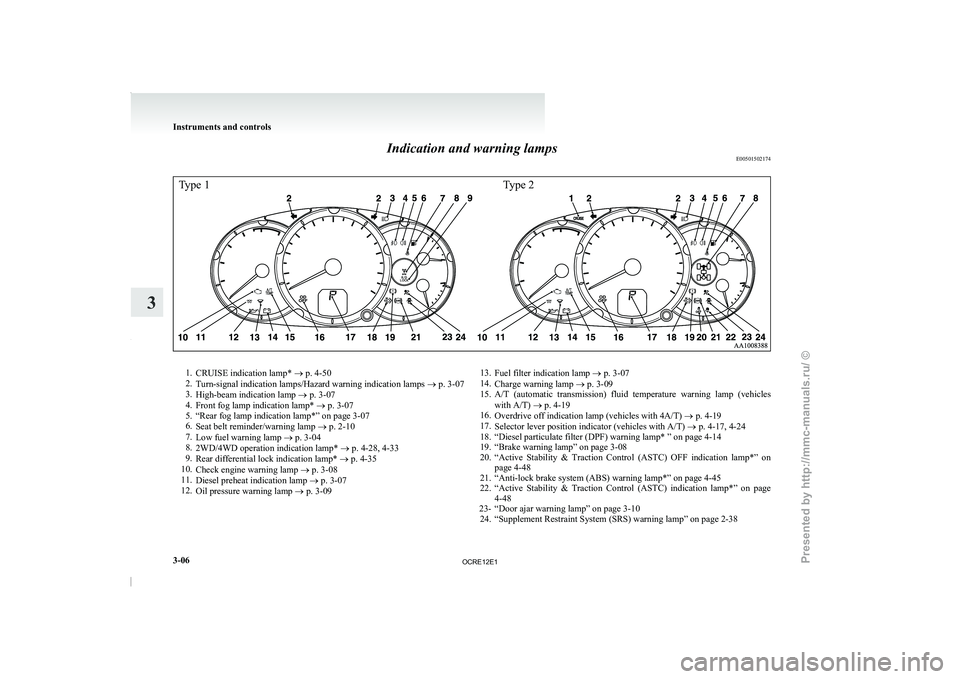
Indication and warning lamps
E00501502174Type 1Type 21.
CRUISE indication lamp* ® p. 4-50
2. Turn-signal indication lamps/Hazard warning indication lamps ®
p. 3-07
3. High-beam indication lamp ® p. 3-07
4. Front fog lamp indication lamp* ® p. 3-07
5. “Rear fog lamp indication lamp*” on page 3-07
6. Seat belt reminder/warning lamp ® p. 2-10
7. Low fuel warning lamp ® p. 3-04
8. 2WD/4WD operation indication lamp* ® p. 4-28, 4-33
9. Rear differential lock indication lamp* ® p. 4-35
10. Check engine warning lamp ® p. 3-08
11. Diesel preheat indication lamp ® p. 3-07
12. Oil pressure warning lamp ® p. 3-09 13.
Fuel filter indication lamp ® p. 3-07
14. Charge warning lamp ® p. 3-09
15.
A/T (automatic transmission) fluid temperature warning lamp (vehicleswith A/T) ® p. 4-19
16. Overdrive off indication lamp (vehicles with 4A/T) ® p. 4-19
17. Selector lever position indicator (vehicles with A/T) ® p. 4-17, 4-24
18. “Diesel particulate filter (DPF) warning lamp* ” on page 4-14
19. “Brake warning lamp” on page 3-08
20. “Active Stability & Traction Control (ASTC) OFF indication lamp*” on page 4-48
21. “Anti-lock brake system (ABS) warning lamp*” on page 4-45
22. “Active Stability & Traction Control (ASTC) indication lamp*” on page 4-48
23- “Door ajar warning lamp” on page 3-10 24. “Supplement Restraint System (SRS) warning lamp” on page 2-38 Instruments and controls
3-06
3
OCRE12E1
Presented by http://mmc-manuals.ru/ \251
Page 94 of 369
CAUTION
l
If the lamp does not illuminate
when the ignition switch is
turned to the “ON” position,
we recommend you to have the
system checked.
l If the lamp illuminates while
the engine is running, avoid
driving at high speeds and we
recommend you to have the sys-
tem checked.
During vehicle operation with
the lamp illuminated, the vehi-
cle may not accelerate when
you depress the accelerator ped-
al.
When the vehicle is stationary
with the lamp illuminated, you
must depress the brake pedal
more firmly than usual since
the engine idling speed is high-
er than usual and the vehicle
with an A/T has a stronger ten-
dency to creep forward. NOTE
l The
engine electronic control mod-
ule
accommodating the onboard di-
agnostic system has various fault
data (especially about the exhaust
emission) stored.
This data will be erased if a bat-
tery cable is disconnected which
will make a rapid diagnosis diffi-
cult. Do not disconnect a battery
cable when the check engine warn-
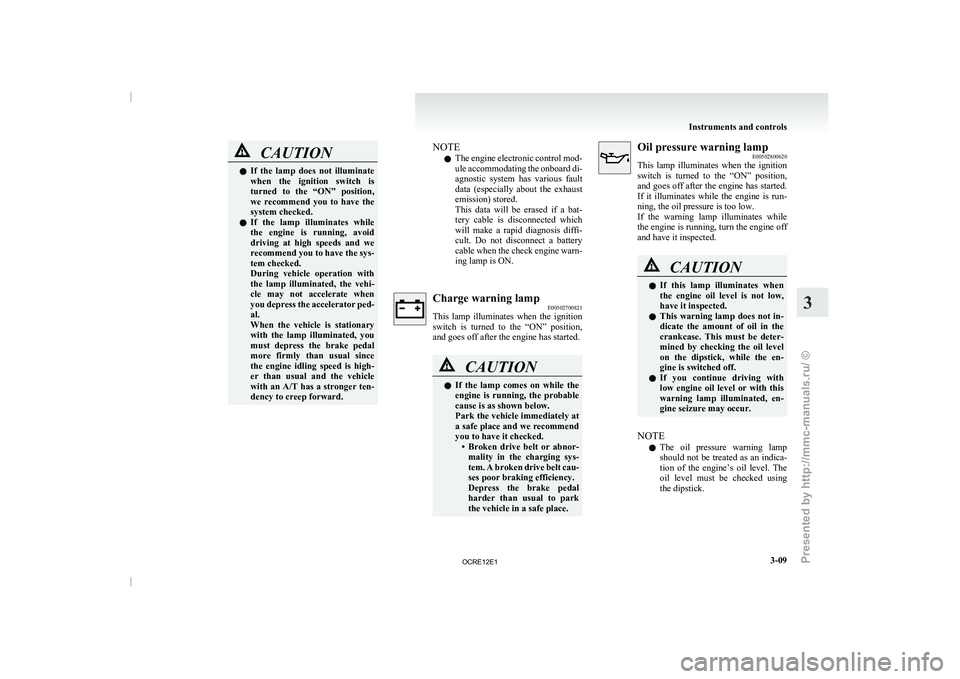
ing lamp is ON. Charge warning lamp
E00502700821
This lamp illuminates when the
ignition
switch is turned to the “ON” position,
and goes off after the engine has started. CAUTION
l
If the lamp comes
on
while the
engine is running, the probable
cause is as shown below.
Park the vehicle immediately at
a safe place and we recommend
you to have it checked. • Broken drive belt or abnor-mality in the charging sys-
tem. A broken drive belt cau-
ses poor braking efficiency.
Depress the brake pedal
harder than usual to park
the vehicle in a safe place. Oil pressure warning lamp
E00502800620
This lamp illuminates when the
ignition
switch is turned to the “ON” position,
and goes off after the engine has started.
If it illuminates while the engine is run-
ning, the oil pressure is too low.
If the warning lamp illuminates while
the engine is running, turn the engine off
and have it inspected. CAUTION
l
If this lamp illuminates
when
the
engine oil level is not low,
have it inspected.
l This warning lamp does not in-
dicate the amount of oil in the
crankcase. This must be deter-
mined by checking the oil level
on the dipstick, while the en-
gine is switched off.
l If you continue driving with
low engine oil level or with this
warning lamp illuminated, en-
gine seizure may occur.
NOTE l The
oil pressure warning lamp
should
not be treated as an indica-
tion of the engine’s oil level. The
oil level must be checked using
the dipstick. Instruments and controls
3-09 3
OCRE12E1
Presented by http://mmc-manuals.ru/ \251