brake MITSUBISHI TRITON 2011 Workshop Manual
[x] Cancel search | Manufacturer: MITSUBISHI, Model Year: 2011, Model line: TRITON, Model: MITSUBISHI TRITON 2011Pages: 369, PDF Size: 26.15 MB
Page 298 of 369
Service precautions
....................................................................... 8-02
Catalytic converter ........................................................................ 8-02
Bonnet...........................................................................................8-03
Engine oil ......................................................................................8-04
Engine coolant .............................................................................. 8-06
Automatic transmission fluid*......................................................8-07 Washer fluid ................................................................................. 8-08
Brake fluid .................................................................................... 8-08
Clutch fluid* ................................................................................. 8-09
Power steering fluid ...................................................................... 8-09
Battery .......................................................................................... 8-10
Tyres............................................................................................. 8-11
Clutch pedal free play* ................................................................. 8-15
Brake pedal free play .................................................................... 8-16
Parking brake lever stroke ............................................................ 8-16
Wiper blades ................................................................................. 8-17
General maintenance .................................................................... 8-18
For cold and snowy weather ......................................................... 8-19
Fusible links
.................................................................................. 8-19
Fuses............................................................................................. 8-20
Replacement of lamp bulbs .......................................................... 8-23Maintenance
8
OCRE12E1
Presented by http://mmc-manuals.ru/ \251
Page 304 of 369
CAUTION
l
Do not use alcohol or methanol anti-
freeze or any engine coolants mixed with
alcohol or methanol anti-freeze. The use
of an improper anti-freeze can cause cor-
rosion of the aluminium components.
l For effective anti-corrosion and anti-
freeze performance, keep the anti-freeze
concentration within the range of 30 to
60 %.
Concentrations exceeding 60 % will re-
sult in a reduction of both the anti-freeze
and cooling performance thus adversely
affecting the engine.
l Do not top up with water only.
Water by itself reduces the rust-protec-
tive and anti-freeze qualities of the cool-
ant and has a lower boiling point. It can
also cause damage to the cooling system if
it should freeze. Do not use tapwater, as it
can cause corrosion and rust formation.
During cold weather
If the temperatures in your
area drop below freez-
ing, there is the danger that the coolant in the en-
gine or radiator could freeze and cause severe dam-
age to the engine and/or radiator. The concentra-
tion should be checked before the start of cold weath-
er and anti-freeze added to the system if necessary.
Add a sufficient amount of anti-freeze to the cool-
ant to prevent it from freezing.
The concentration should be checked before the
start of cold weather and anti-freeze added to the
system if necessary. Automatic transmission fluid*
E01000600974
The proper amount of automatic
transmission fluid
is essential to the life and operation of the automat-
ic transmission. Either insufficient fluid or exces-
sive fluid could cause transmission trouble. The
transmission fluid filler port cap is equipped with a
dipstick. Use the following procedure to check the
fluid level.
Procedure for checking the fluid level
1. Check the fluid level after the vehicle hasbeen driven enough to warm up the transmis-
sion fluid.
2. Park the vehicle on a flat, level surface and apply the parking brake.
3. With the engine idling and the brake pedal fully depressed, move the transmission selec-
tor lever through all the positions from the
"P” (PARK) to “L” (LOW) (with 4A/T), the
“P” (PARK) to “D” (DRIVE) (with 5A/T),
stopping momentarily at each position.
4. Move the selector lever to the “P” (PARK) position.
5. Remove the dipstick and wipe it with a clean lint-free cloth.
6. Reinsert the dipstick as far as it goes. 7. Remove dipstick and read the automatic trans-
mission fluid level.
The fluid level should
always be between the
two marks on the dipstick. WARNING
l Do not spill the
fluid
onto a hot exhaust
manifold during topping up or inspec-
tion, or a fire may occur.
Fluid type
Use only “DIA QUEEN ATF
SP III” transmission
fluid to ensure optimum transmission performance. Maintenance
8-07 8
OCRE12E1
Presented by http://mmc-manuals.ru/ \251
Page 305 of 369
Washer fluid
E01000700672
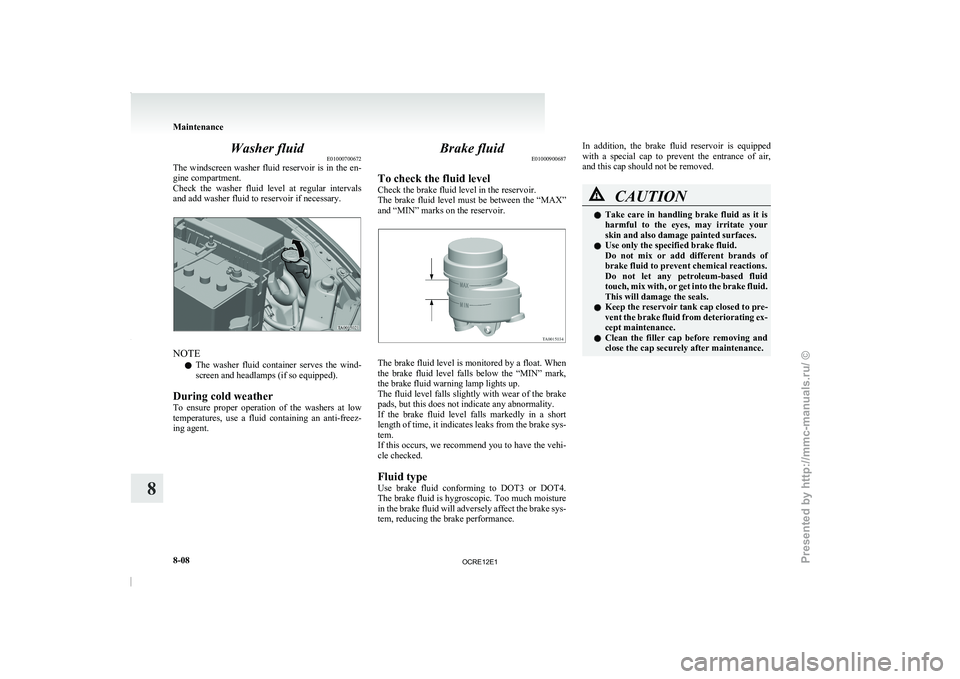
The windscreen washer fluid reservoir
is in the en-
gine compartment.
Check the washer fluid level at regular intervals
and add washer fluid to reservoir if necessary. NOTE
l The
washer fluid container serves
the wind-
screen and headlamps (if so equipped).
During cold weather
To ensure proper operation of the washers at low
temperatures, use a fluid containing an anti-freez-
ing agent. Brake fluid
E01000900687
To check the fluid level
Check the brake fluid level in the reservoir.
The brake fluid level must
be between the “MAX”
and “MIN” marks on the reservoir. The brake fluid level is monitored by a float. When
the brake fluid level
falls
below the “MIN” mark,
the brake fluid warning lamp lights up.
The fluid level falls slightly with wear of the brake
pads, but this does not indicate any abnormality.
If the brake fluid level falls markedly in a short
length of time, it indicates leaks from the brake sys-
tem.
If this occurs, we recommend you to have the vehi-
cle checked.
Fluid type
Use brake fluid conforming to DOT3 or DOT4.
The brake fluid is hygroscopic. Too much moisture
in the brake fluid will adversely affect the brake sys-
tem, reducing the brake performance. In addition, the brake fluid reservoir is equipped
with a special cap
to
prevent the entrance of air,
and this cap should not be removed. CAUTION
l
Take care in handling
brake
fluid as it is
harmful to the eyes, may irritate your
skin and also damage painted surfaces.
l Use only the specified brake fluid.
Do not mix or add different brands of
brake fluid to prevent chemical reactions.
Do not let any petroleum-based fluid
touch, mix with, or get into the brake fluid.
This will damage the seals.
l Keep the reservoir tank cap closed to pre-
vent the brake fluid from deteriorating ex-
cept maintenance.
l Clean the filler cap before removing and
close the cap securely after maintenance. Maintenance
8-08
8
OCRE12E1
Presented by http://mmc-manuals.ru/ \251
Page 306 of 369
Clutch fluid*
E01001000281
To check the fluid level
The clutch fluid in the
master cylinder should be
checked when performing other underhood service.
In addition, the system should be checked for leak-
age at the same time.
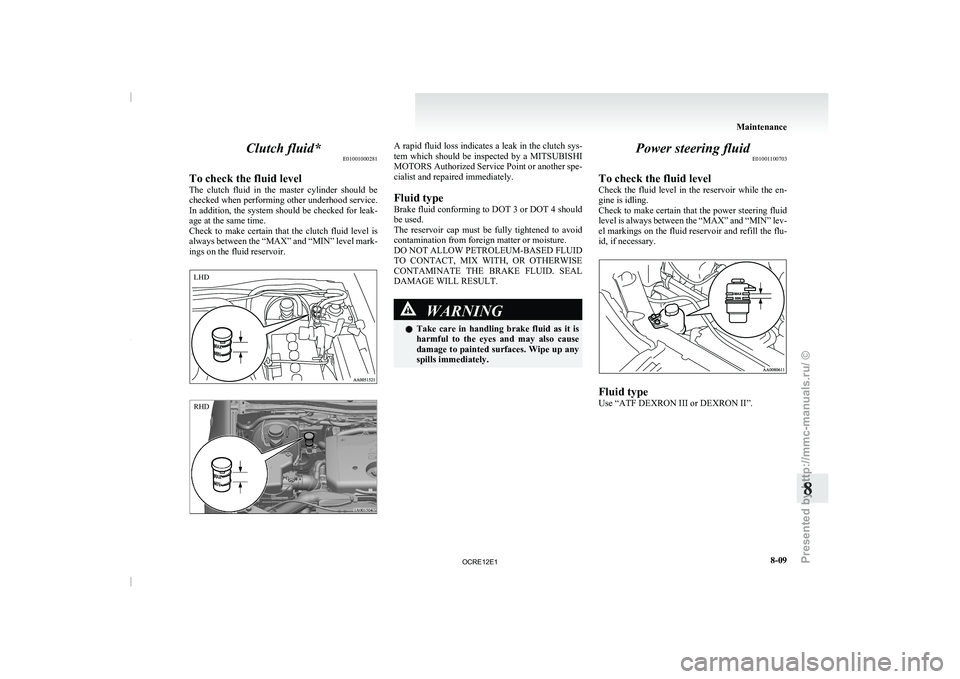
Check to make certain that the clutch fluid level is
always between the “MAX” and “MIN” level mark-
ings on the fluid reservoir. A rapid fluid loss indicates a leak in the clutch sys-
tem which should be inspected
by a MITSUBISHI
MOTORS Authorized Service Point or another spe-
cialist and repaired immediately.
Fluid type
Brake fluid conforming to DOT 3 or DOT 4 should
be used.
The reservoir cap must be fully tightened to avoid
contamination from foreign matter or moisture.
DO NOT ALLOW PETROLEUM-BASED FLUID
TO CONTACT, MIX WITH, OR OTHERWISE
CONTAMINATE THE BRAKE FLUID. SEAL
DAMAGE WILL RESULT. WARNING
l Take
care
in handling
brake
fluid as it is
harmful to the eyes and may also cause
damage to painted surfaces. Wipe up any
spills immediately. Power steering fluid
E01001100703
To check the fluid level
Check the fluid level in
the reservoir while the en-
gine is idling.
Check to make certain that the power steering fluid
level is always between the “MAX” and “MIN” lev-
el markings on the fluid reservoir and refill the flu-
id, if necessary. Fluid type
Use “ATF DEXRON III or DEXRON II”. Maintenance
8-09 8
LHD RHD
OCRE12E1
Presented by http://mmc-manuals.ru/ \251
Page 313 of 369
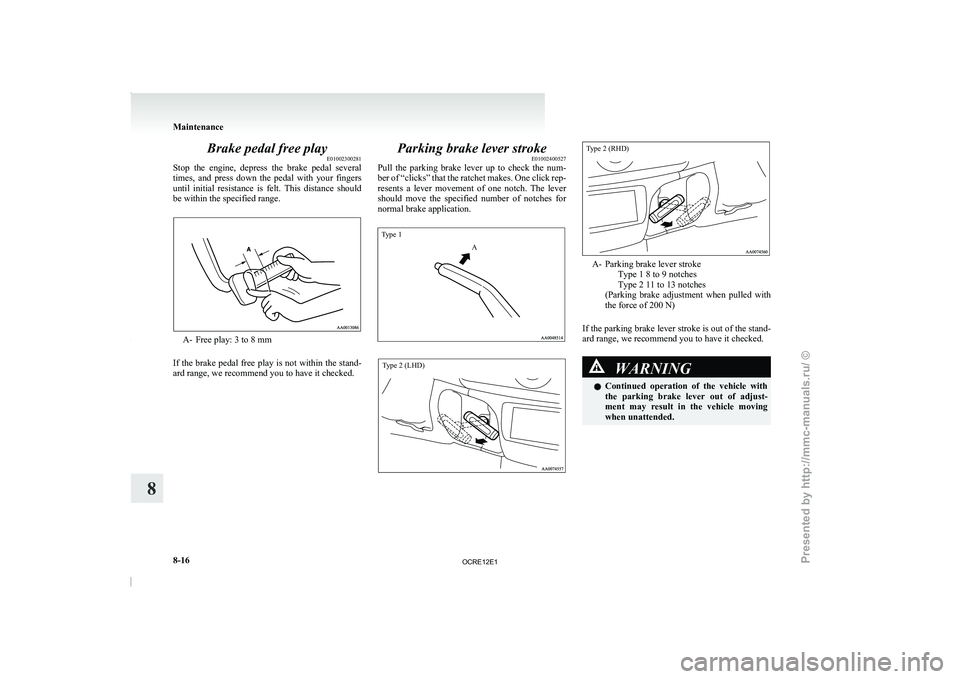
Brake pedal free play
E01002300281
Stop the engine, depress the
brake pedal several
times, and press down the pedal with your fingers
until initial resistance is felt. This distance should
be within the specified range. A- Free play: 3 to 8 mm
If the brake pedal free
play is not within the stand-
ard range, we recommend you to have it checked. Parking brake lever stroke
E01002400527
Pull the parking brake lever
up to check the num-
ber of “clicks” that the ratchet makes. One click rep-
resents a lever movement of one notch. The lever
should move the specified number of notches for
normal brake application.
Type 1
A
Type 2 (LHD)
Type 2 (RHD) A- Parking brake lever stroke
Type 1 8 to 9 notches
Type 2 11 to 13 notches
(Parking brake adjustment when pulled
with
the force of 200 N)
If the parking brake lever stroke is out of the stand-
ard range, we recommend you to have it checked. WARNING
l Continued operation of the
vehicle
with
the parking brake lever out of adjust-
ment may result in the vehicle moving
when unattended. Maintenance
8-16
8
OCRE12E1
Presented by http://mmc-manuals.ru/ \251
Page 341 of 369
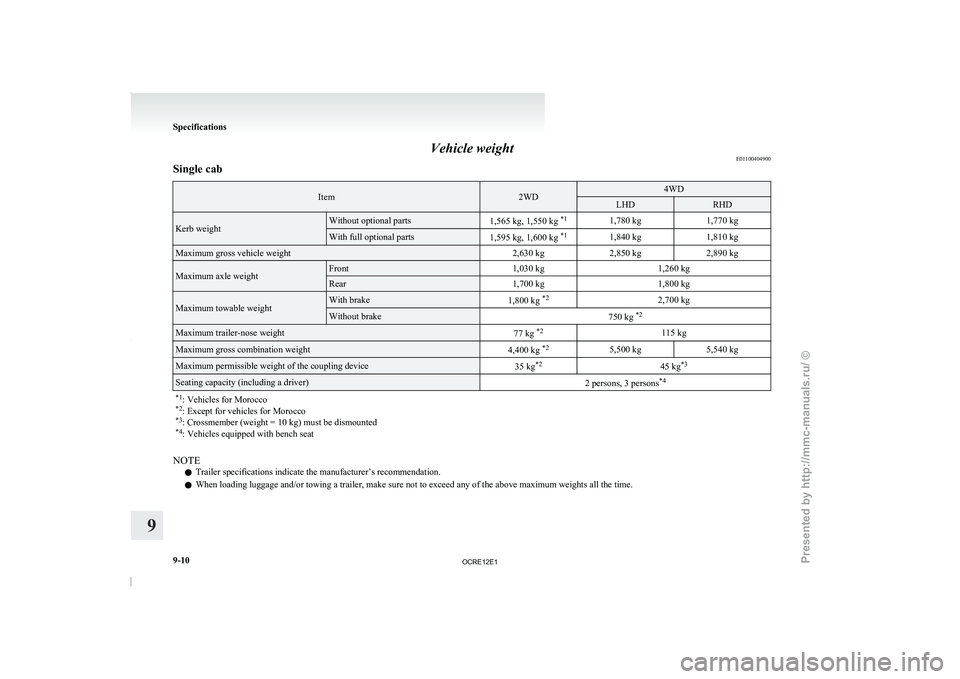
Vehicle weight
E01100404900
Single cab Item 2WD 4WD
LHD RHD
Kerb weight Without optional parts
1,565 kg, 1,550 kg *1
1,780 kg 1,770 kg With full optional parts
1,595 kg, 1,600 kg *1
1,840 kg 1,810 kgMaximum gross vehicle weight
2,630 kg2,850 kg2,890 kgMaximum axle weight Front
1,030 kg1,260 kg Rear
1,700 kg1,800 kgMaximum towable weight With brake
1,800 kg *2
2,700 kg Without brake
750 kg *2 Maximum trailer-nose weight
77 kg *2
115 kgMaximum gross combination weight
4,400 kg *2
5,500 kg 5,540 kgMaximum permissible weight of the coupling device
35 kg*2
45 kg*3 Seating capacity (including a driver)
2 persons, 3 persons*4
*1 : Vehicles for Morocco
*2 : Except for vehicles for Morocco
*3 : Crossmember (weight = 10 kg) must be dismounted
*4 : Vehicles equipped with bench seat NOTE
l Trailer specifications indicate the manufacturer’s recommendation.
l When loading luggage and/or towing a trailer, make sure not to exceed any of the above maximum weights all the time. Specifications
9-10
9
OCRE12E1
Presented by http://mmc-manuals.ru/ \251
Page 342 of 369
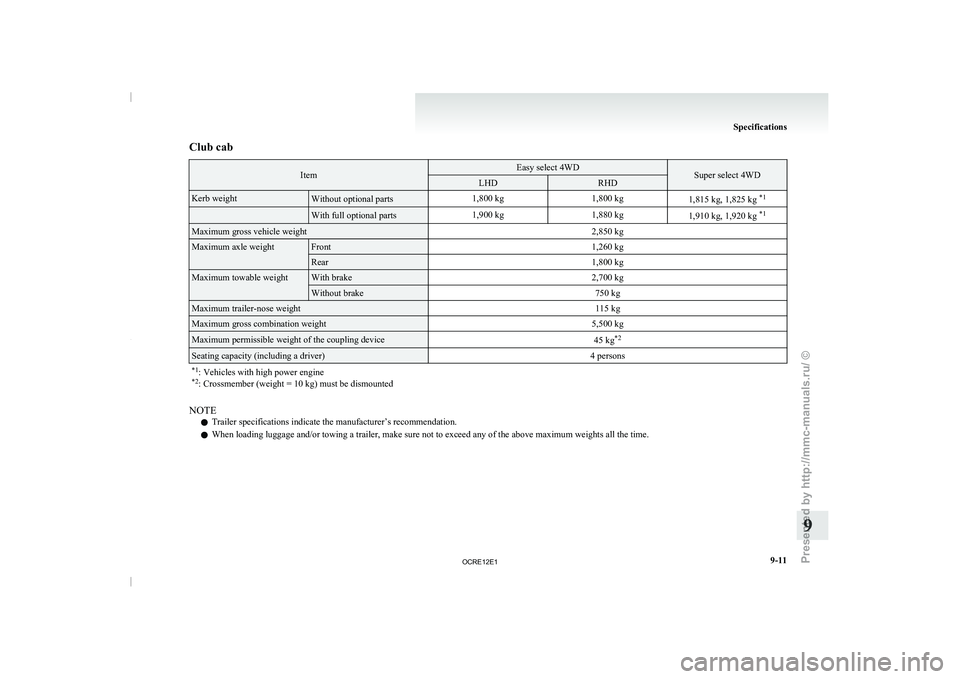
Club cab
Item Easy select 4WD
Super select 4WD
LHD RHD
Kerb weight
Without optional parts
1,800 kg
1,800 kg
1,815 kg, 1,825 kg *1 With full optional parts
1,900 kg
1,880 kg
1,910 kg, 1,920 kg *1Maximum gross vehicle weight
2,850 kgMaximum axle weight Front
1,260 kgRear
1,800 kgMaximum towable weight With brake
2,700 kgWithout brake
750 kgMaximum trailer-nose weight
115 kgMaximum gross combination weight
5,500 kgMaximum permissible weight of the coupling device
45 kg*2 Seating capacity (including a driver)
4 persons
*1 : Vehicles with high power engine
*2 : Crossmember (weight = 10 kg) must be dismounted NOTE
l Trailer specifications indicate the manufacturer’s recommendation.
l When loading luggage and/or towing a trailer, make sure not to exceed any of the above maximum weights all the time. Specifications
9-11 9
OCRE12E1
Presented by http://mmc-manuals.ru/ \251
Page 343 of 369
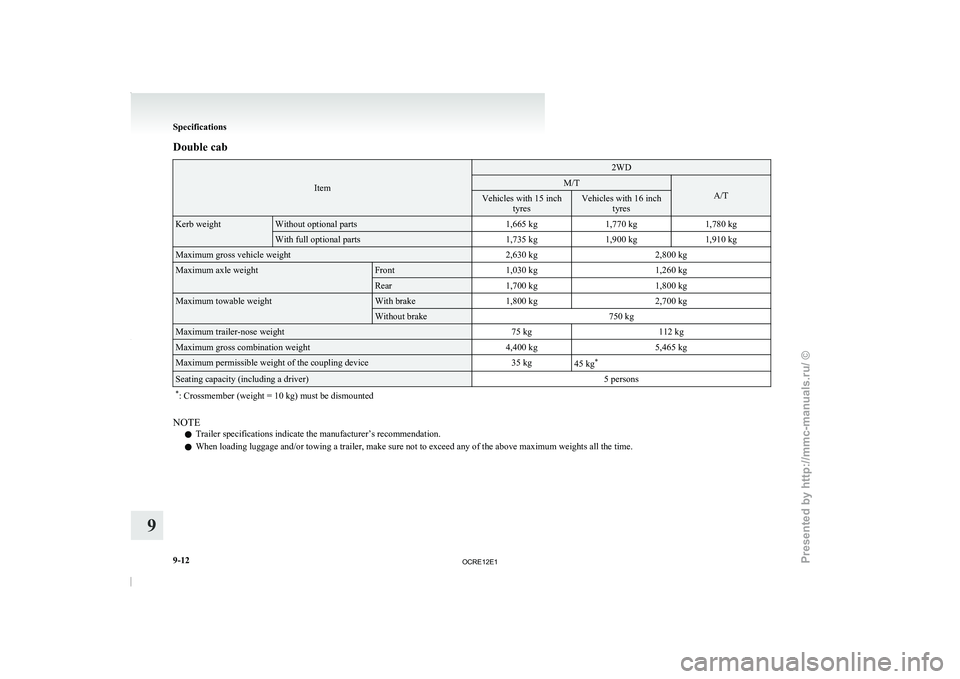
Double cab
Item 2WD
M/T
A/T
Vehicles with 15 inch
tyres Vehicles with 16 inch
tyres Kerb weight Without optional parts
1,665 kg1,770 kg1,780 kg With full optional parts
1,735 kg1,900 kg1,910 kgMaximum gross vehicle weight
2,630 kg2,800 kgMaximum axle weight Front
1,030 kg 1,260 kg Rear
1,700 kg 1,800 kgMaximum towable weight With brake
1,800 kg 2,700 kg Without brake
750 kgMaximum trailer-nose weight
75 kg112 kgMaximum gross combination weight
4,400 kg5,465 kgMaximum permissible weight of the coupling device
35 kg
45 kg* Seating capacity (including a driver)
5 persons
* : Crossmember (weight = 10 kg) must be dismounted NOTE
l Trailer specifications indicate the manufacturer’s recommendation.
l When loading luggage and/or towing a trailer, make sure not to exceed any of the above maximum weights all the time. Specifications
9-12
9
OCRE12E1
Presented by http://mmc-manuals.ru/ \251
Page 344 of 369
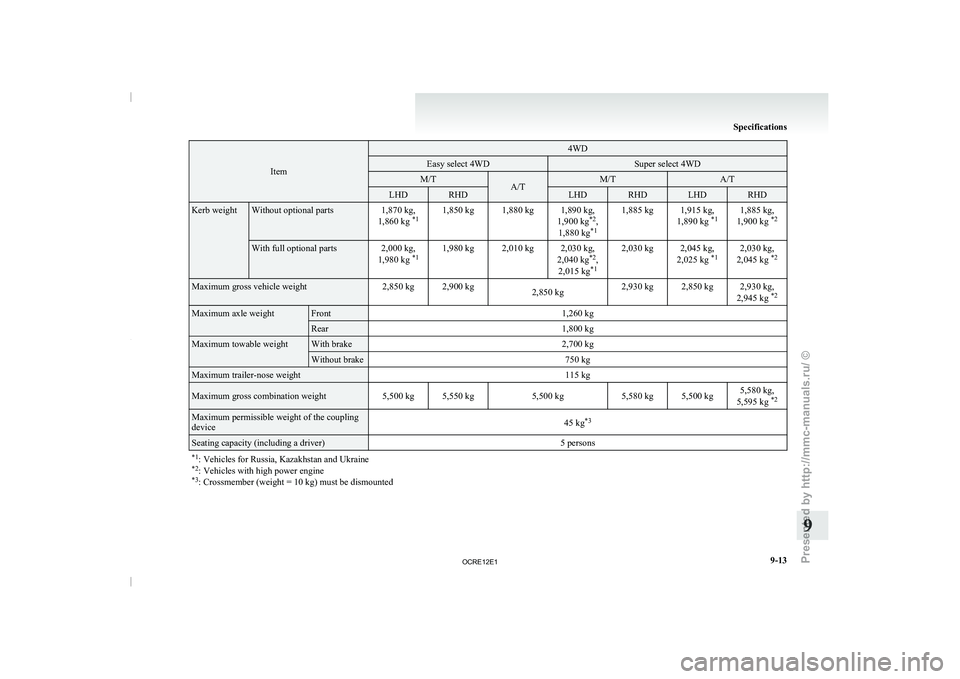
Item 4WD
Easy select 4WD Super select 4WD
M/T
A/T M/T A/T
LHD RHD LHD RHD LHD RHD
Kerb weight Without optional parts
1,870 kg,
1,860 kg *11,850 kg 1,880 kg 1,890 kg,
1,900 kg*2
,
1,880 kg *11,885 kg 1,915 kg,
1,890 kg *11,885 kg,
1,900 kg *2 With full optional parts 2,000 kg,
1,980 kg *11,980 kg 2,010 kg 2,030 kg,
2,040 kg*2
,
2,015 kg *12,030 kg 2,045 kg,
2,025 kg *12,030 kg,
2,045 kg *2 Maximum gross vehicle weight
2,850 kg 2,900 kg
2,850 kg2,930 kg 2,850 kg 2,930 kg,
2,945 kg *2 Maximum axle weight Front
1,260 kgRear
1,800 kgMaximum towable weight With brake
2,700 kgWithout brake
750 kgMaximum trailer-nose weight
115 kgMaximum gross combination weight
5,500 kg 5,550 kg5,500 kg5,580 kg 5,500 kg 5,580 kg,
5,595 kg *2 Maximum permissible weight of the coupling
device
45 kg
*3 Seating capacity (including a driver)
5 persons
*1 : Vehicles for Russia, Kazakhstan and Ukraine
*2 : Vehicles with high power engine
*3 : Crossmember (weight = 10 kg) must be dismounted Specifications
9-13 9
OCRE12E1
Presented by http://mmc-manuals.ru/ \251
Page 350 of 369
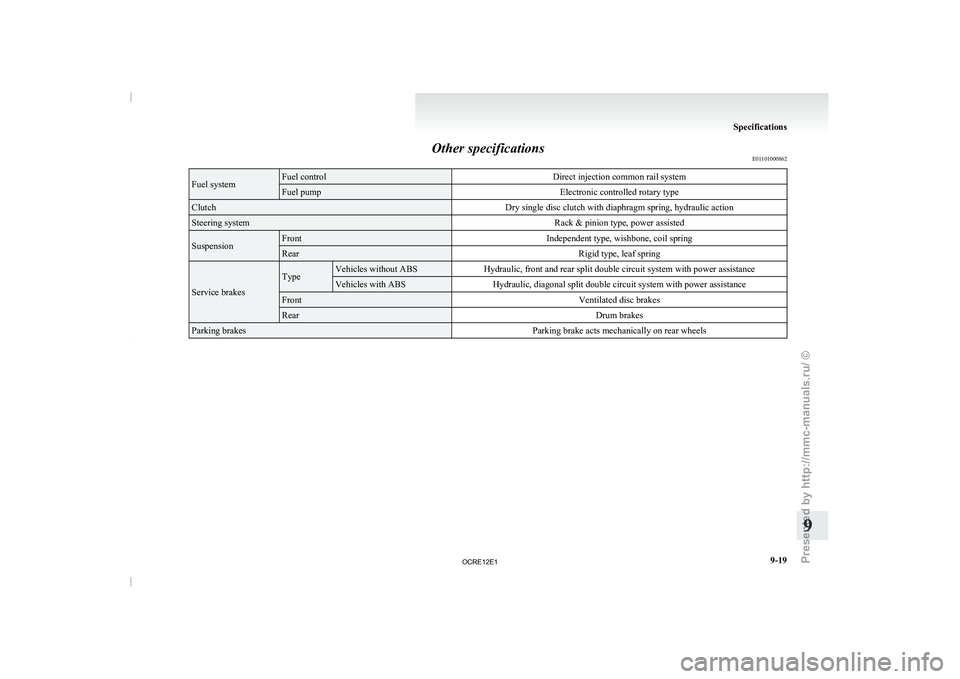
Other specifications
E01101000862Fuel system Fuel control
Direct injection common rail systemFuel pump
Electronic controlled rotary typeClutch
Dry single disc clutch with diaphragm spring, hydraulic actionSteering system
Rack & pinion type, power assistedSuspension Front
Independent type, wishbone, coil springRear
Rigid type, leaf springService brakes Type Vehicles without ABS
Hydraulic, front and rear split double circuit system with power assistance Vehicles with ABS
Hydraulic, diagonal split double circuit system with power assistanceFront
Ventilated disc brakesRear
Drum brakesParking brakes
Parking brake acts mechanically on rear wheels Specifications
9-19 9
OCRE12E1
Presented by http://mmc-manuals.ru/ \251