air condition NISSAN 350Z 2003 Z33 Service Manual
[x] Cancel search | Manufacturer: NISSAN, Model Year: 2003, Model line: 350Z, Model: NISSAN 350Z 2003 Z33Pages: 227, PDF Size: 2.39 MB
Page 165 of 227

Automatic transmission P (Park) position
mechanism:On a fairly steep hill check that the
vehicle is held securely with the selector lever in
the P (Park) position without applying any
brakes.Under the hood and the vehicleThe maintenance items listed here should be
checked periodically (for example, each time you
check the engine oil or refuel).
Windshield washer fluid*:Check that there is
adequate fluid in the tank.
Engine coolant level*:Check the coolant level
when the engine is cold.
Radiator and hoses:Check the front of the
radiator and clean off any dirt, insects, leaves,
etc., that may have accumulated. Make sure the
hoses have no cracks, deformation, deterioration
or loose connections.
Brake and clutch fluid levels*:Make sure that
the brake and clutch fluid levels are between the
MAX and MIN lines on the reservoir.
Battery*:Check the fluid level in each cell. It
should be between the MAX and MIN lines.
Vehicles operated in high temperatures or under
severe conditions require frequent checks of the
battery fluid level.
Engine drive belts*:Make sure that no belt isfrayed, worn, cracked or oily.
Engine oil level*:Check the level on the
dipstick after parking the vehicle on a level spot,
turning off the engine and waiting 10 minutes.
Power steering fluid level* and lines:Check
the level in the reservoir tank with the engine off.
Check the lines for proper attachment, leaks,
cracks, etc.
Exhaust system:Make sure there are no loose
supports, cracks or holes. If the sound of the
exhaust seems unusual or there is a smell of
exhaust fumes, immediately locate the trouble
and correct it. (See ªPrecautions when starting
and drivingº in the ª5. Starting and drivingº
section for exhaust gas (carbon monoxide).)
Underbody:The underbody is frequently ex-
posed to corrosive substances such as those
used on icy roads or to control dust. It is very
important to remove these substances, other-
wise rust will form on the floor pan, frame, fuel
lines and around the exhaust system. At the end
of winter, the underbody should be thoroughly
flushed with plain water, being careful to clean
those areas where mud and dirt may accumu-
late. For additional information, see ªCleaning
exteriorº in the ª7. Appearance and careº sec-
tion.
Fluid leaks:Check under the vehicle for fuel,oil, water or other fluid leaks after the vehicle has
been parked for a while. Water dripping from the
air conditioner after use is normal. If you should
notice any leaks or if gasoline fumes are evident,
check for the cause and have it corrected imme-
diately.8-4
Maintenance and do-it-yourself
Z
02.9.13/Z33-D/V5.0
X
Page 178 of 227
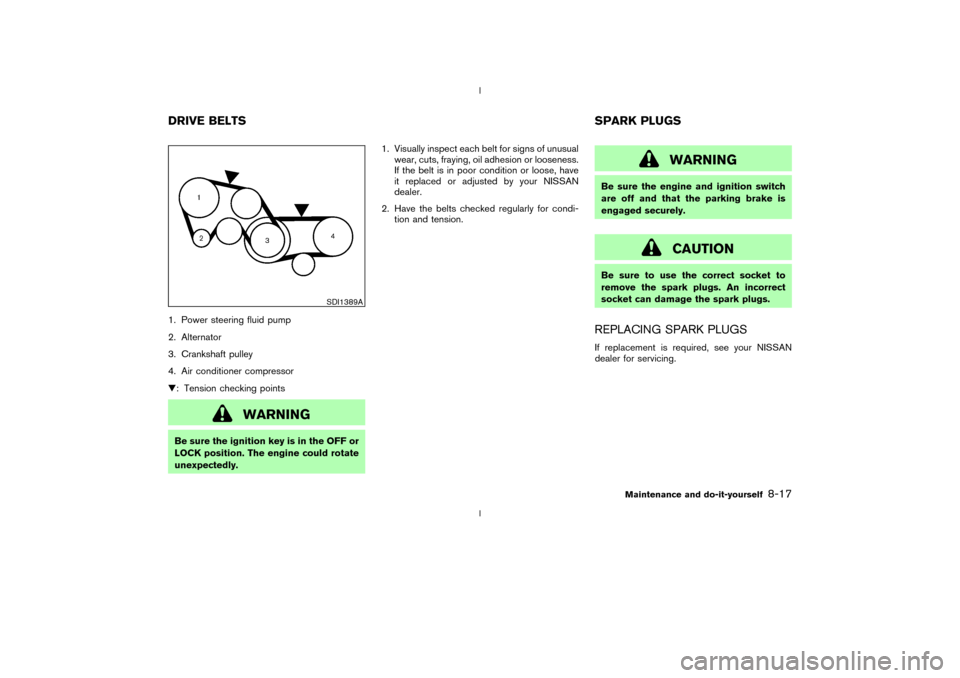
1. Power steering fluid pump
2. Alternator
3. Crankshaft pulley
4. Air conditioner compressor
H: Tension checking points
WARNING
Be sure the ignition key is in the OFF or
LOCK position. The engine could rotate
unexpectedly.1. Visually inspect each belt for signs of unusual
wear, cuts, fraying, oil adhesion or looseness.
If the belt is in poor condition or loose, have
it replaced or adjusted by your NISSAN
dealer.
2. Have the belts checked regularly for condi-
tion and tension.
WARNING
Be sure the engine and ignition switch
are off and that the parking brake is
engaged securely.
CAUTION
Be sure to use the correct socket to
remove the spark plugs. An incorrect
socket can damage the spark plugs.REPLACING SPARK PLUGSIf replacement is required, see your NISSAN
dealer for servicing.
SDI1389A
DRIVE BELTS SPARK PLUGS
Maintenance and do-it-yourself
8-17
Z
02.9.13/Z33-D/V5.0
X
Page 184 of 227

system checked and repaired by your
NISSAN dealer.
Fusible linksIf any electrical equipment does not operate and
fuses are in good condition, check the fusible
links. If any of these fusible links are melted,
replace only with genuine NISSAN parts.
PASSENGER COMPARTMENTIf any electrical equipment does not operate,
check for an open fuse.
1. Be sure the ignition key and the headlight
switch are OFF.
2. Open the fuse box lid.
3. Remove the fuse with the fuse puller.
4. If the fuse is open, replace it with a new fuse.
5. If a new fuse also opens, have the electrical
system checked and repaired by your
NISSAN dealer.
SDI1393
Maintenance and do-it-yourself
8-23
Z
02.9.13/Z33-D/V5.0
X
Page 196 of 227

9 Technical and consumer informationCapacities and recommended fuel/lubricants ................ 9-2
Fuel recommendation...................................................... 9-3
Engine oil and oil filter recommendation.................... 9-5
Recommended SAE viscosity number ....................... 9-6
Air conditioning system refrigerant and lubricant
recommendations ............................................................. 9-6
Specifications.......................................................................... 9-8
Engine ................................................................................. 9-8
Wheels and tires .............................................................. 9-9
Dimensions and weights ................................................ 9-9
When traveling or registering your vehicle in another
country.................................................................................... 9-10
Vehicle identification ........................................................... 9-10
Vehicle identification number (VIN) plate ................ 9-10
Vehicle identification number (Chassis number) ... 9-10
Engine serial number .................................................... 9-11
F.M.V.S.S. certification label ....................................... 9-11
Emission control information label ............................ 9-11Tire placard ..................................................................... 9-12
Air conditioner specification label ............................. 9-12
Installing front license plate .............................................. 9-13
Vehicle loading information ............................................... 9-14
Terms ................................................................................ 9-14
Determining vehicle load capacity ............................ 9-14
Loading tips .................................................................... 9-15
Towing a trailer .................................................................... 9-15
Maximum load limits ...................................................... 9-16
Towing safety.................................................................. 9-17
Uniform tire quality grading............................................... 9-19
Emission control system warranty ................................... 9-20
Reporting safety defects (US only) ................................ 9-20
Readiness for inspection/maintenance (I/M) test
(US only)................................................................................ 9-21
Owner's manual/service manual order information ... 9-22
In the event of a collision ............................................ 9-22
Z
02.9.13/Z33-D/V5.0
X
Page 197 of 227

The following are approximate capacities. The actual refill capacities may be a little different. When refilling, follow the procedure
instructed in the ª8. Maintenance and do-it-yourselfº section to determine the proper refill capacity.
Capacity (Approximate)
Recommended
specifications US
measureImp
measureLiter
Fuel 20 gal 16-5/8 gal 76 Unleaded premium gasoline with an octane rating of at least 91 AKI (RON 96)*1
Engine oil (Drain and refill)*2
With oil filter change 5 qt 4-1/8 qt 4.7IAPI Certification Mark*3, *4
IAPI grade SG/SH, Energy ConservingI&IIorAPIgrade SJ or SL, Energy
Conserving*3, *4
IILSAC grade GF-I, GF-II & GF-III*2, *3 Without oil filter change 4-5/8 qt 3-7/8 qt 4.4
Cooling system
With reservoir 9-1/4 qt 7-5/8 qt 8.7
Genuine NISSAN anti-freeze coolant or equivalent
Reservoir 7/8 qt 3/5 qt 0.8
Automatic transmission fluid Ð Ð Ð Genuine Nissan ATF Matic Fluid J or exact equivalent*5
Manual transmission gear oil Ð Ð Ð API GL-4, Viscosity SAE 75W-85
Differential gear oil Ð Ð Ð API GL-5, Viscosity SAE 80W-90*6
Power steering fluid
Refill to the proper oil level according to the instructions in
the ª8. Maintenance and do-it-yourselfº section.Genuine Nissan PSF II or equivalent*7
Brake and clutch fluidGenuine Nissan Brake Fluid*8 or equivalent DOT 3 (U.S. FMVSS No. 116)
Multi-purpose grease Ð Ð Ð NLGI No. 2 (Lithium soap base)
Air conditioning system refrigerant Ð Ð Ð HFC-134a (R-134a)*9
Air conditioning system lubricants Ð Ð Ð Nissan A/C System Oil Type S or exact equivalent
*1: For additional information, see ªFuel recommendationº later in this chapter.
*2: For additional information, see ªEngine oilº in the ª8. Maintenance and do-it-yourselfº section for changing engine oil.
*3: For additional information, see ªEngine oil and oil filter recommendationº later in this chapter.
*4: For additional information, see ªRecommended SAE viscosity numberº later in this chapter.
*5: Using automatic transmission fluid other than Nissan Genuine ATF Matic Fluid J will cause deterioration in driveability and automatic transmission durability, and may
damage the automatic transmission, which is not covered by the NISSAN new vehicle limited warranty.
*6: For hot areas, viscosity SAE 90 is suitable for ambient temperatures above 32ÉF (0ÉC).
*7: Genuine Nissan PSF, Canada Nissan Automatic Transmission fluid, Dexron
TMIII/Mercon
TMor equivalent ATF may also be used.
*8: Available in mainland US through your NISSAN dealer.
*9: For additional information, see ªVehicle identificationº in this section for air conditioner specification label.
CAPACITIES AND
RECOMMENDED FUEL/
LUBRICANTS9-2
Technical and consumer information
Z
02.9.13/Z33-D/V5.0
X
Page 201 of 227
Change intervalsThe oil and oil filter change intervals for your
engine are based on the use of the specified
quality oils and filters. Oil and filter other than the
specified quality, or oil and filter change intervals
longer than recommended could reduce engine
life. Damage to engines caused by improper
maintenance or use of incorrect oil and filter
quality and/or viscosity is not covered by the
new NISSAN vehicle warranties.
Your engine was filled with a high quality engine
oil when it was built. You do not have to change
the oil before the first recommended change
interval. Oil and filter change intervals depend
upon how you use your vehicle. Operation under
the following conditions may require more fre-
quent oil and filter changes.
Irepeated short distance driving at cold out-
side temperatures,
Idriving in dusty conditions,
Iextensive idling,
Itowing a trailer,
Istop and go ªrush hourº traffic.
RECOMMENDED SAE VISCOSITY
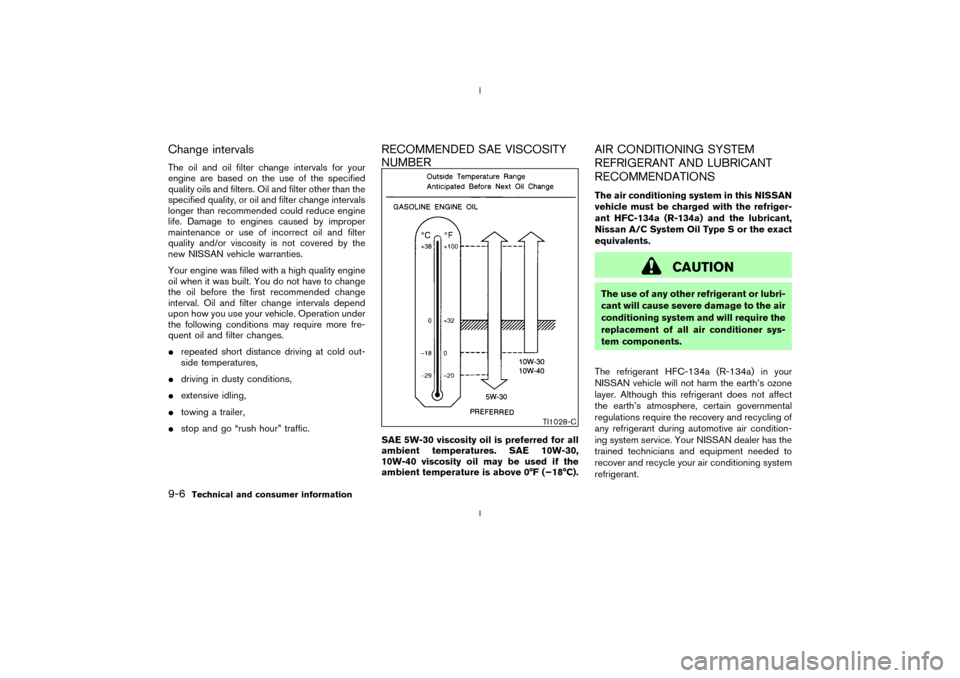
NUMBERSAE 5W-30 viscosity oil is preferred for all
ambient temperatures. SAE 10W-30,
10W-40 viscosity oil may be used if the
ambient temperature is above 0ÉF (þ18ÉC).
AIR CONDITIONING SYSTEM
REFRIGERANT AND LUBRICANT
RECOMMENDATIONSThe air conditioning system in this NISSAN
vehicle must be charged with the refriger-
ant HFC-134a (R-134a) and the lubricant,
Nissan A/C System Oil Type S or the exact
equivalents.
CAUTION
The use of any other refrigerant or lubri-
cant will cause severe damage to the air
conditioning system and will require the
replacement of all air conditioner sys-
tem components.
The refrigerant HFC-134a (R-134a) in your
NISSAN vehicle will not harm the earth's ozone
layer. Although this refrigerant does not affect
the earth's atmosphere, certain governmental
regulations require the recovery and recycling of
any refrigerant during automotive air condition-
ing system service. Your NISSAN dealer has the
trained technicians and equipment needed to
recover and recycle your air conditioning system
refrigerant.
TI1028-C
9-6
Technical and consumer information
Z
02.9.13/Z33-D/V5.0
X
Page 202 of 227

Contact your NISSAN dealer when servicing
your air conditioning system.
Technical and consumer information
9-7
Z
02.9.13/Z33-D/V5.0
X
Page 207 of 227

TIRE PLACARDThe cold tire pressure is shown on the tire
placard affixed to the inside of the console box
lid.
AIR CONDITIONER SPECIFICATION
LABELThe air conditioner specification label is affixed
inside of the hood as shown.
STI0324
STI0325
9-12
Technical and consumer information
Z
02.9.13/Z33-D/V5.0
X
Page 213 of 227

load, worn suspension or other possible
causes of either condition.
IAlways secure items in the trailer to prevent
load shifts while driving.
IBe certain your rear view mirrors conform to
all federal, state or local regulations. If not,
install any mirrors required for towing before
driving the vehicle.
Trailer towing tipsIn order to gain skill and an understanding of the
vehicle's behavior, you should practice turning,
stopping and backing up in an area which is free
from traffic. Steering stability, and braking per-
formance will be somewhat different than under
normal driving conditions.
IAlways secure items in the trailer to prevent
load shift while driving.
IAvoid abrupt starts, acceleration or stops.
IAvoid sharp turns or lane changes.
IAlways drive your vehicle at a moderate
speed.
IAlways block the wheels on both vehicle and
trailer when parking. Parking on a slope is not
recommended; however, if you must do so,
and if your vehicle is equipped with automatic
transmission, first apply the parking brakeand block the wheels, and then move the
transmission selector lever into the P (Park)
position. If you move the selector lever to the
P (Park) position before blocking the wheels
and applying the parking brake, the transmis-
sion may get damaged.
IWhen going down a hill, shift into a lower
gear and use the engine braking effect.
When ascending on a long grade, downshift
the transmission to a lower gear and reduce
speed to reduce chances of engine overload-
ing and/or overheating.
IIf the engine coolant rises to an extremely
high temperature when the air conditioning
system is on, turn off the air conditioner.
Coolant heat can be additionally vented by
opening the windows, switching the fan con-
trol to high and setting the temperature con-
trol to the HOT position.
ITrailer towing consumes more fuel than nor-
mal circumstances.
IAvoid towing a trailer for the first 500 miles
(800 km).
IHave your vehicle serviced more often than at
intervals specified in the recommended main-
tenance schedule.
IWhen making a turn, your trailer wheels will
be closer to the inside of the turn than yourvehicle wheels. To compensate for this, make
a larger than normal turning radius during the
turn.
ICrosswinds and rough roads will adversely
affect vehicle/trailer handling, possibly caus-
ing vehicle sway. When being passed by
larger vehicles, be prepared for possible
changes in crosswinds that could affect ve-
hicle handling. If swaying does occur, firmly
grip the steering wheel, steer straight ahead,
and immediately (but gradually) reduce ve-
hicle speed. This combination will help stabi-
lize the vehicle. Never increase speed.
IBe careful when passing other vehicles.
Passing while towing a trailer requires con-
siderably more distance than normal passing.
Remember the length of the trailer must also
pass the other vehicle before you can safely
change lanes.
ITo maintain engine braking efficiency and
electrical charging performance, do not use
6th gear (manual transmission) or 5th posi-
tion (automatic transmission).
IAvoid holding the brake pedal down too long
or too frequently. This could cause the brakes
to overheat, resulting in reduced braking ef-
ficiency.
When towing a trailer, change transmis-9-18
Technical and consumer information
Z
02.9.13/Z33-D/V5.0
X
Page 216 of 227
Due to legal requirements in some states/
areas, your vehicle may be required to be in what
is called the ªready conditionº for an
Inspection/Maintenance (I/M) test of the emis-
sion control system.
The vehicle is set to the ªready conditionº when
it is driven through certain driving patterns.
Usually, the ªready conditionº can be obtained
by ordinary usage of the vehicle.
If a powertrain system component is repaired or
the battery is disconnected, the vehicle may be
reset to a not ªready conditionº. Before taking
the I/M test, drive the vehicle through the follow-
ing pattern to set the vehicle to the ready
condition. If you cannot or do not want to
perform the driving pattern, a NISSAN dealer
can conduct it for you.
WARNING
Always drive the vehicle in a safe and
prudent manner according to traffic
conditions, and obey all traffic laws.
1. Start the engine. Allow the engine to idle until
the engine coolant temperature gauge needle
points between the C and H (normal operat-
ing temperature).2. Accelerate the vehicle to 55 MPH (88 km/h),
then quickly release the accelerator pedal
completely and keep it released for at least 6
seconds.
3. Quickly depress the accelerator pedal for a
moment, then drive the vehicle at a speed of
53 to 60 MPH (86 to 96 km/h) for at least 5
minutes.
4. Stop the vehicle. Leave the engine running.
5. Accelerate the vehicle to 35 MPH (55 km/h)
and maintain the speed for 20 seconds.
6. Repeat steps 4 and 5 at least 3 times.
7. Accelerate the vehicle to 55 MPH (88 km/h)
and maintain the speed for at least 3 minutes.
8. Stop the vehicle. Place the automatic trans-
mission gear selector lever in the P (Park) or
N (Neutral) position or the manual transmis-
sion shift lever in the N position.
9. Turn the engine off.
10.Repeat steps 1 through 8 at least one more
time.
If step 1 through 7 is interrupted, repeat the
preceding step. Any safe driving mode is ac-
ceptable between steps. Do not stop the engine
until step 7 is completed.READINESS FOR INSPECTION/
MAINTENANCE (I/M) TEST (US
only)
Technical and consumer information
9-21
Z
02.9.13/Z33-D/V5.0
X