engine NISSAN 370Z COUPE 2010 Owners Manual
[x] Cancel search | Manufacturer: NISSAN, Model Year: 2010, Model line: 370Z COUPE, Model: NISSAN 370Z COUPE 2010Pages: 409, PDF Size: 3.56 MB
Page 348 of 409
Black plate (350,1)
Model "Z34-D" EDITED: 2009/ 9/ 10
vehicle jack-up points.
. A suitable adapter should be attached to
the jack stand saddle.
5. Remove the plastic engine undercover. a. Remove the small plastic clips at thecenter of the undercover.
b. Then remove the bolts that hold the undercover in place.
CAUTION
Make sure the correct lifting and sup-
port points are used to avoid vehicle
damage.
SDI2335
Engine oil and filter1. Place a large drain pan under the drain plug.
2. Remove the oil filler cap.
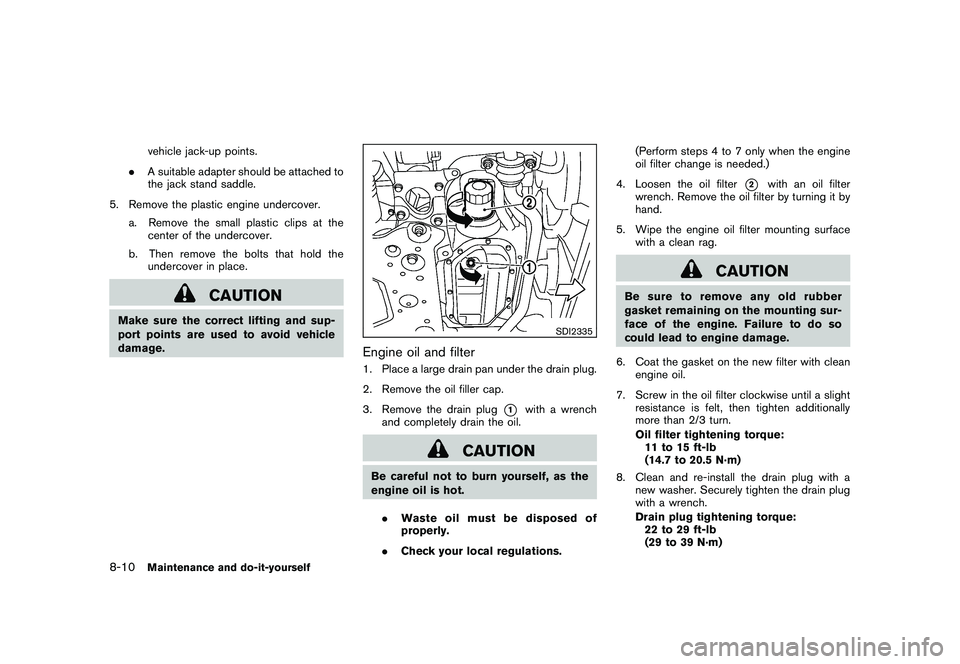
3. Remove the drain plug
*1
with a wrench
and completely drain the oil.
CAUTION
Be careful not to burn yourself, as the
engine oil is hot.
. Waste oil must be disposed of
properly.
. Check your local regulations. (Perform steps 4 to 7 only when the engine
oil filter change is needed.)
4. Loosen the oil filter
*2
with an oil filter
wrench. Remove the oil filter by turning it by
hand.
5. Wipe the engine oil filter mounting surface with a clean rag.
CAUTION
Be sure to remove any old rubber
gasket remaining on the mounting sur-
face of the engine. Failure to do so
could lead to engine damage.
6. Coat the gasket on the new filter with clean engine oil.
7. Screw in the oil filter clockwise until a slight resistance is felt, then tighten additionally
more than 2/3 turn.
Oil filter tightening torque:11 to 15 ft-lb
(14.7 to 20.5 N·m)
8. Clean and re-install the drain plug with a new washer. Securely tighten the drain plug
with a wrench.
Drain plug tightening torque:22 to 29 ft-lb
(29 to 39 N·m)
8-10
Maintenance and do-it-yourself
Page 349 of 409
Black plate (351,1)
Model "Z34-D" EDITED: 2009/ 9/ 10
Do not use excessive force.
9. Refill engine with recommended oil through the oil filler opening, and install the oil filler
cap securely.
See “CAPACITIES AND RECOMMENDED
FUEL/LUBRICANTS” in the “9. Technical
and consumer information” section for drain
and refill capacity. The drain and refill
capacity depends on the oil temperature
and drain time. Use these specifications for
reference only. Always use the dipstick to
determine the proper amount of oil in the
engine.
10. Start the engine and check for leakage around the drain plug and the oil filter.
Correct as required.
11. Turn the engine off and wait more than 15 minutes. Check the oil level with the dipstick.
Add engine oil if necessary.
After the operation1. Install the engine undercover into position as
the following steps.
a. Pull the center of the small plastic clipout.
b. Hold the engine undercover into posi- tion. c. Insert the clip through the undercover
into the hole in the frame, then push the
center of the clip in to lock the clip in
place.
d. Install the bolts that hold the undercover in place. Be careful not to strip the bolts
or over-tighten them.
2. Lower the vehicle carefully to the ground.
3. Dispose of waste oil and filter properly.
WARNING
. Prolonged and repeated contact
with used engine oil may cause skin
cancer.
. Try to avoid direct skin contact with
used oil. If skin contact is made,
wash thoroughly with soap or hand
cleaner as soon as possible.
. Keep used engine oil out of reach of
children. When checking or replacement is required, we
recommend a NISSAN dealer for servicing.
CAUTION
.
Use only Genuine NISSAN Matic S
ATF. Do not mix with other fluids.
. Using automatic transmission fluid
other than Genuine NISSAN Matic S
ATF will cause deterioration in dri-
veability and automatic transmis-
sion durability, and may damage
the automatic transmission, which
is not covered by the NISSAN new
vehicle limited warranty.AUTOMATIC TRANSMISSION FLUID
Maintenance and do-it-yourself
8-11
Page 350 of 409
Black plate (352,1)
Model "Z34-D" EDITED: 2009/ 9/ 10
SDI1765A
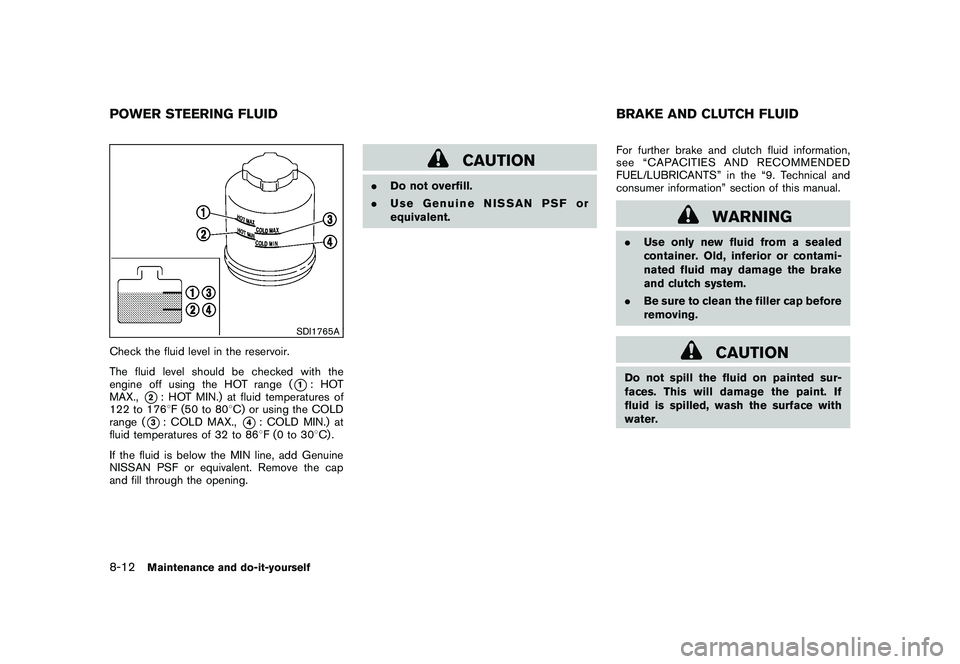
Check the fluid level in the reservoir.
The fluid level should be checked with the
engine off using the HOT range (
*1:HOT
MAX.,
*2: HOT MIN.) at fluid temperatures of
122 to 176 8F (50 to 80 8C) or using the COLD
range (
*3: COLD MAX.,
*4: COLD MIN.) at
fluid temperatures of 32 to 86 8F(0to30 8C) .
If the fluid is below the MIN line, add Genuine
NISSAN PSF or equivalent. Remove the cap
and fill through the opening.
CAUTION
. Do not overfill.
. Use Genuine NISSAN PSF or
equivalent. For further brake and clutch fluid information,
see “CAPACITIES AND RECOMMENDED
FUEL/LUBRICANTS” in the “9. Technical and
consumer information” section of this manual.
WARNING
.
Use only new fluid from a sealed
container. Old, inferior or contami-
nated fluid may damage the brake
and clutch system.
. Be sure to clean the filler cap before
removing.
CAUTION
Do not spill the fluid on painted sur-
faces. This will damage the paint. If
fluid is spilled, wash the surface with
water.
POWER STEERING FLUID BRAKE AND CLUTCH FLUID8-12
Maintenance and do-it-yourself
Page 352 of 409
Black plate (354,1)
Model "Z34-D" EDITED: 2009/ 9/ 10
Recommended fluid is Genuine NISSAN Wind-
shield Washer Concentrate Cleaner & Anti-
freeze or equivalent.
CAUTION
.Do not substitute engine anti-freeze
coolant for window washer solution.
This may result in damage to the
paint.
. Do not fill the window washer
reservoir tank with washer fluid
concentrates at full strength. Some
methyl alcohol based washer fluid
concentrates may permanently stain
the grille if spilled while filling the
window washer reservoir tank.
. Pre-mix washer fluid concentrates
with water to the manufacturer’s
recommended levels before pouring
the fluid into the window washer
reservoir tank. Do not use the
window washer reservoir tank to
mix the washer fluid concentrate
and water. .
Keep the battery surface clean and dry.
Clean the battery with a solution of baking
soda and water.
. Make certain the terminal connections are
clean and securely tightened.
. If the vehicle is not to be used for 30 days or
longer, disconnect the negative ( ) battery
terminal cable to prevent discharging it.
CAUTION
When the battery cable is removed from
the battery terminal, do not close either
of front doors. The automatic window
adjusting function will not work, and
the side roof panel may be damaged.
To disconnect the negative ( ) battery terminal,
perform the procedure in the following order.
Otherwise, the window and the side roof panel
may contact and be damaged.
1. Close the windows.
2. Open the hood.
3. Close and lock all the doors.
4. Disconnect the negative ( ) battery terminal.
5. Securely close the hood.
To connect the negative ( ) battery terminal, perform the procedure in the following order.
Otherwise, the window and the side roof panel
may contact and be damaged.
1. Unlock and open the driver side door. Do
not close the door.
2. Open the hood.
3. Connect the negative ( ) battery terminal.
Then close the hood.
4. Fully open the driver side door window.
5. Close the driver side door and the window.
WARNING
. Do not expose the battery to flames
or electrical sparks. Hydrogen gas
generated by the battery is explo-
sive. Do not allow battery fluid to
contact your skin, eyes, fabrics, or
painted surfaces. After touching a
battery or battery cap, do not touch
or rub your eyes. Thoroughly wash
your hands. If the acid contacts your
eyes, skin or clothing, immediately
flush with water for at least 15
minutes and seek medical attention.
. Do not operate the vehicle if the
fluid in the battery is low. Low
BATTERY
8-14
Maintenance and do-it-yourself
Page 354 of 409
Black plate (356,1)
Model "Z34-D" EDITED: 2009/ 9/ 10
JUMP STARTINGIf jump starting is necessary, see “JUMP
STARTING” in the “6. In case of emergency”
section. If the engine does not start by jump
starting, the battery may have to be replaced.
Contact a NISSAN dealer.
CAUTION
.Do not ground accessories directly
to the battery terminal. Doing so will
bypass the variable voltage control
system and the vehicle battery may
not charge completely.
. Use electrical accessories with the
engine running to avoid discharging
the vehicle battery.
The variable voltage control system measures
the amount of electrical discharge from the
battery and controls voltage generated by the
generator.
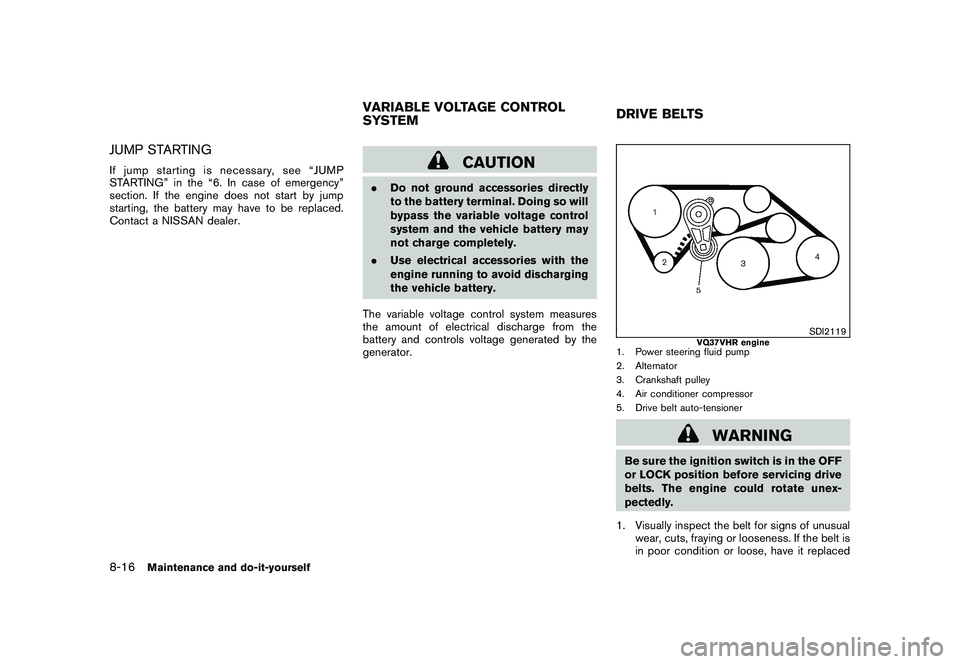
SDI2119
VQ37VHR engine
1. Power steering fluid pump
2. Alternator
3. Crankshaft pulley
4. Air conditioner compressor
5. Drive belt auto-tensioner
WARNING
Be sure the ignition switch is in the OFF
or LOCK position before servicing drive
belts. The engine could rotate unex-
pectedly.
1. Visually inspect the belt for signs of unusual wear, cuts, fraying or looseness. If the belt is
in poor condition or loose, have it replaced
VARIABLE VOLTAGE CONTROL
SYSTEM DRIVE BELTS
8-16
Maintenance and do-it-yourself
Page 355 of 409
Black plate (357,1)
Model "Z34-D" EDITED: 2009/ 9/ 10
or adjusted by a NISSAN dealer.
2. Have the belt condition checked regularly.
WARNING
Be sure the engine and the ignition
switch are off and that the parking
brake is engaged securely.
CAUTION
Be sure to use the correct socket to
remove the spark plugs. An incorrect
socket can damage the spark plugs.
SDI2020
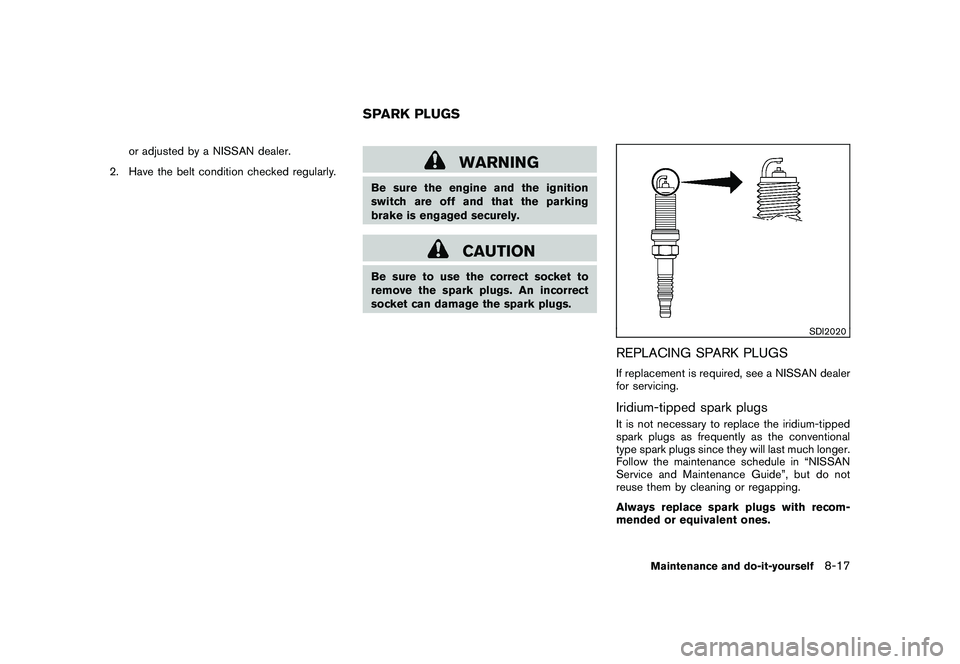
REPLACING SPARK PLUGSIf replacement is required, see a NISSAN dealer
for servicing.Iridium-tipped spark plugsIt is not necessary to replace the iridium-tipped
spark plugs as frequently as the conventional
type spark plugs since they will last much longer.
Follow the maintenance schedule in “NISSAN
Service and Maintenance Guide”, but do not
reuse them by cleaning or regapping.
Always replace spark plugs with recom-
mended or equivalent ones.
SPARK PLUGS
Maintenance and do-it-yourself
8-17
Page 356 of 409
Black plate (358,1)
Model "Z34-D" EDITED: 2009/ 9/ 10
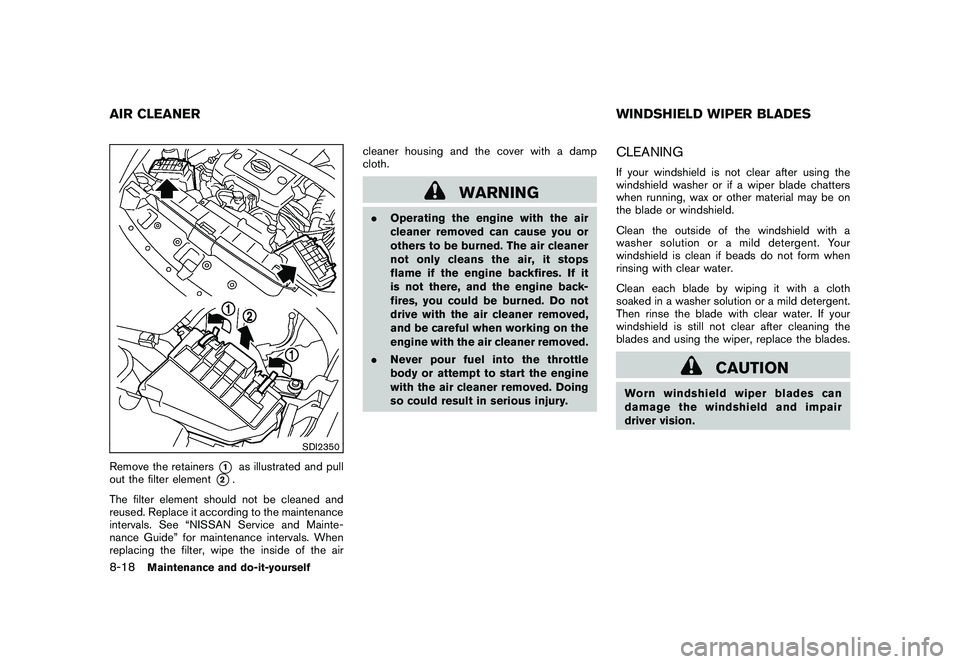
SDI2350
Remove the retainers
*1
as illustrated and pull
out the filter element
*2.
The filter element should not be cleaned and
reused. Replace it according to the maintenance
intervals. See “NISSAN Service and Mainte-
nance Guide” for maintenance intervals. When
replacing the filter, wipe the inside of the air cleaner housing and the cover with a damp
cloth.
WARNING
.
Operating the engine with the air
cleaner removed can cause you or
others to be burned. The air cleaner
not only cleans the air, it stops
flame if the engine backfires. If it
is not there, and the engine back-
fires, you could be burned. Do not
drive with the air cleaner removed,
and be careful when working on the
engine with the air cleaner removed.
. Never pour fuel into the throttle
body or attempt to start the engine
with the air cleaner removed. Doing
so could result in serious injury.
CLEANINGIf your windshield is not clear after using the
windshield washer or if a wiper blade chatters
when running, wax or other material may be on
the blade or windshield.
Clean the outside of the windshield with a
washer solution or a mild detergent. Your
windshield is clean if beads do not form when
rinsing with clear water.
Clean each blade by wiping it with a cloth
soaked in a washer solution or a mild detergent.
Then rinse the blade with clear water. If your
windshield is still not clear after cleaning the
blades and using the wiper, replace the blades.
CAUTION
Worn windshield wiper blades can
damage the windshield and impair
driver vision.
AIR CLEANER WINDSHIELD WIPER BLADES8-18
Maintenance and do-it-yourself
Page 358 of 409
Black plate (360,1)
Model "Z34-D" EDITED: 2009/ 9/ 10
If the brakes do not operate properly, have the
brakes checked by a NISSAN dealer.SELF-ADJUSTING BRAKESYour vehicle is equipped with self-adjusting
brakes.
The disc-type brakes self-adjust every time the
brake pedal is applied.
WARNING
See a NISSAN dealer for a brake
system check if the brake pedal height
does not return to normal.BRAKE PAD WEAR WARNINGThe disc brake pads have audible wear warn-
ings. When a brake pad requires replacement, it
will make a high pitched scraping sound when
the vehicle is in motion. This scraping sound will
first occur only when the brake pedal is
depressed. After more wear of the brake pad
the sound will always be heard even if the brake
pedal is not depressed. Have the brakes
checked as soon as possible if the wear warning
sound is heard.
Under some driving or climate conditions,
occasional brake squeak, squeal or other noise
may be heard. Occasional brake noise during
light to moderate stops is normal and does not affect the function or performance of the brake
system.
Proper brake inspection intervals should
be followed.
For additional information, see the
maintenance log section of your “NISSAN
Service and Maintenance Guide”.
SDI1479A
ENGINE COMPARTMENT
CAUTION
Never use a fuse of a higher or lower
amperage rating than that specified on
the fuse box cover. This could damage
the electrical system or cause a fire.
If any electrical equipment does not operate,
check for an open fuse.
1. Be sure the ignition switch is pushed to the OFF or LOCK position and the headlight
switch is turned to OFF.
BRAKES FUSES8-20
Maintenance and do-it-yourself
Page 359 of 409
Black plate (361,1)
Model "Z34-D" EDITED: 2009/ 9/ 10
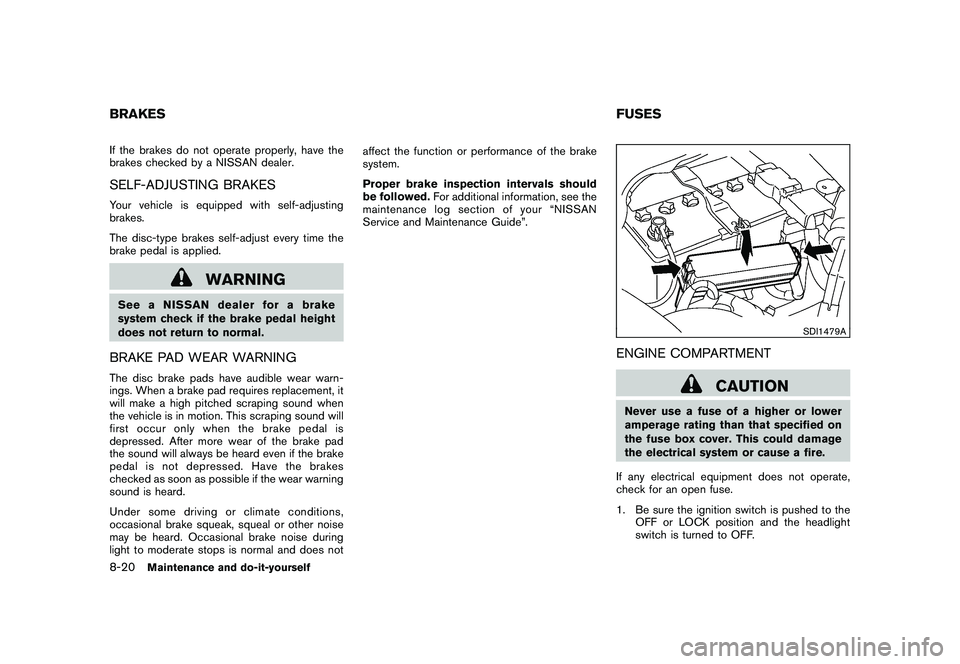
2. Open the engine hood and remove thecover on the battery and the fuse/fusible link
holder.
3. Remove the fuse/fusible link holder cover.
4. Remove the fuse with the fuse puller located in the passenger compartment fuse box.
SDI1754
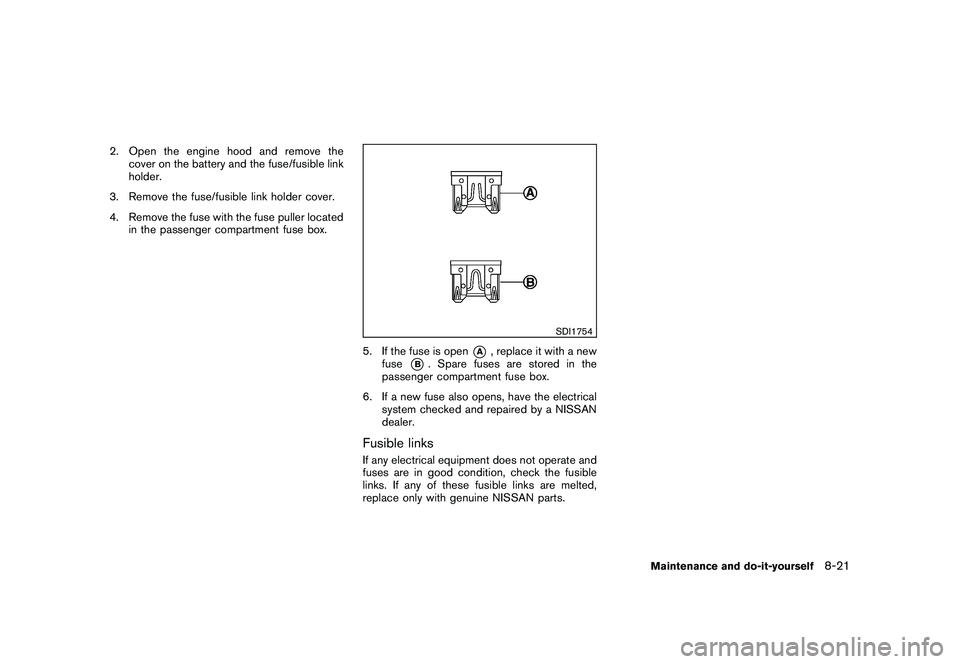
5. If the fuse is open
*A
, replace it with a new
fuse
*B. Spare fuses are stored in the
passenger compartment fuse box.
6. If a new fuse also opens, have the electrical system checked and repaired by a NISSAN
dealer.
Fusible linksIf any electrical equipment does not operate and
fuses are in good condition, check the fusible
links. If any of these fusible links are melted,
replace only with genuine NISSAN parts.
Maintenance and do-it-yourself
8-21
Page 377 of 409
Black plate (28,1)
9 Technical and consumer information
Model "Z34-D" EDITED: 2009/ 9/ 10
Capacities and recommended fuel/lubricants............ 9-2
Fuel recommendation ...................................... 9-3
Engine oil and oil filter recommendation ............... 9-5
Air conditioning system refrigerant and lubricant
recommendations ........................................... 9-6
Specifications. ................................................... 9-7
Engine ......................................................... 9-7
Wheels and tires ............................................ 9-8
Dimensions ................................................... 9-9
When traveling or registering your vehicle in
another country ................................................ 9-10
Vehicle identification ......................................... 9-10
Vehicle Identification Number (VIN) plate ........... 9-10
Vehicle identification number (chassis number) .... 9-10
Engine serial number .................................... 9-11
F.M.V.S.S./C.M.V.S.S. certification label ............. 9-11
Emission control information label .................... 9-11
Tire and loading information label ..................... 9-12
Air conditioner specification label ..................... 9-12
Installing front license plate ................................ 9-13
Except for NISMO models .............................. 9-13
For NISMO models ...................................... 9-15 Removing air deflectors
(except for NISMO models)
................................ 9-16
Vehicle loading information ................................. 9-17
Terms ........................................................ 9-17
Vehicle load capacity .................................... 9-18
Loading tips ................................................ 9-19
Measurement of weights ................................ 9-19
Towing a trailer ................................................ 9-19
Flat towing ..................................................... 9-20
Automatic transmission .................................. 9-20
Manual Transmission ..................................... 9-20
Uniform tire quality grading ................................. 9-20
Treadwear .................................................. 9-20
Traction AA, A, B and C ................................ 9-20
Temperature A, B and C ................................ 9-21
Emission control system warranty ......................... 9-21
Reporting safety defects (US only) ....................... 9-22
Readiness for Inspection/Maintenance (I/M) test
(US only) ....................................................... 9-22
Event Data Recorders (EDR) .............................. 9-23
Owner’s Manual/Service Manual order information . . . 9-24 In the event of a collision ............................... 9-24