trunk NISSAN 370Z COUPE 2012 Owner's Guide
[x] Cancel search | Manufacturer: NISSAN, Model Year: 2012, Model line: 370Z COUPE, Model: NISSAN 370Z COUPE 2012Pages: 427, PDF Size: 3.25 MB
Page 286 of 427
5-2Starting and driving
WARNING
.Do not leave children or adults who
would normally require the support
of others alone in your vehicle. Pets
should not be left alone either. They
could accidentally injure themselves
or others through inadvertent op-
eration of the vehicle. Also, on hot,
sunny days, temperatures in a
closed vehicle could quickly become
high enough to cause severe or
possibly fatal injuries to people or
animals.
. Properly secure all cargo to help
prevent it from sliding or shifting.
Do not place cargo higher than the
seatbacks. In a sudden stop or
collision, unsecured cargo could
cause personal injury (Coupe mod-
els) .
. Closely supervise children when
they are around cars to prevent
them from playing and becoming
locked in the trunk where they could
be seriously injured. Keep the car
locked with the trunk closed when
not in use, and prevent children’s access to car keys (Roadster mod-
els) .
If the engine oil temperature is high, the
engine protection mode, which helps re-
duce the chance of engine damage, could
activate and automatically decrease en-
gine power. Driving while the engine oil
temperature is high may result in engine
damage.
EXHAUST GAS (carbon monoxide)
WARNING
. Do not breathe exhaust gases; they
contain colorless and odorless car-
bon monoxide. Carbon monoxide is
dangerous. It can cause uncon-
sciousness or death.
. If you suspect that exhaust fumes
are entering the vehicle, drive with
all windows fully open, and have the
vehicle inspected immediately.
. Do not run the engine in closed
spaces such as a garage.
. Do not park the vehicle with the
engine running for any extended
length of time. .
Keep the rear hatch/trunk lid closed
while driving, otherwise exhaust
gases could be drawn into the
passenger compartment. If you
must drive with the rear hatch/trunk
lid open, follow these precautions:
1) Open all the windows.
2) Set the
air recirculation to
off and the fan control to high to
circulate the air.
. The exhaust system and body
should be inspected by a qualified
mechanic whenever:
— The vehicle is raised for service.
— You suspect that exhaust fumes
are entering into the passenger
compartment.
— You notice a change in the sound of the exhaust system.
— You have had an accident invol- ving damage to the exhaust
system, underbody, or rear of
the vehicle.
PRECAUTIONS WHEN STARTING
AND DRIVING
Page 292 of 427
5-8Starting and driving
WARNING
Do not operate the push-button ignition
switch while driving the vehicle except
in an emergency. (The engine will stop
when the ignition switch is pushed 3
consecutive times or the ignition switch
is pushed and held for more than 2
seconds.) If the engine stops while the
vehicle is being driven, this could lead
to a crash and serious injury.
Before operating the push-button ignition
switch, be sure to move the selector lever to
the P (Park) position (for automatic transmission
model) or the shift lever to the N (Neutral)
position (for manual transmission model) .
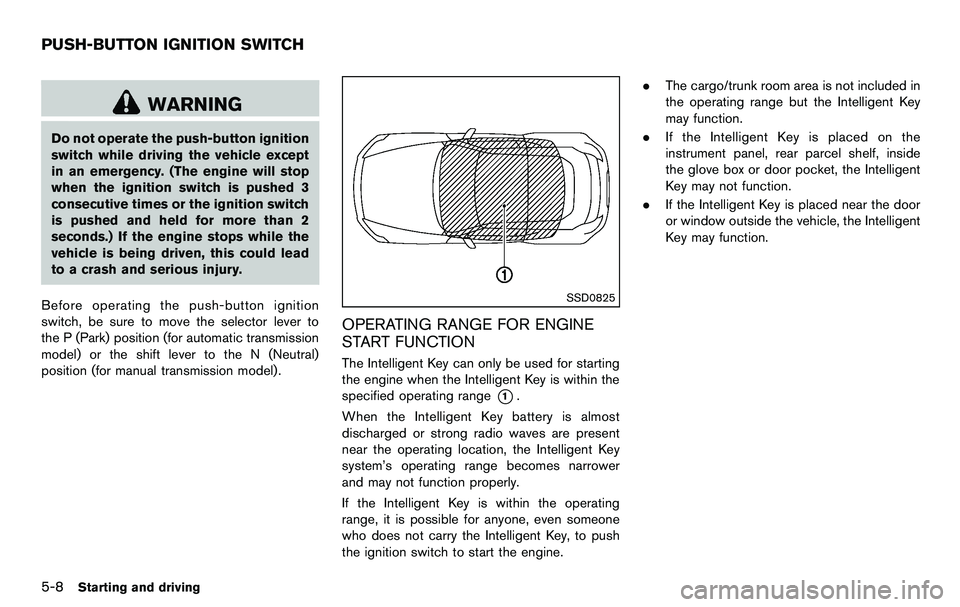
SSD0825
OPERATING RANGE FOR ENGINE
START FUNCTION
The Intelligent Key can only be used for starting
the engine when the Intelligent Key is within the
specified operating range
*1.
When the Intelligent Key battery is almost
discharged or strong radio waves are present
near the operating location, the Intelligent Key
system’s operating range becomes narrower
and may not function properly.
If the Intelligent Key is within the operating
range, it is possible for anyone, even someone
who does not carry the Intelligent Key, to push
the ignition switch to start the engine. .
The cargo/trunk room area is not included in
the operating range but the Intelligent Key
may function.
. If the Intelligent Key is placed on the
instrument panel, rear parcel shelf, inside
the glove box or door pocket, the Intelligent
Key may not function.
. If the Intelligent Key is placed near the door
or window outside the vehicle, the Intelligent
Key may function.
PUSH-BUTTON IGNITION SWITCH
Page 322 of 427
6-4In case of emergency
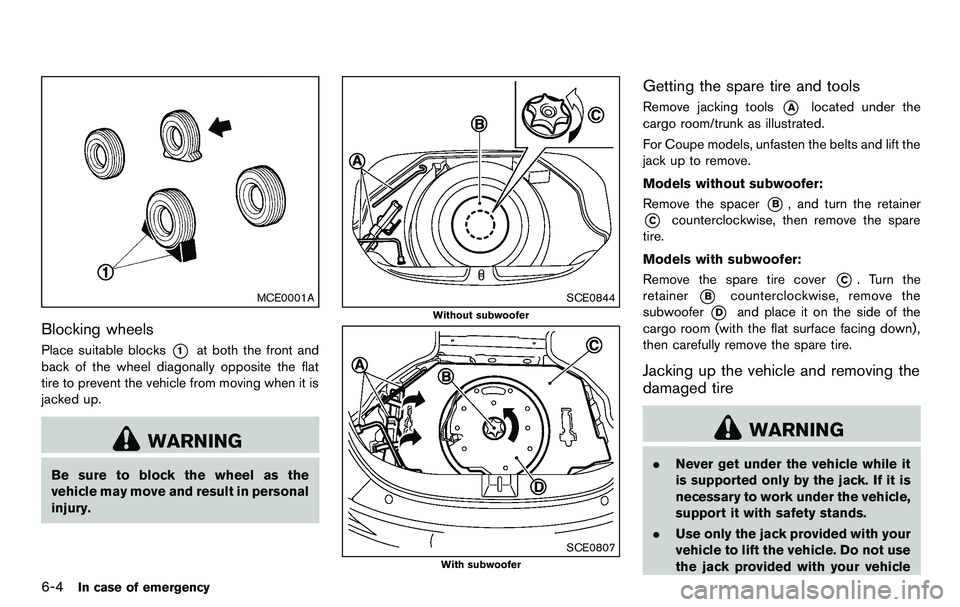
MCE0001A
Blocking wheels
Place suitable blocks*1at both the front and
back of the wheel diagonally opposite the flat
tire to prevent the vehicle from moving when it is
jacked up.
WARNING
Be sure to block the wheel as the
vehicle may move and result in personal
injury.
SCE0844
Without subwoofer
SCE0807
With subwoofer
Getting the spare tire and tools
Remove jacking tools*Alocated under the
cargo room/trunk as illustrated.
For Coupe models, unfasten the belts and lift the
jack up to remove.
Models without subwoofer:
Remove the spacer
*B, and turn the retainer
*Ccounterclockwise, then remove the spare
tire.
Models with subwoofer:
Remove the spare tire cover
*C. Turn the
retainer
*Bcounterclockwise, remove the
subwoofer
*Dand place it on the side of the
cargo room (with the flat surface facing down) ,
then carefully remove the spare tire.
Jacking up the vehicle and removing the
damaged tire
WARNING
. Never get under the vehicle while it
is supported only by the jack. If it is
necessary to work under the vehicle,
support it with safety stands.
. Use only the jack provided with your
vehicle to lift the vehicle. Do not use
the jack provided with your vehicle
Page 325 of 427
the hole in the spare tire wheel is aligned
with the pin on the brake rotor.
3. With the wheel nut wrench, tighten wheel nuts alternately and evenly in the sequence
as illustrated (
*1,*2,*3,*4,*5) until
they are tight.
4. Lower the vehicle slowly until the tire touches the ground. Then, with the wheel
nut wrench, tighten the wheel nuts securely
in the sequence as illustrated. Lower the
vehicle completely.
WARNING
.Incorrect wheel nuts or improperly
tightened wheel nuts can cause the
wheel to become loose or come off.
This could cause an accident.
. Do not use oil or grease on the
wheel studs or nuts. This could
cause the nuts to become loose.
. Retighten the wheel nuts when the
vehicle has been driven for 600
miles (1,000 km) (also in cases of a
flat tire, etc.) .
. As soon as possible, tighten the wheel
nuts to the specified torque with a torque wrench.
Wheel nut tightening torque:
80 ft-lb (108 N·m)
The wheel nuts must be kept tightened
to specification at all times. It is
recommended that wheel nuts be tigh-
tened to specifications at each lubrica-
tion interval.
. Adjust tire pressure to the COLD pres-
sure.
COLD pressure:
After the vehicle has been parked for
three hours or more or driven less than
1 mile (1.6 km) .
COLD tire pressures are shown on the
Tire and Loading Information label
affixed to the driver side center pillar.
Stowing the damaged tire and tools
Coupe models:
1. Securely store the damaged tire and jacking
tools in the storage area.
2. Place the spare tire cover and the cargo room carpet over the damaged tire.
3. Close the rear hatch.
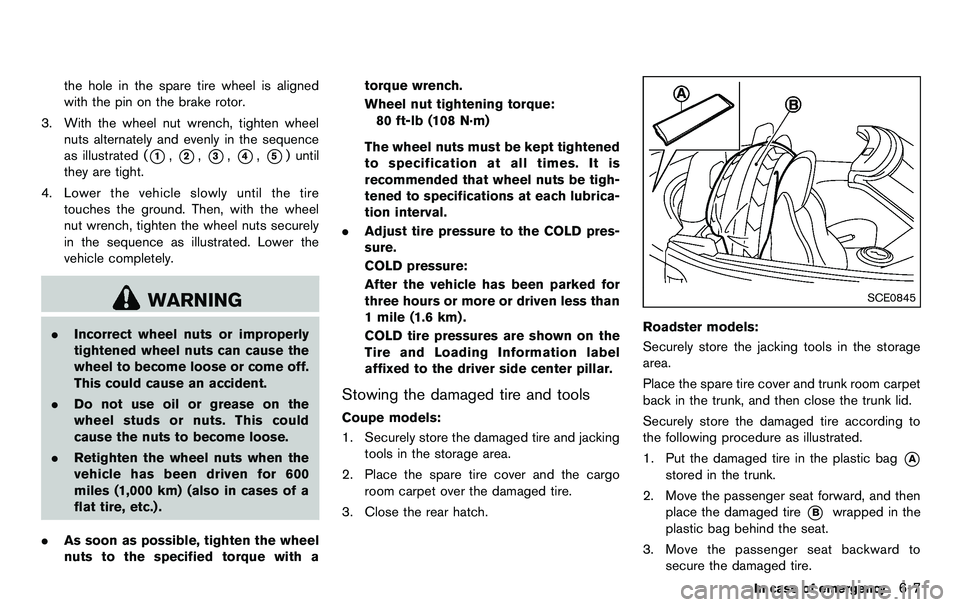
SCE0845
Roadster models:
Securely store the jacking tools in the storage
area.
Place the spare tire cover and trunk room carpet
back in the trunk, and then close the trunk lid.
Securely store the damaged tire according to
the following procedure as illustrated.
1. Put the damaged tire in the plastic bag
*A
stored in the trunk.
2. Move the passenger seat forward, and then place the damaged tire
*Bwrapped in the
plastic bag behind the seat.
3. Move the passenger seat backward to secure the damaged tire.
In case of emergency6-7
Page 327 of 427
— when the sealant has passed itsexpiration date (shown on the
label attached to the bottle)
— when the cut or the puncture is approximately 0.25 in (6 mm) or
longer
— when the tire sidewall is da- maged
— when the vehicle has been dri- ven with extremely low tire
pressure
— when the tire has come off the inside or the outside of the
wheel.
— when the tire wheel is damaged
— when two or more tires are flat
Stopping the vehicle
1. Safely move the vehicle off the road and away from traffic.
2. Turn on the hazard warning flashers.
3. Park on a level surface and apply the parking brake.
4. Automatic Transmission models:
Move the selector lever to the P (Park) position.
Manual Transmission models:
Move the shift lever to the R (Reverse)
position.
5. Turn off the engine.
6. Raise the hood to warn other traffic and to signal professional road assistance person-
nel that you need assistance.
7. Have all passengers get out of the vehicle and stand in a safe place, away from traffic
and clear of the vehicle.
WARNING
Make sure the parking brake is securely
applied and the manual transmission is
shifted into R (Reverse) or the auto-
matic transmission into P (Park) .
.Never repair tires when the vehicle
is on a slope, ice or slippery areas.
This is hazardous.
. Never repair tires if oncoming traffic
is close to your vehicle. Wait for
professional road assistance.
SCE0866
Getting emergency tire puncture repair
kit
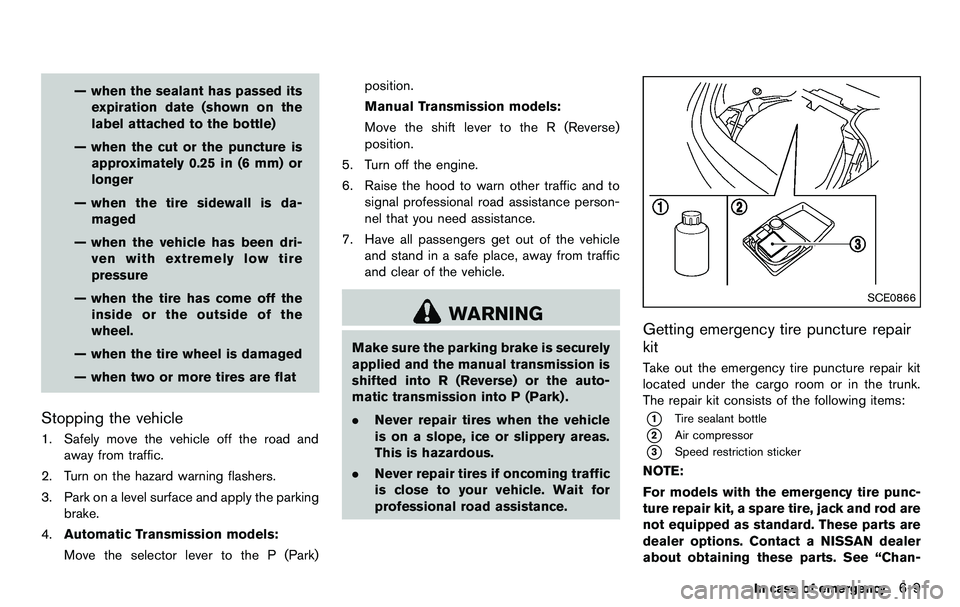
Take out the emergency tire puncture repair kit
located under the cargo room or in the trunk.
The repair kit consists of the following items:
*1Tire sealant bottle
*2Air compressor
*3Speed restriction sticker
NOTE:
For models with the emergency tire punc-
ture repair kit, a spare tire, jack and rod are
not equipped as standard. These parts are
dealer options. Contact a NISSAN dealer
about obtaining these parts. See “Chan-
In case of emergency6-9
Page 330 of 427
6-12In case of emergency
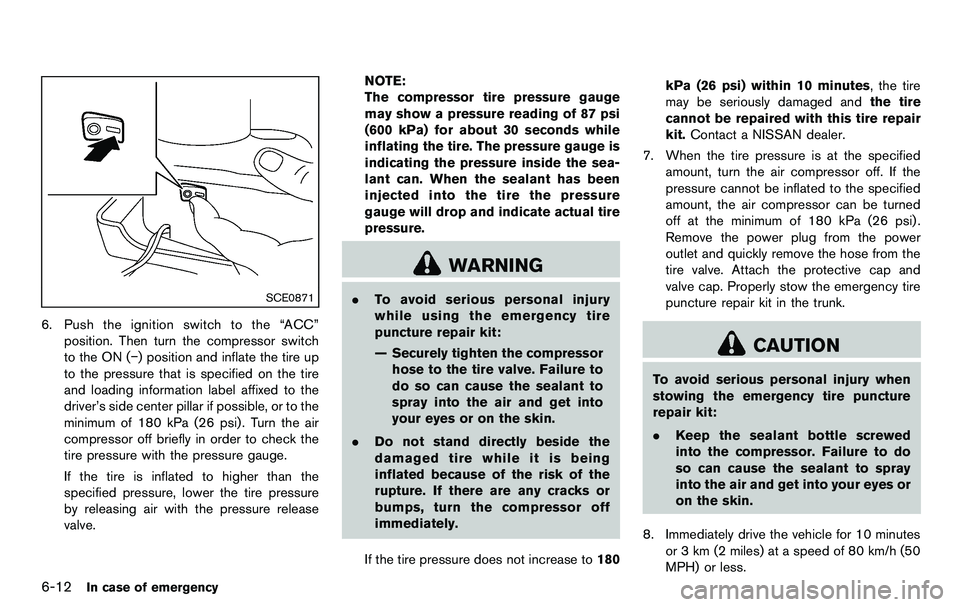
SCE0871
6. Push the ignition switch to the “ACC”position. Then turn the compressor switch
to the ON (−) position and inflate the tire up
to the pressure that is specified on the tire
and loading information label affixed to the
driver’s side center pillar if possible, or to the
minimum of 180 kPa (26 psi) . Turn the air
compressor off briefly in order to check the
tire pressure with the pressure gauge.
If the tire is inflated to higher than the
specified pressure, lower the tire pressure
by releasing air with the pressure release
valve. NOTE:
The compressor tire pressure gauge
may show a pressure reading of 87 psi
(600 kPa) for about 30 seconds while
inflating the tire. The pressure gauge is
indicating the pressure inside the sea-
lant can. When the sealant has been
injected into the tire the pressure
gauge will drop and indicate actual tire
pressure.
WARNING
.
To avoid serious personal injury
while using the emergency tire
puncture repair kit:
— Securely tighten the compressor
hose to the tire valve. Failure to
do so can cause the sealant to
spray into the air and get into
your eyes or on the skin.
. Do not stand directly beside the
damaged tire while it is being
inflated because of the risk of the
rupture. If there are any cracks or
bumps, turn the compressor off
immediately.
If the tire pressure does not increase to 180kPa (26 psi) within 10 minutes, the tire
may be seriously damaged and
the tire
cannot be repaired with this tire repair
kit. Contact a NISSAN dealer.
7. When the tire pressure is at the specified amount, turn the air compressor off. If the
pressure cannot be inflated to the specified
amount, the air compressor can be turned
off at the minimum of 180 kPa (26 psi) .
Remove the power plug from the power
outlet and quickly remove the hose from the
tire valve. Attach the protective cap and
valve cap. Properly stow the emergency tire
puncture repair kit in the trunk.
CAUTION
To avoid serious personal injury when
stowing the emergency tire puncture
repair kit:
.Keep the sealant bottle screwed
into the compressor. Failure to do
so can cause the sealant to spray
into the air and get into your eyes or
on the skin.
8. Immediately drive the vehicle for 10 minutes or 3 km (2 miles) at a speed of 80 km/h (50
MPH) or less.
Page 380 of 427
8-28Maintenance and do-it-yourself
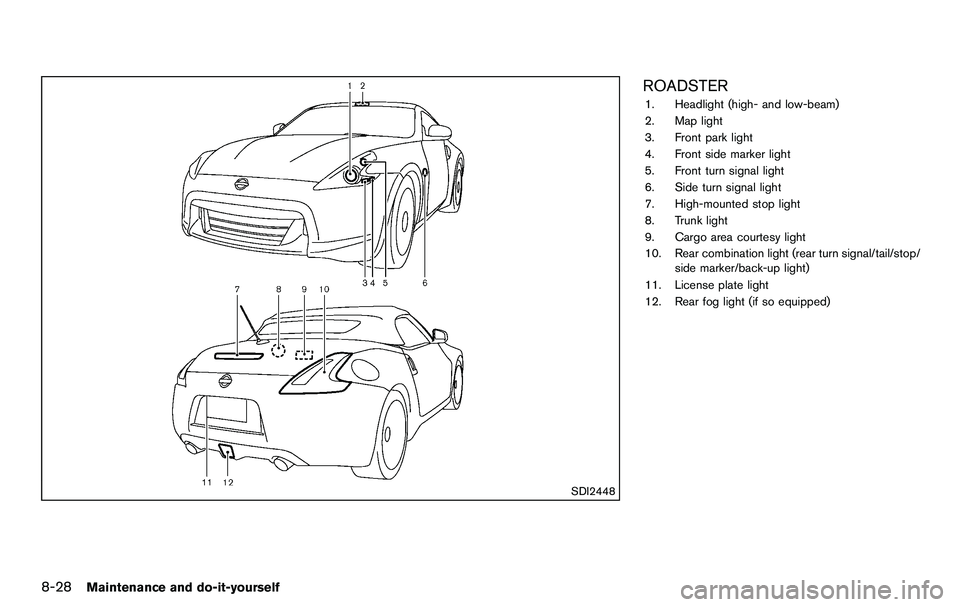
SDI2448
ROADSTER
1. Headlight (high- and low-beam)
2. Map light
3. Front park light
4. Front side marker light
5. Front turn signal light
6. Side turn signal light
7. High-mounted stop light
8. Trunk light
9. Cargo area courtesy light
10. Rear combination light (rear turn signal/tail/stop/side marker/back-up light)
11. License plate light
12. Rear fog light (if so equipped)
Page 381 of 427
HEADLIGHTS
Fog may temporarily form inside the lens of the
exterior lights in the rain or in a car wash. A
temperature difference between the inside and
the outside of the lens causes the fog. This is
not a malfunction. If large drops of water collect
inside the lens, contact a NISSAN dealer.
Replacing
WARNING
HIGH VOLTAGE
When xenon headlights are on, they
produce a high voltage. To prevent an
electric shock, never attempt to modify
or disassemble. Always have your xe-
non headlights replaced at a NISSAN
dealer. For additional information, see
“Headlight and turn signal switch” (P.2-
31) .
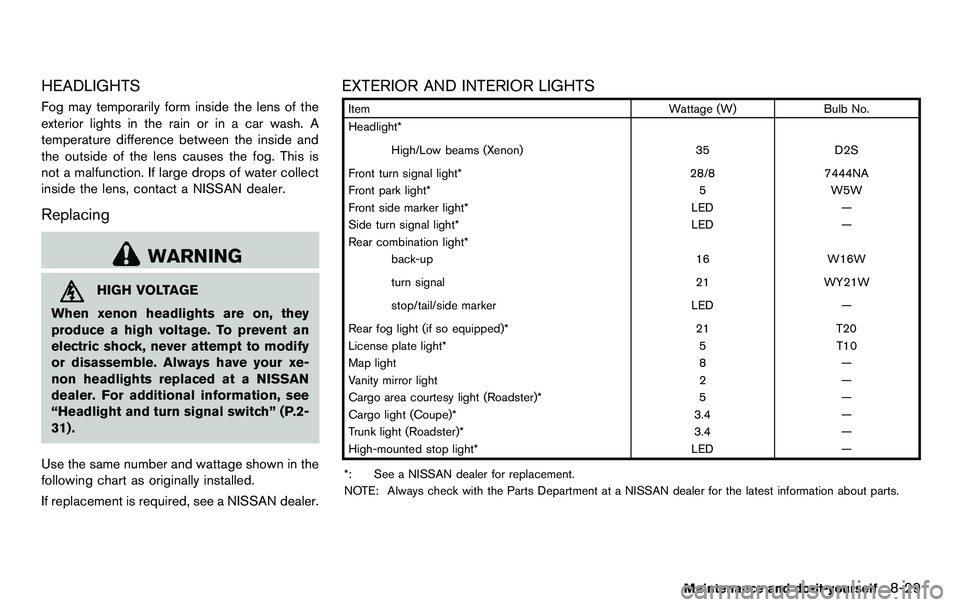
Use the same number and wattage shown in the
following chart as originally installed.
If replacement is required, see a NISSAN dealer.
EXTERIOR AND INTERIOR LIGHTS
Item Wattage (W)Bulb No.
Headlight*
High/Low beams (Xenon) 35D2S
Front turn signal light* 28/87444NA
Front park light* 5W5W
Front side marker light* LED—
Side turn signal light* LED—
Rear combination light* back-up 16W16W
turn signal 21WY21W
stop/tail/side marker LED—
Rear fog light (if so equipped)* 21T20
License plate light* 5T10
Map light 8—
Vanity mirror light 2—
Cargo area courtesy light (Roadster)* 5—
Cargo light (Coupe)* 3.4—
Trunk light (Roadster)* 3.4—
High-mounted stop light* LED—
*: See a NISSAN dealer for replacement.
NOTE: Always check with the Parts Department at a NISSAN dealer for the latest information about parts.
Maintenance and do-it-yourself8-29
Page 421 of 427
G
Garage door opener, HomeLink®
Universal Transceiver.................................................. 2-49
Gas cap......................................................................... 3-34
Gauge .............................................................................. 2-5 Engine coolant temperature gauge .................... 2-7
Fuel gauge................................................................ 2-7
Odometer.................................................................. 2-6
Speedometer............................................................ 2-6
Tachometer ............................................................... 2-6
Trip computer........................................................ 2-22
General maintenance ................................................... 8-3
Glove box...................................................................... 2-41
H
Hands-free phone system, Bluetooth®
(models with navigation system)............................. 4-81
Hands-free phone system, Bluetooth®
(models without navigation system) ....................... 4-91
Hatch, Rear hatch....................................................... 3-16
Hazard warning flasher switch................................. 2-35
Head restraints .............................................................. 1-5
Headlights Bulb replacement................................................. 8-29
Headlight switch................................................... 2-32
Xenon headlights.................................................. 2-31
Heated seats................................................................ 2-36
Heater Engine block heater............................................. 5-32
Heater and air conditioner operation.............. 4-24
HomeLink
®Universal Transceiver ........................... 2-49
Hood release................................................................ 3-16
Horn................................................................................ 2-36
I
Ignition switch (Push-button) ........................................................... 5-8
Manual transmission models............................. 5-16
Immobilizer system...................................................... 2-28
In-cabin microfilter ...................................................... 4-30
Indicator lights.............................................................. 2-14
INFO button.................................................................... 4-8
Inside mirror.................................................................. 3-37
Inspection/maintenance (I/M) test .......................... 9-23
Instrument brightness control .................................. 2-34
Instrument panel............................................................ 2-4
Instrument pocket ....................................................... 2-40
Intelligent Key................................................................. 3-2
Intelligent Key battery discharge indicator............ 2-19
Intelligent Key removal indicator.............................. 2-18
Intelligent Key system .................................................. 3-6 Battery replacement ............................................ 8-25
Intelligent Key system warning light................ 2-11
Key operating range ............................................... 3-8
Key operation ........................................................... 3-9
Warning signals.................................................... 3-11
Interior light control switch ....................................... 2-47
Interior light replacement........................................... 8-29
Interior lights................................................................. 2-46
Interior trunk lid release............................................. 3-19
iPod
®player operation............................................... 4-68
J
Jump starting................................................................ 6-14
K
Keyless entry (See remote keyless
entry system)................................................................ 3-13
Keys.................................................................................. 3-2 For Intelligent Key system..................................... 3-6
L
LabelsAir bag warning labels........................................ 1-40
Air conditioner specification label.................... 9-13
Emission control information label................... 9-12
Engine serial number........................................... 9-12
F.M.V.S.S./C.M.V.S.S. certification label ........ 9-12
Tire and Loading information label ....... 8-32, 9-13
Vehicle identification number (VIN) ................. 9-11
License plate, Installing front license plate .......... 9-14
Light Air bag warning light........................................... 1-41
Bulb replacement................................................. 8-27
Cargo area courtesy light .................................. 2-48
Cargo light............................................................. 2-48
Fog light switch.................................................... 2-35
Headlight switch................................................... 2-32
Headlights bulb replacement............................ 8-29
Indicator lights....................................................... 2-14
Interior light control switch ................................ 2-47
Interior lights.......................................................... 2-46
Map lights .............................................................. 2-46
Replacement.......................................................... 8-27
Trunk light............................................................... 2-49
Vanity mirror lights ............................................... 2-48
Warning/indicator lights and
audible reminders................................................. 2-10
Xenon headlights.................................................. 2-31
10-3
Page 422 of 427
10-4
Lights, Exterior and interior light replacement ..... 8-29
Loading information (See vehicle
loading information) .................................................... 9-17
LockAutomatic door locks ............................................. 3-5
Door locks................................................................. 3-4
Power door lock...................................................... 3-4
Rear hatch lock..................................................... 3-16
Trunk lid .................................................................. 3-18
Locking with mechanical key...................................... 3-4
Low tire pressure warning light............................... 2-12
Low tire pressure warning system
(See tire pressure monitoring system (TPMS)) .... 5-3
M
Maintenance Battery..................................................................... 8-16
General maintenance ............................................. 8-3
Inside the vehicle .................................................... 8-4
Maintenance indicators....................................... 2-21
Maintenance precautions...................................... 8-6
Maintenance requirements.................................... 8-3
Outside the vehicle................................................. 8-3
Seat belt maintenance........................................ 1-14
Malfunction indicator light (MIL).............................. 2-14
Manual front seat adjustment..................................... 1-4
Map lights ..................................................................... 2-46
Master warning light................................................... 2-13
Mechanical key (Intelligent Key system) ................. 3-3
Meter Trip computer........................................................ 2-22
Meters and gauges....................................................... 2-5 Instrument brightness control ........................... 2-34
Mirror Inside mirror........................................................... 3-37
Outside mirrors..................................................... 3-38 Vanity mirror........................................................... 3-39
Multi-function controller............................................... 4-4
N
New vehicle break-in.................................................. 5-23
NISSAN Vehicle Immobilizer System..................... 2-28
NISSAN voice recognition system ...................... 4-103
No key warning............................................................ 2-18
O
Odometer........................................................................ 2-6
Off-road recovery.......................................................... 5-6
Oil Capacities and
recommended fuel/lubricants............................... 9-2
Changing engine oil and filter........................... 8-11
Checking engine oil level................................... 8-11
Engine oil................................................................ 8-11
Engine oil viscosity.................................................. 9-6
Oil filter replacement indicator ......................... 2-21
Opening the soft top.................................................. 3-21
Operation, Operational indicators........................... 2-18
Outside mirrors............................................................ 3-38
Overheat, If your vehicle overheats ........................ 6-16
Owner’s Manual/Service Manual
order information ......................................................... 9-24
P
Panic alarm................................................................... 3-14
Parking Brake break-in....................................................... 5-26
Parking brake operation ..................................... 5-20
Parking on hills ..................................................... 5-24
Performance dampers................................................ 5-30 Phone
Bluetooth
®hands-free phone system
(models with navigation system)...................... 4-81
Bluetooth
®hands-free phone system
(models without navigation system) ................ 4-91
Car phone or CB radio ...................................... 4-80
Power Front seat adjustment ............................................ 1-2
Power door lock...................................................... 3-4
Power outlet .......................................................... 2-39
Power steering fluid............................................. 8-13
Power steering system ....................................... 5-25
Power windows .................................................... 2-44
Precautions................................................................... 5-21 Audio operation .................................................... 4-31
Braking precautions............................................. 5-25
Child restraints...................................................... 1-18
Cruise control operations................................... 5-17
Maintenance ............................................................. 8-6
Seat belt usage ....................................................... 1-9
Supplemental restraint system.......................... 1-28
When starting and driving .................................... 5-2
Push starting ................................................................ 6-16
Push warning (Automatic
Transmission models) ................................................ 2-19
Push-button ignition switch............................... 5-8, 5-9
R
Radio.............................................................................. 4-31 Car phone or CB radio ...................................... 4-80
FM-AM radio with Compact Disc
(CD) player ............................................................ 4-43
FM-AM-SAT radio with compact disc (CD)
changer (models without
navigation system) ............................................... 4-47