window NISSAN 370Z COUPE 2018 Workshop Manual
[x] Cancel search | Manufacturer: NISSAN, Model Year: 2018, Model line: 370Z COUPE, Model: NISSAN 370Z COUPE 2018Pages: 453, PDF Size: 2.23 MB
Page 325 of 453
FREEING A FROZEN DOOR LOCK
To prevent a door lock from freezing,
apply deicer through the key hole. If the
lock becomes frozen, heat the key before
inserting it into the key hole or use the
Intelligent Key system.
ANTIFREEZE
In the winter when it is anticipated that
the outside temperature will drop below
32°F (0°C), check antifreeze to assure
proper winter protection. For additional
information, see “Engine cooling system”
(P.8-4).
BATTERY
If the battery is not fully charged during
extremely cold weather conditions, the
battery fluid may freeze and damage the
battery. To maintain maximum efficiency,
the battery should be checked regularly.
For additional information, see “Battery”
(P.8-11).
DRAINING OF COOLANT WATER
If the vehicle is to be left outside without
antifreeze, drain the cooling system, in-
cluding the engine block. Refill before
operating the vehicle. For details, see
“Engine cooling system” (P.8-4).
TIRE EQUIPMENT
SUMMER tires have a tread designed to
provide superior performance on dry
pavement. However, the performance of
these tires will be substantially reduced in
snowy and icy conditions. If you operate
your vehicle on snowy or icy roads,
NISSAN recommends the use of MUD &
SNOW or ALL SEASON tires on all four
wheels. It is recommended you consult a
NISSAN dealer for the tire type, size, speed
rating and availability information.
For additional traction on icy roads,
studded tires may be used. However,
some U.S. states and Canadian provinces
prohibit their use. Check local, state and
provincial laws before installing studded
tires.
Skid and traction capabilities of
studded snow tires, on wet or dry
surfaces, may be poorer than that of
non-studded snow tires.
Tire chains may be used. For details, see
“Tire chains” (P.8-33) of this manual.
SPECIAL WINTER EQUIPMENT
It is recommended that the following
items be carried in the vehicle during
winter:
.A scraper and stiff-bristled brush to
remove ice and snow from the win-
dows and wiper blades.
. A sturdy, flat board to be placed under
the jack to give it firm support.
. A shovel to dig the vehicle out of
snowdrifts.
. Extra window washer fluid to refill the
reservoir tank.
DRIVING ON SNOW OR ICE
WARNING
. Wet ice (32°F, 0°C and freezing
rain), very cold snow or ice can be
slick and very hard to drive on.
The vehicle will have much less
traction or “grip” under these
conditions. Try to avoid driving
on wet ice until the road is salted
or sanded.
. Whatever the condition, drive
with caution. Accelerate and slow
down with care. If accelerating or
downshifting too fast, the drive
wheels will lose even more trac-
Starting and driving5-33
COLD WEATHER DRIVING
Page 346 of 453
6-18In case of emergency
2. Turn off the air conditioner. Open allthe windows, move the heater or air
conditioner temperature control to
maximum hot and fan control to high
speed.
3. If engine overheating is caused by climbing a long hill on a hot day, run
the engine at a fast idle (approxi-
mately 1,500 rpm) until the tempera-
ture gauge indication returns to
normal.
4. Get out of the vehicle. Look and listen for steam or coolant escaping from
the radiator before opening the hood.
(If steam or coolant is escaping, turn
off the engine.) Do not open the hood
further until no steam or coolant can
be seen.
5. Open the engine hood.
WARNING
If steam or water is coming from the
engine, stand clear to prevent get-
ting burned.
6. Visually check if the cooling fan is running. The radiator hoses and ra-
diator should not leak water. If coolant
is leaking or the cooling fan does not
run, stop the engine.
WARNING
Be careful not to allow your hands,
hair, jewelry or clothing to come into
contact with, or get caught in, engine
belts or the engine cooling fan. The
engine cooling fan can start at any
time.
7. After the engine cools down, check the coolant level in the reservoir with
the engine running. Add coolant to
the reservoir if necessary. Have your
vehicle repaired. It is recommended
you visit a NISSAN dealer for this
service.
Page 354 of 453
7-2Appearance and care
In order to maintain the appearance of
your vehicle, it is important to take proper
care of it.
To protect the paint surface, wash your
vehicle as soon as you can:
.after a rainfall to prevent possible
damage from acid rain
. after driving on coastal roads
. when contaminants such as soot, bird
droppings, tree sap, metal particles or
bugs get on the paint surface
. when dust or mud builds up on the
surface
Whenever possible, store or park your
vehicle inside a garage or in a covered
area.
When it is necessary to park outside, park
in a shady area or protect the vehicle with
a body cover.
Be careful not to scratch the paint
surface when putting on or removing
the body cover.
WASHING
Wash dirt off the vehicle with a wet
sponge and plenty of water. Clean the
vehicle thoroughly using a mild soap, a
special vehicle soap or general purpose
dishwashing liquid mixed with clean, lu-
kewarm (never hot) water.
CAUTION
. Do not use car washes that use
acid in the detergent. Some car
washes, especially brushless
ones, use some acid for cleaning.
The acid may react with some
plastic vehicle components, caus-
ing them to crack. This could
affect their appearance, and also
could cause them not to function
properly. Always check with your
car wash to confirm that acid is
not used.
. Do not wash the vehicle with
strong household soap, strong
chemical detergents, gasoline or
solvents.
. Do not wash the vehicle in direct
sunlight or while the vehicle body
is hot, as the surface may become
water-spotted.
. Avoid using tight-napped or
rough cloths, such as washing
mitts. Care must be taken when
removing caked-on dirt or other
foreign substances so the paint
surface is not scratched or da-
maged. .
For models with decorative stick-
er, observe the following:
— Wash dirt off the vehicle with a
wet sponge and plenty of
water. Then wipe the vehicle
gently using a soft cloth.
— Do not apply direct water pressure, such as high-pres-
sure sprayer, on the vehicle
body around the sticker. This
may cause the sticker edges
to peel away or come off from
the vehicle.
. For Roadster models, observe the
following:
— Do not use an automatic car
wash or a high pressure car
wash. The soft top may be
damaged.
— Avoid applying direct water pressure, such as high pres-
sured water from household
hoses, on the lining of the soft
top and vehicle body. Avoid
applying continuous water on
the parts around the soft top
and the windows. These may
cause water to leak into the
inside of your vehicle.
CLEANING EXTERIOR
Page 356 of 453
7-4Appearance and care
.If glass cleaner gets on the soft
top, immediately wash it off with
clean water.
. Do not apply direct water pres-
sure, such as high pressured
water from household hoses, on
the lining of the soft top and
vehicle body, as this may cause
water to leak into the inside of
your vehicle.
After cleaning, always be sure the top and
its storage are completely drybefore
opening the top. Opening the top while
it is wet or damp may cause interior water
damage, water stains or mildew on the
top.
WAXING
Regular waxing protects the paint surface
and helps retain new vehicle appearance.
Polishing is recommended to remove
built-up wax residue and to avoid a
weathered appearance before reapplying
wax.
A NISSAN dealer can assist you in choos-
ing the proper product.
. Wax your vehicle only after a thorough
washing. Follow the instructions sup-
plied with the wax. .
Do not use a wax containing any
abrasives, cutting compounds or clea-
ners that may damage the vehicle
finish.
Machine compound or aggressive polish-
ing on a base coat/clear coat paint finish
may dull the finish or leave swirl marks.
REMOVING SPOTS
Remove tar and oil spots, industrial dust,
insects, and tree sap as quickly as possi-
ble from the paint surface to avoid lasting
damage or staining. Special cleaning
products are available at a NISSAN dealer
or any automotive accessory stores.
UNDERBODY
In areas where road salt is used in winter,
the underbody must be cleaned regularly.
This will prevent dirt and salt from build-
ing up and causing the acceleration of
corrosion on the underbody and suspen-
sion. Before the winter period and again
in the spring, the underseal must be
checked and, if necessary, re-treated.
GLASS
Use glass cleaner to remove smoke and
dust film from the glass surfaces. It is
normal for glass to become coated with a
film after the vehicle is parked in the hot
sun. Glass cleaner and a soft cloth will
easily remove this film.
CAUTION
. When cleaning the inside of the
windows, do not use sharp-
edged tools, abrasive cleaners or
chlorine-based disinfectant clea-
ners. They could damage the
electrical conductors, radio an-
tenna elements or rear window
defroster elements.
. If glass cleaner gets on the soft
top, immediately wash it off with
clean water (Roadster models).
WHEELS
Wash the wheels when washing the
vehicle to maintain their appearance.
.Clean the inner side of the wheels
when the wheel is changed or the
underside of the vehicle is washed.
. Inspect wheel rims regularly for dents
or corrosion. Such damage may cause
loss of pressure or poor seal at the tire
bead.
. NISSAN recommends that the road
wheels be waxed to protect against
road salt in areas where it is used
during winter.
Page 363 of 453
8 Do-it-yourself
Maintenance precautions ....................................................... 8-2
Engine compartment check locations ......................... 8-3VQ37VHR engine model .................................................... 8-3
Engine cooling system .............................................................. 8-4 Checking engine coolant level ..................................... 8-5
Changing engine coolant ................................................. 8-5
Engine oil ........................................................................\
...................... 8-6 Checking engine oil level .................................................. 8-6
Changing engine oil and filter ...................................... 8-6
Automatic Transmission Fluid (ATF) .............................. 8-8
Power steering fluid .................................................................... 8-8
Brake and clutch fluid ................................................................ 8-9 Brake fluid ........................................................................\
............. 8-9
Clutch fluid (Manual transmission models) ..... 8-10
Window washer fluid ............................................................... 8-10
Battery ........................................................................\
........................... 8-11
Jump starting ........................................................................\
... 8-13
Variable voltage control system ..................................... 8-13
Drive belts ........................................................................\
.................. 8-14
Spark plugs ........................................................................\
............... 8-14
Replacing spark plugs ....................................................... 8-15
Air cleaner ........................................................................\
................. 8-15 Windshield wiper blades ....................................................... 8-16
Cleaning ........................................................................\
............. 8-16
Replacing ........................................................................\
.......... 8-16
Brakes ........................................................................\
.......................... 8-17 Self-adjusting brakes ....................................................... 8-17
Brake pad wear warning .............................................. 8-17
Fuses ........................................................................\
............................. 8-18 Engine compartment ...................................................... 8-18
Passenger compartment ............................................. 8-19
Intelligent Key battery replacement ........................... 8-20
Lights ........................................................................\
........................... 8-22 Coupe ........................................................................\
................. 8-22
Roadster ........................................................................\
........... 8-23
Headlights ........................................................................\
....... 8-23
Exterior and interior lights ......................................... 8-24
Wheels and tires ........................................................................\
. 8-26
Tire pressure ........................................................................\
. 8-26
Tire labeling ........................................................................\
.. 8-30
Types of tires ........................................................................\
8-32
Tire chains ........................................................................\
....... 8-33
Changing wheels and tires ....................................... 8-33
Emergency tire puncture repair kit (if
so equipped) ........................................................................\
.. 8-37
Page 365 of 453
You should be aware that incomplete or
improper servicing may result in operat-
ing difficulties or excessive emissions, and
could affect your warranty coverage.If in
doubt about any servicing, it is recom-
mended you have it done by a NISSAN
dealer.
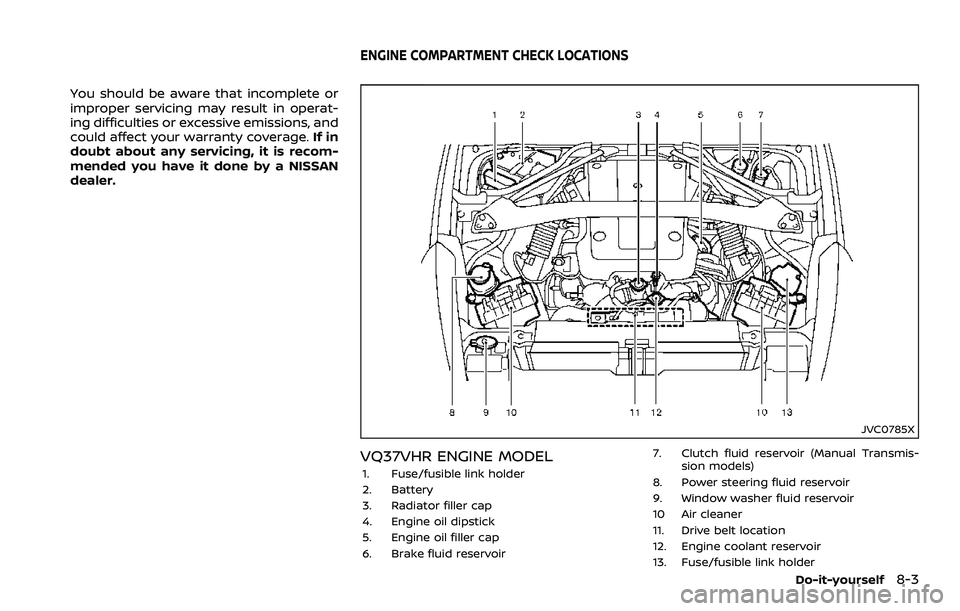
JVC0785X
VQ37VHR ENGINE MODEL
1. Fuse/fusible link holder
2. Battery
3. Radiator filler cap
4. Engine oil dipstick
5. Engine oil filler cap
6. Brake fluid reservoir 7. Clutch fluid reservoir (Manual Transmis-
sion models)
8. Power steering fluid reservoir
9. Window washer fluid reservoir
10 Air cleaner
11. Drive belt location
12. Engine coolant reservoir
13. Fuse/fusible link holder
Do-it-yourself8-3
ENGINE COMPARTMENT CHECK LOCATIONS
Page 372 of 453
8-10Do-it-yourself
WARNING
For NISMO models: Genuine NISSAN
Brake Fluid R35 Special II is the
factory fill brake fluid. The Vehicle
Dynamic Control (VDC) unit and other
related parts were specially de-
signed for this brake fluid. Using
any other non-equivalent brake fluid
may result in improper operation of
the brake system which result in
serious injury or death.
SDI1906A
CLUTCH FLUID (Manual transmis-
sion models)
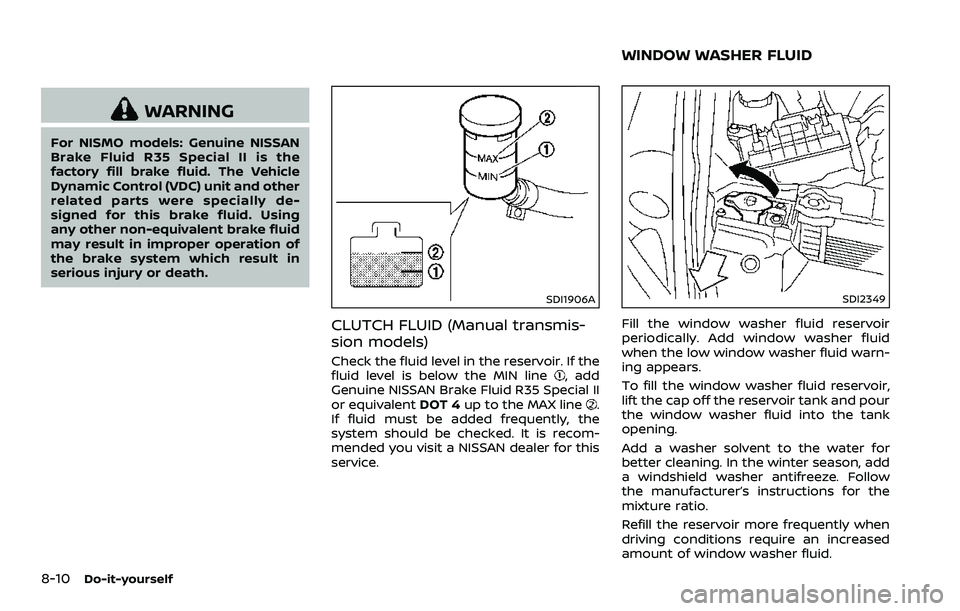
Check the fluid level in the reservoir. If the
fluid level is below the MIN line, add
Genuine NISSAN Brake Fluid R35 Special II
or equivalent DOT 4up to the MAX line
.
If fluid must be added frequently, the
system should be checked. It is recom-
mended you visit a NISSAN dealer for this
service.
SDI2349
Fill the window washer fluid reservoir
periodically. Add window washer fluid
when the low window washer fluid warn-
ing appears.
To fill the window washer fluid reservoir,
lift the cap off the reservoir tank and pour
the window washer fluid into the tank
opening.
Add a washer solvent to the water for
better cleaning. In the winter season, add
a windshield washer antifreeze. Follow
the manufacturer’s instructions for the
mixture ratio.
Refill the reservoir more frequently when
driving conditions require an increased
amount of window washer fluid.
WINDOW WASHER FLUID
Page 373 of 453
Recommended fluid is Genuine NISSAN
Windshield Washer Concentrate Cleaner
& Antifreeze or equivalent.
CAUTION
.Do not substitute engine anti-
freeze coolant for window
washer solution. This may result
in damage to the paint.
. Do not fill the window washer
reservoir tank with washer fluid
concentrates at full strength.
Some methyl alcohol based
washer fluid concentrates may
permanently stain the grille if
spilled while filling the window
washer reservoir tank.
. Pre-mix washer fluid concen-
trates with water to the manu-
facturer’s recommended levels
before pouring the fluid into the
window washer reservoir tank. Do
not use the window washer re-
servoir tank to mix the washer
fluid concentrate and water.
.Keep the battery surface clean and
dry. Clean the battery with a solution
of baking soda and water.
. Make certain the terminal connec-
tions are clean and securely tightened.
. If the vehicle is not to be used for 30
days or longer, disconnect the nega-
tive (−) battery terminal cable to pre-
vent discharging it.
NOTE:
Care should be taken to avoid situations
that can lead to potential battery dis-
charge and potential no-start condi-
tions such as:
1. Installation or extended use of elec-
tronic accessories that consume
battery power when the engine is
not running (Phone chargers, GPS,
DVD players, etc.)
2. Vehicle is not driven regularly and/
or only driven short distances.
In these cases, the battery may need to
be charged to maintain battery health.
CAUTION
When the battery cable is removed
from the battery terminal, do not
close either of front doors. The auto-
matic window adjusting function will
not work, and the side roof panel may be damaged.
To disconnect the negative (−) battery
terminal, perform the procedure in the
following order. Otherwise, the window
and the side roof panel may contact and
be damaged.
1. Close the windows.
2. Open the hood.
3. Close and lock all the doors.
4. Disconnect the negative (−) battery terminal.
5. Securely close the hood.
To connect the negative (−) battery term-
inal, perform the procedure in the follow-
ing order. Otherwise, the window and the
side roof panel may contact and be
damaged.
1. Unlock and open the driver side door. Do not close the door.
2. Open the hood.
3. Connect the negative (−) battery term- inal. Then close the hood.
4. Fully open the driver side door win- dow.
5. Close the driver side door and the window.
Do-it-yourself8-11
BATTERY
Page 421 of 453
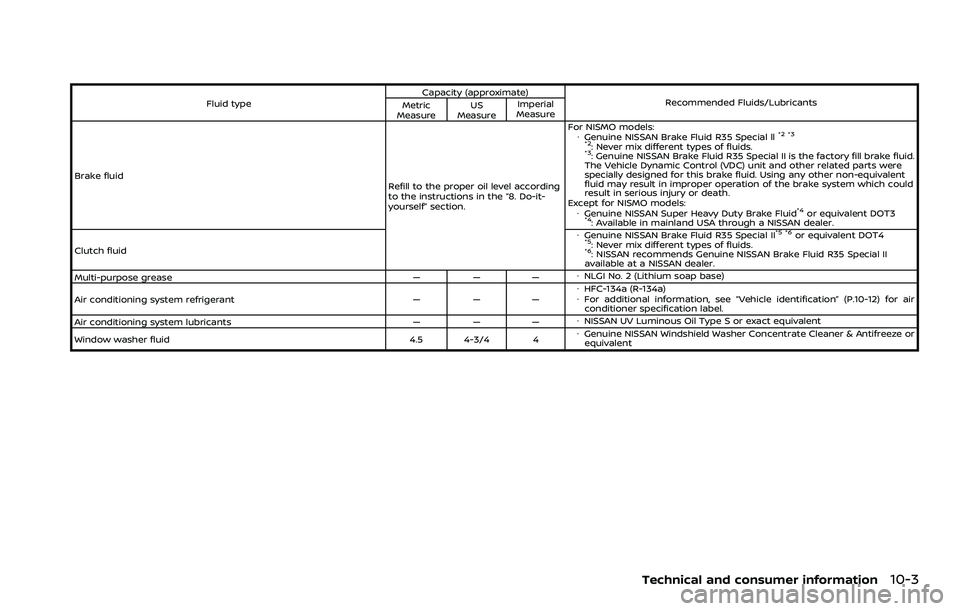
Fluid typeCapacity (approximate)
Recommended Fluids/Lubricants
Metric
Measure US
Measure Imperial
Measure
Brake fluid Refill to the proper oil level according
to the instructions in the “8. Do-it-
yourself” section.For NISMO models:
ÂGenuine NISSAN Brake Fluid R35 Special ll
*2 *3
*2: Never mix different types of fluids.*3: Genuine NISSAN Brake Fluid R35 Special II is the factory fill brake fluid.
The Vehicle Dynamic Control (VDC) unit and other related parts were
specially designed for this brake fluid. Using any other non-equivalent
fluid may result in improper operation of the brake system which could
result in serious injury or death.
Except for NISMO models:
ÂGenuine NISSAN Super Heavy Duty Brake Fluid
*4or equivalent DOT3*4: Available in mainland USA through a NISSAN dealer.
Clutch fluid Â
Genuine NISSAN Brake Fluid R35 Special II*5 *6or equivalent DOT4*5: Never mix different types of fluids.*6: NISSAN recommends Genuine NISSAN Brake Fluid R35 Special II
available at a NISSAN dealer.
Multi-purpose grease — — — Â
NLGI No. 2 (Lithium soap base)
Air conditioning system refrigerant — — — Â
HFC-134a (R-134a)
 For additional information, see “Vehicle identification” (P.10-12) for air
conditioner specification label.
Air conditioning system lubricants — — — Â
NISSAN UV Luminous Oil Type S or exact equivalent
Window washer fluid 4.5 4-3/4 4 Â
Genuine NISSAN Windshield Washer Concentrate Cleaner & Antifreeze or
equivalent
Technical and consumer information10-3
Page 445 of 453
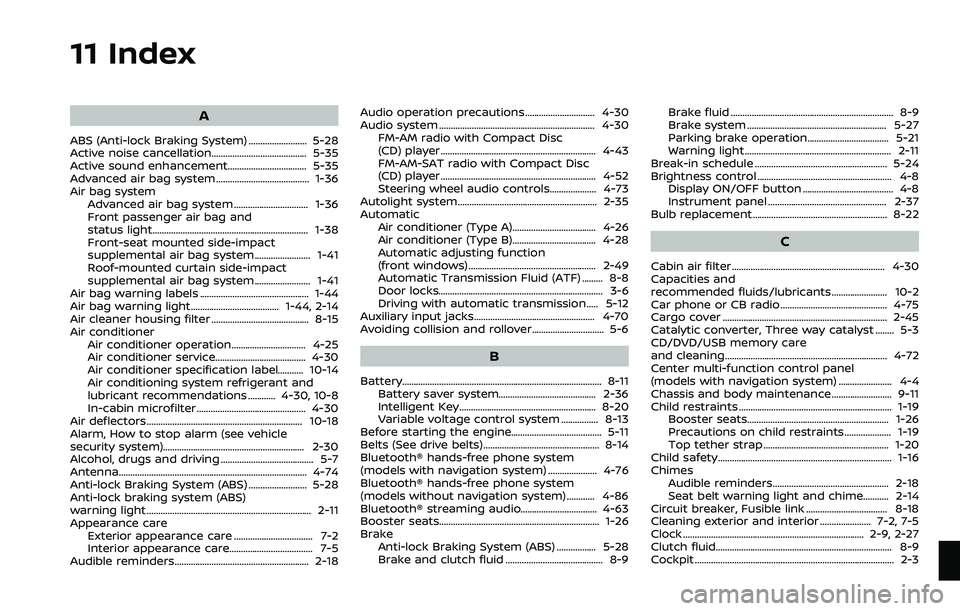
11 Index
A
ABS (Anti-lock Braking System) ......................... 5-28
Active noise cancellation......................................... 5-35
Active sound enhancement.................................. 5-35
Advanced air bag system ........................................ 1-36
Air bag systemAdvanced air bag system ................................ 1-36
Front passenger air bag and
status light................................................................... 1-38
Front-seat mounted side-impact
supplemental air bag system........................ 1-41
Roof-mounted curtain side-impact
supplemental air bag system........................ 1-41
Air bag warning labels ............................................... 1-44
Air bag warning light...................................... 1-44, 2-14
Air cleaner housing filter .......................................... 8-15
Air conditioner Air conditioner operation................................ 4-25
Air conditioner service....................................... 4-30
Air conditioner specification label........... 10-14
Air conditioning system refrigerant and
lubricant recommendations ............ 4-30, 10-8
In-cabin microfilter ............................................... 4-30
Air deflectors ................................................................... 10-18
Alarm, How to stop alarm (see vehicle
security system)............................................................. 2-30
Alcohol, drugs and driving ........................................ 5-7
Antenna........................................................................\
......... 4-74
Anti-lock Braking System (ABS) ......................... 5-28
Anti-lock braking system (ABS)
warning light ....................................................................... 2-11
Appearance care Exterior appearance care .................................. 7-2
Interior appearance care.................................... 7-5
Audible reminders.......................................................... 2-18 Audio operation precautions .............................. 4-30
Audio system ................................................................... 4-30
FM-AM radio with Compact Disc
(CD) player ................................................................... 4-43
FM-AM-SAT radio with Compact Disc
(CD) player ................................................................... 4-52
Steering wheel audio controls.................... 4-73
Autolight system............................................................ 2-35
Automatic Air conditioner (Type A).................................... 4-26
Air conditioner (Type B).................................... 4-28
Automatic adjusting function
(front windows) ....................................................... 2-49
Automatic Transmission Fluid (ATF) ......... 8-8
Door locks....................................................................... 3-6
Driving with automatic transmission..... 5-12
Auxiliary input jacks.................................................... 4-70
Avoiding collision and rollover............................... 5-6
B
Battery........................................................................\
.............. 8-11 Battery saver system.......................................... 2-36
Intelligent Key........................................................... 8-20
Variable voltage control system ................ 8-13
Before starting the engine....................................... 5-11
Belts (See drive belts).................................................. 8-14
Bluetooth® hands-free phone system
(models with navigation system) ..................... 4-76
Bluetooth® hands-free phone system
(models without navigation system) ............ 4-86
Bluetooth® streaming audio................................. 4-63
Booster seats...................................................................\
.. 1-26
Brake Anti-lock Braking System (ABS) ................. 5-28
Brake and clutch fluid .......................................... 8-9 Brake fluid ...................................................................... 8-9
Brake system ............................................................ 5-27
Parking brake operation................................... 5-21
Warning light............................................................... 2-11
Break-in schedule ......................................................... 5-24
Brightness control .......................................................... 4-8 Display ON/OFF button ....................................... 4-8
Instrument panel ................................................... 2-37
Bulb replacement .......................................................... 8-22
C
Cabin air filter .................................................................. 4-30
Capacities and
recommended fluids/lubricants........................ 10-2
Car phone or CB radio .............................................. 4-75
Cargo cover ....................................................................... 2-45
Catalytic converter, Three way catalyst ........ 5-3
CD/DVD/USB memory care
and cleaning...................................................................... 4-72
Center multi-function control panel
(models with navigation system) ....................... 4-4
Chassis and body maintenance.......................... 9-11
Child restraints .................................................................. 1-19 Booster seats............................................................. 1-26
Precautions on child restraints.................... 1-19
Top tether strap ...................................................... 1-20
Child safety........................................................................\
... 1-16
Chimes Audible reminders.................................................. 2-18
Seat belt warning light and chime........... 2-14
Circuit breaker, Fusible link ................................... 8-18
Cleaning exterior and interior ...................... 7-2, 7-5
Clock ........................................................................\
...... 2-9, 2-27
Clutch fluid........................................................................\
.... 8-9
Cockpit ........................................................................\
.............. 2-3