light NISSAN ALTIMA 2019 Owner´s Manual
[x] Cancel search | Manufacturer: NISSAN, Model Year: 2019, Model line: ALTIMA, Model: NISSAN ALTIMA 2019Pages: 592, PDF Size: 7.4 MB
Page 512 of 592
Inside the vehicle
The maintenance items listed here should
be checked on a regular basis, such as
when performing scheduled maintenance,
cleaning the vehicle, etc.
Accelerator pedal:Check the pedal for
smooth operation and make sure the
pedal does not catch or require uneven
effort. Keep the floor mat away from the
pedal.
Brake pedal: Check the pedal for smooth
operation. If the brake pedal suddenly goes
down further than normal, the pedal feels
spongy or the vehicle seems to take longer
to stop, have your vehicle checked imme-
diately. It is recommended that you visit a
NISSAN dealer for this service. Keep the
floor mat away from the pedal.
Brakes: Check that the brakes do not pull
the vehicle to one side when applied.
Continuously Variable Transmission
(CVT) P (Park) position mechanism: On a
fairly steep hill check that the vehicle is held
securely with the shif t lever in the P (Park)
position without applying any brakes.
Parking brake: Check the parking brake
operation regularly. The vehicle should be
securely held on a fairly steep hill with only the parking brake applied. If the parking
brake needs adjustment, it is recom-
mended that you visit a NISSAN dealer for
this service.
Seats:
Check seat position controls such
as seat adjusters, seatback recliner, etc., to
ensure they operate smoothly and all
latches lock securely in every position.
Check that the head restraints/headrests
move up and down smoothly and the locks
(if so equipped) hold securely in all latched
positions.
Seat belts: Check that all parts of the seat
belt system (for example, buckles, anchors,
adjusters and retractors) operate properly
and smoothly, and are installed securely.
Check the belt webbing for cuts, fraying,
wear or damage.
Steering wheel: Check for changes in the
steering system, such as excessive free
play, hard steering or strange noises.
Warning lights and chimes: Make sure all
warning lights and chimes are operating
properly.
Windshield defroster: Check that the air
comes out of the defroster outlets properly
and in sufficient quantity when operating
the heater or air conditioner. Windshield wiper and washer*:
Check
that the wipers and washer operate prop-
erly and that the wipers do not streak.
Under the hood and vehicle
The maintenance items listed here should
be checked periodically (for example, each
time you check the engine oil or refuel).
Battery*: This vehicle is equipped with a
sealed maintenance free battery. It is rec-
ommended that you visit a NISSAN dealer
for service.
NOTE:
Care should be taken to avoid situations
that can lead to potential battery dis-
charge and potential no-start conditions
such as:
1. Installation or extended use of elec-
tronic accessories that consume bat-
tery power when the engine is not
running (Phone chargers, GPS, DVD
players, etc.).
2. Vehicle is not driven regularly and/or
only driven short distances.
In these cases, the battery may need to
be charged to maintain battery health.
9-4Maintenance and schedules
Page 516 of 592
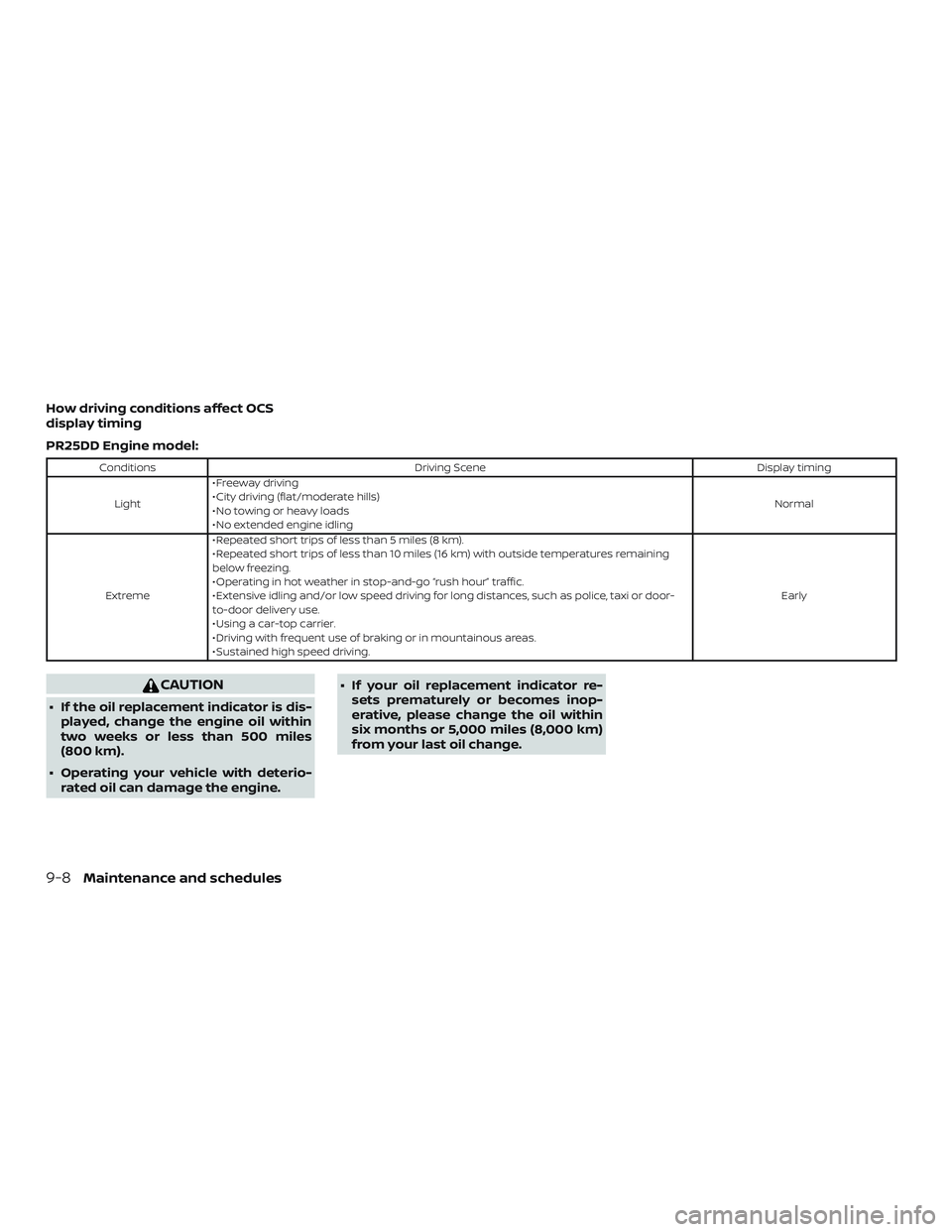
How driving conditions affect OCS
display timing
PR25DD Engine model:
ConditionsDriving Scene Display timing
Light ∙ Freeway driving
∙ City driving (flat/moderate hills)
∙ No towing or heavy loads
∙ No extended engine idling Normal
Extreme ∙ Repeated short trips of less than 5 miles (8 km).
∙ Repeated short trips of less than 10 miles (16 km) with outside temperatures remaining
below freezing.
∙ Operating in hot weather in stop-and-go “rush hour” traffic.
∙ Extensive idling and/or low speed driving for long distances, such as police, taxi or door-
to-door delivery use.
∙ Using a car-top carrier.
∙ Driving with frequent use of braking or in mountainous areas.
∙ Sustained high speed driving. Early
CAUTION
∙ If the oil replacement indicator is dis-
played, change the engine oil within
two weeks or less than 500 miles
(800 km).
∙ Operating your vehicle with deterio- rated oil can damage the engine. ∙ If your oil replacement indicator re-
sets prematurely or becomes inop-
erative, please change the oil within
six months or 5,000 miles (8,000 km)
from your last oil change.
9-8Maintenance and schedules
Page 517 of 592
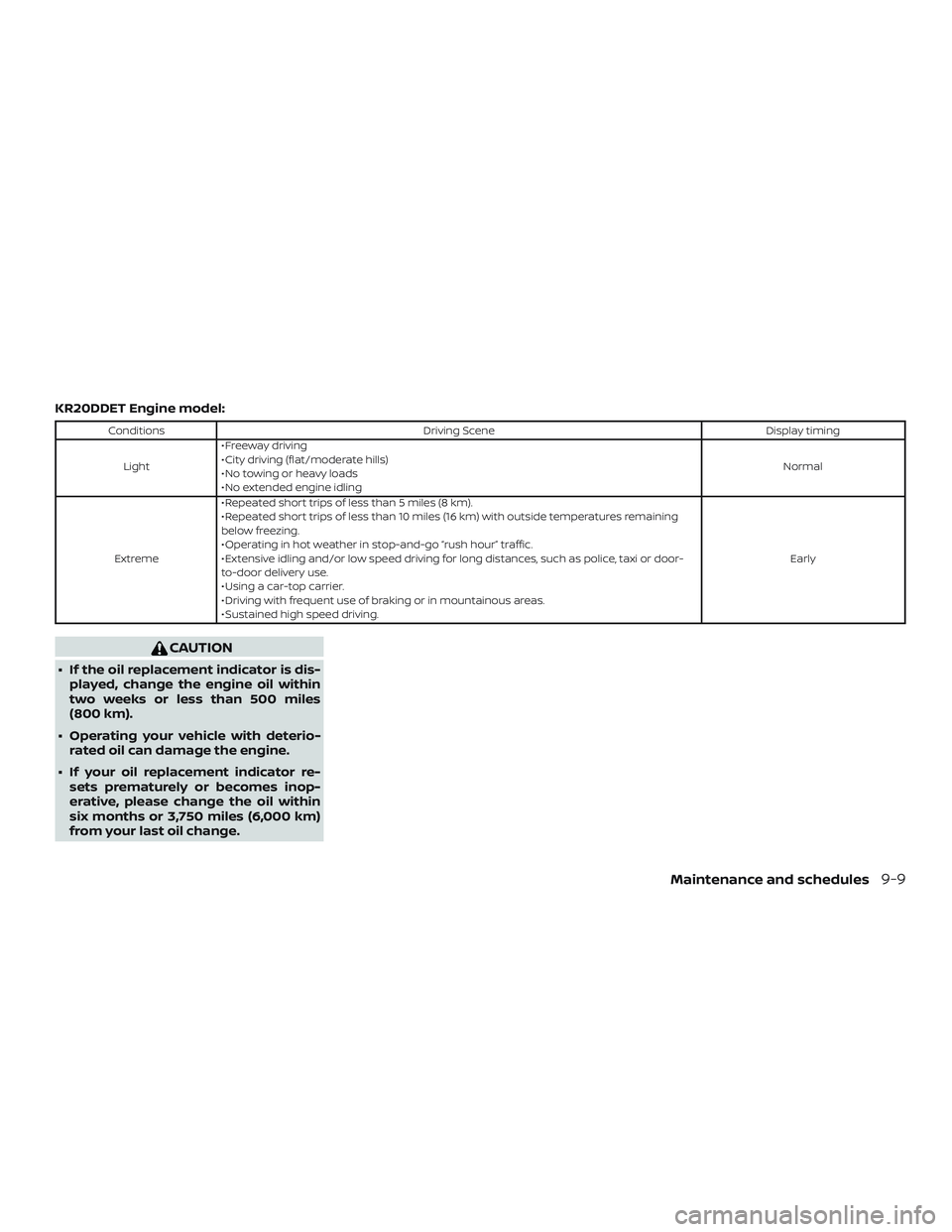
KR20DDET Engine model:
ConditionsDriving Scene Display timing
Light ∙ Freeway driving
∙ City driving (flat/moderate hills)
∙ No towing or heavy loads
∙ No extended engine idling Normal
Extreme ∙ Repeated short trips of less than 5 miles (8 km).
∙ Repeated short trips of less than 10 miles (16 km) with outside temperatures remaining
below freezing.
∙ Operating in hot weather in stop-and-go “rush hour” traffic.
∙ Extensive idling and/or low speed driving for long distances, such as police, taxi or door-
to-door delivery use.
∙ Using a car-top carrier.
∙ Driving with frequent use of braking or in mountainous areas.
∙ Sustained high speed driving. Early
CAUTION
∙ If the oil replacement indicator is dis-
played, change the engine oil within
two weeks or less than 500 miles
(800 km).
∙ Operating your vehicle with deterio- rated oil can damage the engine.
∙ If your oil replacement indicator re- sets prematurely or becomes inop-
erative, please change the oil within
six months or 3,750 miles (6,000 km)
from your last oil change.
Maintenance and schedules9-9
Page 536 of 592
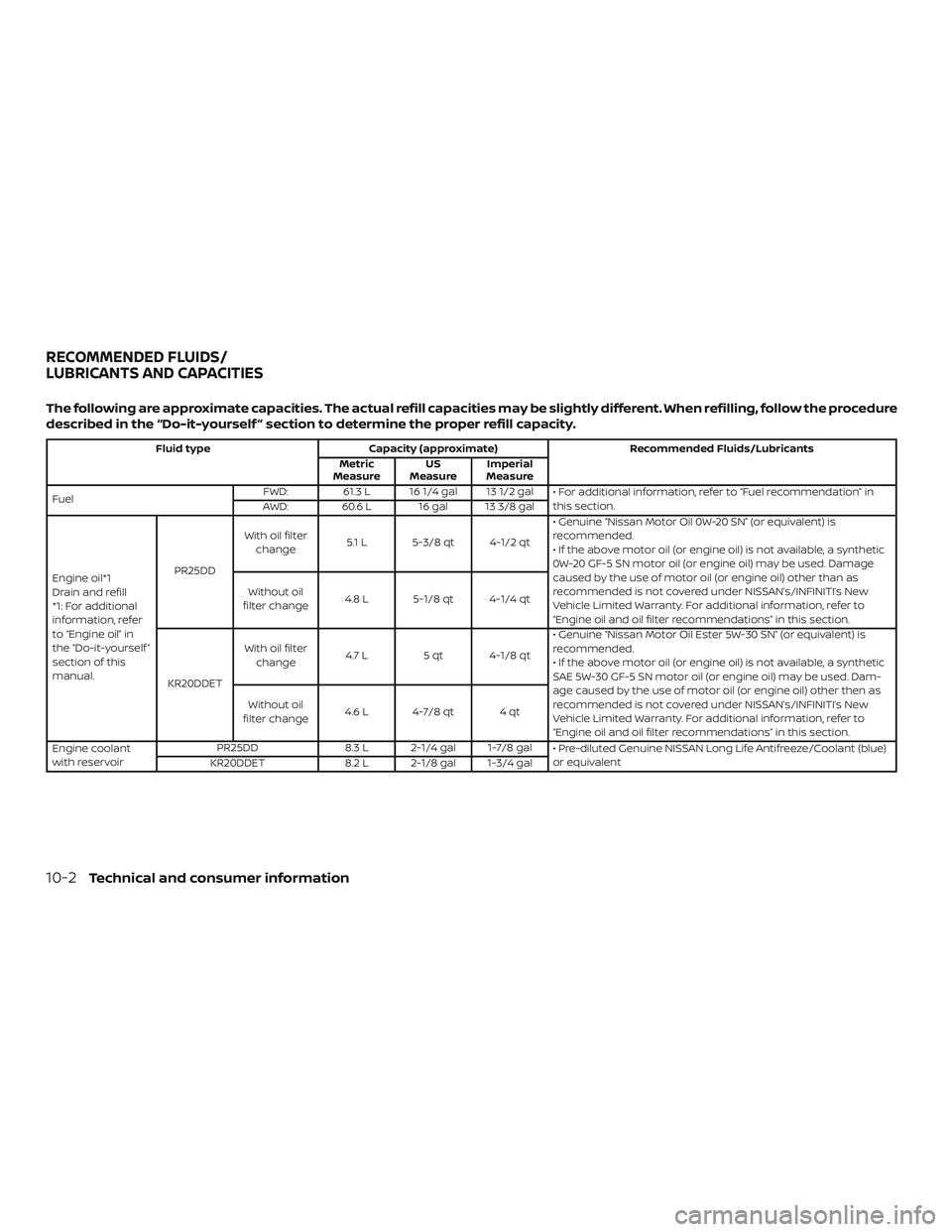
The following are approximate capacities. The actual refill capacities may be slightly different. When refilling, follow the procedure
described in the “Do-it-yourself ” section to determine the proper refill capacity.
Fluid typeCapacity (approximate) Recommended Fluids/Lubricants
Metric
Measure US
Measure Imperial
Measure
Fuel FWD:
61.3 L 16 1/4 gal 13 1/2 gal
• For additional information, refer to “Fuel recommendation” in
this section.
AWD: 60.6 L 16 gal 13 3/8 gal
Engine oil*1
Drain and refill
*1: For additional
information, refer
to “Engine oil” in
the “Do-it-yourself ”
section of this
manual. PR25DD
With oil filter
change 5.1 L 5-3/8 qt 4-1/2 qt • Genuine “Nissan Motor Oil 0W-20 SN” (or equivalent) is
recommended.
• If the above motor oil (or engine oil) is not available, a synthetic
0W-20 GF-5 SN motor oil (or engine oil) may be used. Damage
caused by the use of motor oil (or engine oil) other than as
recommended is not covered under NISSAN’s/INFINITI’s New
Vehicle Limited Warranty. For additional information, refer to
“Engine oil and oil filter recommendations” in this section.
Without oil
filter change 4.8 L 5-1/8 qt 4-1/4 qt
KR20DDET With oil filter
change 4.7 L
5 qt 4-1/8 qt • Genuine “Nissan Motor Oil Ester 5W-30 SN” (or equivalent) is
recommended.
• If the above motor oil (or engine oil) is not available, a synthetic
SAE 5W-30 GF-5 SN motor oil (or engine oil) may be used. Dam-
age caused by the use of motor oil (or engine oil) other then as
recommended is not covered under NISSAN’s/INFINITI’s New
Vehicle Limited Warranty. For additional information, refer to
“Engine oil and oil filter recommendations” in this section.
Without oil
filter change 4.6 L 4-7/8 qt 4 qt
Engine coolant
with reservoir PR25DD
8.3 L 2-1/4 gal 1-7/8 gal
• Pre-diluted Genuine NISSAN Long Life Antifreeze/Coolant (blue)
or equivalent
KR20DDET 8.2 L 2-1/8 gal 1-3/4 gal
RECOMMENDED FLUIDS/
LUBRICANTS AND CAPACITIES
10-2Technical and consumer information
Page 540 of 592
Octane rating tips
Using unleaded gasoline with an octane
rating lower than recommended can
cause persistent, heavy “spark knock.”
(“Spark knock” is a metallic rapping
noise.) If severe, this can lead to engine
damage. If you detect a persistent heavy
spark knock even when using gasoline
of the stated octane rating, or if you hear
steady spark knock while holding a
steady speed on level roads, it is recom-
mended that you have a NISSAN dealer
correct the condition. Failure to correct
the condition is misuse of the vehicle, for
which NISSAN is not responsible.
Incorrect ignition timing may result in
spark knock, af ter-run and/or overheating,
which may cause excessive fuel consump-
tion or engine damage. If any of the above
symptoms are encountered, have your ve-
hicle checked. It is recommended that you
visit a NISSAN dealer for servicing.
However, now and then you may notice
light spark knock for a short time while
accelerating or driving up hills. This is not
a cause for concern, because you get the
greatest fuel benefit when there is light
spark knock for a short time under heavy
engine load.
ENGINE OIL AND OIL FILTER
RECOMMENDATIONS
Selecting the correct oil
It is essential to choose the correct grade,
quality and viscosity engine oil to ensure
satisfactory engine life and performance.
For additional information, refer to “Recom-
mended fluids/lubricants and capacities”
in this section. NISSAN recommends the
use of an energy conserving oil in order to
improve fuel economy.
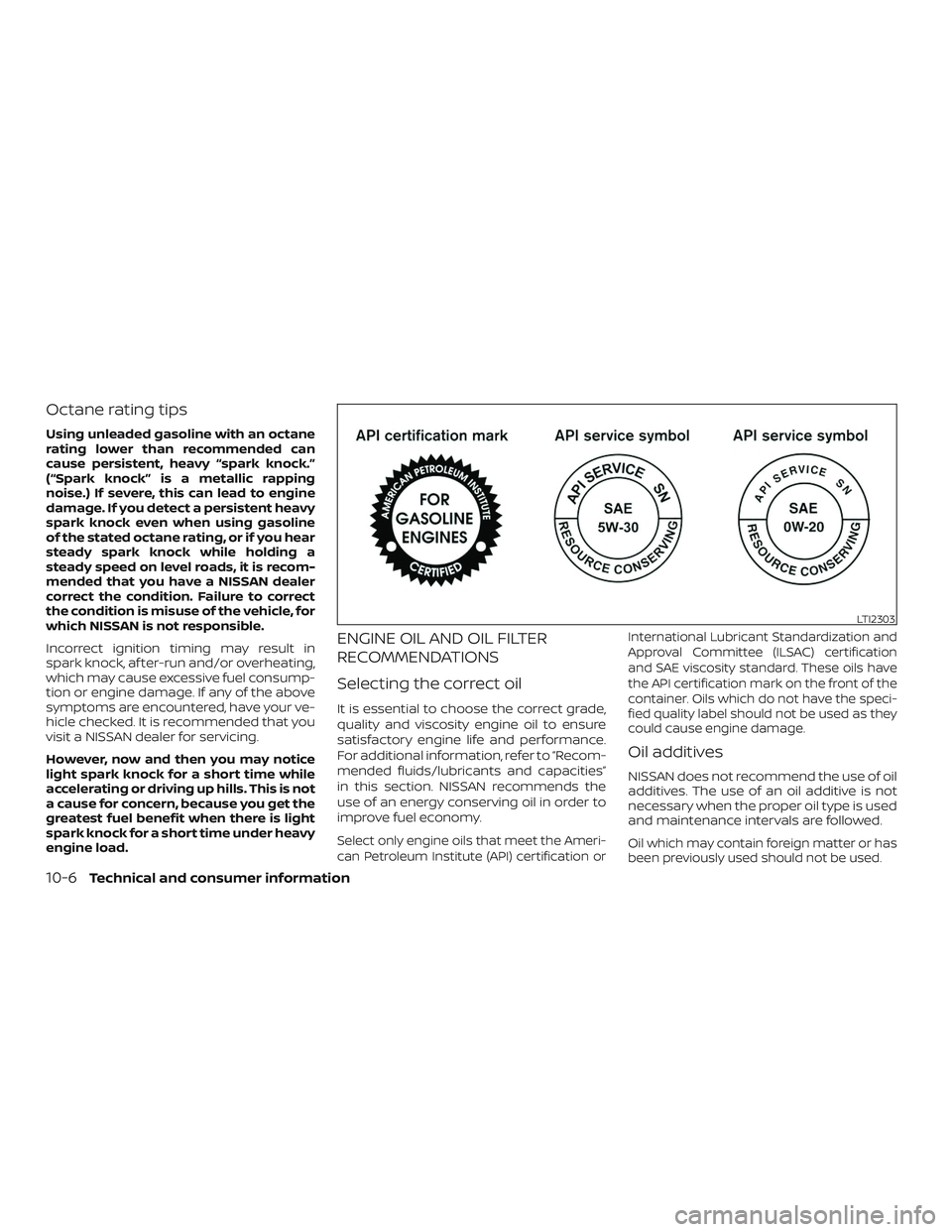
Select only engine oils that meet the Ameri-
can Petroleum Institute (API) certification orInternational Lubricant Standardization and
Approval Committee (ILSAC) certification
and SAE viscosity standard. These oils have
the API certification mark on the front of the
container. Oils which do not have the speci-
fied quality label should not be used as they
could cause engine damage.
Oil additives
NISSAN does not recommend the use of oil
additives. The use of an oil additive is not
necessary when the proper oil type is used
and maintenance intervals are followed.
Oil which may contain foreign matter or has
been previously used should not be used.
LTI2303
10-6Technical and consumer information
Page 554 of 592
WARNING
A vehicle equipped with All -Wheel Drive
(AWD) should never be tested using a
two wheel dynamometer (such as the
dynamometers used by some states for
emissions testing), or similar equip-
ment. Make sure you inform the test fa-
cility personnel that your vehicle is
equipped with AWD before it is placed
on a dynamometer. Using the wrong
test equipment may result in drivetrain
damage or unexpected vehicle move-
ment which could result in serious ve-
hicle damage or personal injury.
Due to legal requirements in some states
and Canadian Provinces, your vehicle
may be required to be in what is called
the “ready condition” for an Inspection/
Maintenance (I/M) test of the emission
control system.
The vehicle is set to the “ready condition”
when it is driven through certain driving
patterns. Usually, the ready condition can
be obtained by ordinary usage of the ve-
hicle. If a powertrain system component is re-
paired or the battery is disconnected, the
vehicle may be reset to a “not ready” condi-
tion. Before taking the I/M test, check the
vehicle’s inspection/maintenance test
readiness condition. Place the ignition
switch in the ON position without starting
the engine. If the Malfunction Indicator
Light (MIL) comes on steady for 20 seconds
and then blinks for 10 seconds , the I/M test
condition is “not ready”. If the MIL does not
blink af ter 20 seconds, the I/M test condi-
tion is “ready”. It is recommended that you
visit a NISSAN dealer to set the “ready con-
dition” or to prepare the vehicle for testing.
This vehicle is equipped with an EDR. The
main purpose of an EDR is to record, in
certain collision or near collision-like situa-
tions, such as an air bag deployment or
hitting a road obstacle, data that will assist
in understanding how a vehicle’s systems
performed. The EDR is designed to record
data related to vehicle dynamics and
safety systems for a short period of time,
typically 30 seconds or less. The EDR in this
vehicle is designed to record such data as:
∙ How various systems in your vehicle were operating;
∙ Whether or not the driver and passen- ger safety belts were buckled/fastened;
∙ How far (if at all) the driver was depress- ing the accelerator and/or brake pedal;
and,
∙ How fast the vehicle was traveling.
∙ Sounds are not recorded.
READINESS FOR INSPECTION/
MAINTENANCE (I/M) TEST EVENT DATA RECORDERS (EDR)
10-20Technical and consumer information
Page 557 of 592
11 Index
A
Active noise cancellation Active sound
enhancement ..........5-184,5-184
ActiveRideControl(ARC)..........5-175
Air bag (See supplemental restraint
system) .................... .1-46
Air bag system Front (See supplemental front impact
airbagsystem)..............1-53
Airbagwarninglight..........1-66, 2-15
Air bag warning light,
supplemental ..............1-66, 2-15
Air cleaner housing filter ..........8-19
Air conditioner Air conditioner operation ....4-32,4-38
Air conditioner specification label . .10-12
Air conditioner system refrigerant
and oil recommendations .......10-7
Air conditioner system refrigerant
recommendations ............10-7
Heater and air conditioner
controls...............4-29,4-38
Servicing air conditioner ........4-41
Air flow charts .................4-33
Alarm system
(See vehicle security system) .......2-39
All-Wheel Drive .............5-166,6-14
Anchor point locations ...........1-28
Antenna ....................4-42
Antifreeze ...................5-181 Anti-lock brake warning light
........2-10
Anti-lock Braking System (ABS) ......5-171
Armrests.................... .1-7
Audible reminders ..............2-18
Autolightswitch ...............2-44
Automatic Automatic drive
positioner ...........3-33,3-34,3-35
Automatic power window switch . . .2-61
Automatic anti-glare inside mirror . . . .3-32
Automaticbrakehold............5-28
Automatic door locks .............3-7
Automatic drive positioner . .3-33, 3-34, 3-35
Automatic Emergency Braking
(AEB) ................2-10,2-14,5-130
Automatic Emergency Braking (AEB) with
Pedestrian Detection ............5-139
AWD...................5-166,6-14
B
Battery .................5-181,8-15 Charge warning light ...........2-11
Battery replacement ............8-24
Keyfob...................8-24
NISSAN Intelligent Key® .........8-25
Before starting the engine .........5-16
Belt(Seedrivebelt)..............8-17
Blind Spot Warning (BSW) ..........5-45
Booster seats .................1-42
Brake Anti-lock Braking System (ABS) ....5-171 Brakefluid.................8-13
Brakelight(Seestoplight).......8-27
Brakesystem...............5
-170
Brakewarninglight............2-11
Brakewearindicators.......2-18,8-21
Parking brake operation ........5-25
Self-adjustingbrakes ..........8-21
Brake Assist ..................5-172
Brakefluid...................8-13
Brakes......................8-21
Brakesystem.................5 -170
Break-in schedule ..............5-164
Brightness control Instrument panel .............2-49
Bulb check/instrument panel .......2-10
Bulb replacement ..............8-27
C
Capacities and recommended
fuel/lubricants.................10-2
Ca
rgo
(See vehicle loading information) .....10-13
Car phone or CB radio ...........4-42
Chassis control ...............5 -175
Check tire pressure .............2-34
Childrestraints.......1-21, 1-22, 1-23, 1-26 LATCH (Lower Anchors and Tethers for
CHildren)System.............1-26
Precautions on child
restraints.........1-23, 1-31, 1-38, 1-43
Page 558 of 592
Top tether strap anchor point
locations...................1-28
Child safety rear door lock ..........3-7
Chimes, audible reminders .........2-18
Cleaningexteriorandinterior......7-2,7-4
C.M.V.S.S. certification label .........10-11
Coldweatherdriving.............5-181
Console box ..................2-57
Continuously Variable Transmission
(CVT) .......................5-18
Continuously Variable Transmission
(CVT) fluid ..................8-13
Driving with Continuously Variable
Transmission (CVT) ............5-18
Controls Heater and air conditioner
controls................4-29,4-38
Coolant Capacities and recommended
fuel/lubricants...............10-2
Changing engine coolant .........8-7
Checking engine coolant level ......8-7
Engine coolant temperature gauge . .2-6
Corrosionprotection..............7-7
Cruisecontrol.................5-64
Cupholders...............2-58,2-59
D
Daytime Running Light System ......2-48
Defroster switch Rear window and outside mirror
defrosterswitch..............2-43
Dimensions and weights ...........10-9
Dimmer switch for instrument panel . . .2-49 Door locks
..................3-4,3-5
Drivebelt.....................8-17
Drive positioner, Automatic . . .3-33, 3-34, 3-35
Driving Cold weather driving ...........5-181
Driving with Continuously Variable
Transmission (CVT) ............5-18
Precautions when starting and
driving..................5-4,5-11
Drivingthevehicle...............5-18
E
E-CALL (SOS) SWITCH .............2-53
Economy - fuel ................5-165
Emergency engine shutoff .......5-15,6-2
Emission control information label . . . .10-12
Emission control system warranty . . . .10-18
Engine Before starting the engine ........5-16
Capacities and recommended
fuel/lubricants...............10-2
Changing engine coolant .........8-7
Changing engine oil ............8-9
Changing engine oil filter .........8-9
Checking engine coolant level ......8-7
Checking engine oil level .........8-8
Engine compartment check
locations...................8-4
Engine coolant temperature gauge . .2-6
Engine cooling system ..........8-6
Engine oil ...................8-8
Engine oil and oil filter
recommendation .............10-6
Engine oil pressure warning light ....2-12Engine oil viscosity
.............10-7
Engine serial number ...........10-11
Engine specifications ...........10-8
Starting the engine ............5-17
Engine Block Heater .............5-183
Engine coolant temperature gauge ....2-6
EventDatarecorders.........10-20,10-21
Exhaust gas (Carbon monoxide) .......5-4
Explanation of maintenance items .....9-3
Explanation of scheduled maintenance
items .......................9-5
Extended storage switch ..........2-55
Eyeglasscase.................2-58
F
Flashers
(Seehazardwarningflasherswitch)....6-2
Flattire....................6-3,6-4
Floormatpositioningaid...........7-6
Fluid Brakefluid..................8-13
Capacities and recommended
fuel/lubricants...............10-2
Continuously Variable Transmission
(CVT) fluid ..................8-13
Engine coolant ...............
8-6
Engine oil ...................8-8
Windshield-washer fluid .........8-14
F.M.V.S.S. certification label ..........10-11
Foglightswitch................2-50
Front air bag system (See supplemental
restraintsystem)................1-53
Front-door pocket ..............2-56
Front power seat adjustment ........1-4
11-2
Page 559 of 592
Frontseats....................1-2
Fuel Capacities and recommended
fuel/lubricants...............10-2
Fuel economy ...............5-165
Fuel-filler door and cap ..........3-27
Fuel-filler door lock opener lever ....3-27
Fuel gauge ..................2-7
Fueloctanerating.............10-6
Fuel recommendation ..........10-4
Loose fuel cap warning .........2-34
Fuelefficientdrivingtips..........5-164
Fuel-filler door .................3-27
Fuel gauge ....................2-7
Fuses .......................8-22
Fusiblelinks...................8-23
G
Garage door opener, HomeLink® Universal
Transceiver ......2-66,2-68,2-69,2-69,2-70
Gascap.....................3-27
Gauge Engine coolant temperature gauge . .2-6
Fuel gauge ..................2-7
Odometer ..................2-5
Speedometer ..............2-4,2-5
Tachometer .................2-6
Trip odometer .............2-4,2-5
General maintenance .............9-3
Glovebox....................2-57
Gloveboxlock.................2-57 H
Hazard warning flasher switch ........6-2
Headlight and turn signal switch ......2-43
Headlightcontrolswitch...........2-43
Headlights ...................8-26
Headrestraints................. .1-7
Heated seat switches .............2-51
Heated steering wheel ............2-52
Heater Heater and air conditioner
controls................4-29,4-38
Heater operation ..........4-30,4-39
Hill start assist system ...........5-176
HomeLink® Universal
Transceiver ......2-66,2-68,2-69,2-69,2-70
Hood ...................... .3-24
Horn.......................2-50
I
Ignition switch Push-button ignition switch .......5-13
Immobilizer system ..........2-40,5-16
Important vehicle information label . . . .10-11
In-cabinmicrofilter ..............8-19
Increasing fuel economy ..........5-165
Indicator NISSAN Intelligent Key® battery discharge
indicator...................5-15
Indicator lights and audible reminders
(See warning/indicator lights and audible
reminders) ....................2-15
Inside automatic anti-glare mirror .....3-32
Instrument brightness control .......2-49Instrument panel
.............0-6,2-2
Instrument panel dimmer switch .....2-49
Intelligent Around View Monitor .......4-11
Intelligent Cruise Control (ICC)
(for vehicles without ProPILOT Assist) . . .5-67
Intelligent Cruise Control (ICC)
(for vehicles with ProPILOT Assist) ....5-103
Intelligent Driver Alertness (I-DA) .....5-160
Intelligent Forward Collision Warning
(I-FCW).....................5-148
Intelligent Key system Key operating range ............3-9
Key operation ................3-10
Mechanical key ...............3-3
Remote keyless entry operation ....3-14
Troubleshooting guide ..........3-18
W
arning signals ..............3-18
Intelligent Lane Intervention (I-LI) .....5-39
Intelligent Trace Control (I-TC) .......5-175
Interiorlight...................2-64
Interiortrunklidrelease...........3-26
ISOFIX child restraints .............1-26
J
Jumpstarting...............6-9,8-16
K
Key........................ .3-2
Key fob battery replacement ........8-24
Keyless entry With Intelligent Key system
(See Intelligent Key system) .......3-14
11-3
Page 560 of 592
KeysNISSAN Intelligent Key® ..........3-2
NISSAN Vehicle Immobilizer System
keys......................3-4
L
Label Tire and Loading Information label . .10-12
Labels Air conditioner specification label . . .10-12
C.M.V.S.S. certification label .......10-11
Emission control information label . .10-12
Engine serial number ...........10-11
F.M.V.S.S. certification label ........10-11
Tire and Loading Information label . .10-12
Vehicle identification number (VIN) . .10-10
Vehicle identification number (VIN)
plate.....................10-10
Warning labels (for SRS) .........1-66
Lane Departure Warning (LDW) .......5-34
LATCH (Lower Anchors and Tethers for
CHildren)System............... .1-26
License plate Installing the license plate .......10-13
Light Airbagwarninglight........1-66, 2-15
Brakelight(Seestoplight)........8-27
Bulb check/instrument panel ......2-10
Bulb replacement .............8-27
Charge warning light ...........2-11
ExteriorandInteriorlights........8-27
Foglights..................8-27
Foglightswitch..............2-50
Headlight and turn signal switch ....2-43Headlightcontrolswitch.........2-43
Headlights .................8-26
Interiorlight.................2-64
Lightbulbs.................8-26
Low tire pressure warning light
.....2-12
Low windshield-washer fluid warning
light......................2-34
Personal lights ...............2-65
Security indicator light ..........2-17
Spotlights(Seemaplight)........2-65
Trunklight..................2-65
Warning/indicator lights and audible
reminders ..................2-15
Lights......................8-26 Maplights..................2-65
Lock Child safety rear door lock ........3-7
Door locks ................3-4,3-5
Fuel-filler door lock opener lever ....3-27
Gloveboxlock...............2-57
Power door locks ..............3-6
Trunk lid lock opener lever ........3-25
Loose fuel cap warning ...........2-34
Lowfuelwarninglight.........2-14,2-34
Low tire pressure warning light .......2-12
Low windshield-washer fluid warning
light........................2-34
Luggage
(See vehicle loading information) .....10-13
M
Maintenance General maintenance ...........9-3
Insidethevehicle..............9-4 Maintenance precautions
.........8-2
Outsidethevehicle.............9-3
Seat belt maintenance ..........1-20
Under the hood and vehicle .......9-4
Maintenance log ................9-20
Maintenance requirements ..........9-2
Maintenance schedules .........9-7,9-7
Maintenance under severe operation
conditions.................9-14,9-19
Malfunctionindicatorlight..........2-16
Manual front seat adjustment ........1-3
Maplights....................2-65
Memory Seat ...........3-33,3-34,3-35
Meters and gauges ...............2-4
Instrument brightness control .....2-49
Mirror Automatic anti-glare inside mirror . . .3-32
Outsidemirrors..............3-32
Rearview...................3-31
Vanitymirror................3-31
Mirrors......................3-31
Moonroof ..................2-62, 7-5
Moving Object Detection (MOD) ......4-23
N
NissanConnect® Owner's Manual ......
4-2
NISSAN Intelligent Key® ............3-2
NISSAN Intelligent Key® battery discharge
indicator.....................5-15
NISSAN Vehicle Immobilizer
System..................2-40,5-16
11-4