fuel cap NISSAN ALTIMA 2020 Owner´s Manual
[x] Cancel search | Manufacturer: NISSAN, Model Year: 2020, Model line: ALTIMA, Model: NISSAN ALTIMA 2020Pages: 559, PDF Size: 6.3 MB
Page 502 of 559
fuel fumes are evident, check for the cause
and have it corrected immediately.
Radiator and hoses:Check the front of the
radiator and clean off any dirt, insects,
leaves, etc., that may have accumulated.
Make sure the hoses have no cracks, defor-
mation, rot or loose connections.
Underbody: The underbody is frequently
exposed to corrosive substances such as
those used on icy roads or to control dust. It
is very important to remove these sub-
stances, otherwise rust may form on the
floor pan, frame, fuel lines and around the
exhaust system. At the end of winter, the
underbody should be thoroughly flushed
with plain water, being careful to clean
those areas where mud and dirt may accu-
mulate. For additional information, refer to
the “Appearance and care” section of this
manual.
Windshield-washer fluid*: Check that
there is adequate fluid in the reservoir. The following descriptions are provided to
give you a better understanding of the
scheduled maintenance items that should
be regularly checked or replaced. The
maintenance schedule indicates at which
mileage/time intervals each item requires
service.
In addition to scheduled maintenance,
your vehicle requires that some items be
checked during normal day-to-day opera-
tion. For additional information, refer to
“General maintenance” in this section.
Items marked with
“*”are recommended
by NISSAN for reliable vehicle operation.
You are not required to perform mainte-
nance on these items in order to maintain
the warranties which come with your
NISSAN. Other maintenance items and in-
tervals are required.
When applicable, additional information
can be found in the “Do-it-yourself ” section
of this manual. NOTE:
NISSAN does not advocate the use of
non-OEM approved af termarket flush-
ing systems and strongly advises
against performing these services on a
NISSAN product. Many of the af termar-
ket flushing systems use non-OEM ap-
proved chemicals or solvents, the use of
which has not been validated by NISSAN.
For recommended fuel, lubricants, fluids,
grease, and refrigerant, refer to “Recom-
mended fluids/lubricants and capaci-
ties” in the “Technical and consumer in-
formation” section of this manual.
EMISSION CONTROL SYSTEM
MAINTENANCE:
Drive belts*:
Check engine drive belts for
wear, fraying or cracking and for proper
tension. Replace any damaged drive belts.
Engine air filter: Replace at specified inter-
vals. When driving for prolonged periods in
dusty conditions, check/replace the filter
more frequently.
EXPLANATION OF SCHEDULED
MAINTENANCE ITEMS
Maintenance and schedules9-5
Page 503 of 559
Engine coolant*:Replace coolant at the
specified interval. When adding or replac-
ing coolant, be sure to use only Genuine
NISSAN Long Life Antifreeze/Coolant (blue)
or equivalent with the proper mixture. (For
additional information on the proper mix-
ture for your area, refer to “Engine cooling
system” in the “Do-it-yourself ” section of
this manual.)
NOTE: Mixing any other type of coolant
or the use of non-distilled water may re-
duce the recommended service interval
of the coolant.
Engine oil and oil filter: Replace engine oil
and oil filter at the specified intervals. For
recommended oil grade and viscosity refer
to “Recommended fluids/lubricants and
capacities” in the “Technical and consumer
information” section of this manual.
Engine valve clearance*: Inspect only if
valve noise increases. Adjust valve clear-
ance if necessary.
Evaporative emissions control vapor
lines*: Check vapor lines for leaks or loose-
ness. Tighten connections or replace parts
as necessary.
Fuel filter: Periodic maintenance is not re-
quired. (in-tank type filter) Fuel lines*:
Check the fuel hoses, piping
and connections for leaks, looseness, or
deterioration. Tighten connections or re-
place parts as necessary.
Spark plugs: Replace at specified intervals.
Install new plugs of the type as originally
equipped.
CHASSIS AND BODY
MAINTENANCE:
Brake lines and cables: Visually inspect for
proper installation. Check for chafing,
cracks, deterioration, and signs of leaking.
Replace any deteriorated or damaged
parts immediately.
Brake pads and rotors: Check for wear,
deterioration and fluid leaks. Replace any
deteriorated or damaged parts immedi-
ately.
Exhaust system: Visually inspect the ex-
haust pipes, muffler and hangers for leaks,
cracks, deterioration, and damage. Tighten
connections or replace parts as necessary.
Propeller shaf t(s): Check for damage,
looseness, and grease leakage. (AWD) In-cabin microfilter:
Replace at specified
intervals. When driving for prolonged peri-
ods in dusty conditions, replace the filter
more frequently.
Steering gear and linkage, axle and sus-
pension parts, drive shaf t boots: Check
for damage, looseness, and leakage of oil
or grease. Under severe driving conditions,
inspect more frequently.
Tire rotation: PR25DD Engine model; Tires
should be rotated every 5,000 miles
(8,000 km) according to the instructions
under “Explanation of general mainte-
nance items” in this section. When rotating
tires, check for damage and uneven wear.
Replace if necessary.
KR20DDET Engine model; Tires should be
rotated every 7,500 miles (12,000 km) ac-
cording to the instructions under “Explana-
tion of general maintenance items” in this
section. When rotating tires, check for
damage and uneven wear. Replace if nec-
essary.
Transmission fluid/oil, differential oil,
and transfer case oil: Visually inspect for
signs of leakage at specified intervals.
Replace at specified intervals.
9-6Maintenance and schedules
Page 522 of 559
10 Technical and consumer information
Recommended fluids/lubricants and
capacities...................................... 10-2
Fuel recommendation ....................... 10-4
Engine oil and oil filter
recommendations .......................... 10-7
Air conditioner system refrigerant and
oil recommendations .......................10-8
Specifications .................................. 10-9
Engine ...................................... 10-9
Wheels and tires ............................ 10-10
Dimensions and weights ...................10-10
When traveling or registering in another
country ......................................... 10-11
Vehicle identification ........................... 10-11
Vehicle Identification Number (VIN)
plate ........................................ 10-11
Vehicle identification number
(chassis number) ............................ 10-11
Engine serial number ....................... 10-12
F.M.V.S.S./C.M.V.S.S. certification label ........10-12
Emission control information label .........10-13 Tire and Loading Information label
.........10-13
Air conditioner specification label ...........10-13
Installing front license plate ....................10-14
Vehicle loading information ...................10-14
Terms ...................................... 10-14
Vehicle load capacity ....................... 10-15
Loading tips ................................ 10-17
Measurement of weights ...................10-17
Towing a trailer ................................ 10-18
Flat towing ................................. 10-18
Uniform tire quality grading ....................10-18
Emission control system warranty .............10-19
Reporting safety defects ......................10-20
Readiness for Inspection/Maintenance (I/M)
test ............................................ 10-21
Event Data Recorders (EDR) ....................10-21
Additional Data Recording (on vehicles
equipped with optional ProPILOT
Assist) ...................................... 10-22
Owner’s Manual/Service Manual order
inf
ormation ................................... 10-23
Page 523 of 559
The following are approximate capacities. The actual refill capacities may be slightly different. When refilling, follow the procedure
described in the “Do-it-yourself ” section to determine the proper refill capacity.
Fluid typeCapacity (approximate) Recommended Fluids/Lubricants
Metric
Measure US
Measure Imperial
Measure
Fuel FWD:
61.3 L 16 1/4 gal 13 1/2 gal
• For additional information, refer to “Fuel recommendation” in
this section.
AWD: 60.6 L 16 gal 13 3/8 gal
Engine oil*1
Drain and refill
*1: For additional
information, refer
to “Engine oil” in
the “Do-it-yourself ”
section of this
manual. PR25DD
With oil filter
change 5.1 L 5-3/8 qt 4-1/2 qt • Genuine “Nissan Motor Oil 0W-20 SN” (or equivalent) is
recommended.
• If the above motor oil (or engine oil) is not available, a synthetic
0W-20 GF-5 SN motor oil (or engine oil) may be used. Damage
caused by the use of motor oil (or engine oil) other than as rec-
ommended is not covered under NISSAN’s New Vehicle Limited
Warranty. For additional information, refer to “Engine oil and oil
filter recommendations” in this section.
Without oil
filter change 4.8 L 5-1/8 qt 4-1/4 qt
KR20DDET With oil filter
change 4.7 L
5 qt 4-1/8 qt • Genuine “Nissan Motor Oil Ester 5W-30 SN” (or equivalent) is
recommended.
• If the above motor oil (or engine oil) is not available, a synthetic
SAE 5W-30 GF-5 SN motor oil (or engine oil) may be used. Dam-
age caused by the use of motor oil (or engine oil) other then as
recommended is not covered under NISSAN’s New Vehicle Lim-
ited Warranty. For additional information, refer to “Engine oil and
oil filter recommendations” in this section.
Without oil
filter change 4.6 L 4-7/8 qt 4 qt
Engine coolant
with reservoir PR25DD
8.3 L 2-1/4 gal 1-7/8 gal
• Pre-diluted Genuine NISSAN Long Life Antifreeze/Coolant (blue)
or equivalent
KR20DDET 8.2 L 2-1/8 gal 1-3/4 gal
RECOMMENDED FLUIDS/
LUBRICANTS AND CAPACITIES
10-2Technical and consumer information
Page 528 of 559
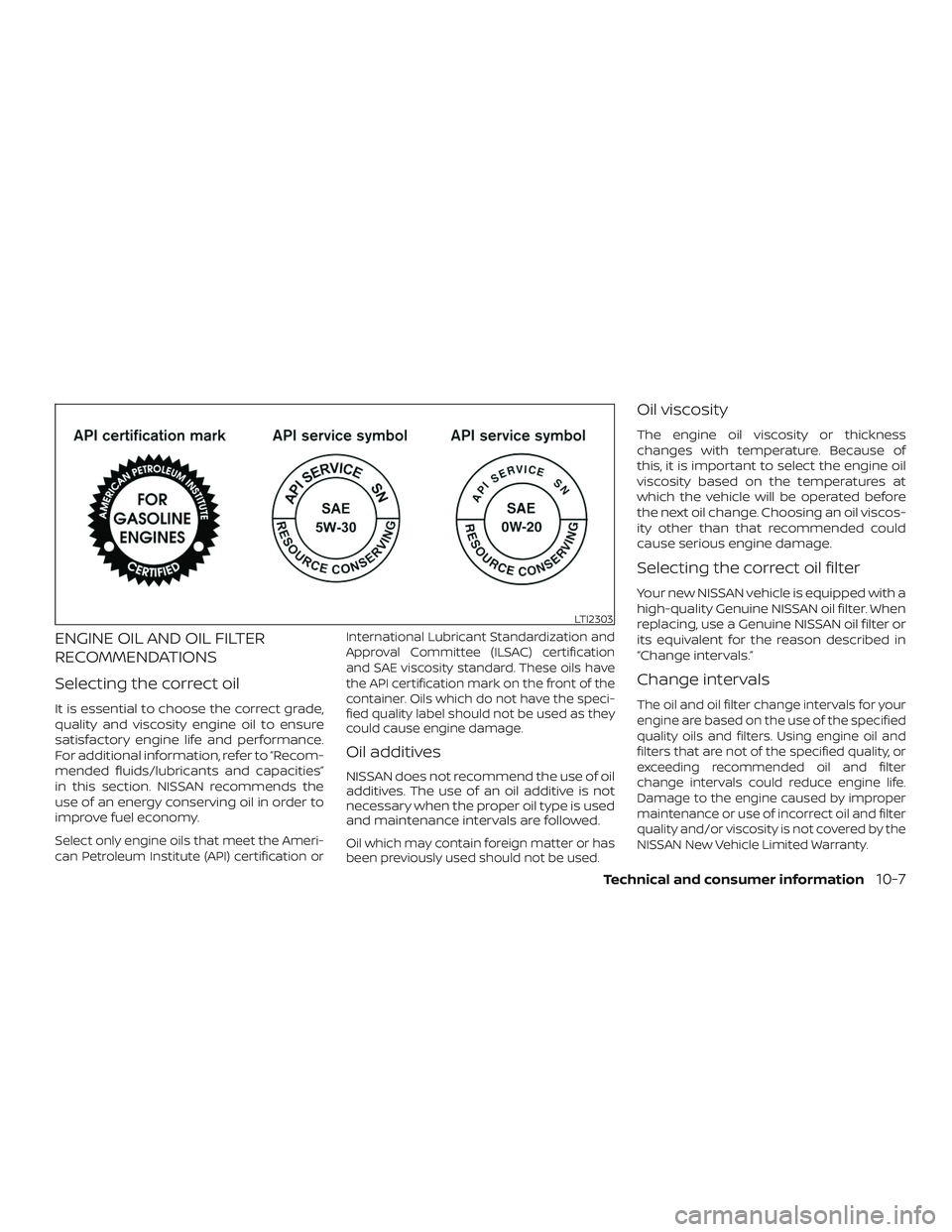
ENGINE OIL AND OIL FILTER
RECOMMENDATIONS
Selecting the correct oil
It is essential to choose the correct grade,
quality and viscosity engine oil to ensure
satisfactory engine life and performance.
For additional information, refer to “Recom-
mended fluids/lubricants and capacities”
in this section. NISSAN recommends the
use of an energy conserving oil in order to
improve fuel economy.
Select only engine oils that meet the Ameri-
can Petroleum Institute (API) certification orInternational Lubricant Standardization and
Approval Committee (ILSAC) certification
and SAE viscosity standard. These oils have
the API certification mark on the front of the
container. Oils which do not have the speci-
fied quality label should not be used as they
could cause engine damage.
Oil additives
NISSAN does not recommend the use of oil
additives. The use of an oil additive is not
necessary when the proper oil type is used
and maintenance intervals are followed.
Oil which may contain foreign matter or has
been previously used should not be used.
Oil viscosity
The engine oil viscosity or thickness
changes with temperature. Because of
this, it is important to select the engine oil
viscosity based on the temperatures at
which the vehicle will be operated before
the next oil change. Choosing an oil viscos-
ity other than that recommended could
cause serious engine damage.
Selecting the correct oil filter
Your new NISSAN vehicle is equipped with a
high-quality Genuine NISSAN oil filter. When
replacing, use a Genuine NISSAN oil filter or
its equivalent for the reason described in
“Change intervals.”
Change intervals
The oil and oil filter change intervals for your
engine are based on the use of the specified
quality oils and filters. Using engine oil and
filters that are not of the specified quality, or
exceeding recommended oil and filter
change intervals could reduce engine life.
Damage to the engine caused by improper
maintenance or use of incorrect oil and filter
quality and/or viscosity is not covered by the
NISSAN New Vehicle Limited Warranty.
LTI2303
Technical and consumer information10-7
Page 546 of 559
11 Index
A
Active noise cancellation Active sound enhancement. .5-183, 5-183
ActiveRideControl(ARC)..........5-174
Air bag (See supplemental restraint
system) .................... .1-46
Air bag system Front (See supplemental front impact air
bagsystem)............... .1-54
Airbagwarninglight..........1-67, 2-15
Air bag warning light,
supplemental ..............1-67, 2-15
Air cleaner housing filter ..........8-18
Air conditioner Air conditioner operation ....4-32,4-38
Air conditioner specification label . .10-13
Air conditioner system refrigerant and oil
recommendations ............10-8
Air conditioner system refrigerant
recommendations ............10-8
Heater and air conditioner
controls...............4-29,4-38
Servicing air conditioner ........4-41
Air flow charts .................4-33
Alarm system
(See vehicle security system) .......2-40
All-Wheel Drive .............5-164,6-13
Anchor point locations ...........1-28
Antenna ....................4-42
Antifreeze ...................5-180
Anti-lock brake warning light ........2-10Anti-lock Braking System (ABS)
.....5-169
Armrests.................... .1-7
Audible reminders ..............2-18
Autolightswitch................2-47
Automatic Automatic drive
positioner ...........3-32,3-33,3-34
Automatic power window switch . . .2-63
Automatic anti-glare inside mirror ....3-30
Automaticbrakehold............5-28
Automatic door locks .............3-6
Automatic drive positioner . .3-32, 3-33, 3-34
Automatic Emergency Braking
(AEB) .............2-10,2 -11, 2-15, 5-130
Automatic Emergency Braking (AEB) with
Pedestrian Detection ............5-138
AWD...................5-164,6-13
B
Battery.................5-180,8-14 Charge warning light ...........2-11
Battery replacement ............8-23
Keyfob...................8-23
NISSAN Intelligent Key® .........8-24
Before starting the engine .........5-17
Belt(Seedrivebelt)..............8-16
Blind Spot Warning (BSW) ..........5-45
Booster seats .................1-42
Brake Anti-lock Braking System (ABS) . . .5-169
Brakefluid.................8-12 Brakelight(Seestoplight).......8-26
Brakesystem ..............5-169
Brakewarninglight............2-11
Brakewearindicators.......2-18,8-20
Parking brake operation
........5-25
Self-adjustingbrakes..........8-20
Brake Assist .................5-170
Brakefluid...................8-12
Brakes.....................8-20
Brakesystem ................5-169
Break-in schedule ..............5 -162
Brightness control Instrument panel .............2-50
Bulb check/instrument panel .......2-10
Bulb replacement .............. 8-26
C
Capacities and recommended fuel/
lubricants....................10-2
Cargo
(See vehicle loading information) . . . .10-14
Car phone or CB radio ...........4-42
Chassis control ...............
5-174
Check tire pressure .............2-35
Childrestraints.......1-21, 1-22, 1-23, 1-26 LATCH (Lower Anchors and Tethers for
CHildren)System.............1-26
Precautions on child
restraints.........1-23, 1-31, 1-38, 1-43
Top tether strap anchor point
locations..................1-28
Page 547 of 559
Child safety rear door lock..........3-7
Chimes, audible reminders .........2-18
Cleaningexteriorandinterior......7-2,7-5
C.M.V.S.S. certification label .........10-12
Coldweatherdriving ............5-180
Console box ..................2-59
Continuously Variable Transmission
(CVT) .......................5-18
Continuously Variable Transmission
(CVT) fluid ..................8-12
Driving with Continuously Variable
Transmission (CVT) ............5-18
Controls Heater and air conditioner
controls................4-29,4-38
Coolant Capacities and recommended
fuel/lubricants...............10-2
Changing engine coolant .........8-6
Checking engine coolant level ......8-6
Engine coolant temperature gauge . .2-6
Corrosionprotection..............7-8
Cruisecontrol .................5-63
Cupholders ...............2-60,2-61
D
Daytime Running Light System ......2-50
Defroster switch Rear window and outside mirror
defrosterswitch..............2-44
Dimensions and weights ..........10-10
Dimmer switch for instrument panel . . .2-50
Door locks ....................3-4
Drivebelt ....................8-16 Drive positioner, Automatic . . .3-32, 3-33, 3-34
Driving
Cold weather driving ..........5-180
Driving with Continuously Variable
Transmission (CVT) ............5-18
Precautions when starting and
driving..................5-4,5-11
Drivingthevehicle...............5-18
E
E-call (SOS) Button ..............2-54
Economy - fuel ................5-164
Emergency engine shutoff .......5-15,6-2
Emission control information label . . . .10-13
Emission control system warranty . . . .10-19
Engine Before starting the engine ........5-17
Capacities and recommended
fuel/lubricants...............10-2
Changing engine coolant .........8-6
Changing engine oil ............8-8
Changing engine oil filter .........8-8
Checking engine coolant level ......8-6
Checking engine oil level .........8-7
Engine compartment check
locations...................8-3
Engine coolant temperature gauge . .2-6
Engine cooling system ..........8-5
Engine oil ...................8-7
Engine oil and oil filter
recommendation .............10-7
Engine oil pressure warning light ....2-12
Engine oil viscosity .............10-7
Engine serial number ..........10-12 Engine specifications
...........10-9
Starting the engine ............5-17
Engine Block Heater .............5-182
Engine coolant temperature gauge ....2-6
EventDatarecorders.........10-21,10-22
Exhaust gas (Carbon monoxide) .......5-4
Explanation of maintenance items .....9-2
Explanation of scheduled maintenance
items .......................9-5
Extended storage switch ..........2-57
Eyeglasscase.................2-59
F
Flashers
(Seehazardwarningflasherswitch)....6-2
Flattire....................6-3,6-4
Floormatpositioningaid...........7-6
Fluid Brakefluid..................8-12
Capacities and recommended
fuel/lubricants...............10-2
Continuously Variable Transmission (CVT)
fluid......................8-12
Engine coolant ...............8-5
Engine oil ...................8-7
Windshield-washer fluid .........8-13
F
.M.V.S.S. certification label .........10-12
Foglightswitch ................2-51
Front air bag system
(See supplemental restraint system) . . .1-54
Front-door pocket ..............2-58
Front power seat adjustment ........1-4
Frontseats....................1-2
11-2
Page 548 of 559
FuelCapacities and recommended
fuel/lubricants...............10-2
Fuel economy ...............5-164
Fuel-filler door and cap ..........3-25
Fuel-filler door lock opener lever ....3-25
Fuel gauge ..................2-7
Fueloctanerating.............10-6
Fuel recommendation ..........10-4
Loose fuel cap warning .........2-35
Fuelefficientdrivingtips ..........5-163
Fuel-filler door .................3-25
Fuel gauge ....................2-7
Fuses .......................8-21
Fusiblelinks...................8-22
G
Garage door opener, HomeLink® Universal
Transceiver . . .2-67, 2-68, 2-69, 2-70, 2-70, 2-71
Gascap.....................3-25
Gauge Engine coolant temperature gauge . .2-6
Fuel gauge ..................2-7
Odometer ..................2-5
Speedometer ..............2-4,2-5
Tachometer .................2-6
Trip odometer .............2-4,2-5
General maintenance .............9-2
Glovebox....................2-59
Gloveboxlock.................2-59 H
Hazard warning flasher switch ........6-2
Headlight and turn signal switch ......2-45
Headlightcontrolswitch...........2-45
Headlights ...................8-25
Headrestraints................. .1-7
Heated seat switches ............2-52
Heated steering wheel ............2-53
Heater Heater and air conditioner
controls................4-29,4-38
Heater operation ..........4-30,4-39
Hill start assist system ............5-174
HomeLink® Universal
Transceiver . . .2-67, 2-68, 2-69, 2-70, 2-70, 2-71
Hood .......................3-22
Horn.......................2-52
I
Ignition switch Push-button ignition switch .......5-13
Immobilizer system ..........2-42,5-16
Important vehicle information label . . .10-12
In-cabinmicrofilter..............8-18
Increasing fuel economy ..........5-164
Indicator NISSAN Intelligent Key® battery discharge
indicator...................5-16
Indicator lights and audible reminders
(See warning/indicator lights and audible
reminders) ....................2-15
Inside automatic anti-glare mirror .....3-30
Instrument brightness control .......2-50Instrument panel
.............0-6,2-2
Instrument panel dimmer switch .....2-50
Intelligent Around View Monitor .......4-11
Intelligent Cruise Control (ICC)
(for vehicles without ProPILOT Assist) . . .5-66
Intelligent Cruise Control (ICC)
(for vehicles with ProPILOT Assist) . . . .5-102
Intelligent Driver Alertness (I-DA) .....5-159
Intelligent Forward Collision Warning
(I-FCW) .................... .5-147
Intelligent Key system Key operating range ............3-9
Key operation ................3-10
Mechanical key ...............3-3
Remote keyless entry operation ....3-14
Troubleshooting guide ..........3-17
Warning signals ...............3-17
Intelligent Lane Intervention (I-LI) .....5-39
Intelligent Trace Control (I-TC) .......5-174
Interiorlight...................2-66
I
nteriortrunklidrelease...........3-24
ISOFIX child restraints .............1-26
J
Jumpstarting...............6-9,8-15
K
Key........................ .3-2
Key fob battery replacement ........8-23
Keyless entry With Intelligent Key system
(See Intelligent Key system) .......3-14
11-3
Page 549 of 559
KeysNISSAN Intelligent Key® ..........3-2
NISSAN Vehicle Immobilizer System
keys......................3-4
L
Label Tire and Loading Information label . .10-13
Labels Air conditioner specification label . . .10-13
C.M.V.S.S. certification label .......10-12
Emission control information label . .10-13
Engine serial number ..........10-12
F.M.V.S.S. certification label .......10-12
Tire and Loading Information label . .10-13
Vehicle identification number (VIN) . .10-11
Vehicle identification number (VIN)
plate.....................10-11
Warning labels (for SRS) ..........1-67
Lane Departure Warning (LDW) .......5-34
LATCH (Lower Anchors and Tethers for
CHildren)System............... .1-26
License plate Installing the license plate .......10-14
Light Airbagwarninglight ........1-67, 2-15
Brakelight(Seestoplight)........8-26
Bulb check/instrument panel ......2-10
Bulb replacement .............8-26
Charge warning light ...........2-11
ExteriorandInteriorlights........8-26
Foglights..................8-26
Foglightswitch ..............2-51
Headlight and turn signal switch ....2-45Headlightcontrolswitch.........2-45
Headlights .................8-25
Interiorlight.................2-66
Lightbulbs.................8-25
Low tire pressure warning light
.....2-12
Low windshield-washer fluid warning
light......................2-35
Personal lights ...............2-67
Security indicator light ..........2-17
Spotlights(Seemaplight)........2-66
Trunklight..................2-67
Warning/indicator lights and audible
reminders ..................2-15
Lights ......................8-25 Maplights..................2-66
Lock Child safety rear door lock ........3-7
Door locks ..................3-4
Fuel-filler door lock opener lever ....3-25
Gloveboxlock...............2-59
Power door locks ..............3-6
Trunk lid lock opener lever ........3-23
Loose fuel cap warning ...........2-35
Lowfuelwarninglight.........2-14,2-35
Low tire pressure warning light .......2-12
Low windshield-washer fluid warning
light........................2-35
Luggage
(See vehicle loading information) .....10-14
M
Maintenance General maintenance ...........9-2
Insidethevehicle..............9-3 Maintenance precautions
.........8-2
Outsidethevehicle.............9-2
Seat belt maintenance ..........1-20
Under the hood and vehicle .......9-4
Maintenance log ................9-19
Maintenance requirements ..........9-2
Maintenance schedules .........9-7,9-7
Maintenance under severe operation
conditions.................9-13,9-18
Malfunctionindicatorlight..........2-17
Manual front seat adjustment ........1-3
Maplights................... .2-66
Memory Seat ...........3-32,3-33,3-34
Meters and gauges ...............2-4
Instrument brightness control .....2-50
Mirror Automatic anti-glare inside mirror. . .3-30
Outsidemirrors...............3-31
Rearview ..................3-30
Vanitymirror................3-29
Mirrors......................3-30
Moonroof ..................2-64,7-5
Moving Object Detection (MOD) ......4-23
N
NissanConnect® Owner's Manual ......
4-2
NISSAN Intelligent Key® ............3-2
NISSAN Intelligent Key® battery discharge
indicator.................... .5-16
NISSAN Vehicle Immobilizer
System..................2-42, 5-16
11-4
Page 550 of 559
O
Octane rating (See fuel octane rating) . .10-6
Odometer ....................2-5
Oil Capacities and recommended
fuel/lubricants...............10-2
Changing engine oil ............8-8
Changing engine oil filter .........8-8
Checking engine oil level .........8-7
Engine oil ...................8-7
Engine oil and oil filter
recommendation .............10-7
Engine oil viscosity .............10-7
Outsidemirrors.................3-31
Overhead sunglasses holder ........2-59
Overheat Ifyourvehicleoverheats.........6-11
Owner's manual order form ........10-23
Owner's manual/service manual order
information..................10-23
P
Parking Parking brake operation .........5-25
Parking/parkingonhills.........5-168
Parkingbrake...........2-12,2-16,5-25
Personal lights .................2-67
Power Power door locks ..............3-6
Poweroutlet................2-56
Powerrearwindows...........2-63
Power steering system .........5-168
Powerwindows ..............2-61 Rearpowerwindows...........2-63
Poweroutlet..................2-56
Powersteering................5-168
Precautions Maintenance precautions .........8-2
Precautions on booster
seats............1-23, 1-31, 1-38, 1-43
Precautions on child
restraints .........1-23, 1-31, 1-38, 1-43
Precautions on seat belt usage .....1-12
Precautions on supplemental restraint
system ................... .1-46
Precautions when starting and
driving..................5-4,5-11
ProPILOT Assist ................5-90
Push starting ..................6-11
R
Radio Car phone or CB radio ..........4-42
Readiness for inspection maintenance (I/M)
test .......................10-21
Rear Automatic Braking (RAB) .......5-124
RearCrossTrafficAlert(RCTA) .......5-55
Rear Door Alert .............2-37,2-55
Rearpowerwindows.............2-63
Rearseat.................... .1-5
Rear Sonar System (RSS) ..........5-175
Rearviewmirror................3-30
RearViewMonitor................4-3
Rear window and outside mirror defroster
switch......................2-44
Recommended Fluids ............10-2 Recorders
EventData.............10-21,10-22
Refrigerant recommendation ........10-8
Registering a vehicle in another
country .....................10-11
Remote Engine Start ..........3-19,5-18
Reporting safety defects (US only) . . . .10-20
S
Safety Child safety rear door lock ........3-7
Childseatbelts......1-23, 1-31, 1-38, 1-43
Reporting safety defects (US only) . .10-20
Seat adjustment Front manual seat adjustment ......1-3
Front power seat adjustment ......1-4
Rear seat adjustment ...........1-5
Seatback pockets ...............
2-58
Seat belt Childsafety ................ .1-21
Infants and small children ........1-22
InjuredPerson............... .1-15
Largerchildren.............. .1-22
Precautionsonseatbeltusage.....1-12
Pregnant women ..............1-15
Seat belt extenders ............1-20
Seat belt maintenance ..........1-20
Seatbelts................1-12, 7-7
Shoulder belt height adjustment . . . .1-19
Three-pointtypewithretractor.....1-15
Seat belt extenders ..............1-20
Seatbeltwarninglight.........1-14, 2-15
Seats Adjustment ..................1-2
11-5