display NISSAN ALTIMA 2023 Owners Manual
[x] Cancel search | Manufacturer: NISSAN, Model Year: 2023, Model line: ALTIMA, Model: NISSAN ALTIMA 2023Pages: 644, PDF Size: 4.12 MB
Page 545 of 644
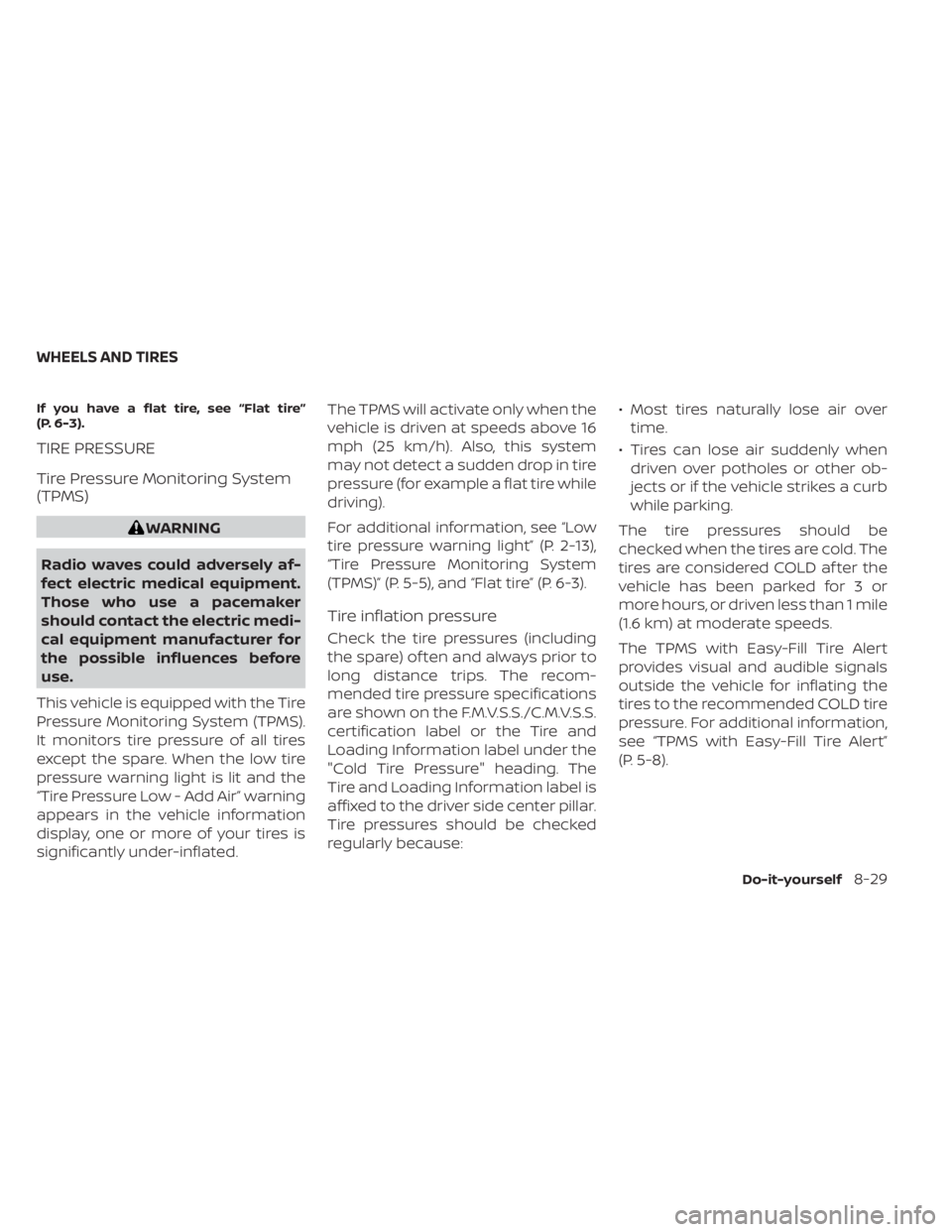
If you have a flat tire, see “Flat tire”
(P. 6-3).
TIRE PRESSURE
Tire Pressure Monitoring System
(TPMS)
WARNING
Radio waves could adversely af-
fect electric medical equipment.
Those who use a pacemaker
should contact the electric medi-
cal equipment manufacturer for
the possible influences before
use.
This vehicle is equipped with the Tire
Pressure Monitoring System (TPMS).
It monitors tire pressure of all tires
except the spare. When the low tire
pressure warning light is lit and the
“Tire Pressure Low - Add Air” warning
appears in the vehicle information
display, one or more of your tires is
significantly under-inflated. The TPMS will activate only when the
vehicle is driven at speeds above 16
mph (25 km/h). Also, this system
may not detect a sudden drop in tire
pressure (for example a flat tire while
driving).
For additional information, see “Low
tire pressure warning light” (P. 2-13),
“Tire Pressure Monitoring System
(TPMS)” (P. 5-5), and “Flat tire” (P. 6-3).
Tire inflation pressure
Check the tire pressures (including
the spare) of ten and always prior to
long distance trips. The recom-
mended tire pressure specifications
are shown on the F.M.V.S.S./C.M.V.S.S.
certification label or the Tire and
Loading Information label under the
"Cold Tire Pressure" heading. The
Tire and Loading Information label is
affixed to the driver side center pillar.
Tire pressures should be checked
regularly because:
• Most tires naturally lose air over
time.
• Tires can lose air suddenly when driven over potholes or other ob-
jects or if the vehicle strikes a curb
while parking.
The tire pressures should be
checked when the tires are cold. The
tires are considered COLD af ter the
vehicle has been parked for 3 or
more hours, or driven less than 1 mile
(1.6 km) at moderate speeds.
The TPMS with Easy-Fill Tire Alert
provides visual and audible signals
outside the vehicle for inflating the
tires to the recommended COLD tire
pressure. For additional information,
see “TPMS with Easy-Fill Tire Alert”
(P. 5-8).
WHEELS AND TIRES
Do-it-yourself8-29
Page 568 of 644
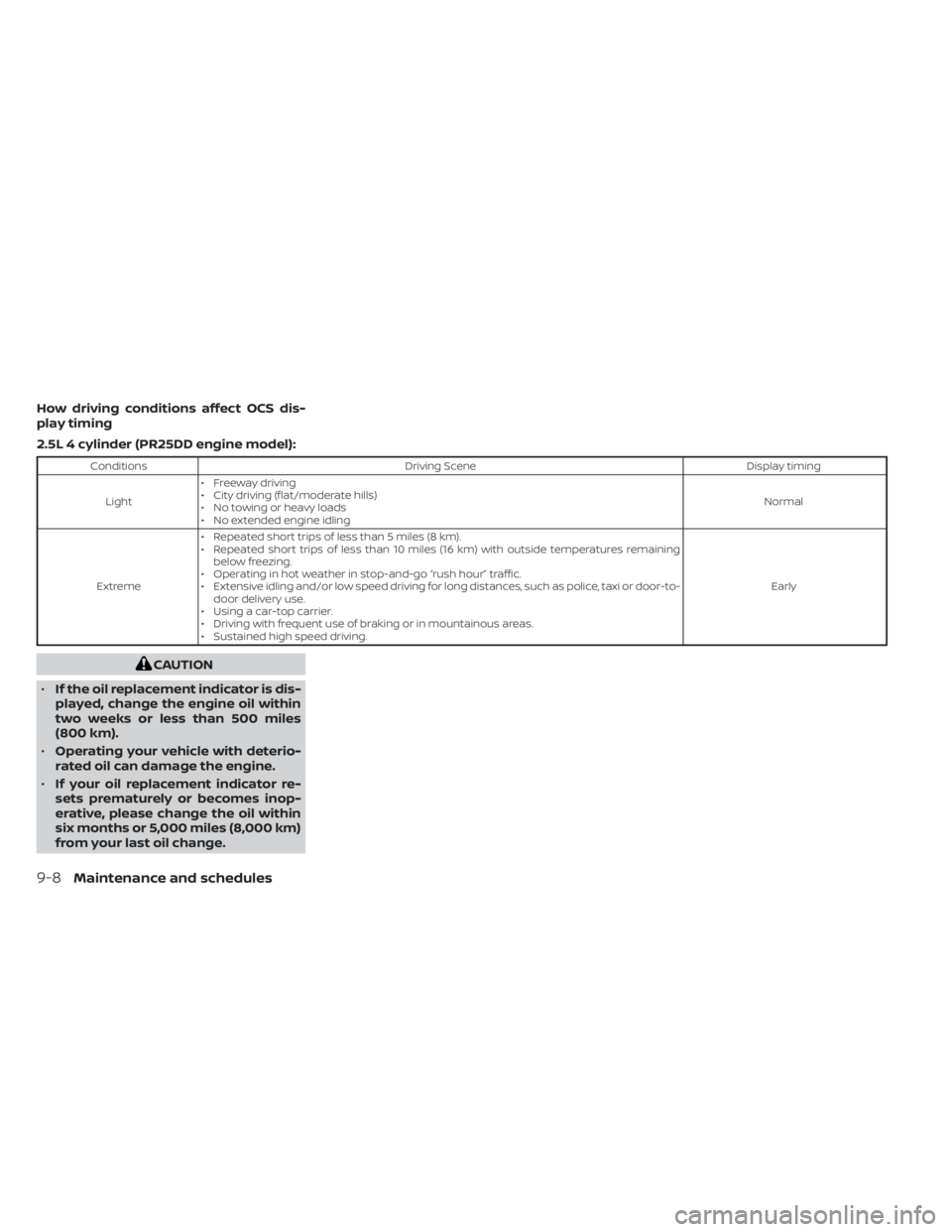
How driving conditions affect OCS dis-
play timing
2.5L 4 cylinder (PR25DD engine model):
ConditionsDriving Scene Display timing
Light • Freeway driving
• City driving (flat/moderate hills)
• No towing or heavy loads
• No extended engine idling Normal
Extreme • Repeated short trips of less than 5 miles (8 km).
• Repeated short trips of less than 10 miles (16 km) with outside temperatures remaining
below freezing.
• Operating in hot weather in stop-and-go “rush hour” traffic.
• Extensive idling and/or low speed driving for long distances, such as police, taxi or door-to- door delivery use.
• Using a car-top carrier.
• Driving with frequent use of braking or in mountainous areas.
• Sustained high speed driving. Early
CAUTION
• If the oil replacement indicator is dis-
played, change the engine oil within
two weeks or less than 500 miles
(800 km).
• Operating your vehicle with deterio-
rated oil can damage the engine.
• If your oil replacement indicator re-
sets prematurely or becomes inop-
erative, please change the oil within
six months or 5,000 miles (8,000 km)
from your last oil change.
9-8Maintenance and schedules
Page 569 of 644
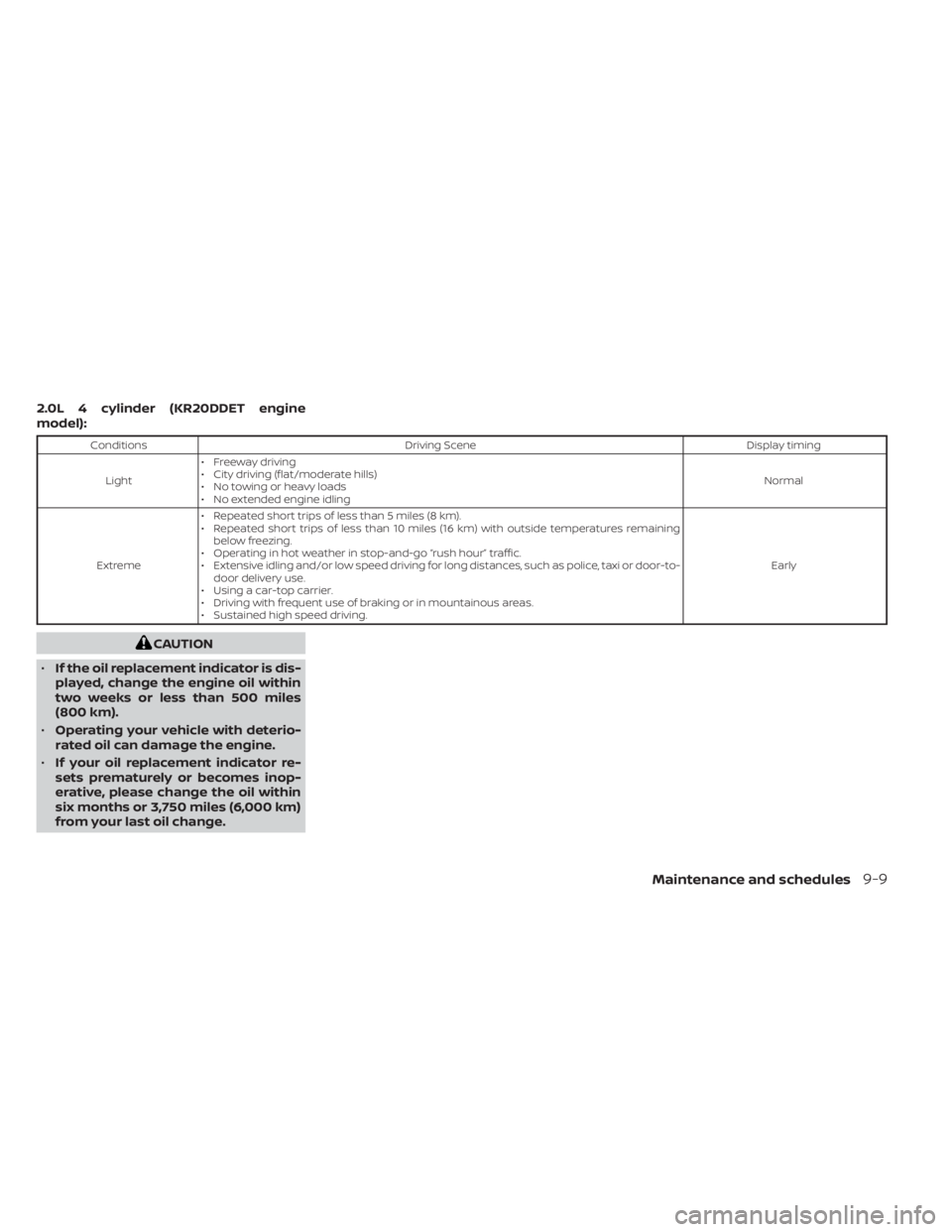
2.0L 4 cylinder (KR20DDET engine
model):
ConditionsDriving Scene Display timing
Light • Freeway driving
• City driving (flat/moderate hills)
• No towing or heavy loads
• No extended engine idling Normal
Extreme • Repeated short trips of less than 5 miles (8 km).
• Repeated short trips of less than 10 miles (16 km) with outside temperatures remaining
below freezing.
• Operating in hot weather in stop-and-go “rush hour” traffic.
• Extensive idling and/or low speed driving for long distances, such as police, taxi or door-to- door delivery use.
• Using a car-top carrier.
• Driving with frequent use of braking or in mountainous areas.
• Sustained high speed driving. Early
CAUTION
• If the oil replacement indicator is dis-
played, change the engine oil within
two weeks or less than 500 miles
(800 km).
• Operating your vehicle with deterio-
rated oil can damage the engine.
• If your oil replacement indicator re-
sets prematurely or becomes inop-
erative, please change the oil within
six months or 3,750 miles (6,000 km)
from your last oil change.
Maintenance and schedules9-9
Page 628 of 644
Brightness controlInstrument panel.............2-62Brightness/contrast button.........4-7Bulb check/instrument panel........2-10Bulb replacement...............8-26
C
C.M.V.S.S. certification label.........10-13Capacities and recommended
fuel/lubricants................ .10-2Car phone or CB radio............4-67Cargo
(See vehicle loading information).....10-16Chassis control................5-178Check tire pressure..........2-31, 2-48Child restraints.......1-21,1-22,1-23,1-25LATCH (Lower Anchors and Tethers for
CHildren) System..............1-25Precautions on child
restraints............1-31, 1-38, 1-43Top tether strap anchor point
locations...................1-28Child safety rear door lock..........3-7Cleaning exterior and interior......7-2,7-5Clock set/adjustment.............4-5Cold weather driving............5-185Console box..................2-72Continuously Variable Transmission
(CVT).......................5-18Continuously Variable Transmission (CVT)
fluid......................8-12
Driving with Continuously Variable
Transmission (CVT)............5-18Control panel buttons.............4-3Brightness/contrast button........4-7Controls
Audio controls (steering wheel).....4-63Heater and air conditioner
controls................4-33, 4-41CoolantCapacities and recommended
fuel/lubricants
...............10-2Changing engine coolant.........8-6Checking engine coolant level......8-6Engine coolant temperature gauge. . .2-6Corrosion protection..............7-8Cruise control................ .5-68Cup holders...............2-73,2-74
D
Daytime Running Light System......2-62Defroster switch
Rear window and outside mirror defroster
switch
................... .2-56Dimensions and weights..........10-11Dimmer switch for instrument panel. . .2-62Display controls (see control panel
buttons).................... .4-3Door locks....................3-4Drive belt....................8-16Driving
Cold weather driving...........5-185
Driving with Continuously Variable
Transmission (CVT)............5-18Precautions when starting and
driving................. .5-4, 5-10Driving the vehicle...............5-18
E
Economy - fuel................5-168Emergency call (SOS) button........2-67Emergency engine shutoff.......5-15,6-2Emission control information label. . . .10-14Emission control system warranty. . . .10-22Engine
Before starting the engine........5-16Capacities and recommended
fuel/lubricants...............10-2Changing engine coolant.........8-6Changing engine oil............8-8Changing engine oil filter.........8-8Checking engine coolant level......8-6Checking engine oil level..........8-7Engine compartment check
locations.................. .8-3Engine coolant temperature gauge. . .2-6Engine cooling system...........8-5Engine oil...................8-7Engine oil and oil filter
recommendation.............10-7Engine oil pressure warning light. . . .2-11Engine oil viscosity.............10-7Engine serial number..........10-13Engine specifications...........10-9
11-2
Page 633 of 644
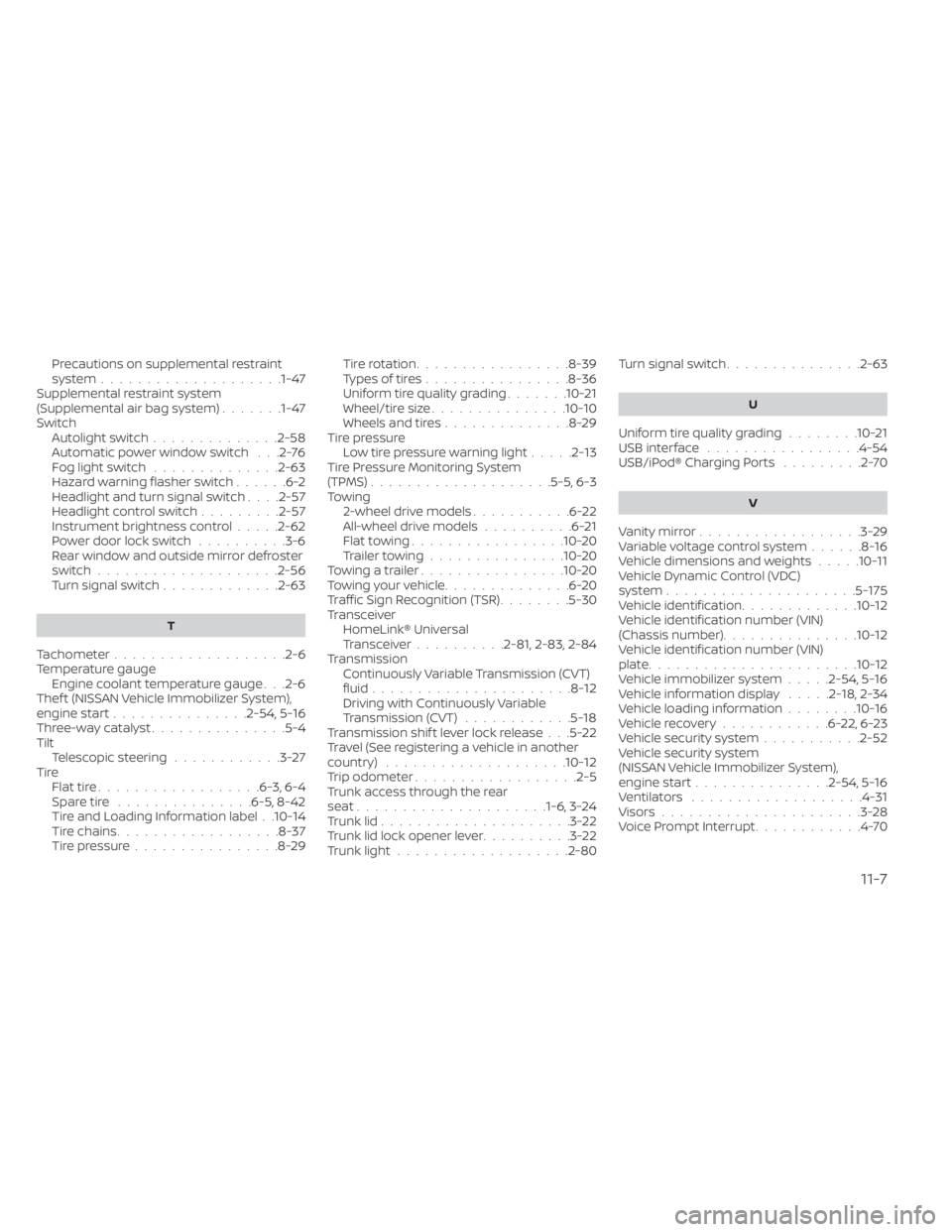
Precautions on supplemental restraint
system....................1-47Supplemental restraint system
(Supplemental air bag system).......1-47Switch
Autolight switch..............2-58Automatic power window switch. . .2-76Fog light switch..............2-63Hazard warning flasher switch......6-2Headlight and turn signal switch. . . .2-57Headlight control switch.........2-57Instrument brightness control.....2-62Power door lock switch..........3-6Rear window and outside mirror defroster
switch................... .2-56Turn signal switch.............2-63
T
Tachometer...................2-6Temperature gauge
Engine coolant temperature gauge. . .2-6Thef t (NISSAN Vehicle Immobilizer System),
engine start...............2-54, 5-16Three-way catalyst...............5-4TiltTelescopic steering............3-27TireFlat tire................. .6-3, 6-4Spare tire...............6-5, 8-42Tire and Loading Information label. .10-14Tire chains..................8-37Tire pressure................8-29
Tire rotation.................8-39Types of tires................8-36Uniform tire quality grading.......10-21Wheel/tire size...............10-10Wheels and tires..............8-29Tire pressure
Low tire pressure warning light.....2-13Tire Pressure Monitoring System
(TPMS)................... .5-5, 6-3Towing
2-wheel drive models...........6-22All-wheel drive models..........6-21Flat towing................ .10-20Trailer towing...............10-20Towing a trailer................10-20Towing your vehicle..............6-20Traffic Sign Recognition (TSR)........5-30Transceiver
HomeLink® Universal
Transceiver
..........2-81, 2-83, 2-84TransmissionContinuously Variable Transmission (CVT)
fluid
......................8-12Driving with Continuously Variable
Transmission (CVT)............5-18Transmission shif t lever lock release. . .5-22Travel (See registering a vehicle in another
country)................... .10-12Trip odometer..................2-5Trunk access through the rear
seat.................... .1-6, 3-24Trunk lid.....................3-22Trunk lid lock opener lever..........3-22Trunk light...................2-80
Turn signal switch...............2-63
U
Uniform tire quality grading........10-21USB interface.................4-54USB/iPod® Charging Ports.........2-70
V
Vanity mirror..................3-29Variable voltage control system......8-16Vehicle dimensions and weights.....10-11Vehicle Dynamic Control (VDC)
system.....................5-175Vehicle identification.............10-12Vehicle identification number (VIN)
(Chassis number)...............10-12Vehicle identification number (VIN)
plate...................... .10-12Vehicle immobilizer system.....2-54, 5-16Vehicle information display.....2-18,2-34Vehicle loading information........10-16Vehicle recovery............6-22,6-23Vehicle security system...........2-52Vehicle security system
(NISSAN Vehicle Immobilizer System),
engine start
...............2-54, 5-16Ventilators.................. .4-31Visors......................3-28Voice Prompt Interrupt............4-70
11-7