display NISSAN ALTIMA COUPE 2013 D32 / 4.G Owners Manual
[x] Cancel search | Manufacturer: NISSAN, Model Year: 2013, Model line: ALTIMA COUPE, Model: NISSAN ALTIMA COUPE 2013 D32 / 4.GPages: 414, PDF Size: 4.59 MB
Page 312 of 414
TIRE PRESSURE MONITORING
SYSTEM (TPMS)
This vehicle is equipped with the Tire Pressure
Monitoring System (TPMS) . It monitors tire pres-
sure of all tires except the spare. When the low
tire pressure warning light is lit, and the CHECK
TIRE PRESSURE warning appears in the vehicle
information display, one or more of your tires is
significantly under-inflated. If the vehicle is being
driven with low tire pressure, the TPMS will acti-
vate and warn you of it by the low tire pressure
warning light. This system will activate only when
the vehicle is driven at speeds above 16 MPH
(25 km/h) . For more details, refer to
“Warning/indicator lights and audible reminders”
in the “Instruments and controls” section, and
“Tire Pressure Monitoring System (TPMS)” in the
“Starting and driving” section.
WARNING
●If the low tire pressure warning light
illuminates while driving, avoid sudden
steering maneuvers or abrupt braking,
reduce vehicle speed, pull off the road
to a safe location and stop the vehicle
as soon as possible. Driving with under-
inflated tires may permanently damage
the tires and increase the likelihood of
tire failure. Serious vehicle damage
could occur and may lead to an acci-
dent and could result in serious per-
sonal injury. Check the tire pressure for
all four tires. Adjust the tire pressure to
the recommended COLD tire pressure
shown on the Tire and Loading Informa-
tion label to turn the low tire pressure
warning light OFF. If you have a flat tire,
replace it with a spare tire as soon as
possible.
● When a spare tire is mounted or a wheel
is replaced, the TPMS will not function
and the low tire pressure warning light
will flash for approximately 1 minute.
The light will remain on after 1 minute.
Contact your NISSAN dealer as soon as
possible for tire replacement and/or
system resetting. ●
Replacing tires with those not originally
specified by NISSAN could affect the
proper operation of the TPMS.
● Do not inject any tire liquid or aerosol
tire sealant into the tires, as this may
cause a malfunction of the tire pressure
sensors.
CHANGING A FLAT TIRE
If you have a flat tire, follow the instructions be-
low:
Stopping the vehicle
1. Safely move the vehicle off the road and
away from traffic.
2. Turn on the hazard warning flashers.
3. Park on a level surface and apply the parking brake. Move the shift selector to P (Park) .
4. Turn off the engine.
5. Raise the hood to warn other traffic and to signal professional road assistance person-
nel that you need assistance.
6. Have all passengers get out of the vehicle and stand in a safe place, away from traffic
and clear of the vehicle.
FLAT TIRE
In case of emergency6-3
Page 365 of 414
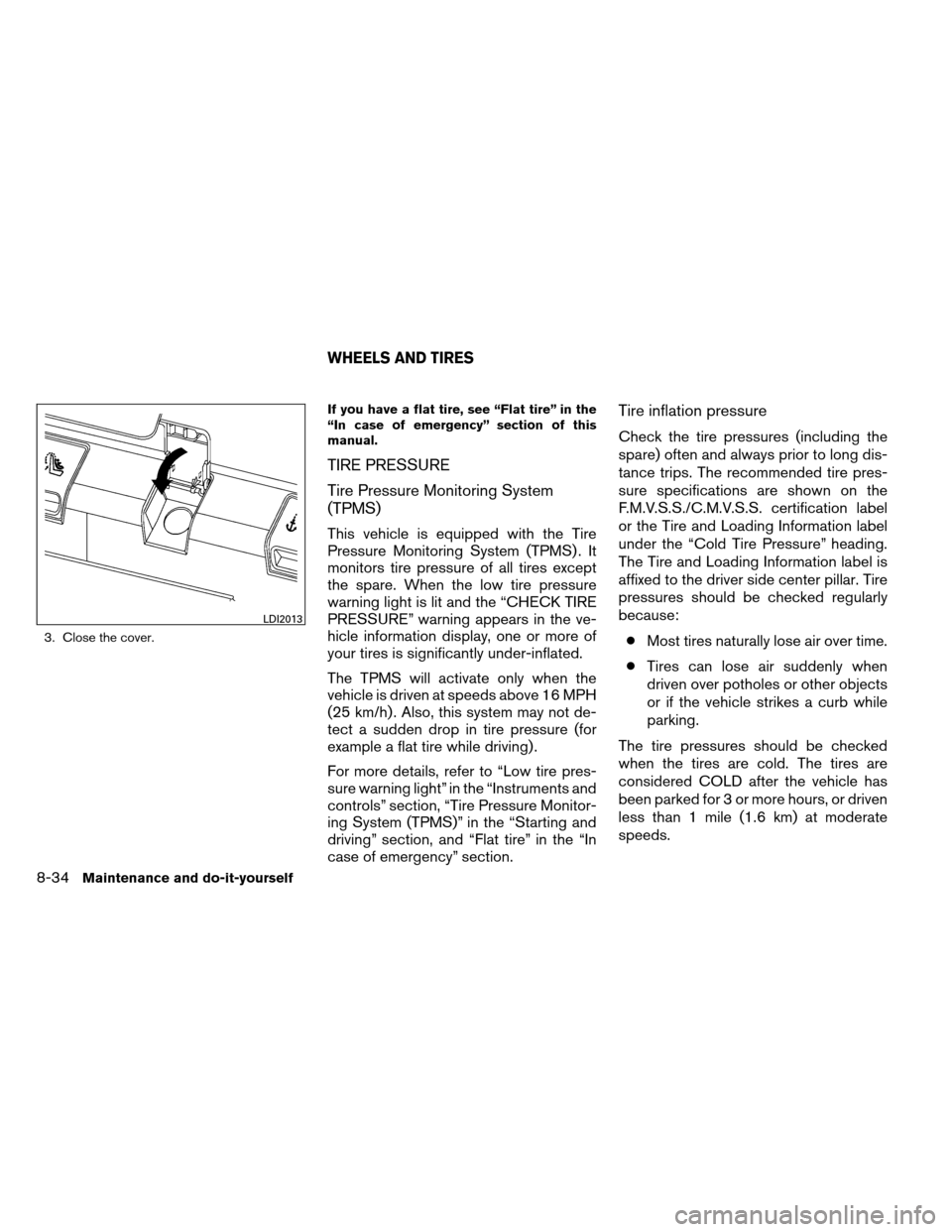
3. Close the cover.If you have a flat tire, see “Flat tire” in the
“In case of emergency” section of this
manual.
TIRE PRESSURE
Tire Pressure Monitoring System
(TPMS)
This vehicle is equipped with the Tire
Pressure Monitoring System (TPMS) . It
monitors tire pressure of all tires except
the spare. When the low tire pressure
warning light is lit and the “CHECK TIRE
PRESSURE” warning appears in the ve-
hicle information display, one or more of
your tires is significantly under-inflated.
The TPMS will activate only when the
vehicle is driven at speeds above 16 MPH
(25 km/h) . Also, this system may not de-
tect a sudden drop in tire pressure (for
example a flat tire while driving) .
For more details, refer to “Low tire pres-
sure warning light” in the “Instruments and
controls” section, “Tire Pressure Monitor-
ing System (TPMS)” in the “Starting and
driving” section, and “Flat tire” in the “In
case of emergency” section.
Tire inflation pressure
Check the tire pressures (including the
spare) often and always prior to long dis-
tance trips. The recommended tire pres-
sure specifications are shown on the
F.M.V.S.S./C.M.V.S.S. certification label
or the Tire and Loading Information label
under the “Cold Tire Pressure” heading.
The Tire and Loading Information label is
affixed to the driver side center pillar. Tire
pressures should be checked regularly
because:
● Most tires naturally lose air over time.
● Tires can lose air suddenly when
driven over potholes or other objects
or if the vehicle strikes a curb while
parking.
The tire pressures should be checked
when the tires are cold. The tires are
considered COLD after the vehicle has
been parked for 3 or more hours, or driven
less than 1 mile (1.6 km) at moderate
speeds.
LDI2013
WHEELS AND TIRES
8-34Maintenance and do-it-yourself
Page 407 of 414
Precautions on child
restraints.........1-20, 1-26, 1-31, 1-35
Top tether strap anchor point locations . .1-24
Chimes, audible reminders ...........2-16
Cleaning exterior and interior ...........7-2
Clock ...................4-45, 4-50
(models with navigation system) .......4-8
(models without navigation system) . . . .4-45
Clock set ..................4-8, 4-45
C.M.V.S.S. certification label ..........9-10
Cold weather driving ..............5-26
Compact disc (CD) player .4-46, 4-52, 4-58, 4-64
Compass display .................2-6
Console box ...................2-40
Console light ...................2-47
Continuously Variable Transmission (CVT). . .5-12 Continuously Variable Transmission
(CVT) fluid ..................8-11
Driving with Continuously Variable
Transmission (CVT) .............5-12
Transmission shift selector lock release . .5-16
Control panel buttons ...............4-2
Brightness/contrast button .........4-12
Enter button ..................4-2
Setting button .................4-6
Controls Heater and air conditioner
controls ................4-18, 4-26
Coolant Capacities and recommended
fuel/lubricants .................9-2
Changing engine coolant ...........8-8
Checking engine coolant level ........8-8
Engine coolant temperature gauge .....2-5
Corrosion protection ...............7-6
Cruise control ..................5-18 Cup holders
................2-38, 2-39
D
Daytime running light system (Canada only) . .2-32
Defroster switch Rear window and outside mirror defroster
switch .....................2-28
Digital Versatile Disc (DVD) player .......4-63
Dimensions and weights .............9-8
Dimmer switch for instrument panel ......2-33
Display controls (see control panel buttons) . .4-2
Door locks .....................3-4
Drive belt .....................8-17
Driving Cold weather
driving............5-26
Driving with Continuously Variable
Transmission (CVT) .............5-12
Precautions when starting and driving . . . .5-2
E
Economy - fuel ..................5-20
Emission control information label .......9-10
Emission control system warranty .......9-24
Engine Before starting the engine ..........5-10
Block heater .................5-27
Capacities and recommended
fuel/lubricants .................9-2
Changing engine coolant ...........8-8
Changing engine oil ..............8-9
Changing engine oil filter ..........8-10
Checking engine coolant level ........8-8Checking engine oil level
...........8-9
Engine compartment check locations . . . .8-6
Engine coolant temperature gauge .....2-5
Engine cooling system ............8-7
Engine oil ...................8-9
Engine oil and oil filter recommendation . . .9-5
Engine oil pressure warning light ......2-12
Engine oil viscosity ..............9-5
Engine serial number ............9-10
Engine specifications .............9-7
Starting the engine .............5-11
Enter button ....................4-2
Event data recorders ..............9-26
Exhaust gas (Carbon monoxide) .........5-2
Extended storage switch ............8-24
Eyeglass case ..................2-38
F
Flashers (See hazard warning flasher switch) . .6-2
Flat tire .......................6-3
Floor mat positioning aid .............7-5
Fluid Brake fluid ..................8-12
Capacities and recommended
fuel/lubricants .................9-2
Continuously V
ariable Transmission
(CVT) fluid ..................8-11
Engine coolant .................8-7
Engine oil ...................8-9
Power steering fluid .............8-12
F.M.V.S.S. certification label ...........9-10
Fog light switch .................2-34
Front air bag system
(See supplemental restraint system) ......1-46
10-2