turn signal NISSAN ARMADA 2015 1.G Owner's Manual
[x] Cancel search | Manufacturer: NISSAN, Model Year: 2015, Model line: ARMADA, Model: NISSAN ARMADA 2015 1.GPages: 510, PDF Size: 4.18 MB
Page 357 of 510
●The low tire pressure warning light does not
automatically turn off when the tire pressure
is adjusted in all 4 tires. After the tire is
inflated to the recommended pressure, the
vehicle must be driven at speeds above
16 MPH (25 km/h) to activate the TPMS and
turn off the low tire pressure warning light.
Use a tire pressure gauge to check the tire
pressure.
● Tire pressure rises and falls depending on
the heat caused by the vehicle’s operation
and the outside temperature. Low outside
temperature can lower the temperature of
the air inside the tire which can cause a
lower tire inflation pressure. This may cause
the low tire pressure warning light to illumi-
nate. If the warning light illuminates, check
the tire pressure for all 4 tires.
● The Tire and Loading Information label (also
referred to as the vehicle placard or tire
inflation pressure label) is located in the
driver’s door opening.
For additional information, refer to “Low tire pres-
sure warning light” in the “Instruments and con-
trols” section and “Tire Pressure Monitoring Sys-
tem (TPMS)” in the “In case of emergency” section.
WARNING
● If the low tire pressure warning light
illuminates while driving, avoid sudden
steering maneuvers or abrupt braking,
reduce vehicle speed, pull off the road
to a safe location and stop the vehicle
as soon as possible. Driving with under-
inflated tires may permanently damage
the tires and increase the likelihood of
tire failure. Serious vehicle damage
could occur and may lead to an accident
and could result in serious personal in-
jury. Check the tire pressure for all four
tires. Adjust the tire pressure to the
recommended COLD tire pressure
shown on the Tire and Loading Informa-
tion label to turn the low tire pressure
warning light OFF. If you have a flat tire,
replace it with a spare tire as soon as
possible. For additional information, re-
fer to “Flat tire” in the “In case of emer-
gency” section for changing a flat tire. ●
When a spare tire is mounted or a wheel
is replaced, tire pressure will not be
indicated, the TPMS will not function
and the low tire pressure warning light
will flash for approximately 1 minute.
The light will remain on after 1 minute.
Contact your NISSAN dealer as soon as
possible for tire replacement and/or
system resetting.
● Replacing tires with those not originally
specified by NISSAN could affect the
proper operation of the TPMS.
● Do not inject any tire liquid or aerosol
tire sealant into the tires, as this may
cause a malfunction of the tire pressure
sensors.
CAUTION
Do not place metalized film or any metal
parts (antenna, etc.) on the windows. This
may cause poor reception of the signals
from the tire pressure sensors, and the
TPMS will not function properly.
Some devices and transmitters may temporarily
interfere with the operation of the TPMS and
cause the low tire pressure warning light to illu-
minate.
5-4Starting and driving
Page 395 of 510
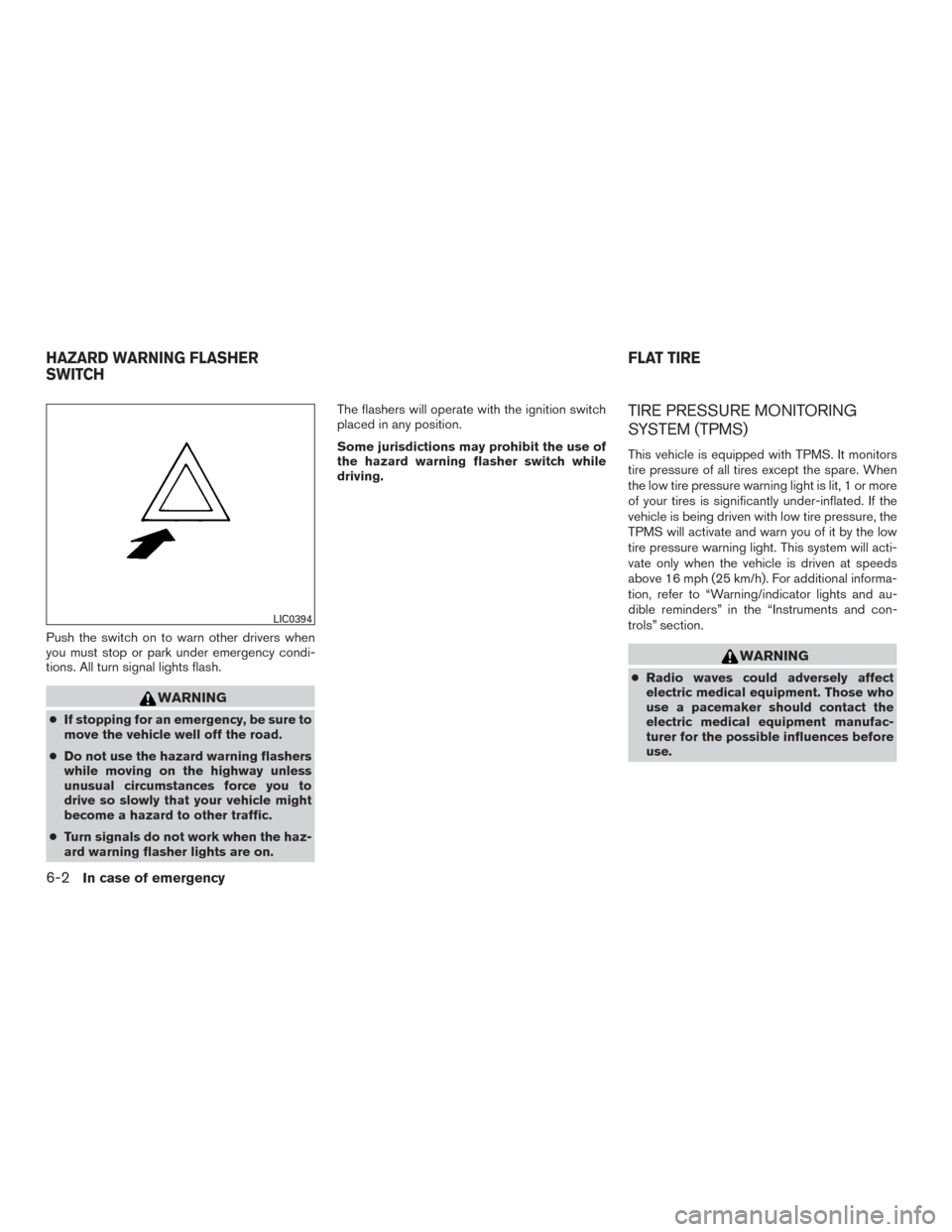
Push the switch on to warn other drivers when
you must stop or park under emergency condi-
tions. All turn signal lights flash.
WARNING
●If stopping for an emergency, be sure to
move the vehicle well off the road.
● Do not use the hazard warning flashers
while moving on the highway unless
unusual circumstances force you to
drive so slowly that your vehicle might
become a hazard to other traffic.
● Turn signals do not work when the haz-
ard warning flasher lights are on. The flashers will operate with the ignition switch
placed in any position.
Some jurisdictions may prohibit the use of
the hazard warning flasher switch while
driving.
TIRE PRESSURE MONITORING
SYSTEM (TPMS)
This vehicle is equipped with TPMS. It monitors
tire pressure of all tires except the spare. When
the low tire pressure warning light is lit, 1 or more
of your tires is significantly under-inflated. If the
vehicle is being driven with low tire pressure, the
TPMS will activate and warn you of it by the low
tire pressure warning light. This system will acti-
vate only when the vehicle is driven at speeds
above 16 mph (25 km/h). For additional informa-
tion, refer to “Warning/indicator lights and au-
dible reminders” in the “Instruments and con-
trols” section.
WARNING
●
Radio waves could adversely affect
electric medical equipment. Those who
use a pacemaker should contact the
electric medical equipment manufac-
turer for the possible influences before
use.
LIC0394
HAZARD WARNING FLASHER
SWITCH FLAT TIRE
6-2In case of emergency
Page 396 of 510
●If the low tire pressure warning light
illuminates while driving, avoid sudden
steering maneuvers or abrupt braking,
reduce vehicle speed, pull off the road
to a safe location and stop the vehicle
as soon as possible. Driving with under-
inflated tires may permanently damage
the tires and increase the likelihood of
tire failure. Serious vehicle damage
could occur and may lead to an accident
and could result in serious personal in-
jury. Check the tire pressure for all four
tires. Adjust the tire pressure to the
recommended COLD tire pressure
shown on the Tire and Loading Informa-
tion label to turn the low tire pressure
warning light OFF. If you have a flat tire,
replace it with a spare tire as soon as
possible.
● When a spare tire is mounted or a wheel
is replaced, tire pressure will not be
indicated, the TPMS will not function
and the low tire pressure warning light
will flash for approximately 1 minute.
The light will remain on after 1 minute.
Have your tires replaced and/or TPMS
system reset as soon as possible. It is
recommended you visit a NISSAN
dealer for these services. ●
Replacing tires with those not originally
specified by NISSAN could affect the
proper operation of the TPMS.
● Do not inject any tire liquid or aerosol
tire sealant into the tires, as this may
cause a malfunction of the tire pressure
sensors.
CHANGING A FLAT TIRE
If you have a flat tire, follow the instructions be-
low:
Stopping the vehicle
1. Safely move the vehicle off the road and
away from traffic.
2. Turn on the hazard warning flashers.
3. Park on a level surface and apply the parking brake. Move the shift lever to P (Park) .
4. Turn off the engine.
5. Raise the hood to warn other traffic and to signal professional road assistance person-
nel that you need assistance.
6. Have all passengers get out of the vehicle and stand in a safe place, away from traffic
and clear of the vehicle.
WARNING
●Make sure the parking brake is securely
applied and the shift lever is shifted into
P (Park) .
● Never change tires when the vehicle is
on a slope, ice or slippery areas. This is
hazardous.
● Never change tires if oncoming traffic is
close to your vehicle. Wait for profes-
sional road assistance.
In case of emergency6-3
Page 418 of 510
When driving in areas using road salt or other
corrosive materials, check lubrication frequently.
Lights*Clean the headlights on a regular basis.
Make sure that the headlights, stop lights, tail
lights, turn signal lights, and other lights are all
operating properly and installed securely. Also
check headlight aim.
Road wheel nuts (lug nuts)* When checking
the tires, make sure no wheel nuts are missing,
and check for any loose wheel nuts. Tighten if
necessary.
Tire rotation* Tires should be rotated every
5,000 miles (8,000 km).
Tires* Check the pressure with a gauge often
and always prior to long distance trips. If neces-
sary, adjust the pressure in all tires, including the
spare, to the pressure specified. Check carefully
for damage, cuts or excessive wear.
Tire Pressure Monitoring System (TPMS)
transmitter components Replace the TPMS
transmitter grommet seal, valve core and cap
when the tires are replaced due to wear or age.
Wheel alignment and balance If the vehicle
should pull to either side while driving on a
straight and level road, or if you detect uneven or
abnormal tire wear, there may be a need for wheel alignment. If the steering wheel or seat vibrates at
normal highway speeds, wheel balancing may be
needed.
● For additional information regarding tires,
refer to “Important Tire Safety Information”
(US) or “Tire Safety Information” (Canada) in
the Warranty Information Booklet.
Windshield Clean the windshield on a regular
basis. Check the windshield at least every six
months for cracks or other damage. Have a dam-
aged windshield repaired by a qualified repair
facility.
Windshield wiper blades* Check for cracks or
wear if they do not wipe properly.
Inside the vehicle
The maintenance items listed here should be
checked on a regular basis, such as when per-
forming periodic maintenance, cleaning the ve-
hicle, etc.
Additional information on the following
items with an “*” is found in this section.
Accelerator pedal Check the pedal for smooth
operation and make sure the pedal does not bind
or require uneven effort. Keep the floor mat away
from the pedal.
Automatic transmission P (Park) position
mechanism On a fairly steep hill check that your vehicle is held securely with the shift lever in the P
(Park) position without applying any brakes.
Brake pedal
Check the pedal for smooth opera-
tion. If the brake pedal suddenly goes down fur-
ther than normal, the pedal feels spongy or the
vehicle seems to take longer to stop, see a
NISSAN dealer immediately. Keep the floor mat
away from the pedal.
Brakes Check that the brakes do not pull the
vehicle to one side when applied.
Parking brake Check the parking brake opera-
tion regularly. The vehicle should be securely held
on a fairly steep hill with only the parking brake
applied. If the parking brake needs adjustment,
see a NISSAN dealer.
Seats Check seat position controls such as seat
adjusters, seatback recliner, etc. to ensure they
operate smoothly and all latches lock securely in
every position. Check that the head
restraints/headrests move up and down
smoothly and the locks (if so equipped) hold
securely in all latched positions.
Seat belts Check that all parts of the seat belt
system (for example, buckles, anchors, adjusters
and retractors) operate properly and smoothly,
and are installed securely. Check the belt web-
bing for cuts, fraying, wear or damage.
Maintenance and do-it-yourself8-3
Page 448 of 510
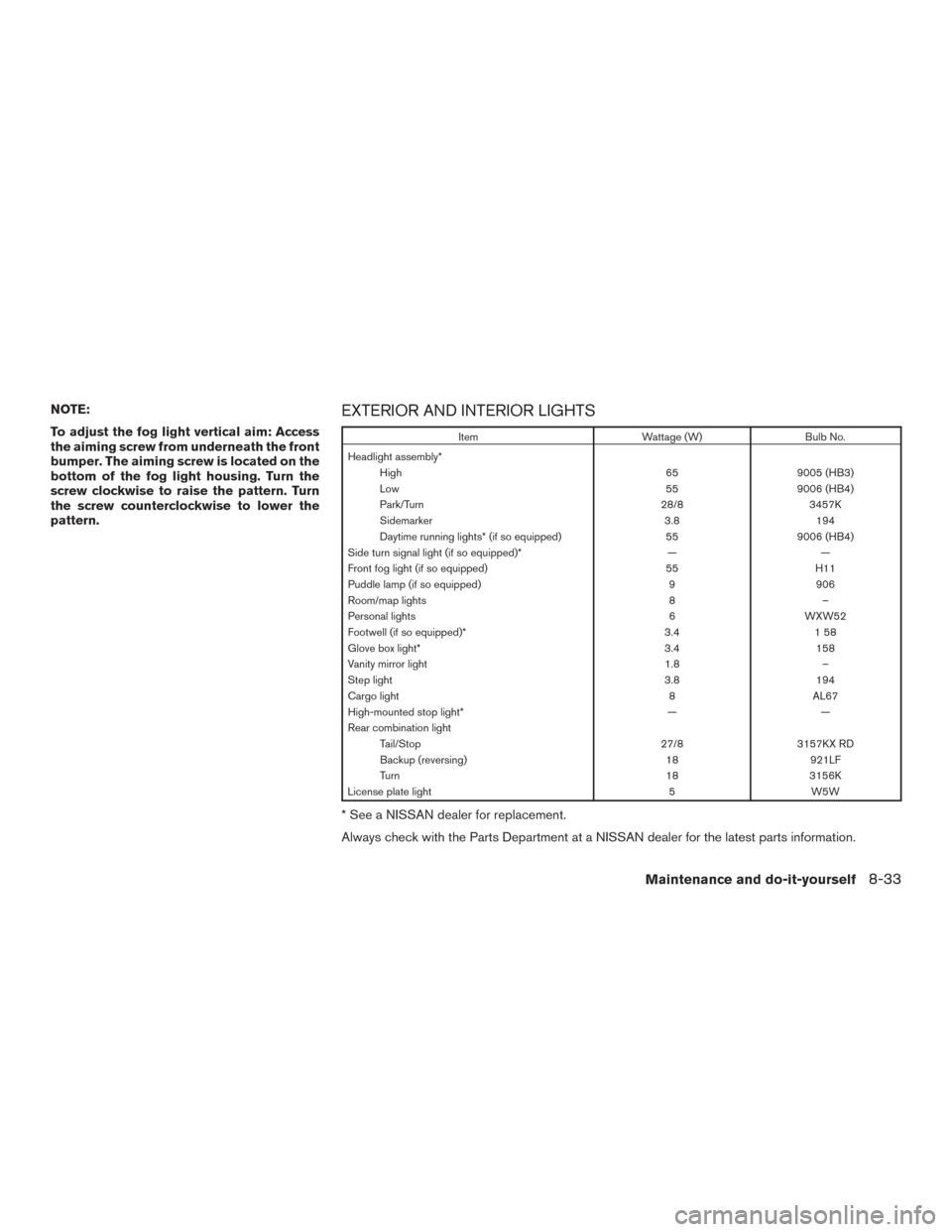
NOTE:
To adjust the fog light vertical aim: Access
the aiming screw from underneath the front
bumper. The aiming screw is located on the
bottom of the fog light housing. Turn the
screw clockwise to raise the pattern. Turn
the screw counterclockwise to lower the
pattern.EXTERIOR AND INTERIOR LIGHTS
ItemWattage (W)Bulb No.
Headlight assembly* High 659005 (HB3)
Low 559006 (HB4)
Park/Turn 28/83457K
Sidemarker 3.8194
Daytime running lights* (if so equipped) 559006 (HB4)
Side turn signal light (if so equipped)* ——
Front fog light (if so equipped) 55H11
Puddle lamp (if so equipped) 9906
Room/map lights 8–
Personal lights 6WXW52
Footwell (if so equipped)* 3.41 58
Glove box light* 3.4158
Vanity mirror light 1.8–
Step light 3.8194
Cargo light 8AL67
High-mounted stop light* ——
Rear combination light Tail/Stop 27/83157KX RD
Backup (reversing) 18921LF
Turn 183156K
License plate light 5W5W
* See a NISSAN dealer for replacement.
Always check with the Parts Department at a NISSAN dealer for the latest parts information.
Maintenance and do-it-yourself8-33
Page 449 of 510
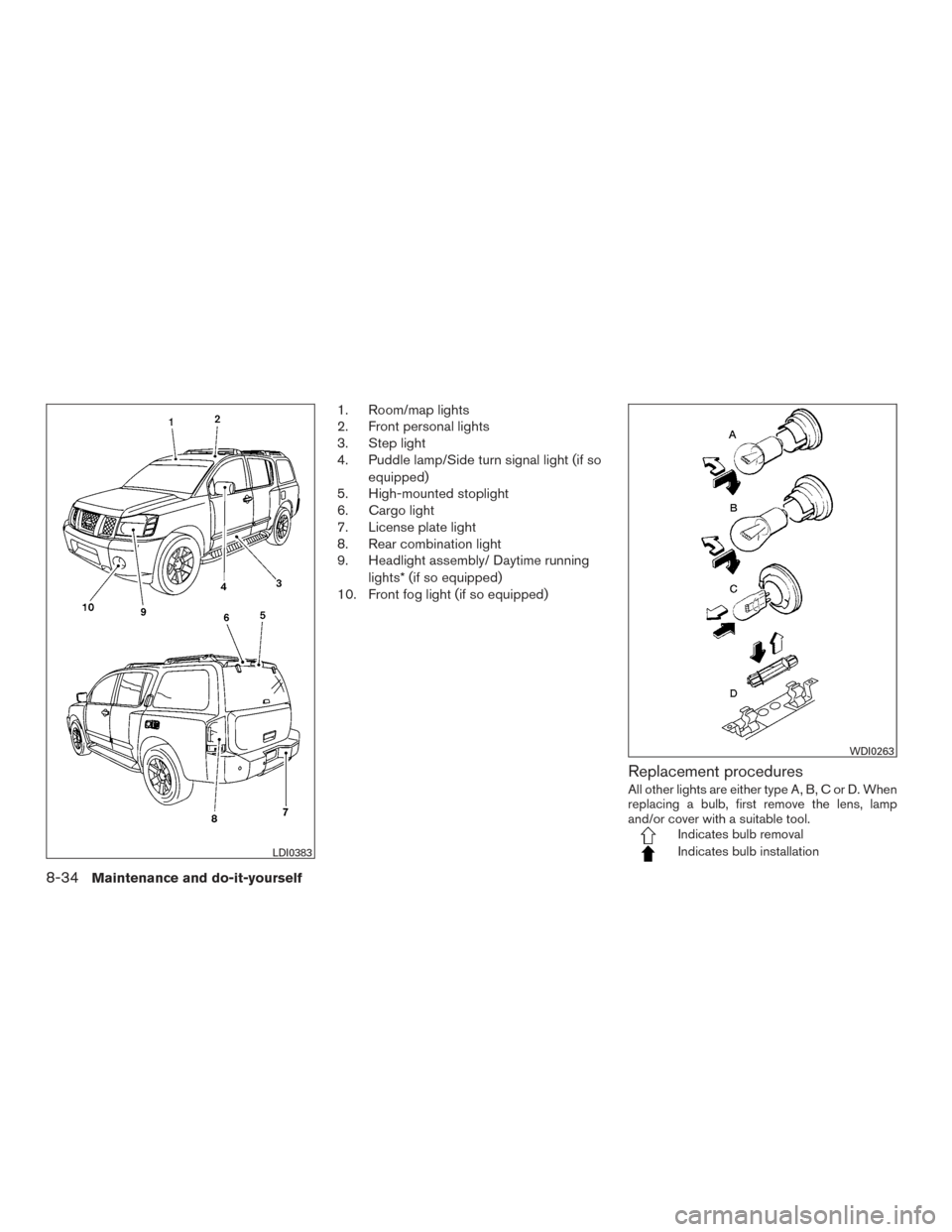
1. Room/map lights
2. Front personal lights
3. Step light
4. Puddle lamp/Side turn signal light (if soequipped)
5. High-mounted stoplight
6. Cargo light
7. License plate light
8. Rear combination light
9. Headlight assembly/ Daytime running
lights* (if so equipped)
10. Front fog light (if so equipped)
Replacement procedures
All other lights are either type A, B, C or D. When
replacing a bulb, first remove the lens, lamp
and/or cover with a suitable tool.
Indicates bulb removal
Indicates bulb installationLDI0383
WDI0263
8-34Maintenance and do-it-yourself
Page 488 of 510
CAUTION
●Special hitches which include frame re-
inforcements are required for towing
above 2,000 lb (907 kg) . Suitable genu-
ine NISSAN hitches, ball mounts and
hitch balls for pickup trucks and sport
utility vehicles are available at a
NISSAN dealer.
● The hitch should not be attached to or
affect the operation of the impact-
absorbing bumper.
● Do not use axle-mounted hitches.
● Do not modify the vehicle exhaust sys-
tem, brake system, etc. to install a
trailer hitch.
● To reduce the possibility of additional
damage if your vehicle is struck from
the rear, where practical, remove the
receiver when not in use.
● Regularly check that all trailer hitch
mounting bolts are securely mounted.
Tire pressures
● When towing a trailer, inflate the ve-
hicle tires to the recommended cold
tire pressure indicated on the Tire
and Loading Information label.
● Trailer tire condition, size, load rating
and proper inflation pressure should
be in accordance with the trailer and
tire manufacturer’s specifications.
Safety chains
Always use suitable safety chains between your
vehicle and the trailer. The safety chains should
be crossed and should be attached to the hitch,
not to the vehicle bumper or axle. The safety
chains can be attached to the bumper if the hitch
ball is mounted to the bumper. Be sure to leave
enough slack in the chains to permit turning
corners.
Trailer lights
CAUTION
When splicing into the vehicle electrical
system, a commercially available power-
type module/converter must be used to
provide power for all trailer lighting. This
unit uses the vehicle battery as a direct
power source for all trailer lights while
using the vehicle tail light, stoplight and
turn signal circuits as a signal source. The
module/converter must draw no more that
15 milliamps from the stop and tail lamp
circuits. Using a module/converter that
exceeds these power requirements may
damage the vehicle’s electrical system.
See a reputable trailer dealer to obtain the
proper equipment and to have it installed.
Trailer lights should comply with federal and/or
local regulations. For assistance in hooking up
trailer lights, contact a NISSAN dealer or repu-
table trailer dealer. Vehicles equipped with the
optional trailer tow package are equipped with a
7-pin trailer harness connector. If your trailer is
equipped with a flat 4-pin connector, an adapter
will be needed to connect the trailer lights to the
vehicle. Adapters are available at NISSAN deal-
ers, auto parts stores and hitch retailers.
Technical and consumer information9-25
Page 502 of 510
Extendedstorageswitch ............8-28
Eyeglass case..................2-47
F
Flashers (See hazard warning flasher switch) . .6-2
Flat tire ....................6-2,6-3
Floor mat positioning aid .............7-5
Fluid Brake fluid ..................8-13
Capacities and recommended
fuel/lubricants .................9-2
Engine coolant .................8-7
Engine oil ...................8-9
Power steering fluid .............8-13
Windshield-washerfluid...........8-14
F.M.V.S.S. certification label ...........9-12
Foglightswitch .................2-38
Front air bag system
(See supplemental restraint system) ......1-62
Front and rear sonar system ..........5-36
Front power seat adjustment ...........1-3
Frontseats.....................1-2
Fuel Capacities and recommended
fuel/lubricants .................9-2
Fuel economy ................5-23
Fuel gauge ...................2-6
Fuel octane rating ...............9-5
Fuel recommendation .............9-4
Loose fuel cap warning ........2-28,3-28
Fuel Cell Vehicle (FCV) System Tirepressure.................8-37
Fuel-filler door ..................3-28
Fuel gauge .....................2-6 Fuses.......................8-24
Fusiblelinks ...................8-26
G
Garage door opener, HomeLink® Universal
Transceiver .........2-64,2-65,2-66,2-67
Gauge Automatic transmission fluid temperature
gauge .....................2-8
Engine coolant temperature gauge .....2-5
Engine oil pressure gauge ..........2-7
Fuel gauge ...................2-6
Odometer ...................2-4
Speedometer .................2-4
Tachometer ..................2-5
Trip odometer .................2-4
Voltmeter....................2-7
General maintenance ...............8-2
Glass hatch ...................3-28
Glovebox.....................2-47
Gloveboxlock..................2-47
H
Hands-free phone system,
Bluetooth®...............4- 108, 4-122
Hazard warning flasher switch ..........6-2
Headlight and turn signal switch ........2-34
Headlight control switch ............2-35
Headlights ....................8-31
Head restraints ..................1-14
Heated seats ...............2-39,2-40
Heated steering wheel .............2-41 Heater
Heater and air conditioner controls .....4-29
Heater operation ...............4-30
Rear seat air conditioner ..........4-31
HomeLink® Universal
Transceiver .........2-64,2-65,2-66,2-67
H
ood.......................3-23
Hook Luggage hook ................2-53
Horn .......................2-38
I
Ignition switch ...................5-9
Imageviewer...................4-19
Immobilizer system .........2-30,3-4,5-12
Important vehicle information label .......9-12
In-cabin microfilter ................8-19
Increasing fuel economy .............5-23
Indicator lights and audible reminders
(See warning/indicator lights and
audible reminders) .........2-12,2-13,2-18
Information display ................2-21
Inside automatic anti-glare mirror ........3-33
Instrument brightness control ..........2-37
Instrumentpanel...............0-6,2-2
Instrument panel dimmer switch ........2-37
Intelligent Key system Key operating range .............3-14
Key operation ................3-15
Mechanical key ................3-3
Remote keyless entry operation.......3-17
Troubleshooting guide ............3-22
Warning signals ...............3-22
Interior light ....................2-62
10-3
Page 503 of 510
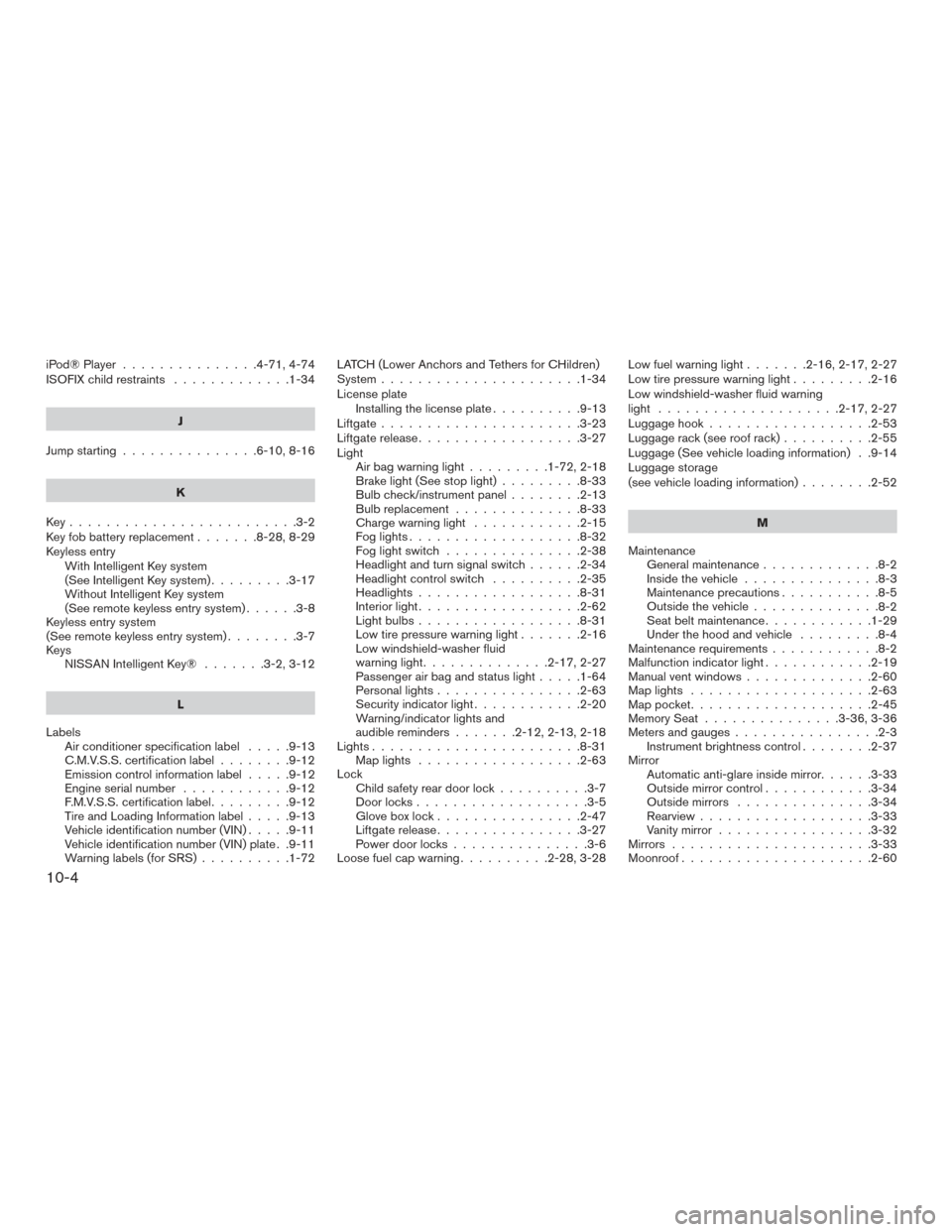
iPod®Player ...............4-71,4-74
ISOFIX child restraints.............1-34
J
Jump starting ...............6-10,8-16
K
Key.........................3-2
Key fob battery replacement .......8-28,8-29
Keyless entry With Intelligent Key system
(See Intelligent Key system) .........3-17
Without Intelligent Key system
(See remote keyless entry system) ......3-8
Keyless entry system
(See remote keyless entry system) ........3-7
Keys NISSAN Intelligent Key® .......3-2,3-12
L
Labels Air conditioner specification label .....9-13
C.M.V.S.S. certification label ........9-12
Emissioncontrolinformationlabel.....9-12
Engine serial number ............9-12
F.M.V.S.S. certification label .........9-12
Tire and Loading Information label .....9-13
Vehicle identification number (VIN) .....9-11
Vehicle identification number (VIN) plate . .9-11
Warning labels (for SRS) ..........1-72LATCH (Lower Anchors and Tethers for CHildren)
System
......................1-34
License plate Installing the license plate ..........9-13
Liftgate ......................3-23
Liftgate release ..................3-27
Light Air bag warning light .........1-72,2-18
Brake light (See stop light) .........8-33
Bulb check/instrument panel ........2-13
Bulbreplacement..............8-33
Charge warning light ............2-15
Foglights...................8-32
Foglightswitch ...............2-38
Headlight and turn signal switch ......2-34
Headlight control switch ..........2-35
Headlights..................8-31
Interiorlight..................2-62
Lightbulbs..................8-31
Low tire pressure warning light .......2-16
Low windshield-washer fluid
warning light ..............2-17,2-27
Passenger air bag and status light .....1-64
Personal lights ................2-63
Security indicator light ............2-20
Warning/indicator lights and
audiblereminders.......2-12,2-13,2-18
Lights.......................8-31 Maplights ..................2-63
Lock Child safety rear door lock ..........3-7
Door locks ...................3-5
Gloveboxlock................2-47
Liftgate release ................3-27
Power door locks ...............3-6
Loose fuel cap warning ..........2-28,3-28 Low fuel warning light
.......2-16,2-17,2-27
Low tire pressure warning light .........2-16
Low windshield-washer fluid warning
light ....................2-17,2-27
Luggage hook ..................2-53
Luggage rack (see roof rack) ..........2-55
Luggage (See vehicle loading information) . .9-14
Luggage storage
(see vehicle loading information) ........2-52
M
Maintenance General maintenance .............8-2
Insidethevehicle...............8-3
Maintenance precautions ...........8-5
Outside the vehicle ..............
8-2
Seat belt maintenance ............1-29
Under the hood and vehicle .........8-4
Maintenance requirements ............8-2
Malfunction indicator light ............2-19
Manual vent windows ..............2-60
Maplights ....................2-63
Mappocket....................2-45
Memory Seat ...............3-36,3-36
Meters and gauges ................2-3
Instrument brightness control ........2-37
Mirror Automatic anti-glare inside mirror ......3-33
Outside mirror control ............3-34
Outside mirrors ...............3-34
Rearview ...................3-33
Vanity mirror .................3-32
Mirrors ......................3-33
Moonroof .....................2-60
10-4
Page 505 of 510
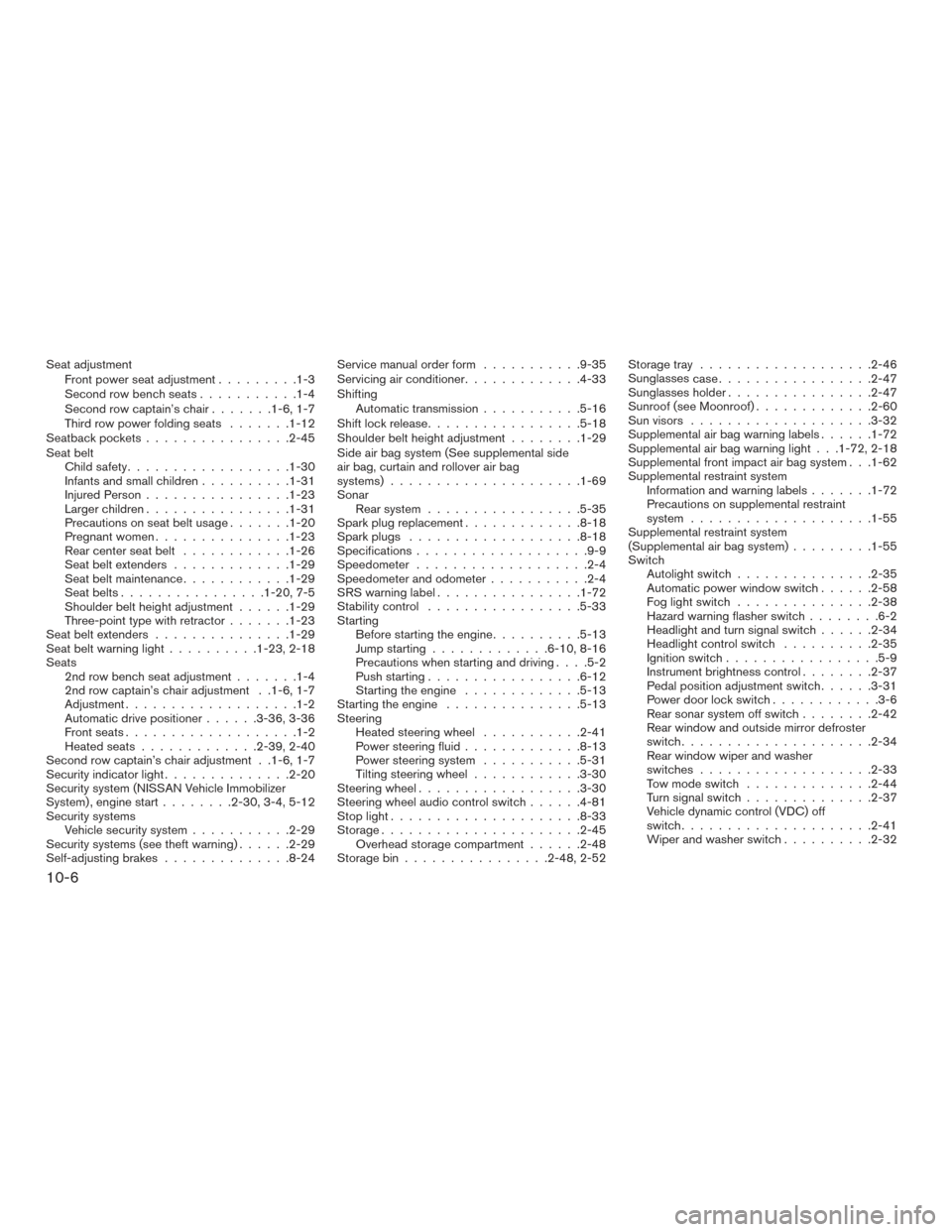
Seat adjustmentFront power seat adjustment .........1-3
Second row bench seats ...........1-4
Second row captain’s chair .......1-6,1-7
Third row power folding seats .......1-12
Seatback pockets ................2-45
Seat belt Childsafety..................1-30
Infantsandsmallchildren..........1-31
Injured Person ................1-23
Largerchildren................1-31
Precautionsonseatbeltusage.......1-20
Pregnant women ...............1-23
Rear center seat belt ............1-26
Seat belt extenders .............1-29
Seat belt maintenance ............1-29
Seat belts ................1-20,7-5
Shoulder belt height adjustment ......1-29
Three-point type with retractor .......1-23
Seat belt extenders ...............1-29
Seatbeltwarninglight..........1-23,2-18
Seats 2nd row bench seat adjustment .......1-4
2nd row captain’s chair adjustment . .1-6, 1-7
Adjustment ...................1-2
Automatic drive positioner ......3-36,3-36
Frontseats...................1-2
Heatedseats.............2-39,2-40
Second row captain’s chair adjustment . .1-6, 1-7
Security indicator light ..............2-20
Security system (NISSAN Vehicle Immobilizer
System) , engine start ........2-30,3-4,5-12
Security systems Vehicle security system ...........2-29
Security systems (see theft warning) ......2-29
Self-adjusting brakes ..............8-24 Service manual order form
...........9-35
Servicing air conditioner .............4-33
Shifting Automatic transmission ...........5-16
Shiftlockrelease.................5-18
Shoulder belt height adjustment ........1-29
Side air bag system (See supplemental side
air bag, curtain and rollover air bag
systems) .....................1-69
Sonar Rear system .................5-35
Sparkplugreplacement.............8-18
Sparkplugs ...................8-18
Specifications ...................9-9
Speedometer ...................2-4
Speedometer and odometer ...........2-4
SRSwarninglabel................1-72
Stability control .................5-33
Starting Before starting the engine ..........5-13
Jump starting .............6-10,8-16
Precautions when starting and driving ....5-2
Push starting .................6-12
Starting the engine .............5-13
Starting the engine ...............5-13
Steering Heated steering wheel ...........2-41
Power steering fluid .............8-13
Power steering system ...........5-31
Tilting steering wheel ............3-30
Steeringwheel..................3-30
Steering wheel audio control switch ......4-81
Stoplight.....................8-33
Storage......................2-45 Overhead storage compartment ......2-48
Storagebin................2-48,2-52 Storage tray
...................2-46
Sunglasses
case .................2-47
Sunglasses holder ................2-47
Sunroof(seeMoonroof).............2-60
Sun visors ....................3-32
Supplemental air bag warning labels ......1-72
Supplemental air bag warning light . . .1-72, 2-18
Supplemental front impact air bag system . . .1-62
Supplemental restraint system Information and warning labels .......1-72
Precautions on supplemental restraint
system ....................1-55
Supplemental restraint system
(Supplemental air bag system) .........1-55
Switch Autolightswitch...............2-35
Automatic power window switch ......2-58
Fog light switch ...............2-38
Hazard warning flasher switch ........6-2
Headlightandturnsignalswitch......2-34
Headlight control switch ..........2-35
Ignition switch .................5-9
Instrument brightness control ........2-37
Pedal position adjustment switch ......3-31
Power door lock switch ............3-6
Rear sonar system off switch ........2-42
Rear window and outside mirror defroster
switch .....................2-34
Rear window wiper and washer
switches ...................2-33
Tow mode switch ..............2-44
Turnsignalswitch..............2-37
Vehicle dynamic control (VDC) off
switch .....................2-41
Wiper and washer switch ..........2-32
10-6